Phi-4-Mini-Reasoning
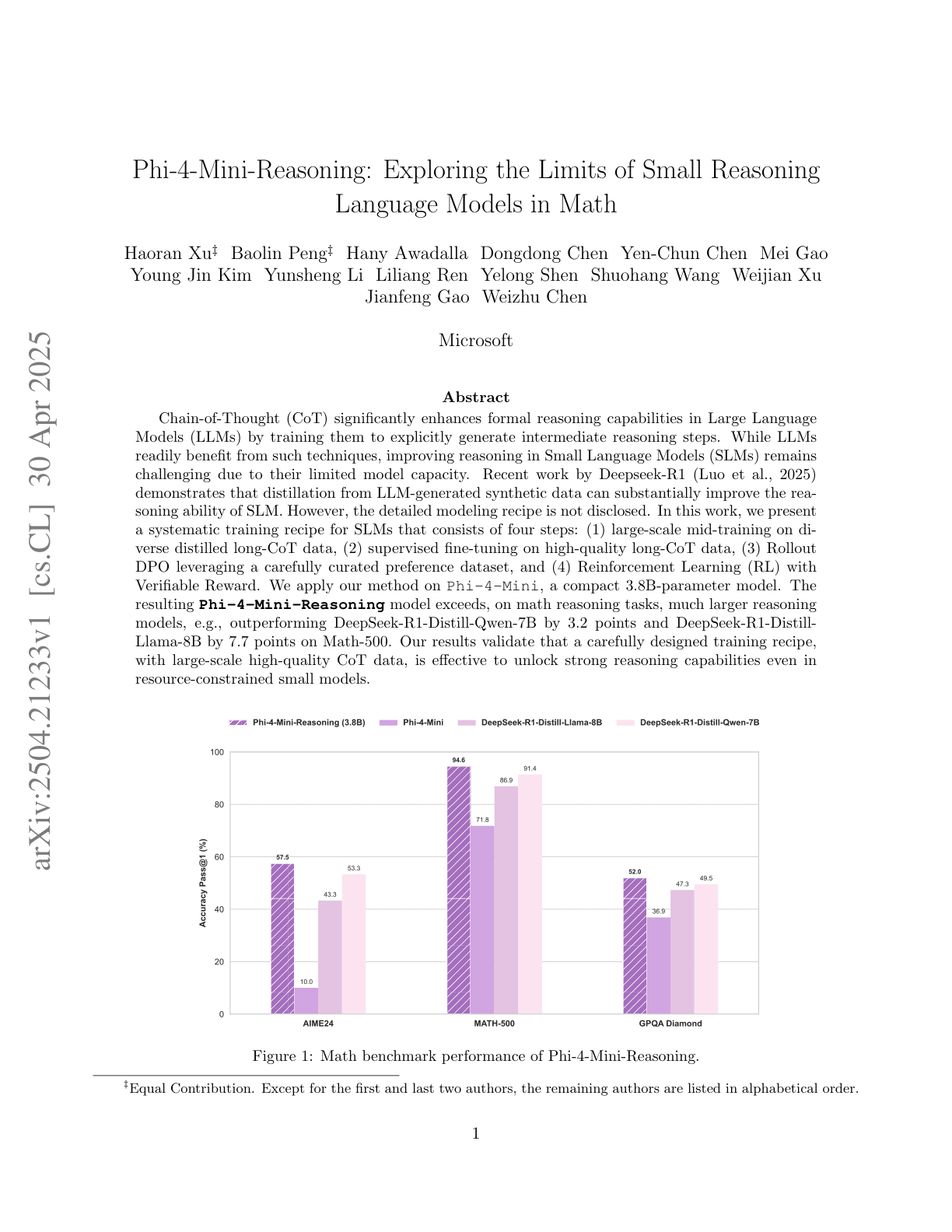
Microsoft released Phi-4-Mini-Reasoning to explore small reasoning language models for math. Highlights:
Ask this paper
Phi-4-Mini-Reasoning: The paper introduces Phi-4-Mini-Reasoning, a 3.8B parameter small language model (SLM) that achieves state-of-the-art mathematical reasoning performance, rivaling or outperforming models nearly twice its size.
Unlocking Reasoning: They use a systematic, multi-stage training pipeline to unlock strongbr> reasoning capabilities in compact models, addressing the challenges posed by their limited capacity. Uses large-scale distillation, preference learning, and RL with verifiable rewards.
Four-Stage Training Pipeline: The model is trained using (1) mid-training with large-scale long CoT data, (2) supervised fine-tuning on high-quality CoT data, (3) rollout-based Direct Preference Optimization (DPO), and (4) RL using verifiable reward signals.
Math Performance: On MATH-500, Phi-4-Mini-Reasoning reaches 94.6%, surpassing DeepSeek-R1-Distill-Qwen-7B (91.4%) and DeepSeek-R1-Distill-Llama-8B (86.9%), despite being smaller.
Verifiable Reward Reinforcement Learning: The final RL stage, tailored for small models, includes prompt filtering, oversampling for balanced training signals, and temperature annealing. This improves training stability and aligns exploration with evaluation conditions.
Massive Synthetic Data Generation: The model is mid-trained on 10M CoT rollouts generated by DeepSeek-R1, filtered for correctness using math verifiers and GPT-4o-mini, and categorized by domain and difficulty to ensure broad generalization.
Ablation Study: Each phase of the pipeline shows clear gains. Notably, fine-tuning and RL each deliver ~5–7 point improvements after mid-training and DPO, showing the value of the full pipeline over isolated techniques.
Abstract
Chain-of-Thought (CoT) significantly enhances formal reasoning capabilities in Large Language Models (LLMs) by training them to explicitly generate intermediate reasoning steps. While LLMs readily benefit from such techniques, improving reasoning in Small Language Models (SLMs) remains challenging due to their limited model capacity. Recent work by Deepseek-R1 demonstrates that distillation from LLM-generated synthetic data can substantially improve the reasoning ability of SLM. However, the detailed modeling recipe is not disclosed. In this work, we present a systematic training recipe for SLMs that consists of four steps: (1) large-scale mid-training on diverse distilled long-CoT data, (2) supervised fine-tuning on high-quality long-CoT data, (3) Rollout DPO leveraging a carefully curated preference dataset, and (4) Reinforcement Learning (RL) with Verifiable Reward. We apply our method on Phi-4-Mini, a compact 3.8B-parameter model. The resulting Phi-4-Mini-Reasoning model exceeds, on math reasoning tasks, much larger reasoning models, e.g., outperforming DeepSeek-R1-Distill-Qwen-7B by 3.2 points and DeepSeek-R1-Distill-Llama-8B by 7.7 points on Math-500. Our results validate that a carefully designed training recipe, with large-scale high-quality CoT data, is effective to unlock strong reasoning capabilities even in resource-constrained small models.