DeepSeek-Prover-V2
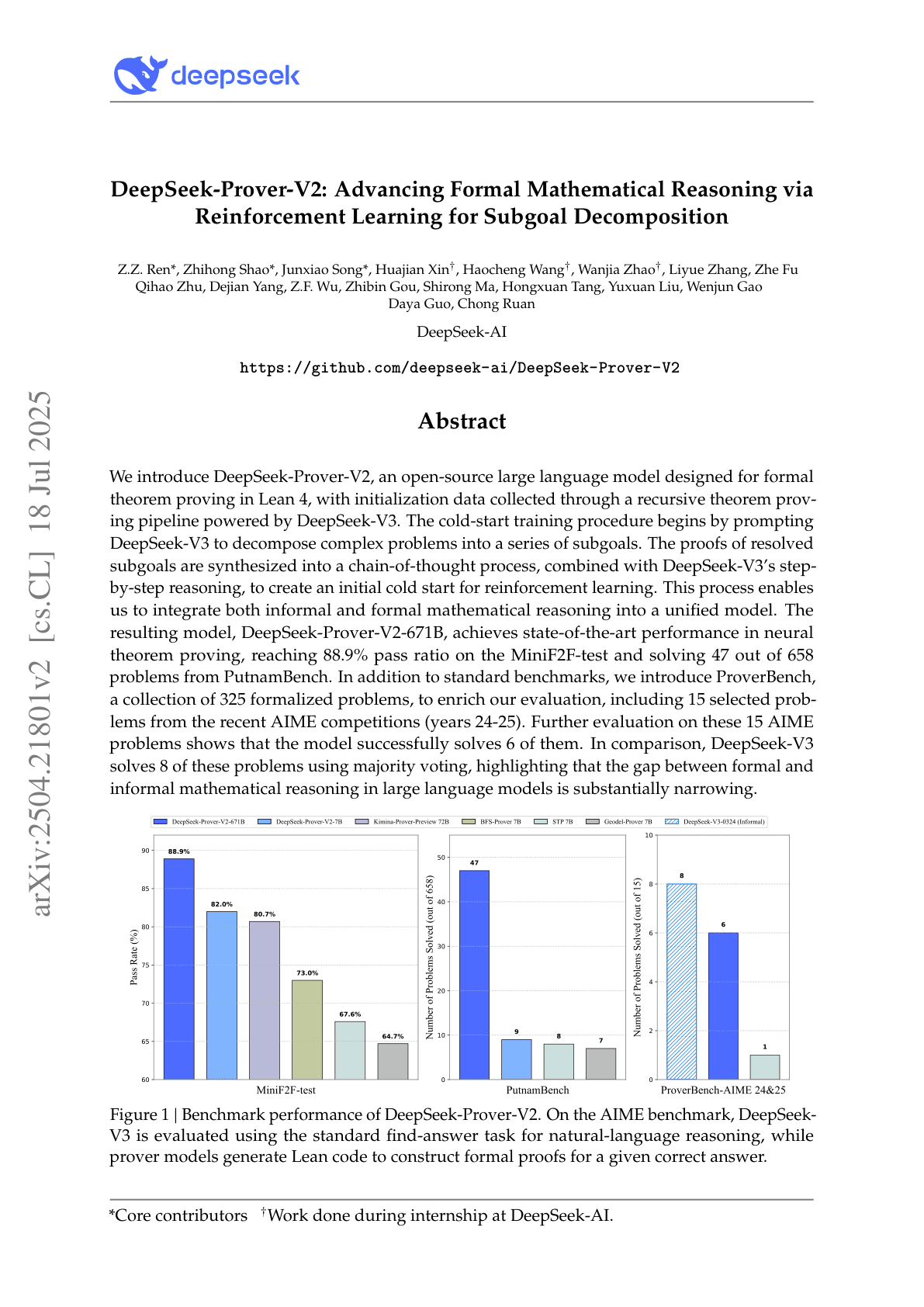
DeepSeek-Prover-V2 is an LLM (671B) that significantly advances formal theorem proving in Lean 4. The model is built through a novel cold-start training pipeline that combines informal chain-of-thought reasoning with formal subgoal decomposition, enhanced through reinforcement learning. It surpasses prior state-of-the-art on multiple theorem-proving benchmarks. Key highlights:
Ask this paper
Cold-start data via recursive decomposition: The authors prompt DeepSeek-V3 to generate natural-language proof sketches, decompose them into subgoals, and formalize these steps in Lean with sorry placeholders. A 7B prover model then recursively fills in the subgoal proofs, enabling efficient construction of complete formal proofs and training data.
Curriculum learning + RL: A subgoal-based curriculum trains the model on increasingly complex problems. Reinforcement learning with a consistency reward is used to enforce alignment between proof structure and CoT decomposition, improving performance on complex tasks.
Dual proof generation modes: The model is trained in two modes, non-CoT (efficient, minimal proofs) and CoT (high-precision, interpretable). The CoT mode yields significantly better performance, particularly on hard problems.
Benchmark results:
Abstract
We introduce DeepSeek-Prover-V2, an open-source large language model designed for formal theorem proving in Lean 4, with initialization data collected through a recursive theorem proving pipeline powered by DeepSeek-V3. The cold-start training procedure begins by prompting DeepSeek-V3 to decompose complex problems into a series of subgoals. The proofs of resolved subgoals are synthesized into a chain-of-thought process, combined with DeepSeek-V3's step-by-step reasoning, to create an initial cold start for reinforcement learning. This process enables us to integrate both informal and formal mathematical reasoning into a unified model. The resulting model, DeepSeek-Prover-V2-671B, achieves state-of-the-art performance in neural theorem proving, reaching 88.9% pass ratio on the MiniF2F-test and solving 49 out of 658 problems from PutnamBench. In addition to standard benchmarks, we introduce ProverBench, a collection of 325 formalized problems, to enrich our evaluation, including 15 selected problems from the recent AIME competitions (years 24-25). Further evaluation on these 15 AIME problems shows that the model successfully solves 6 of them. In comparison, DeepSeek-V3 solves 8 of these problems using majority voting, highlighting that the gap between formal and informal mathematical reasoning in large language models is substantially narrowing.