UniversalRAG
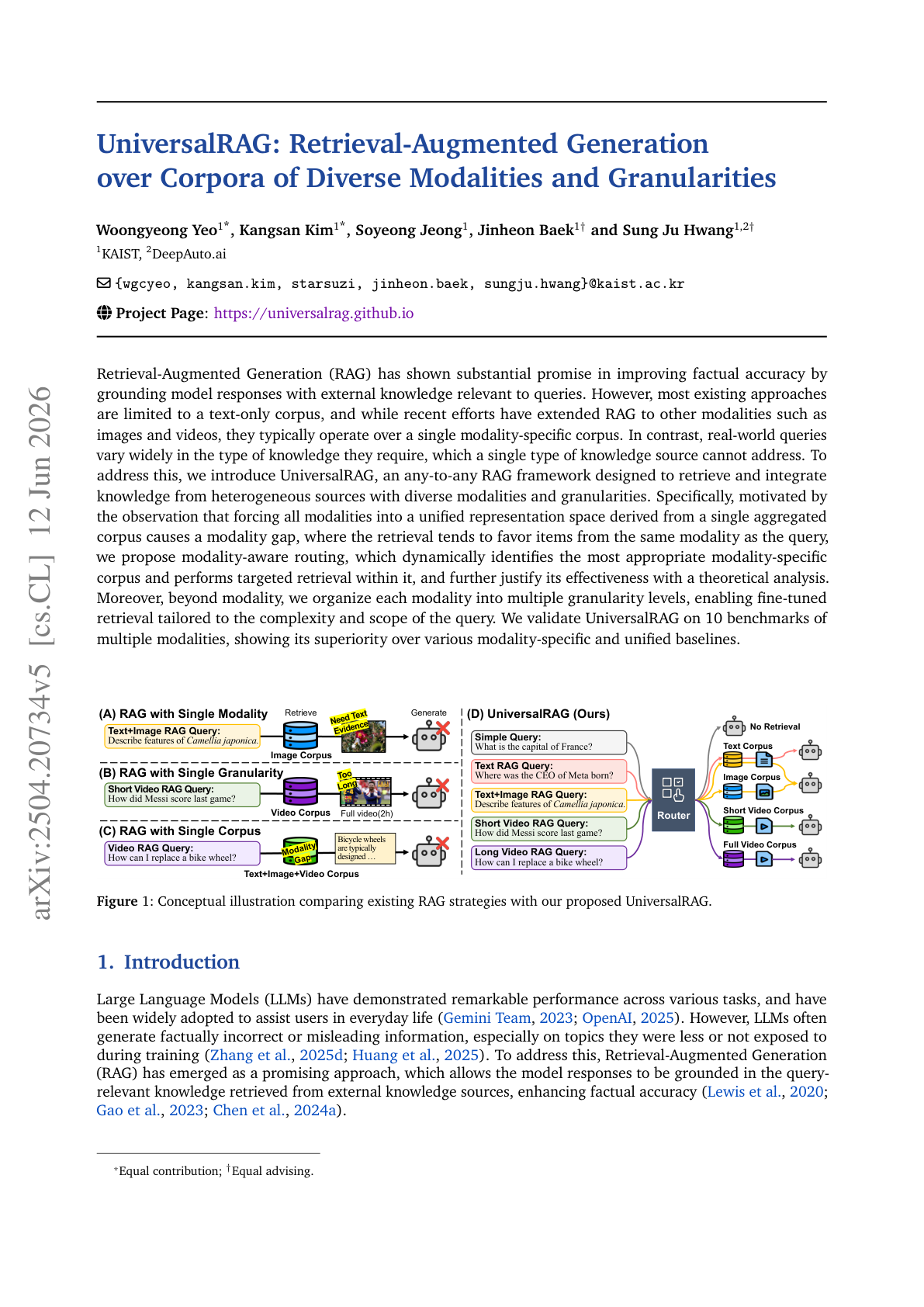
UniversalRAG is a framework that overcomes the limitations of existing RAG systems confined to single modalities or corpora. It supports retrieval across modalities (text, image, video) and at multiple granularities (e.g., paragraph vs. document, clip vs. video). Contributions from the paper:
Ask this paper
Modality-aware routing: To counter modality bias in unified embedding spaces (where queries often retrieve same-modality results regardless of relevance), UniversalRAG introduces a router that dynamically selects the appropriate modality (e.g., image vs. text) for each query.
Granularity-aware retrieval: Each modality is broken into granularity levels (e.g., paragraphs vs. documents for text, clips vs. full-length videos). This allows queries to retrieve content that matches their complexity -- factual queries use short segments while complex reasoning accesses long-form data.
Flexible routing: It supports both training-free (zero-shot GPT-4o prompting) and trained (T5-Large) routers. Trained routers perform better on in-domain data, while GPT-4o generalizes better to out-of-domain tasks. An ensemble router combines both for robust performance.
Performance: UniversalRAG outperforms modality-specific and unified RAG baselines across 8 benchmarks spanning text (e.g., MMLU, SQuAD), image (WebQA), and video (LVBench, VideoRAG). With T5-Large, it achieves the highest average score across modalities.
Case study: In WebQA, UniversalRAG correctly routes a visual query to the image corpus (retrieving an actual photo of the event), while TextRAG and VideoRAG fail. Similarly, on HotpotQA and LVBench, it chooses the right granularity, retrieving documents or short clips. Overall, this is a great paper showing the importance of considering modality and granularity in a RAG system.