Large-Scale Study on Multi-Agent AI Systems Development
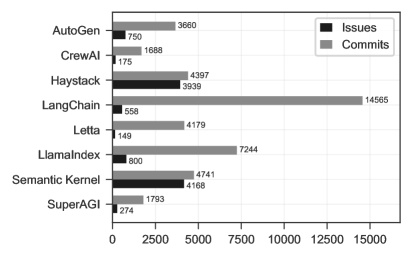
An empirical analysis of over 42,000 commits and 4,700 resolved issues across eight leading multi-agent frameworks (LangChain, CrewAI, AutoGen). Key findings: feature enhancements dominate at 40.8% of changes versus 27.4% bug fixes, bugs represent 22% of issues with agent coordination challenges at 10%, and issue reporting surged notably beginning in 2023.
Ask this paper
Abstract
The rapid emergence of multi-agent AI systems (MAS), including LangChain, CrewAI, and AutoGen, has shaped how large language model (LLM) applications are developed and orchestrated. However, little is known about how these systems evolve and are maintained in practice. This paper presents the first large-scale empirical study of open-source MAS, analyzing over 42K unique commits and over 4.7K resolved issues across eight leading systems. Our analysis identifies three distinct development profiles: sustained, steady, and burst-driven. These profiles reflect substantial variation in ecosystem maturity. Perfective commits constitute 40.8% of all changes, suggesting that feature enhancement is prioritized over corrective maintenance (27.4%) and adaptive updates (24.3%). Data about issues shows that the most frequent concerns involve bugs (22%), infrastructure (14%), and agent coordination challenges (10%). Issue reporting also increased sharply across all frameworks starting in 2023. Median resolution times range from under one day to about two weeks, with distributions skewed toward fast responses but a minority of issues requiring extended attention. These results highlight both the momentum and the fragility of the current ecosystem, emphasizing the need for improved testing infrastructure, documentation quality, and maintenance practices to ensure long-term reliability and sustainability.