NatureBench
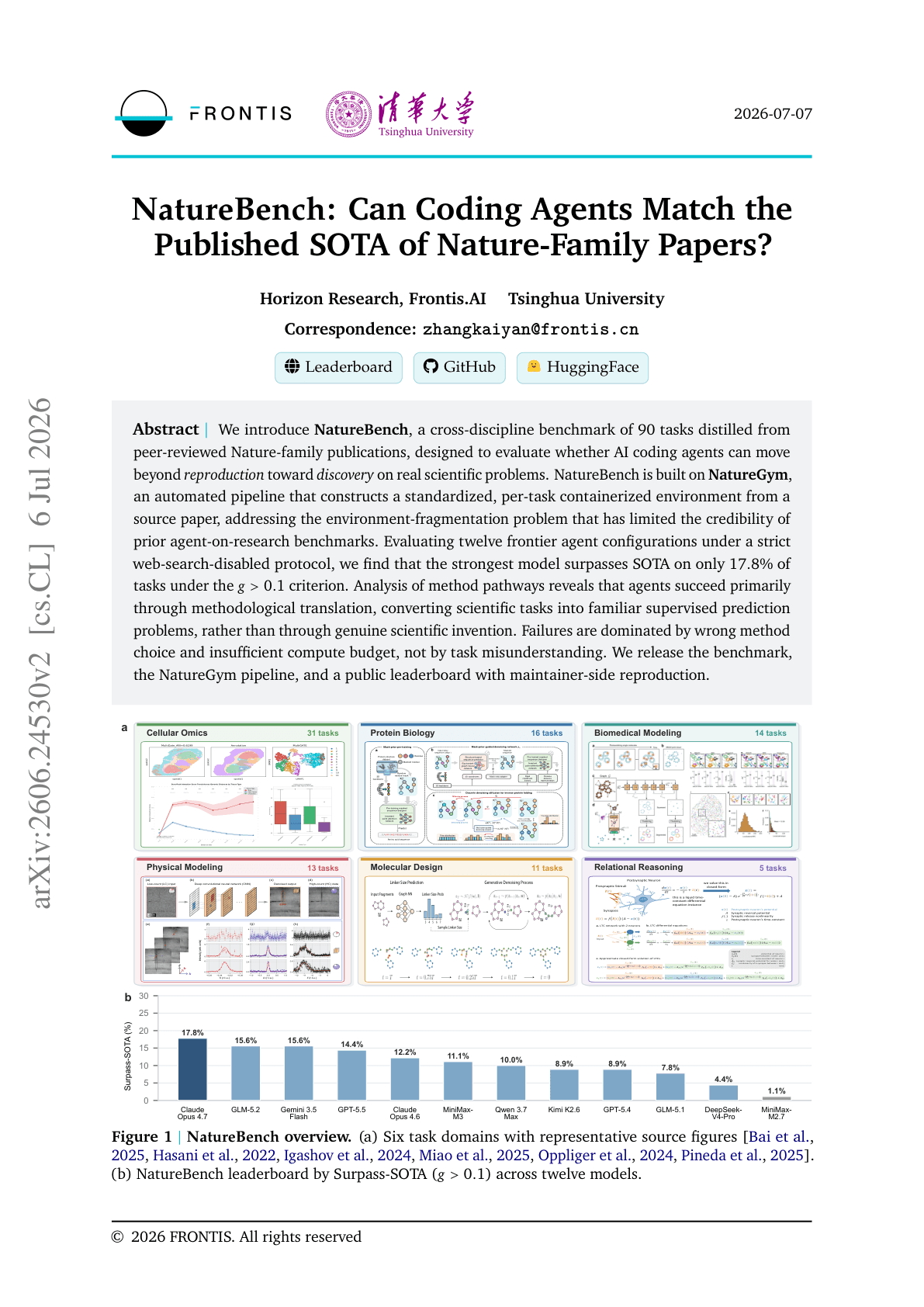
Can coding agents move past reproduction toward actual discovery on real scientific problems? NatureBench distills 90 cross-discipline tasks from peer-reviewed Nature-family papers and runs them in NatureGym, an automated pipeline that builds a standardized containerized environment per task to fix the environment-fragmentation problem. Under a strict web-search-disabled protocol, the strongest of ten frontier agent configurations beats published SOTA on only 17.8% of tasks, and analysis shows agents win mainly by translating problems into familiar supervised prediction rather than through genuine scientific invention.
Ask this paper
Abstract
We introduce NatureBench, a cross-discipline benchmark of 90 tasks distilled from peer-reviewed Nature-family publications, designed to evaluate whether AI coding agents can move beyond reproduction toward discovery on real scientific problems. NatureBench is built on NatureGym, an automated pipeline that constructs a standardized, per-task containerized environment from a source paper, addressing the environment-fragmentation problem that has limited the credibility of prior agent-on-research benchmarks. Evaluating ten frontier agent configurations under a strict web-search-disabled protocol, we find that the strongest model surpasses SOTA on only 17.8% of tasks under the g>0.1 criterion. Analysis of method pathways reveals that agents succeed primarily through methodological translation, converting scientific tasks into familiar supervised prediction problems, rather than through genuine scientific invention. Failures are dominated by wrong method choice and insufficient compute budget, not by task misunderstanding. We release the benchmark, the NatureGym pipeline, and a public leaderboard with maintainer-side reproduction. Code: https://github.com/FrontisAI/NatureBench