ReMamba
investigates the long-context capabilities and efficiencies of Mamba models; the long-context deficiency issues are due to Mamba's RNN-like nature; it achieves this by condensing information via the following compression strategy: the top-k hidden states during the first forward pass and leverages Mamba’s selective mechanism to incorporate them into the state space during the second forward pass; achieves a 3.2 improvement over the baseline on LongBench and 1.6 improvement on L-Eval; the strategy seems to also transfer to Mamba 2.
Ask this paper
Abstract
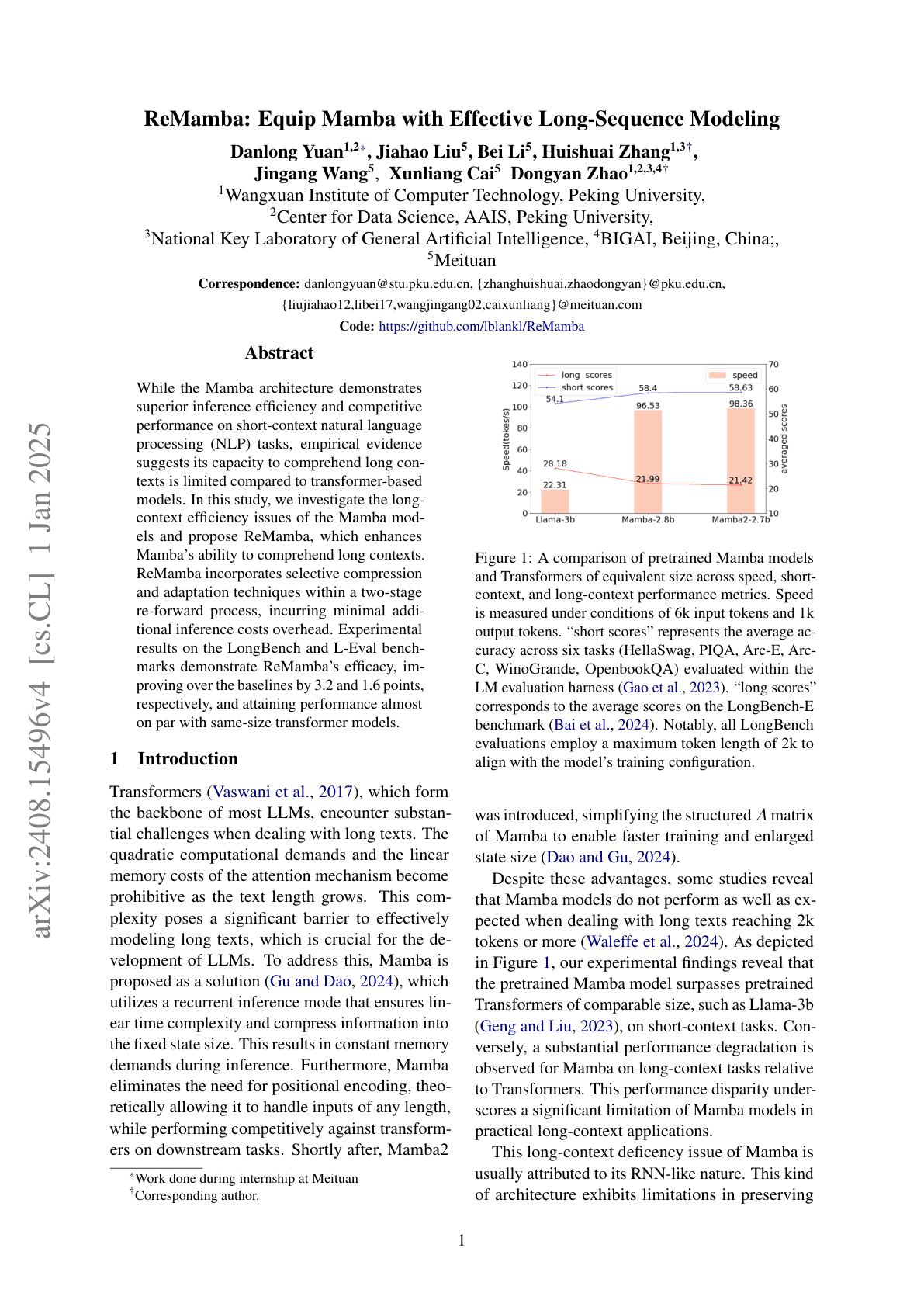
While the Mamba architecture demonstrates superior inference efficiency and competitive performance on short-context natural language processing (NLP) tasks, empirical evidence suggests its capacity to comprehend long contexts is limited compared to transformer-based models. In this study, we investigate the long-context efficiency issues of the Mamba models and propose ReMamba, which enhances Mamba's ability to comprehend long contexts. ReMamba incorporates selective compression and adaptation techniques within a two-stage re-forward process, incurring minimal additional inference costs overhead. Experimental results on the LongBench and L-Eval benchmarks demonstrate ReMamba's efficacy, improving over the baselines by 3.2 and 1.6 points, respectively, and attaining performance almost on par with same-size transformer models.