Task-Decoupled Planning for Long-Horizon Agents
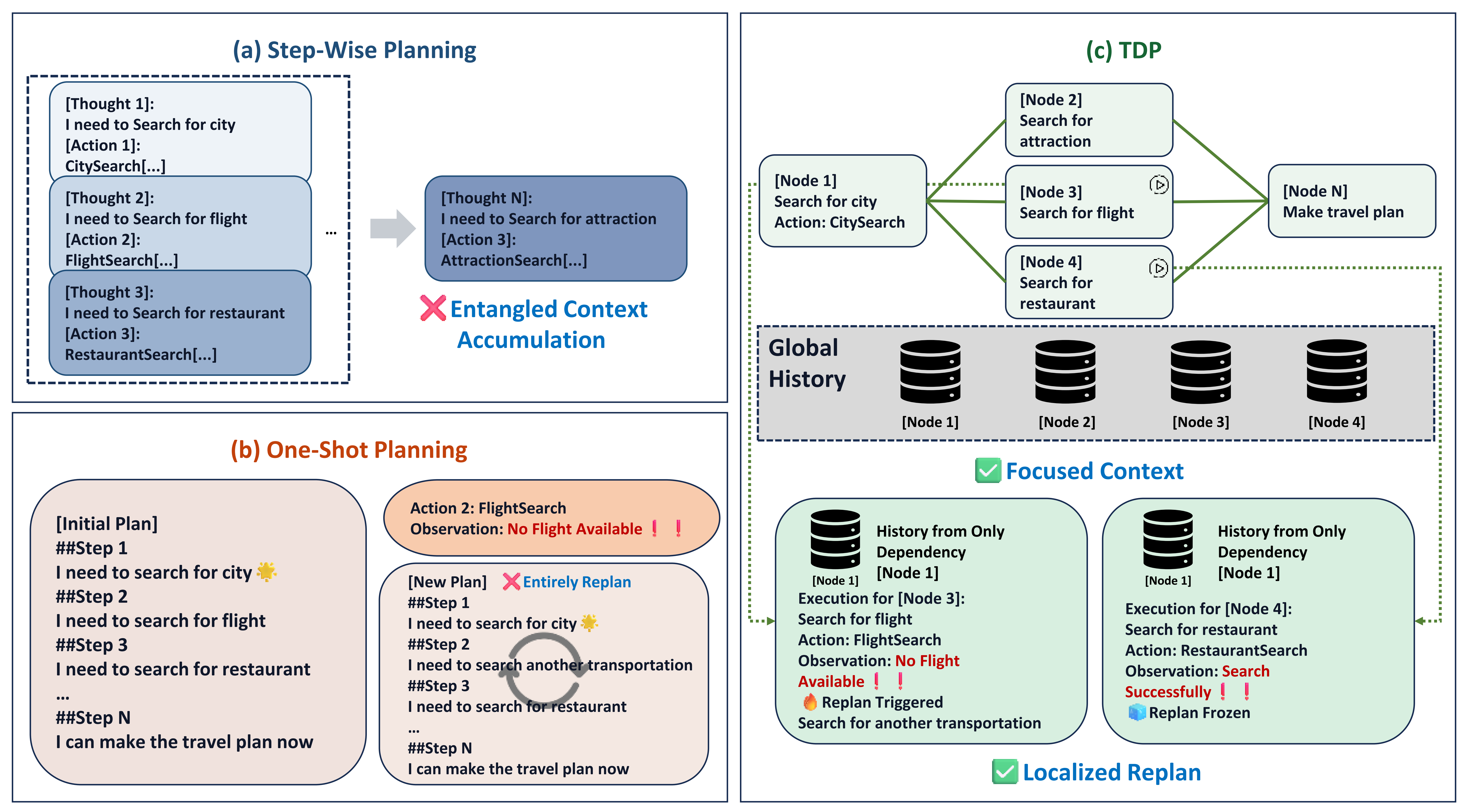
Task-Decoupled Planning (TDP) is a training-free framework that restructures agent planning by decomposing tasks into a directed acyclic graph of sub-goals using three components: Supervisor, Planner, and Executor. By isolating reasoning to individual subtasks through scoped contexts, TDP prevents error cascading and reduces token consumption by up to 82% while outperforming baselines on TravelPlanner, ScienceWorld, and HotpotQA.
Ask this paper
Abstract
Recent advances in large language models (LLMs) have enabled agents to autonomously execute complex, long-horizon tasks, yet planning remains a primary bottleneck for reliable task execution. Existing methods typically fall into two paradigms: step-wise planning, which is reactive but often short-sighted; and one-shot planning, which generates a complete plan upfront yet is brittle to execution errors. Crucially, both paradigms suffer from entangled contexts, where the agent must reason over a monolithic history spanning multiple sub-tasks. This entanglement increases cognitive load and lets local errors propagate across otherwise independent decisions, making recovery computationally expensive. To address this, we propose Task-Decoupled Planning (TDP), a training-free framework that replaces entangled reasoning with task decoupling. TDP decomposes tasks into a directed acyclic graph (DAG) of sub-goals via a Supervisor. Using a Planner and Executor with scoped contexts, TDP confines reasoning and replanning to the active sub-task. This isolation prevents error propagation and corrects deviations locally without disrupting the workflow. Results on TravelPlanner, ScienceWorld, and HotpotQA show that TDP outperforms strong baselines while reducing token consumption by up to 82%, demonstrating that sub-task decoupling improves both robustness and efficiency for long-horizon agents.