UniversalRAG
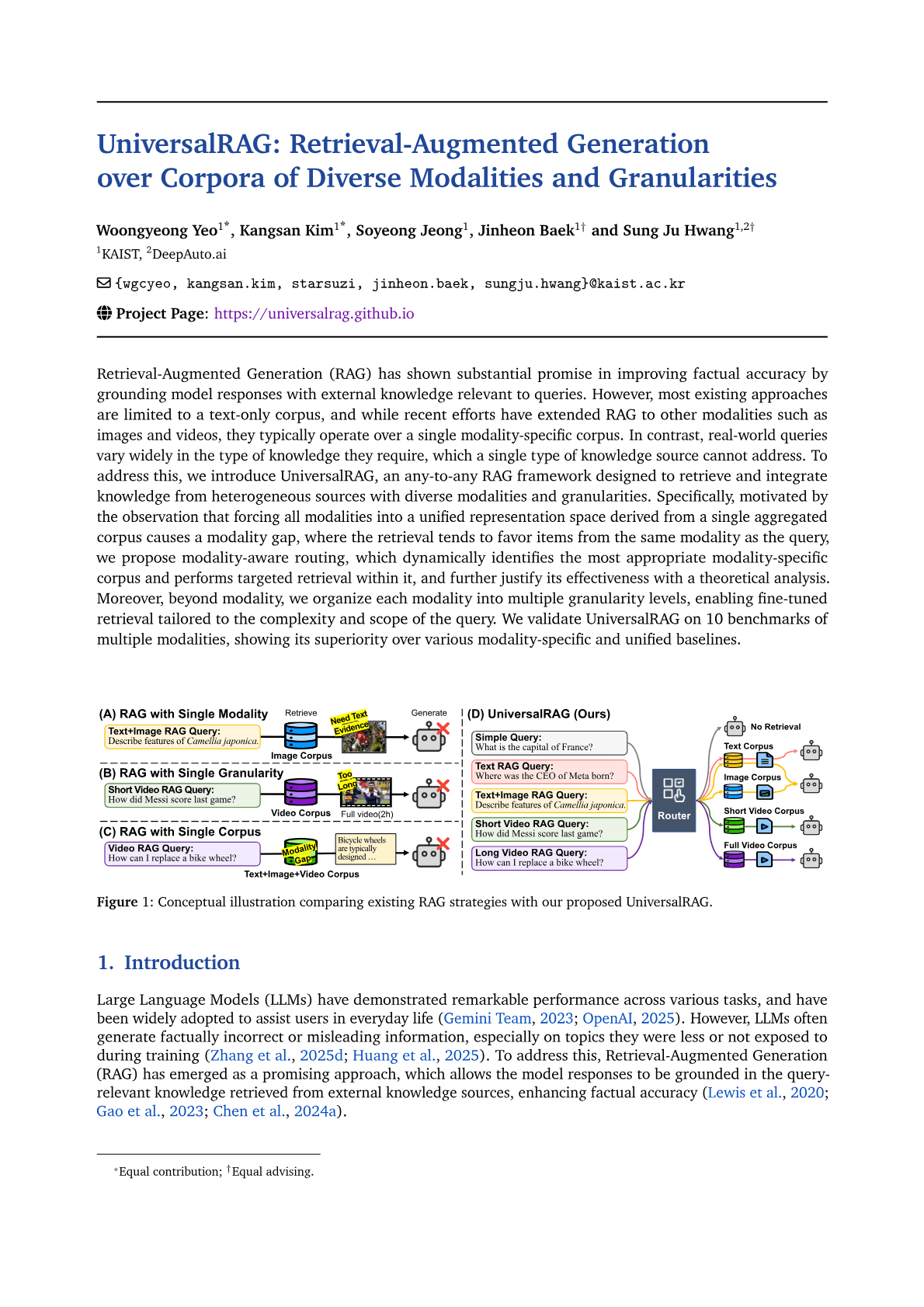
UniversalRAG introduces a RAG system that handles knowledge retrieval from heterogeneous sources containing multiple data types (text, images, videos) with varying granularities. Rather than forcing diverse modalities into a single embedding space where embeddings cluster by modality rather than meaning, it uses modality-aware routing to dynamically select appropriate corpus and granularity for each query, outperforming both unimodal and unified multimodal RAG baselines across 10 benchmarks.
Ask this paper
Abstract
Retrieval-Augmented Generation (RAG) has shown substantial promise in improving factual accuracy by grounding model responses with external knowledge relevant to queries. However, most existing approaches are limited to a text-only corpus, and while recent efforts have extended RAG to other modalities such as images and videos, they typically operate over a single modality-specific corpus. In contrast, real-world queries vary widely in the type of knowledge they require, which a single type of knowledge source cannot address. To address this, we introduce UniversalRAG, an any-to-any RAG framework designed to retrieve and integrate knowledge from heterogeneous sources with diverse modalities and granularities. Specifically, motivated by the observation that forcing all modalities into a unified representation space derived from a single aggregated corpus causes a modality gap, where the retrieval tends to favor items from the same modality as the query, we propose modality-aware routing, which dynamically identifies the most appropriate modality-specific corpus and performs targeted retrieval within it, and further justify its effectiveness with a theoretical analysis. Moreover, beyond modality, we organize each modality into multiple granularity levels, enabling fine-tuned retrieval tailored to the complexity and scope of the query. We validate UniversalRAG on 10 benchmarks of multiple modalities, showing its superiority over various modality-specific and unified baselines.