A-RAG
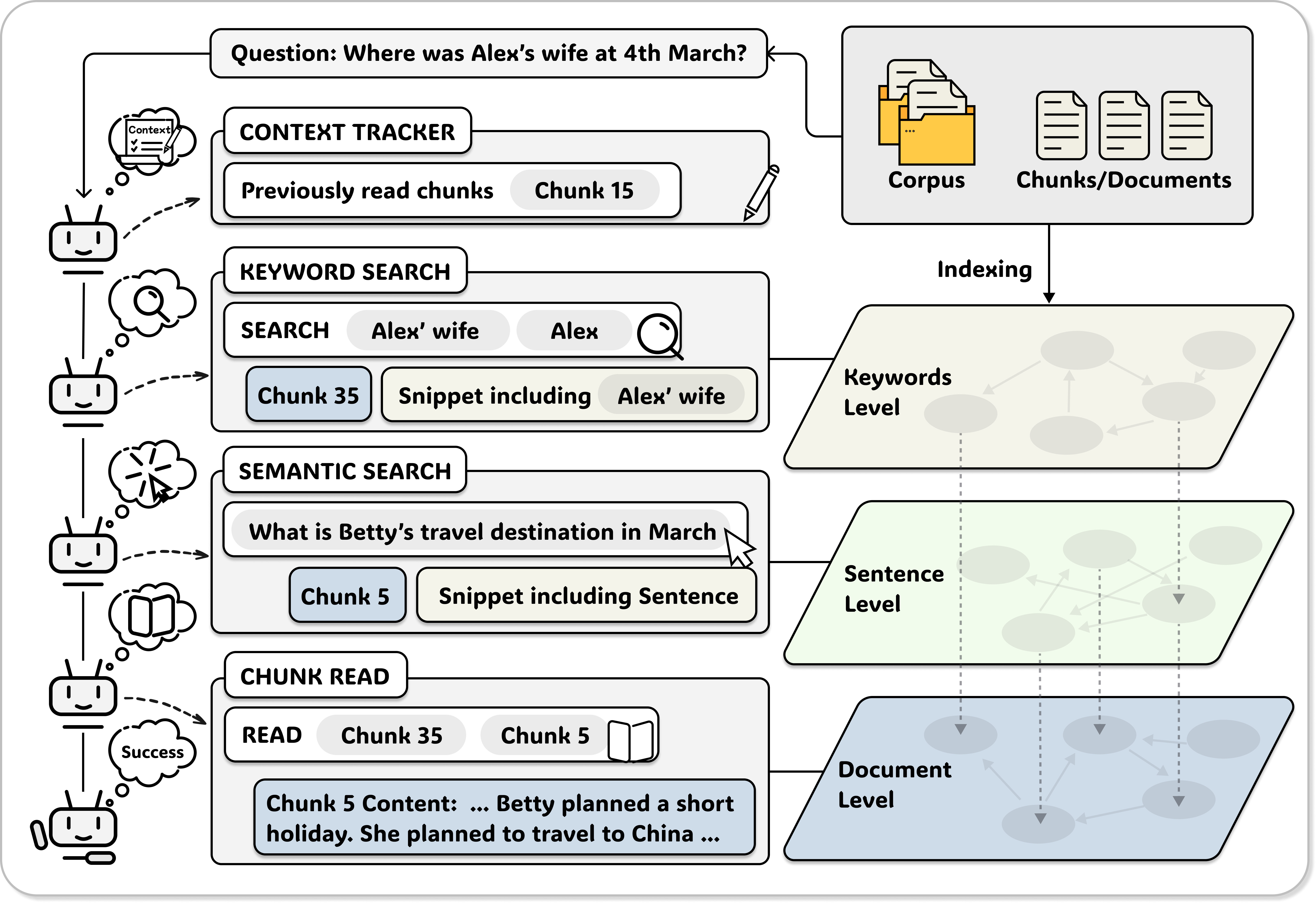
A-RAG is an agentic RAG framework that gives LLMs direct access to hierarchical retrieval interfaces instead of relying on fixed retrieval algorithms or predefined workflows. The agent autonomously decides what to search, at which granularity, and when to stop - representing a paradigm shift from static retrieval pipelines to truly agentic information gathering. - **Hierarchical retrieval tools:** A-RAG provides three tools operating at different granularities: keyword search for exact lexical matching at the keyword level, semantic search for dense retrieval at the sentence level, and chunk read for accessing full document chunks. The agent chooses which tool to call at each step based on the task, enabling adaptive multi-granularity retrieval. - **Agentic autonomy over fixed workflows:** Unlike Graph RAG (algorithm-driven, no iterative execution) and Workflow RAG (predefined steps, no autonomous strategy), A-RAG satisfies all three principles of agentic autonomy: autonomous strategy selection, iterative execution, and interleaved tool use. The model decides its own retrieval path in a ReAct-style loop. - **Consistent gains across benchmarks:** With GPT-5-mini as backbone, A-RAG outperforms all baselines on every benchmark tested (MuSiQue, HotpotQA, 2WikiMultiHopQA, Medical QA, Novel QA), beating strong methods like LinearRAG, HippoRAG2, and FaithfulRAG by significant margins. - **Better accuracy with fewer tokens:** A-RAG (Full) retrieves comparable or fewer tokens than traditional RAG methods while achieving higher accuracy. The hierarchical interface design lets the agent progressively disclose information and selectively read only the most relevant chunks, avoiding noise from irrelevant content. - **Scales with test-time compute:** Increasing max retrieval steps and reasoning effort both improve performance, with stronger models benefiting more from additional steps. Scaling reasoning effort from minimal to high yields approximately 25% improvement for both GPT-5-mini and GPT-5.
Ask this paper
Hierarchical retrieval tools: A-RAG provides three tools operating at different granularities: keyword search for exact lexical matching at the keyword level, semantic search for dense retrieval at the sentence level, and chunk read for accessing full document chunks. The agent chooses which tool to call at each step based on the task, enabling adaptive multi-granularity retrieval.
Agentic autonomy over fixed workflows: Unlike Graph RAG (algorithm-driven, no iterative execution) and Workflow RAG (predefined steps, no autonomous strategy), A-RAG satisfies all three principles of agentic autonomy: autonomous strategy selection, iterative execution, and interleaved tool use. The model decides its own retrieval path in a ReAct-style loop.
Consistent gains across benchmarks: With GPT-5-mini as backbone, A-RAG outperforms all baselines on every benchmark tested (MuSiQue, HotpotQA, 2WikiMultiHopQA, Medical QA, Novel QA), beating strong methods like LinearRAG, HippoRAG2, and FaithfulRAG by significant margins.
Better accuracy with fewer tokens: A-RAG (Full) retrieves comparable or fewer tokens than traditional RAG methods while achieving higher accuracy. The hierarchical interface design lets the agent progressively disclose information and selectively read only the most relevant chunks, avoiding noise from irrelevant content.
Scales with test-time compute: Increasing max retrieval steps and reasoning effort both improve performance, with stronger models benefiting more from additional steps. Scaling reasoning effort from minimal to high yields approximately 25% improvement for both GPT-5-mini and GPT-5.
Abstract
Frontier language models have demonstrated strong reasoning and long-horizon tool-use capabilities. However, existing RAG systems fail to leverage these capabilities. They still rely on two paradigms: (1) designing an algorithm that retrieves passages in a single shot and concatenates them into the model's input, or (2) predefining a workflow and prompting the model to execute it step-by-step. Neither paradigm allows the model to participate in retrieval decisions, preventing efficient scaling with model improvements. In this paper, we introduce A-RAG, an Agentic RAG framework that exposes hierarchical retrieval interfaces directly to the model. A-RAG provides three retrieval tools: keyword search, semantic search, and chunk read, enabling the agent to adaptively search and retrieve information across multiple granularities. Experiments on multiple open-domain QA benchmarks show that A-RAG consistently outperforms existing approaches with comparable or lower retrieved tokens, demonstrating that A-RAG effectively leverages model capabilities and dynamically adapts to different RAG tasks. We further systematically study how A-RAG scales with model size and test-time compute. We will release our code and evaluation suite to facilitate future research. Code and evaluation suite are available at this https URL.