SALE
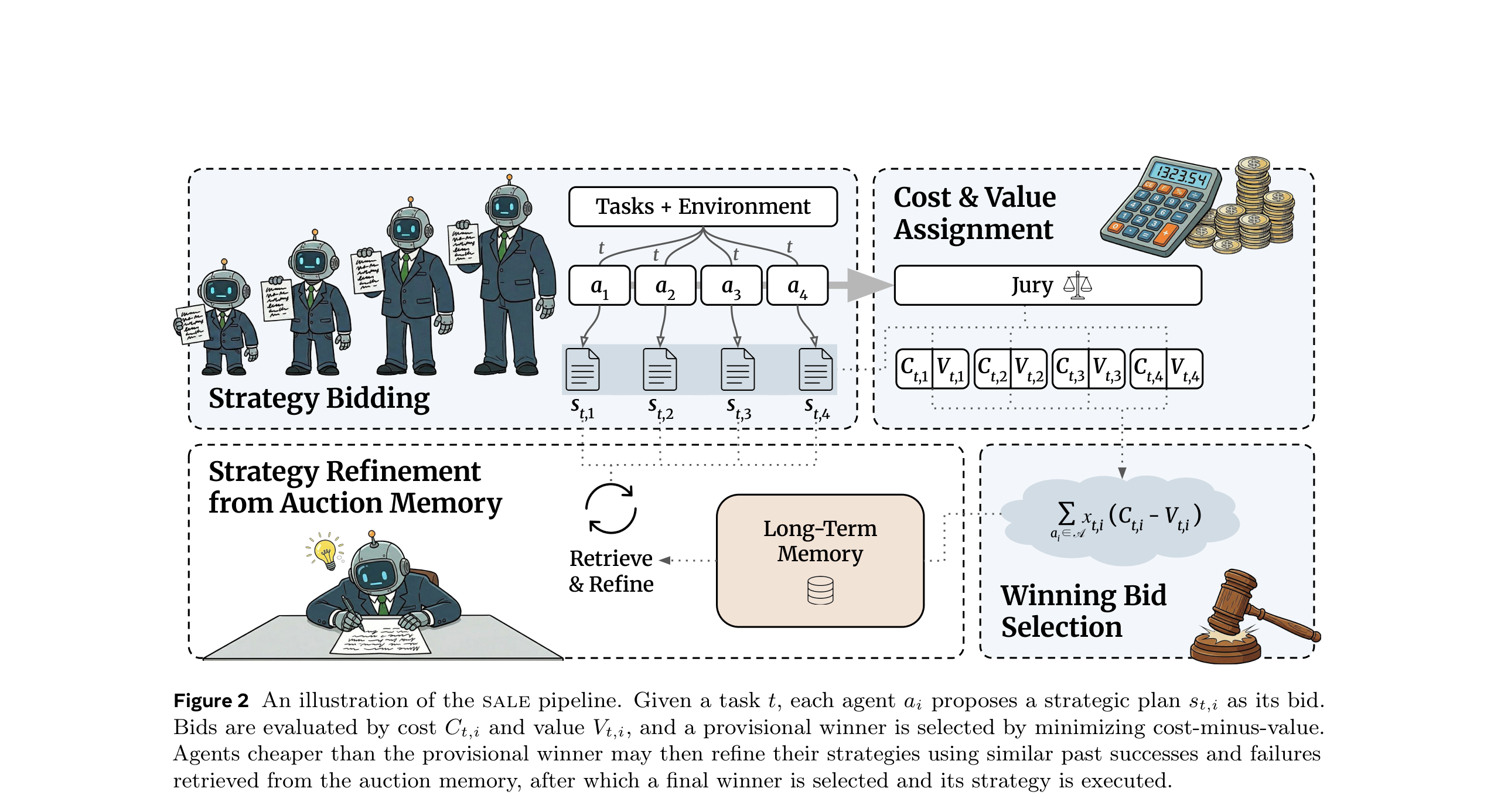
This paper from Meta shows that small agents match large ones on simple tasks but fall sharply behind as complexity grows, with the cheapest agent reaching only about 21% of the largest agent's accuracy on the hardest problems. To address this, the authors introduce SALE (Strategy Auctions for Workload Efficiency), a marketplace-inspired framework where heterogeneous agents bid with strategic plans, are scored on cost-value trade-offs, and refine their bids using shared auction memory. - **Small agents don't scale with complexity:** On deep search and coding tasks graded by human solution time, the 4B agent achieves approximately 87% of the 32B agent's accuracy on simple tasks but drops to roughly 21% on the most complex ones. This confirms that model size should be treated as a per-task routing decision, not a global choice. - **Auction-based routing mechanism:** Each agent proposes a short strategic plan as its bid. A jury of all agents scores each plan's value via peer assessment, while cost is estimated from plan length and per-token price. The agent with the best cost-minus-value trade-off wins and executes its strategy. - **Memory-driven self-improvement:** After each auction, all bids (winning and losing) are stored in a shared memory bank. Cheaper agents that lost can retrieve similar past tasks, learn from winning strategies via contrastive prompting, and submit refined bids - progressively taking on more work over time, similar to how freelancers upskill in a marketplace. - **Beats the largest agent at lower cost:** SALE consistently improves upon the best single agent's accuracy by 2.7-3.8 points on the hardest tasks while reducing reliance on the 32B model by 53% and cutting overall cost by 35%. It also outperforms four established routers (WTP, CARROT, TO-Router, FrugalGPT) that either underperform the largest agent or fail to reduce cost. - **Complementary failure modes:** Analysis reveals that large agents tend to over-engineer and skip tool use, while small agents favor simpler, tool-heavy strategies. SALE exploits this complementarity at bid time, routing tasks to whichever approach fits best without needing to execute full trajectories first.
Ask this paper
Small agents don’t scale with complexity: On deep search and coding tasks graded by human solution time, the 4B agent achieves approximately 87% of the 32B agent’s accuracy on simple tasks but drops to roughly 21% on the most complex ones. This confirms that model size should be treated as a per-task routing decision, not a global choice.
Auction-based routing mechanism: Each agent proposes a short strategic plan as its bid. A jury of all agents scores each plan’s value via peer assessment, while cost is estimated from plan length and per-token price. The agent with the best cost-minus-value trade-off wins and executes its strategy.
Memory-driven self-improvement: After each auction, all bids (winning and losing) are stored in a shared memory bank. Cheaper agents that lost can retrieve similar past tasks, learn from winning strategies via contrastive prompting, and submit refined bids - progressively taking on more work over time, similar to how freelancers upskill in a marketplace.
Beats the largest agent at lower cost: SALE consistently improves upon the best single agent’s accuracy by 2.7-3.8 points on the hardest tasks while reducing reliance on the 32B model by 53% and cutting overall cost by 35%. It also outperforms four established routers (WTP, CARROT, TO-Router, FrugalGPT) that either underperform the largest agent or fail to reduce cost.
Complementary failure modes: Analysis reveals that large agents tend to over-engineer and skip tool use, while small agents favor simpler, tool-heavy strategies. SALE exploits this complementarity at bid time, routing tasks to whichever approach fits best without needing to execute full trajectories first.
Abstract
Small language models are increasingly viewed as a promising, cost-effective approach to agentic AI, with proponents claiming they are sufficiently capable for agentic workflows. However, while smaller agents can closely match larger ones on simple tasks, it remains unclear how their performance scales with task complexity, when large models become necessary, and how to better leverage small agents for long-horizon workloads. In this work, we empirically show that small agents' performance fails to scale with task complexity on deep search and coding tasks, and we introduce Strategy Auctions for Workload Efficiency (SALE), an agent framework inspired by freelancer marketplaces. In SALE, agents bid with short strategic plans, which are scored by a systematic cost-value mechanism and refined via a shared auction memory, enabling per-task routing and continual self-improvement without training a separate router or running all models to completion. Across deep search and coding tasks of varying complexity, SALE reduces reliance on the largest agent by 53%, lowers overall cost by 35%, and consistently improves upon the largest agent's pass@1 with only a negligible overhead beyond executing the final trace. In contrast, established routers that rely on task descriptions either underperform the largest agent or fail to reduce cost -- often both -- underscoring their poor fit for agentic workflows. These results suggest that while small agents may be insufficient for complex workloads, they can be effectively "scaled up" through coordinated task allocation and test-time self-improvement. More broadly, they motivate a systems-level view of agentic AI in which performance gains come less from ever-larger individual models and more from market-inspired coordination mechanisms that organize heterogeneous agents into efficient, adaptive ecosystems.