xMemory
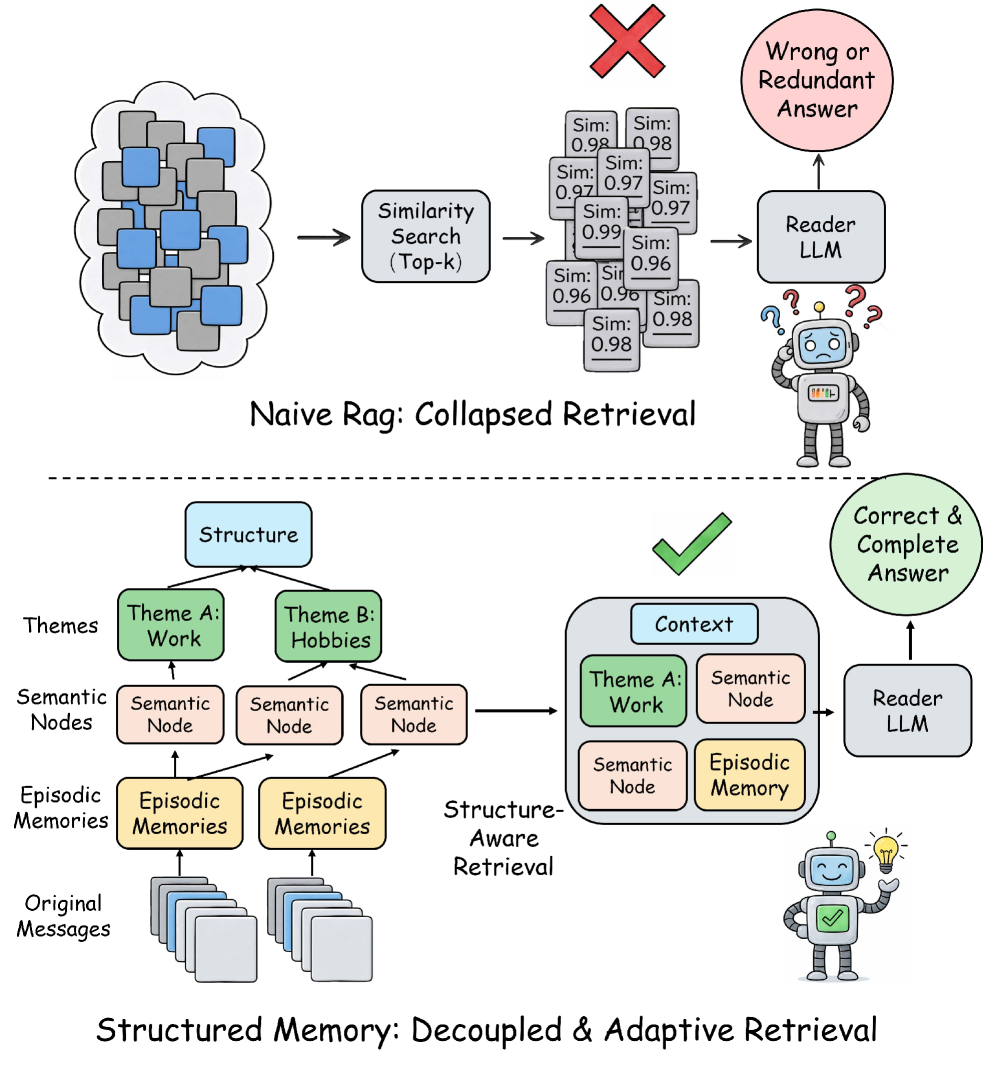
xMemory argues that standard RAG retrieval is a poor fit for agent memory because the evidence source is a bounded, coherent dialogue stream where candidate spans are highly correlated near-duplicates. Fixed top-k similarity retrieval collapses into a single dense region, returning redundant context, while post-hoc pruning can break temporally linked evidence chains. xMemory replaces this with hierarchical memory construction and structure-aware top-down retrieval. - **Four-level memory hierarchy:** Raw messages are grouped into episodes (contiguous dialogue blocks), which are distilled into semantic nodes (reusable facts), which are organized under themes. A sparsity-semantics guidance objective balances theme sizes during construction via split and merge operations, preventing both overly large themes that cause retrieval collapse and overly fragmented ones that weaken evidence coverage. - **Two-stage top-down retrieval:** Stage I selects a compact, diverse set of relevant themes and semantic nodes using a greedy coverage-relevance procedure on a kNN graph. Stage II then adaptively expands to episodes and raw messages only when the added detail reduces the reader LLM's uncertainty, controlled by an early stopping mechanism. - **Evidence density over retrieval volume:** Analysis shows xMemory retrieves substantially more evidence-dense contexts (higher 2-hit and multi-hit proportions) than both Naive RAG and RAG with pruning. It covers all answer content with fewer blocks (5.66 vs 10.81) and roughly half the token cost (975 vs 1,979 tokens). - **Consistent gains across backbones:** On LoCoMo and PerLTQA benchmarks, xMemory achieves the best average performance across Qwen3-8B, Llama-3.1-8B-Instruct, and GPT-5 nano, outperforming five baselines including Naive RAG, A-Mem, MemoryOS, Nemori, and LightMem while using fewer tokens per query. - **Retroactive restructuring:** Unlike static memory stores, xMemory dynamically reassigns semantic nodes to different themes as new interactions arrive, with split and merge operations updating the high-level structure over time. Enabling this restructuring substantially improves downstream QA accuracy compared to frozen hierarchies.
Ask this paper
Four-level memory hierarchy: Raw messages are grouped into episodes (contiguous dialogue blocks), which are distilled into semantic nodes (reusable facts), which are organized under themes. A sparsity-semantics guidance objective balances theme sizes during construction via split and merge operations, preventing both overly large themes that cause retrieval collapse and overly fragmented ones that weaken evidence coverage.
Two-stage top-down retrieval: Stage I selects a compact, diverse set of relevant themes and semantic nodes using a greedy coverage-relevance procedure on a kNN graph. Stage II then adaptively expands to episodes and raw messages only when the added detail reduces the reader LLM’s uncertainty, controlled by an early stopping mechanism.
Evidence density over retrieval volume: Analysis shows xMemory retrieves substantially more evidence-dense contexts (higher 2-hit and multi-hit proportions) than both Naive RAG and RAG with pruning. It covers all answer content with fewer blocks (5.66 vs 10.81) and roughly half the token cost (975 vs 1,979 tokens).
Consistent gains across backbones: On LoCoMo and PerLTQA benchmarks, xMemory achieves the best average performance across Qwen3-8B, Llama-3.1-8B-Instruct, and GPT-5 nano, outperforming five baselines, including Naive RAG, A-Mem, MemoryOS, Nemori, and LightMem while using fewer tokens per query.
Retroactive restructuring: Unlike static memory stores, xMemory dynamically reassigns semantic nodes to different themes as new interactions arrive, with split and merge operations updating the high-level structure over time. Enabling this restructuring substantially improves downstream QA accuracy compared to frozen hierarchies.
Abstract
Agent memory systems often adopt the standard Retrieval-Augmented Generation (RAG) pipeline, yet its underlying assumptions differ in this setting. RAG targets large, heterogeneous corpora where retrieved passages are diverse, whereas agent memory is a bounded, coherent dialogue stream with highly correlated spans that are often duplicates. Under this shift, fixed top-$k$ similarity retrieval tends to return redundant context, and post-hoc pruning can delete temporally linked prerequisites needed for correct reasoning. We argue retrieval should move beyond similarity matching and instead operate over latent components, following decoupling to aggregation: disentangle memories into semantic components, organise them into a hierarchy, and use this structure to drive retrieval. We propose xMemory, which builds a hierarchy of intact units and maintains a searchable yet faithful high-level node organisation via a sparsity--semantics objective that guides memory split and merge. At inference, xMemory retrieves top-down, selecting a compact, diverse set of themes and semantics for multi-fact queries, and expanding to episodes and raw messages only when it reduces the reader's uncertainty. Experiments on LoCoMo and PerLTQA across the three latest LLMs show consistent gains in answer quality and token efficiency.