InfMem
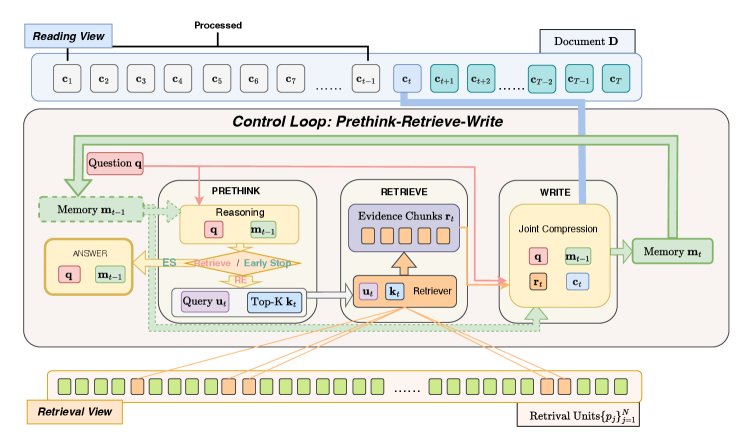
InfMem is a cognitive agent for ultra-long document QA that uses System-2-style control to actively manage bounded memory. Instead of passively compressing each chunk as it streams in, InfMem runs a PreThink-Retrieve-Write loop that monitors evidence sufficiency, fetches missing facts from anywhere in the document, and compresses everything into a fixed-size memory - then stops early once it has enough. - **PreThink-Retrieve-Write protocol:** At each step, a PreThink controller checks whether the current memory can already answer the question. If not, it generates a targeted retrieval query and specifies how many passages to fetch. Retrieve then pulls fine-grained paragraphs from anywhere in the document (not just nearby chunks), and Write jointly compresses the new evidence with existing memory under a fixed token budget. - **Adaptive early stopping:** Once the agent determines its memory is sufficient, it terminates the loop immediately rather than processing remaining chunks. This cuts inference time by up to 5.1x on 1M-token documents while preserving or improving accuracy. - **SFT-to-RL training recipe:** A two-stage pipeline first distills protocol-valid trajectories from a strong teacher (Qwen3-32B) via supervised fine-tuning, then applies GRPO with verifier-based rewards to align retrieval, writing, and stopping decisions with end-task correctness. RL adds an early-stop shaping reward that penalizes redundant retrieval after the memory becomes sufficient. - **Strong gains over MemAgent:** Across Qwen3-1.7B/4B and Qwen2.5-7B on benchmarks spanning 32k to 1M tokens, InfMem outperforms MemAgent by over 10 points on average after RL, while reducing latency by 3.3-5.1x. It also transfers well to LongBench QA with consistent improvements. - **Robustness at extreme lengths:** While baselines like YaRN collapse beyond 128k tokens and RAG struggles with dispersed evidence, InfMem remains stable up to 1M tokens, especially on complex multi-hop tasks that require synthesizing scattered bridging facts across distant document segments.
Ask this paper
PreThink-Retrieve-Write protocol: At each step, a PreThink controller checks whether the current memory can already answer the question. If not, it generates a targeted retrieval query and specifies how many passages to fetch. Retrieve then pulls fine-grained paragraphs from anywhere in the document (not just nearby chunks), and Write jointly compresses the new evidence with existing memory under a fixed token budget.
Adaptive early stopping: Once the agent determines its memory is sufficient, it terminates the loop immediately rather than processing remaining chunks. This cuts inference time by up to 5.1x on 1M-token documents while preserving or improving accuracy.
SFT-to-RL training recipe: A two-stage pipeline first distills protocol-valid trajectories from a strong teacher (Qwen3-32B) via supervised fine-tuning, then applies GRPO with verifier-based rewards to align retrieval, writing, and stopping decisions with end-task correctness. RL adds an early-stop shaping reward that penalizes redundant retrieval after the memory becomes sufficient.
Strong gains over MemAgent: Across Qwen3-1.7B/4B and Qwen2.5-7B on benchmarks spanning 32k to 1M tokens, InfMem outperforms MemAgent by over 10 points on average after RL, while reducing latency by 3.3-5.1x. It also transfers well to LongBench QA with consistent improvements.
Robustness at extreme lengths: While baselines like YaRN collapse beyond 128k tokens and RAG struggles with dispersed evidence, InfMem remains stable up to 1M tokens, especially on complex multi-hop tasks that require synthesizing scattered bridging facts across distant document segments.
Abstract
Reasoning over ultra-long documents requires synthesizing sparse evidence scattered across distant segments under strict memory constraints. While streaming agents enable scalable processing, their passive memory update strategy often fails to preserve low-salience bridging evidence required for multi-hop reasoning. We propose InfMem, a control-centric agent that instantiates System-2-style control via a PreThink-Retrieve-Write protocol. InfMem actively monitors evidence sufficiency, performs targeted in-document retrieval, and applies evidence-aware joint compression to update a bounded memory. To ensure reliable control, we introduce a practical SFT-to-RL training recipe that aligns retrieval, writing, and stopping decisions with end-task correctness. On ultra-long QA benchmarks from 32k to 1M tokens, InfMem consistently outperforms MemAgent across backbones. Specifically, InfMem improves average absolute accuracy by +10.17, +11.84, and +8.23 points on Qwen3-1.7B, Qwen3-4B, and Qwen2.5-7B, respectively, while reducing inference time by $3.9\times$ on average (up to $5.1\times$) via adaptive early stopping.