TinyLoRA
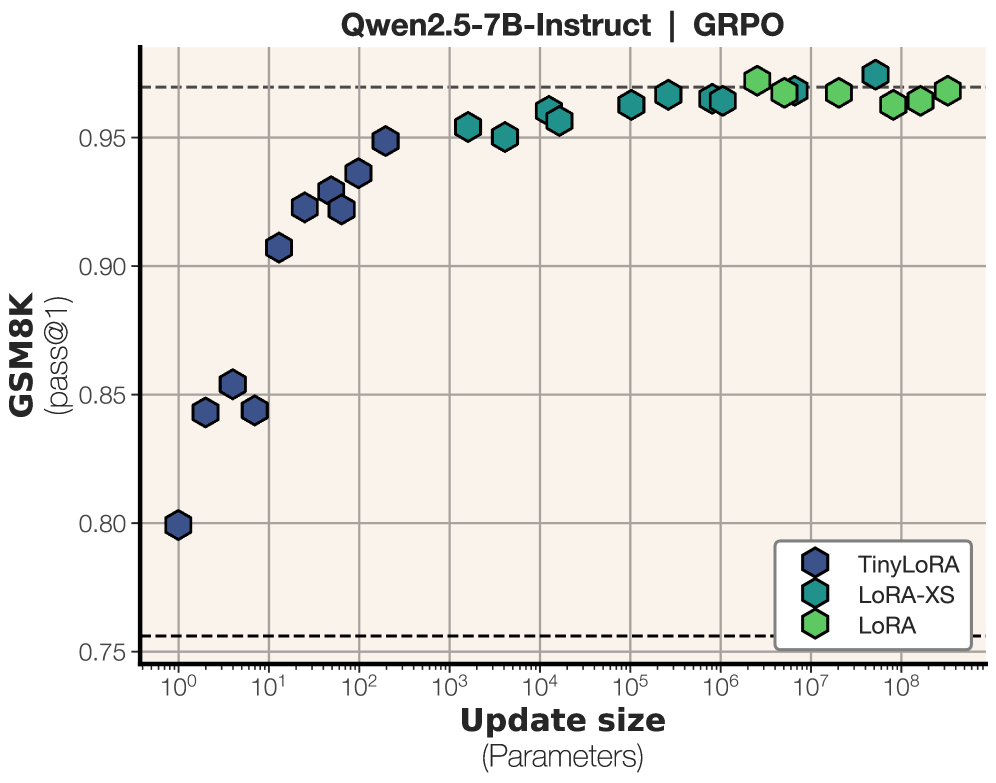
This paper from Meta FAIR asks how small a LoRA adapter can get and still teach a model to reason. The answer: remarkably small. The authors propose TinyLoRA, a method that scales low-rank adapters down to as few as one trainable parameter by projecting through fixed random tensors and sharing weights across all modules. The key insight is that RL makes fundamentally more information-dense updates than SFT, enabling effective learning with orders of magnitude fewer parameters. - **91% accuracy with 13 parameters:** Using TinyLoRA with GRPO on GSM8K, Qwen2.5-7B-Instruct reaches 91% accuracy while training just 13 parameters (26 bytes in bf16). This recovers 95% of the full finetuning performance improvement, and even a single trained parameter yields a measurable 4% accuracy gain. - **RL vastly outperforms SFT at low parameter counts:** At 13 parameters, RL scores 91% while SFT scores only 83% on GSM8K. The gap widens further below 100 parameters. The paper explains this through signal separation: RL's reward signal cleanly isolates task-relevant features from noise, while SFT must absorb entire demonstrations including irrelevant details, requiring far more capacity. - **TinyLoRA method:** Builds on LoRA-XS by replacing the trainable rotation matrix with a low-dimensional vector projected through fixed random tensors, and shares this vector across all adapted modules via weight tying. This reduces the minimum trainable parameter count from hundreds (LoRA-XS) down to one. - **Scales across model sizes and harder benchmarks:** On six difficult math benchmarks (MATH500, Minerva Math, OlympiadBench, AIME24, AMC23), finetuning Qwen2.5-7B with just 196 parameters retains 87% of the absolute performance improvement. Larger models need fewer parameters to reach the same performance threshold, suggesting trillion-scale models may be trainable with a handful of parameters. - **Practical implications for personalization:** Updates under 1KB in total size open new possibilities for efficient distributed training, mass personalization (10x more LoRAs served concurrently with 10x smaller adapters), and reduced forgetting since tiny updates preserve more of the base model's knowledge.
Ask this paper
91% accuracy with 13 parameters: Using TinyLoRA with GRPO on GSM8K, Qwen2.5-7B-Instruct reaches 91% accuracy while training just 13 parameters (26 bytes in bf16). This recovers 95% of the full finetuning performance improvement, and even a single trained parameter yields a measurable 4% accuracy gain.
RL vastly outperforms SFT at low parameter counts: At 13 parameters, RL scores 91% while SFT scores only 83% on GSM8K. The gap widens further below 100 parameters. The paper explains this through signal separation: RL’s reward signal cleanly isolates task-relevant features from noise, while SFT must absorb entire demonstrations, including irrelevant details, requiring far more capacity.
TinyLoRA method: Builds on LoRA-XS by replacing the trainable rotation matrix with a low-dimensional vector projected through fixed random tensors, and shares this vector across all adapted modules via weight tying. This reduces the minimum trainable parameter count from hundreds (LoRA-XS) down to one.
Scales across model sizes and harder benchmarks: On six difficult math benchmarks (MATH500, Minerva Math, OlympiadBench, AIME24, AMC23), finetuning Qwen2.5-7B with just 196 parameters retains 87% of the absolute performance improvement. Larger models need fewer parameters to reach the same performance threshold, suggesting trillion-scale models may be trainable with a handful of parameters.
Practical implications for personalization: Updates under 1KB in total size open new possibilities for efficient distributed training, mass personalization (10x more LoRAs served concurrently with 10x smaller adapters), and reduced forgetting since tiny updates preserve more of the base model’s knowledge.
Abstract
Recent research has shown that language models can learn to \textit{reason}, often via reinforcement learning. Some work even trains low-rank parameterizations for reasoning, but conventional LoRA cannot scale below the model dimension. We question whether even rank=1 LoRA is necessary for learning to reason and propose TinyLoRA, a method for scaling low-rank adapters to sizes as small as one parameter. Within our new parameterization, we are able to train the 8B parameter size of Qwen2.5 to 91\% accuracy on GSM8K with only 13 trained parameters in bf16 (26 total bytes). We find this trend holds in general: we are able to recover 90\% of performance improvements while training $1000x$ fewer parameters across a suite of more difficult learning-to-reason benchmarks such as AIME, AMC, and MATH500. Notably, we are only able to achieve such strong performance with RL: models trained using SFT require $100-1000x$ larger updates to reach the same performance.