Semi-Autonomous Mathematics Discovery with Gemini
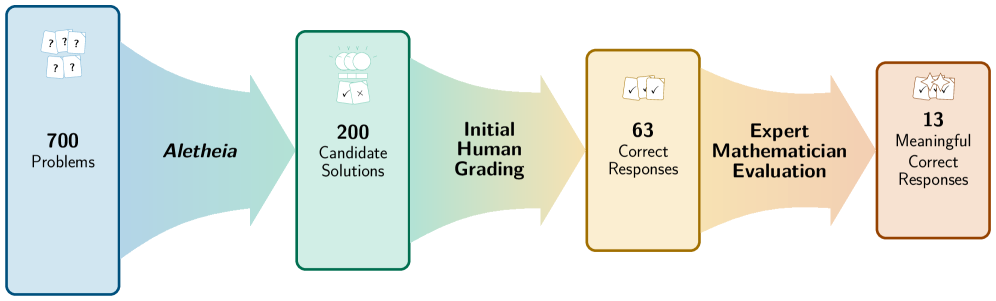
This paper from Google DeepMind presents a case study in semi-autonomous mathematics discovery using Aletheia, a specialized math research agent built on Gemini Deep Think. The team systematically evaluated 700 open conjectures from Bloom's Erdos Problems database, combining AI-driven natural language verification with human expert evaluation, and addressed 13 previously open problems. - **Hybrid methodology:** Aletheia was deployed on all 700 open Erdos problems, producing 212 candidate solutions. After initial human grading, 63 were technically correct, but only 13 (6.5%) meaningfully addressed the intended problem statement, revealing how challenging accurate mathematical reasoning remains for AI. - **Four categories of results:** The 13 meaningful solutions fell into autonomous resolution (2 problems solved with novel arguments), partial AI solutions (2 multi-part problems partially solved), independent rediscovery (4 problems where solutions already existed in the literature), and literature identification (5 problems already solved but not recorded as such). - **Subconscious plagiarism risk:** A key finding is that AI models can reproduce solutions from the literature without attribution, raising concerns about novelty claims. The authors found that for all AI-generated solutions not yet located in the literature, it is plausible they were previously discovered by humans but never published. - **Challenges at scale:** The most arduous step was not verifying correctness but determining whether solutions already existed in prior work. Many technically correct solutions were mathematically vacuous due to misinterpreted problem statements or notational ambiguity. - **Tempered expectations:** The authors caution against overexcitement about mathematical significance, noting that most resolved problems could have been dispatched by the right human expert. However, AI shows potential to accelerate attention-bottlenecked aspects of mathematical discovery.
Ask this paper
Hybrid methodology: Aletheia was deployed on all 700 open Erdos problems, producing 212 candidate solutions. After initial human grading, 63 were technically correct, but only 13 (6.5%) meaningfully addressed the intended problem statement, revealing how challenging accurate mathematical reasoning remains for AI.
Four categories of results: The 13 meaningful solutions fell into autonomous resolution (2 problems solved with novel arguments), partial AI solutions (2 multi-part problems partially solved), independent rediscovery (4 problems where solutions already existed in the literature), and literature identification (5 problems already solved but not recorded as such).
Subconscious plagiarism risk: A key finding is that AI models can reproduce solutions from the literature without attribution, raising concerns about novelty claims. The authors found that for all AI-generated solutions not yet located in the literature, it is plausible that they were previously discovered by humans but never published.
Challenges at scale: The most arduous step was not verifying correctness but determining whether solutions already existed in prior work. Many technically correct solutions were mathematically vacuous due to misinterpreted problem statements or notational ambiguity.
Tempered expectations: The authors caution against overexcitement about mathematical significance, noting that most resolved problems could have been dispatched by the right human expert. However, AI shows potential to accelerate attention-bottlenecked aspects of mathematical discovery.
Abstract
We present a case study in semi-autonomous mathematics discovery, using Gemini to systematically evaluate 700 conjectures labeled 'Open' in Bloom's Erdős Problems database. We employ a hybrid methodology: AI-driven natural language verification to narrow the search space, followed by human expert evaluation to gauge correctness and novelty. We address 13 problems that were marked 'Open' in the database: 5 through seemingly novel autonomous solutions, and 8 through identification of previous solutions in the existing literature. Our findings suggest that the 'Open' status of the problems was through obscurity rather than difficulty. We also identify and discuss issues arising in applying AI to math conjectures at scale, highlighting the difficulty of literature identification and the risk of ''subconscious plagiarism'' by AI. We reflect on the takeaways from AI-assisted efforts on the Erdős Problems.