Accelerating Scientific Research with Gemini
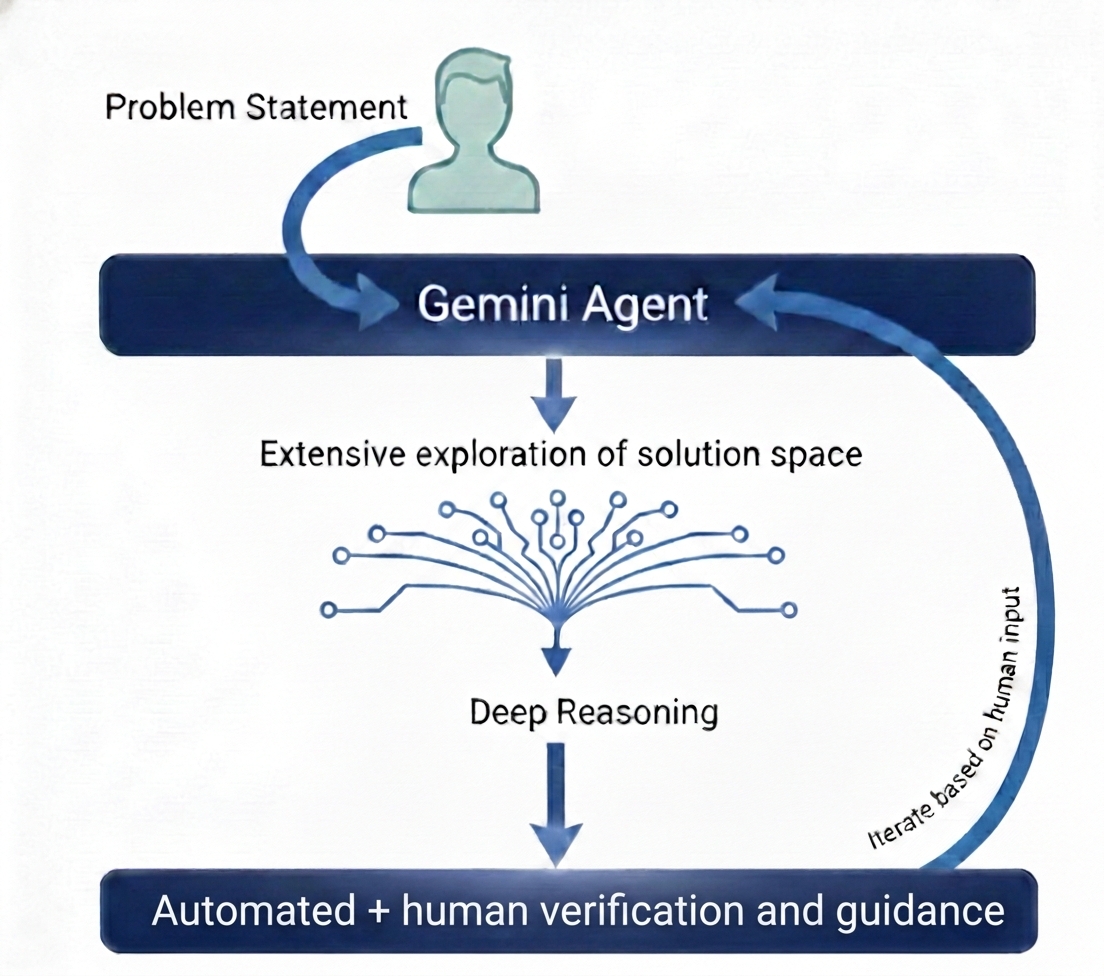
A collection of case studies from Google Research showing how researchers used Gemini Deep Think to solve open problems, refute conjectures, and generate new proofs across theoretical computer science, information theory, cryptography, optimization, economics, and physics. The paper extracts a practical playbook of recurring techniques including iterative refinement, cross-disciplinary knowledge transfer, counterexample search, and neuro-symbolic verification loops where the model autonomously writes and executes code to validate derivations. Notable results include identifying a fatal flaw in a cryptography preprint on SNARGs, resolving the Courtade-Kumar conjecture in information theory, and proving that the simplex is optimal for Euclidean Steiner trees.
Ask this paper
Abstract
Recent advances in large language models (LLMs) have opened new avenues for accelerating scientific research. While models are increasingly capable of assisting with routine tasks, their ability to contribute to novel, expert-level mathematical discovery is less understood. We present a collection of case studies demonstrating how researchers have successfully collaborated with advanced AI models, specifically Google's Gemini-based models (in particular Gemini Deep Think and its advanced variants), to solve open problems, refute conjectures, and generate new proofs across diverse areas in theoretical computer science, as well as other areas such as economics, optimization, and physics. Based on these experiences, we extract common techniques for effective human-AI collaboration in theoretical research, such as iterative refinement, problem decomposition, and cross-disciplinary knowledge transfer. While the majority of our results stem from this interactive, conversational methodology, we also highlight specific instances that push beyond standard chat interfaces. These include deploying the model as a rigorous adversarial reviewer to detect subtle flaws in existing proofs, and embedding it within a "neuro-symbolic" loop that autonomously writes and executes code to verify complex derivations. Together, these examples highlight the potential of AI not just as a tool for automation, but as a versatile, genuine partner in the creative process of scientific discovery.