Advances and Challenges in Foundation Agents
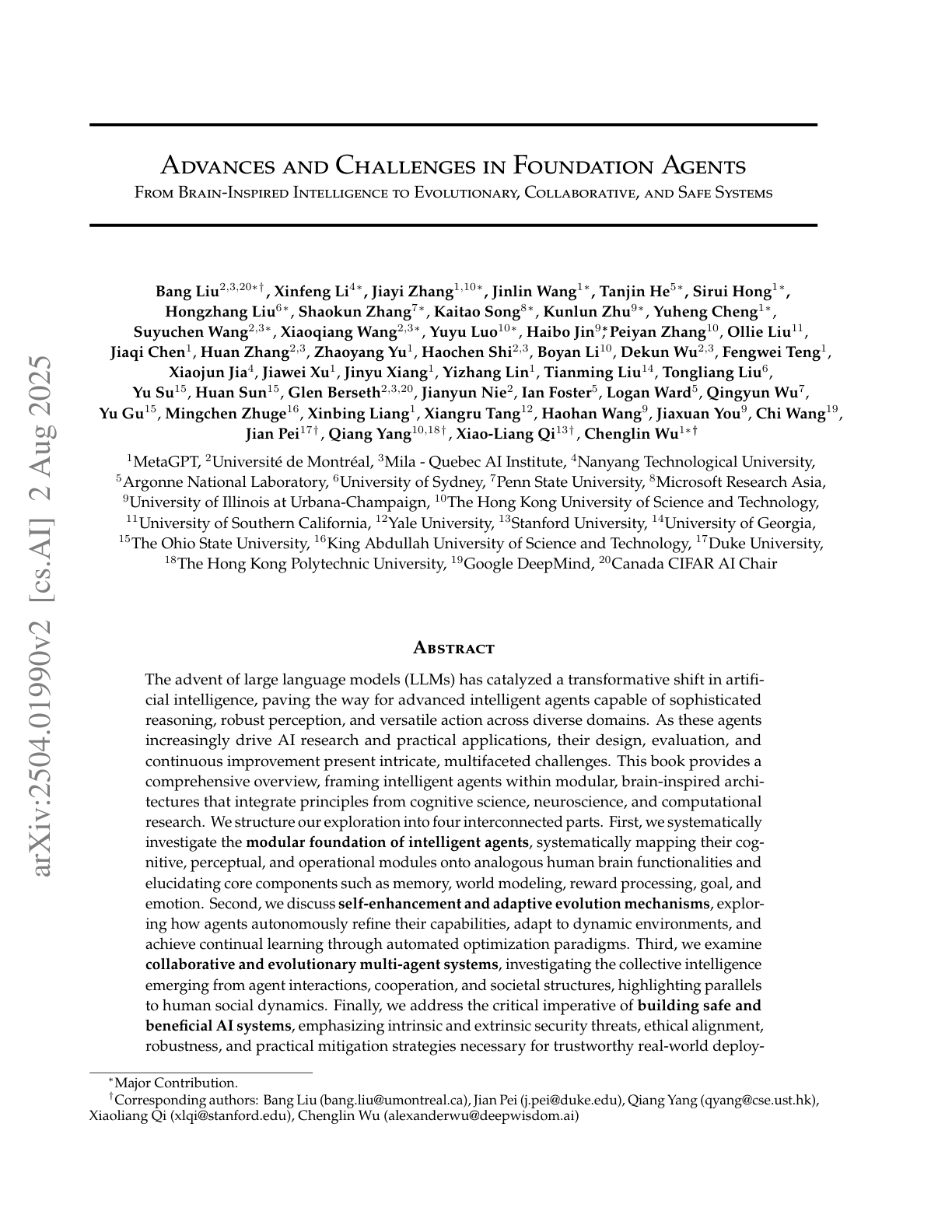
A new survey frames intelligent agents with a modular, brain-inspired architecture that integrates ideas from cognitive science, neuroscience, and computational research. Key topics covered:
Ask this paper
Human Brain and LLM Agents: Helps to better understand what differentiates LLM agents from human/brain cognition, and what inspirations we can get from the way humans learn and operate.
Definitions: Provides a nice, detailed, and formal definition of what makes up an AI agent.
Reasoning: It has a detailed section on the core components of intelligent agents. There is a deep dive into reasoning, which is one of the key development areas of AI agents and what unlocks things like planning, multi-turn tooling, backtracking, and much more.
Memory: Agent memory is a challenging area of building agentic systems, but there is already a lot of good literature out there from which to get inspiration.
Action Systems: You can already build very complex agentic systems today, but the next frontier is agents that take actions and make decisions in the real world. We need better tooling, better training algorithms, and robust operation in different action spaces.
Self-Evolving Agents: For now, building effective agentic systems requires human effort and careful optimization tricks. However, one of the bigger opportunities in the field is to build AI that can itself build powerful and self-improving AI systems.