BitNet b1.58 2B4T
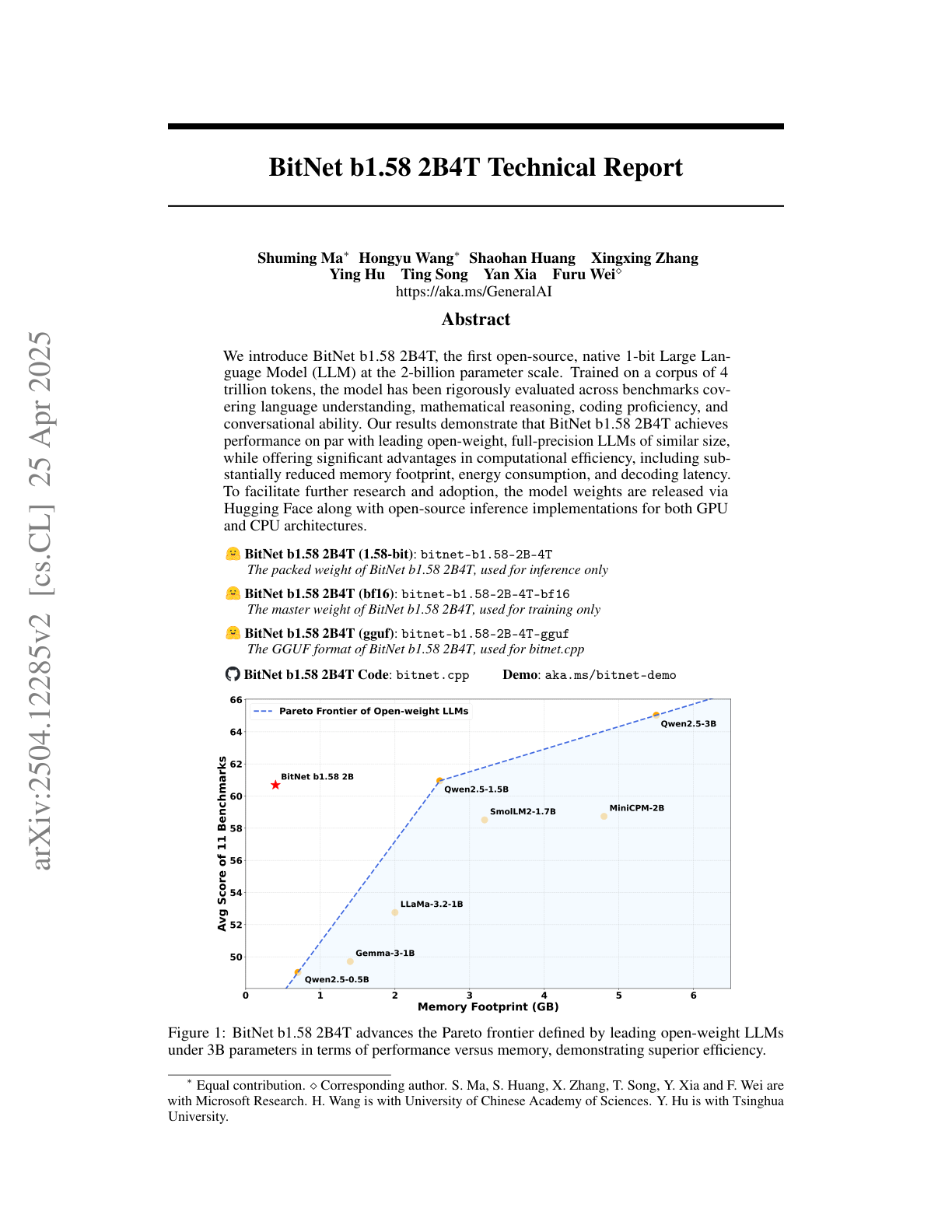
This work introduces BitNet b1.58 2B4T, the first open-source, natively trained 1-bit LLM at the 2B parameter scale, achieving strong performance while being extremely efficient. The model uses a custom ternary quantization scheme (1.58 bits per weight), enabling dramatic reductions in memory (0.4 GB), energy (0.028J/token), and latency (29ms), while still competing with state-of-the-art full-precision models across diverse benchmarks.
Ask this paper
New Pareto frontier in efficiency-performance: Trained from scratch on 4T tokens, BitNet b1.58 2B4T outperforms or matches open full-precision models (e.g., Qwen2.5 1.5B, MiniCPM 2B) on tasks like ARC-Challenge, PIQA, WinoGrande, and GSM8K. It achieves 54.19% average. across 16 benchmarks, comparable to Qwen2.5-1.5B’s 55.23%, but with ~6.5× lower memory and 10× lower energy usage.
Outperforms quantized baselines: Against INT4 post-training quantized Qwen2.5 models (GPTQ/AWQ), BitNet is both smaller and more accurate, showing the advantage of native 1-bit training over PTQ approaches.
Architectural & training innovations: It replaces standard linear layers with BitLinear layers using absmean ternary quantization and 8-bit activations, combines RoPE embeddings, squared ReLU activation, and bias-free layers. Training includes cosine LR and weight decay schedules, plus supervised fine-tuning and Direct Preference Optimization (DPO) instead of full RLHF.
Best-in-class among 1-bit LLMs: When compared to other 1-bit models like OLMo-Bitnet (1B) and post-quantized Falcon3/Llama3 (7B–8B), BitNet b1.58 2B4T is +10 pts stronger on average, establishing a new benchmark for ultra-efficient LLMs. The authors also release optimized CUDA kernels for GPU and a C++ inference library for CPU, enabling practical deployment of 1-bit LLMs on diverse hardware. BitNet b1.58 2B4T demonstrates that extreme quantization does not mean compromised capability, and it opens the door to the broader adoption of LLMs in resource-constrained environments.