Test-Time Reinforcement Learning
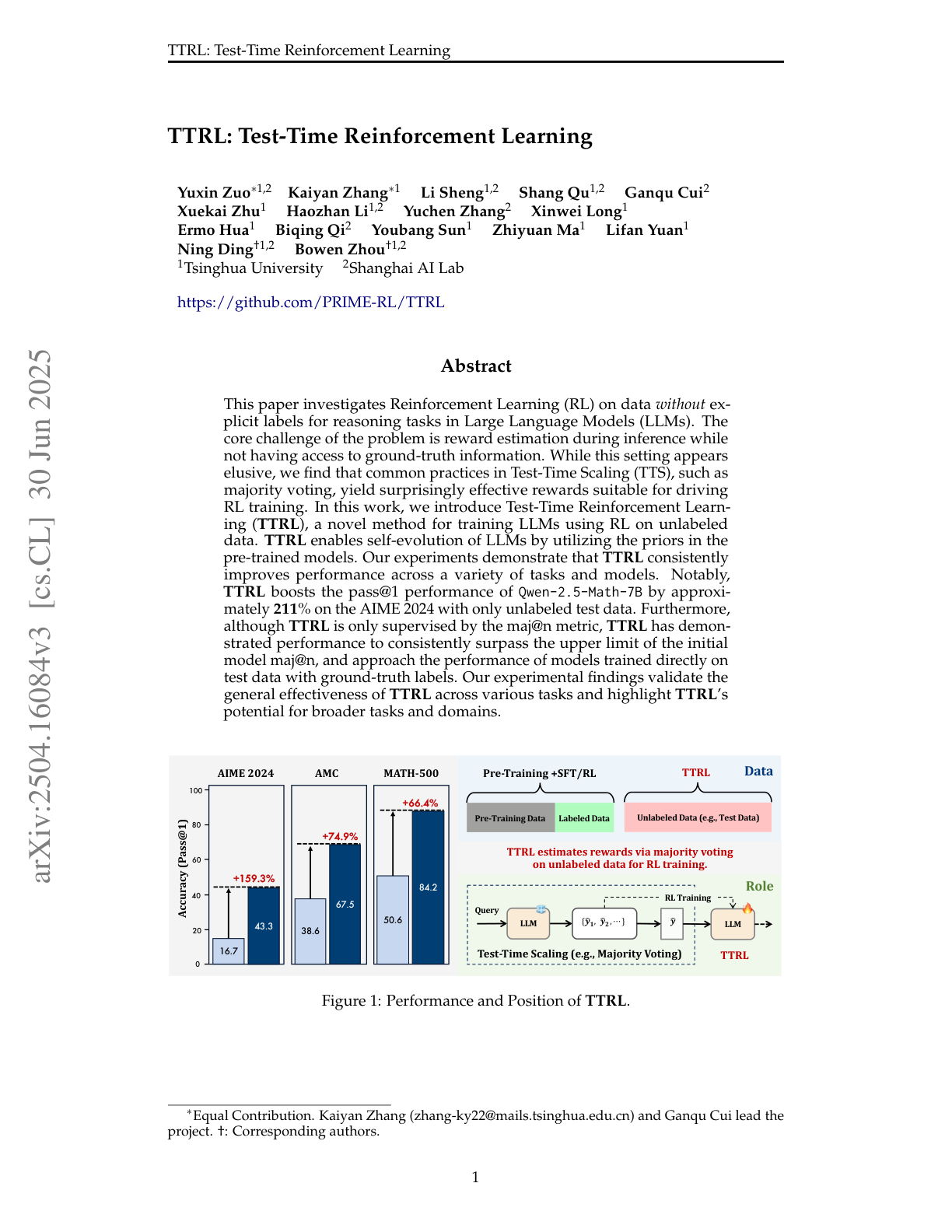
Test-Time Reinforcement Learning (TTRL) is a method that allows LLMs to improve themselves during inference without ground-truth labels. Instead of relying on labeled datasets, TTRL uses majority voting over multiple model generations to estimate pseudo-rewards, enabling reinforcement learning (RL) on unlabeled test data. The method integrates Test-Time Scaling (TTS) and Test-Time Training (TTT) strategies, letting models adapt dynamically to new and challenging inputs. Key highlights:
Ask this paper
Majority Voting as Reward: TTRL generates multiple candidate outputs for a query and uses majority voting to derive a pseudo-label. Rewards are assigned based on agreement with the consensus answer.
Significant Performance Gains: Applying TTRL to Qwen2.5-Math-7B leads to a +159% improvement on AIME 2024 and +84% average gains across AIME, AMC, and MATH-500 benchmarks, without using any labeled training data.
Self-Evolution Beyond Supervision: Remarkably, TTRL surpasses the performance ceiling of its own majority-vote supervision (Maj@N) and approaches the performance of models trained with full label leakage, indicating efficient and stable unsupervised RL.
Generalization and Robustness: TTRL generalizes well across tasks, maintains effectiveness even under label estimation noise, and is compatible with different RL algorithms like PPO and GRPO.
Limitations: TTRL may fail when the base model lacks sufficient prior knowledge about the domain or when hyperparameters (like batch size and temperature) are poorly tuned.