UI-TARS
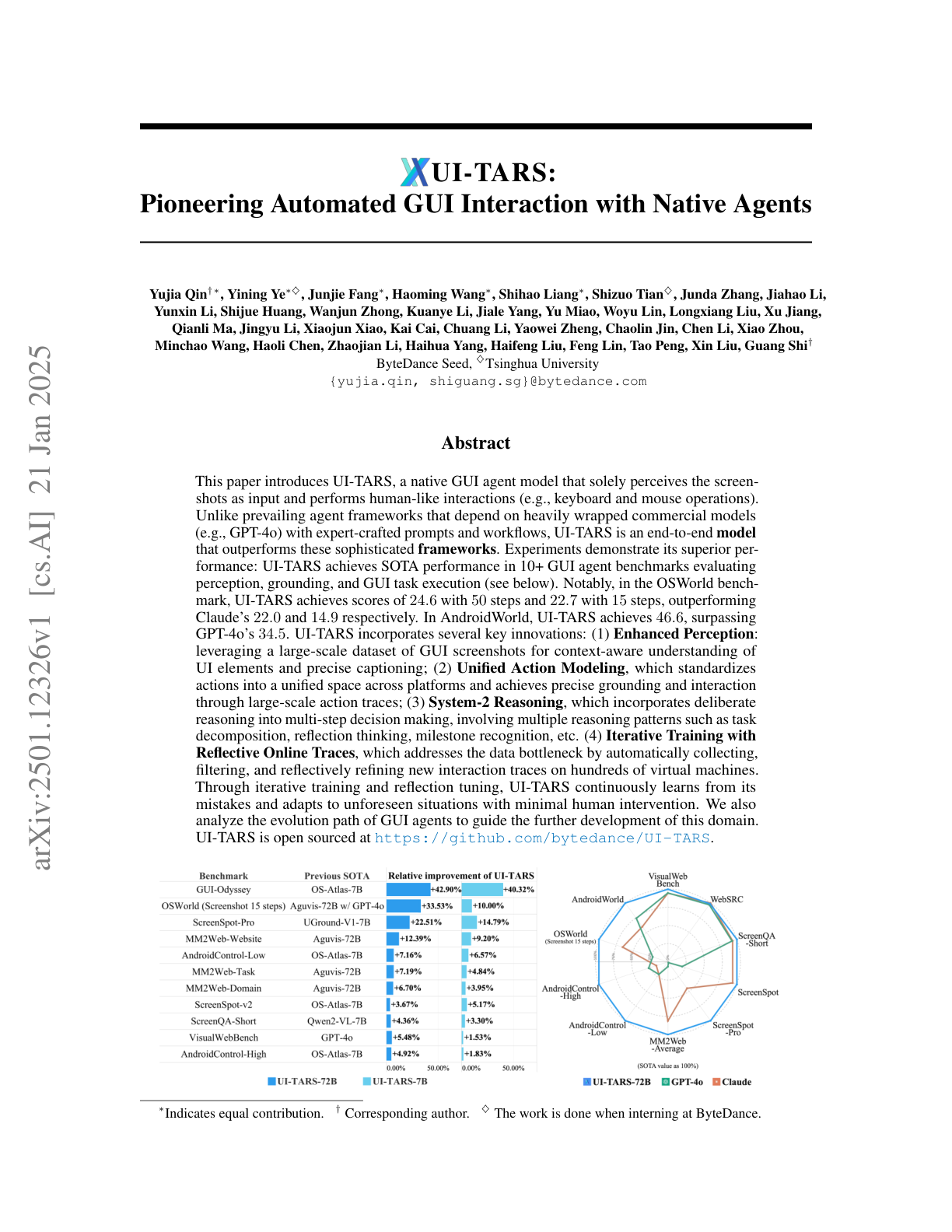
UI-TARS introduces a powerful, end-to-end native GUI agent that operates purely from visual screenshots, performing human-like keyboard and mouse interactions across platforms. Unlike existing modular agent frameworks that rely on prompt engineering and external scripts, UI-TARS integrates perception, action, reasoning, and memory directly into its architecture, achieving strong generalization and adaptability in dynamic real-world settings. Key contributions:
Ask this paper
Enhanced GUI Perception: UI-TARS is trained on a large-scale, richly annotated dataset of screenshots with metadata, enabling dense captioning, state transition understanding, and precise element description. It excels in perception benchmarks like VisualWebBench, scoring 82.8, outperforming GPT-4o’s.
Unified Action Modeling and Grounding: UI-TARS standardizes actions across platforms into a shared action space and learns from large-scale multi-step action traces. It surpasses baselines in grounding tasks with 38.1 on ScreenSpot Pro, the new SOTA.
System-2 Reasoning via “Thoughts”: Inspired by ReAct-style frameworks, UI-TARS generates internal reasoning steps (thoughts) before actions. These thoughts reflect patterns like task decomposition, reflection, and long-term consistency, significantly improving performance in complex scenarios. For example, in OSWorld, UI-TARS-72B-DPO scores 24.6 with a 50-step budget, outperforming Claude’s.
Iterative Self-Improvement with Reflective Learning: UI-TARS continuously refines itself through online trace collection and reflection tuning using error correction and post-error adaptation data. This allows it to recover from mistakes and adapt with minimal human oversight. Overall, UI-TARS marks a significant step forward in GUI automation, setting new benchmarks across more than 10 datasets and outperforming top commercial agents like GPT-4o and Claude. Its open-source release aims to drive further innovation in native agent development.