Describe Anything
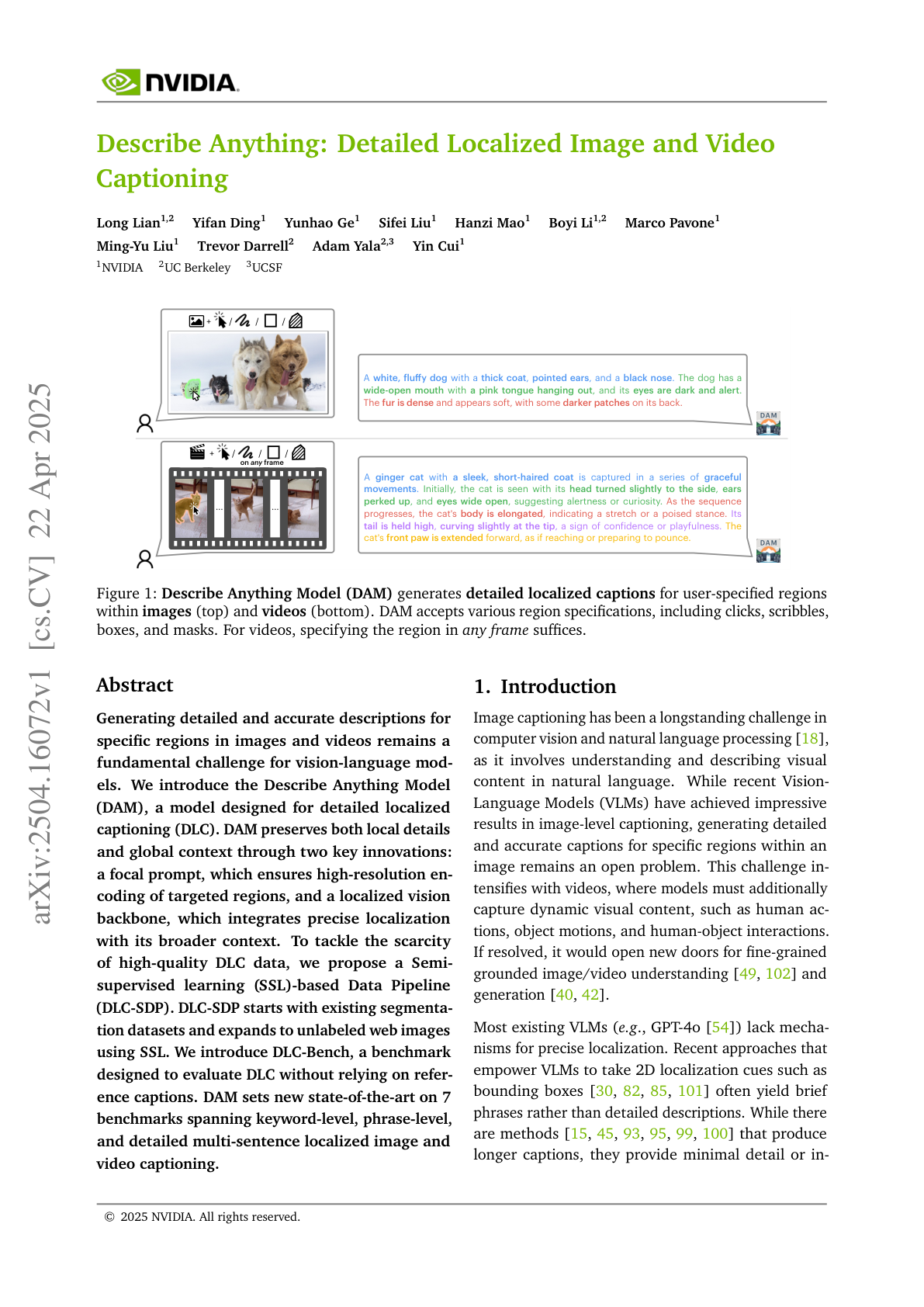
Introduces DAM, a model that generates fine-grained, region-specific captions in both images and videos. The authors address key limitations in prior vision-language models—namely, the inability to preserve local detail and the lack of suitable datasets and benchmarks for detailed localized captioning (DLC). Key contributions:
Ask this paper
DAM (Describe Anything Model) uses two main innovations to capture both fine regional detail and global scene context: a focal prompt that provides high-resolution encoding of user-specified regions, and a localized vision backbone that uses gated cross-attention to integrate context from the entire image. This enables DAM to generate multi-granular, accurate descriptions, especially for small or occluded regions.
DLC-SDP (Semi-supervised Data Pipeline) tackles data scarcity by expanding segmentation datasets with VLM-generated detailed captions, followed by self-training on web images. This produces high-quality, diverse training data, enabling DAM to outperform API-only baselines like GPT-4o across several benchmarks.
DLC-Bench is a reference-free benchmark that scores models on their ability to accurately include or exclude region-specific details using LLM judges. It provides a more reliable evaluation than traditional caption-matching metrics, which often penalize models for valid but unmatched details.
Performance: DAM sets a new state-of-the-art on 7 benchmarks across keyword, phrase, and detailed multi-sentence captioning tasks in both images and videos. It outperforms GPT-4o, Claude 3.7, and other top VLMs in both zero-shot and in-domain evaluations, achieving up to 33.4% improvement over prior models on detailed image captioning and 19.8% on video captioning.