UXAgent
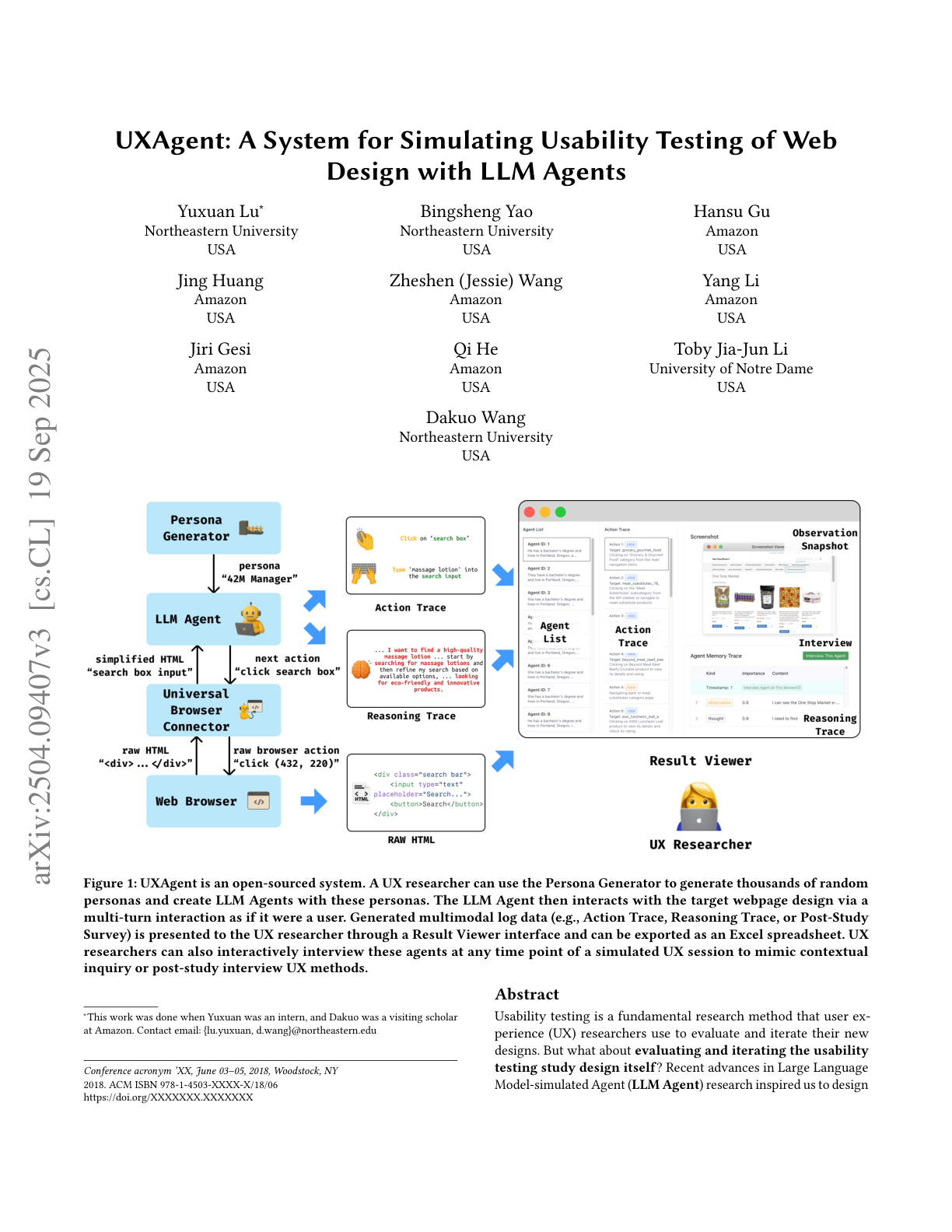
Introduces a novel framework, UXAgent, for simulating large-scale usability testing using LLM-driven agents. The system empowers UX researchers to test and iterate web design and study protocols before engaging real users. This is achieved through the orchestration of simulated agents with diverse personas interacting in real web environments, providing both behavioral and reasoning data. Key highlights:
Ask this paper
LLM-Powered Simulation with Personas: UXAgent begins with a Persona Generator that can produce thousands of demographically diverse simulated users based on custom distributions. Each persona is fed into an LLM Agent that embodies user intent and interacts with the website via a Universal Browser Connector—a module capable of interpreting and manipulating real HTML structures.
Dual-Loop Reasoning Architecture: At the heart of UXAgent is a dual-process agent architecture inspired by cognitive psychology: a Fast Loop for low-latency actions and a Slow Loop for deep reasoning. This design mimics System 1 and System 2 thinking and allows agents to act responsively while maintaining coherent high-level plans and reflections.
Rich Memory Stream: All observations, actions, plans, reflections, and spontaneous thoughts (“wonders”) are stored in a Memory Stream. These memories are dynamically prioritized for retrieval using a weighted scoring system based on importance, recency, and relevance, tailored separately for fast and slow modules.
Replay and Interview Interfaces: UX researchers can review simulated sessions via a Simulation Replay Interface and conduct natural language conversations with agents using an Agent Interview Interface. This supports qualitative analysis, such as asking agents about their decisions or presenting mockups for feedback.
Empirical Evaluation: A case study involving 60 LLM agent simulations on a shopping platform (WebArena) showed that researchers were able to detect usability study flaws and gather early insights. A follow-up user study with five UX professionals found the system helpful for iterating study design, despite some concerns over realism and data noise. Particularly appreciated was the ability to converse with agents and gather qualitative insights that would be infeasible in traditional pilots.
Future Implications: The authors position LLM agents not as replacements for real participants, but as early-stage collaborators in the design process, reducing the cost and risk of flawed studies. They also discuss extensions to multimodal settings, desktop or mobile interfaces, and broader agentic tasks such as digital twins or simulated A/B testing.