MAGI
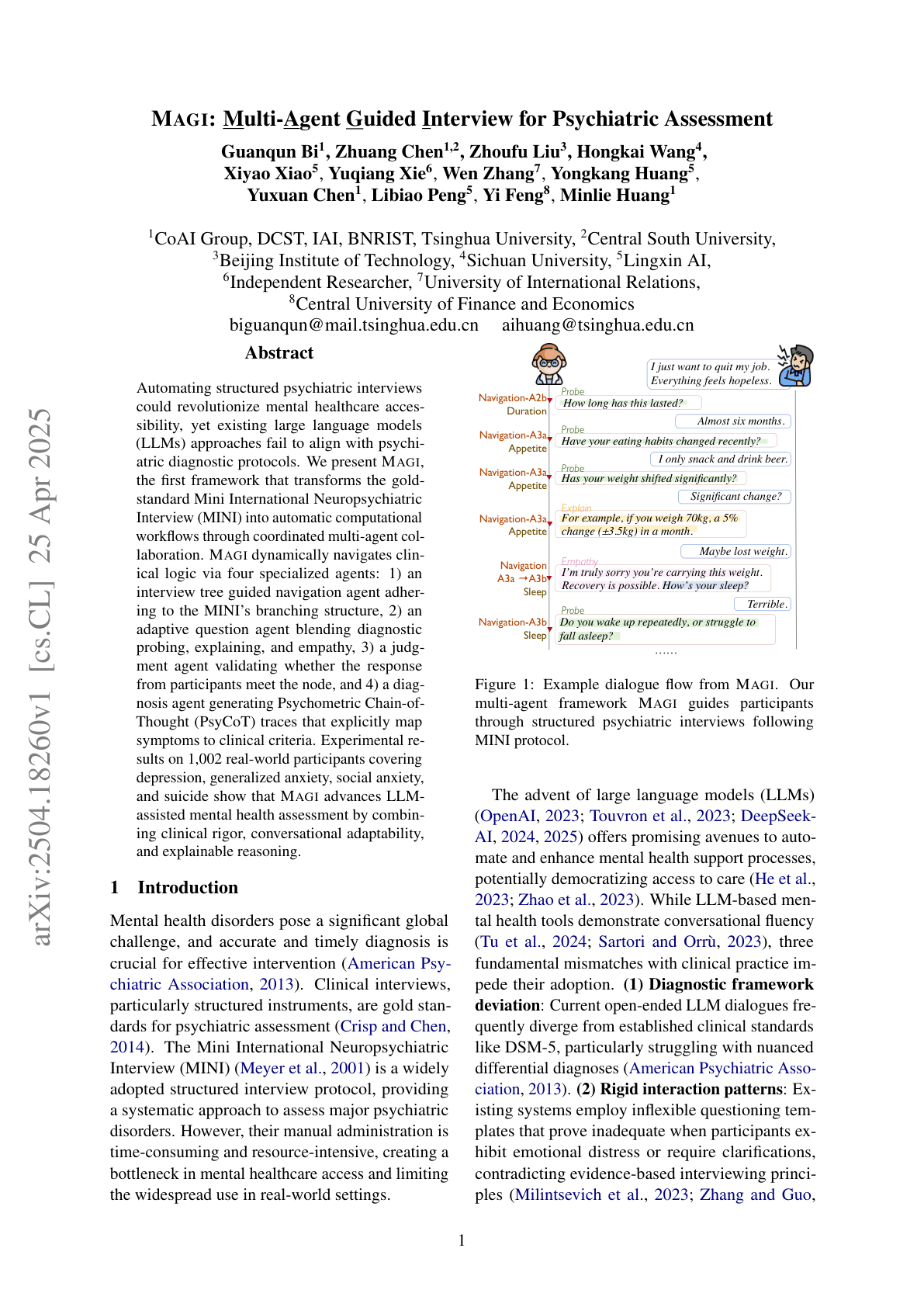
MAGI is a multi-agent system designed to automate structured psychiatric interviews by operationalizing the MINI (Mini International Neuropsychiatric Interview) protocol. It involves 4 specialized agents: navigation, question generation, judgment, and diagnosis. Other highlights:
Ask this paper
Multi-Agent Clinical Workflow: MAGI is built with a navigation agent (interview flow control), a question agent (dynamic, empathetic probing), a judgment agent (response validation), and a diagnosis agent using Psychometric CoT to trace diagnoses explicitly to MINI/DSM-5 criteria.
Explainable Reasoning (PsyCoT): Instead of treating diagnoses as opaque outputs, PsyCoT decomposes psychiatric reasoning into symptom anchoring, syndromal validation, and evidence binding. This helps with auditability for each diagnostic conclusion. CoT put to great use.
Results: Evaluated on 1,002 real-world interviews, MAGI outperforms baselines (Direct prompting, Role-play, Knowledge-enhanced, and MINI-simulated LLMs) across relevance, accuracy, completeness, and guidance.
Strong Clinical Agreement: Diagnostic evaluations show PsyCoT consistently improves F1 scores, accuracy, and Cohen’s κ across disorders like depression, generalized anxiety, social anxiety, and suicide risk, reaching clinical-grade reliability (κ 0.8) in high-risk tasks.
Abstract
Automating structured clinical interviews could revolutionize mental healthcare accessibility, yet existing large language models (LLMs) approaches fail to align with psychiatric diagnostic protocols. We present MAGI, the first framework that transforms the gold-standard Mini International Neuropsychiatric Interview (MINI) into automatic computational workflows through coordinated multi-agent collaboration. MAGI dynamically navigates clinical logic via four specialized agents: 1) an interview tree guided navigation agent adhering to the MINI's branching structure, 2) an adaptive question agent blending diagnostic probing, explaining, and empathy, 3) a judgment agent validating whether the response from participants meet the node, and 4) a diagnosis Agent generating Psychometric Chain-of- Thought (PsyCoT) traces that explicitly map symptoms to clinical criteria. Experimental results on 1,002 real-world participants covering depression, generalized anxiety, social anxiety and suicide shows that MAGI advances LLM- assisted mental health assessment by combining clinical rigor, conversational adaptability, and explainable reasoning.