MemRL
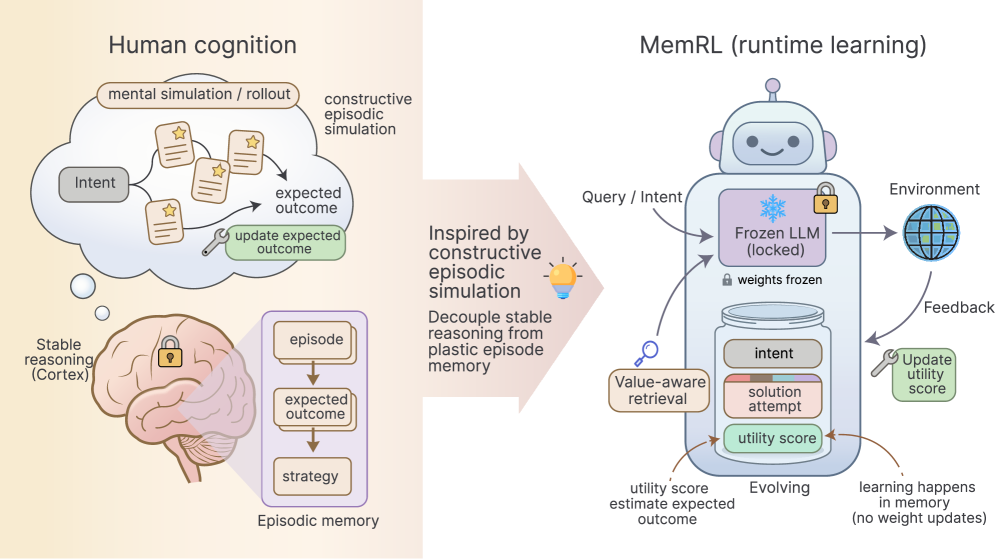
MemRL enables LLM agents to improve continuously without retraining by separating a frozen model's reasoning from an evolving memory system. A Two-Phase Retrieval mechanism filters candidates by semantic relevance then ranks them using learned Q-values that improve through trial-and-error, outperforming existing methods on HLE, BigCodeBench, ALFWorld, and Lifelong Agent Bench.
Ask this paper
Abstract
The hallmark of human intelligence is the self-evolving ability to master new skills by learning from past experiences. However, current AI agents struggle to emulate this self-evolution: fine-tuning is computationally expensive and prone to catastrophic forgetting, while existing memory-based methods rely on passive semantic matching that often retrieves noise. To address these challenges, we propose MemRL, a non-parametric approach that evolves via reinforcement learning on episodic memory. By decoupling stable reasoning from plastic memory, MemRL employs a Two-Phase Retrieval mechanism to filter noise and identify high-utility strategies through environmental feedback. Extensive experiments on HLE, BigCodeBench, ALFWorld, and Lifelong Agent Bench demonstrate that MemRL significantly outperforms state-of-the-art baselines, confirming that MemRL effectively reconciles the stability-plasticity dilemma, enabling continuous runtime improvement without weight updates. Code is available at this https URL.