Efficient Lifelong Memory for LLM Agents
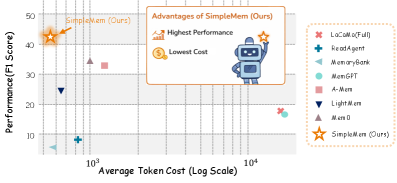
SimpleMem introduces a memory framework built on semantic lossless compression that addresses the tension between maintaining comprehensive long-term memory and minimizing token overhead for LLM agents. The approach achieves a 26.4% F1 improvement over baselines while reducing token consumption by up to 30-fold during inference. - **Semantic structured compression:** The first stage applies filtering to transform unstructured interactions into compact, multi-view indexed memory units, preserving essential information while dramatically reducing storage requirements. - **Recursive memory consolidation:** An asynchronous process reduces redundancy by integrating related memory units into higher-level representations, similar to how human memory consolidates experiences during rest periods. - **Adaptive query-aware retrieval:** The system dynamically adjusts retrieval scope based on query complexity, constructing context efficiently by pulling only the most relevant memories rather than fixed-size chunks. - **Strong efficiency gains:** Experimental results demonstrate token consumption reduced by up to 30-fold during inference while improving accuracy, making long-horizon agent tasks practically feasible without prohibitive computational costs. - **Balanced performance:** The framework provides a practical solution for deploying agents that need comprehensive memory without sacrificing response quality, addressing a critical bottleneck in real-world agent applications.
Ask this paper
Semantic structured compression: The first stage applies filtering to transform unstructured interactions into compact, multi-view indexed memory units, preserving essential information while dramatically reducing storage requirements.
Recursive memory consolidation: An asynchronous process reduces redundancy by integrating related memory units into higher-level representations, similar to how human memory consolidates experiences during rest periods.
Adaptive query-aware retrieval: The system dynamically adjusts the retrieval scope based on query complexity, constructing context efficiently by pulling only the most relevant memories rather than fixed-size chunks.
Strong efficiency gains: Experimental results demonstrate token consumption reduced by up to 30-fold during inference while improving accuracy, making long-horizon agent tasks practically feasible without prohibitive computational costs.
Balanced performance: The framework provides a practical solution for deploying agents that need comprehensive memory without sacrificing response quality, addressing a critical bottleneck in real-world agent applications.
Abstract
To support long-term interaction in complex environments, LLM agents require memory systems that manage historical experiences. Existing approaches either retain full interaction histories via passive context extension, leading to substantial redundancy, or rely on iterative reasoning to filter noise, incurring high token costs. To address this challenge, we introduce SimpleMem, an efficient memory framework based on semantic lossless compression. We propose a three-stage pipeline designed to maximize information density and token utilization: (1) Semantic Structured Compression, which distills unstructured interactions into compact, multi-view indexed memory units; (2) Online Semantic Synthesis, an intra-session process that instantly integrates related context into unified abstract representations to eliminate redundancy; and (3) Intent-Aware Retrieval Planning, which infers search intent to dynamically determine retrieval scope and construct precise context efficiently. Experiments on benchmark datasets show that our method consistently outperforms baseline approaches in accuracy, retrieval efficiency, and inference cost, achieving an average F1 improvement of 26.4% in LoCoMo while reducing inference-time token consumption by up to 30-fold, demonstrating a superior balance between performance and efficiency. Code is available at this https URL.