Agent Primitives
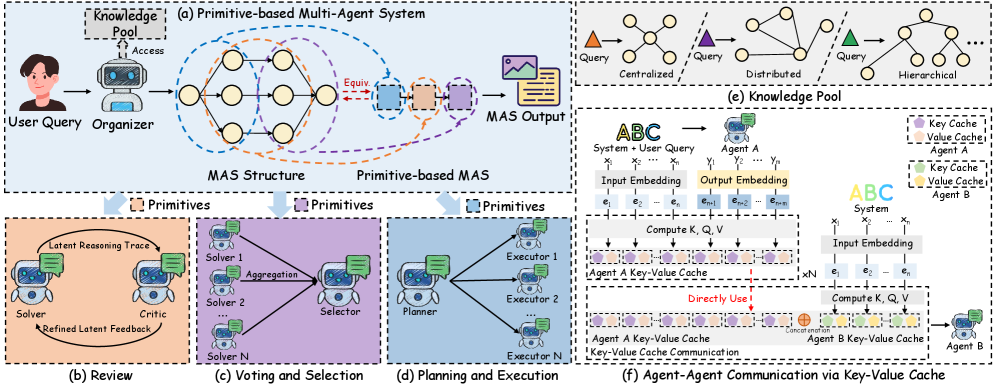
Agent Primitives introduces reusable latent building blocks for LLM-based multi-agent systems. Inspired by how neural networks are built from composable modules like residual blocks and attention heads, the authors decompose existing MAS architectures into three recurring computation patterns that communicate via KV cache instead of natural language, reducing error accumulation and boosting efficiency. - **Three core primitives:** Review (a Solver-Critic feedback loop for iterative self-refinement), Voting and Selection (parallel Solvers with a Selector that aggregates latent candidates), and Planning and Execution (a Planner that decomposes tasks into subgoals consumed by Executor agents). Each primitive communicates internally through KV cache concatenation rather than text generation. - **KV cache over natural language:** Stress tests show natural-language communication degrades sharply under long contexts and noise injection, while KV cache communication stays robust. With midpoint task injection, natural-language accuracy drops to 15.6% compliance versus 73.3% for KV cache. - **Automatic composition via an Organizer:** An LLM-based Organizer selects and composes primitives per query, guided by a lightweight Knowledge Pool of 45 previously successful MAS configurations. This eliminates manual system design while maintaining strong performance across tasks. - **Consistent accuracy gains:** Across eight benchmarks (math, code, QA) and five open-source backbones, primitives-based MAS improves accuracy by 12.0-16.5% over single-agent baselines. It also outperforms 10 existing MAS methods including Self-Refine, AgentVerse, and MAS-GPT on a unified Llama-3-70B evaluation. - **Major efficiency improvements:** Compared to text-based MAS, Agent Primitives reduces token usage and inference latency by 3-4x while achieving higher accuracy. Total overhead is only 1.3-1.6x relative to single-agent inference, making it practical for deployment.
Ask this paper
Three core primitives: Review (a Solver-Critic feedback loop for iterative self-refinement), Voting and Selection (parallel Solvers with a Selector that aggregates latent candidates), and Planning and Execution (a Planner that decomposes tasks into subgoals consumed by Executor agents). Each primitive communicates internally through KV cache concatenation rather than text generation.
KV cache over natural language: Stress tests show natural-language communication degrades sharply under long contexts and noise injection, while KV cache communication stays robust. With midpoint task injection, natural-language accuracy drops to 15.6% compliance versus 73.3% for KV cache.
Automatic composition via an Organizer: An LLM-based Organizer selects and composes primitives per query, guided by a lightweight Knowledge Pool of 45 previously successful MAS configurations. This eliminates manual system design while maintaining strong performance across tasks.
Consistent accuracy gains: Across eight benchmarks (math, code, QA) and five open-source backbones, primitives-based MAS improves accuracy by 12.0-16.5% over single-agent baselines. It also outperforms 10 existing MAS methods, including Self-Refine, AgentVerse, and MAS-GPT, on a unified Llama-3-70B evaluation.
Major efficiency improvements: Compared to text-based MAS, Agent Primitives reduces token usage and inference latency by 3-4x while achieving higher accuracy. Total overhead is only 1.3-1.6x relative to single-agent inference, making it practical for deployment.
Abstract
While existing multi-agent systems (MAS) can handle complex problems by enabling collaboration among multiple agents, they are often highly task-specific, relying on manually crafted agent roles and interaction prompts, which leads to increased architectural complexity and limited reusability across tasks. Moreover, most MAS communicate primarily through natural language, making them vulnerable to error accumulation and instability in long-context, multi-stage interactions within internal agent histories. In this work, we propose \textbf{Agent Primitives}, a set of reusable latent building blocks for LLM-based MAS. Inspired by neural network design, where complex models are built from reusable components, we observe that many existing MAS architectures can be decomposed into a small number of recurring internal computation patterns. Based on this observation, we instantiate three primitives: Review, Voting and Selection, and Planning and Execution. All primitives communicate internally via key-value (KV) cache, which improves both robustness and efficiency by mitigating information degradation across multi-stage interactions. To enable automatic system construction, an Organizer agent selects and composes primitives for each query, guided by a lightweight knowledge pool of previously successful configurations, forming a primitive-based MAS. Experiments show that primitives-based MAS improve average accuracy by 12.0-16.5\% over single-agent baselines, reduce token usage and inference latency by approximately 3$\times$-4$\times$ compared to text-based MAS, while incurring only 1.3$\times$-1.6$\times$ overhead relative to single-agent inference and providing more stable performance across model backbones.