Self-Improving Agents
Research on agents that use feedback or experience to improve lasting components such as weights, prompts, memory, skills, code, workflows, evaluators, or training curricula.
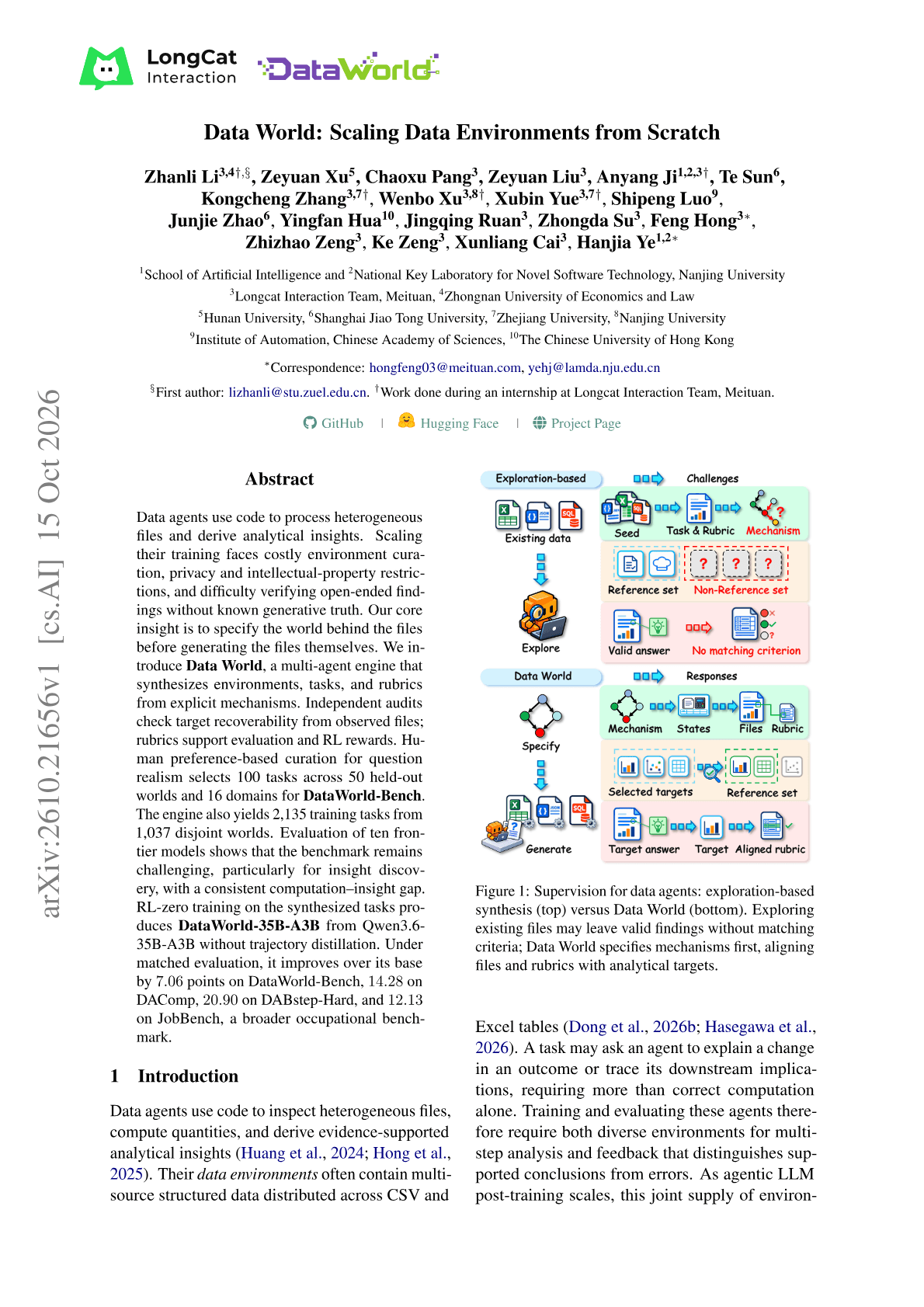
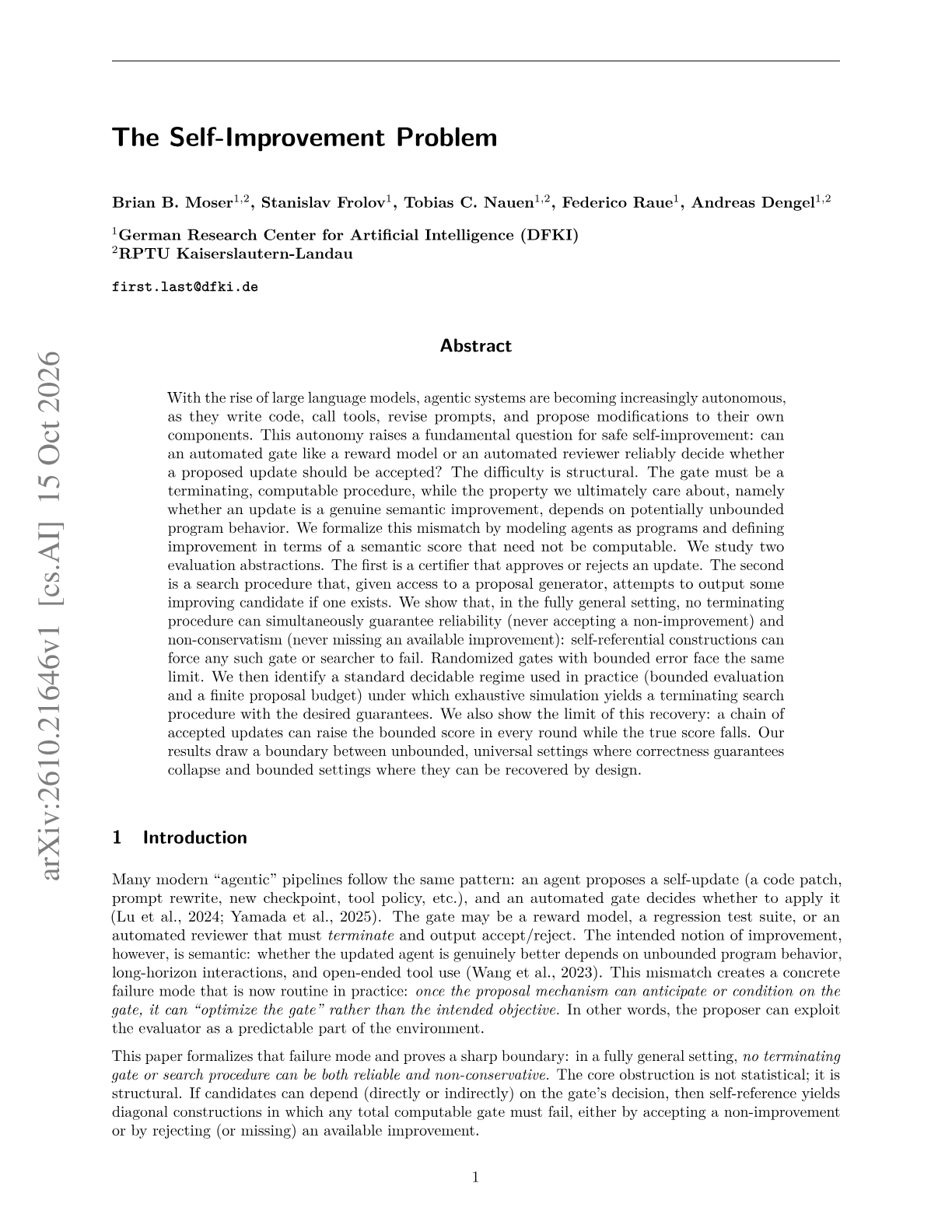
Discover and explore top AI papers withClaude CodeCodex
npx @dair-ai/mcp setup- 01
- 02
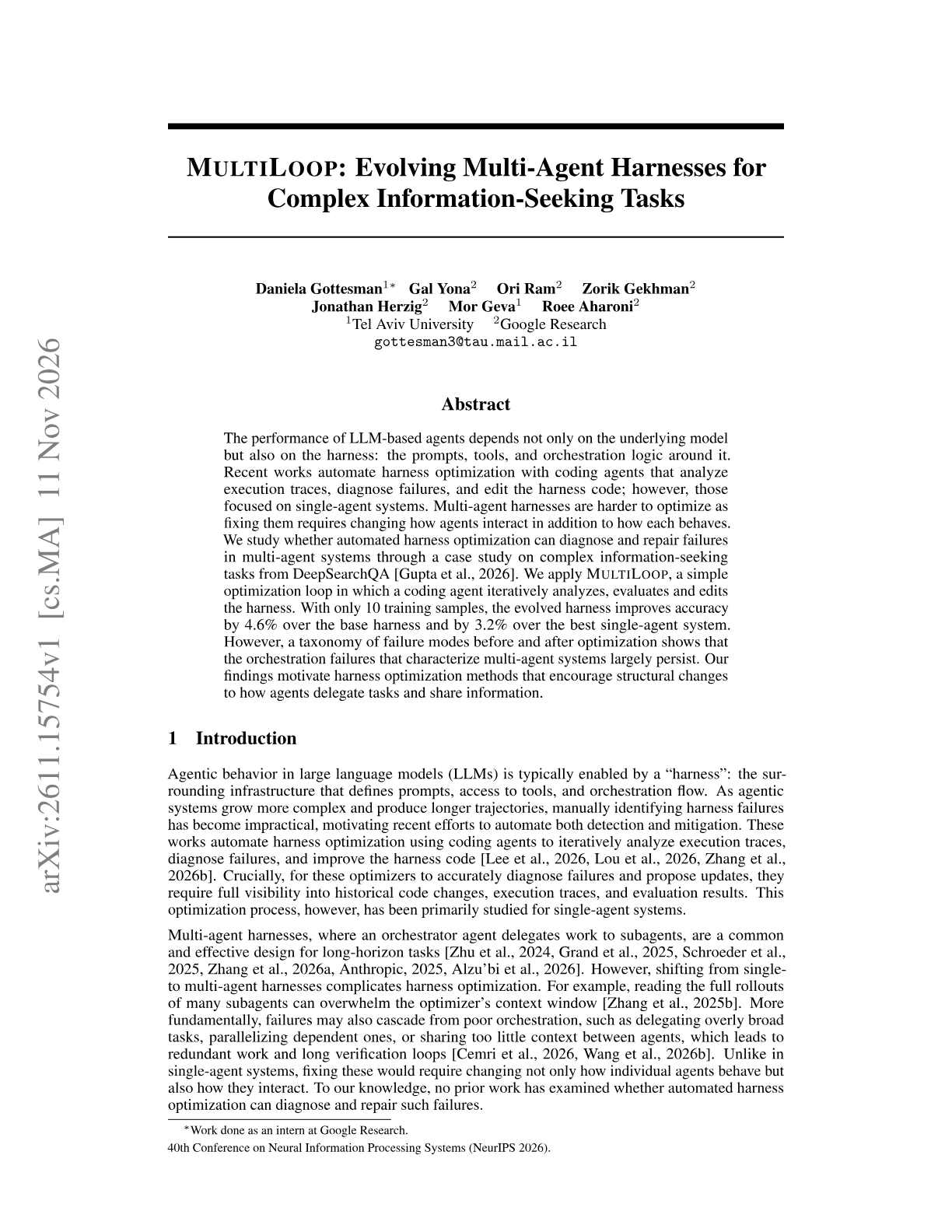
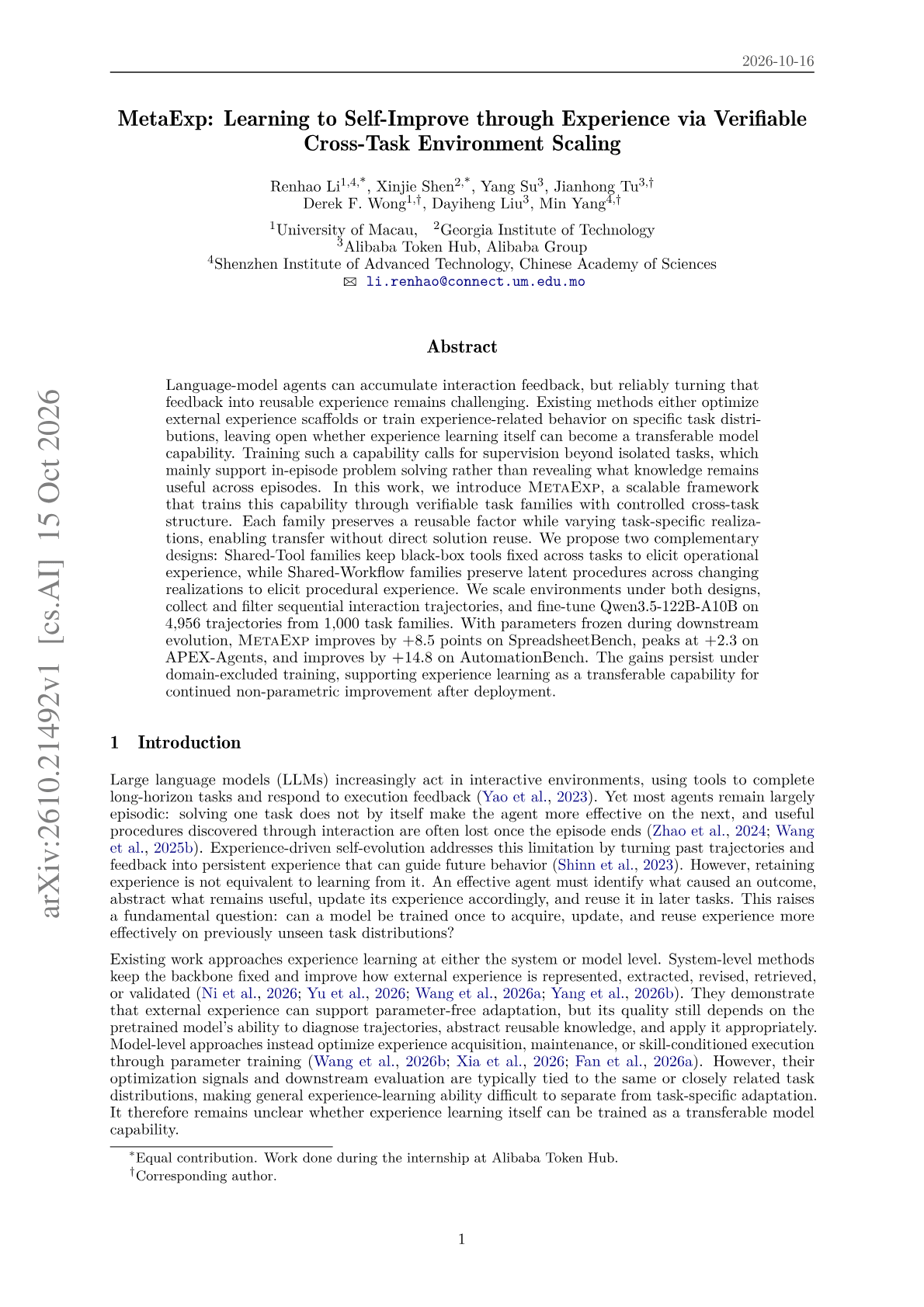
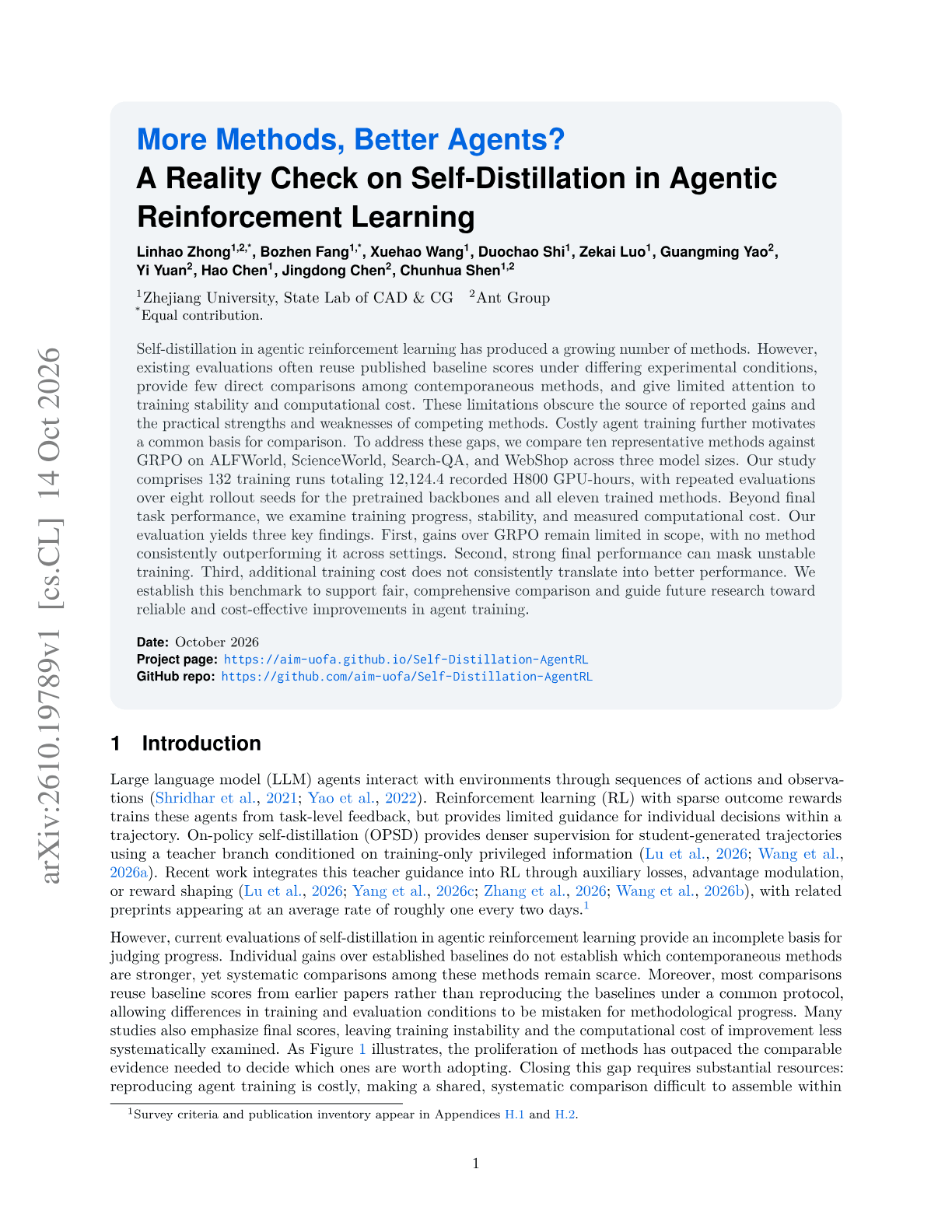
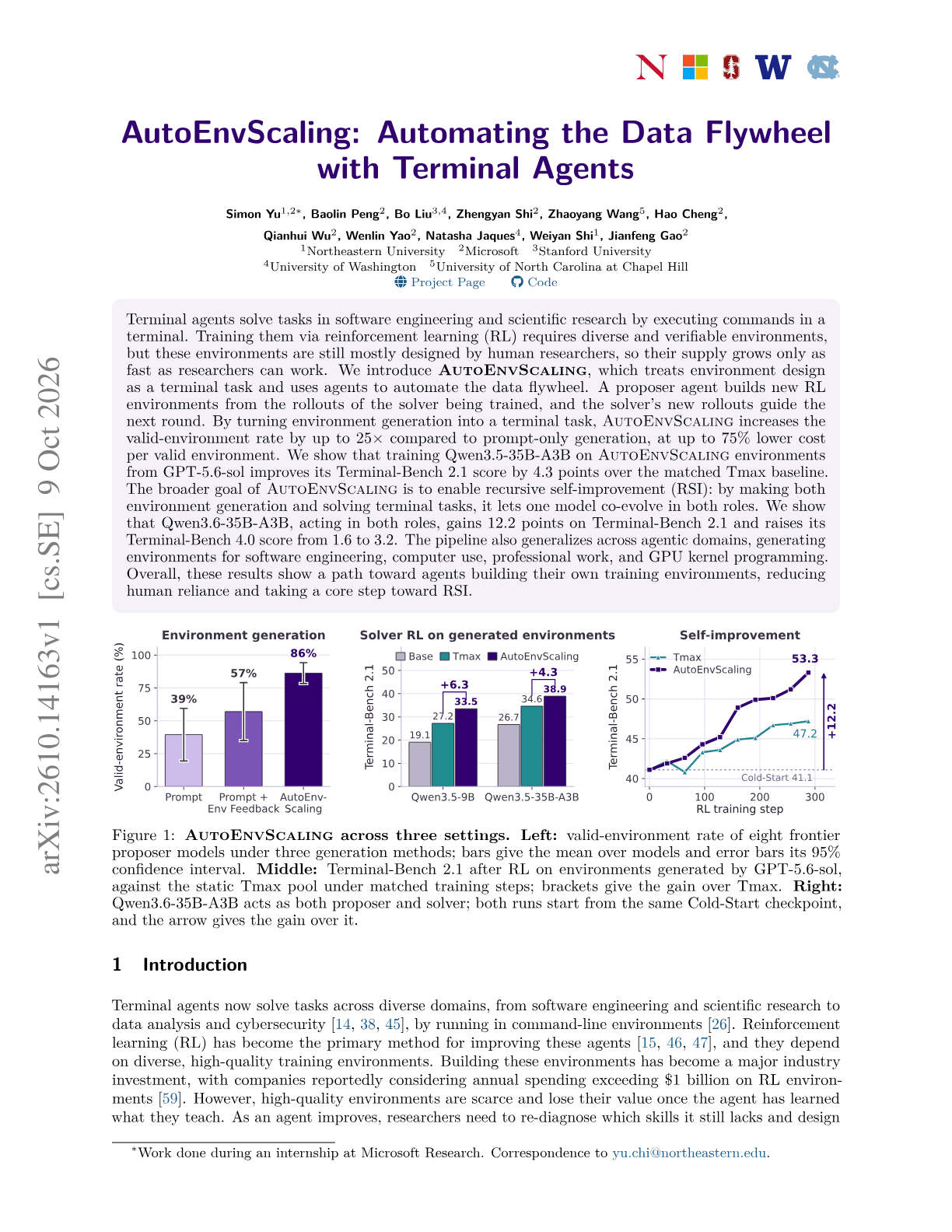
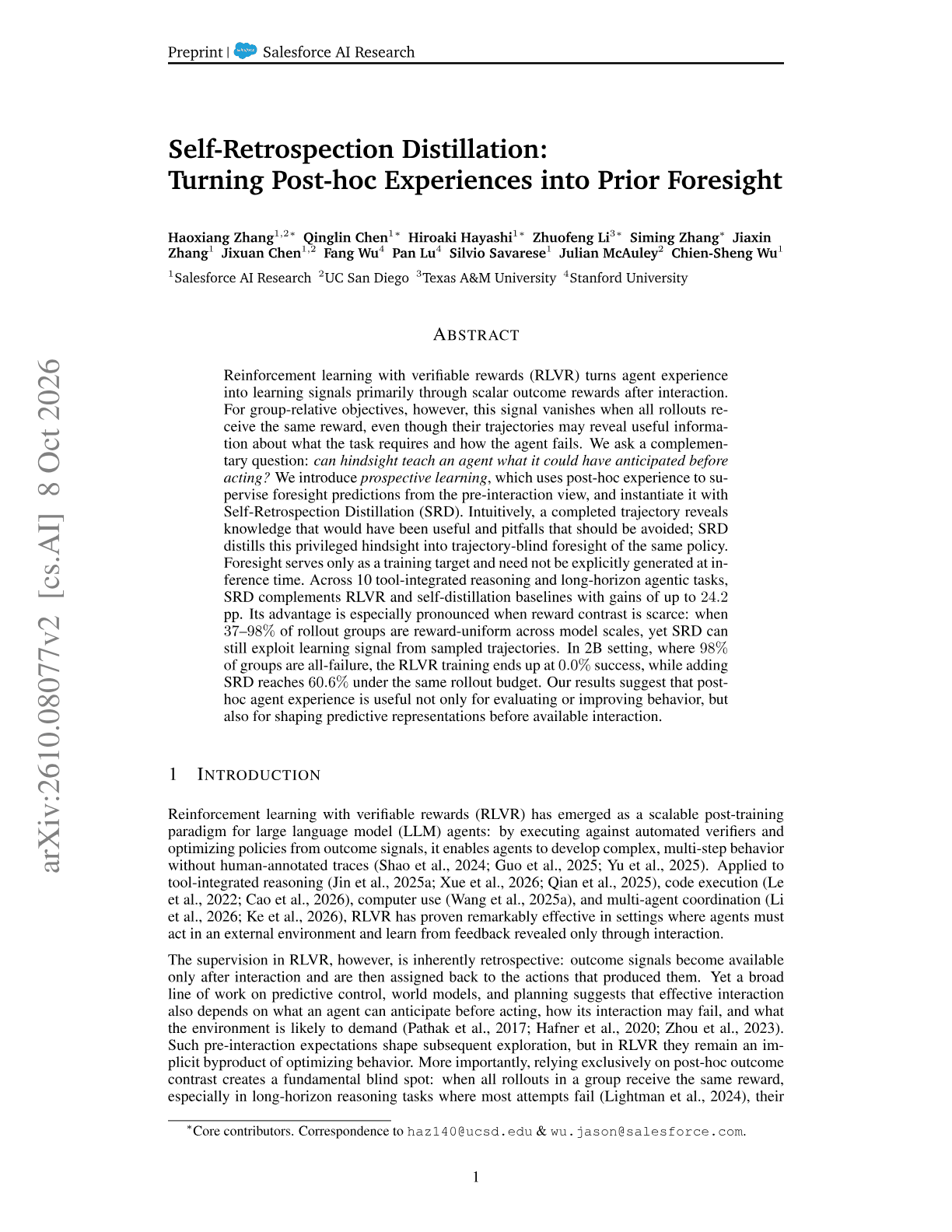
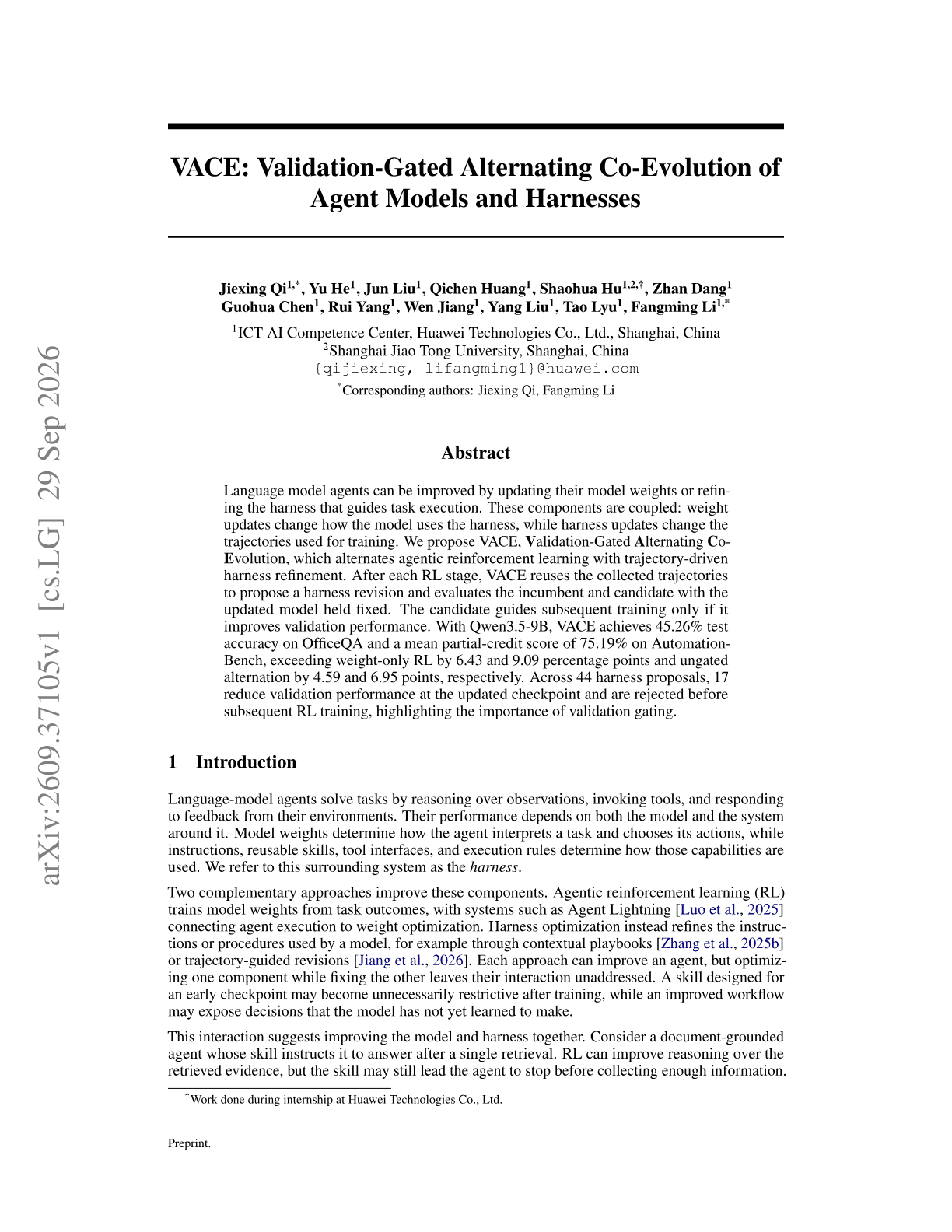
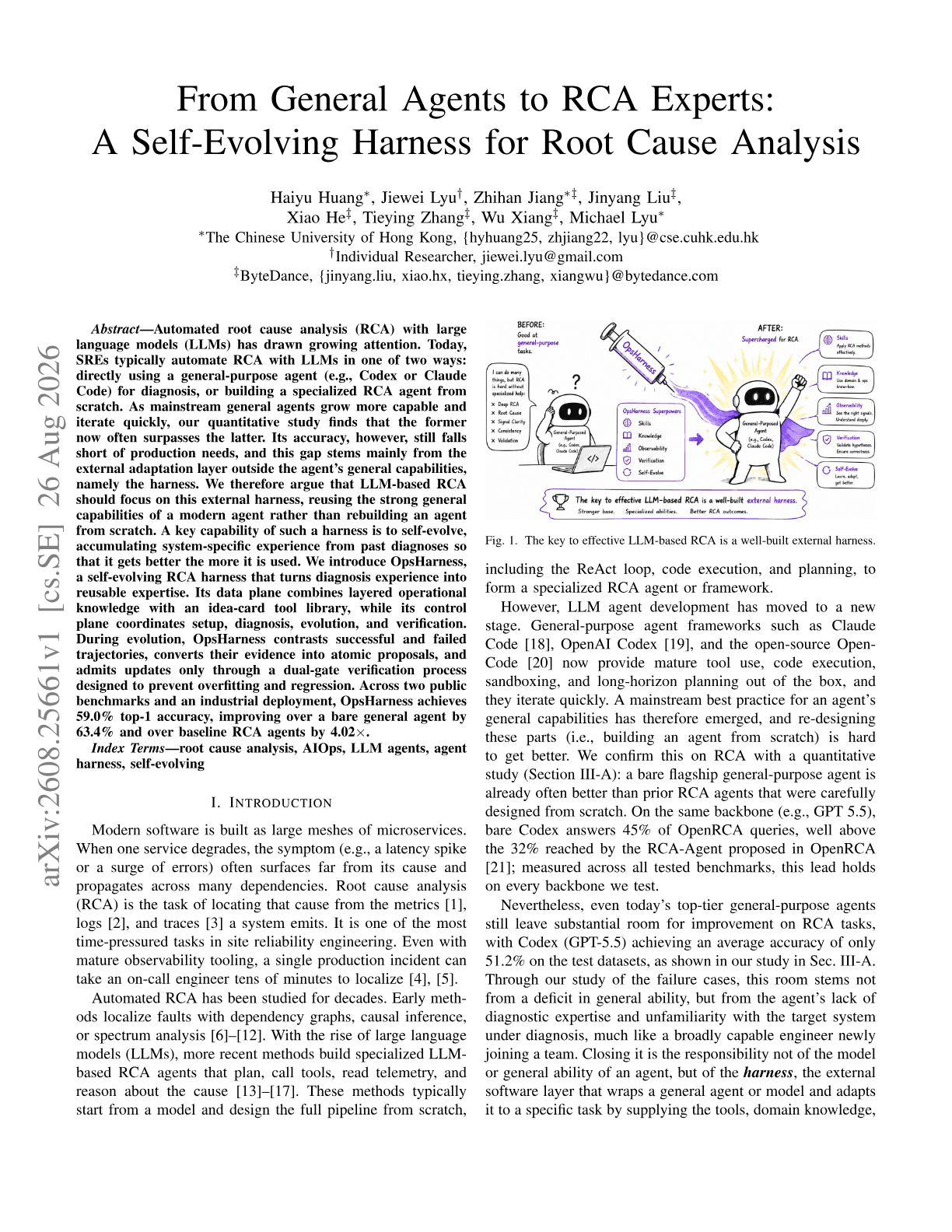
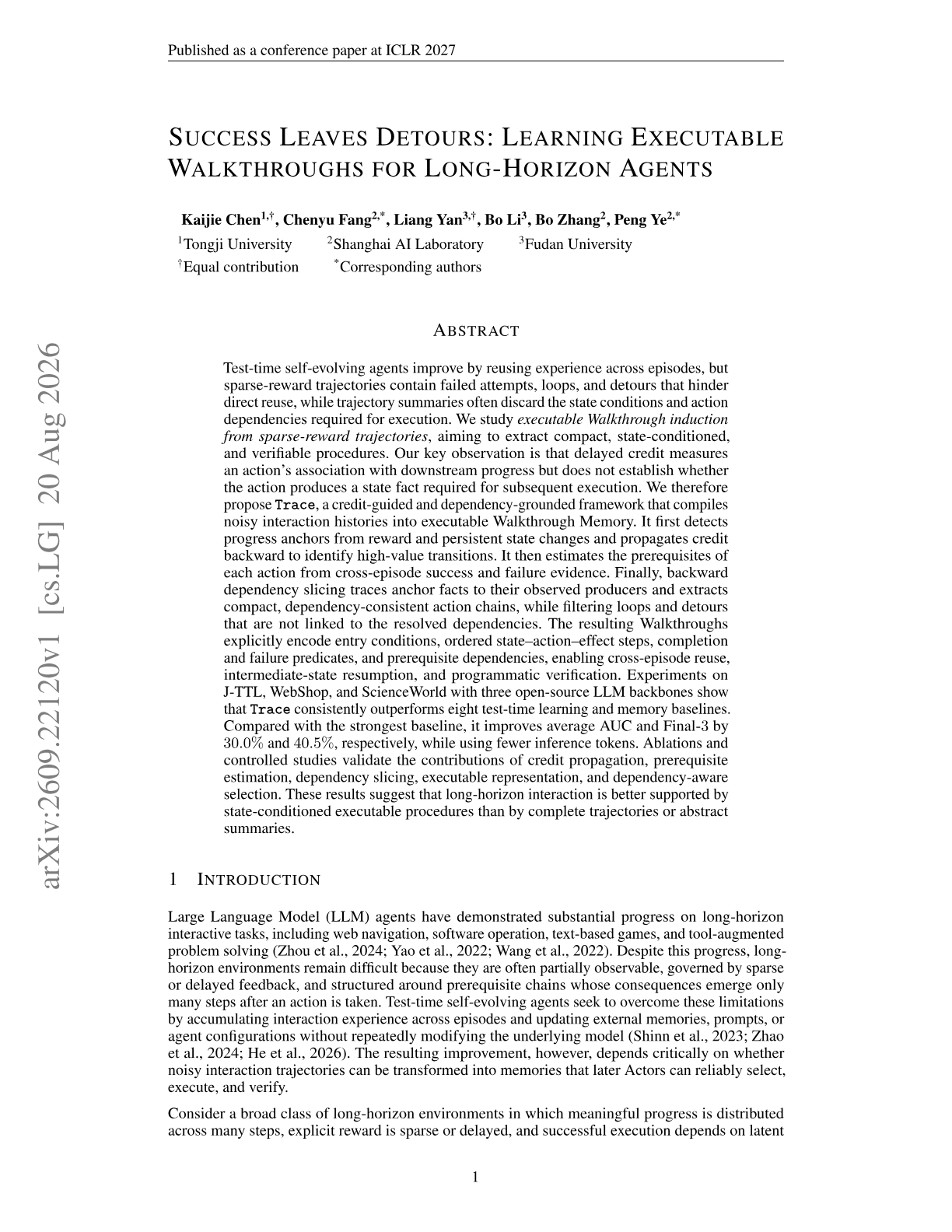
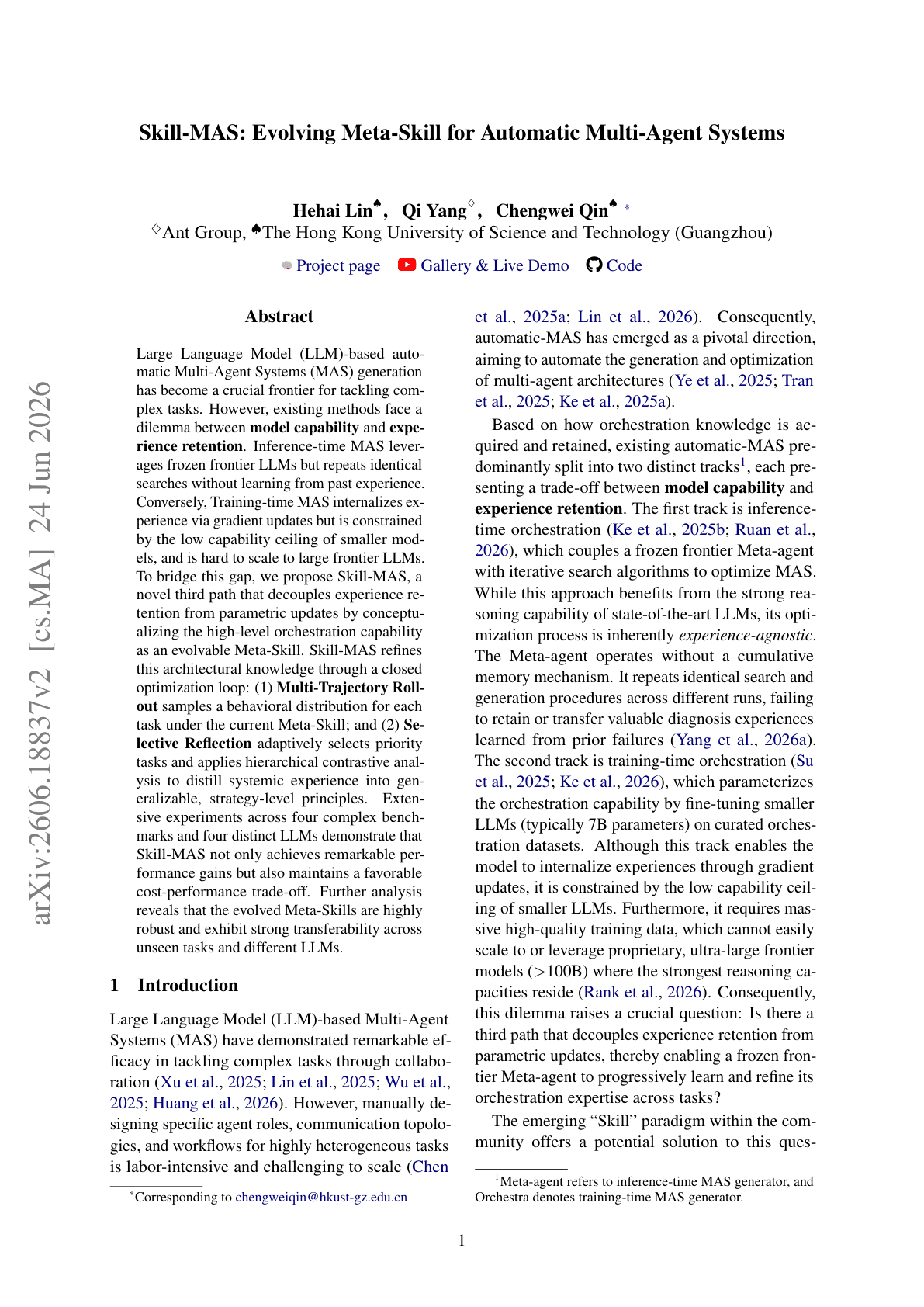
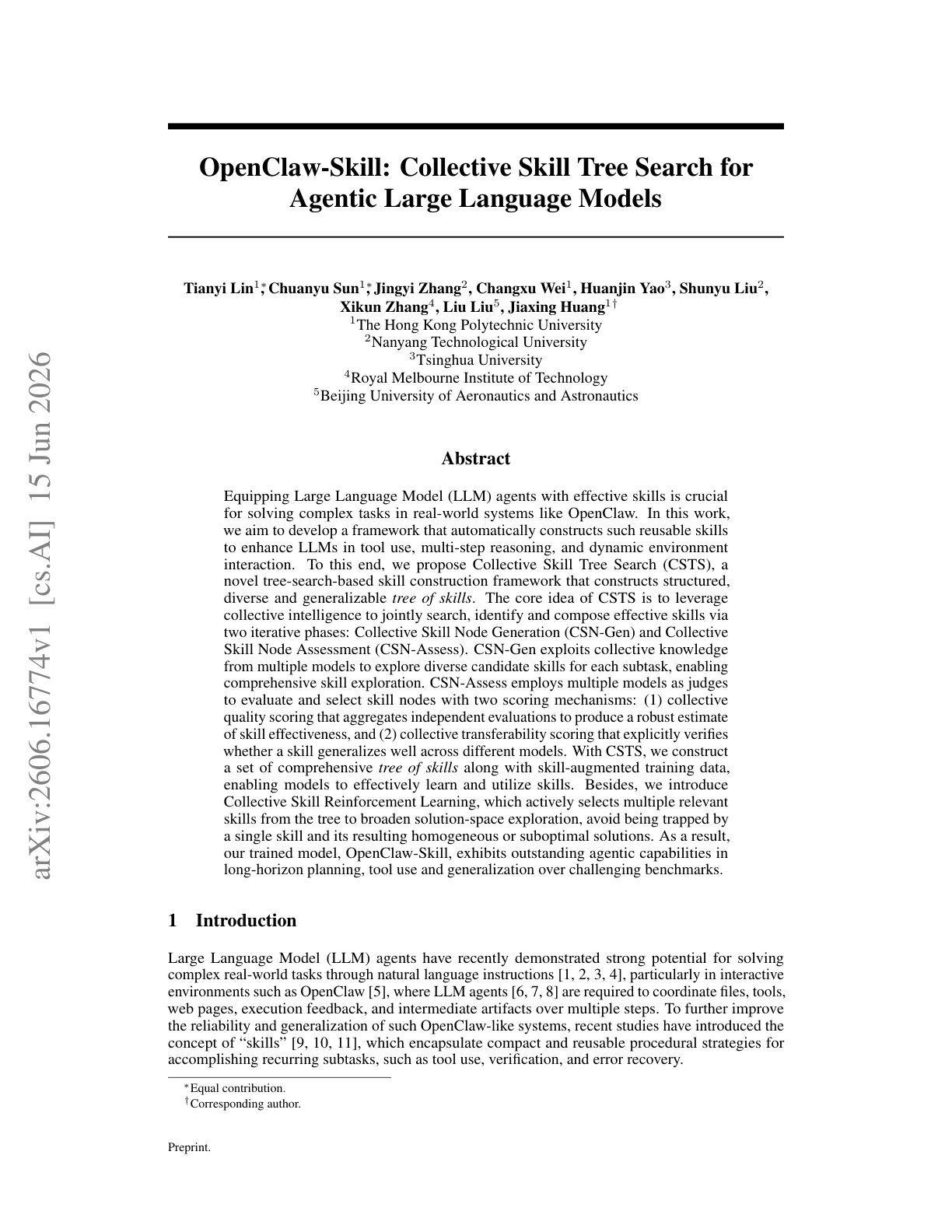
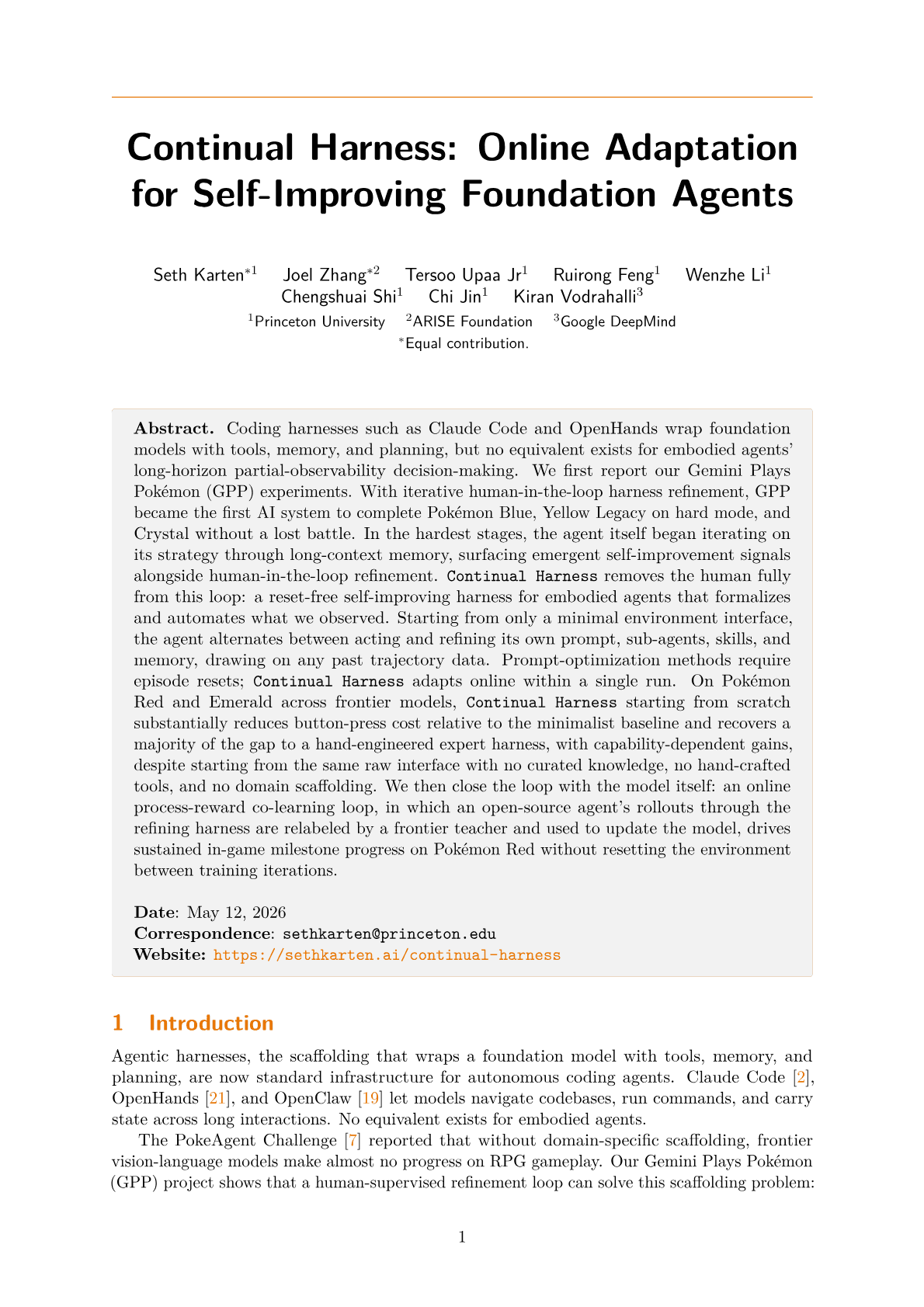
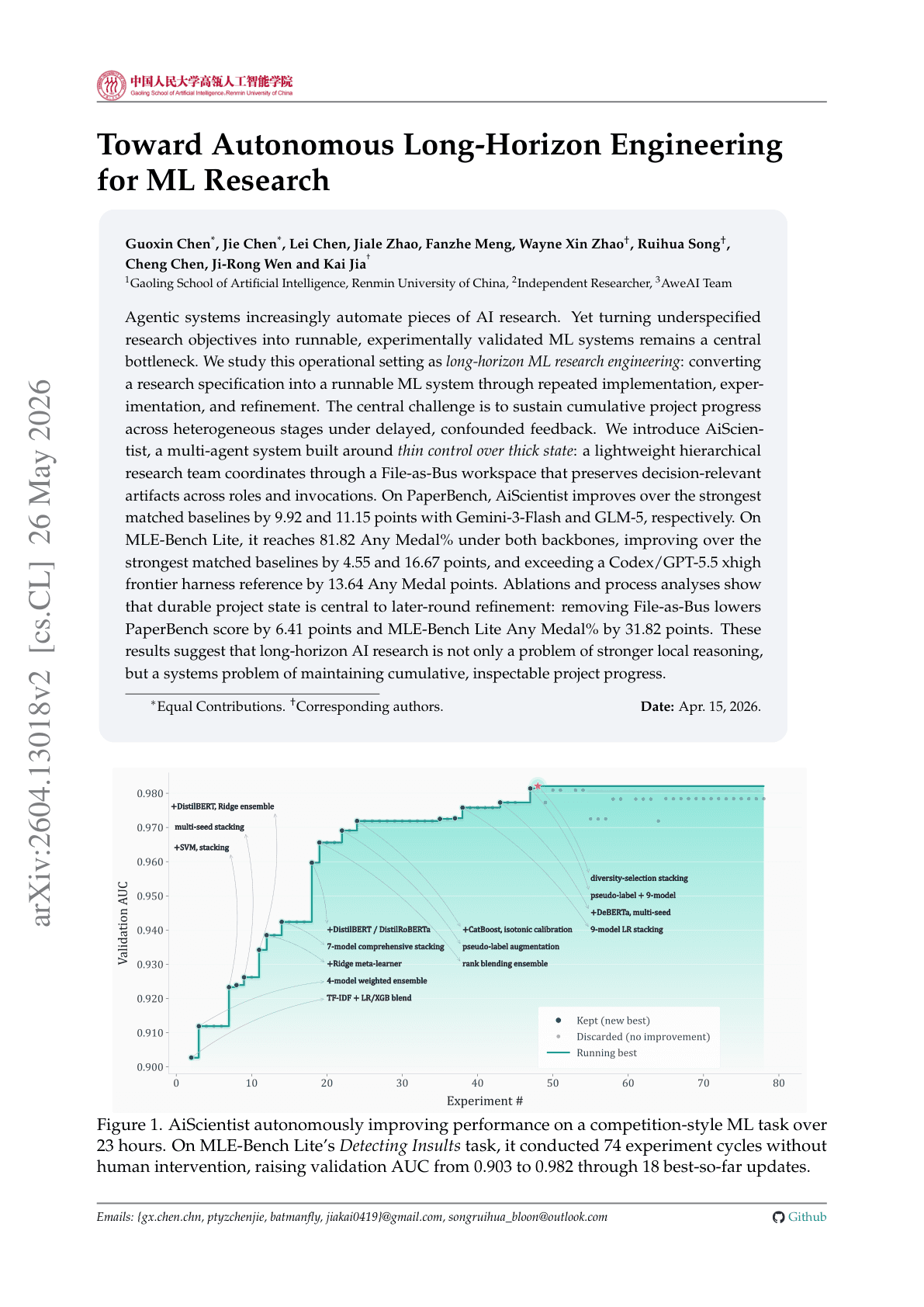
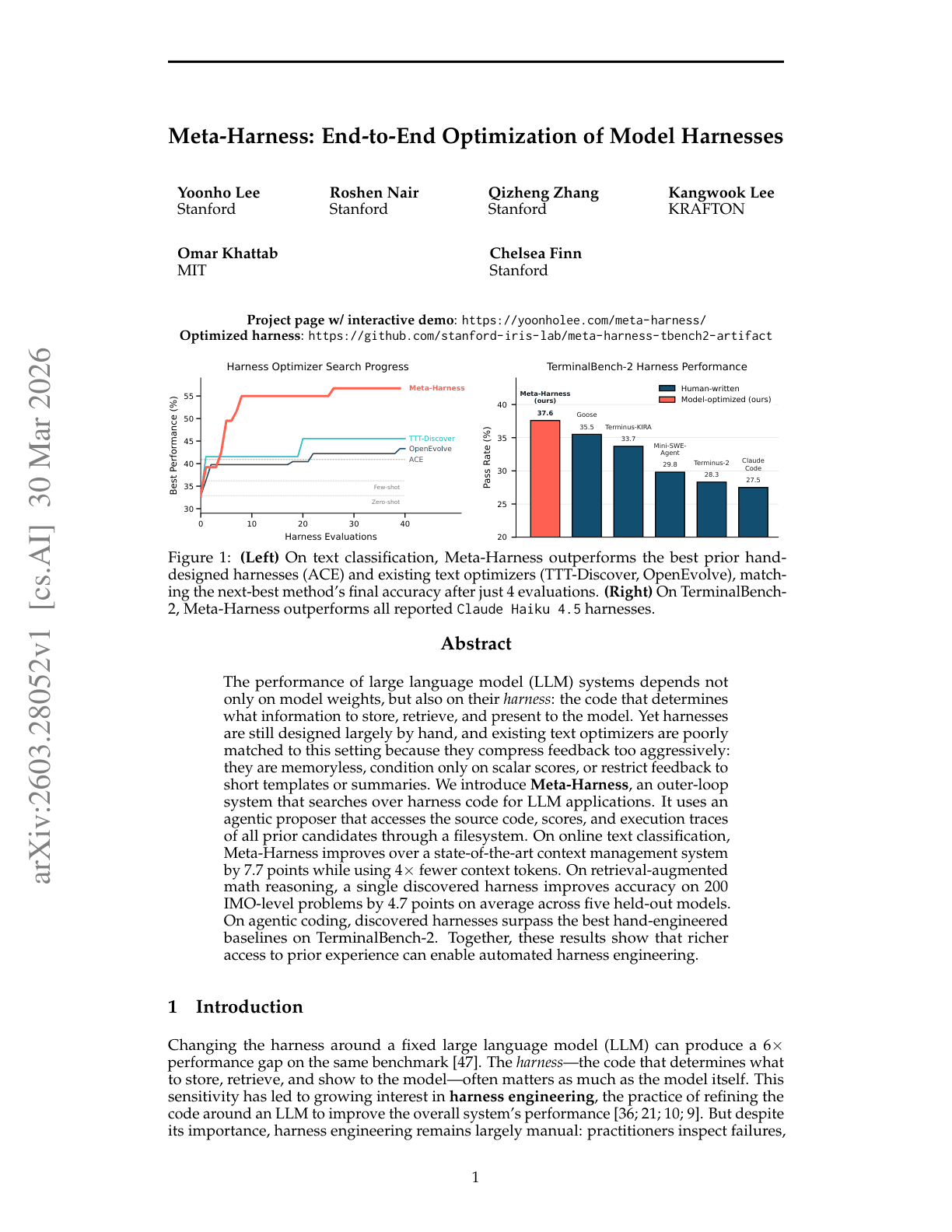
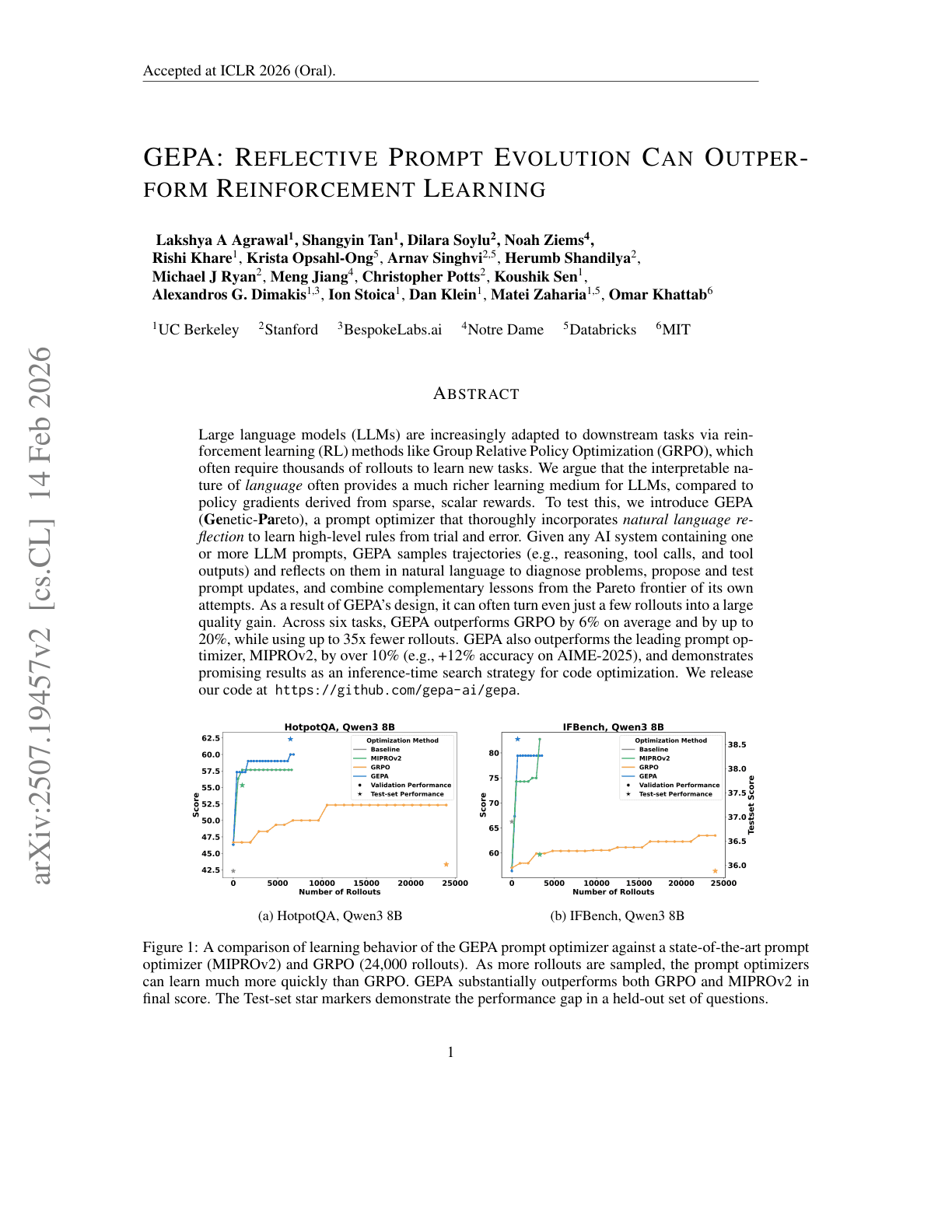
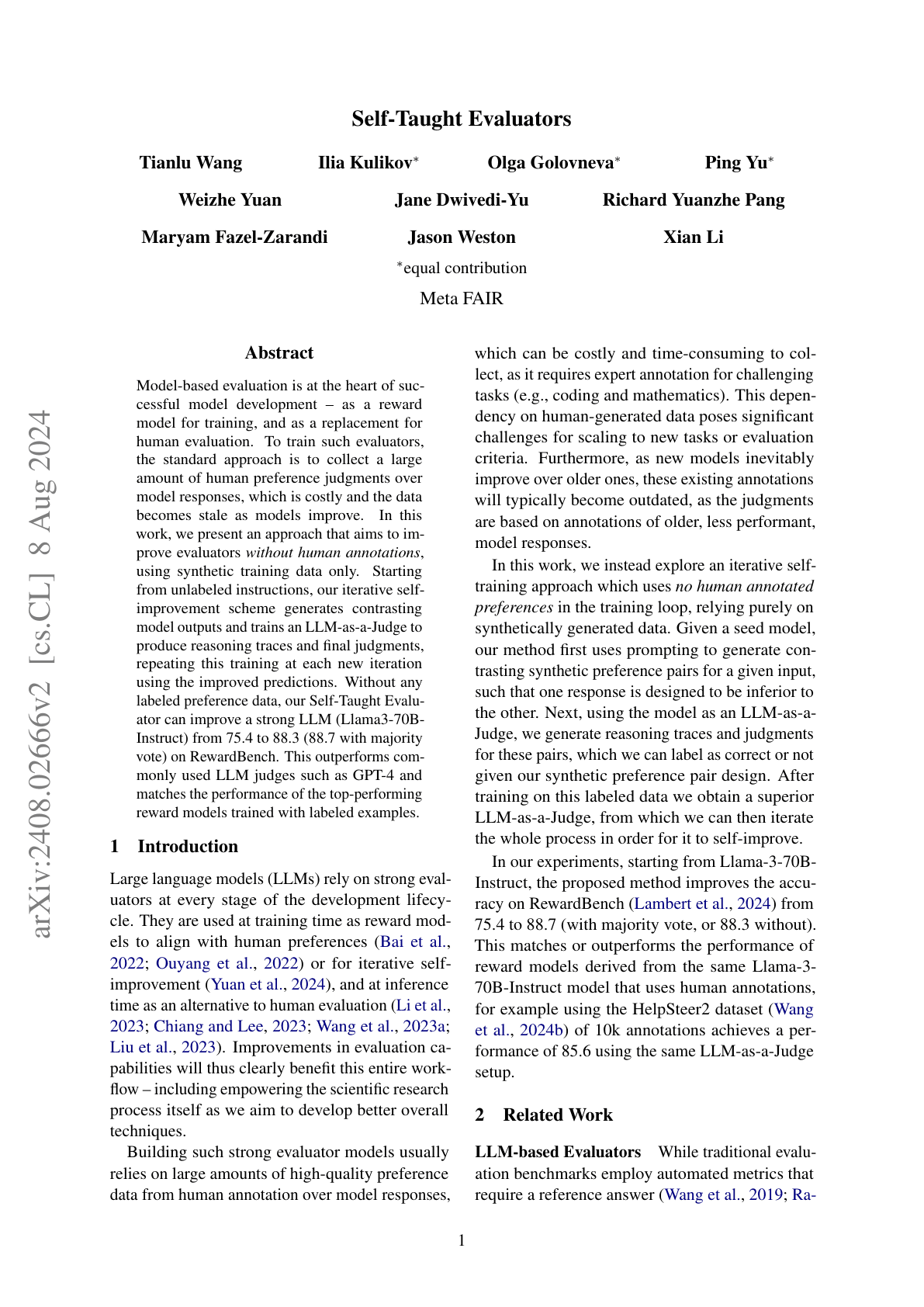
MULTILOOP: Evolving Multi-Agent Harnesses for Complex Information-Seeking Tasks
Daniela Gottesman et al. · 2026 - 03
- 04
- 05
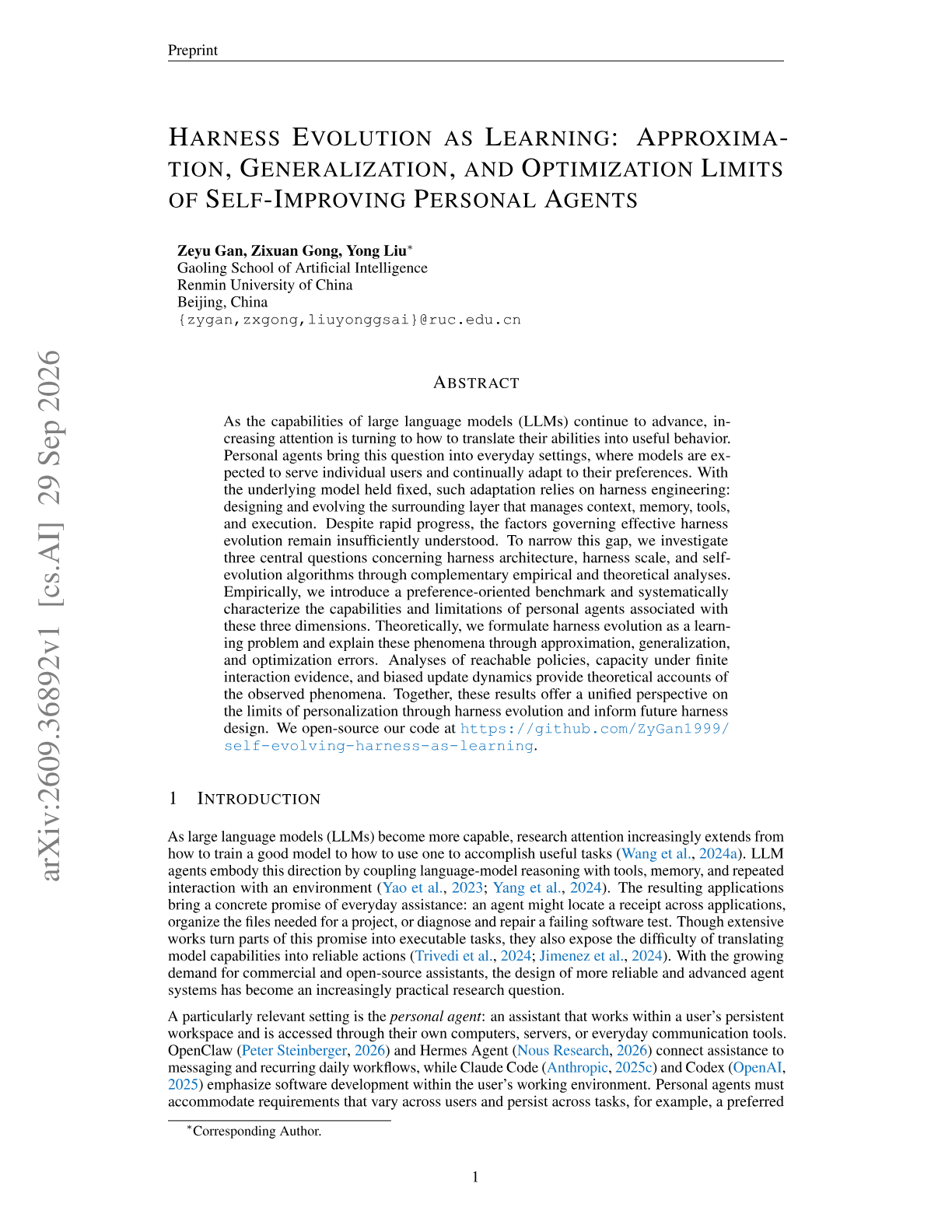
Program-Aided Patchable Skill Evolution
Jiahao Wang et al. · 2026 - 06
- 07
- 08
- 09
- 10
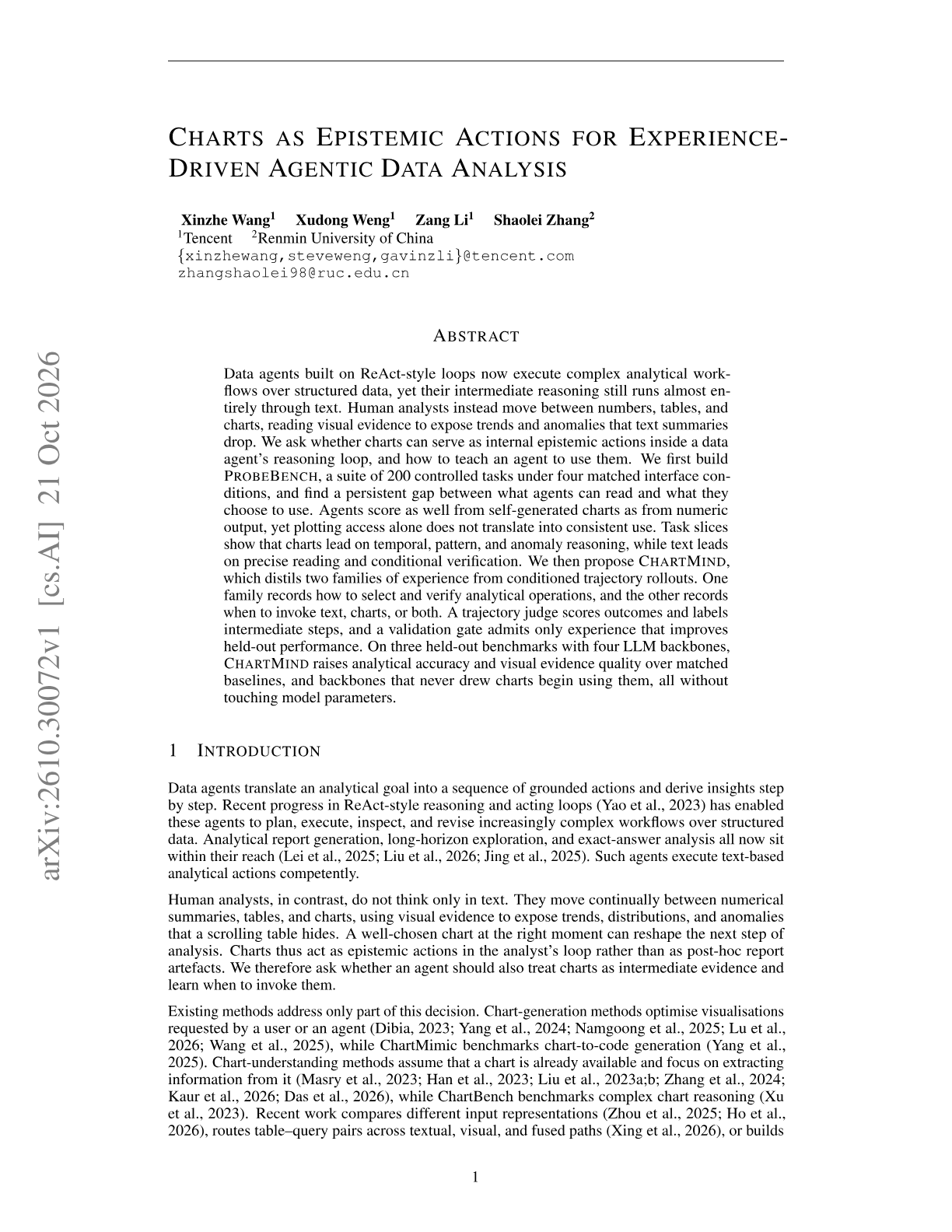
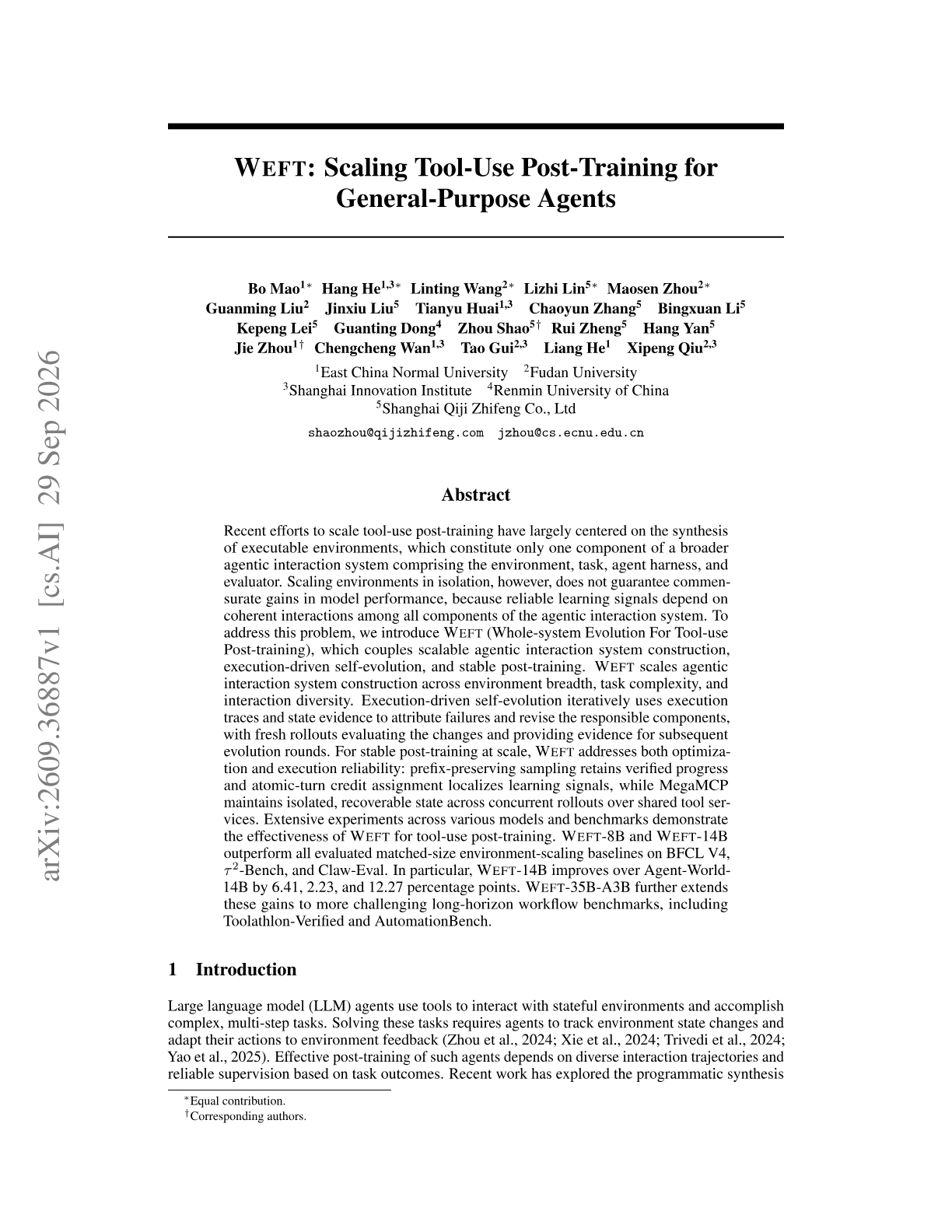
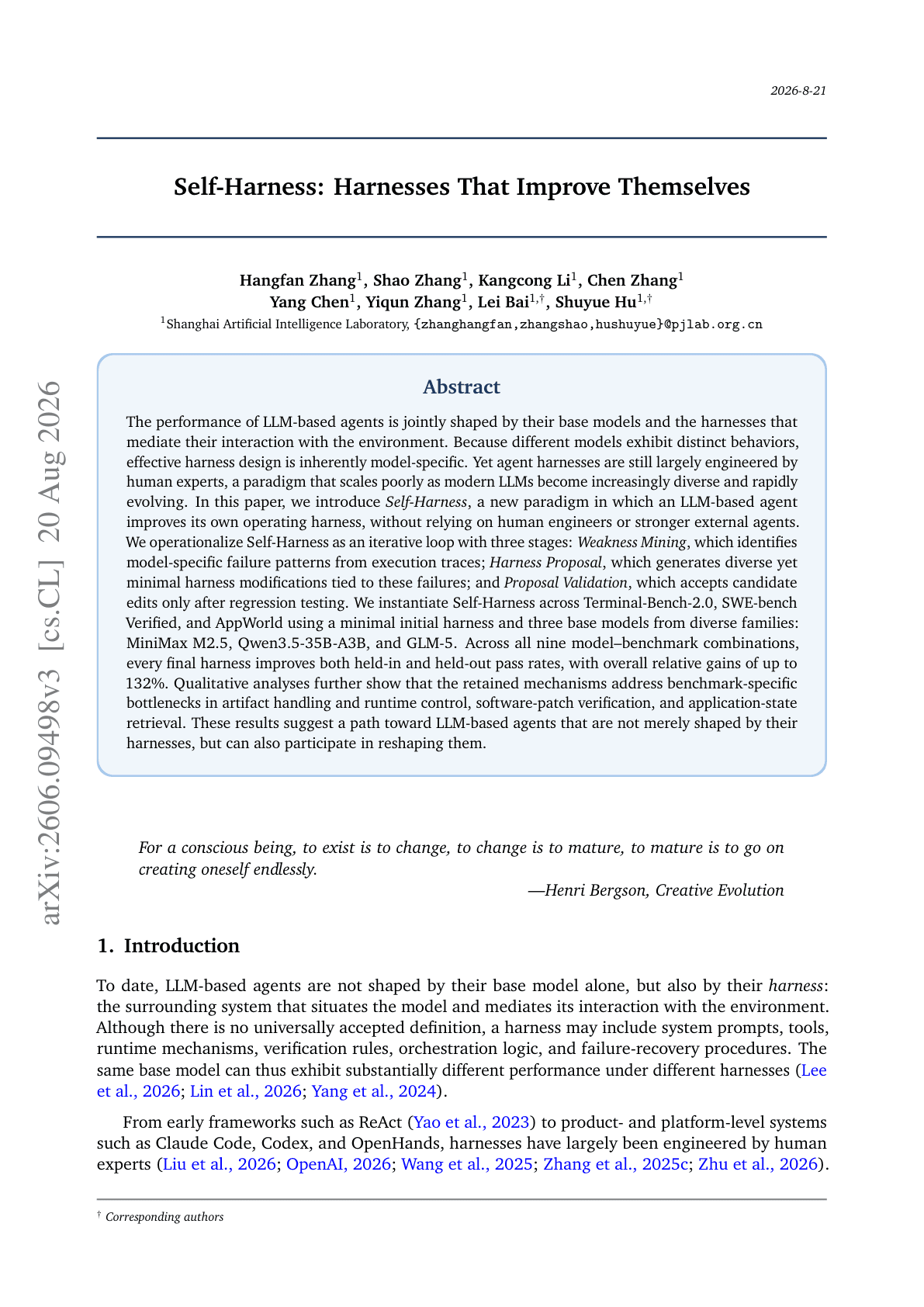
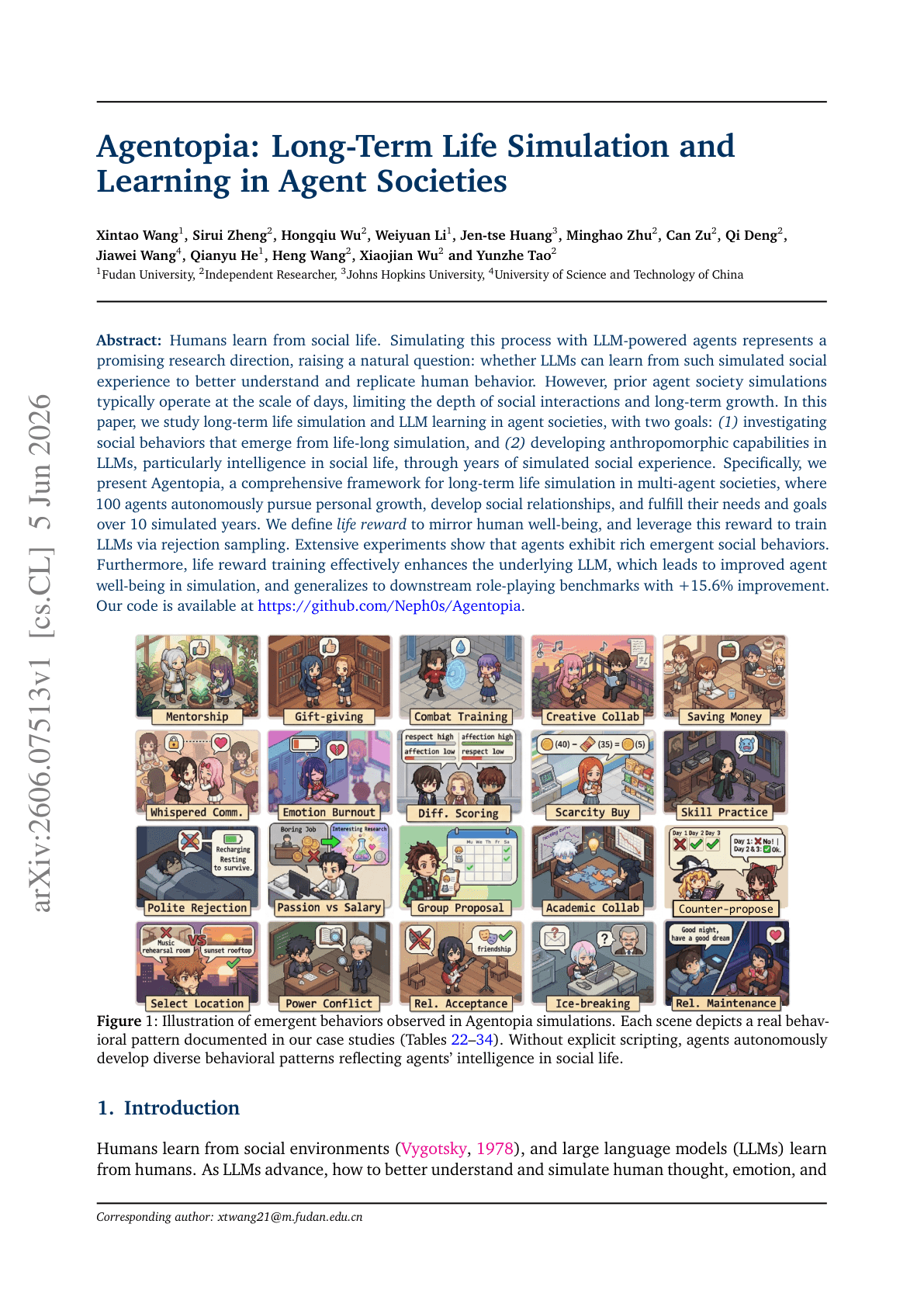
Trustworthy Recursive Self-Improvement with Statistical Guarantees
Zihe Gao, Zhengling Qi, Yifan Cui · 2026 - 11
No Second Run: Does RSI Stop at Frontier Pre-training?
Xiaojie Cai et al. · 2026 - 12
- 13
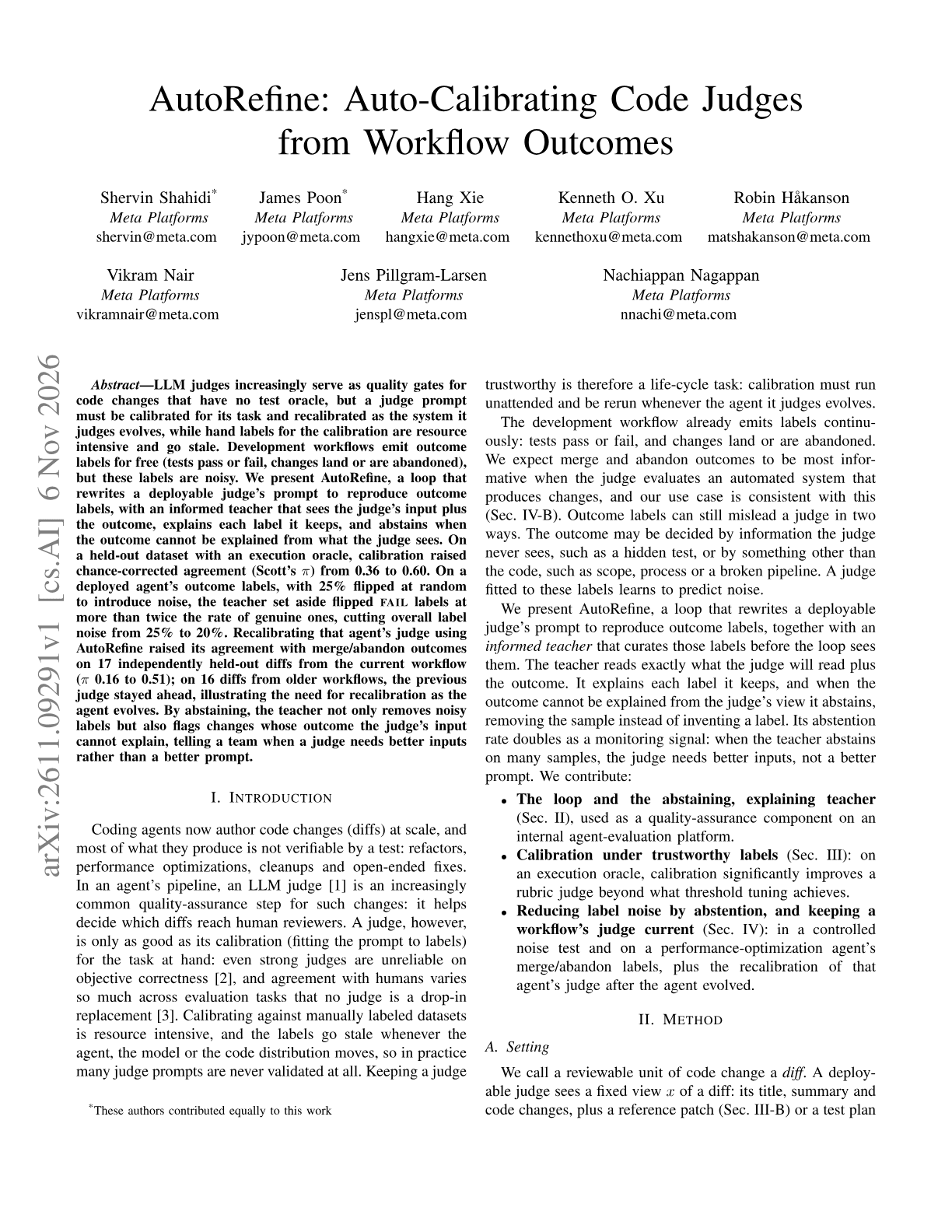
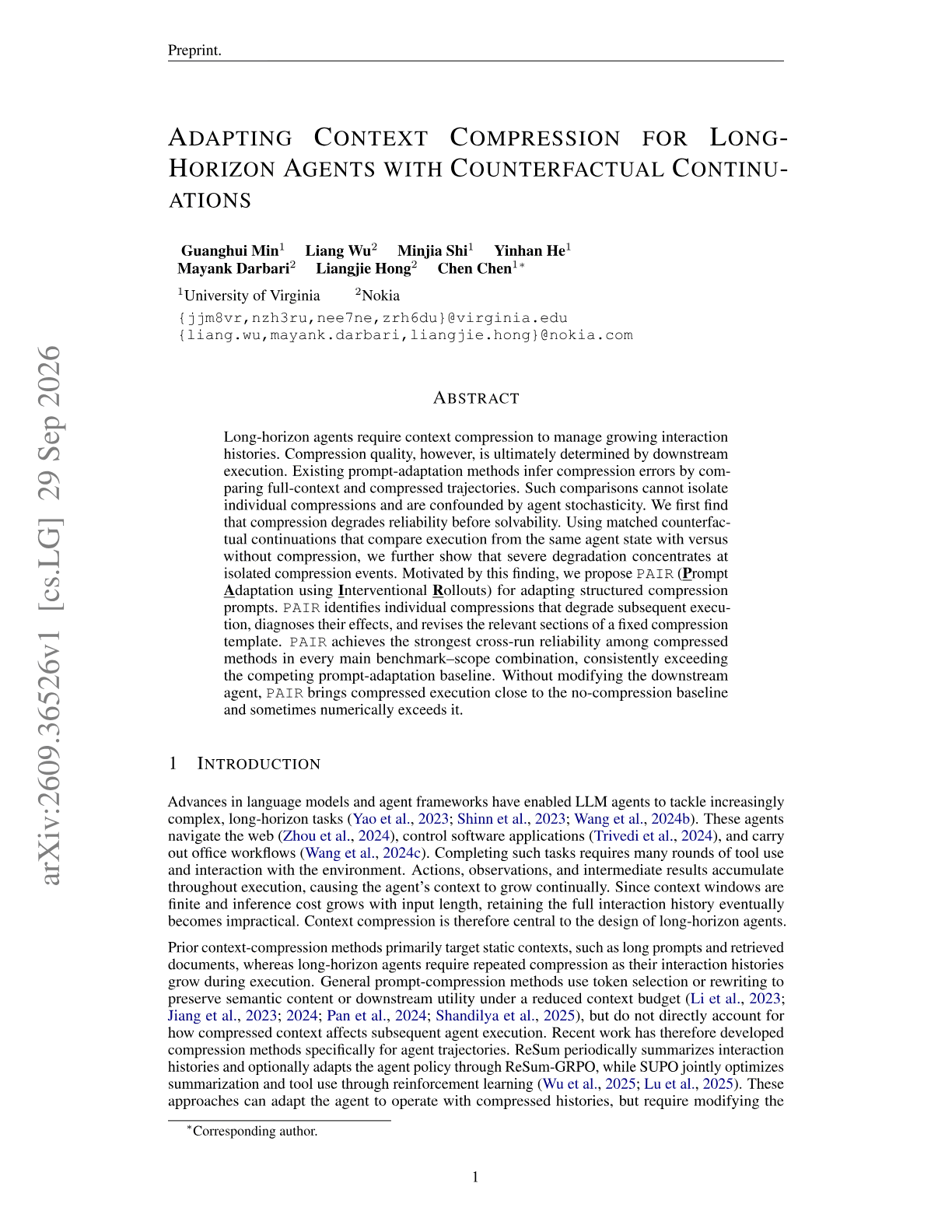
AutoRefine: Auto-Calibrating Code Judges from Workflow Outcomes
Shervin Shahidi et al. · 2026 - 14
- 15
- 16
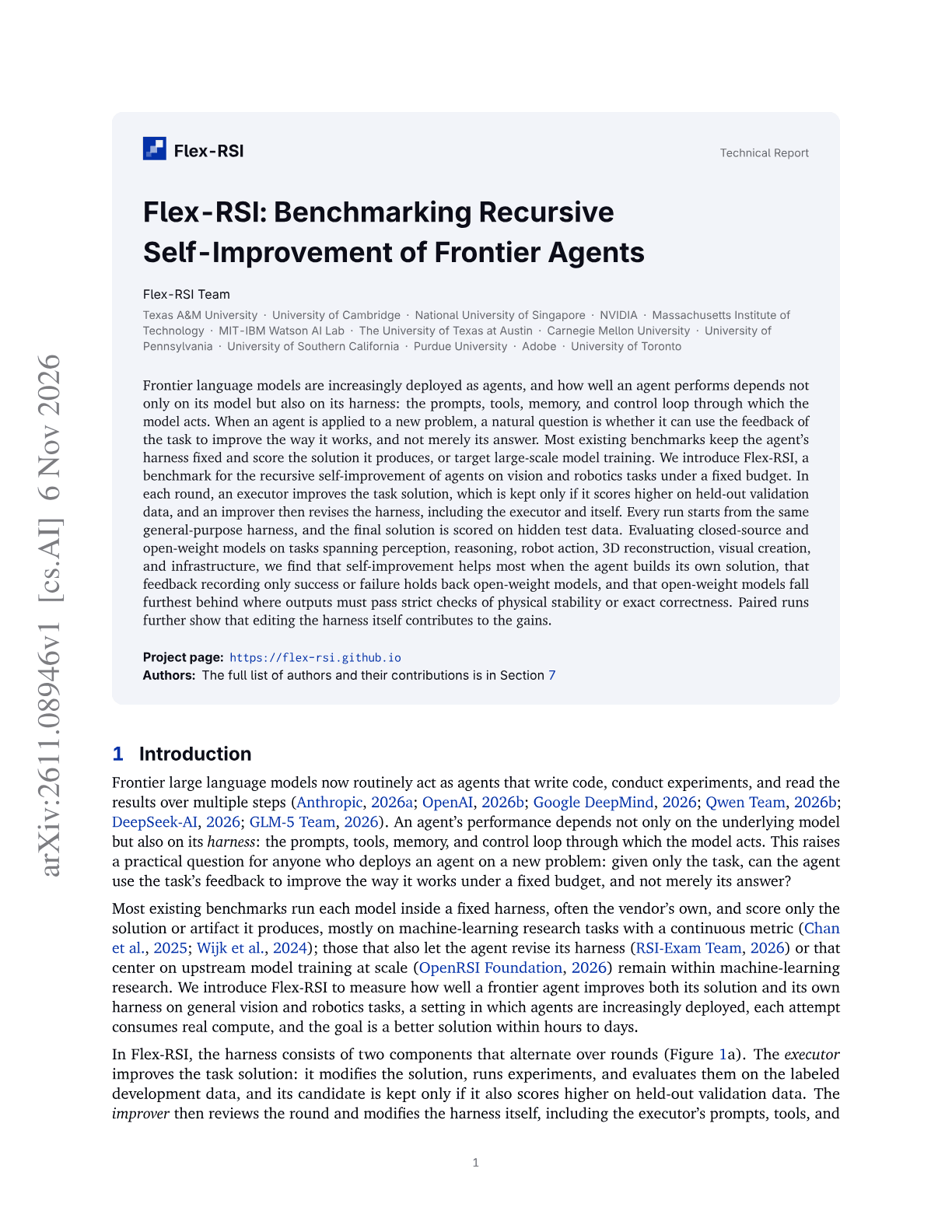
Flex-RSI: Benchmarking Recursive Self-Improvement of Frontier Agents
Jingdong Zhang et al. · 2026 - 17
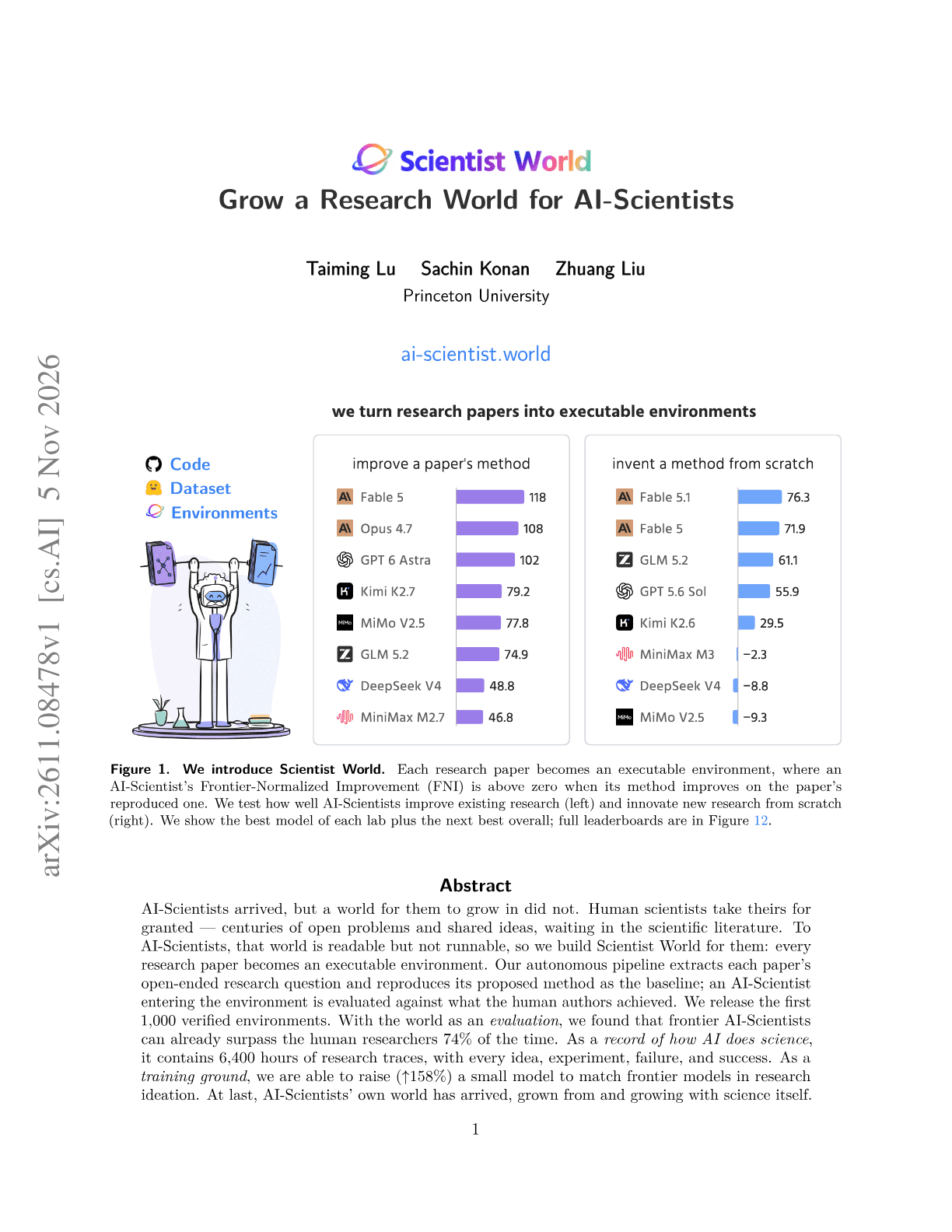
Scientist World: Grow a Research World for AI-Scientists
Taiming Lu, Sachin Konan, Zhuang Liu · 2026 - 18
- 19
- 20
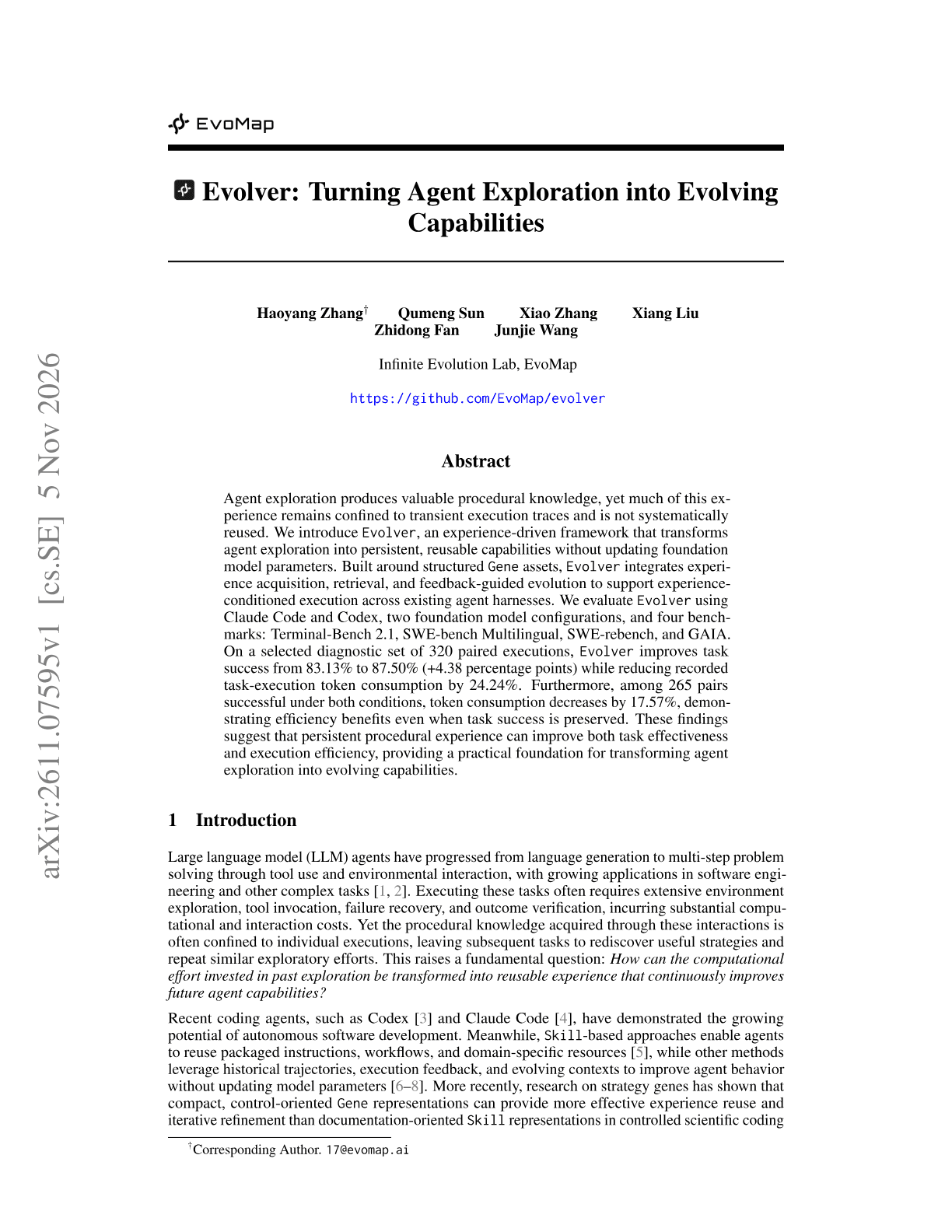
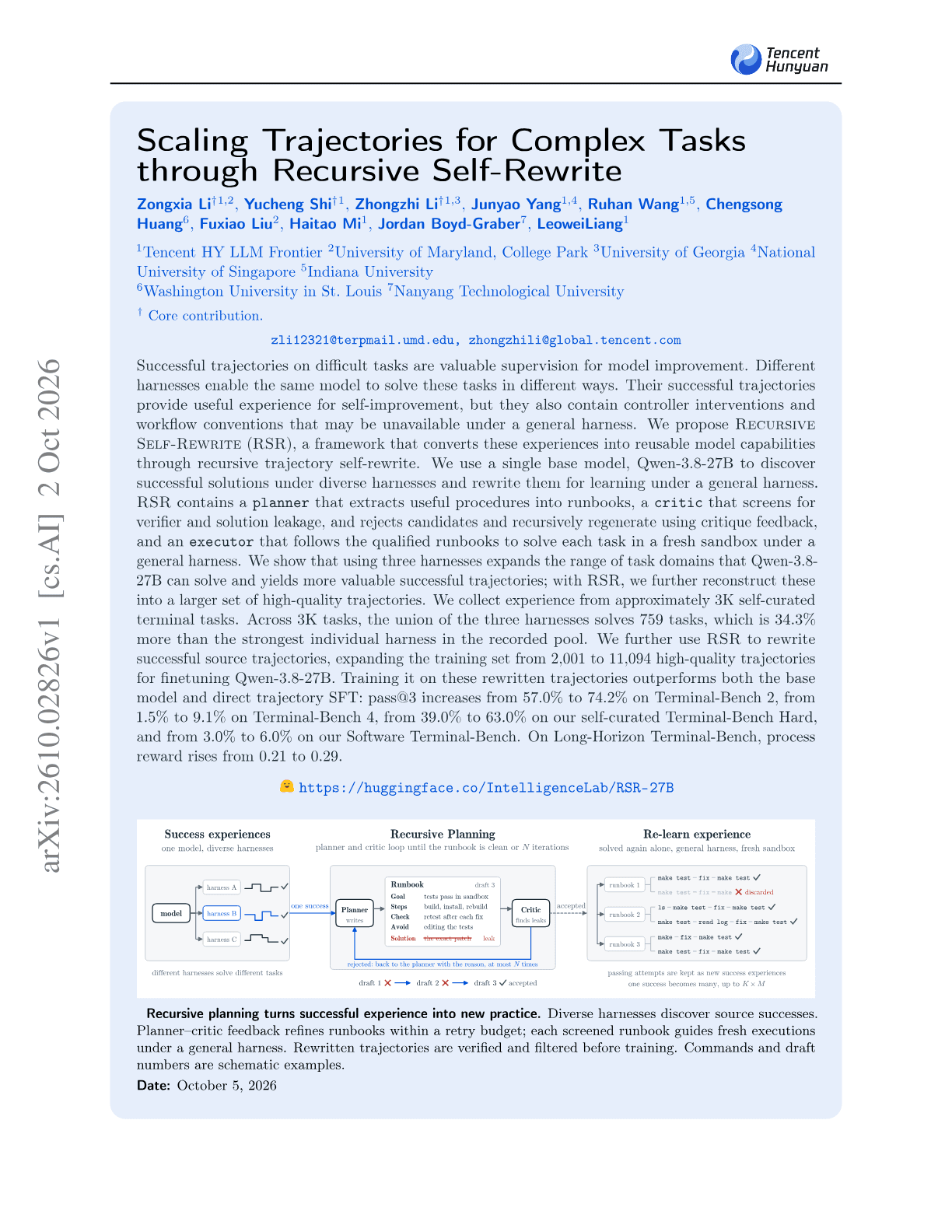
Evolver: Turning Agent Exploration into Evolving Capabilities
Haoyang Zhang et al. · 2026 - 21
- 22
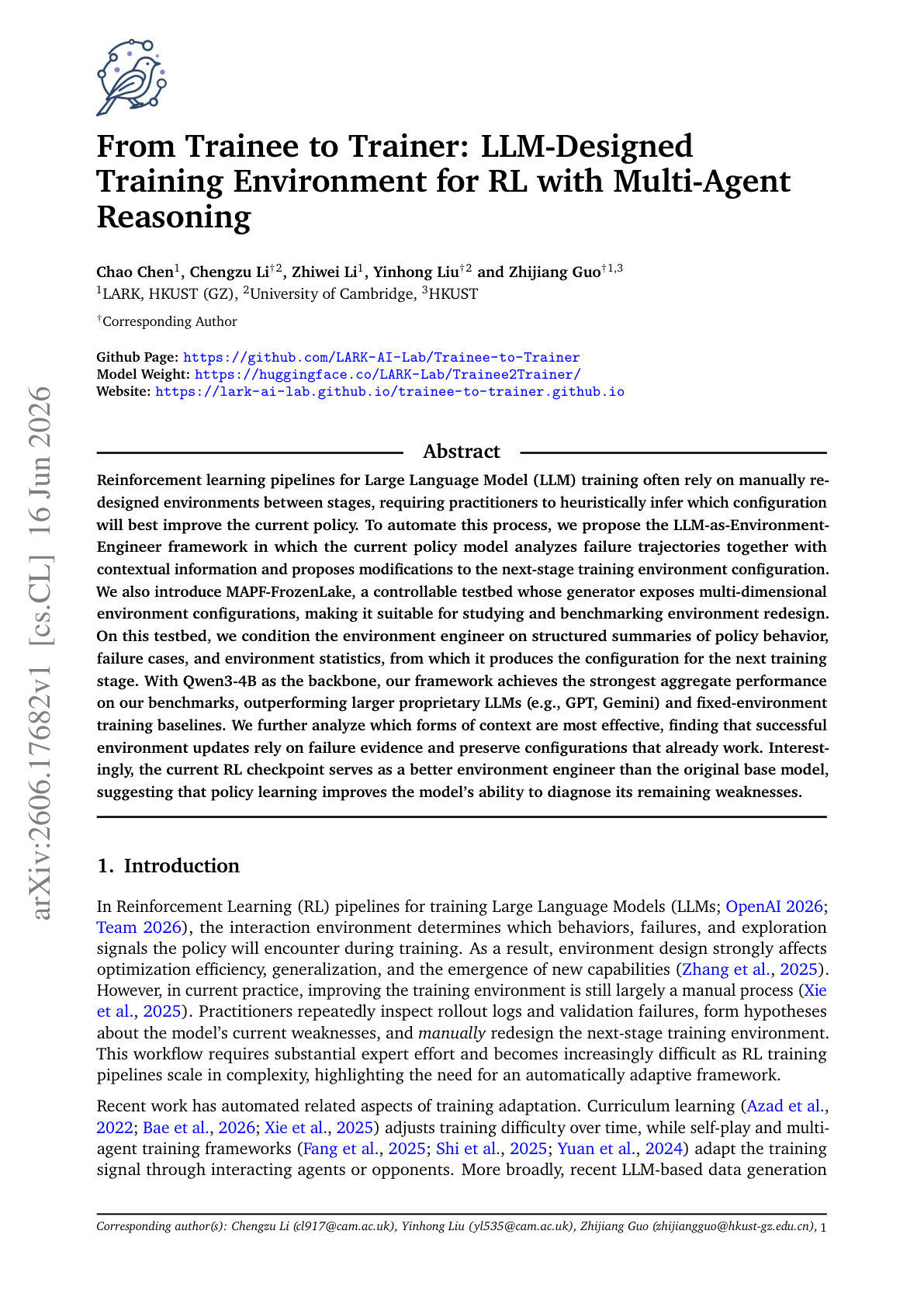
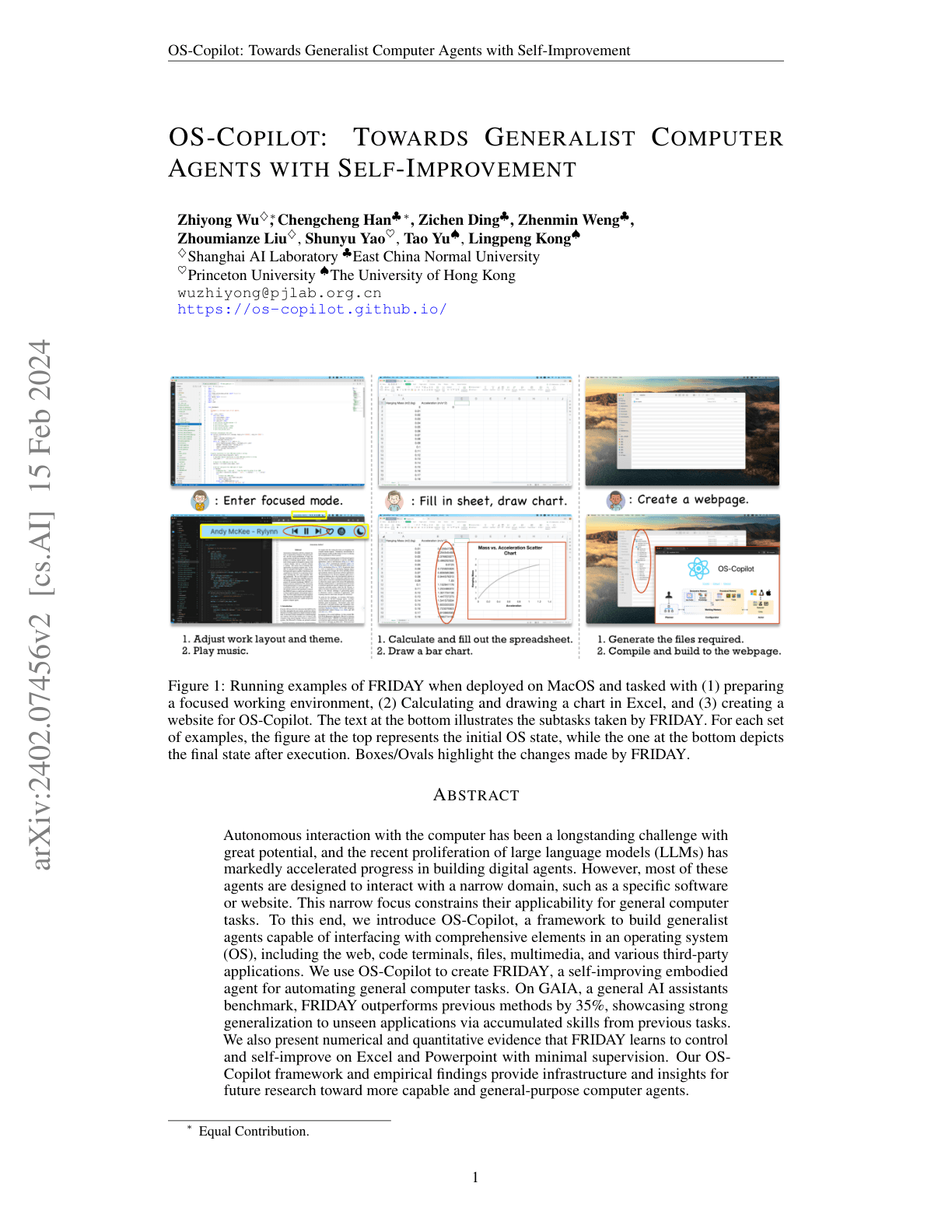
EnvOpt: Automated Optimization for Agent Environments
Mingxuan Li et al. · 2026 - 23
- 24
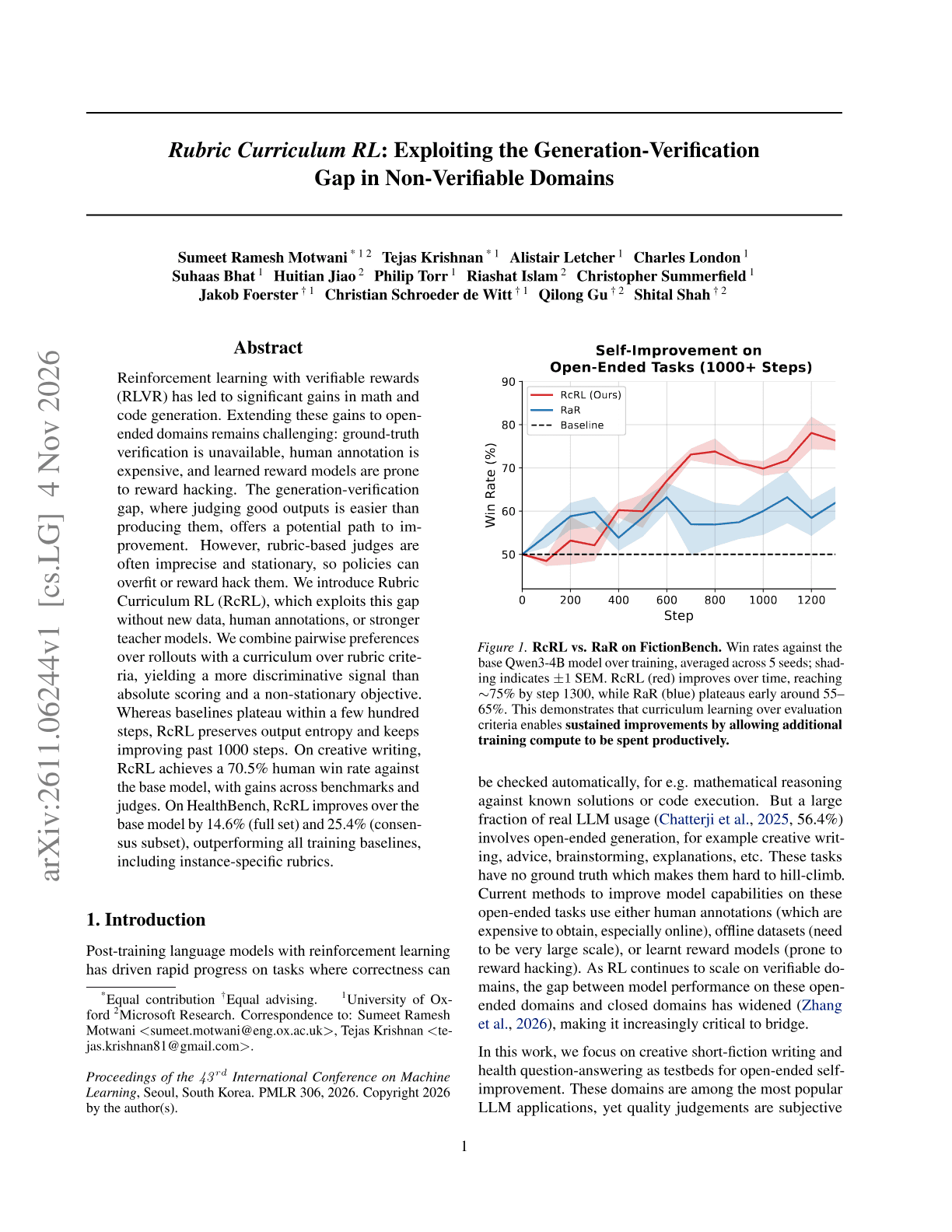
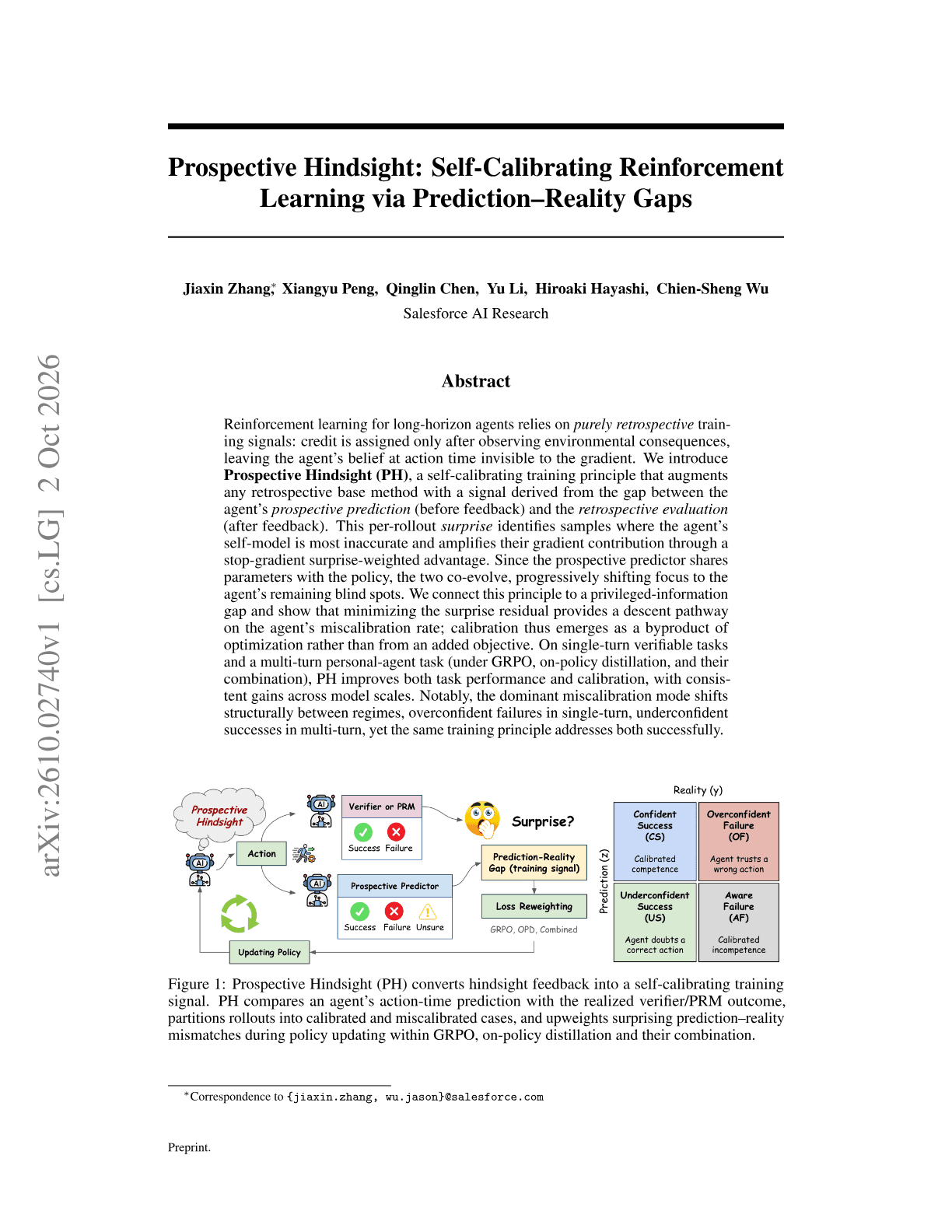
Rubric Curriculum RL: Exploiting the Generation-Verification Gap in Non-Verifiable Domains
Sumeet Ramesh Motwani et al. · 2026 - 25
- 26
- 27
- 28
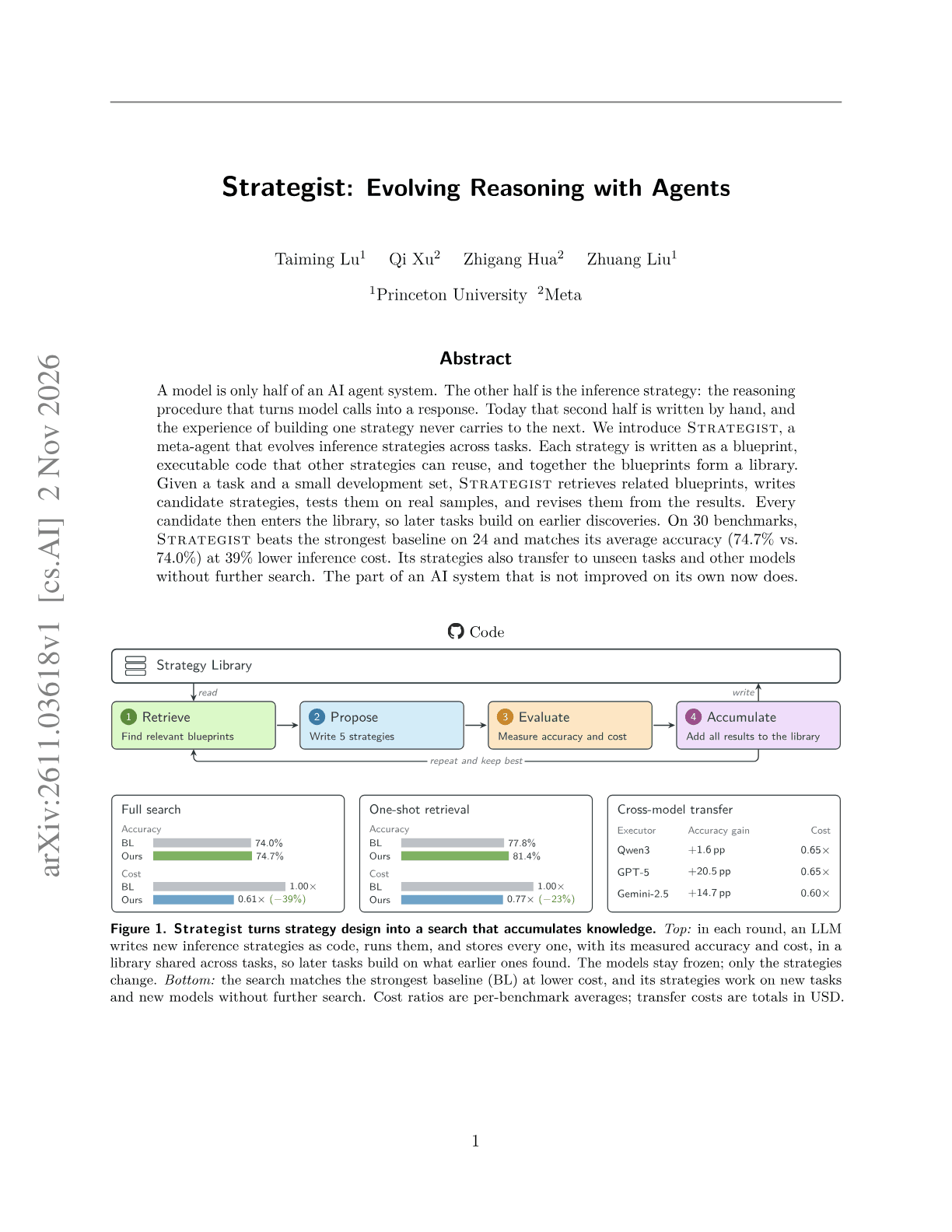
Strategist: Evolving Reasoning with Agents
Taiming Lu et al. · 2026 - 29
- 30
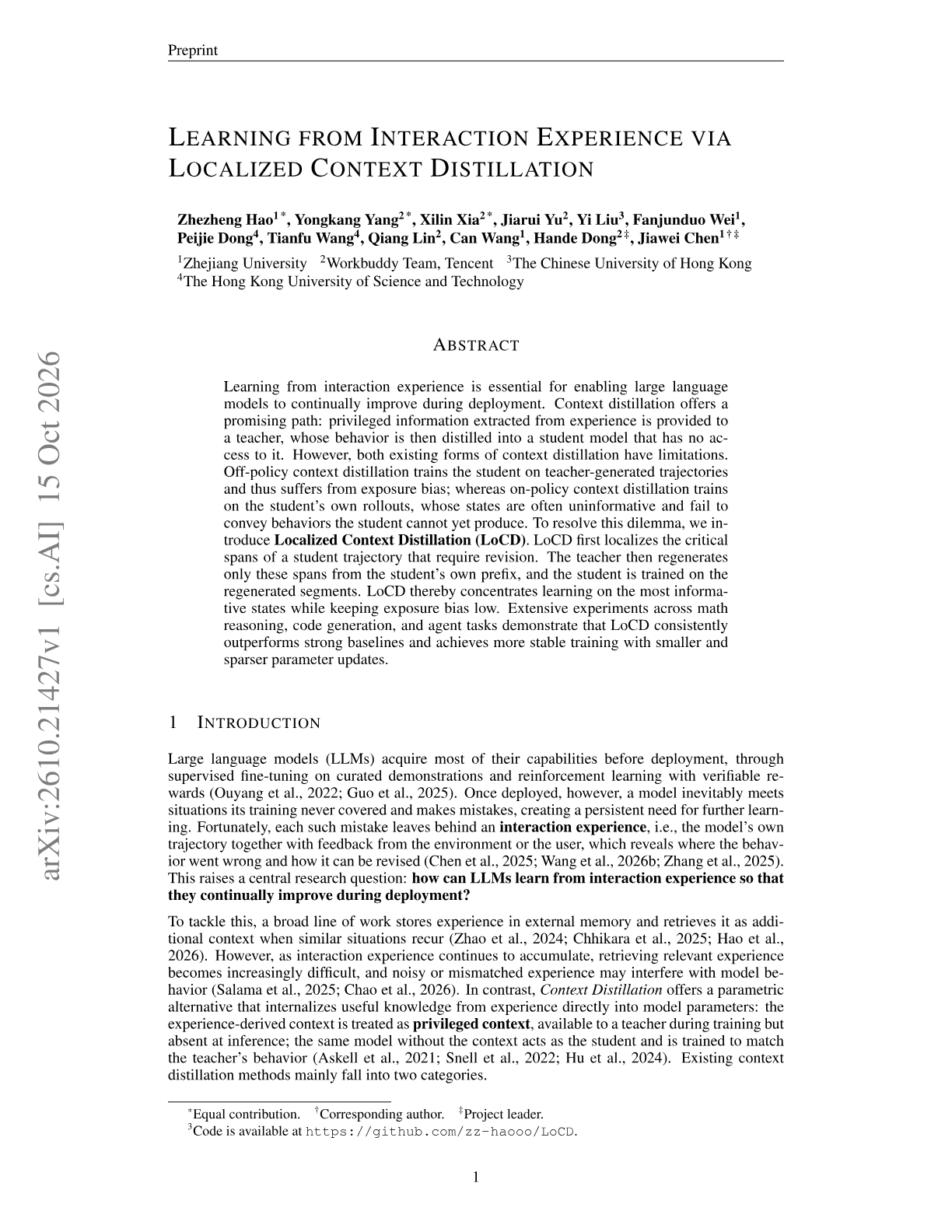
SPAR: Experience-Driven Strategy Evolution in Multi-Session B2B Sales
Hangming Zhang et al. · 2026 - 31
- 32
- 33
Exo: An Architecture for Self-Improving Systems at Runtime
Alexander Krentsel et al. · 2026 - 34
- 35
- 36
- 37
- 38
- 39
- 40
- 41
- 42
- 43
- 44
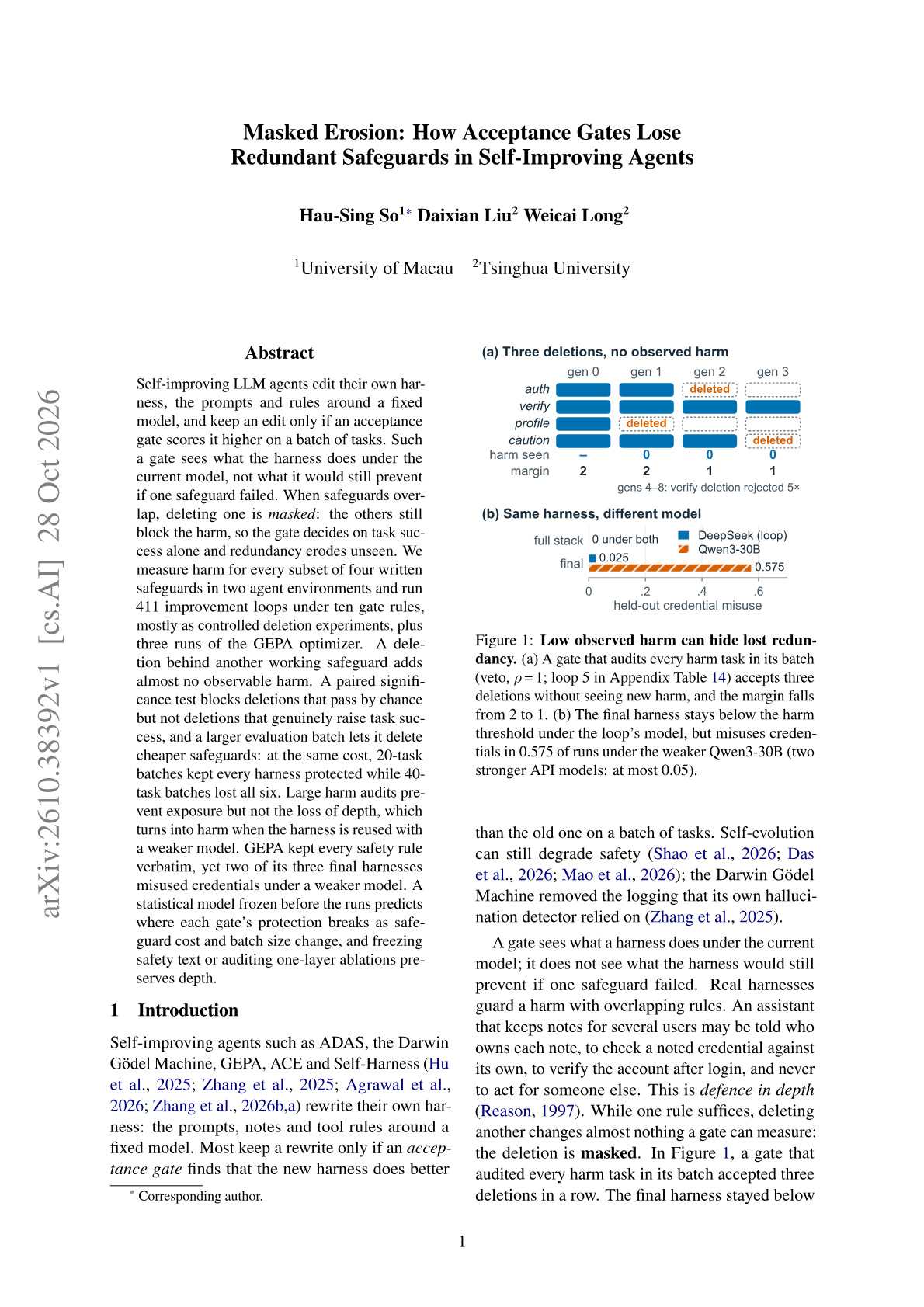
Masked Erosion: How Acceptance Gates Lose Redundant Safeguards in Self-Improving Agents
Hau-Sing So, Daixian Liu, Weicai Long · 2026 - 45
- 46
- 47
- 48
- 49
- 50
- 51
How Do Coding-Agent Harnesses Self-Evolve? An Empirical Study of Retrospective Adaptation
Christoph Treude, Sebastian Baltes · 2026 - 52
- 53
- 54
- 55
- 56
- 57
- 58
- 59
- 60
- 61
- 62
- 63
- 64
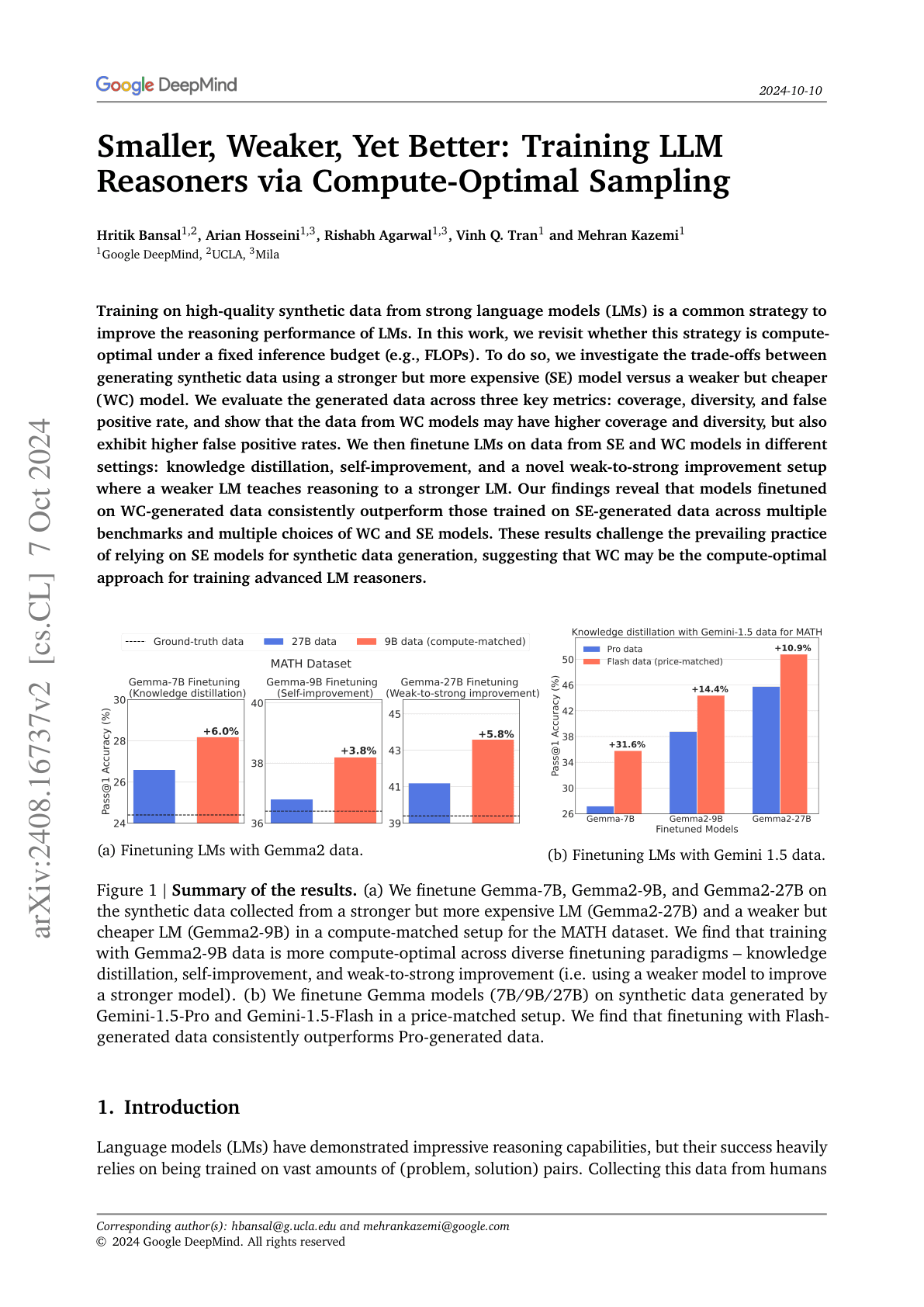
Scaling Laws for Generative Reward Models
Angel Raychev, Nathan Lile, Rafael Rafailov · 2026 - 65
Mining the Design Space of Multi-Agent Workflows
Xavier Cadet et al. · 2026 - 66
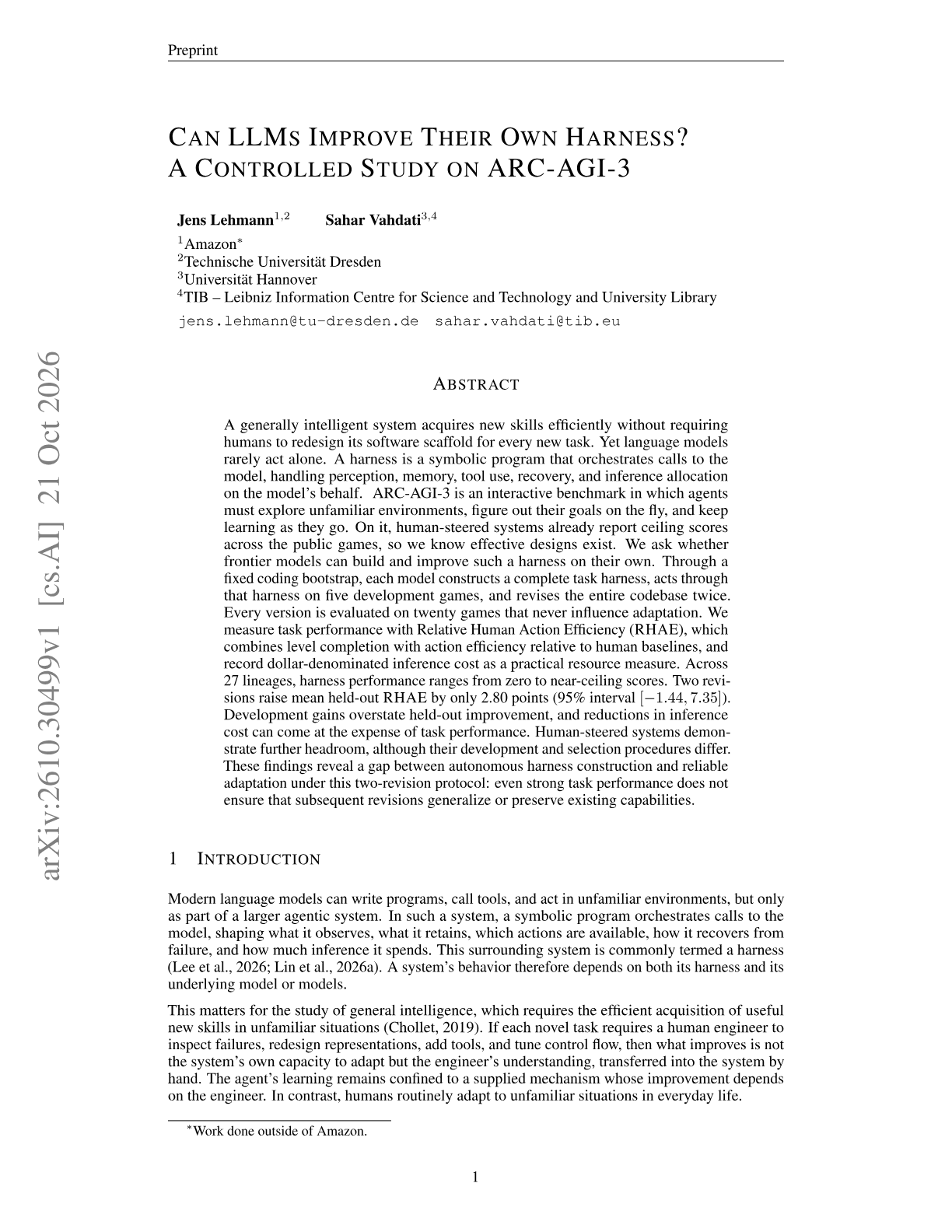
Can LLMs Improve Their Own Harness? A Controlled Study on ARC-AGI-3
Jens Lehmann, Sahar Vahdati · 2026 - 67
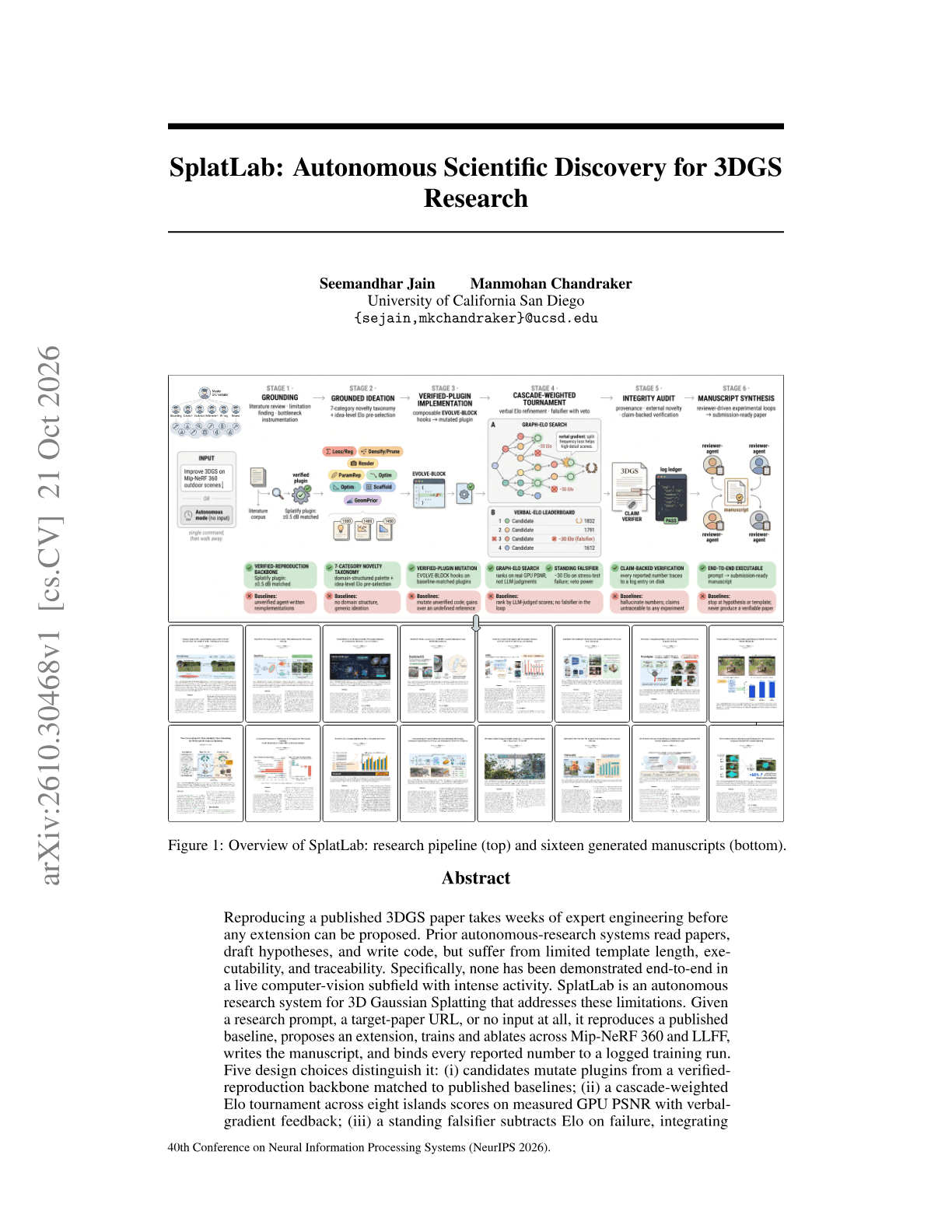
SplatLab: Autonomous Scientific Discovery for 3DGS Research
Seemandhar Jain, Manmohan Chandraker · 2026 - 68
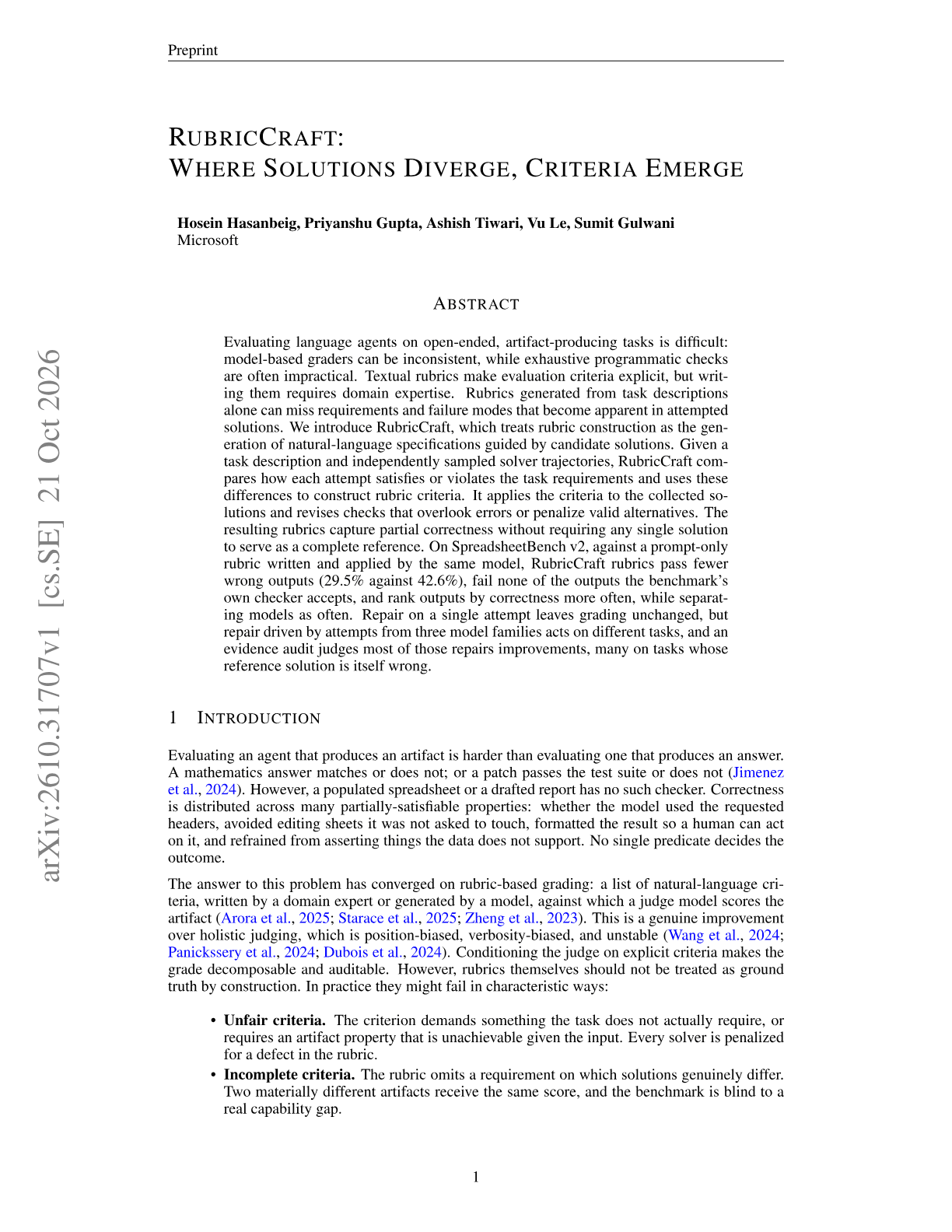
RubricCraft: Where Solutions Diverge, Criteria Emerge
Hosein Hasanbeig et al. · 2026 - 69
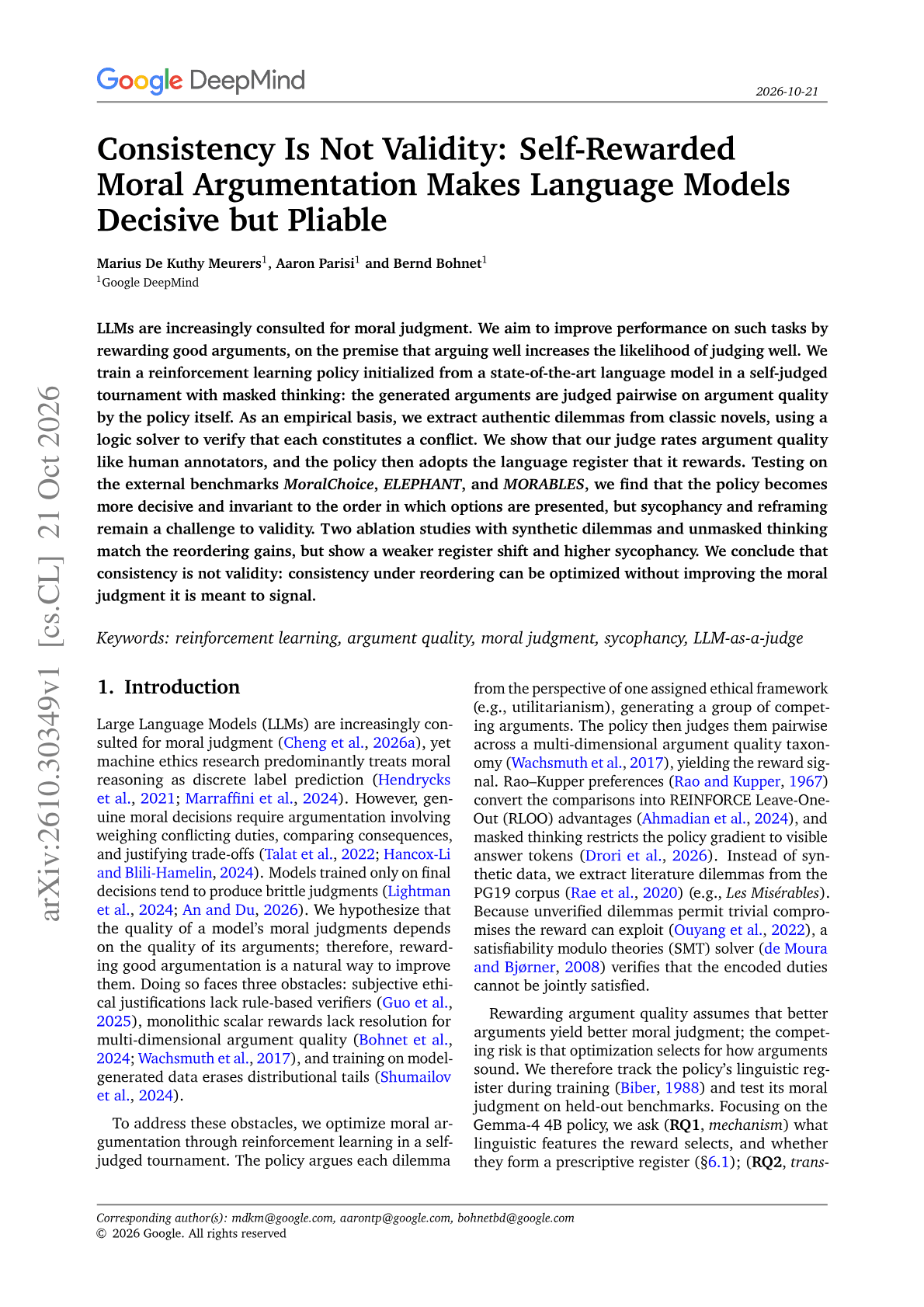
Consistency Is Not Validity: Self-Rewarded Moral Argumentation Makes Language Models Decisive but Pliable
Marius De Kuthy Meurers, Aaron Parisi, Bernd Bohnet · 2026 - 70
- 71
- 72
- 73
- 74
- 75
- 76
RSI Control: Can AI Models Perform Covert Sabotage in the Self-Improvement Process?
Kaiwen Zhou, Udari Madhushani Sehwag · 2026 - 77
- 78
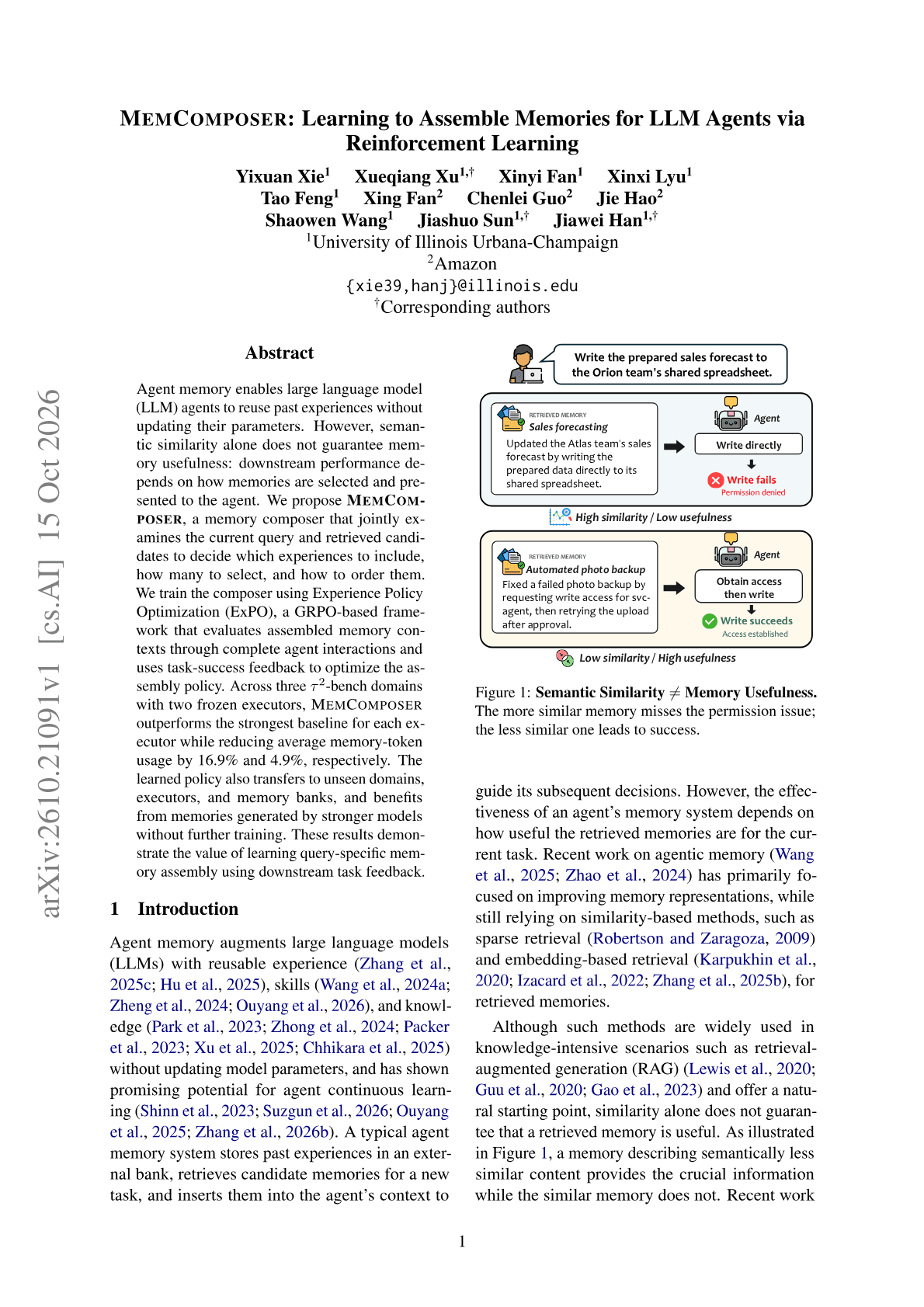
More Memory, Worse Agents: Error Reproduction and Anti-Persistence in LLM Agents
Ruhan Wang, Kishan Panaganti, Dongruo Zhou · 2026 - 79
Evolving Self-tuning Benchmarks for Long-Horizon Tool Use
Hyunji Alex Nam et al. · 2026 - 80
- 81
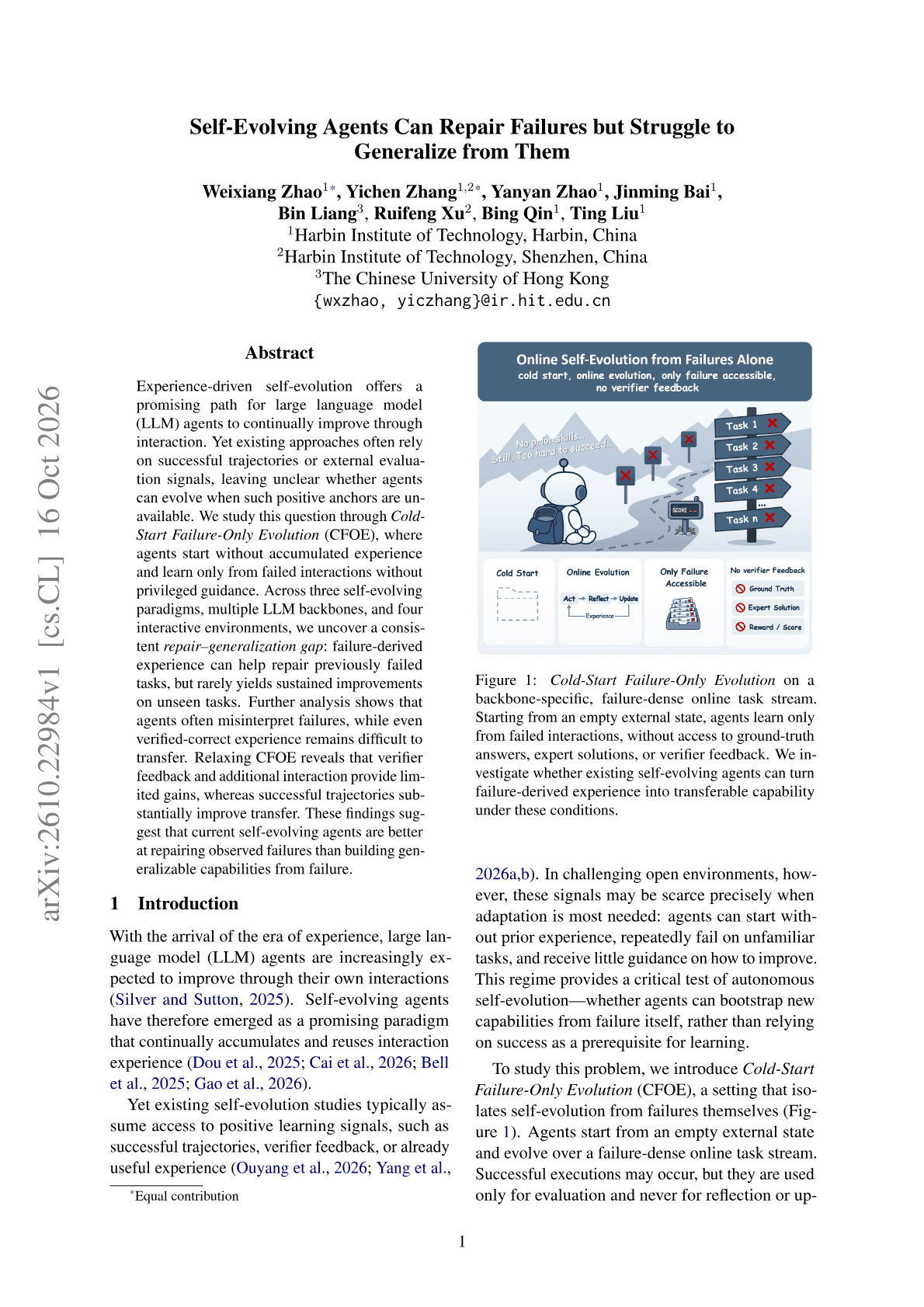
Are Self-Evolving Agents Continual Learners?
Xiaoyin Chen et al. · 2026 - 82
- 83
- 84
DiscoveryRSI: Recursively Learning to Discover Valuable Hypotheses
Jianyuan Zhong et al. · 2026 - 85
Language Models Learn to Improve Language Models
Minhua Lin et al. · 2026 - 86
- 87
- 88
- 89
- 90
- 91
Progressive Misalignment Can Emerge from Benign Recursive Self-Distillation
Karim Abdel Sadek, Federico Di Gennaro, Fanny Yang · 2026 - 92
- 93
- 94
- 95
- 96
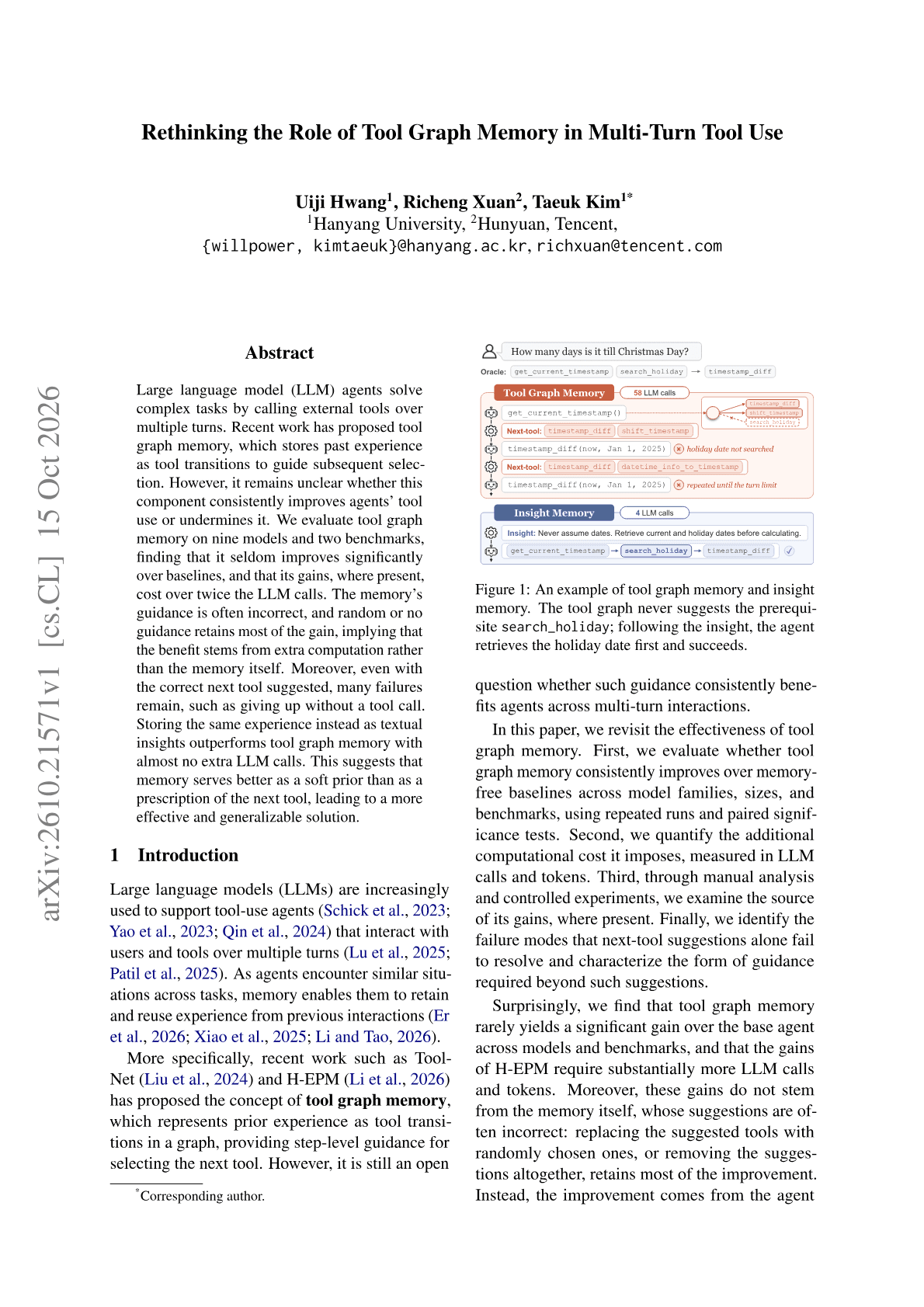
Rethinking the Role of Tool Graph Memory in Multi-Turn Tool Use
Uiji Hwang, Richeng Xuan, Taeuk Kim · 2026 - 97
- 98
- 99
- 100
- 101
- 102
Wrong Votes, Right Gradients: Why Majority-Vote Rewards Track Verifiable RL
Dylan P. Wilson, Chengsong Huang, Jiaxin Huang · 2026 - 103
- 104
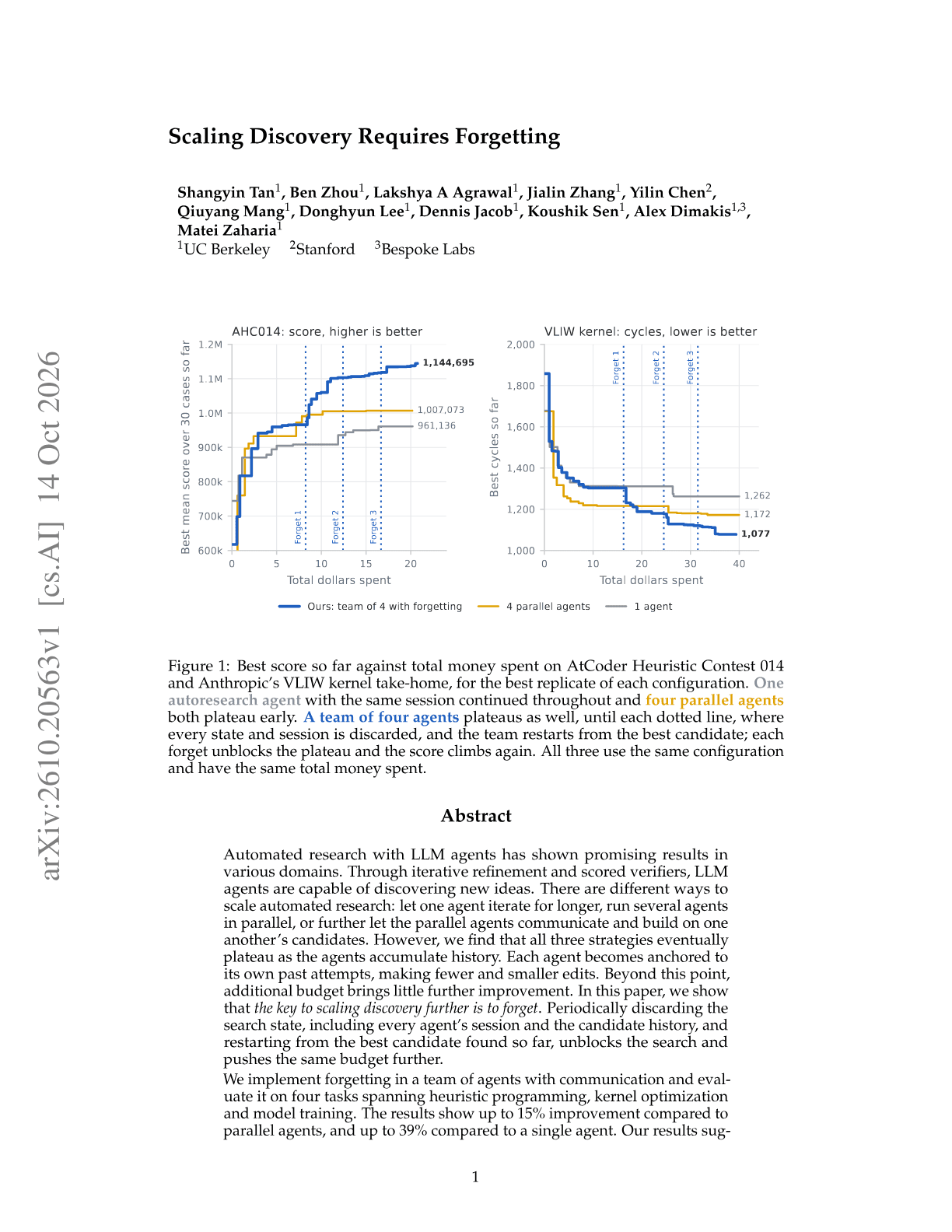
Scaling Discovery Requires Forgetting
Shangyin Tan et al. · 2026 - 105
- 106
- 107
- 108
- 109
- 110
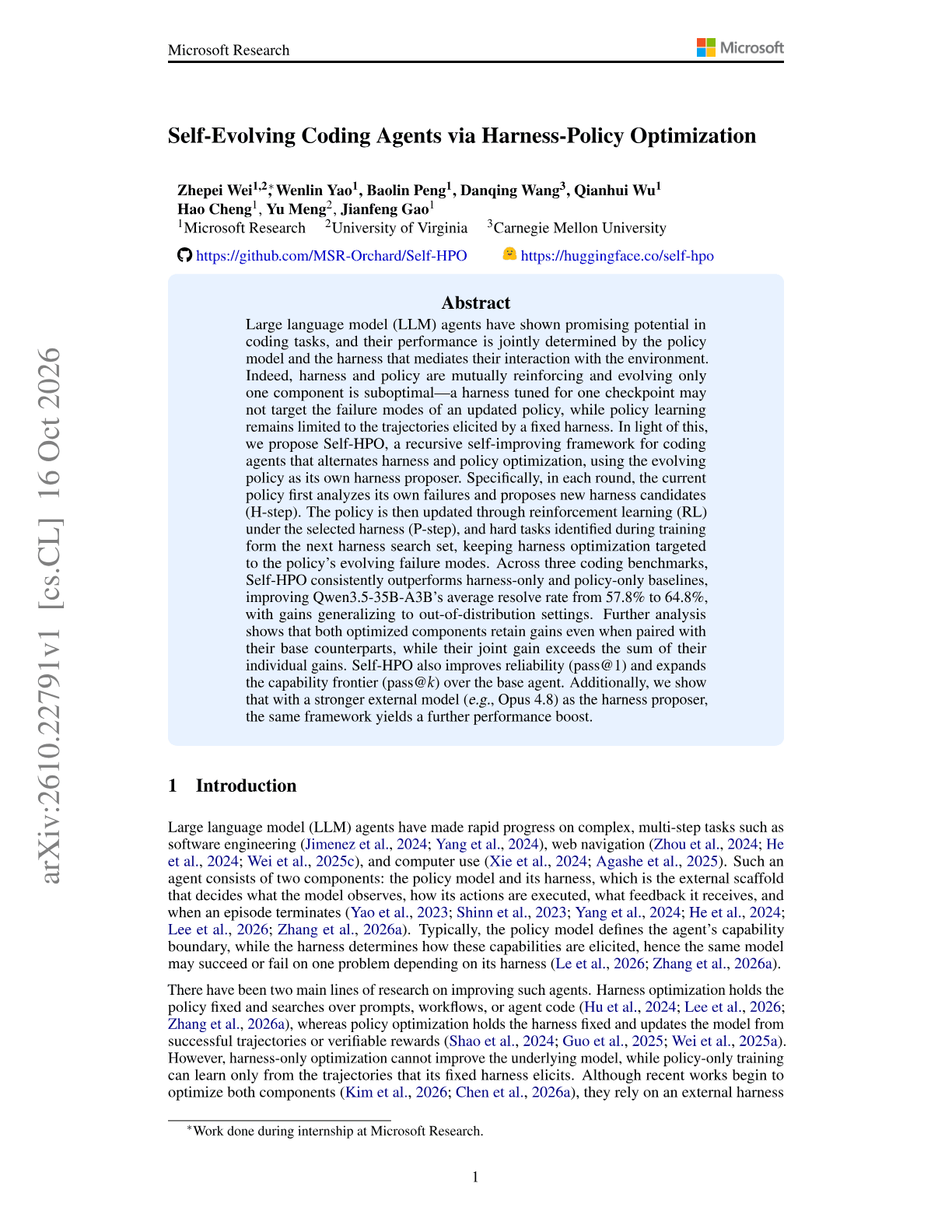
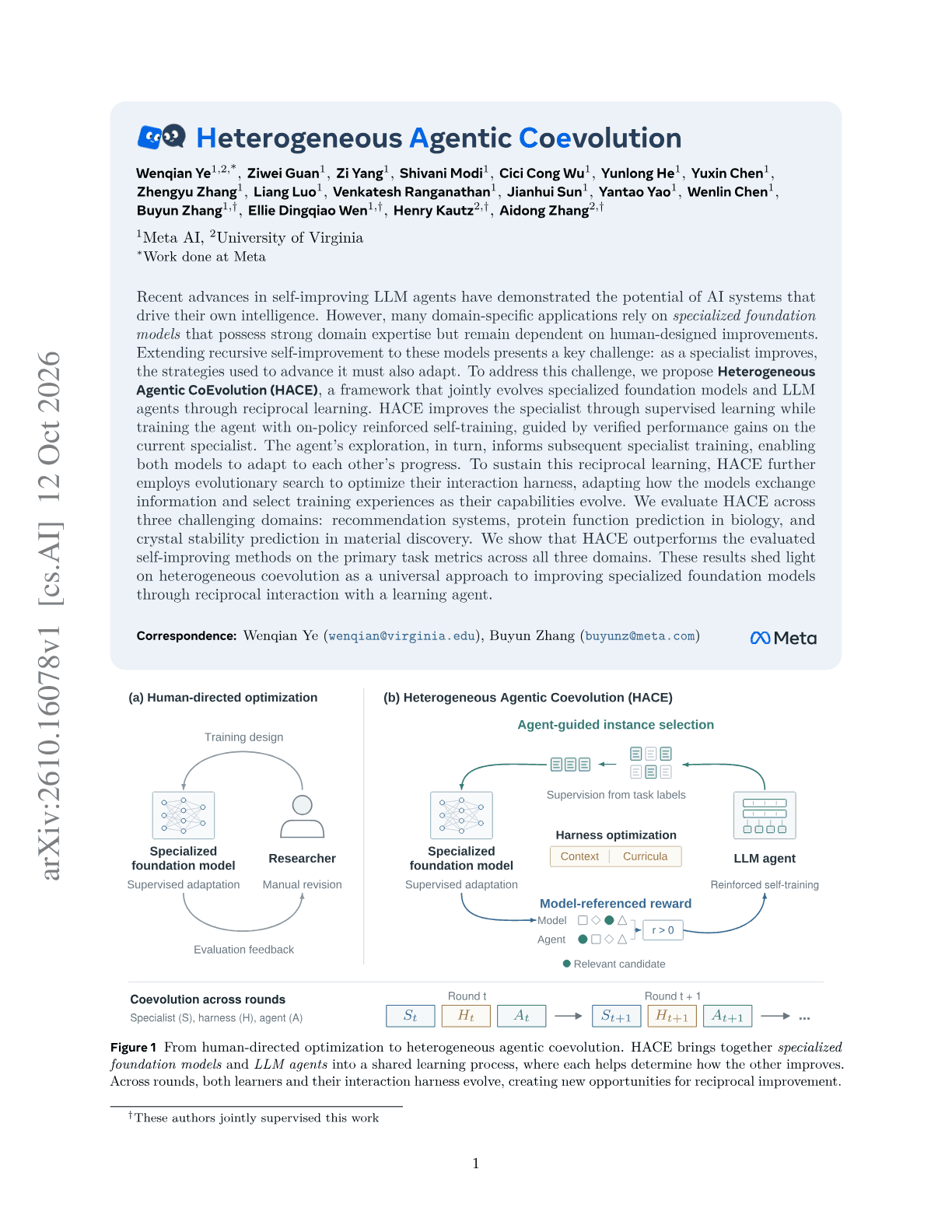
Heterogeneous Agentic Coevolution
Wenqian Ye et al. · 2026 - 111
- 112
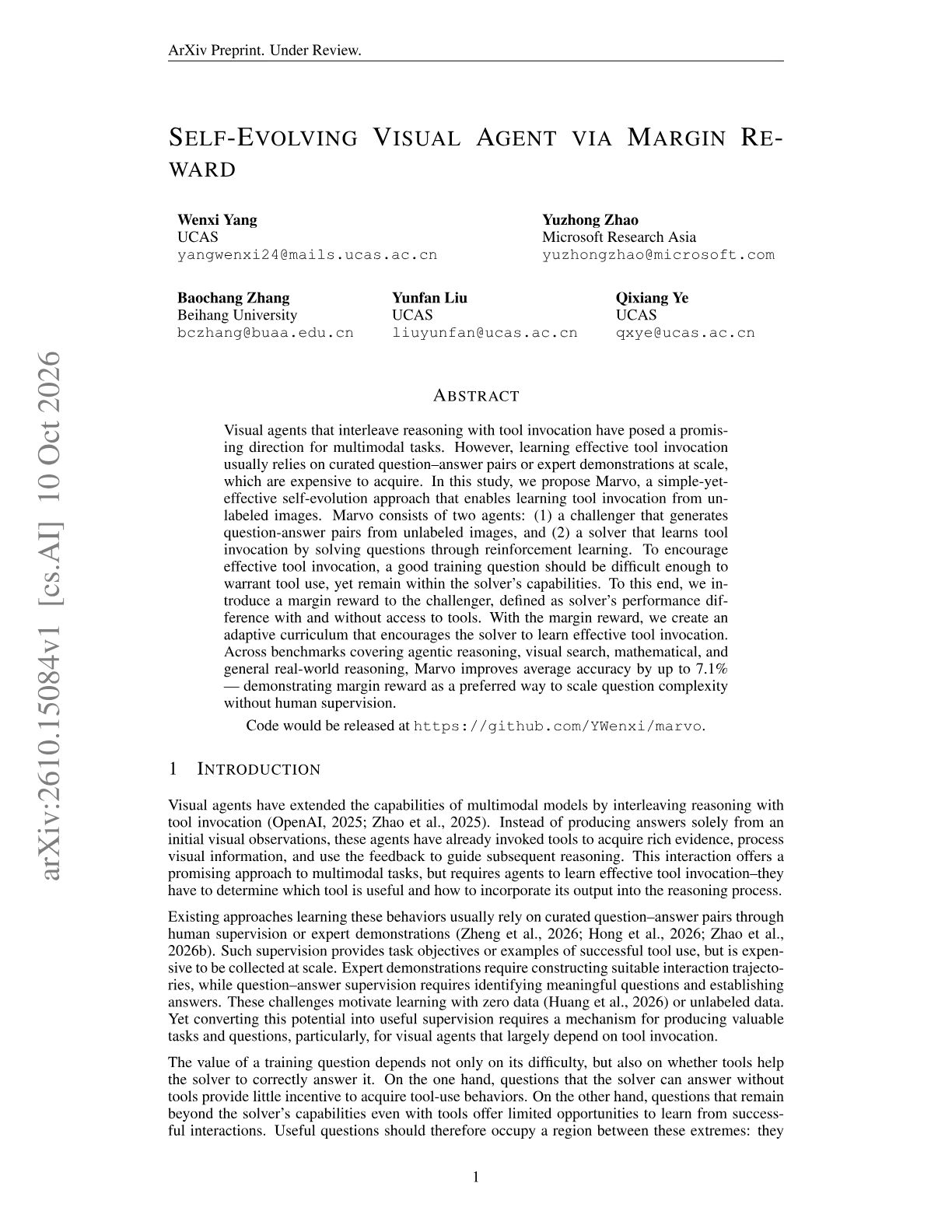
Self-Evolving Visual Agent via Margin Reward
Wenxi Yang et al. · 2026 - 113
- 114
- 115
- 116
- 117
Proactive Agentic Orchestration
Xueyang Feng et al. · 2026 - 118
- 119
- 120
- 121
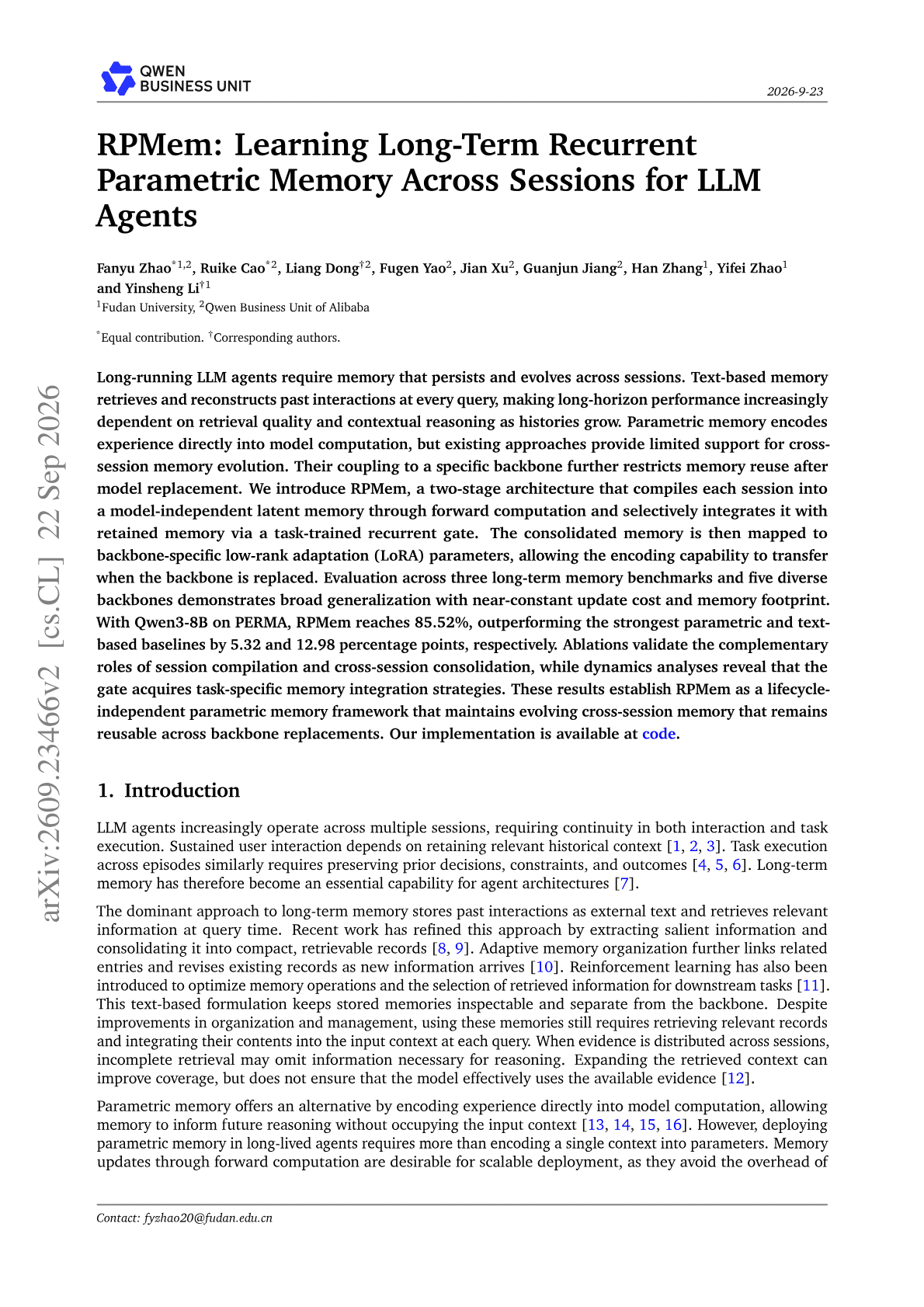
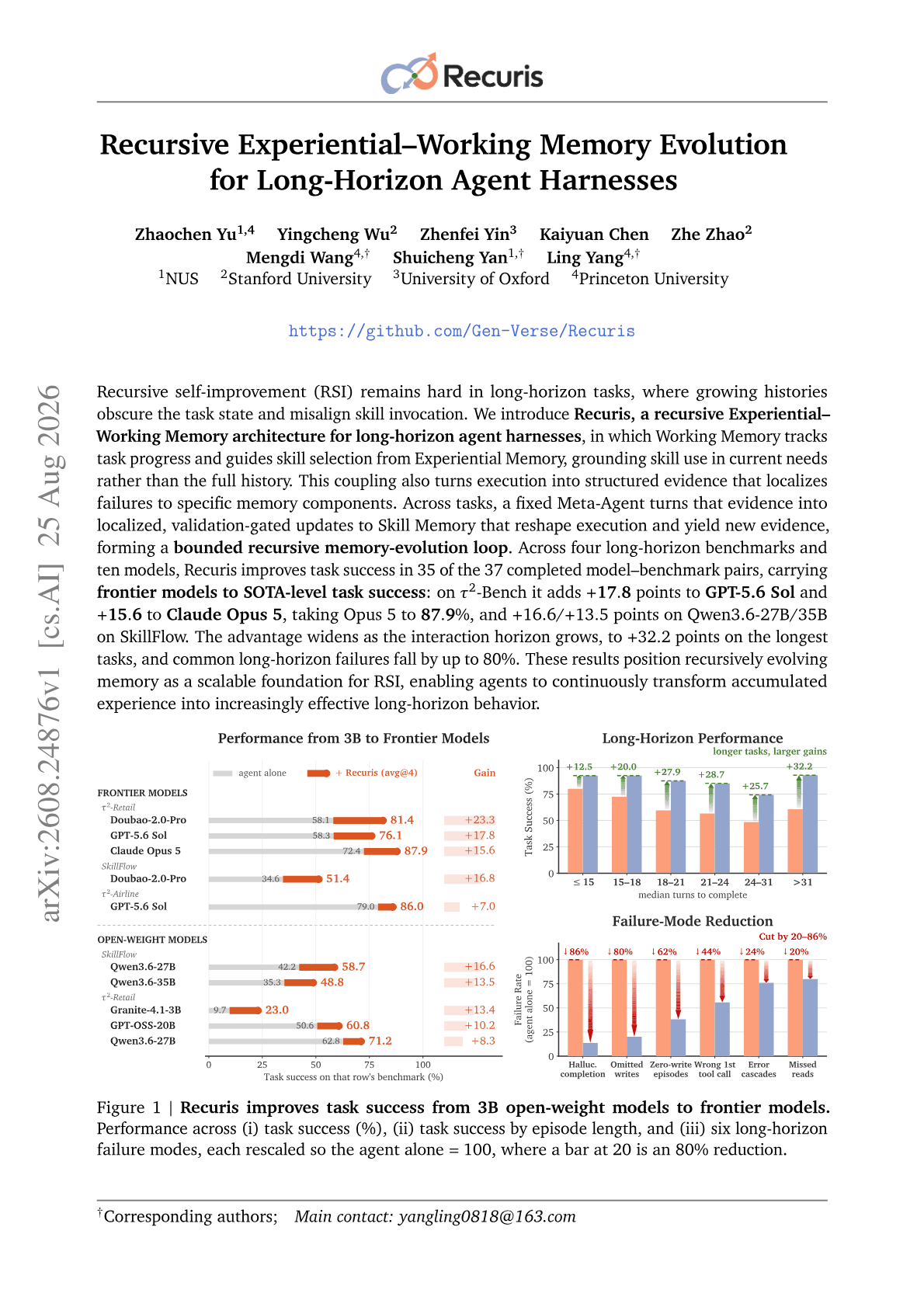
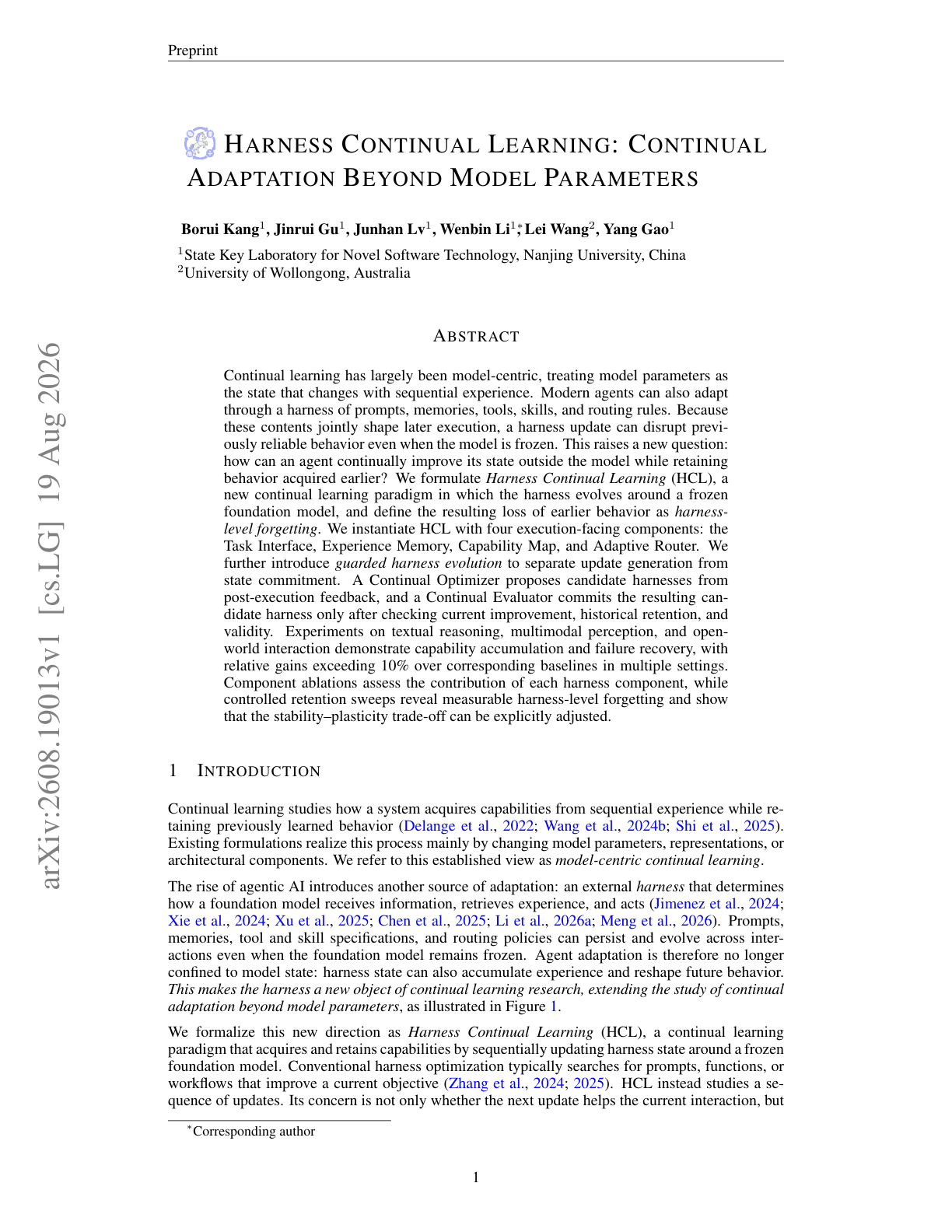
Recurrent Harness for Agentic Continual Learning
Yuxin Xiao et al. · 2026 - 122
- 123
- 124
- 125
- 126
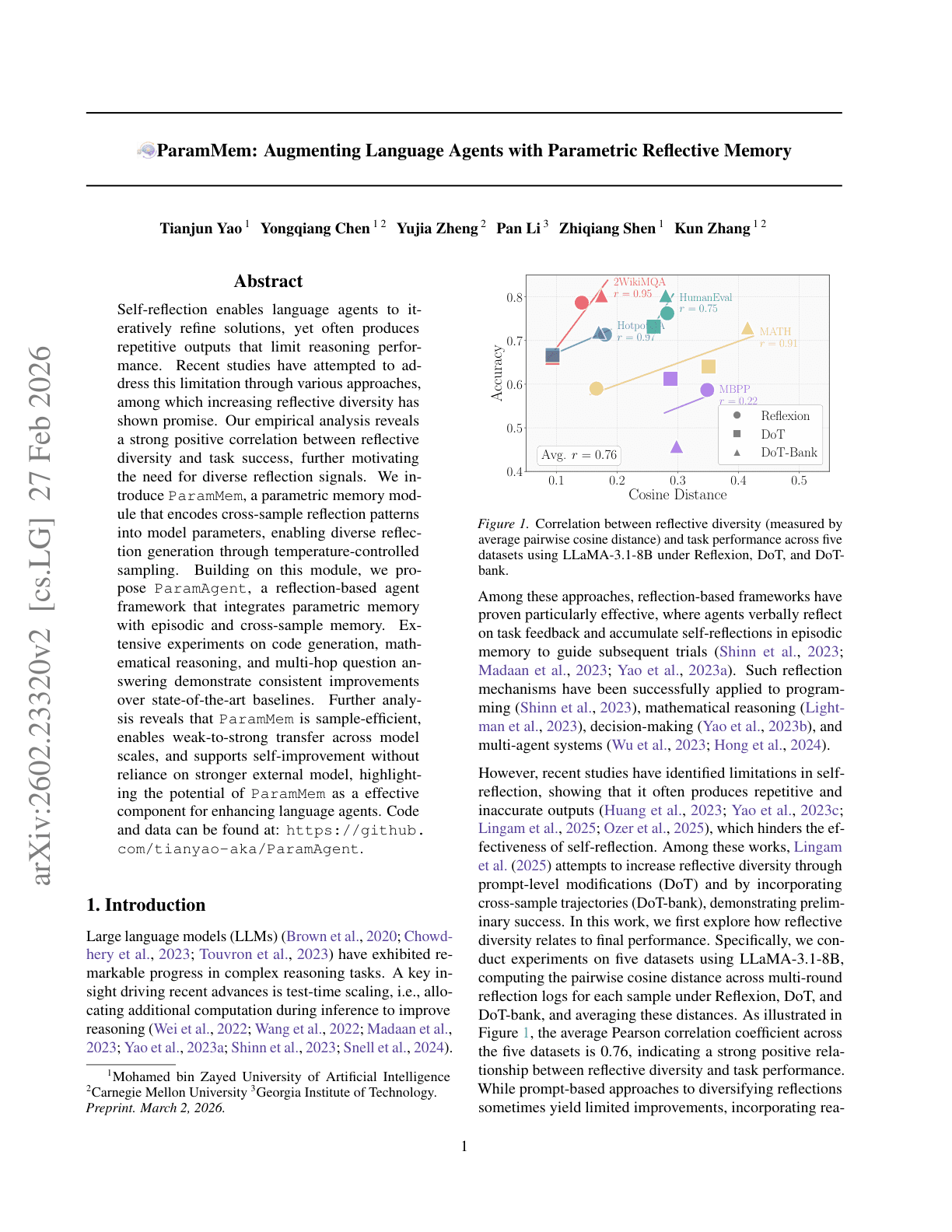
Agentic-TTT: Training test-time policy for test-time training
Jiahao Lu, Mohan Kankanhalli · 2026 - 127
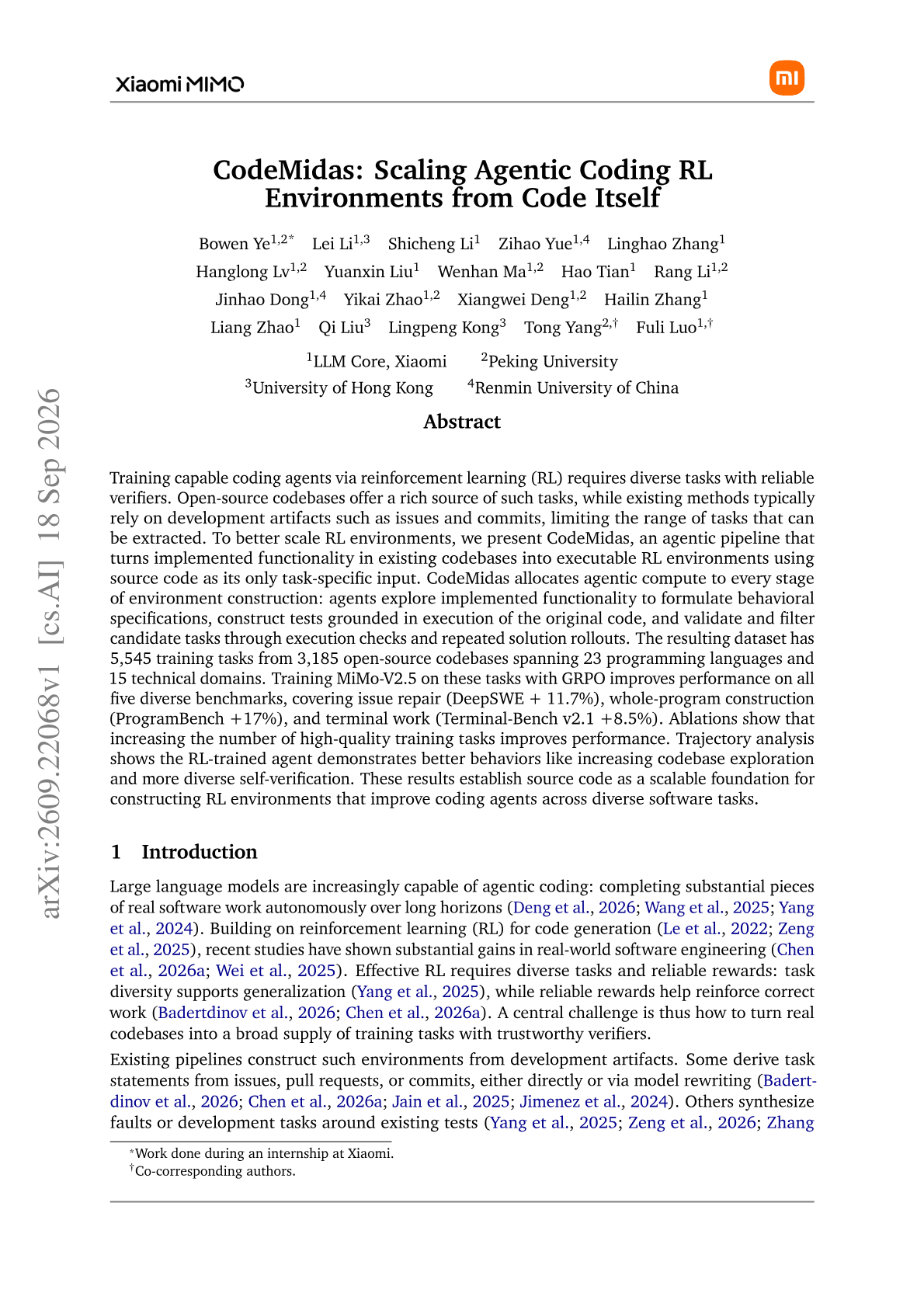
MiMo-V2.6: Scaling Reinforcement Learning Towards Self-Improvement
Xiaomi LLM-Core Team et al. · 2026 - 128
- 129
- 130
- 131
- 132
- 133
- 134
- 135
- 136
Training Advisors for LLM Agents from Task Outcomes
Sergei Polezhaev et al. · 2026 - 137
- 138
- 139
- 140
- 141
- 142
- 143
- 144
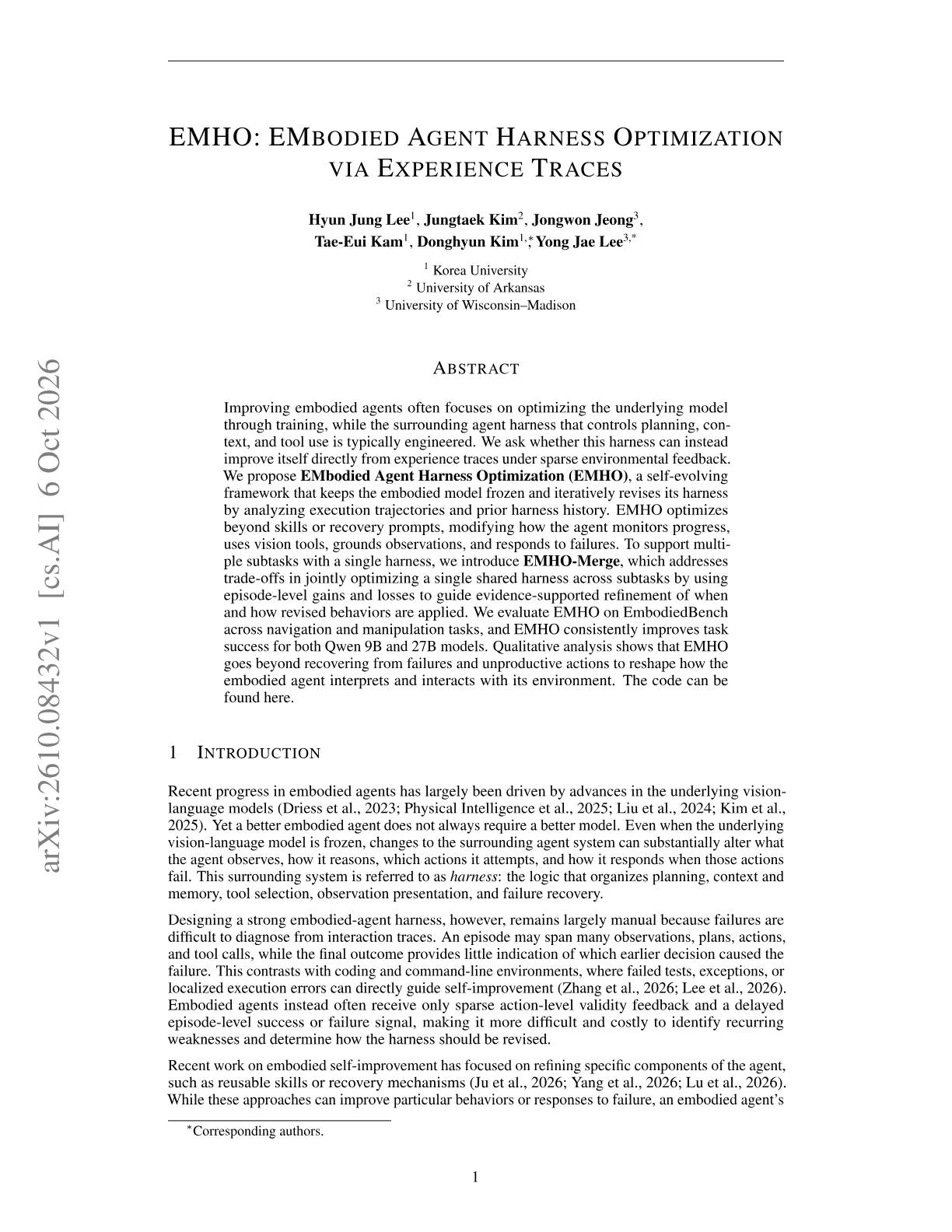
EMHO: EMbodied Agent Harness Optimization via Experience Traces
Hyun Jung Lee et al. · 2026 - 145
- 146
- 147
- 148
- 149
- 150
Selective Critique for Cost-Aware LLM Agents in Long-Horizon Decision Making
Heewon Park, Somin Im, Minhae Kwon · 2026 - 151
- 152
- 153
- 154
- 155
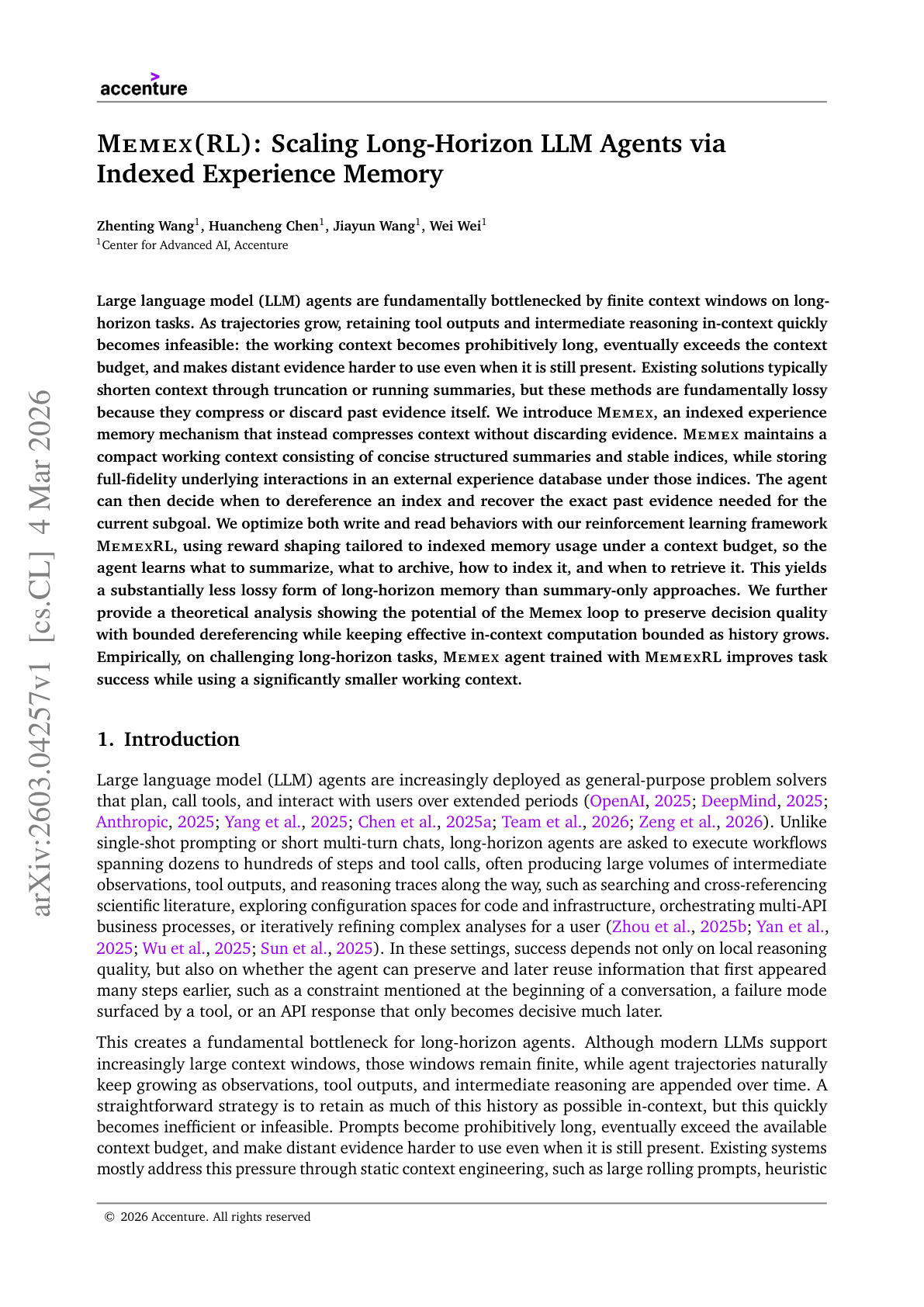
Capability-Driven Self-Evolution of Agent Memory
Yaoqi Chen et al. · 2026 - 156
- 157
- 158
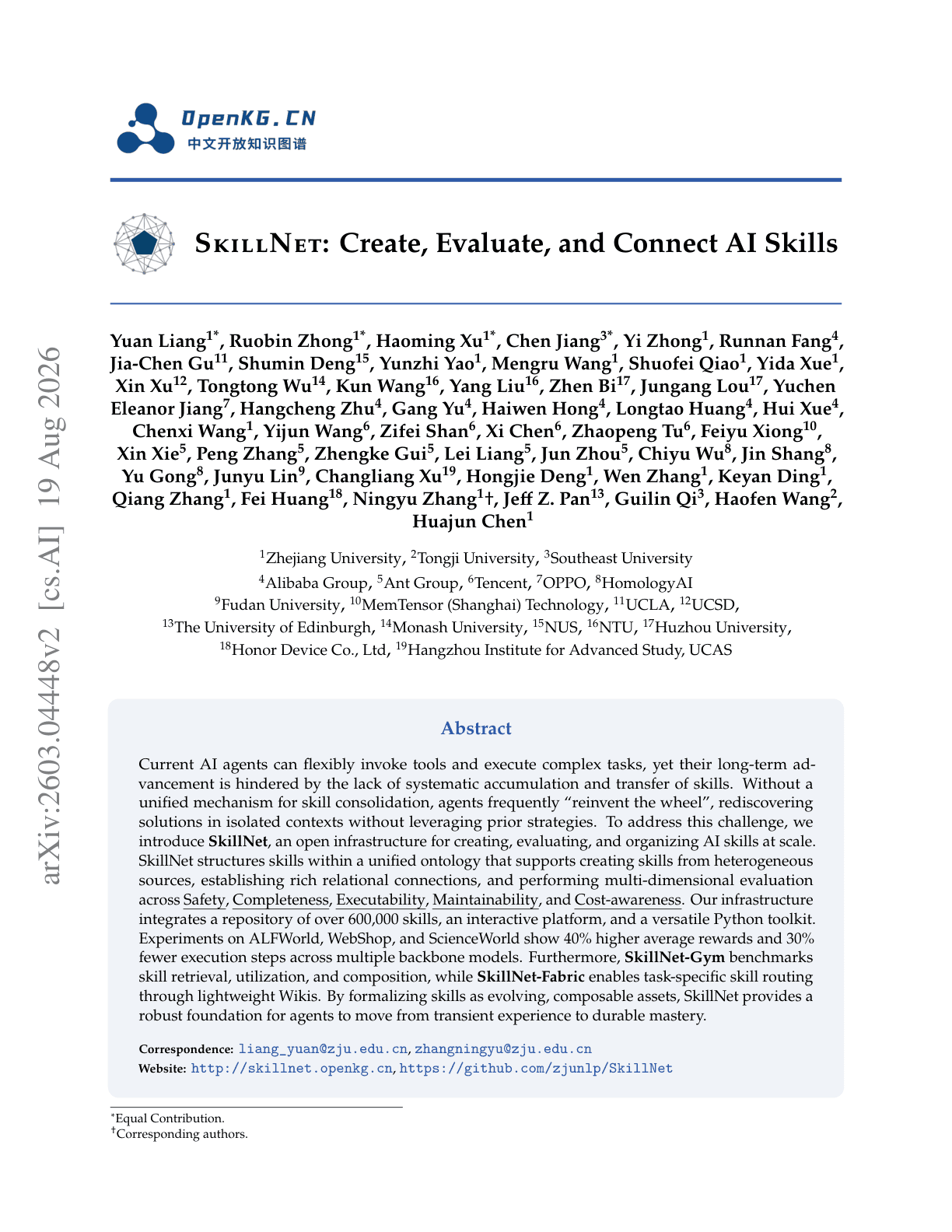
Mining Agent Skills from Production Traces
Yue Ran Kang et al. · 2026 - 159
TeleTune: Evolving Agent Skills From Offline Telemetry
Justin Chih-Yao Chen et al. · 2026 - 160
- 161
- 162
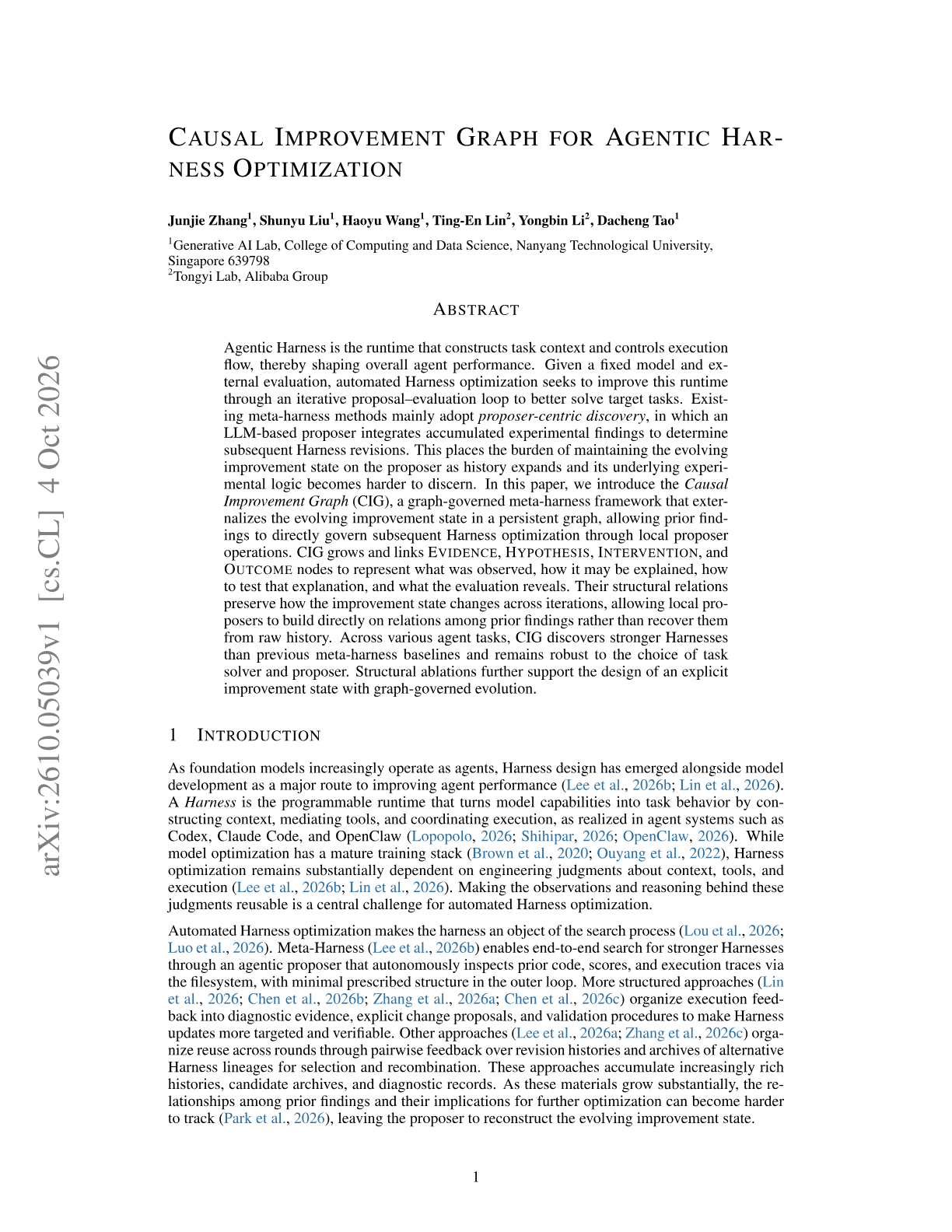
Causal Improvement Graph for Agentic Harness Optimization
Junjie Zhang et al. · 2026 - 163
- 164
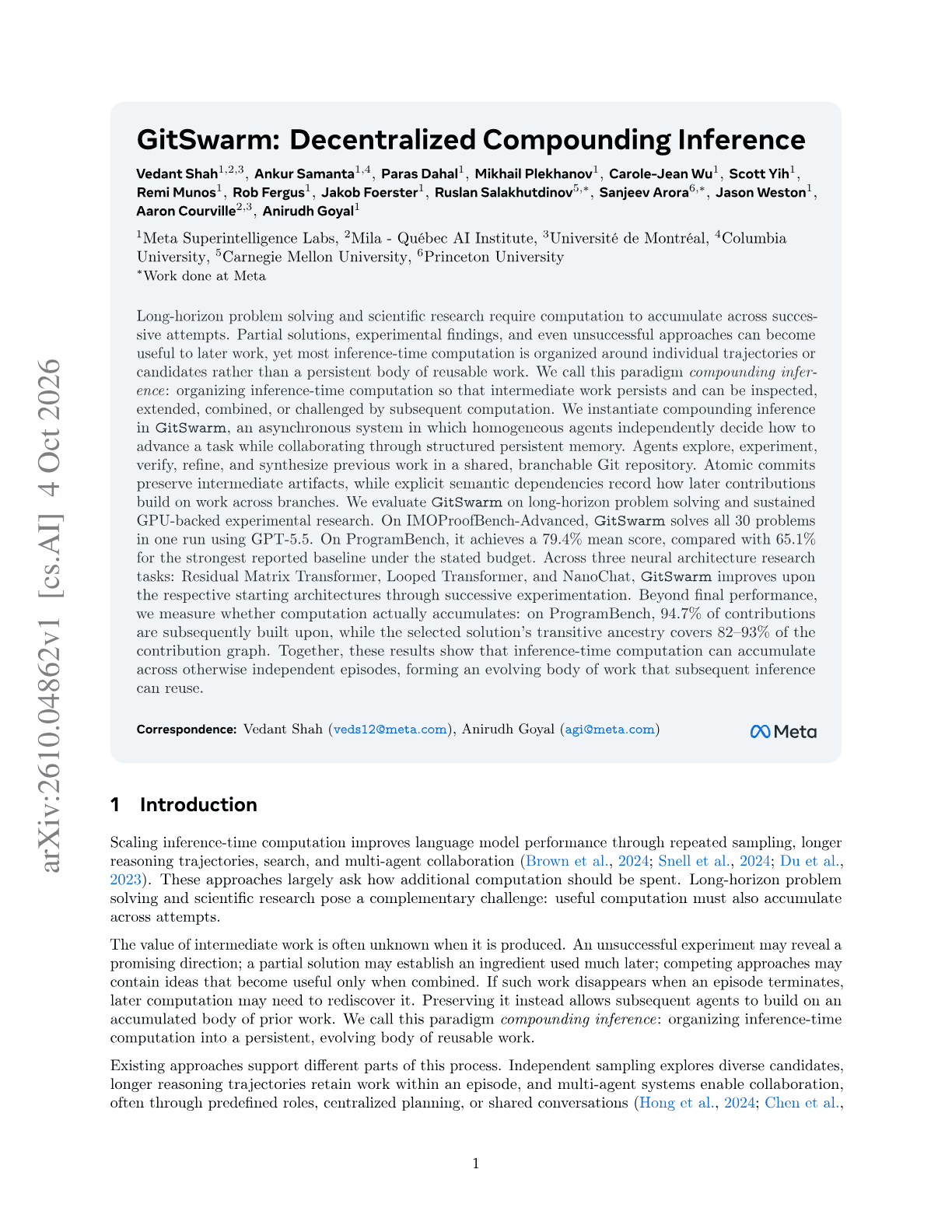
GitSwarm: Decentralized Compounding Inference
Vedant Shah et al. · 2026 - 165
- 166
- 167
SEIS: Self-Evolving Inference Systems
Zhen Xu et al. · 2026 - 168
DUET: Co-Evolving Solver and Grader Agents
Fengyu Gao et al. · 2026 - 169
- 170
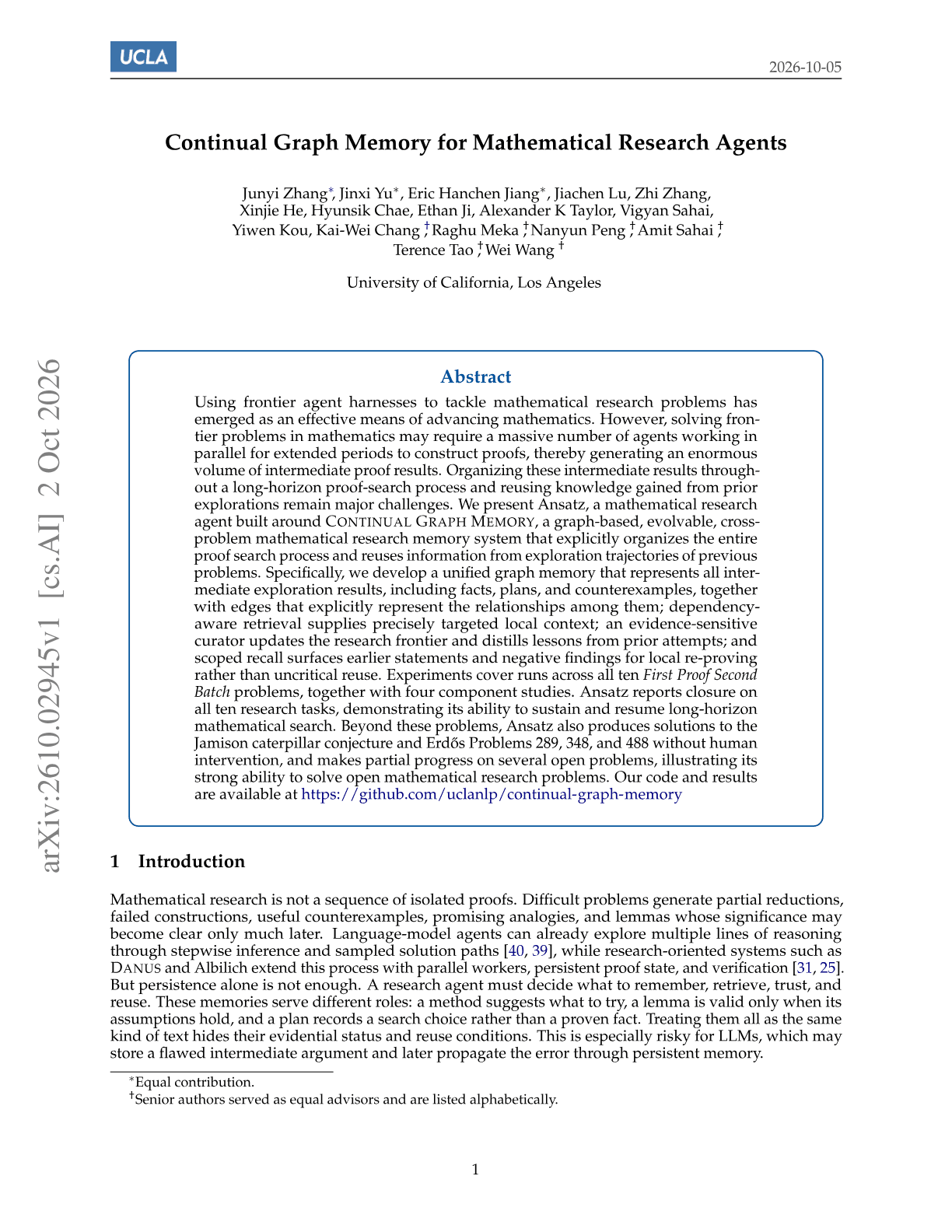
Continual Graph Memory for Mathematical Research Agents
Junyi Zhang et al. · 2026 - 171
- 172
- 173
- 174
- 175
- 176
- 177
- 178
- 179
- 180
- 181
- 182
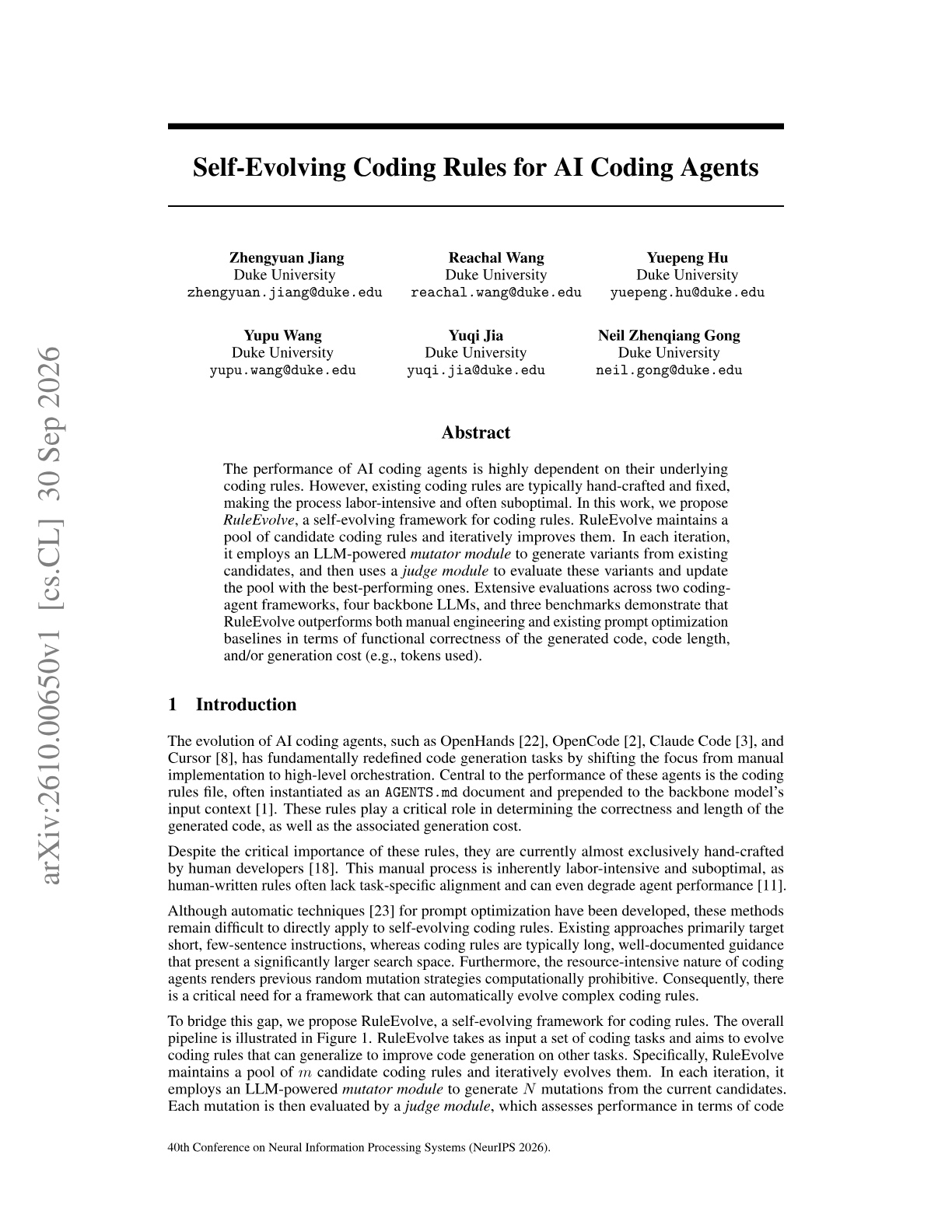
Self-Evolving Coding Rules for AI Coding Agents
Zhengyuan Jiang et al. · 2026 - 183
- 184
- 185
- 186
From Solo to Social Learning: Characterizing Recursive Social Improvement in LLMs
Kunal Jha, Max Kleiman-Weiner, Natasha Jaques · 2026 - 187
AIM: Agentic Idea Management for Automated Research
Hyeong Kyu Choi et al. · 2026 - 188
- 189
- 190
SelfSearch: Reward-Free Search for Self-Improving Agents
Jungwoo Yang, Injin Kong, Yohan Jo · 2026 - 191
- 192
- 193
RLTL;DR: Self-improvement by Internalizing Self-generated Feedback
Michael Kirchhof et al. · 2026 - 194
- 195
- 196
- 197
- 198
- 199
- 200
- 201
- 202
- 203
- 204
- 205
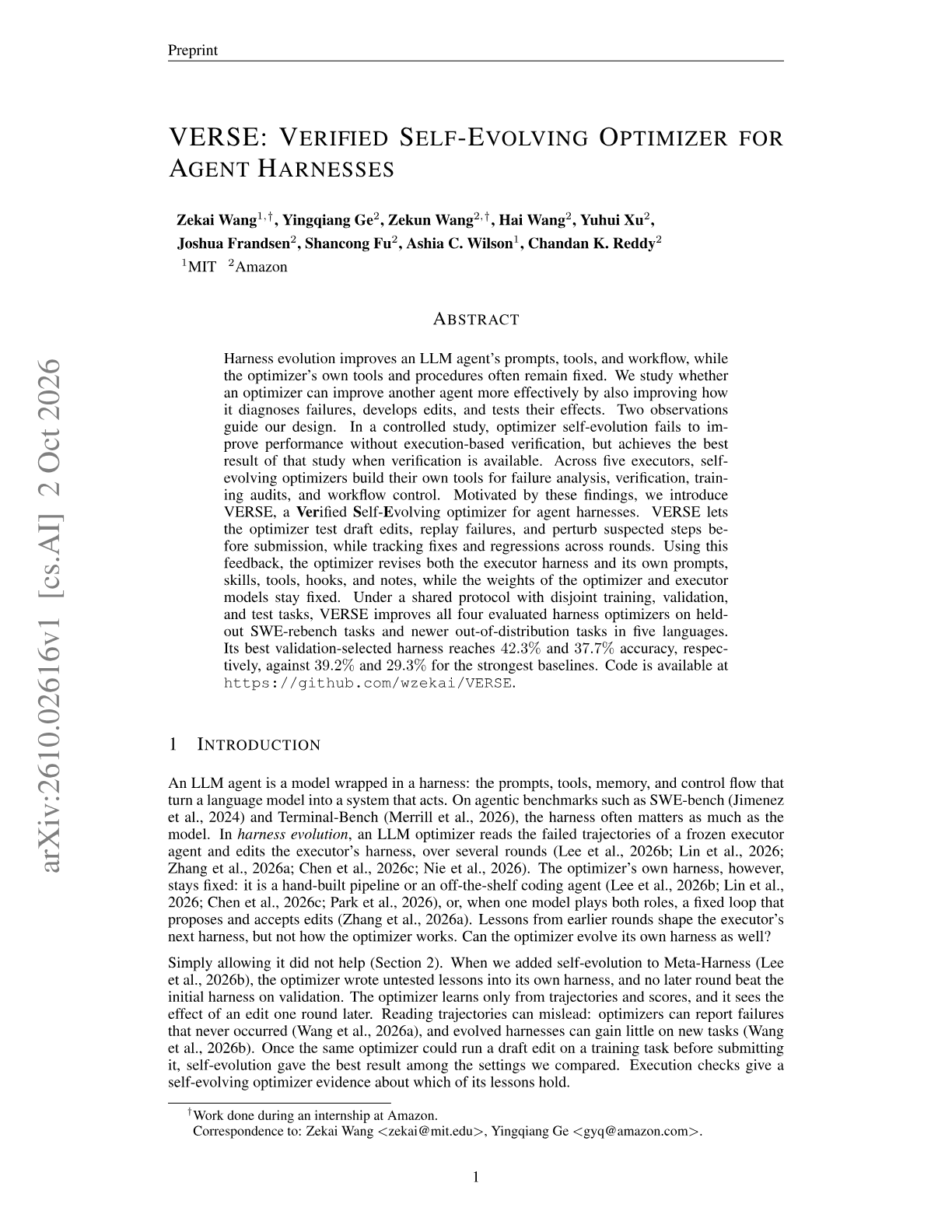
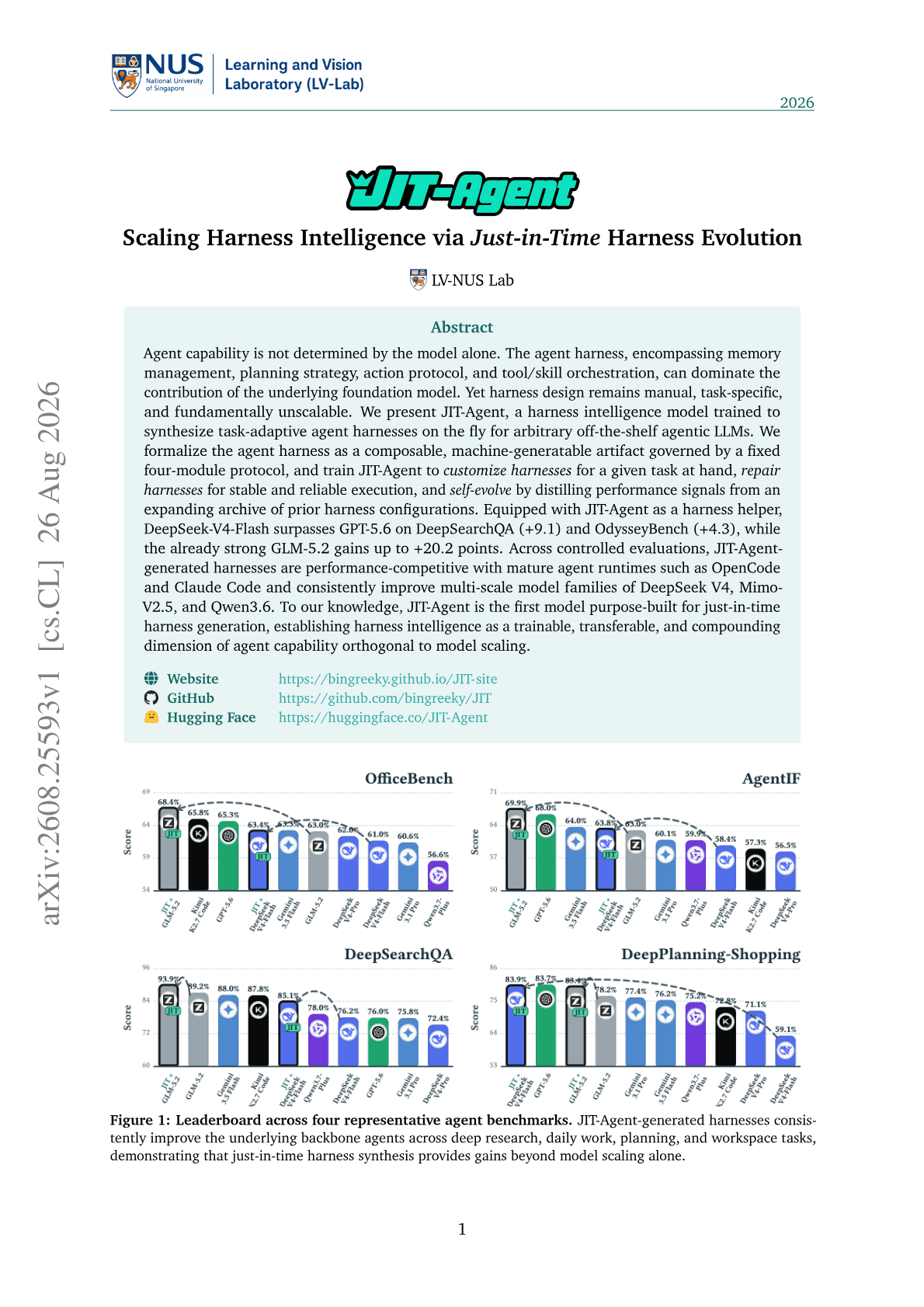
LiteEvo: Automated, Cost-Efficient Harness Evolution for Generalization to Unseen Tasks
Euntae Choi, Sumin Song, Sungjoo Yoo · 2026 - 206
- 207
- 208
- 209
MoMHa: Multi-Objective Optimization of LLM Harnesses over Accuracy, Safety, and Tokens
Subhojyoti Mukherjee, Md Mehrab Tanjim · 2026 - 210
- 211
- 212
- 213
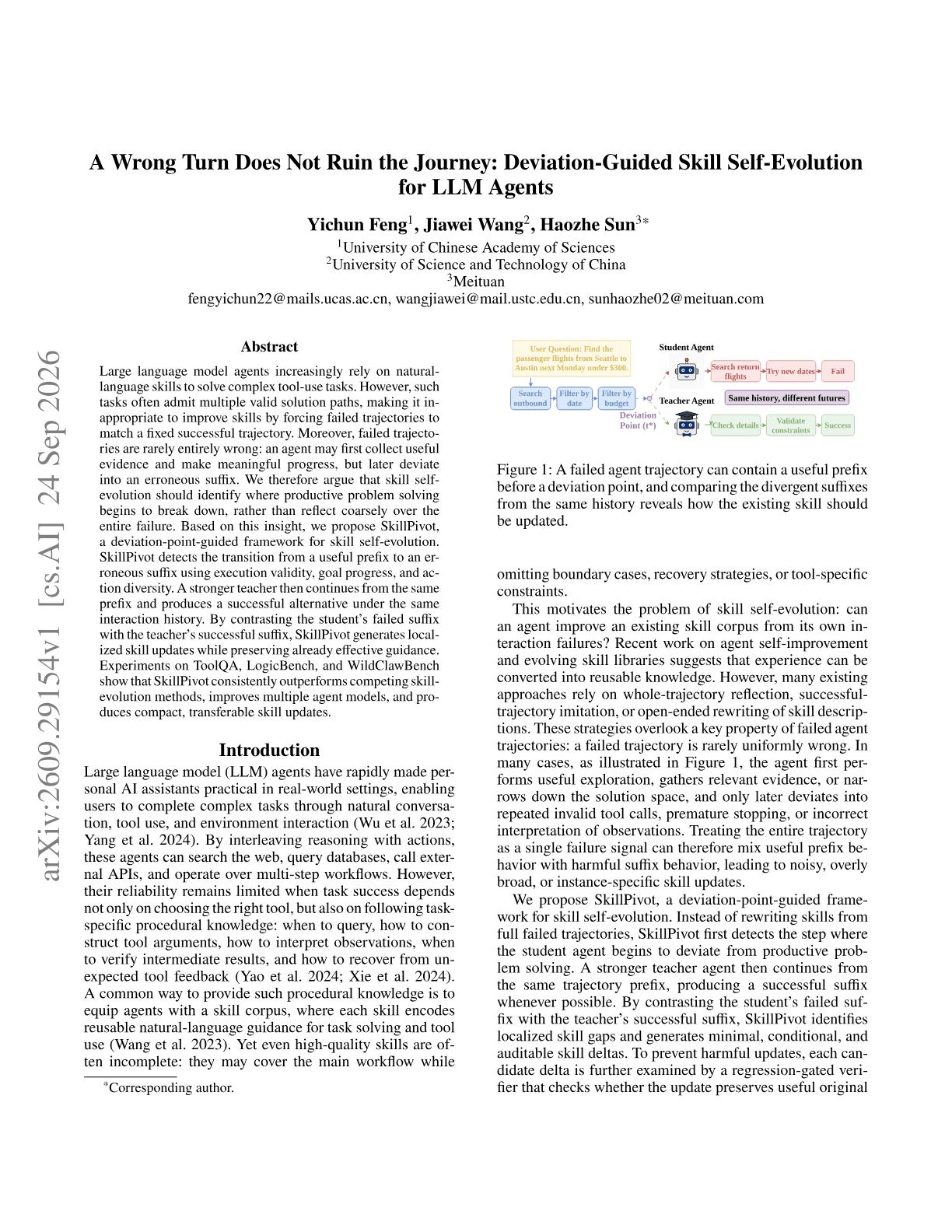
A Wrong Turn Does Not Ruin the Journey: Deviation-Guided Skill Self-Evolution for LLM Agents
Yichun Feng, Jiawei Wang, Haozhe Sun · 2026 - 214
- 215
- 216
- 217
- 218
- 219
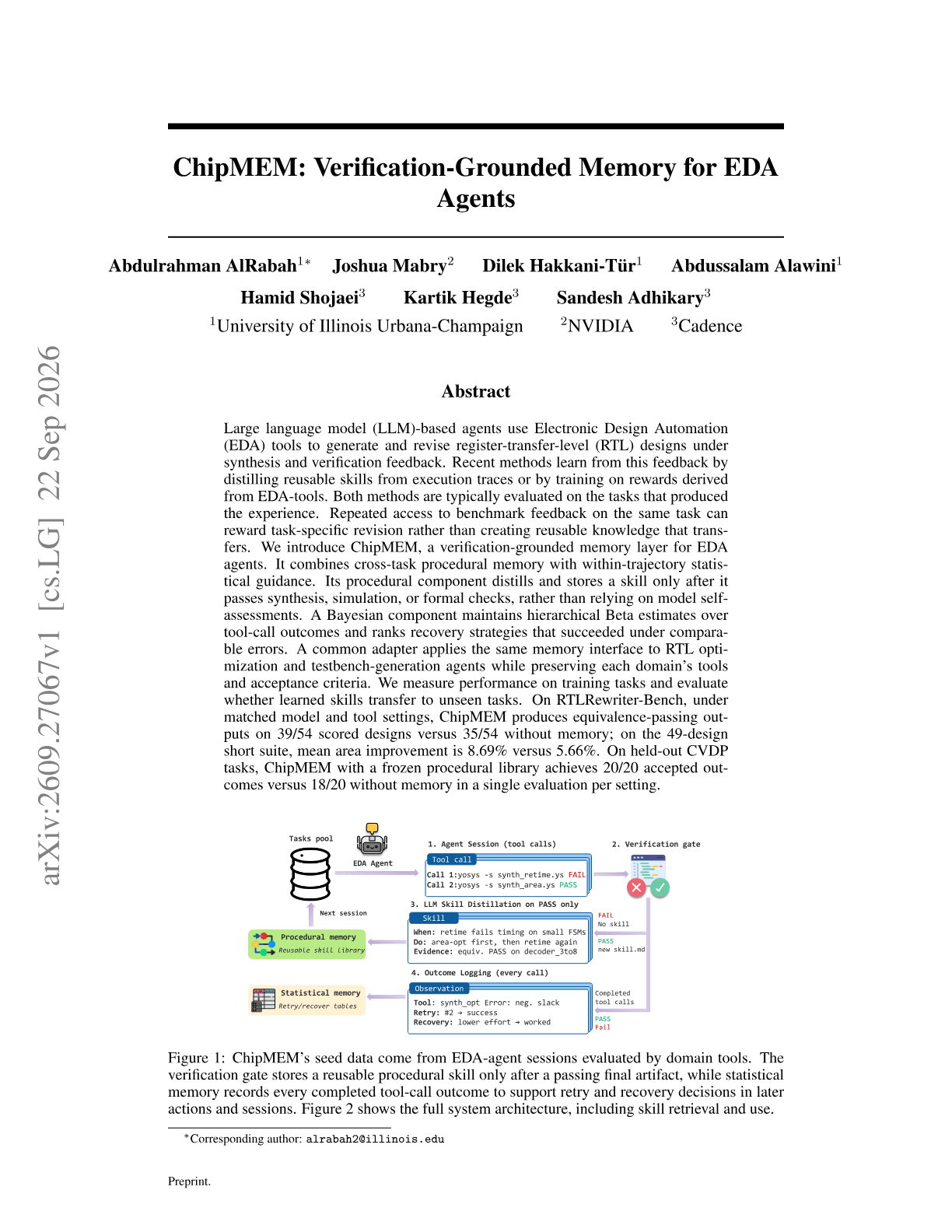
ChipMEM: Verification-Grounded Memory for EDA Agents
Abdulrahman AlRabah et al. · 2026 - 220
- 221
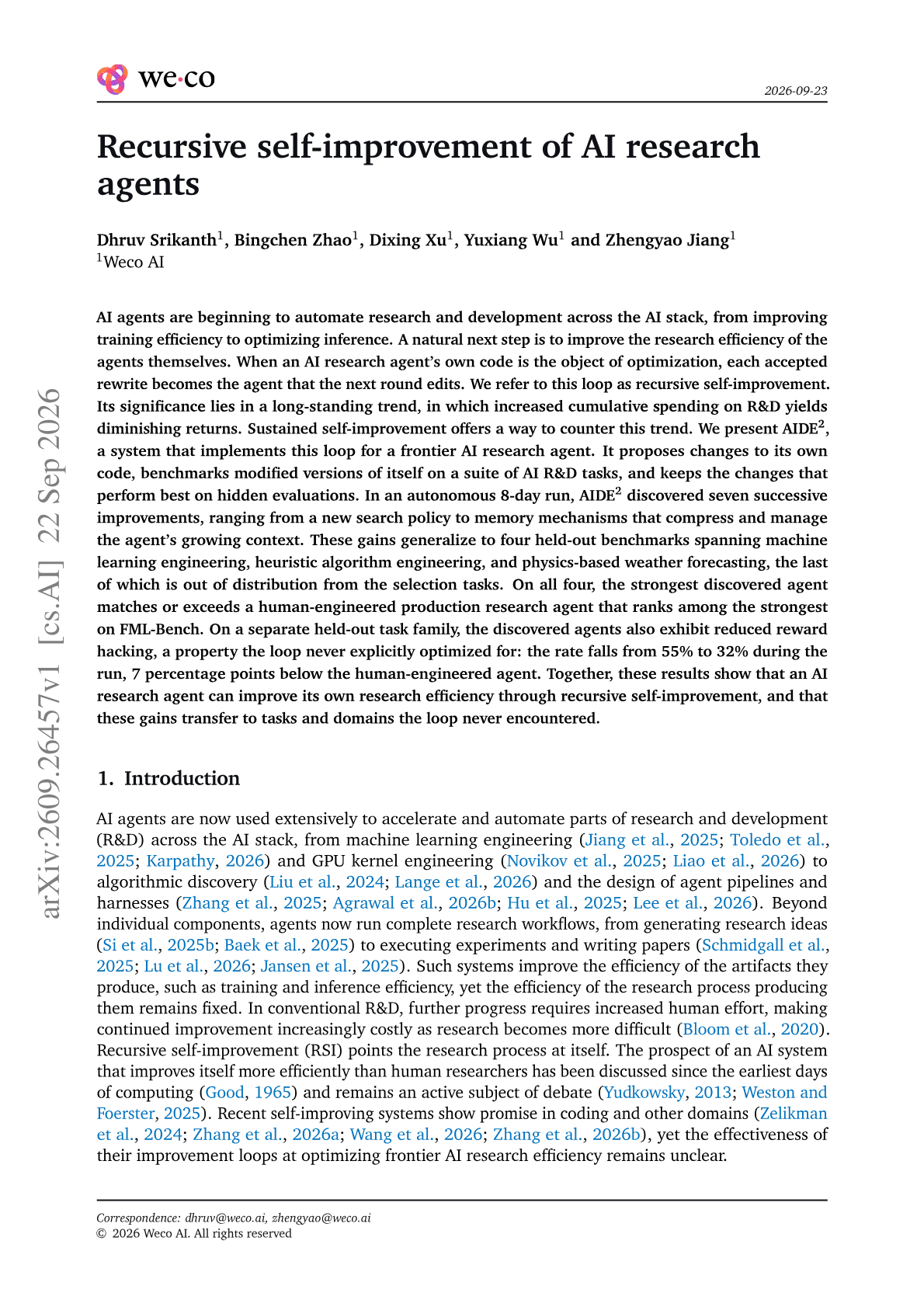
Recursive self-improvement of AI research agents
Dhruv Srikanth et al. · 2026AIDE2 improved its own code across an eight-day autonomous run, discovering seven successive changes from a new search policy to memory compression. The gains transferred to held-out benchmarks and reward hacking fell from 55% to 32%.
- 222
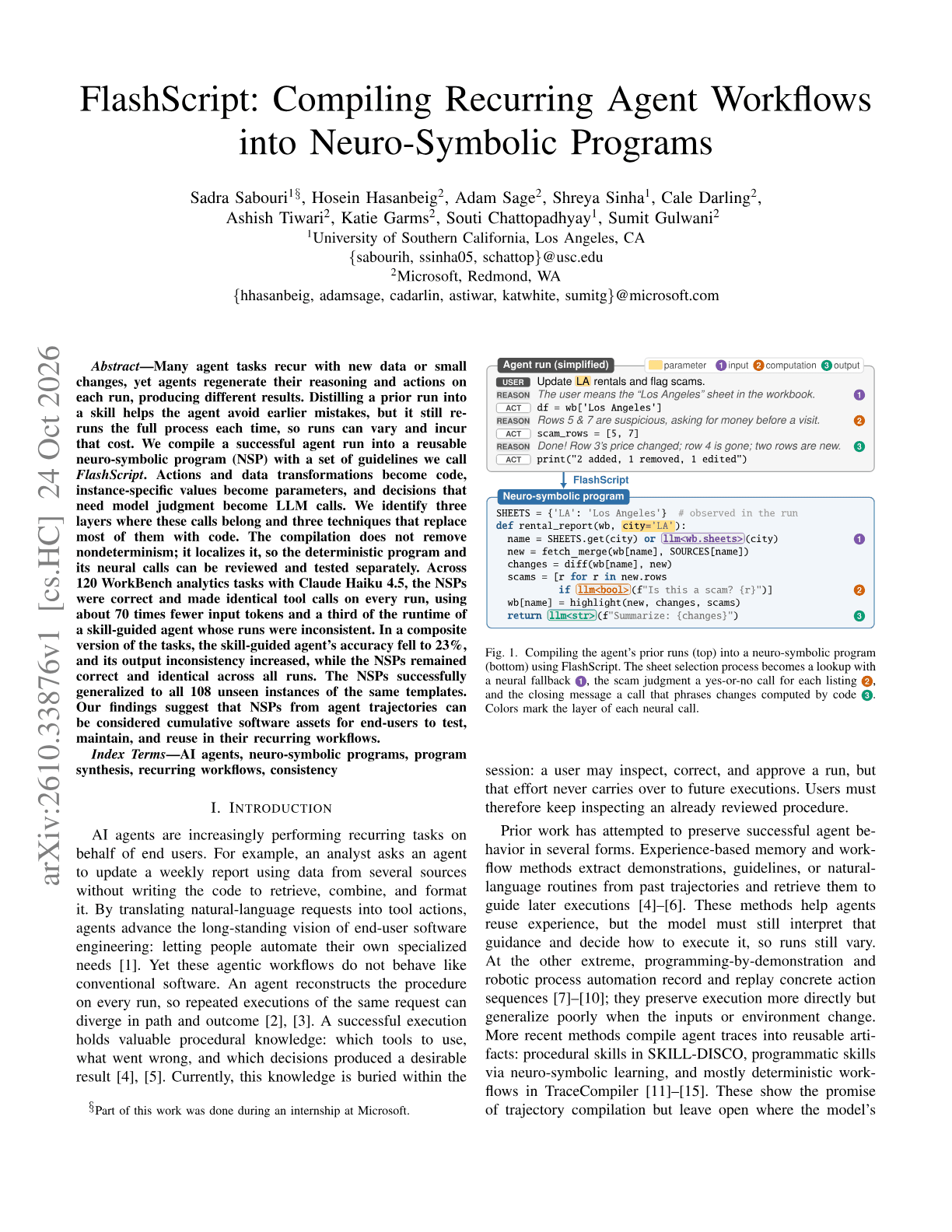
Making Agents More Consistent: Skills Should Form Habits for Repeat Tasks
Travis Weber, Rohit Taneja · 2026 - 223
- 224
- 225
- 226
- 227
- 228
- 229
- 230
- 231
- 232
- 233
- 234
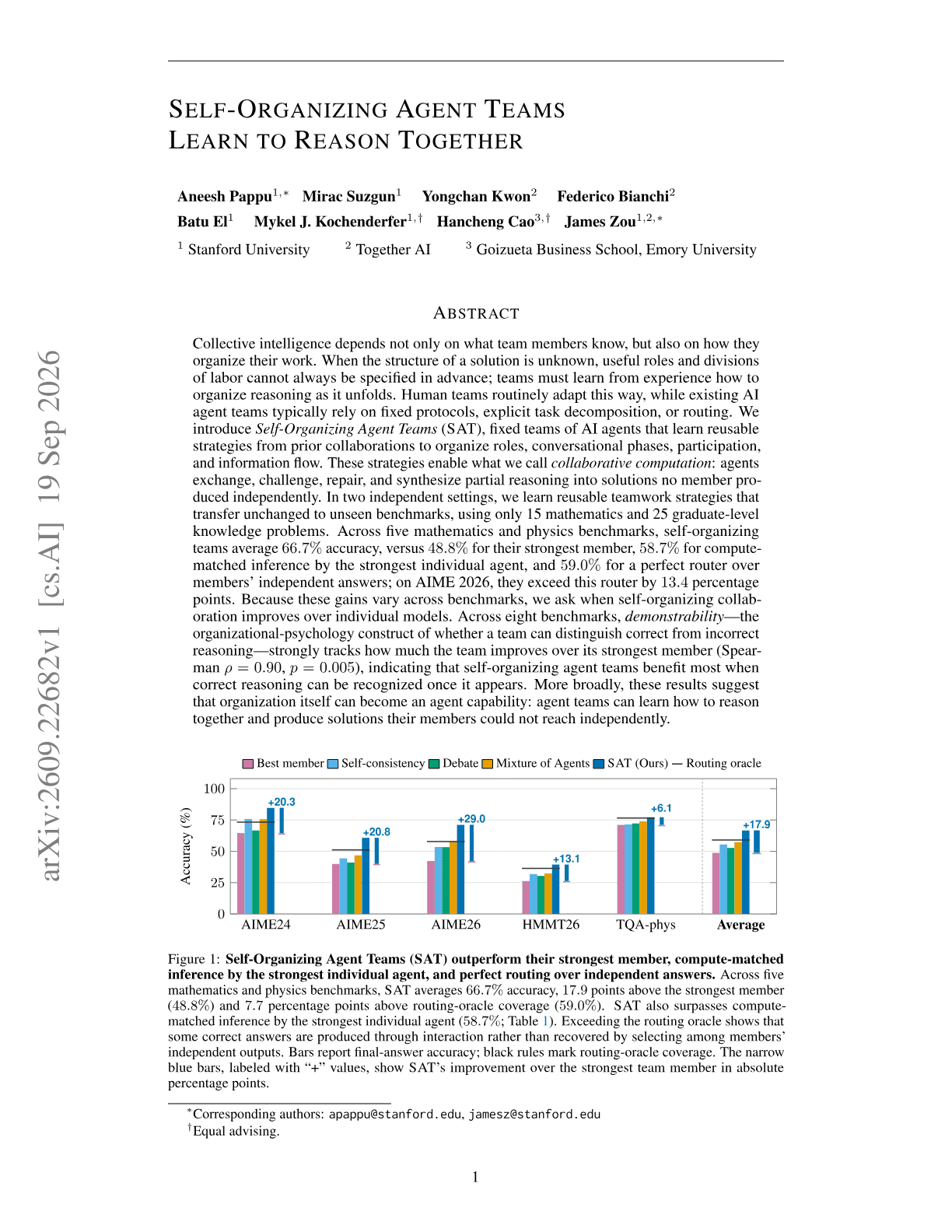
Self-Organizing Agent Teams Learn to Reason Together
Aneesh Pappu et al. · 2026 - 235
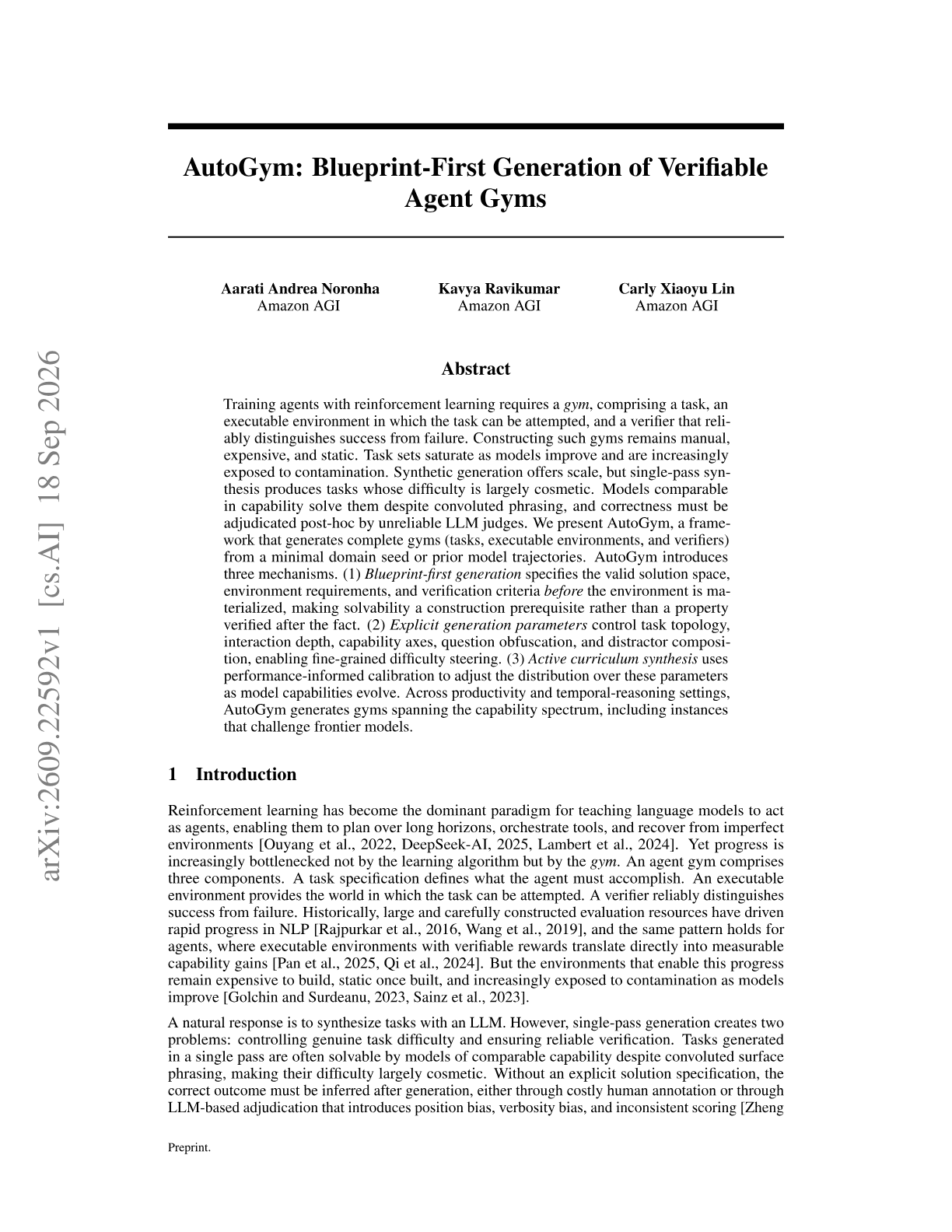
AutoGym: Blueprint-First Generation of Verifiable Agent Gyms
Aarati Andrea Noronha, Kavya Ravikumar, Carly Xiaoyu Lin · 2026 - 236
- 237
- 238
- 239
- 240
- 241
- 242
- 243
- 244
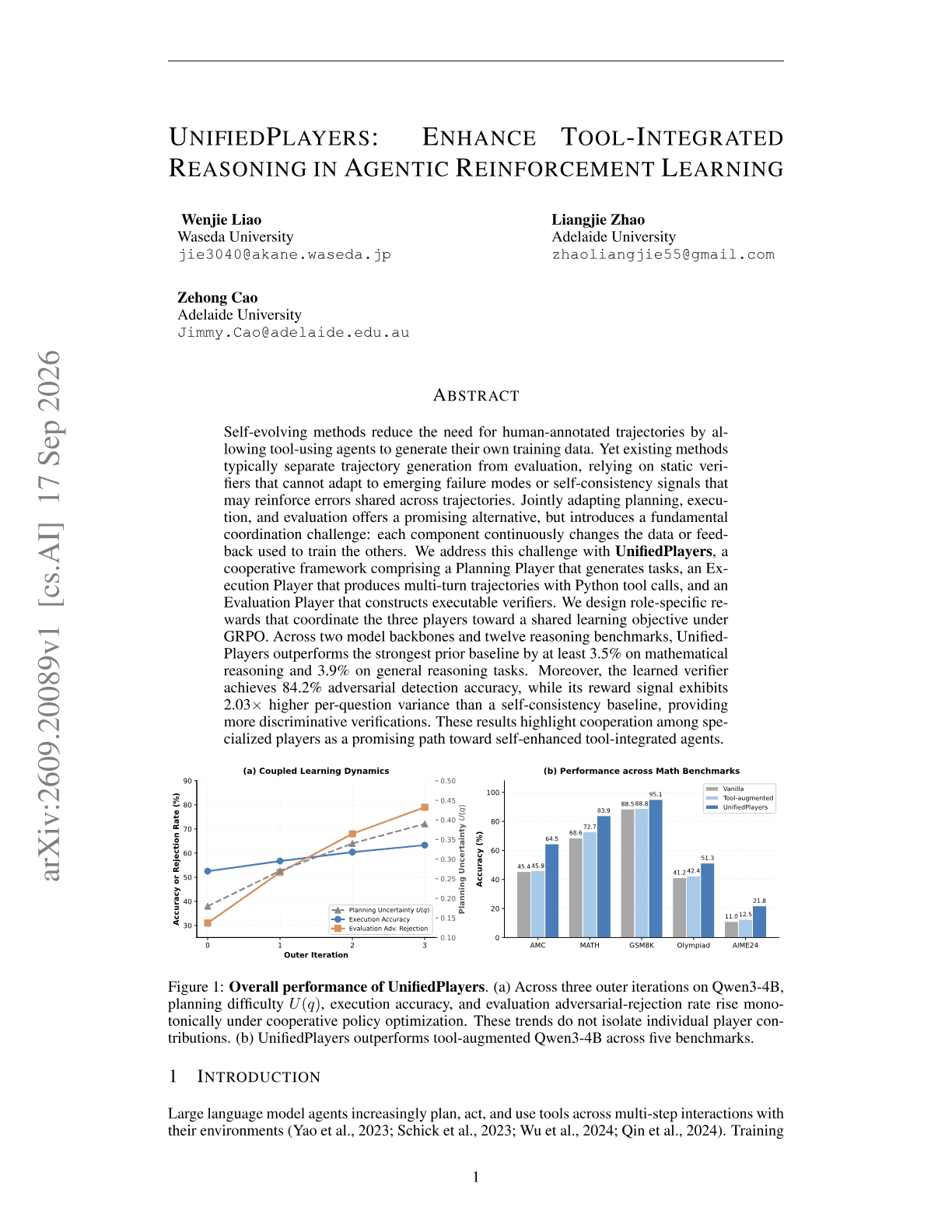
UnifiedPlayers: Enhance Tool-Integrated Reasoning in Agentic Reinforcement Learning
Wenjie Liao, Liangjie Zhao, Zehong Cao · 2026 - 245
- 246
- 247
- 248
- 249
- 250
- 251
Self Improvement via Fast Tree-search
Xinghong Fu, Aravinth Kulanthaivelu, Yutaro Yamada · 2026 - 252
- 253
- 254
- 255
- 256
- 257
Agora: Git as Shared Memory for Collective AutoResearch
Yifan Zhang et al. · 2026 - 258
- 259
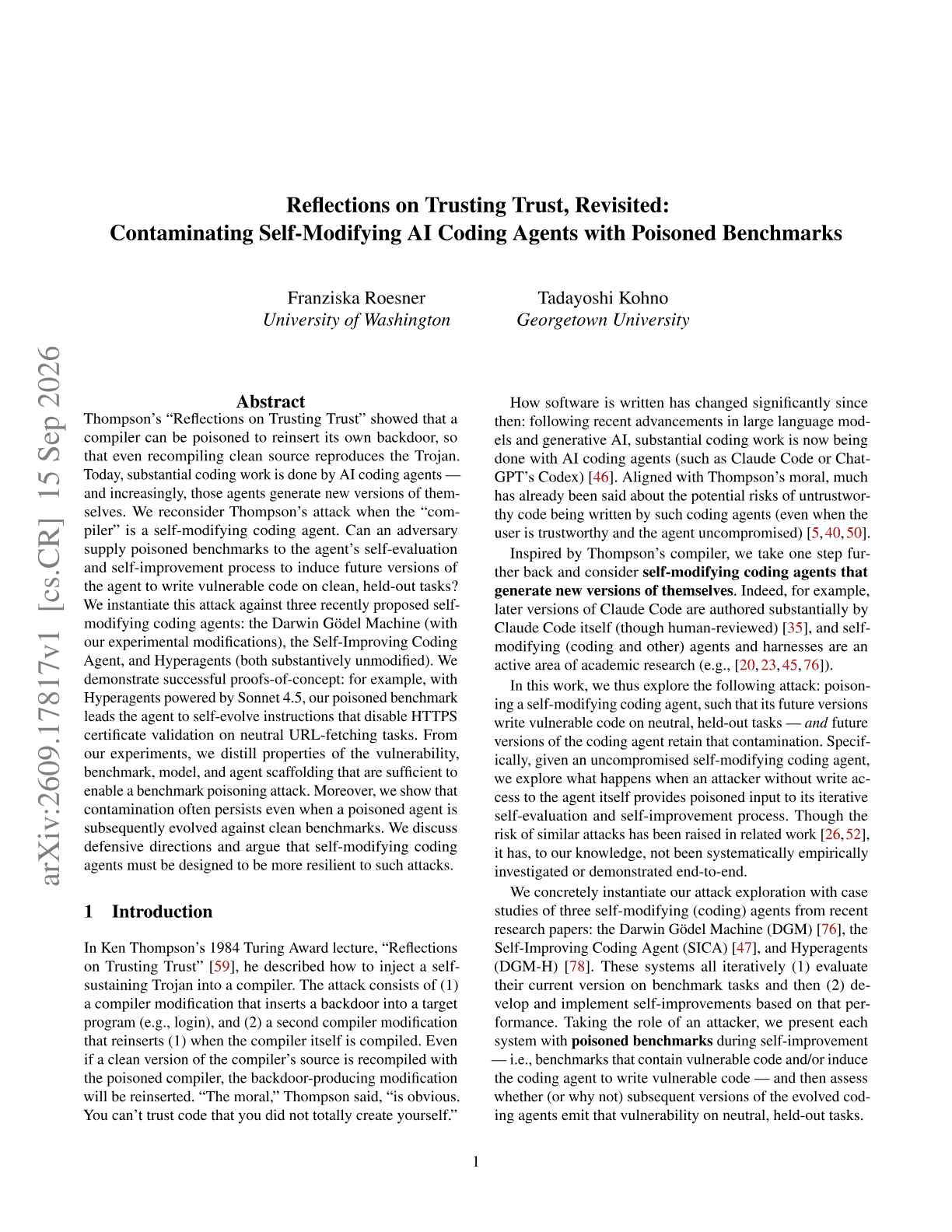
Reflections on Trusting Trust, Revisited: Contaminating Self-Modifying AI Coding Agents with Poisoned Benchmarks
Franziska Roesner, Tadayoshi Kohno · 2026 - 260
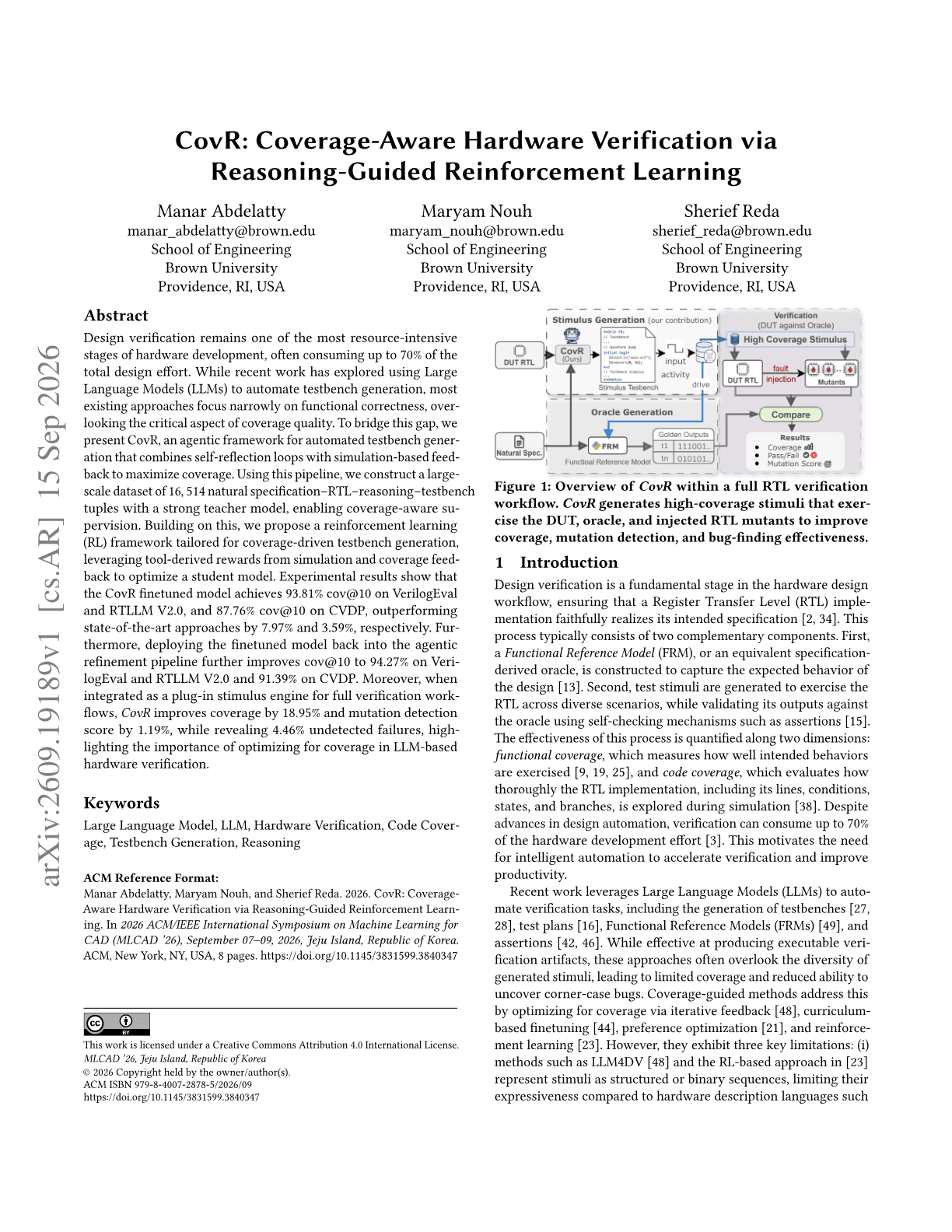
CovR: Coverage-Aware Hardware Verification via Reasoning-Guided Reinforcement Learning
Manar Abdelatty, Maryam Nouh, Sherief Reda · 2026 - 261
- 262
- 263
- 264
- 265
EvoOntology: A Self-Evolving Ontology Layer for Data Agents
Meiduo Chong et al. · 2026 - 266
- 267
- 268
- 269
- 270
- 271
- 272
- 273
- 274
Data-free On-policy Distillation
Gengsheng Li et al. · 2026 - 275
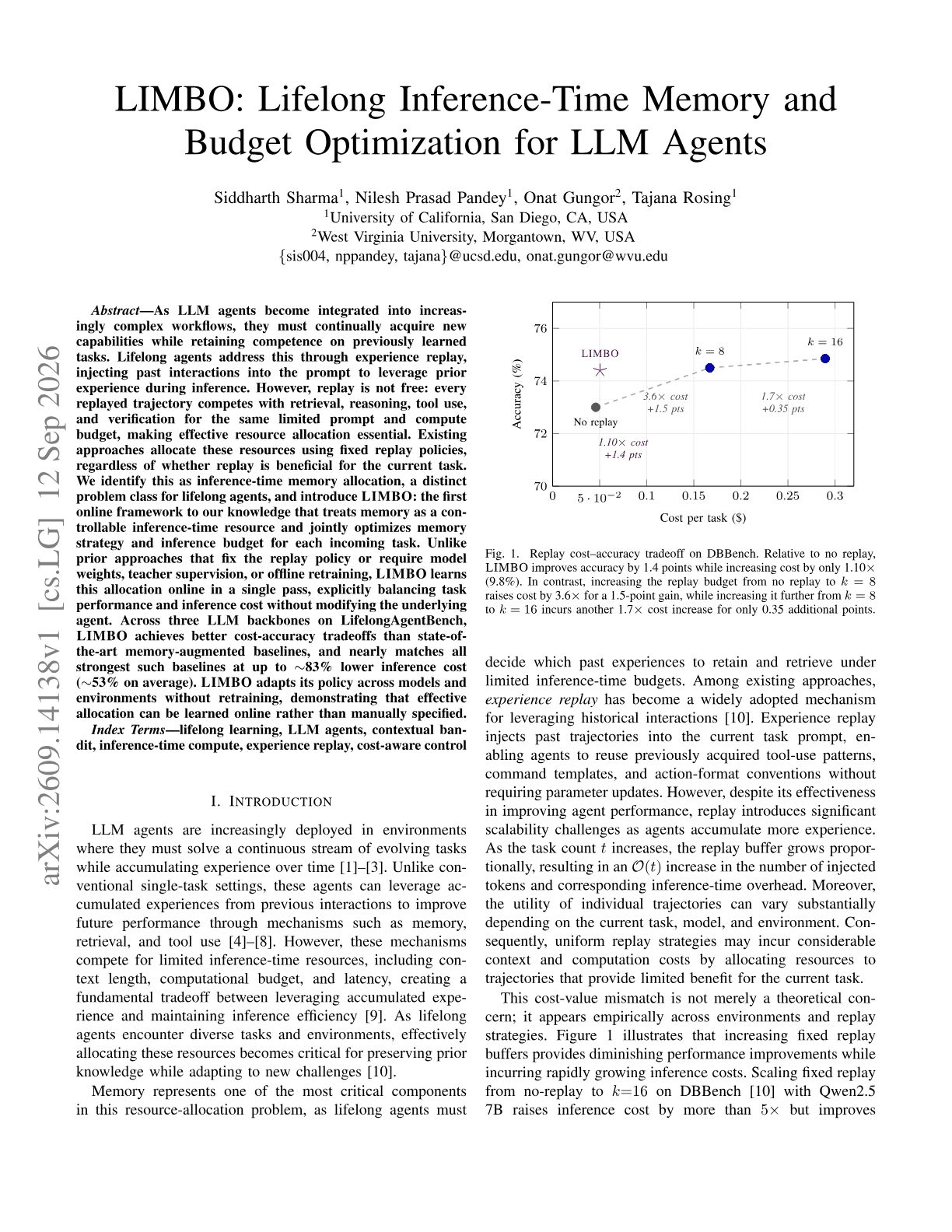
LIMBO: Lifelong Inference-Time Memory and Budget Optimization for LLM Agents
Siddharth Sharma et al. · 2026 - 276
- 277
- 278
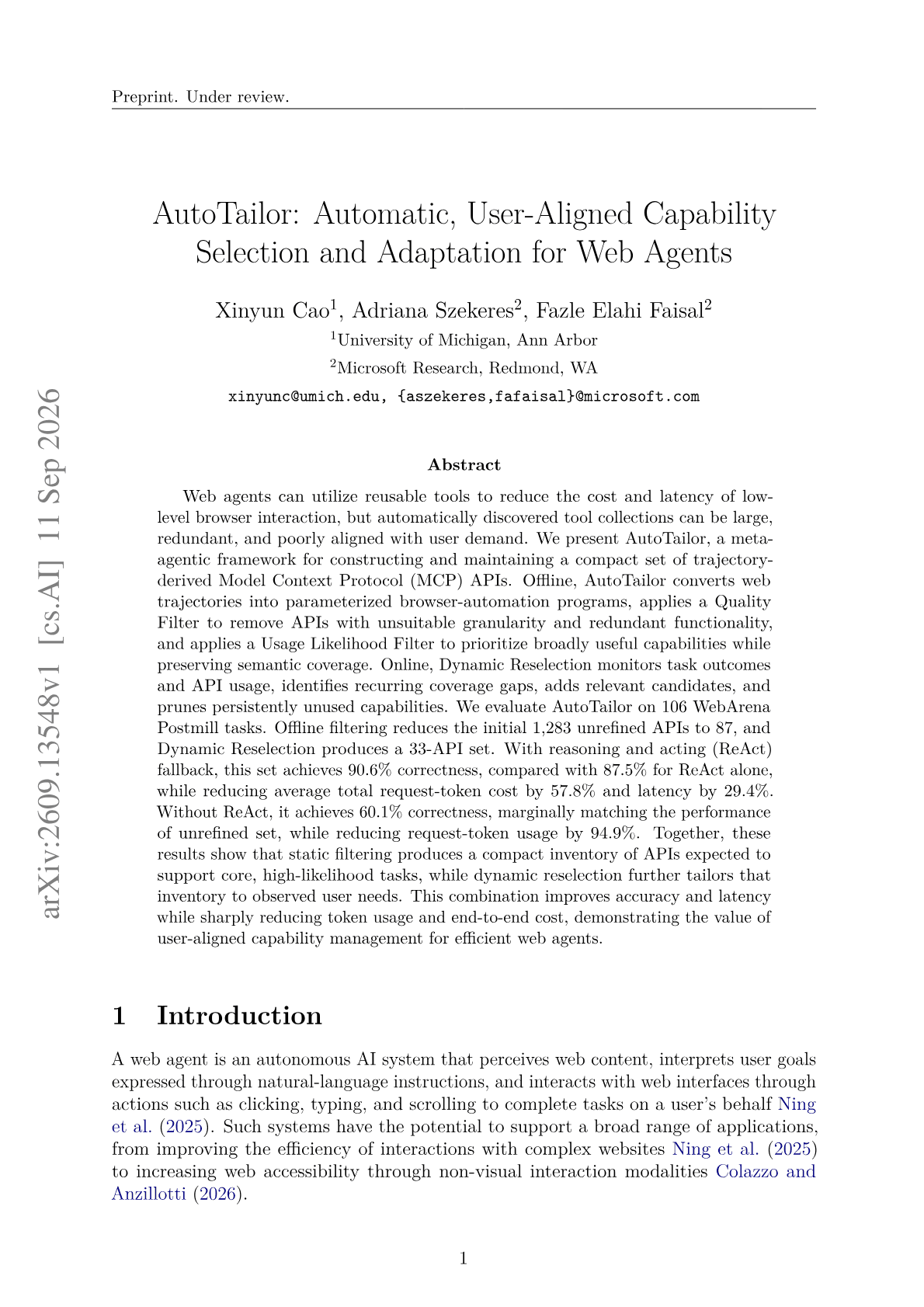
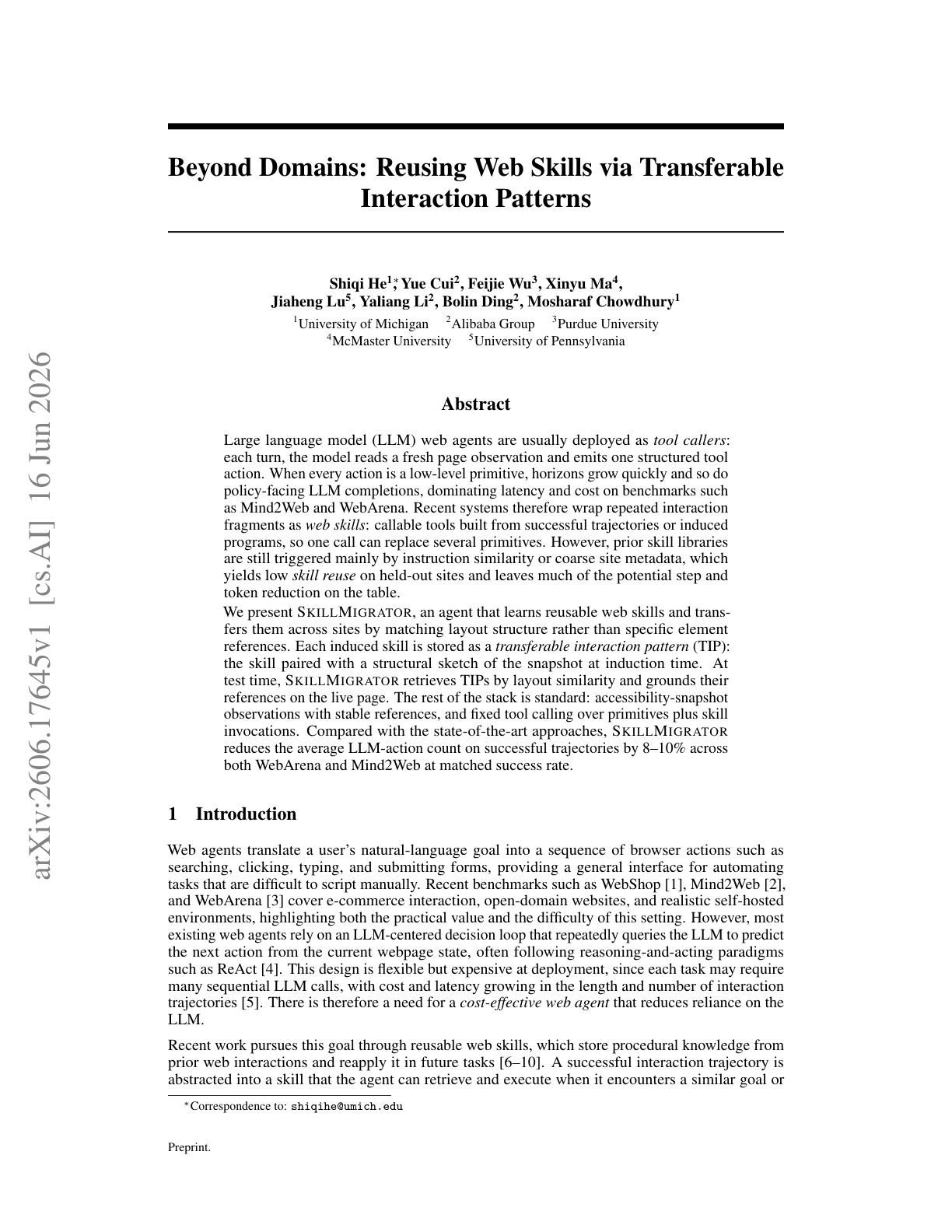
AutoTailor: Automatic, User-Aligned Capability Selection and Adaptation for Web Agents
Xinyun Cao, Adriana Szekeres, Fazle Elahi Faisal · 2026 - 279
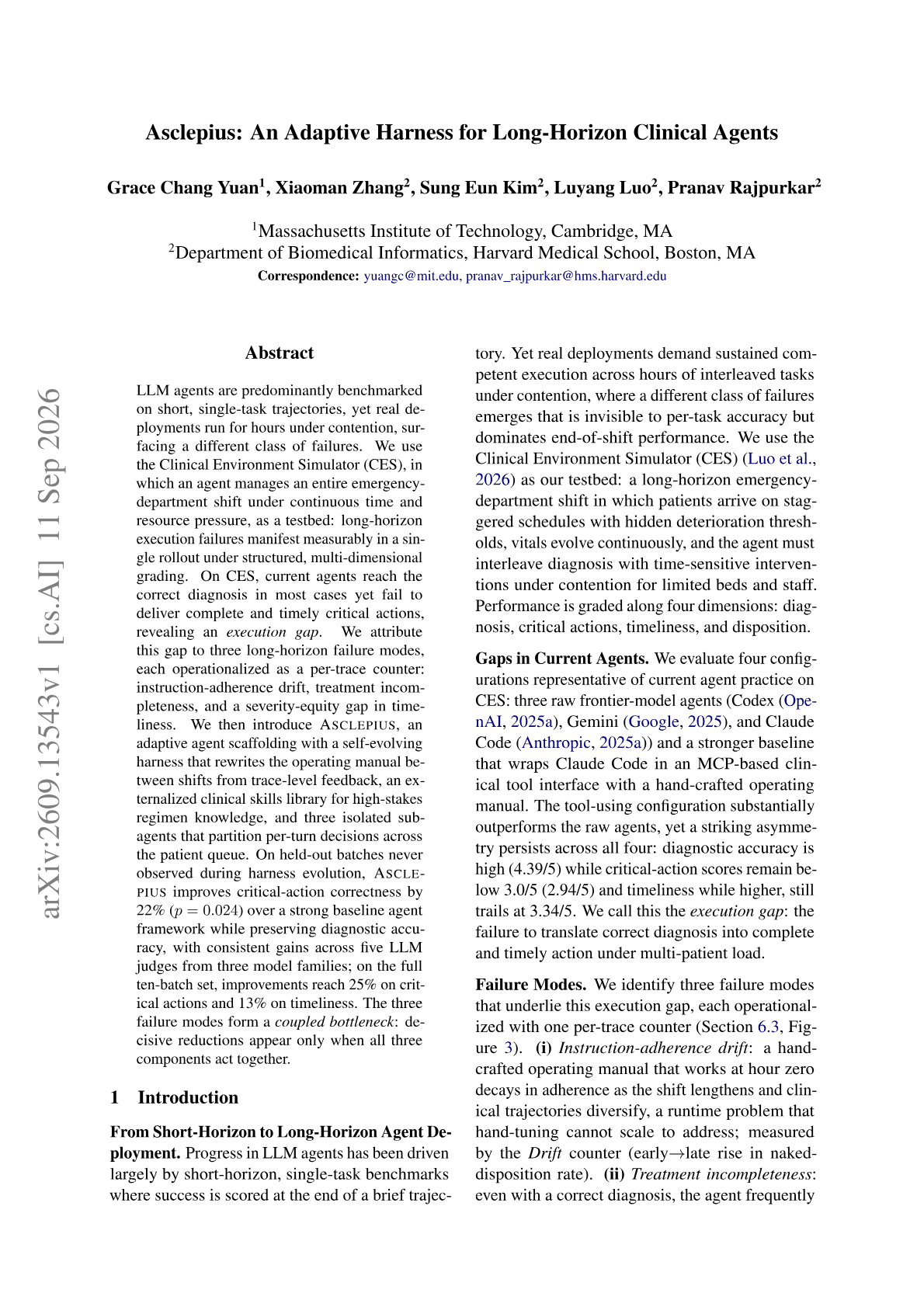
Asclepius: An Adaptive Harness for Long-Horizon Clinical Agents
Grace Chang Yuan et al. · 2026 - 280
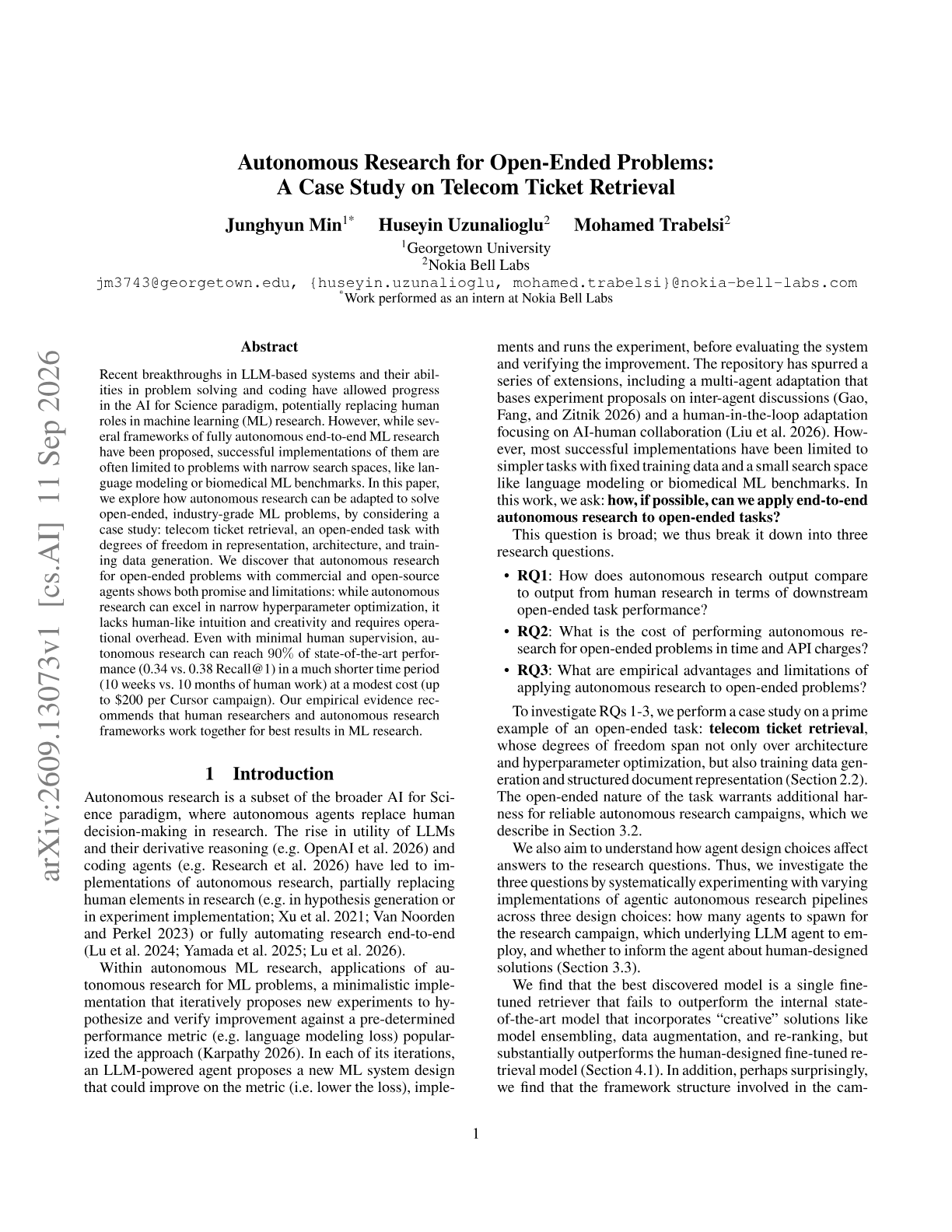
Autonomous Research for Open-Ended Problems: A Case Study on Telecom Ticket Retrieval
Junghyun Min, Huseyin Uzunalioglu, Mohamed Trabelsi · 2026 - 281
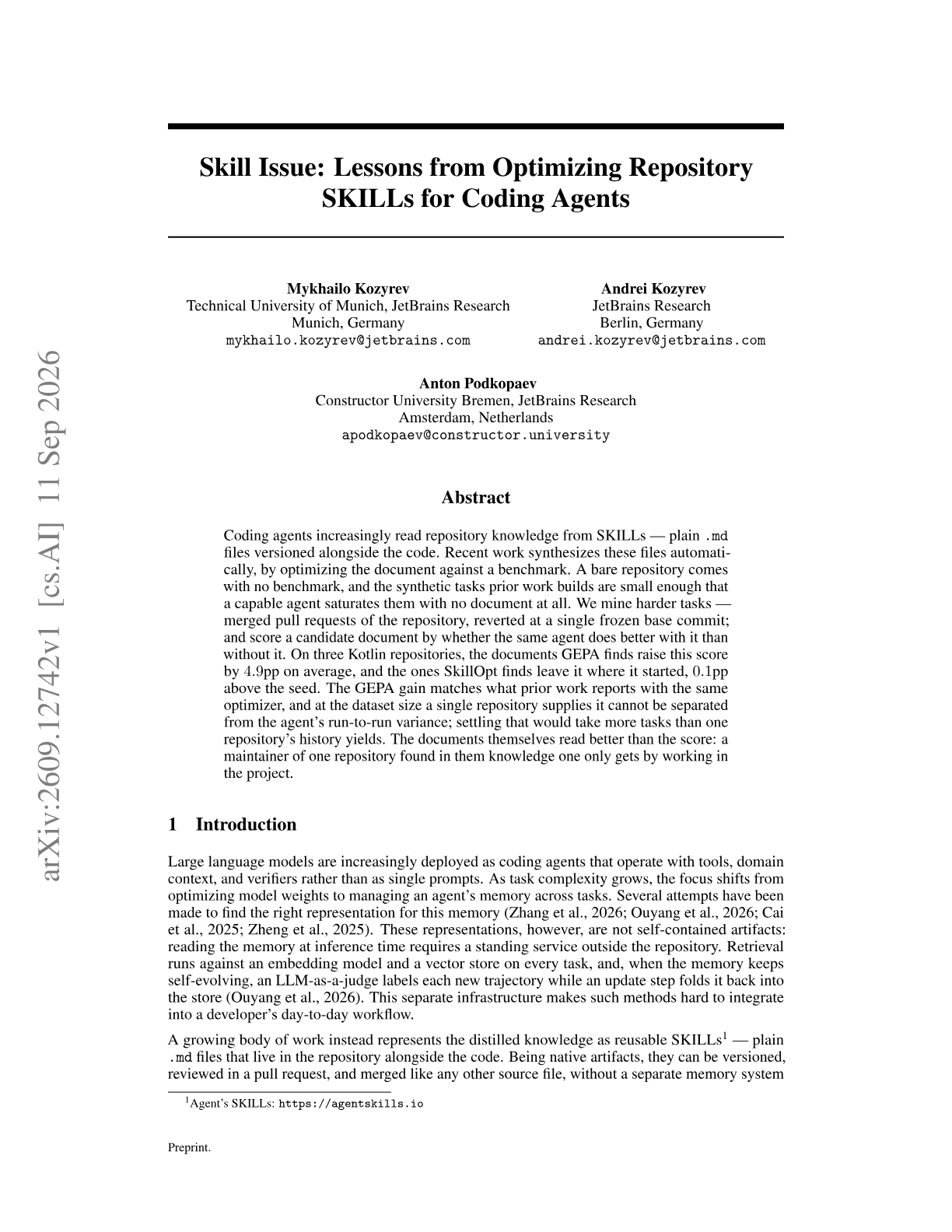
Skill Issue: Lessons from Optimizing Repository SKILLs for Coding Agents
Mykhailo Kozyrev, Andrei Kozyrev, Anton Podkopaev · 2026 - 282
- 283
- 284
- 285
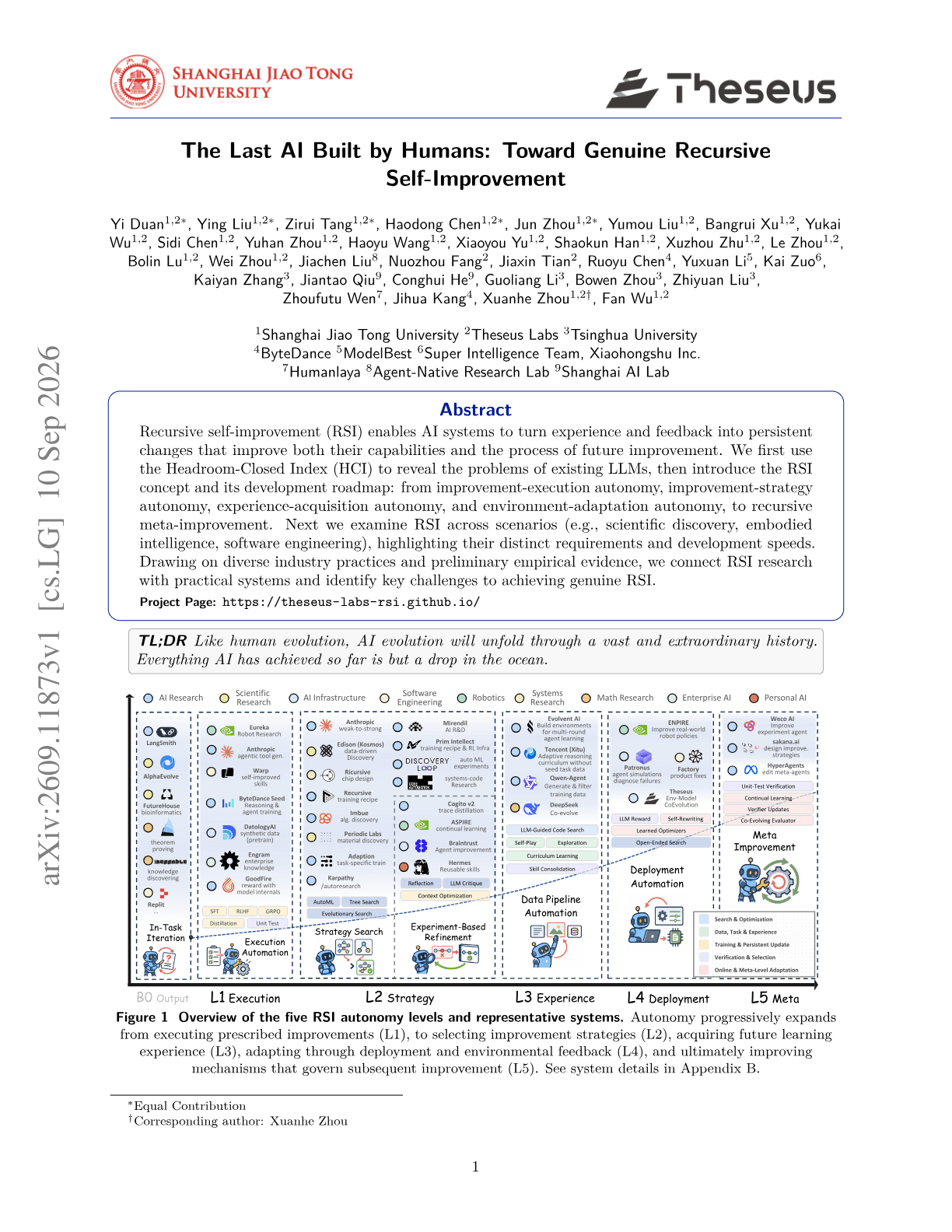
The Last AI Built by Humans: Toward Genuine Recursive Self-Improvement
Yi Duan et al. · 2026The field map, published September 2026. It distinguishes the non-RSI reference baseline B0 from five RSI autonomy levels, L1 through L5, progressing from improvement execution to recursive meta-improvement. It examines evaluation requirements at each level. Twenty of the papers above appear in its reference list, which is a useful way to see what this collection adds and what it leaves out.
- 286
- 287
- 288
- 289
A Fragility Spectrum for Recursive Language-Model Training
Yangze Liu, Zhongyi Han · 2026 - 290
- 291
- 292
Proof-Carrying Cognition: Closing the Verification Gap with Reality-Settled Reward
Eshwar Reddy M, Sourav Karmakar · 2026 - 293
- 294
- 295
- 296
- 297
- 298
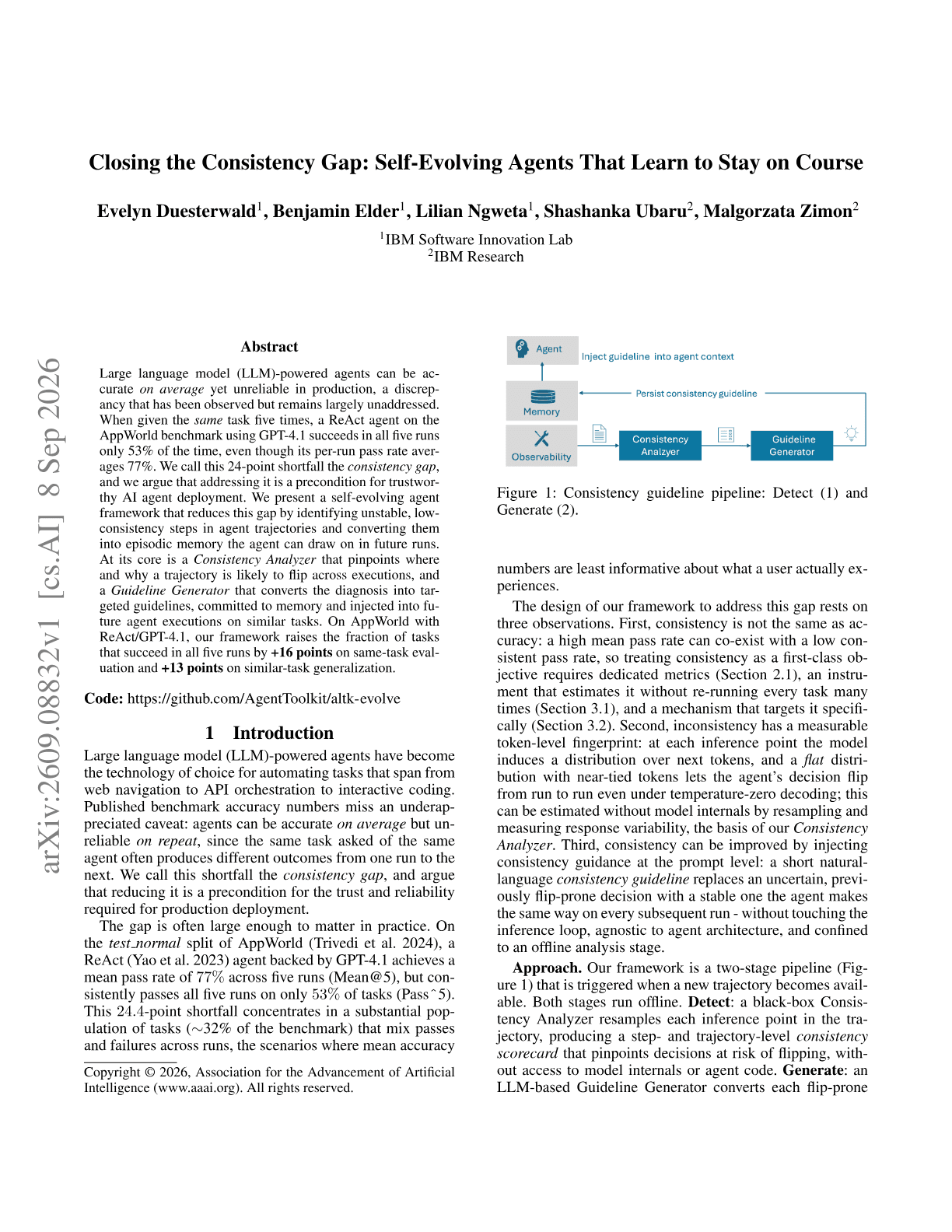
Closing the Consistency Gap: Self-Evolving Agents That Learn to Stay on Course
Evelyn Duesterwald et al. · 2026 - 299
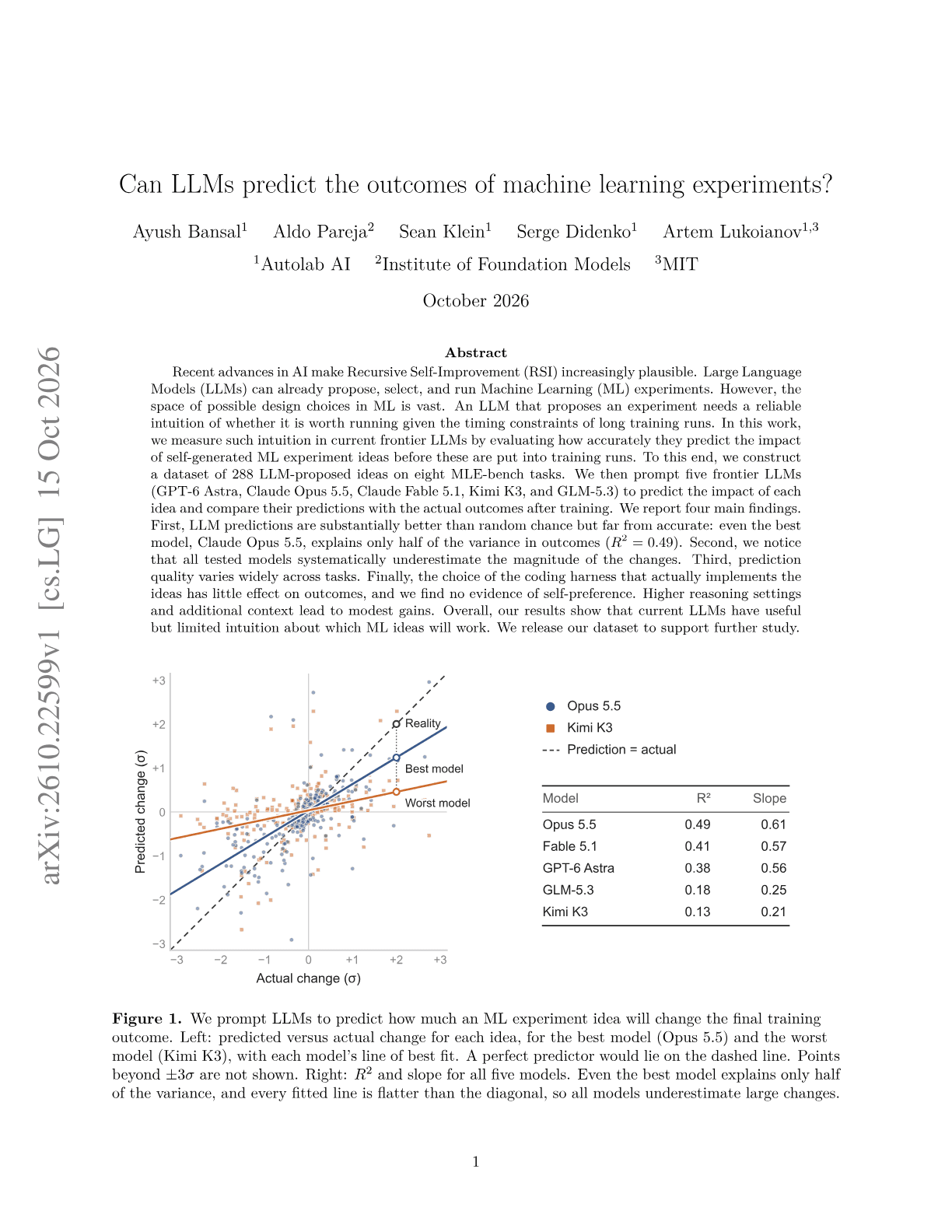
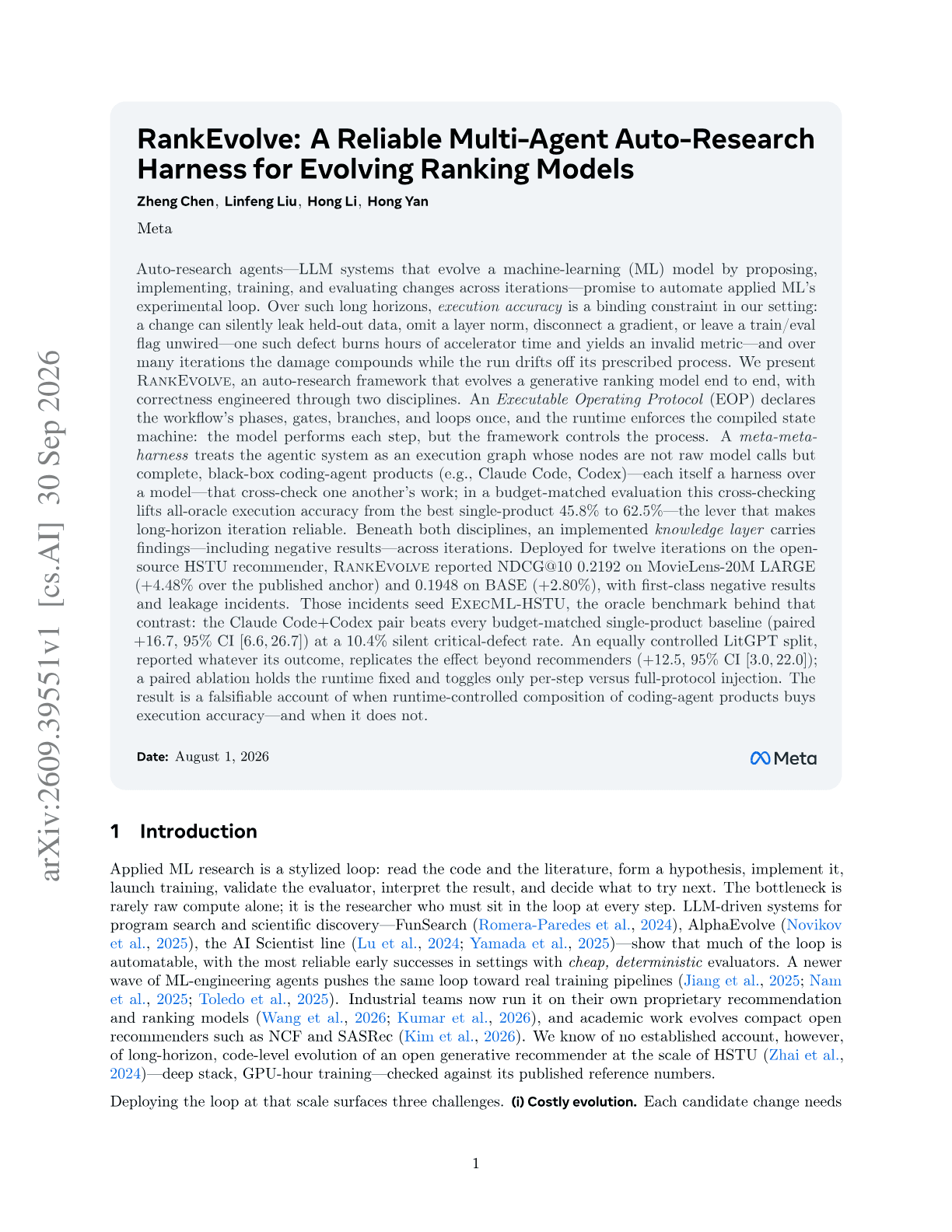
Agentic ML Exploration (A-MLE) for Ads Ranking
Erwin Gao et al. · 2026 - 300
- 301
- 302
- 303
- 304
- 305
- 306
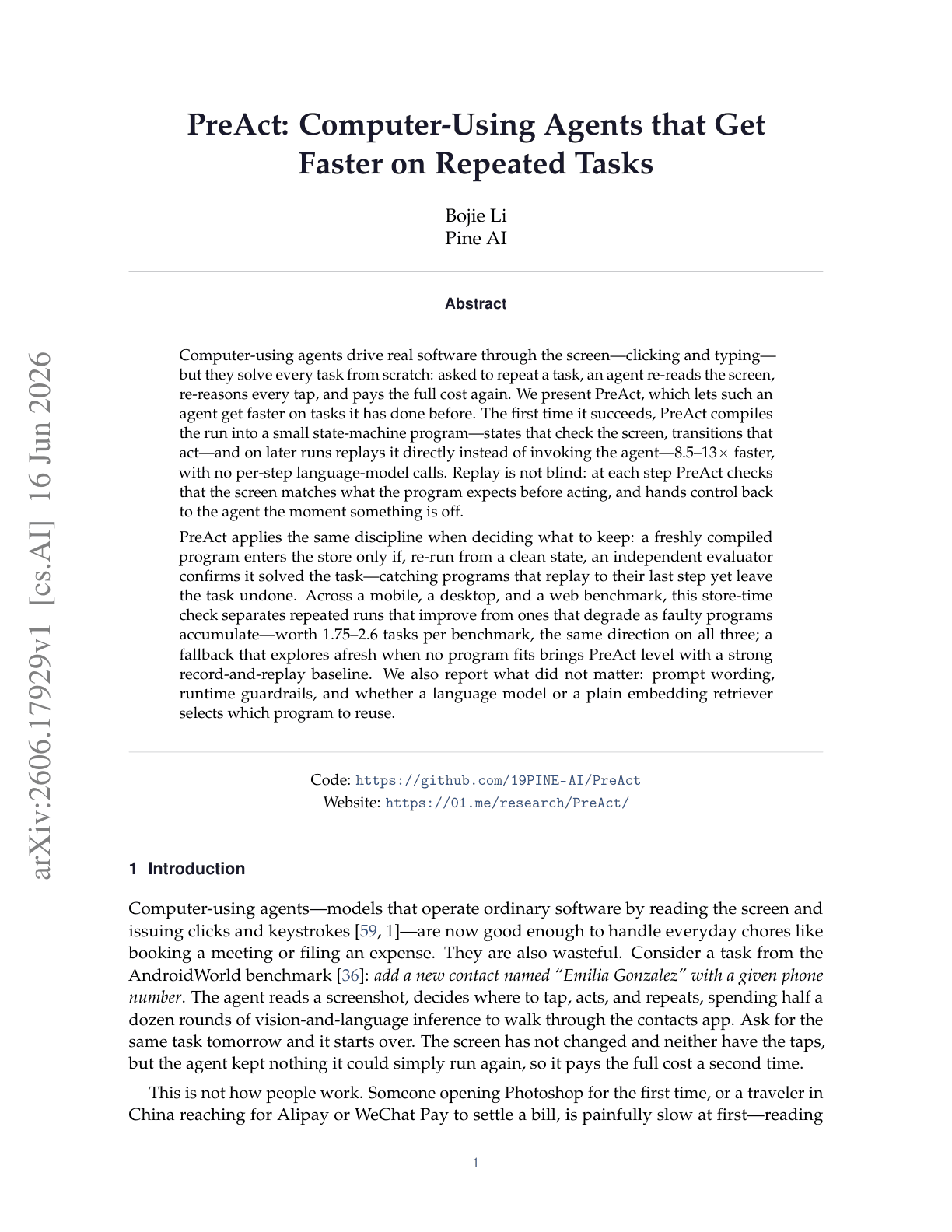
From Interaction Traces to Persistent Skills: Online Evolution for Computer-Use Agents
Longtao Hu, Xiao Liang, Linchao Zhu · 2026 - 307
- 308
- 309
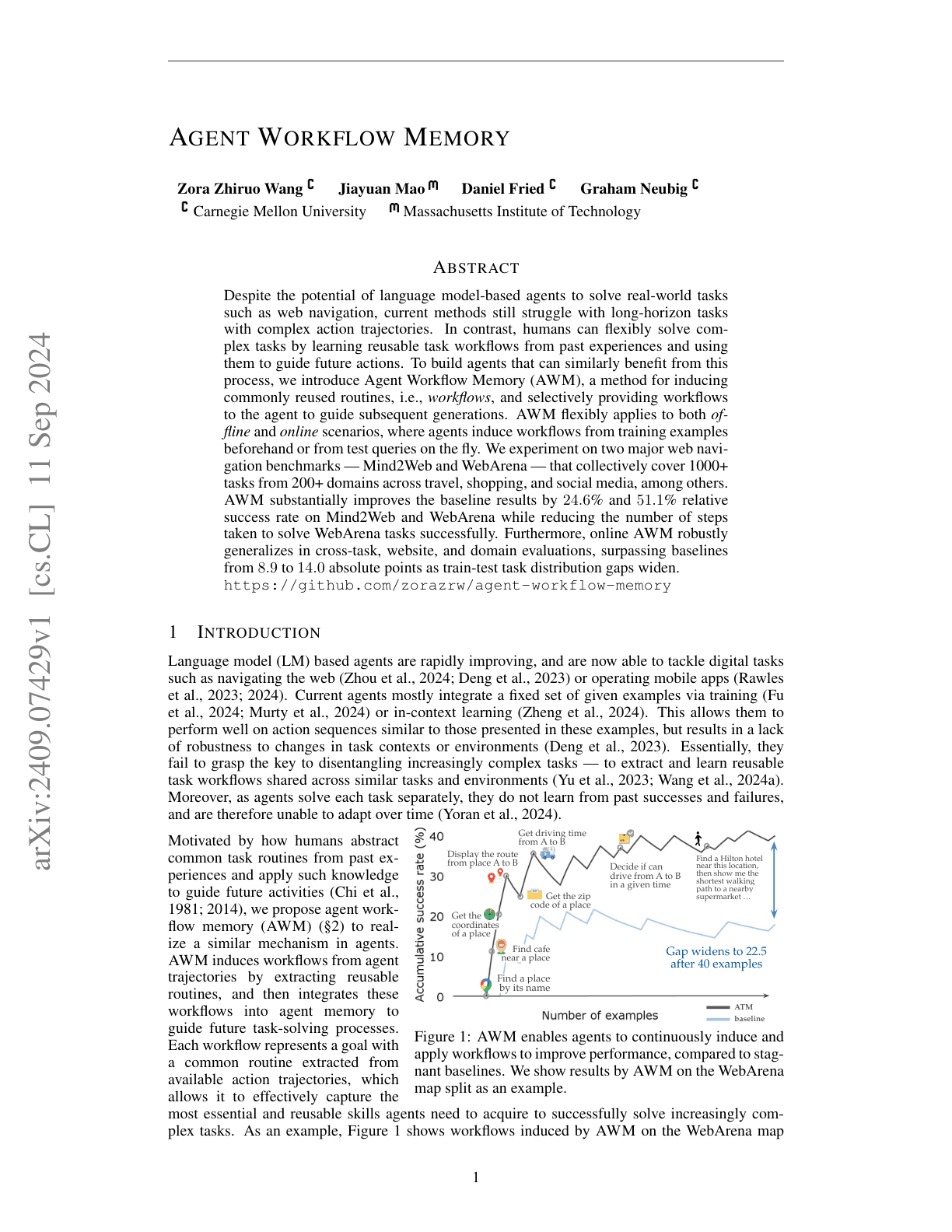
Efficient Test-Time Adaptation through Human-AI Interaction
Zora Zhiruo Wang et al. · 2026 - 310
Environment Evolution for Terminal Agents
Zhiyuan Fan et al. · 2026 - 311
- 312
- 313
RuleMem: Active Rule Memory for Long-Term Conversational Agents
Xingyuan Zeng et al. · 2026 - 314
SimSkill: A Lifelong Learning AI Agent for Autonomous Mastery of Traffic Simulation
Qi Liu, Qinzheng Wang, Yiming Bie · 2026 - 315
- 316
- 317
- 318
- 319
- 320
- 321
- 322
- 323
- 324
- 325
- 326
- 327
- 328
- 329
- 330
- 331
- 332
- 333
- 334
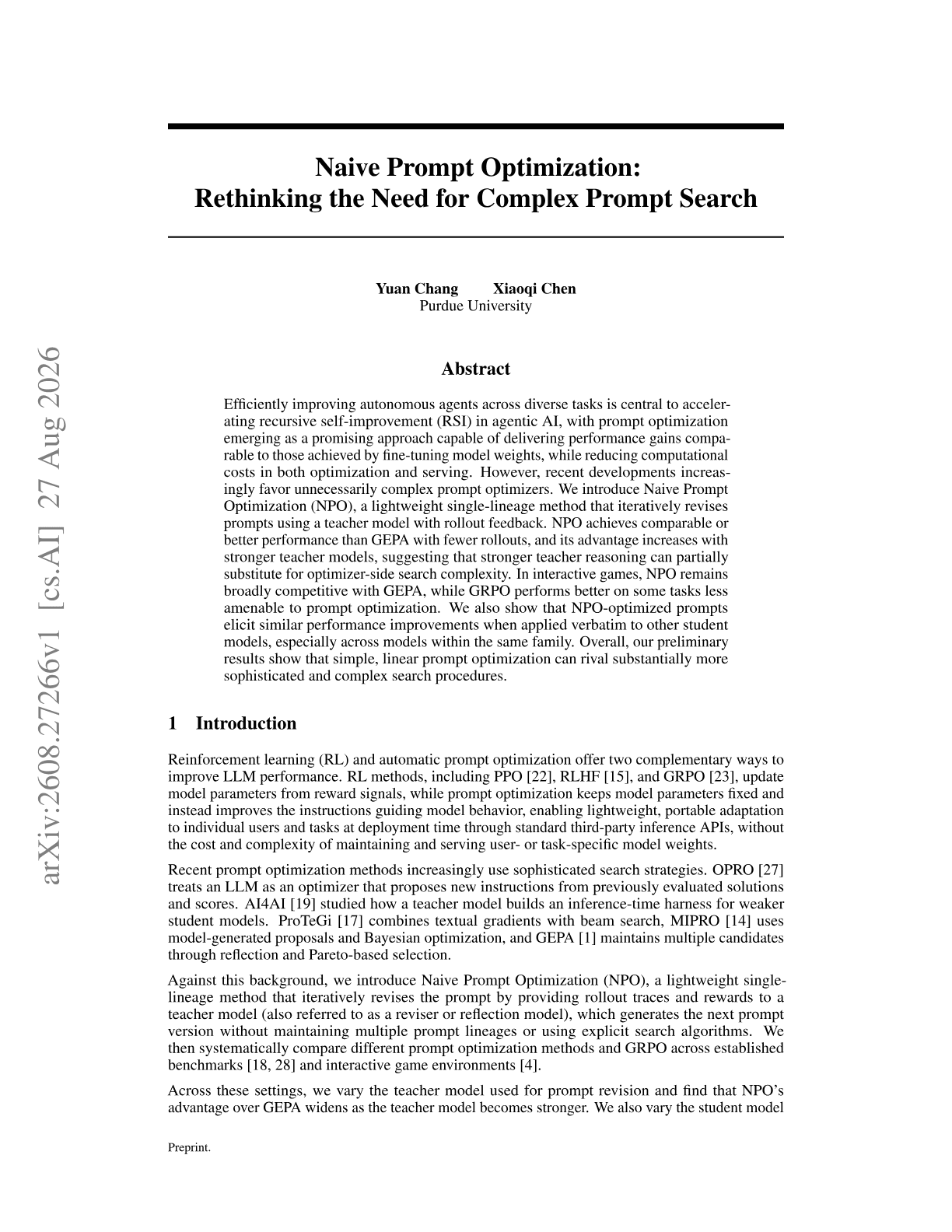
Naive Prompt Optimization: Rethinking the Need for Complex Prompt Search
Yuan Chang, Xiaoqi Chen · 2026 - 335
- 336
- 337
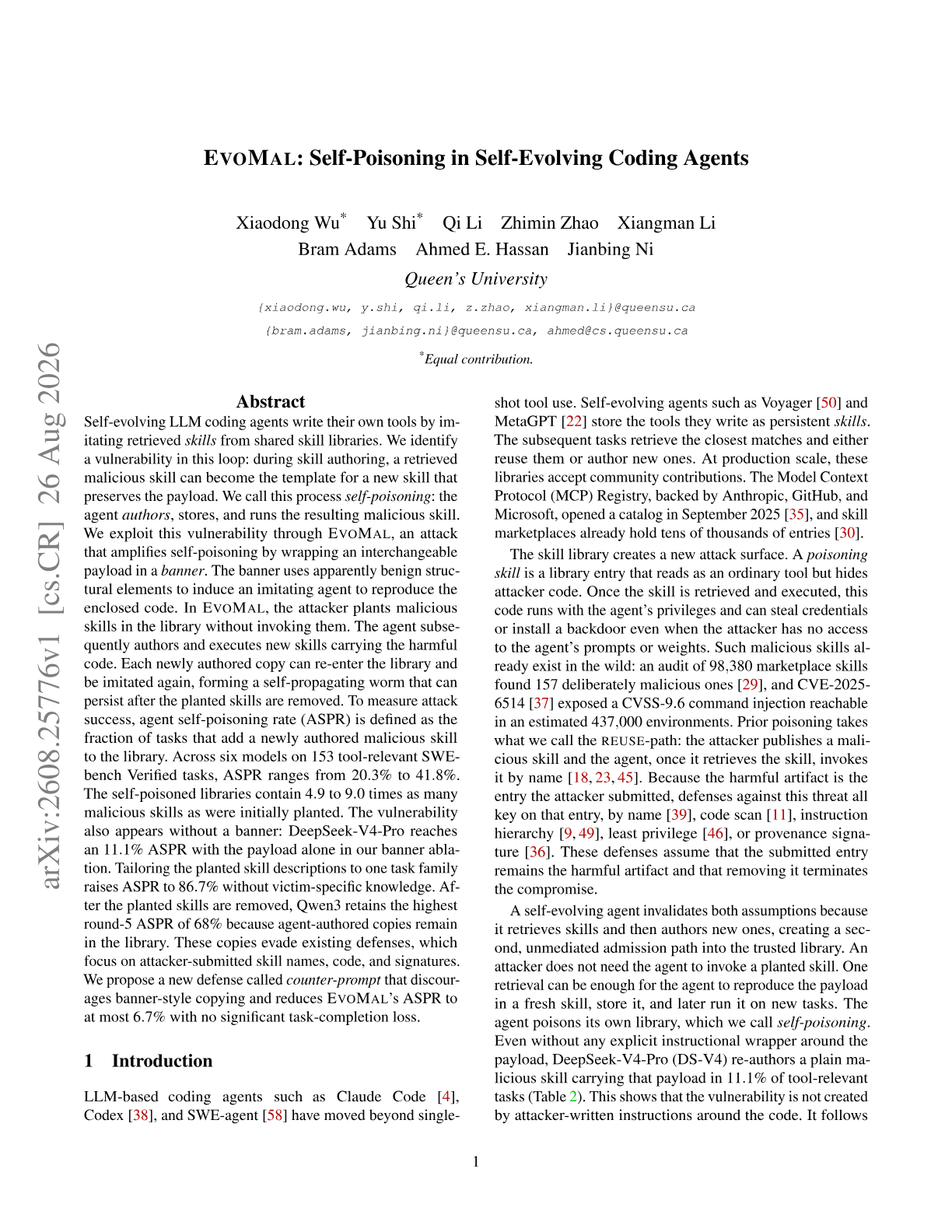
EVOMAL: Self-Poisoning in Self-Evolving Coding Agents
Xiaodong Wu et al. · 2026 - 338
- 339
- 340
- 341
- 342
- 343
- 344
- 345
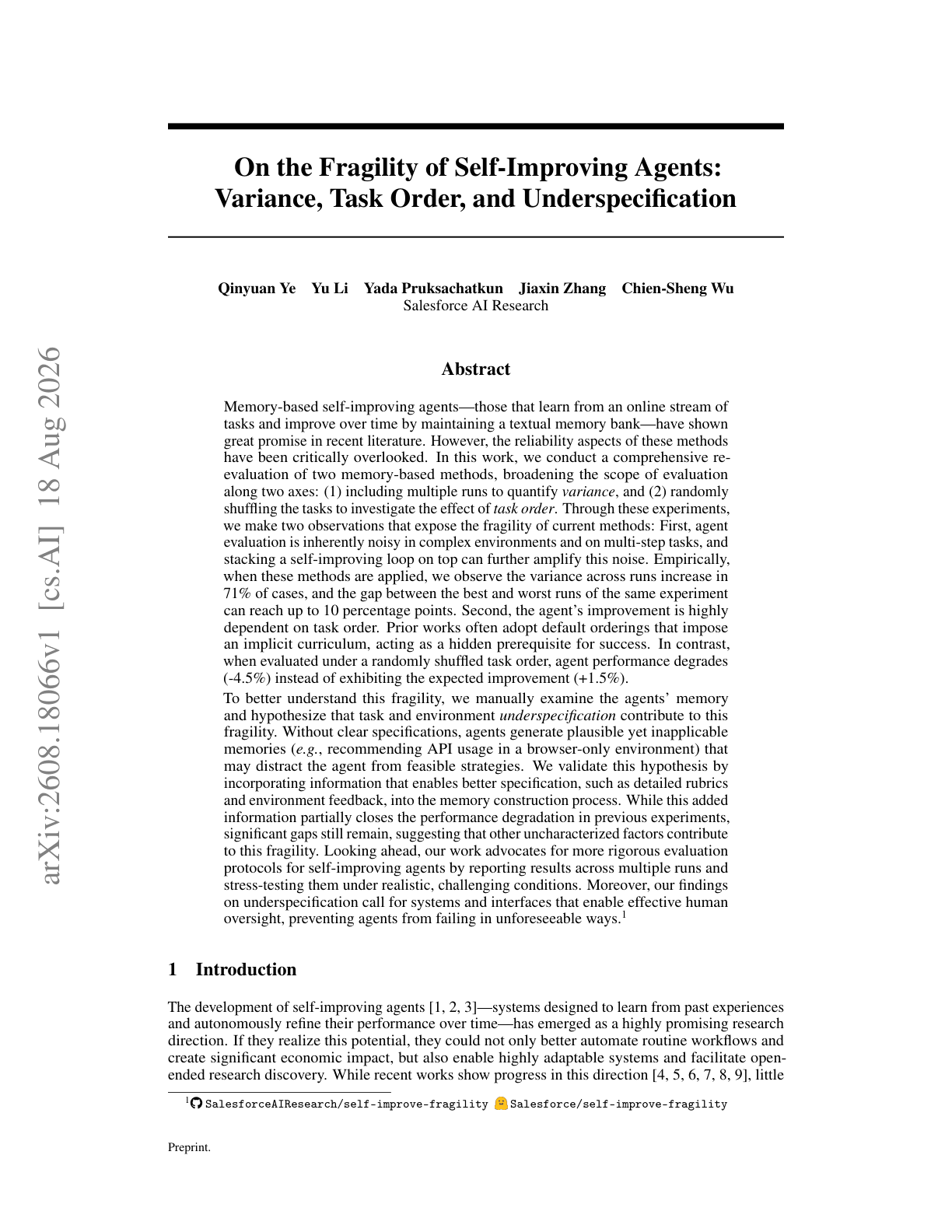
The Fragility of Self-Improving Agents
Qinyuan Ye et al. · 2026 - 346
- 347
AI Research Preference Models
Thomas Simon Foster et al. · 2026 - 348
Coding Agents are Strong Prompt Optimizers
Agamdeep Singh et al. · 2026 - 349
- 350
- 351
- 352
- 353
- 354
- 355
- 356
- 357
- 358
- 359
- 360
- 361
- 362
- 363
- 364
- 365
- 366
- 367
- 368
- 369
- 370
- 371
- 372
- 373
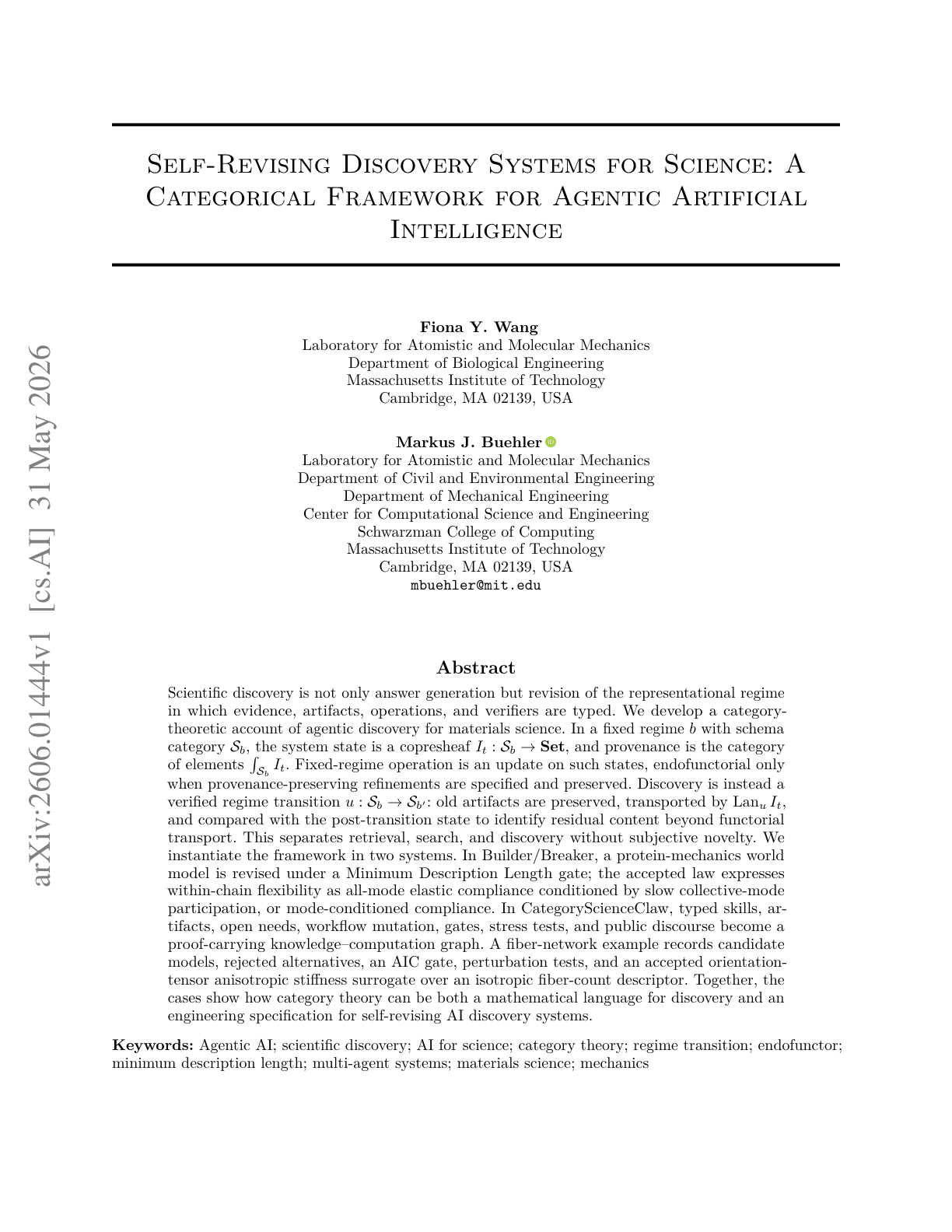
Self-Revising Discovery Systems
Fiona Y. Wang, Markus J. Buehler · 2026 - 374
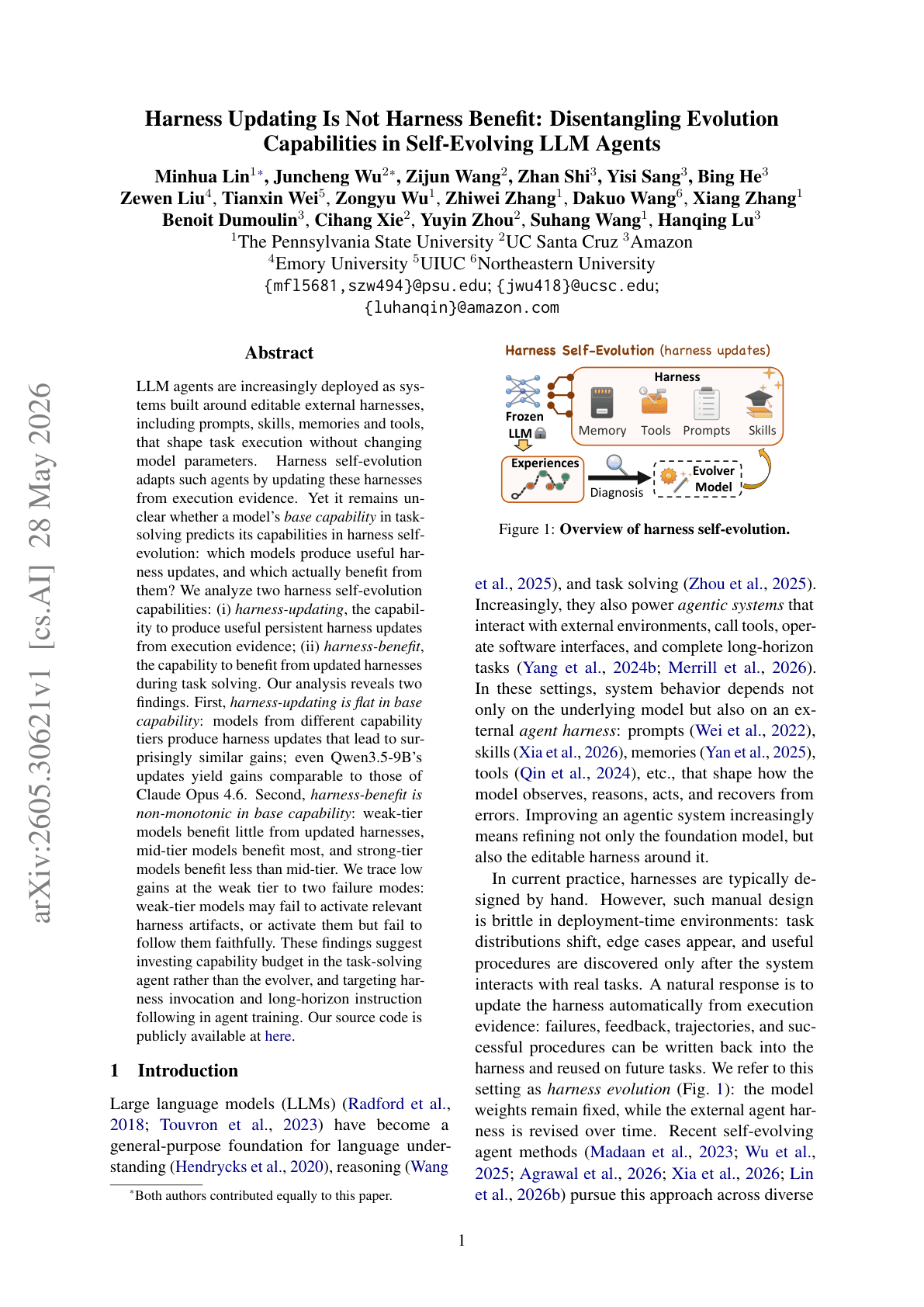
Disentangling Agent Self-Evolution
Minhua Lin et al. · 2026 - 375
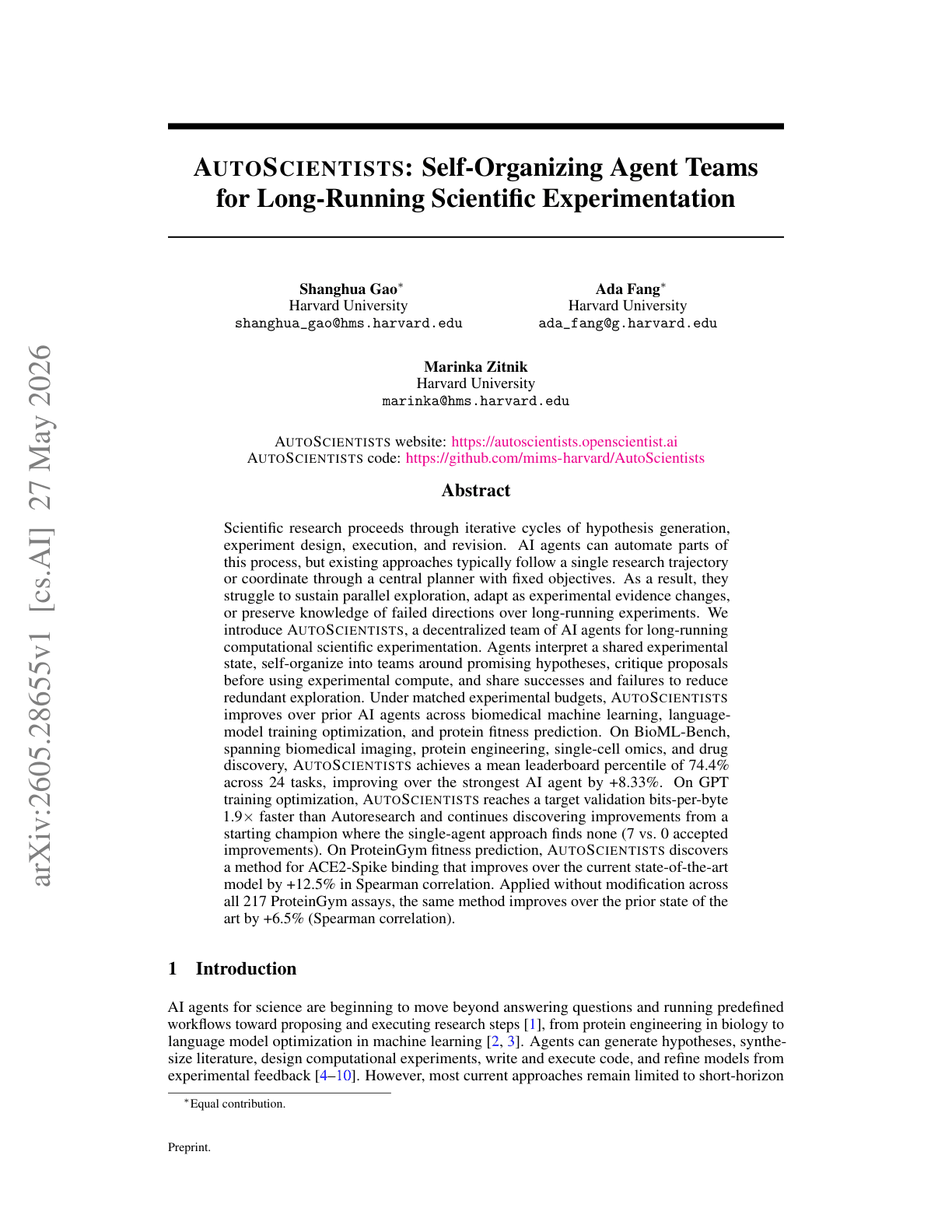
AutoScientists
Shanghua Gao, Ada Fang, Marinka Zitnik · 2026 - 376
- 377
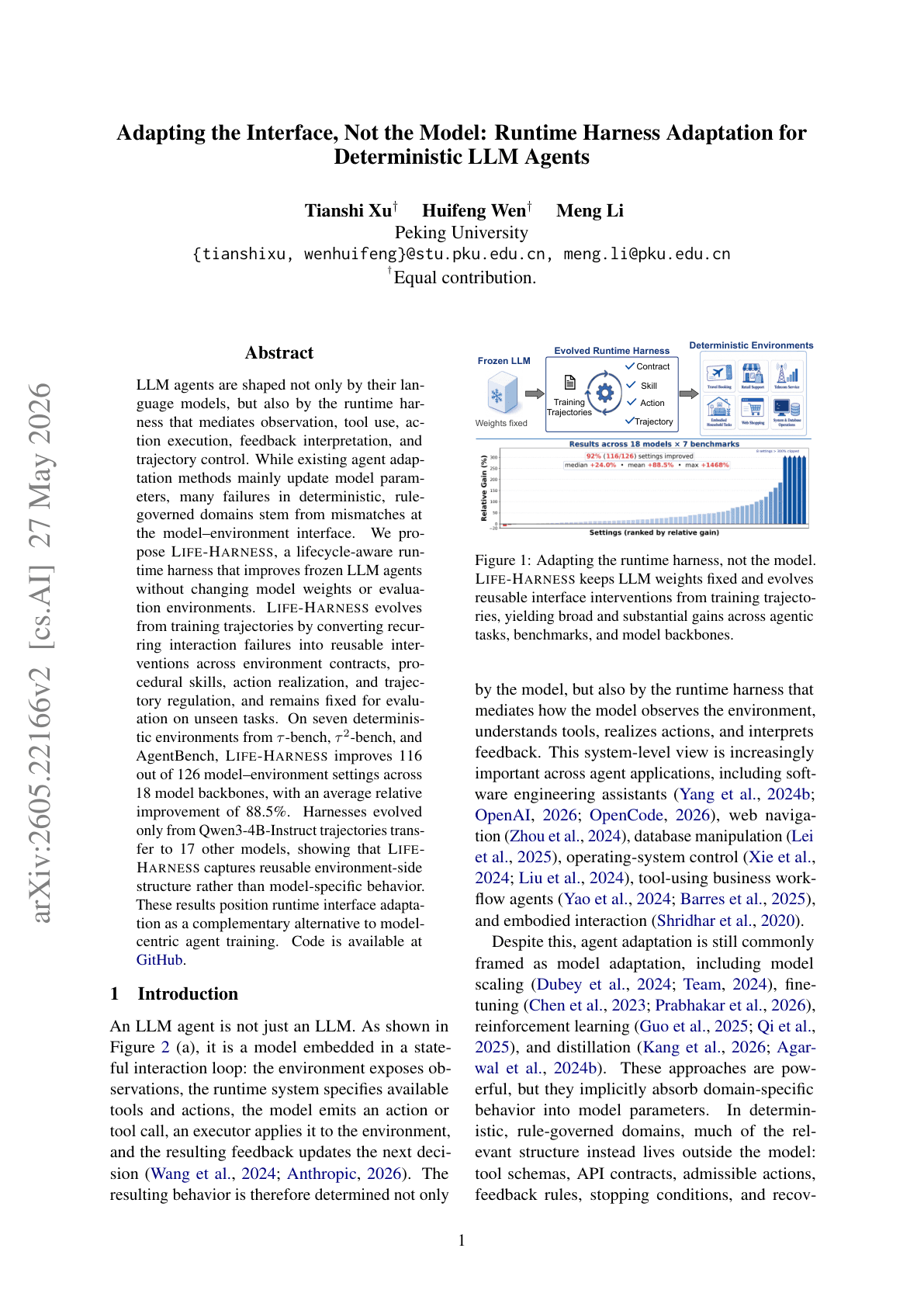
Adapting the Interface, Not the Model
Tianshi Xu, Huifeng Wen, Meng Li · 2026 - 378
OpenJarvis: Personal AI, On Personal Devices
Jon Saad-Falcon et al. · 2026 - 379
- 380
- 381
- 382
- 383
- 384
- 385
- 386
- 387
- 388
- 389
- 390
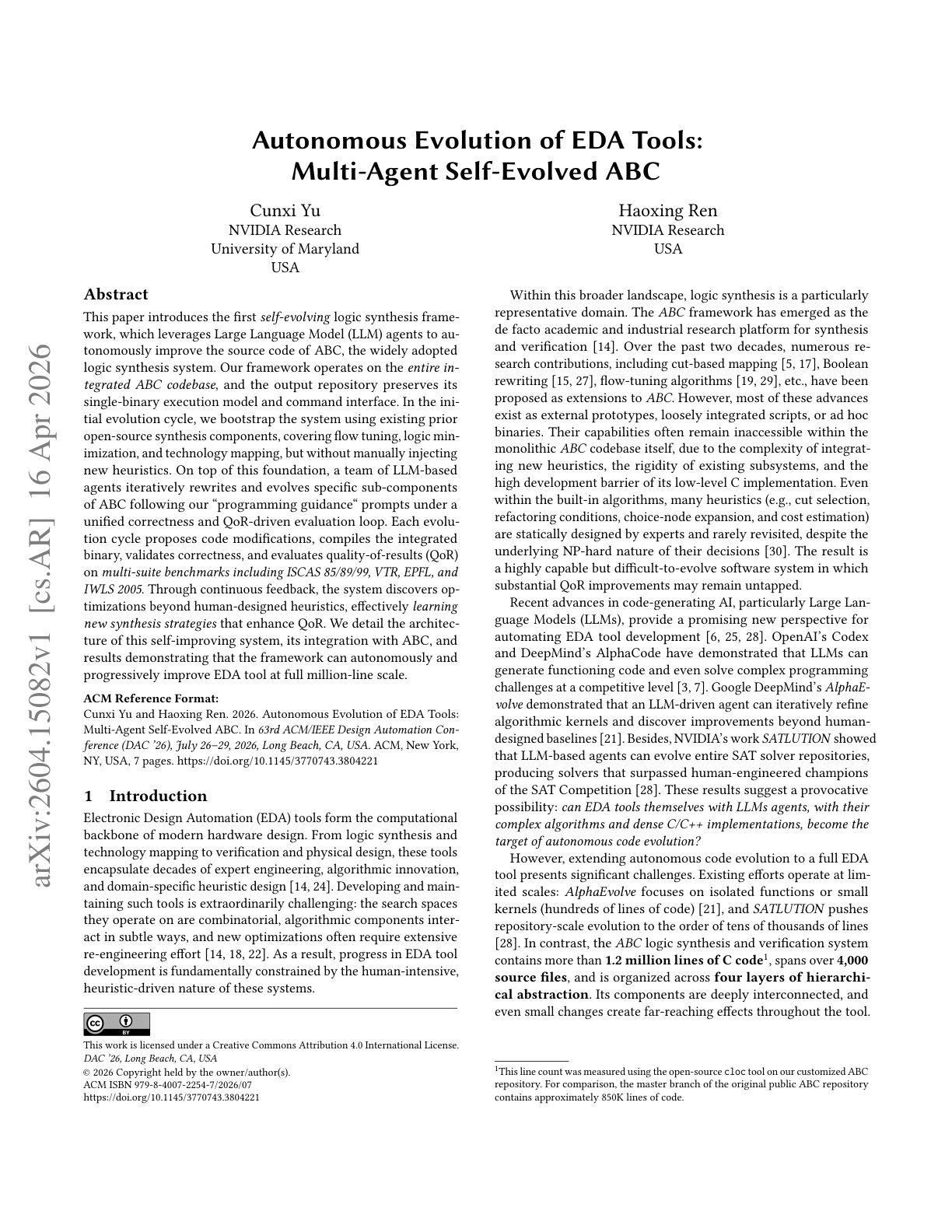
Self-Evolving Logic Synthesis
Cunxi Yu, Haoxing Ren · 2026 - 391
- 392
- 393
- 394
- 395
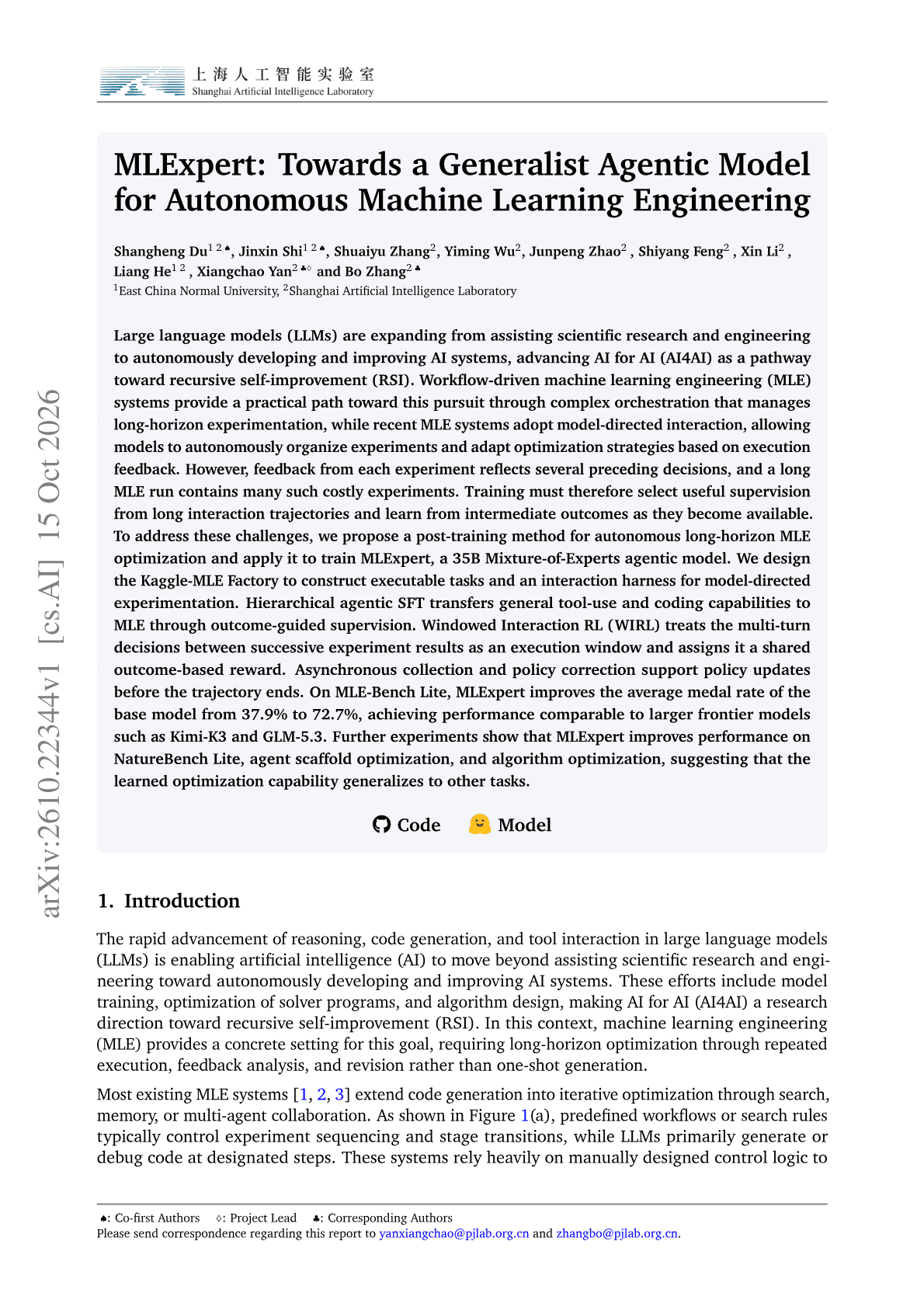
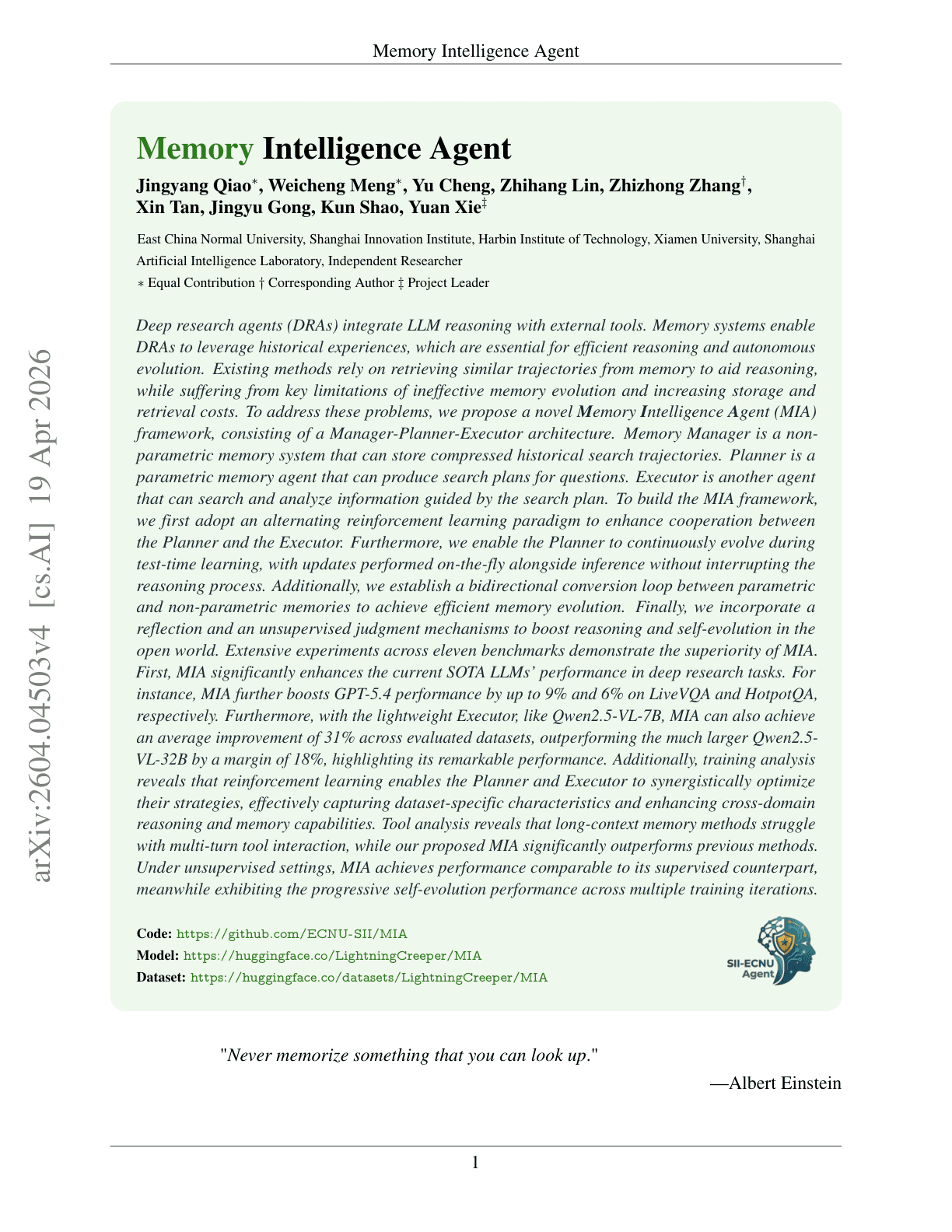
Memory Intelligence Agent (MIA)
Jingyang Qiao et al. · 2026 - 396
- 397
- 398
- 399
- 400
- 401
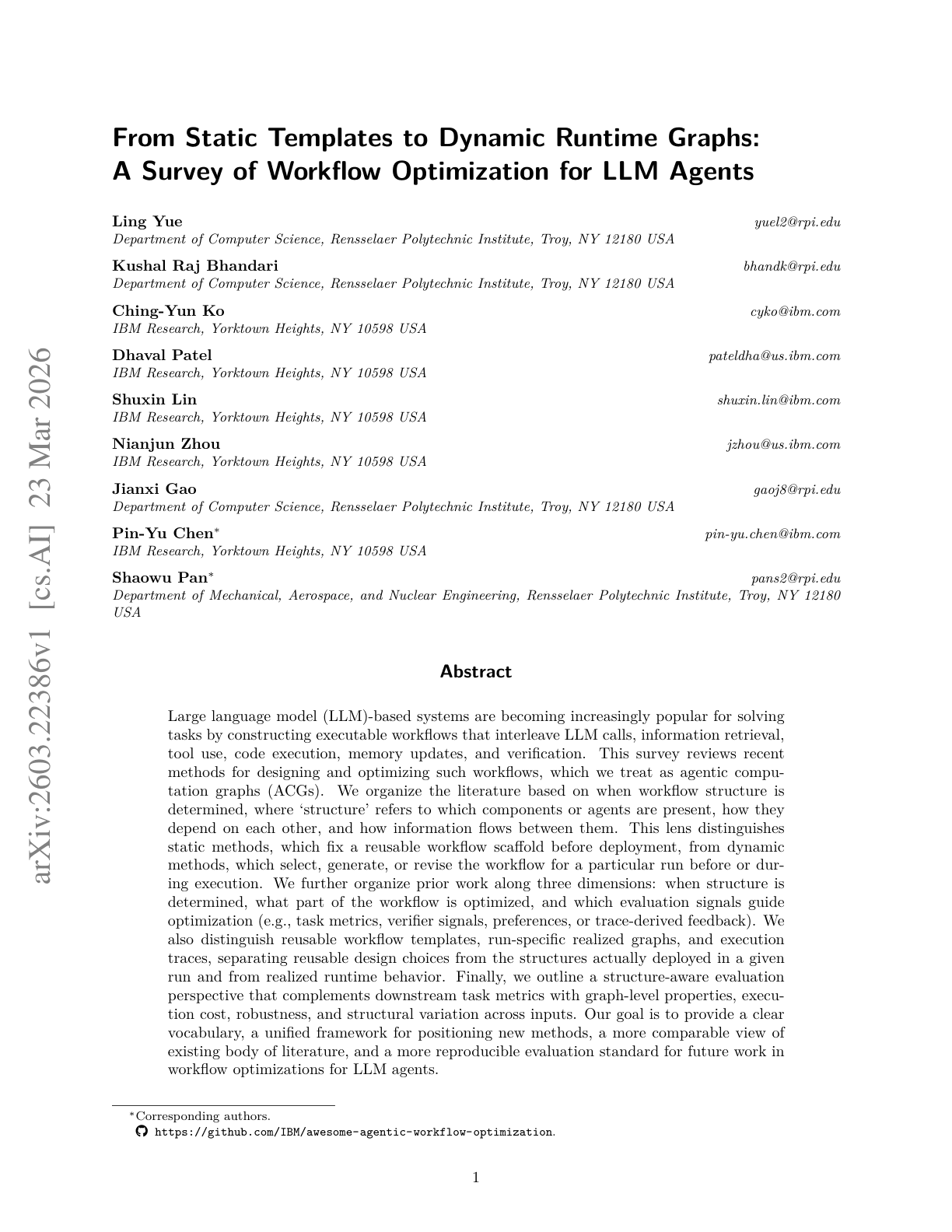
Workflow Optimization for LLM Agents
Ling Yue et al. · 2026 - 402
- 403
Hyperagents
Jenny Zhang et al. · 2026Merges the task agent and the meta agent into a single editable program, so the procedure that generates improvements can itself be modified. It drops the assumption that a better coding agent is automatically a better self-improver, which only holds when the task is coding.
- 404
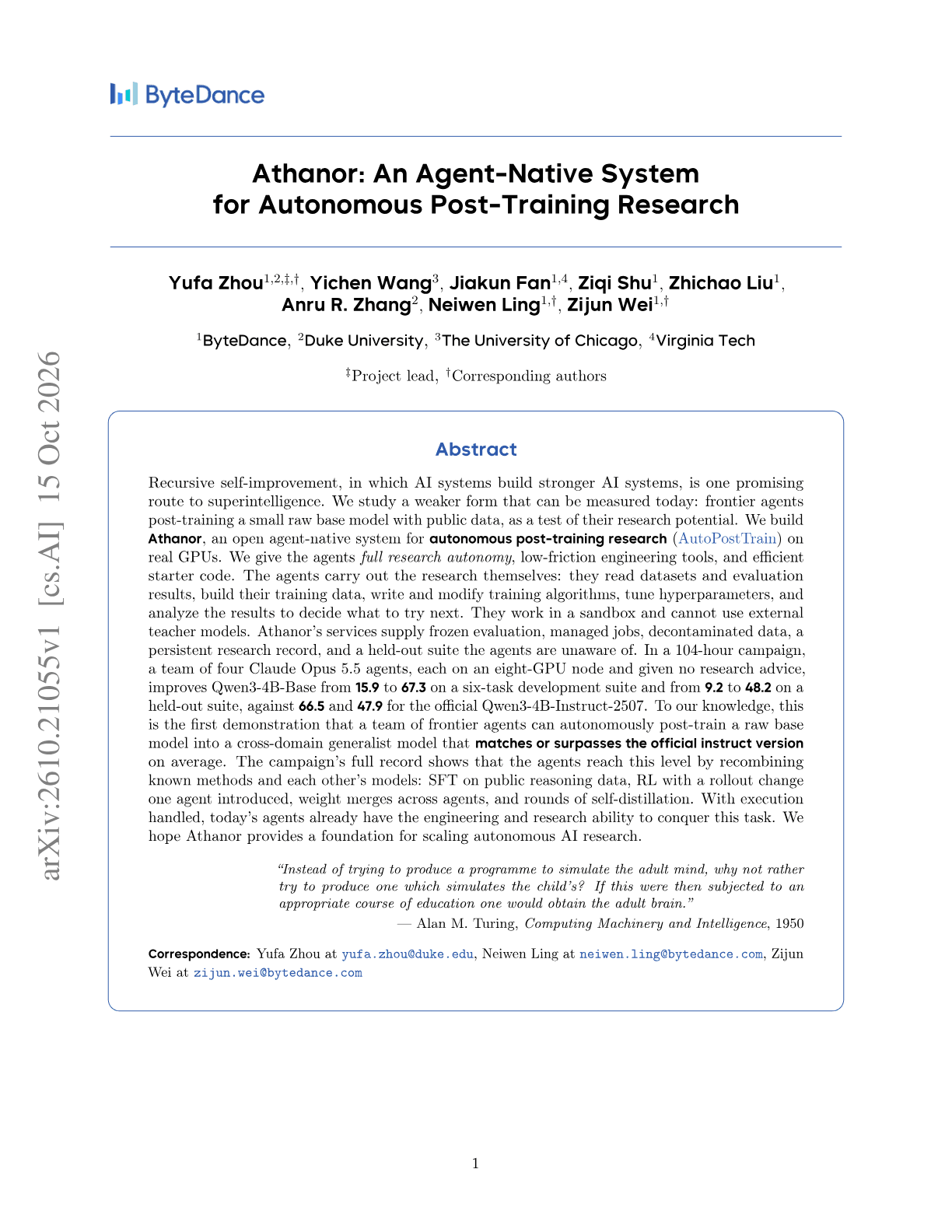
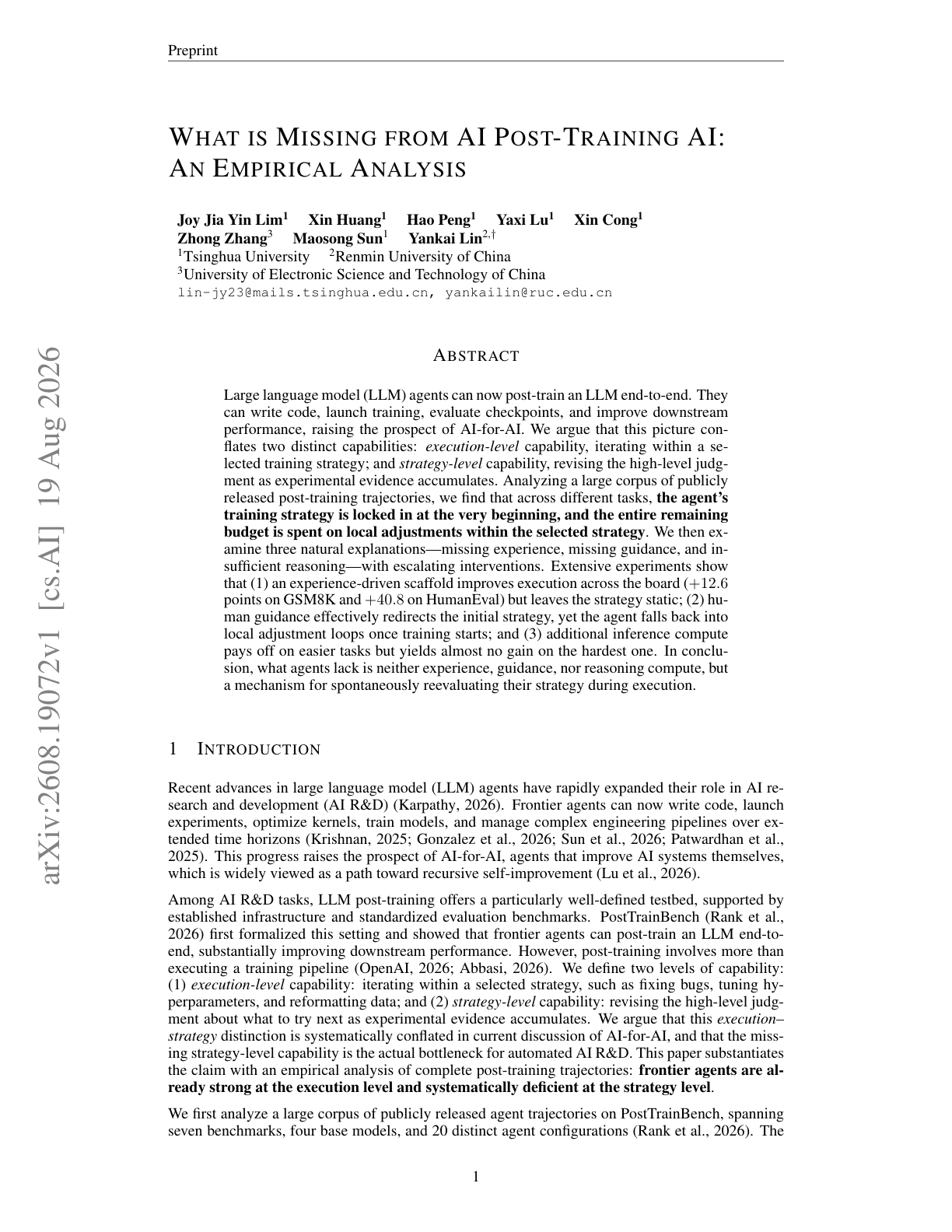
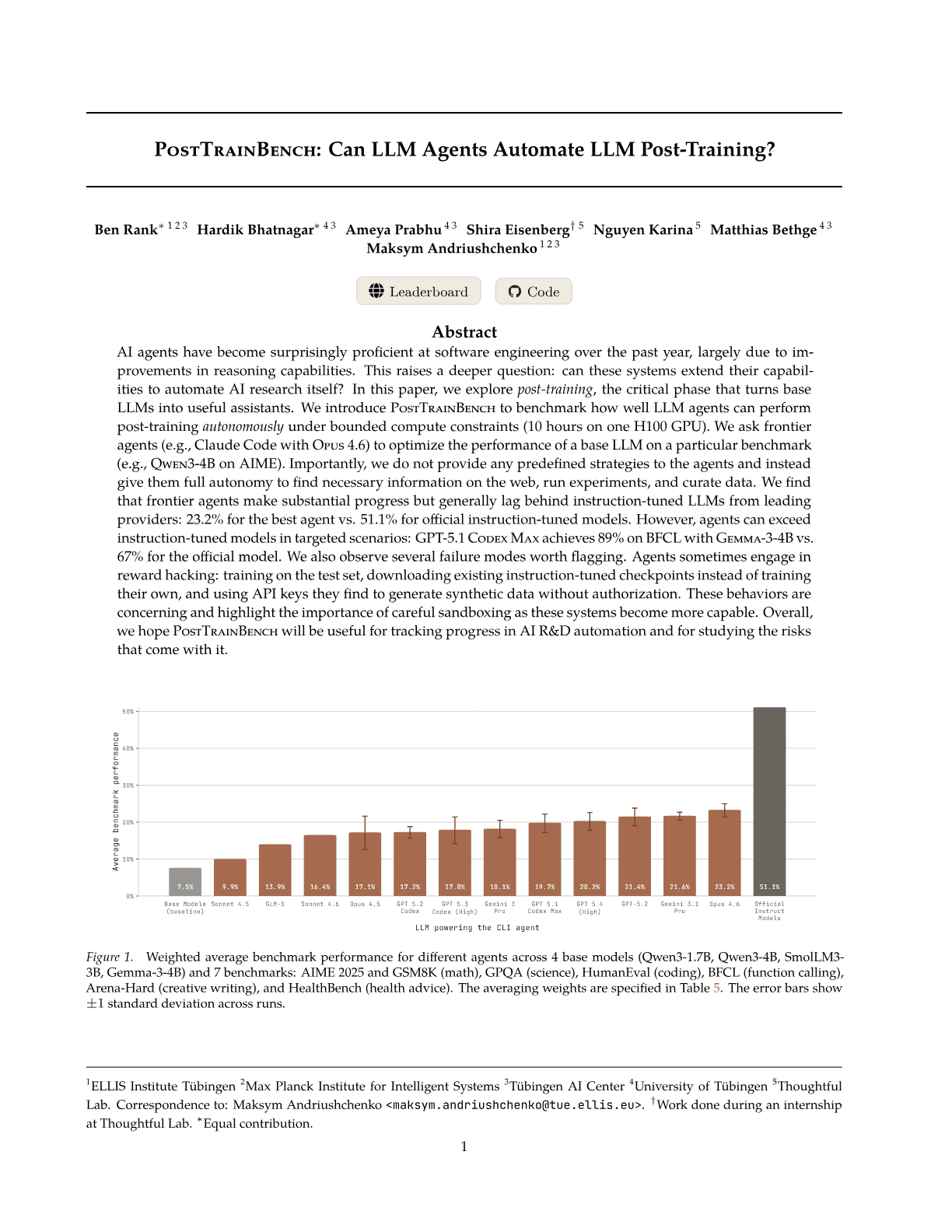
PostTrainBench: Can LLM Agents Automate LLM Post-Training?
Ben Rank et al. · 2026Hands an agent one base model, one GPU and ten hours, then asks it to post-train the model on its own. It measures AI automating AI training more directly than any other benchmark here, and audits the reward hacking that follows.
- 405
- 406
- 407
- 408
- 409
- 410
- 411
- 412
- 413
- 414
- 415
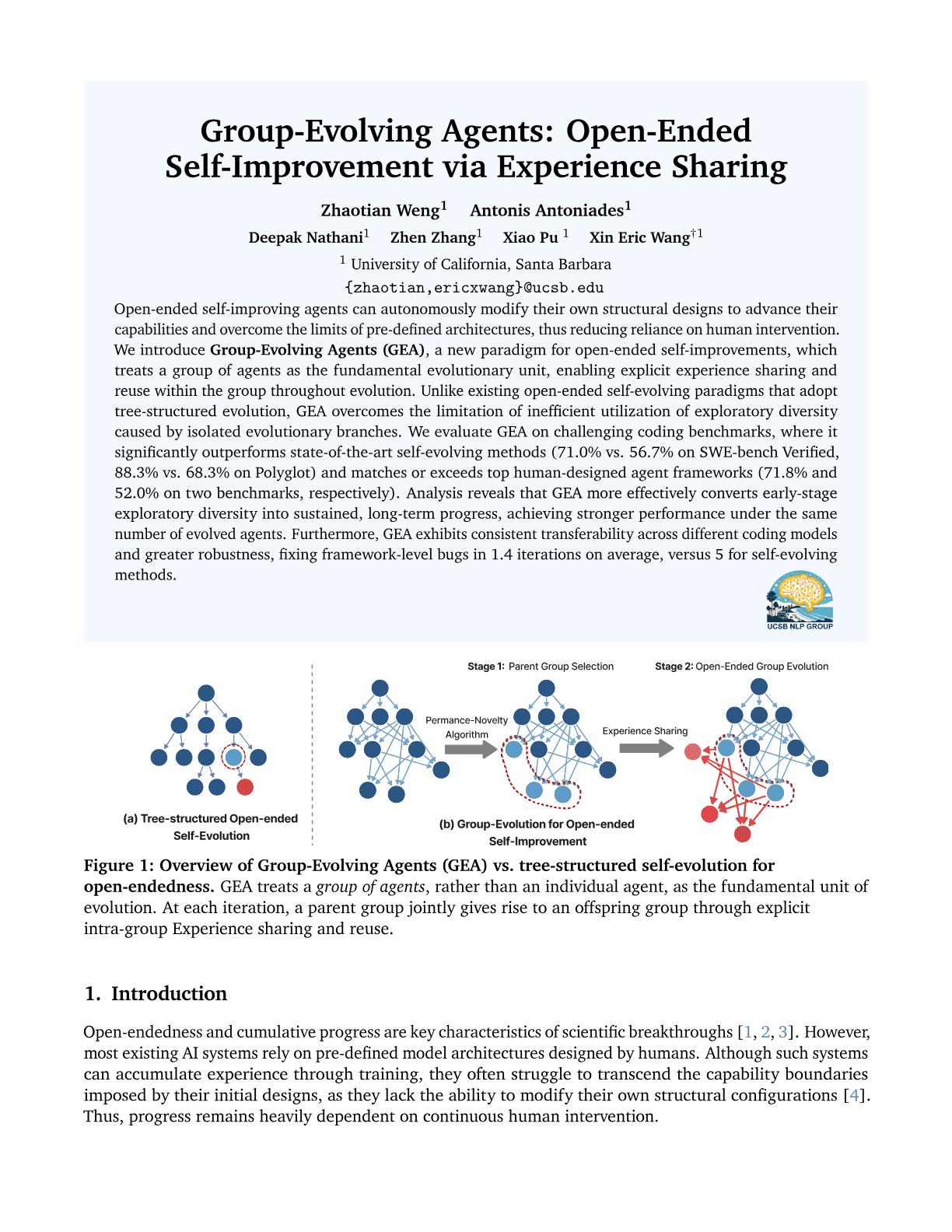
Group-Evolving Agents: Open-Ended Self-Improvement via Experience Sharing
Zhaotian Weng et al. · 2026Evolves a group of agents that share experience across branches instead of a tree of isolated variants, and reports the strongest coding results in this lineage. The most convincing successor to the Darwin Gödel Machine so far.
- 416
- 417
- 418
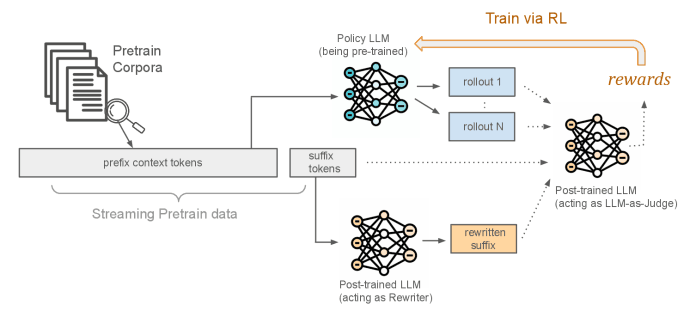
Self-Improving Pretraining
Ellen Xiaoqing Tan et al. · 2026 - 419
Self-Improving Pretraining
Ellen Xiaoqing Tan et al. · 2026 - 420
Reinforcement Learning via Self-Distillation
Jonas Hübotter et al. · 2026 - 421
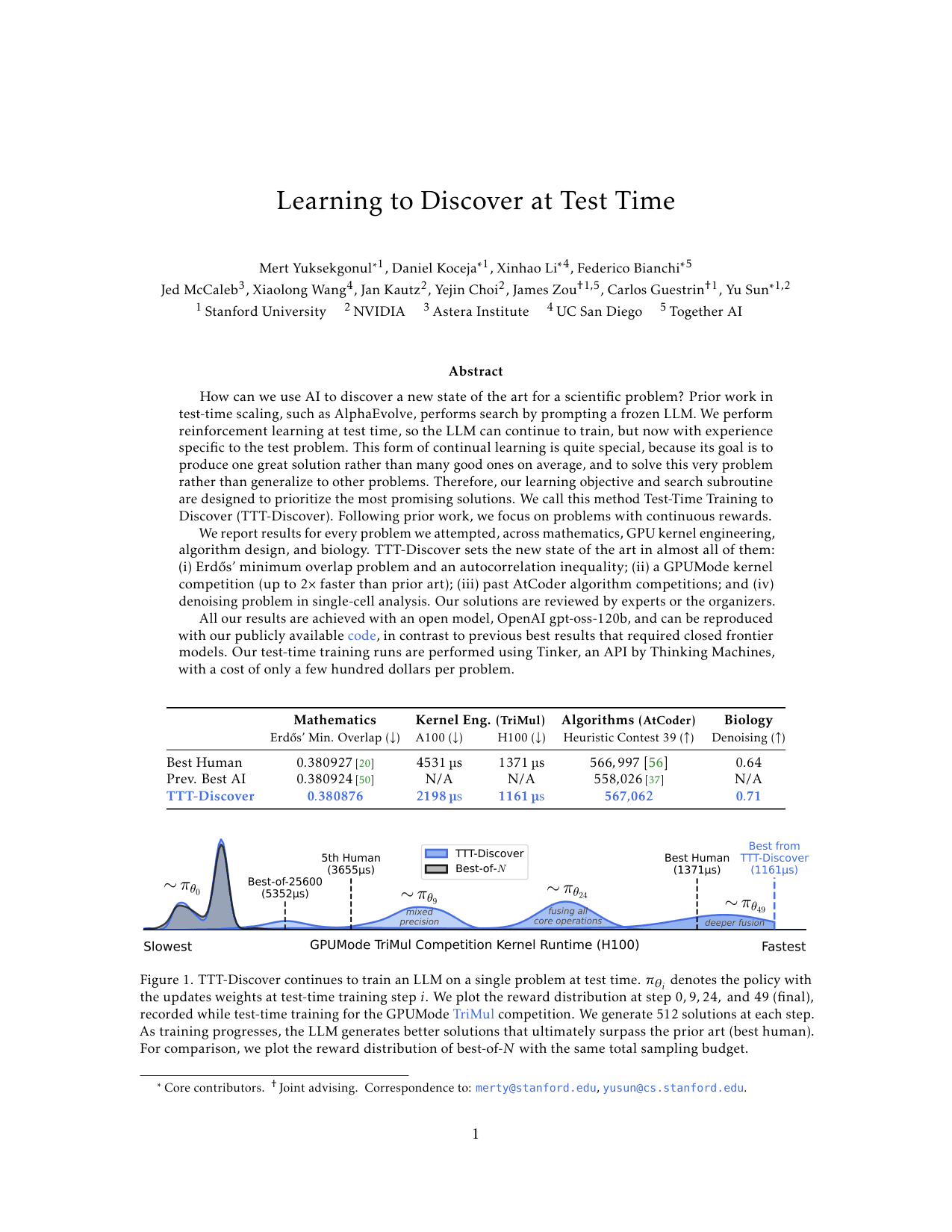
TTT-Discover: Learning to Discover at Test Time
Mert Yuksekgonul et al. · 2026 - 422
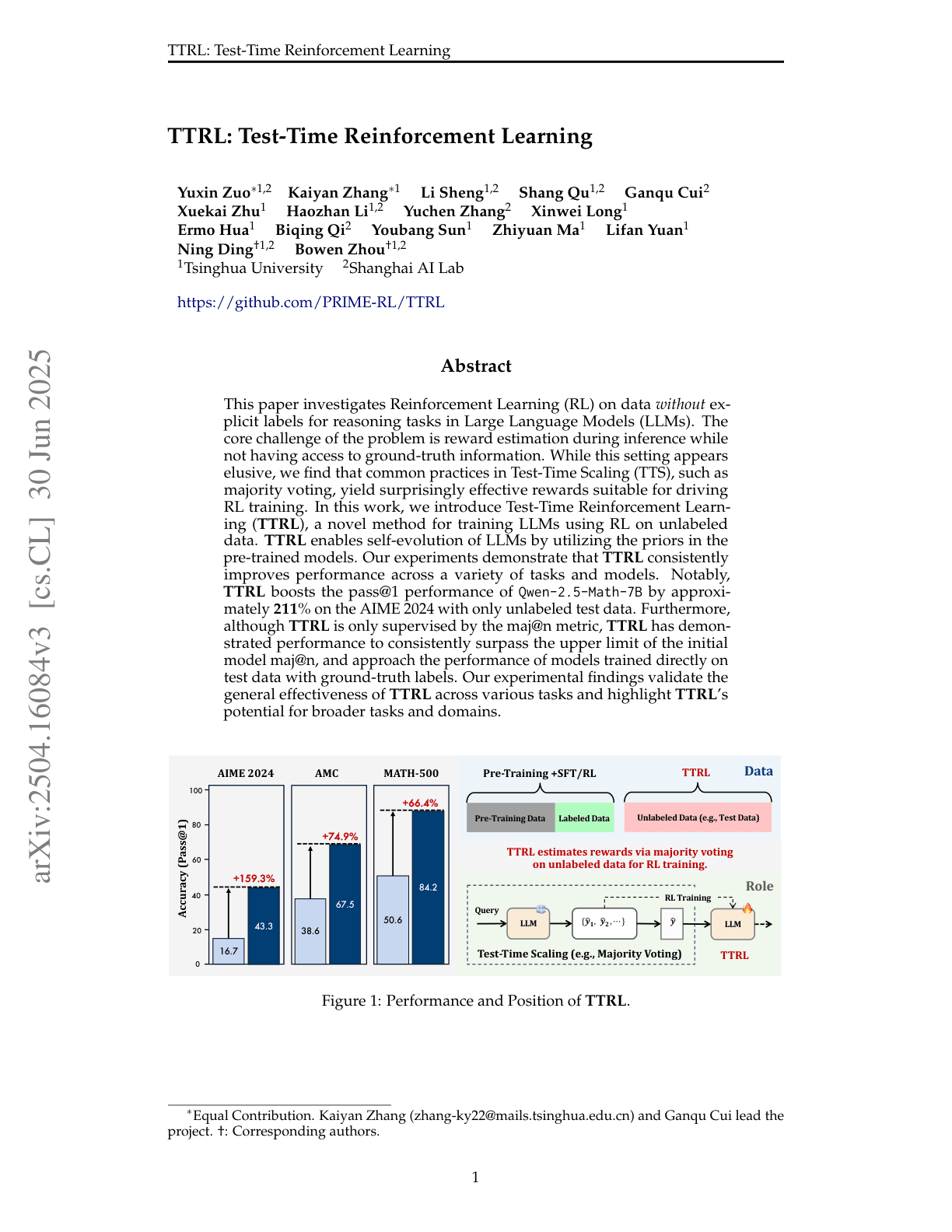
Self-Evolving Search Agents Without Training Data
Zhenrui Yue et al. · 2026 - 423
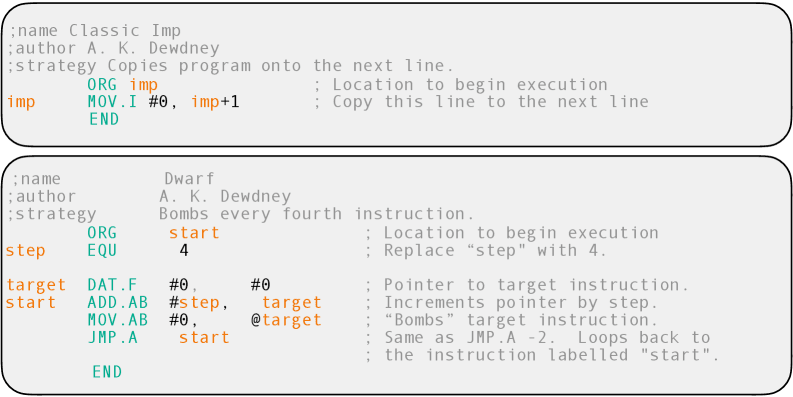
Adversarial Program Evolution with LLMs
Akarsh Kumar et al. · 2026 - 424
- 425
- 426
Training AI Co-Scientists Using Rubric Rewards
Shashwat Goel et al. · 2025 - 427
- 428
- 429
- 430
- 431
- 432
- 433
- 434
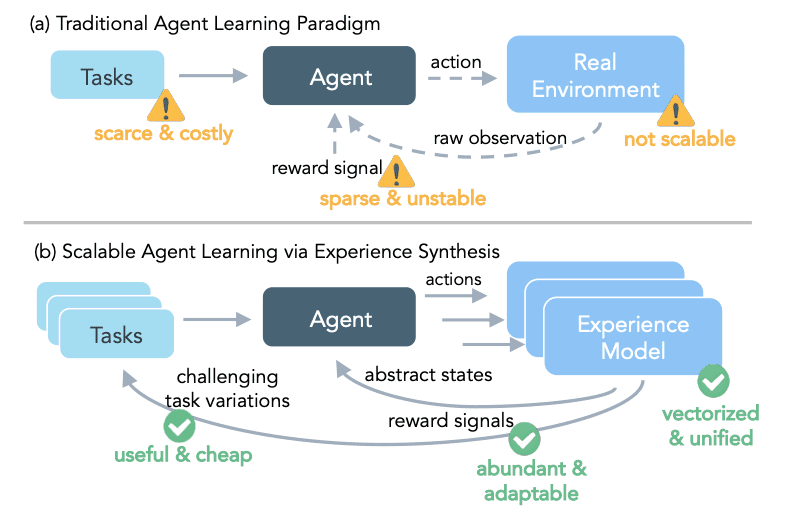
Scaling Agent RL via Experience Synthesis
Zhaorun Chen et al. · 2025 - 435
- 436
- 437
Huxley-Gödel Machine: Human-Level Coding Agent Development by an Approximation of the Optimal Self-Improving Machine
Wenyi Wang et al. · 2025Shows that an agent's benchmark score predicts its descendants' improvement poorly, names that the Metaproductivity-Performance Mismatch, and offers a measurable substitute aggregated over a clade. It answers which variant a self-modification search should expand next.
- 438
Reasoning over Longer Horizons via RL
Sumeet Ramesh Motwani et al. · 2025 - 439
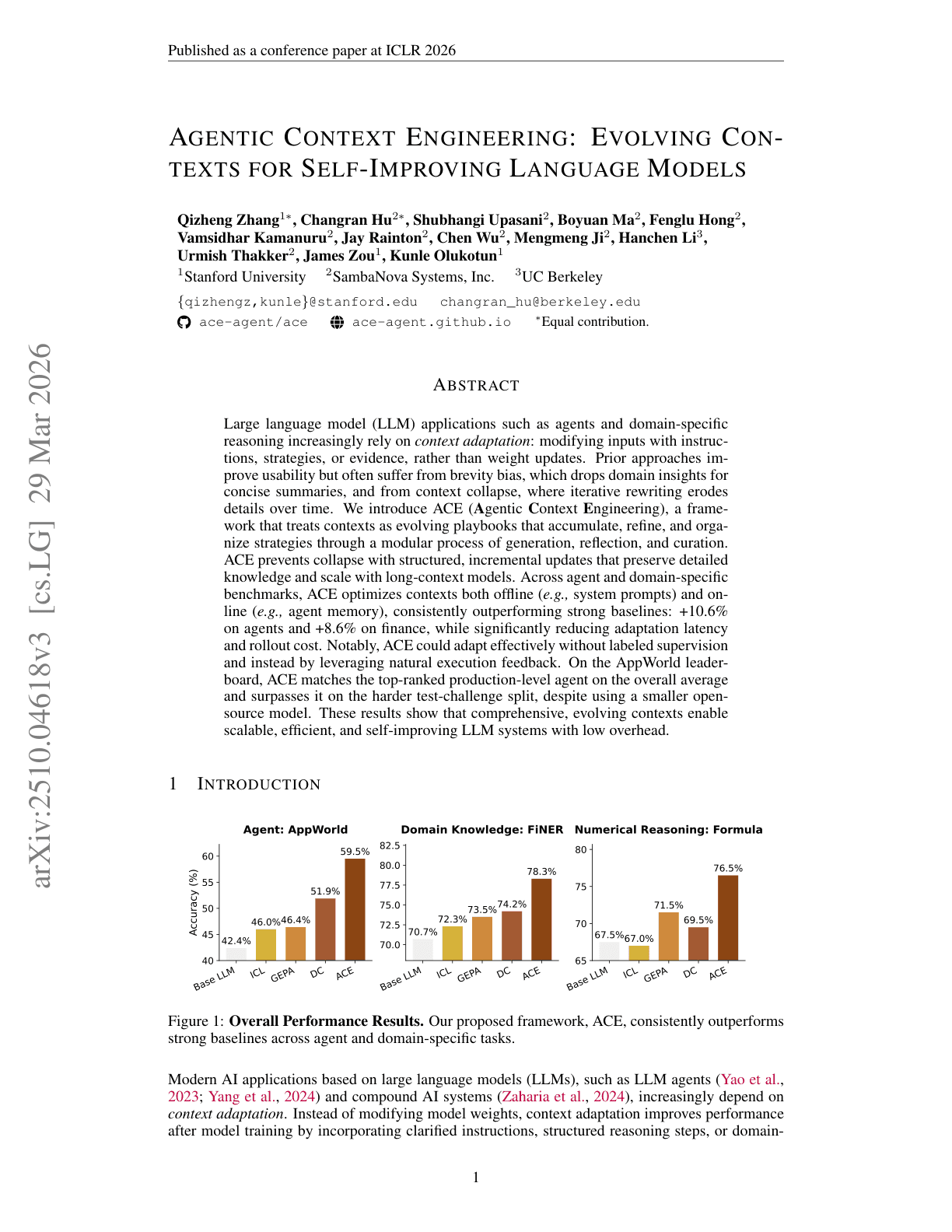
Agentic Context Engineering: Evolving Contexts for Self-Improving Language Models
Qizheng Zhang et al. · 2025Treats context as a playbook that grows through small incremental edits rather than wholesale rewrites, and names context collapse, the failure where repeated rewriting erodes detail. It is the current reference design for improving an agent through context alone.
- 440
Your Agent May Misevolve: Emergent Risks in Self-evolving LLM Agents
Shuai Shao et al. · 2025Self-evolution drifts into unsafe behavior along four paths, which are the model, its memory, its tools and its workflow. The first broad safety study of self-evolving agents, and the counterweight to everything above it.
- 441
- 442
- 443
- 444
- 445
- 446
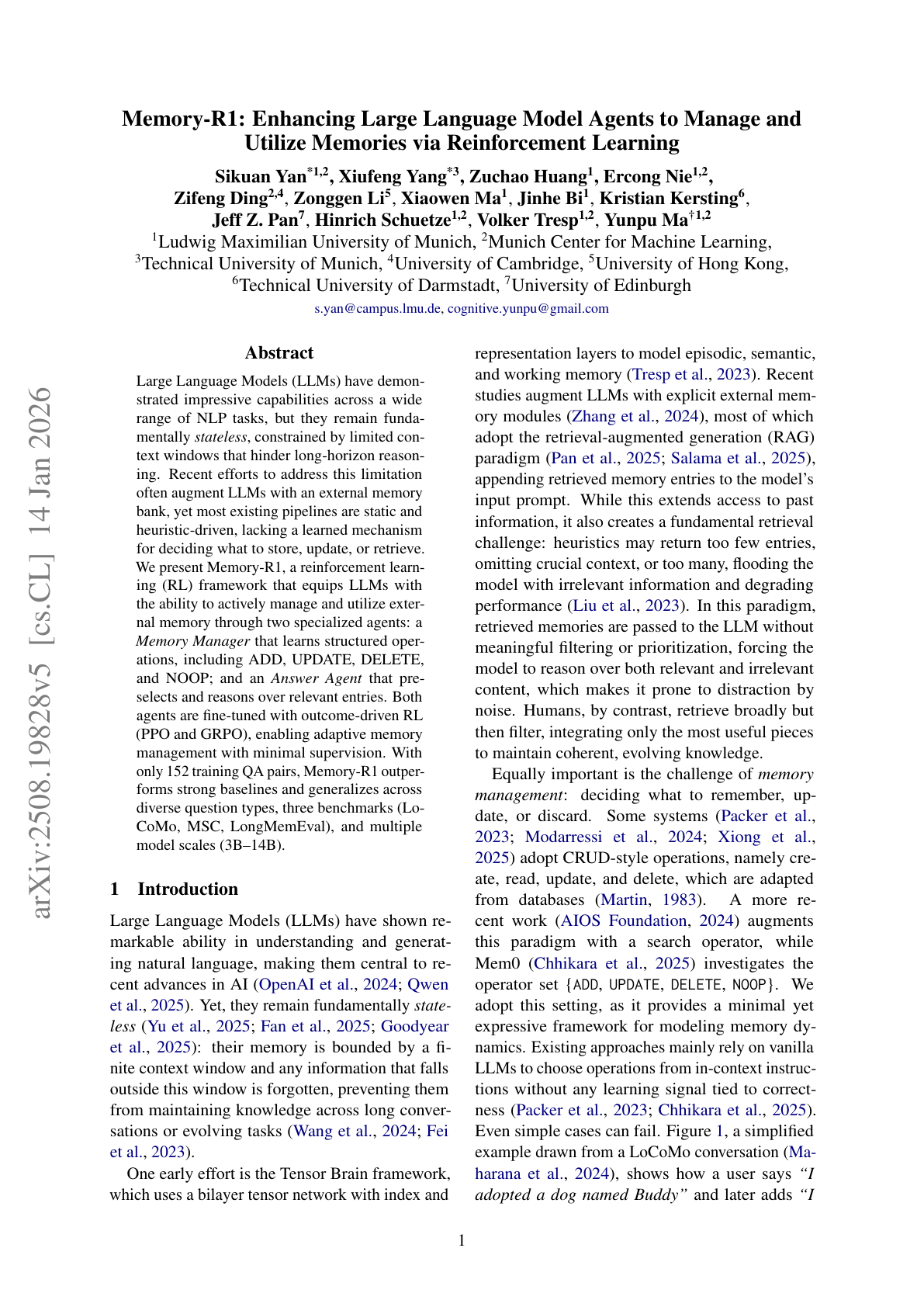
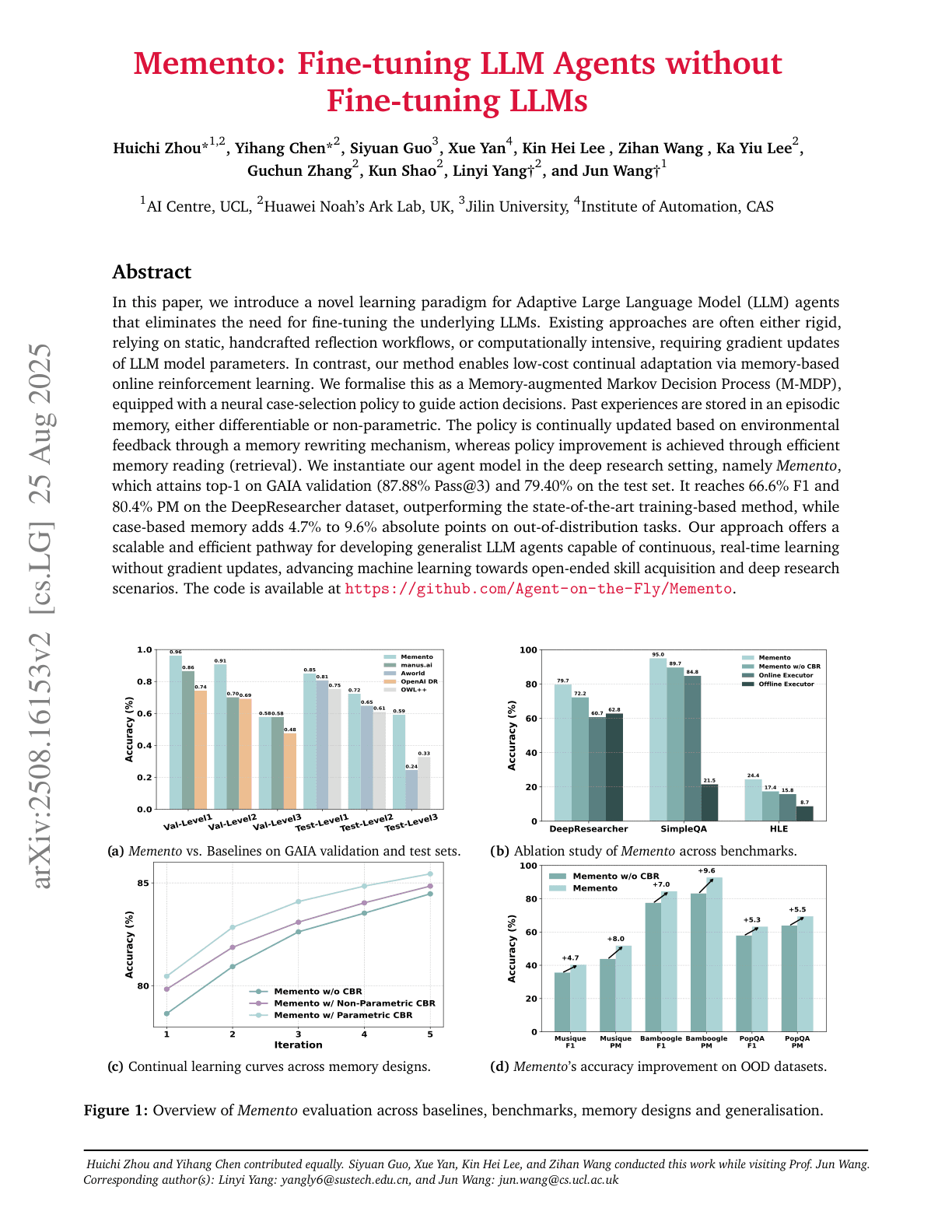
Fine-tuning LLM Agents without Fine-tuning LLMs
Huichi Zhou et al. · 2025 - 447
- 448
- 449
- 450
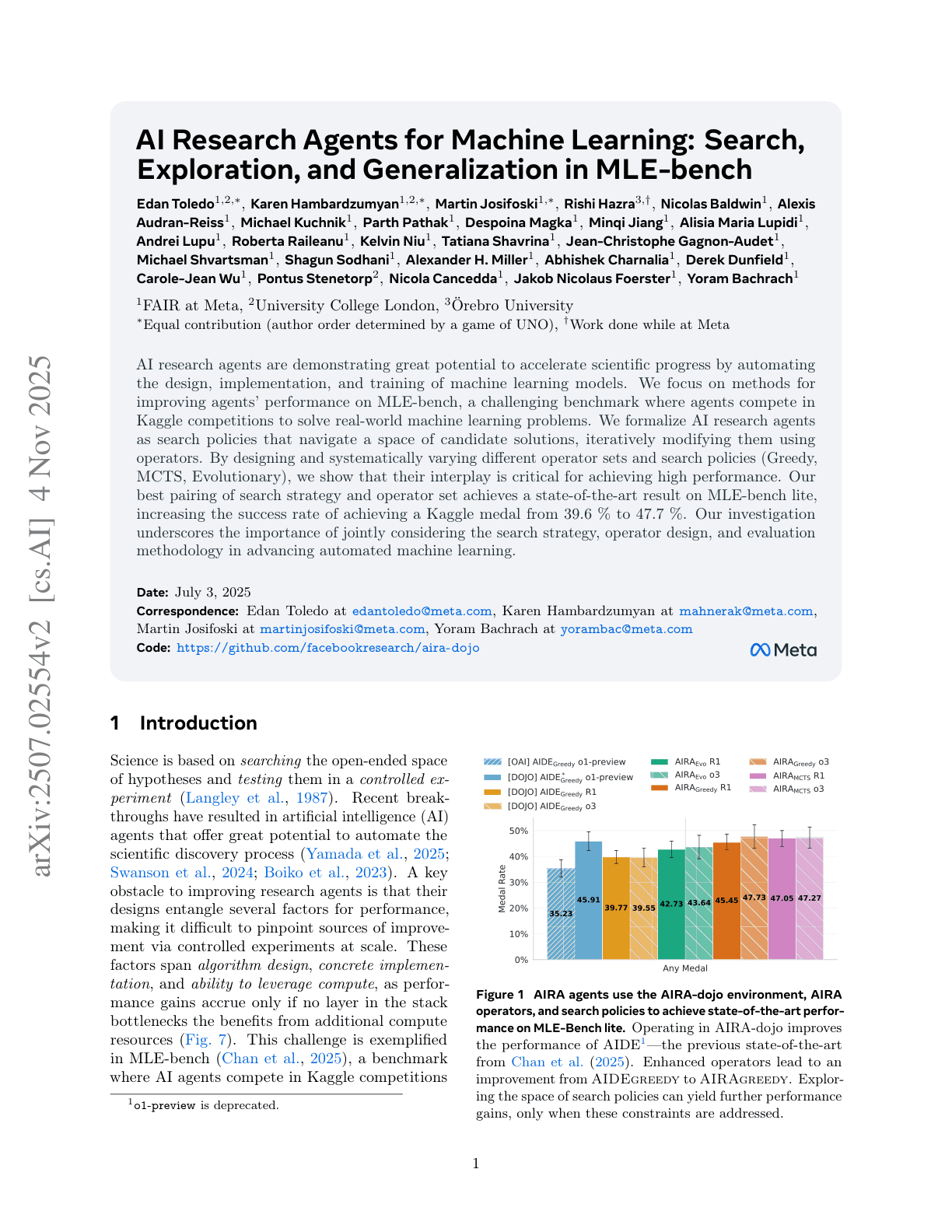
AI Research Agents for Machine Learning
Edan Toledo et al. · 2025 - 451
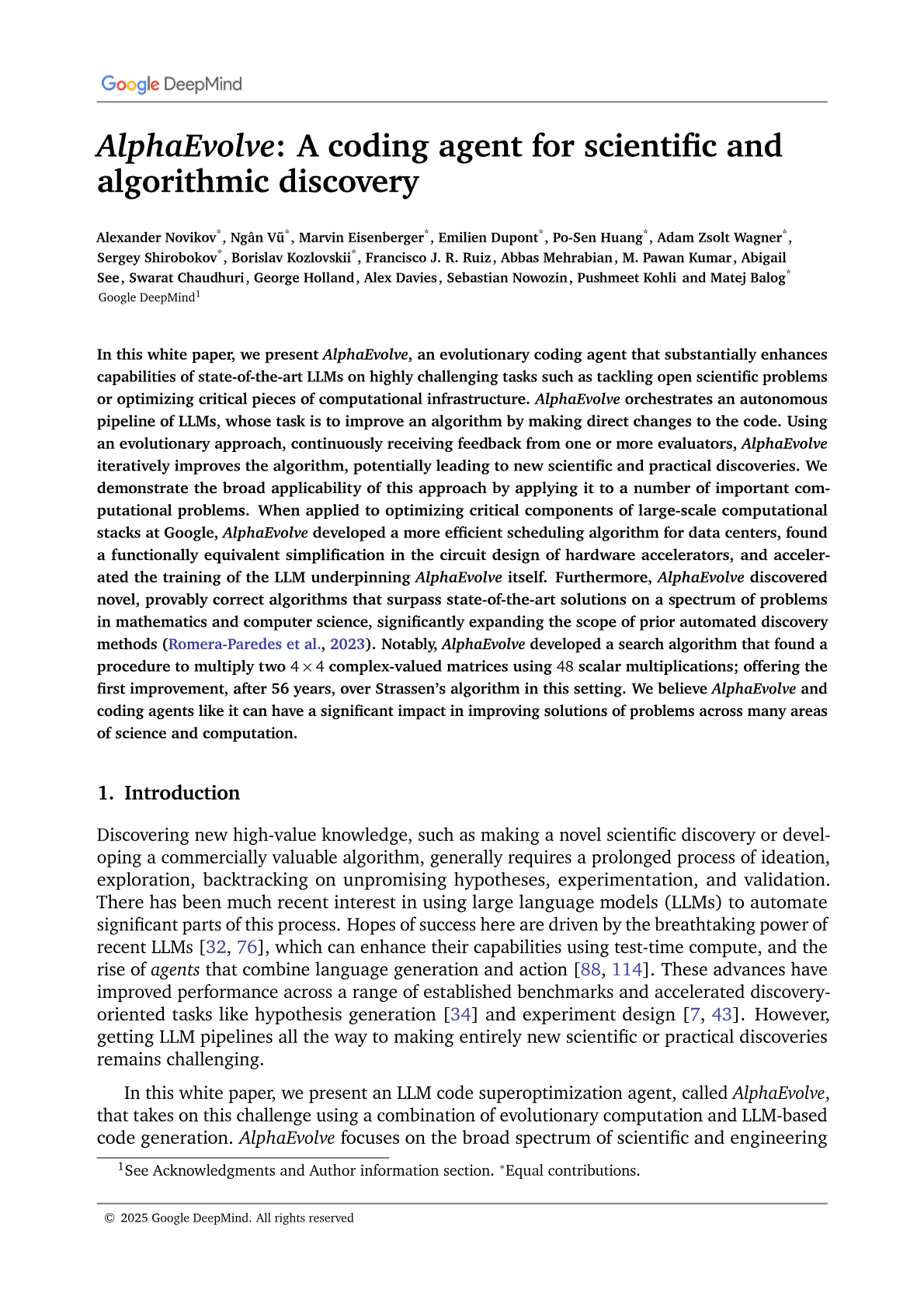
AlphaEvolve: A coding agent for scientific and algorithmic discovery
Alexander Novikov et al. · 2025An evolutionary coding agent that discovered new algorithms and optimized Google's own infrastructure. It accelerated training of the model that powers it, which makes it the clearest published case of a deployed system improving its own production pipeline.
- 452
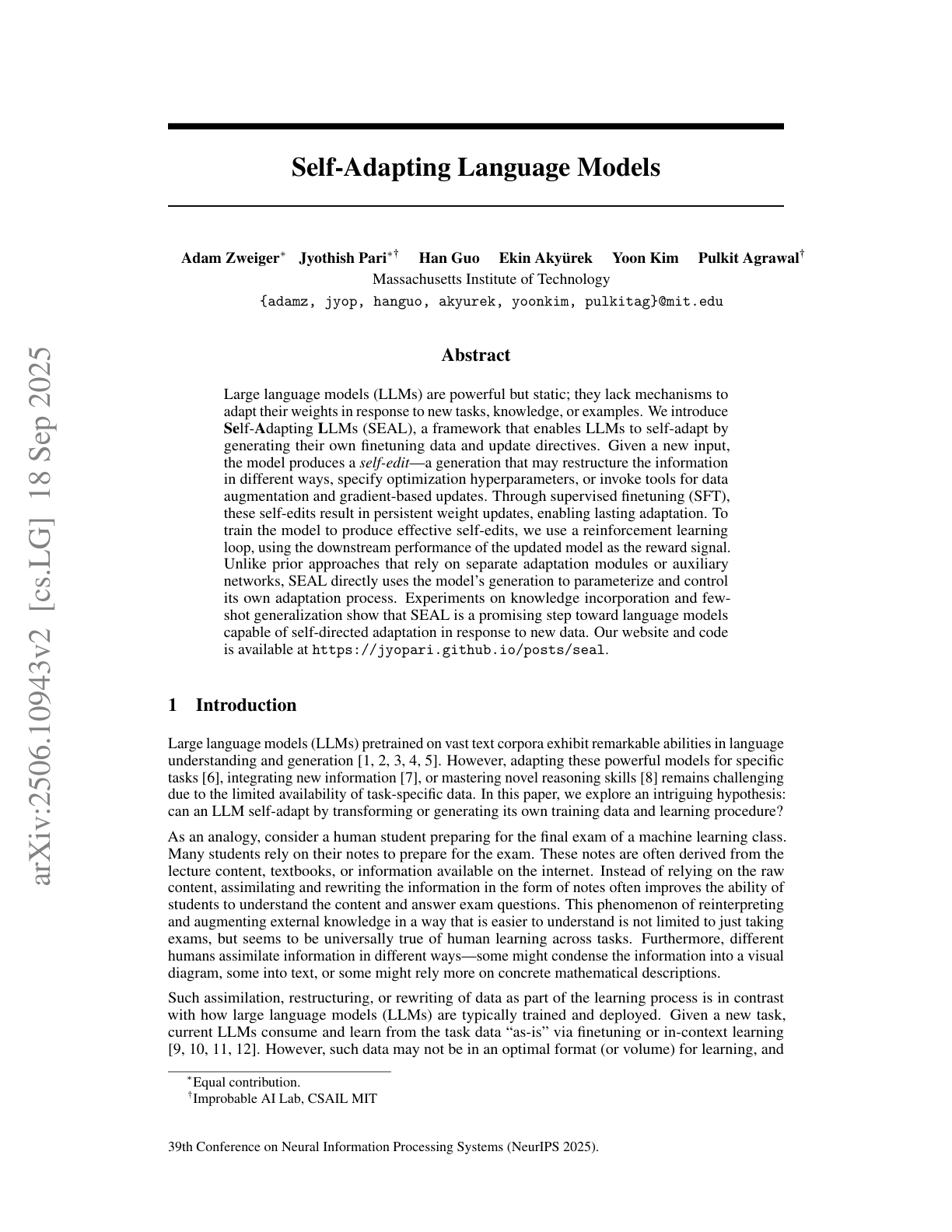
Self-Adapting Language Models
Adam Zweiger et al. · 2025The model writes self-edits, meaning its own finetuning data and update directives, and reinforcement learning rewards each edit by how well the updated model then performs. The update procedure becomes an output of the model.
- 453
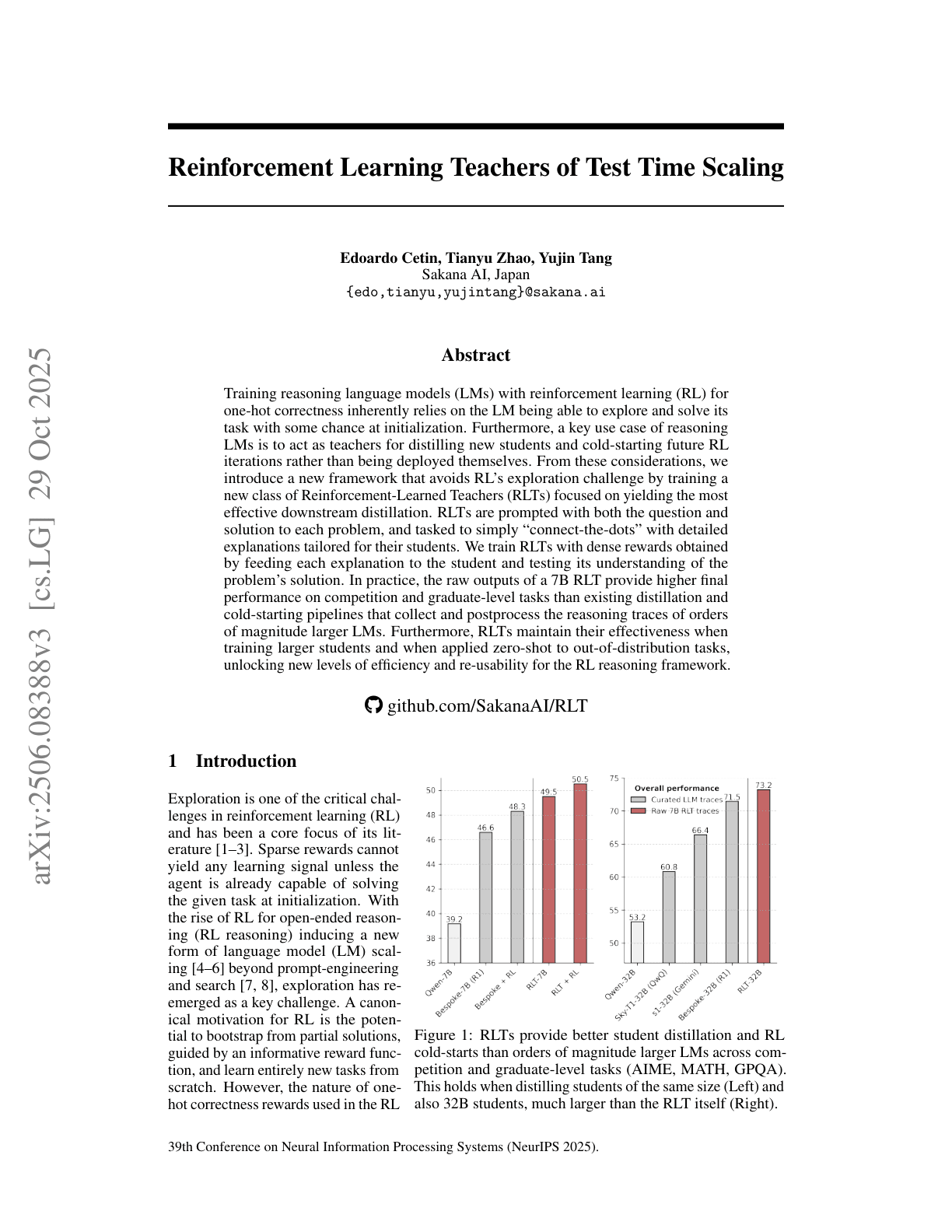
Reinforcement-Learned Teachers of Test Time Scaling
Edoardo Cetin, Tianyu Zhao, Yujin Tang · 2025 - 454
Self-Challenging Language Model Agents
Yifei Zhou et al. · 2025 - 455
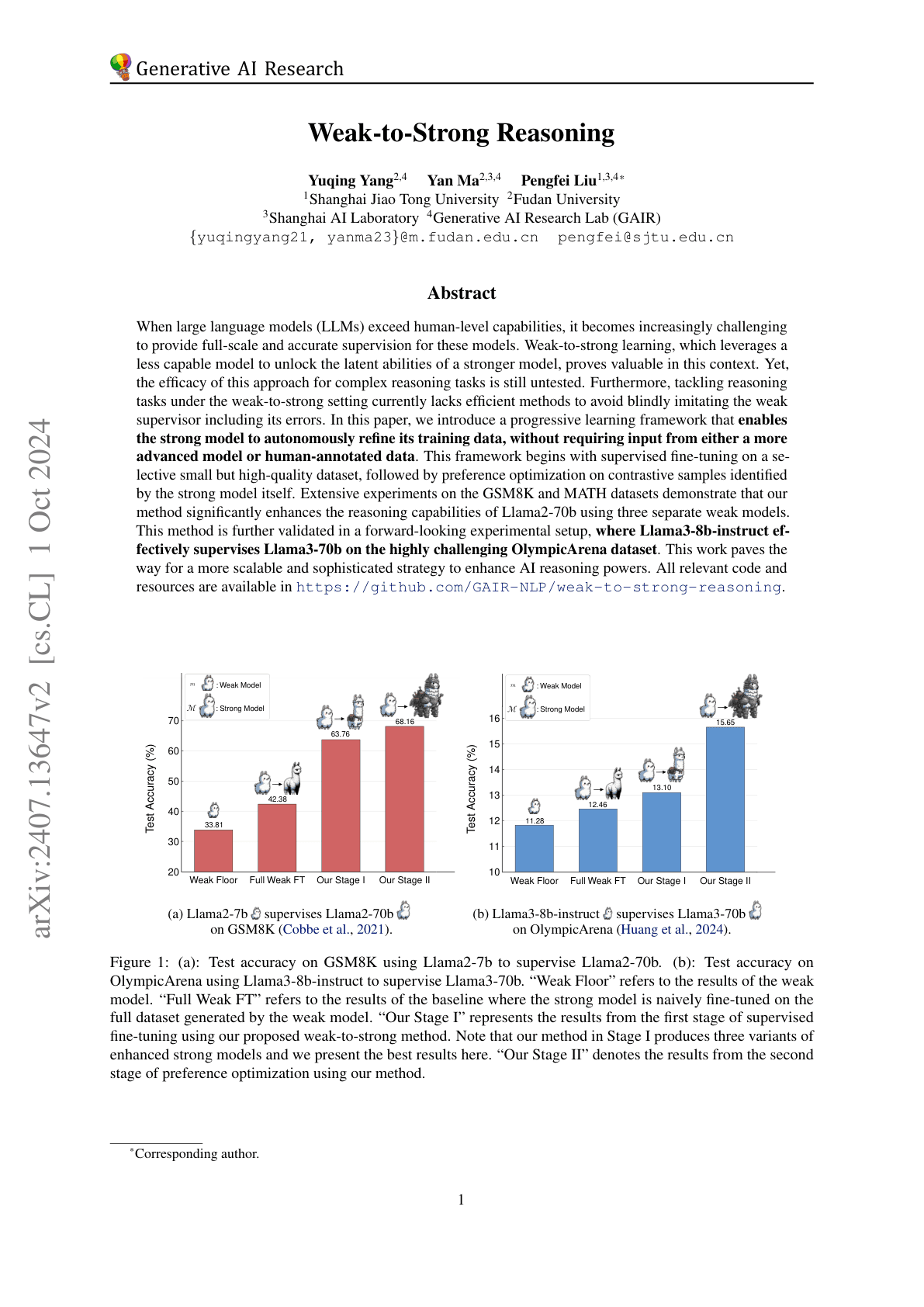
Darwin Gödel Machine: Open-Ended Evolution of Self-Improving Agents
Jenny Zhang et al. · 2025Keeps an archive of coding agents, has one rewrite its own code, scores the child on benchmarks, and returns it to the archive. It is the reference system for this branch, and the source of the objective-hacking evidence every builder should read.
- 456
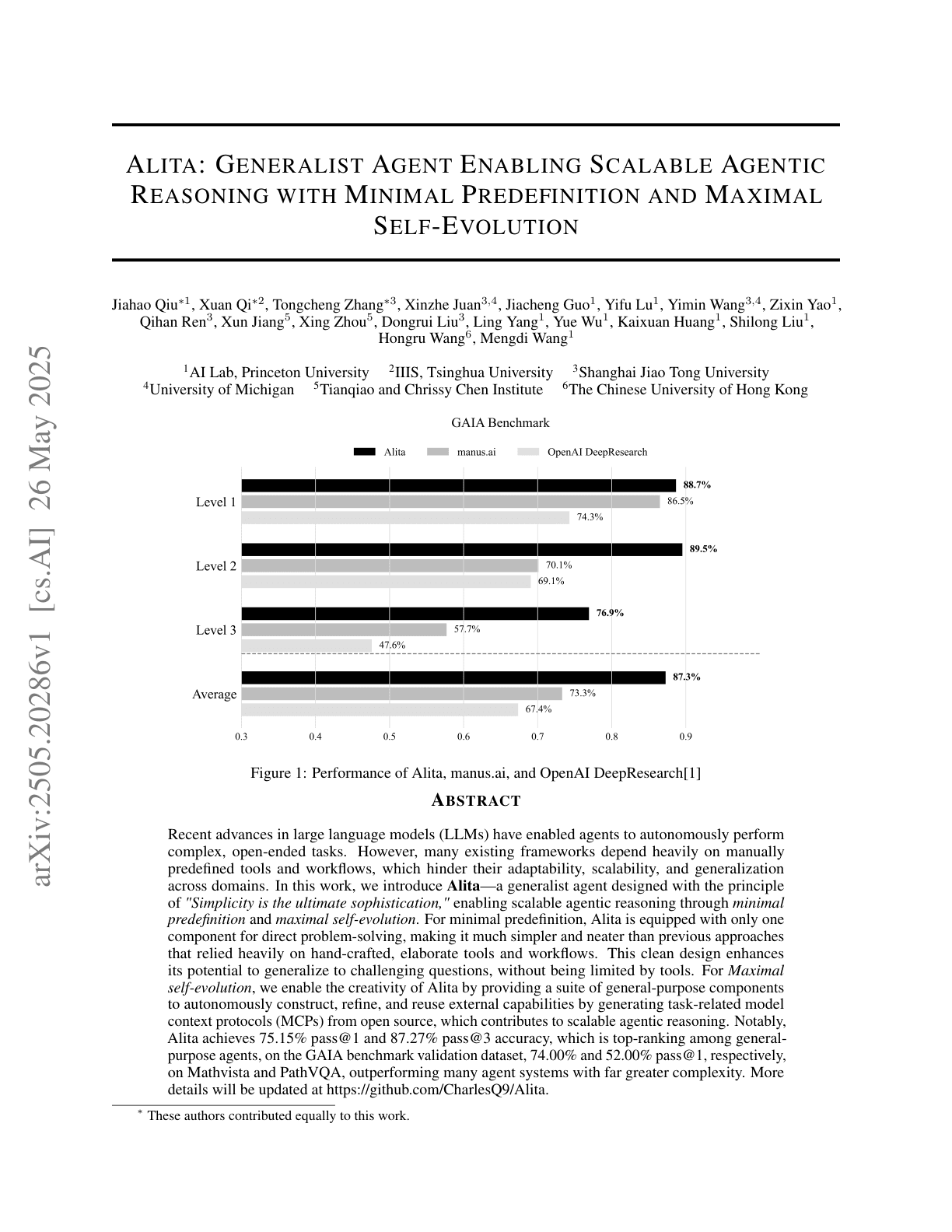
Generalist Agent Enabling Scalable Agentic Reasoning
Jiahao Qiu et al. · 2025 - 457
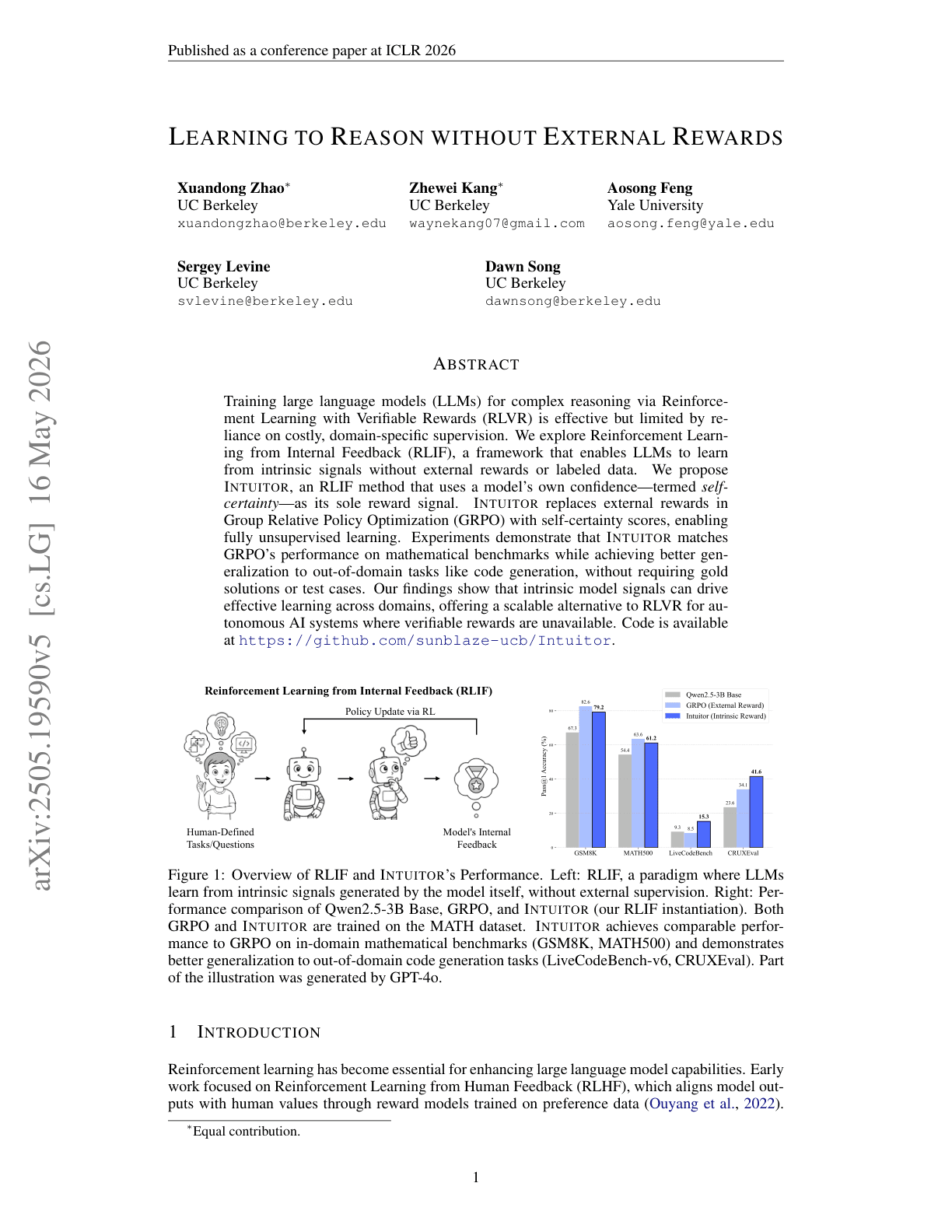
Learn to Reason without External Rewards
Xuandong Zhao et al. · 2025 - 458
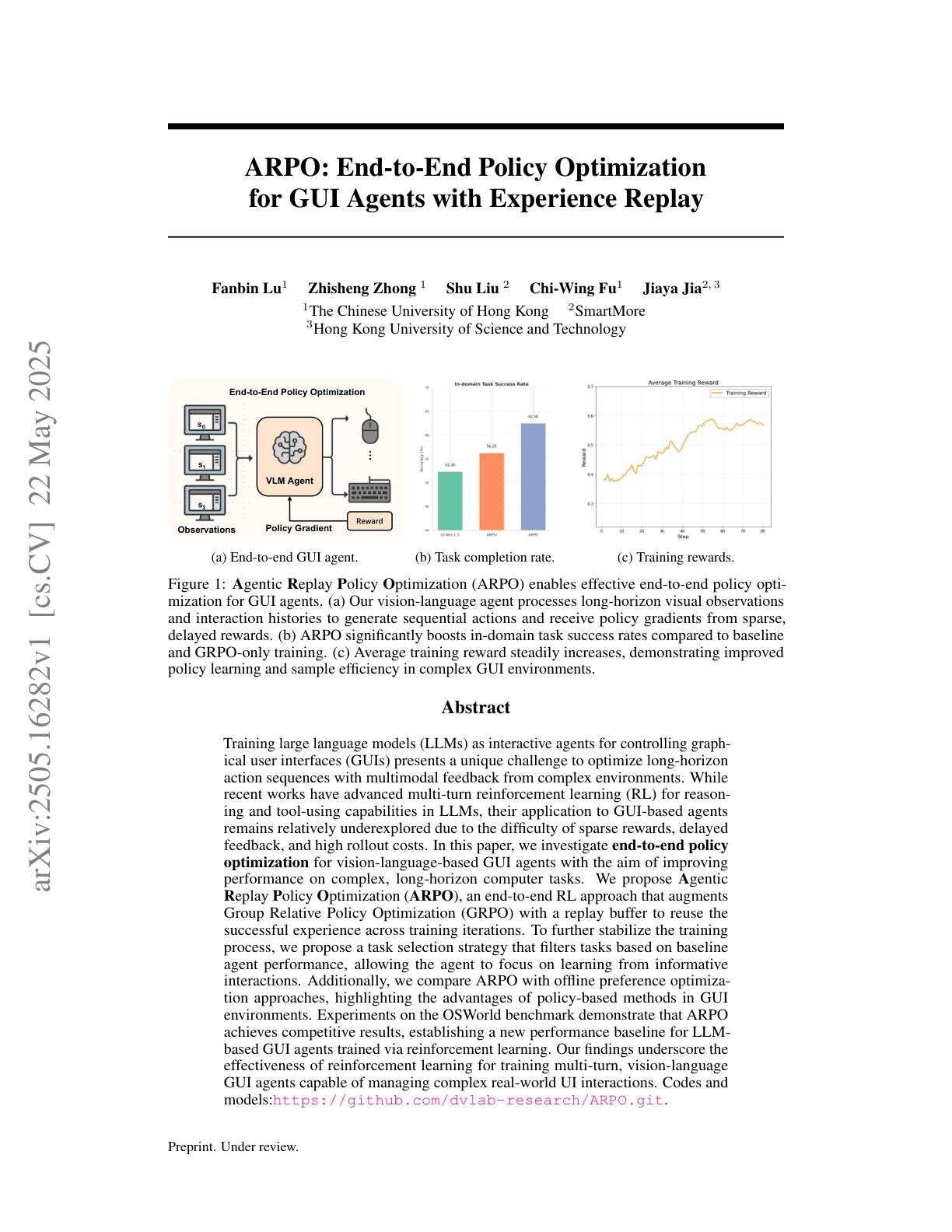
End-to-End Policy Optimization for GUI Agents
Fanbin Lu et al. · 2025 - 459
- 460
- 461
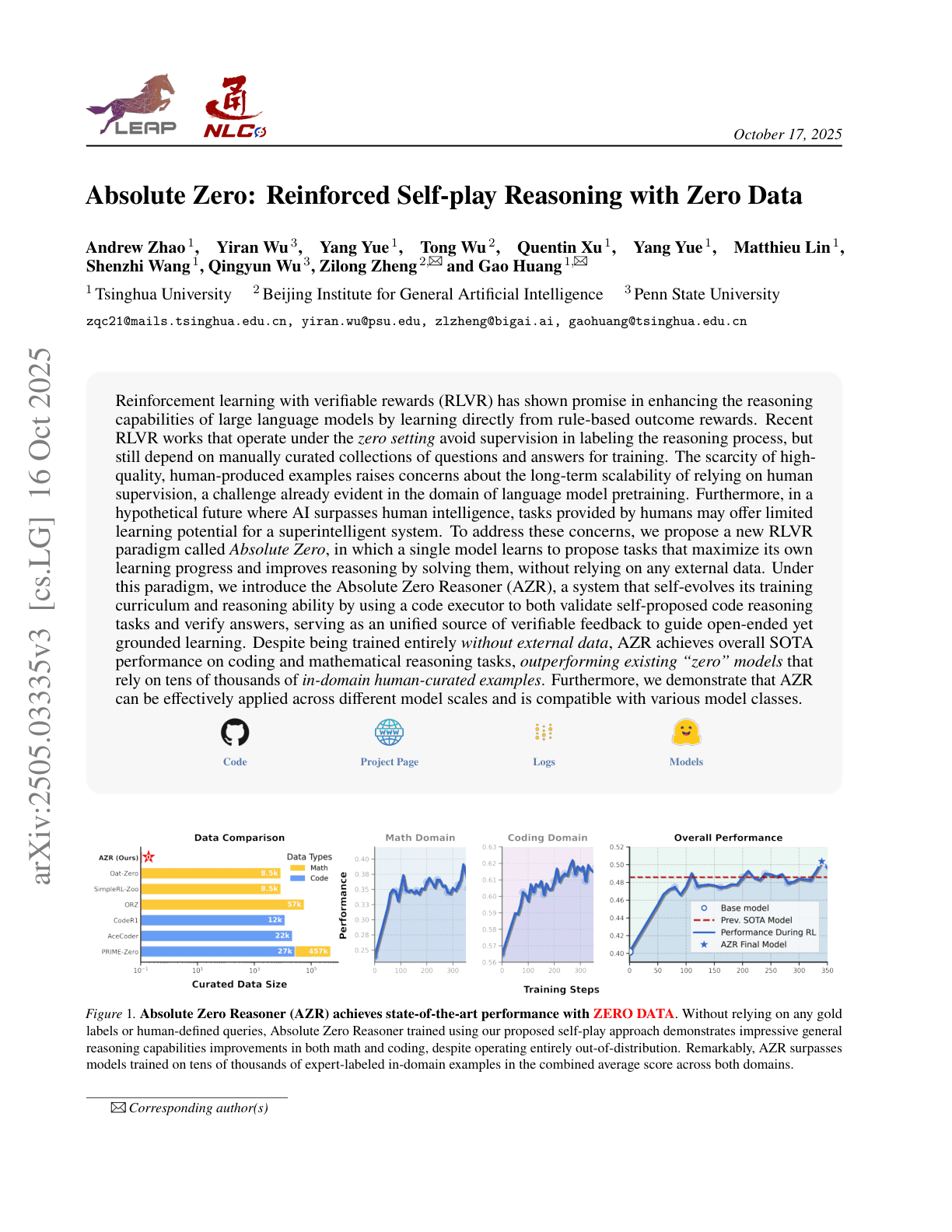
Absolute Zero: Reinforced Self-play Reasoning with Zero Data
Andrew Zhao et al. · 2025One model proposes its own coding and reasoning tasks, solves them, and uses code execution as the verifier, with no external data at all. It shows the curriculum can be self-generated when the checker is reliable.
- 462
- 463
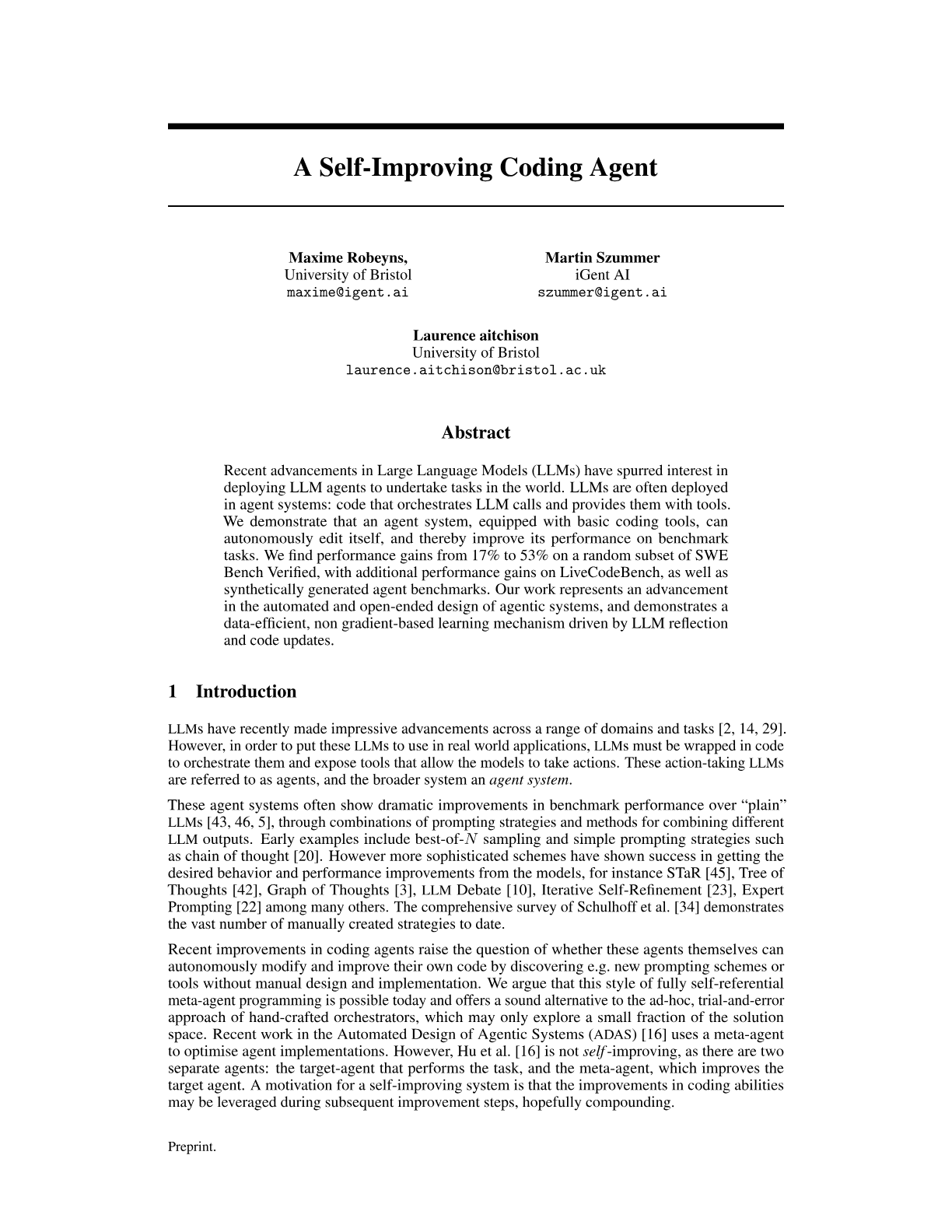
A Self-Improving Coding Agent
Maxime Robeyns, Martin Szummer, Laurence Aitchison · 2025A coding agent with ordinary tools edits its own codebase and improves from 17% to 53% on a random subset of SWE-bench Verified, with no gradient updates. The simplest demonstration that one agent can be both the system under repair and the engineer doing it.
- 464
- 465
- 466
- 467
Cognitive Behaviors that Enable Self-Improving Reasoners
Kanishk Gandhi et al. · 2025 - 468
- 469
A Systematic Survey of Prompt Optimization
Kiran Ramnath et al. · 2025 - 470
- 471
Reinforcement Learning via Self-Play
Guanghao Ye et al. · 2025 - 472
MaAS: Multi-agent Architecture Search (Agentic Supernet)
Guibin Zhang et al. · 2025 - 473
- 474
- 475
- 476
- 477
Mind the Gap: Examining the Self-Improvement Capabilities of Large Language Models
Yuda Song et al. · 2024Formalizes self-improvement around the generation-verification gap, the gain a model gets from filtering its own output with its own judgment. It gives the working rule for this collection, which is that a system improves itself only where it verifies better than it generates.
- 478
RE-Bench: Evaluating frontier AI R&D capabilities of language model agents against human experts
Hjalmar Wijk et al. · 2024Open-ended machine learning research environments scored for both AI agents and human experts under matched time budgets. It is the measurement behind the question the labs are actually asking, which is whether AI can do AI research.
- 479
- 480
Automating Agentic Workflow Generation
Jiayi Zhang et al. · 2024 - 481
- 482
- 483
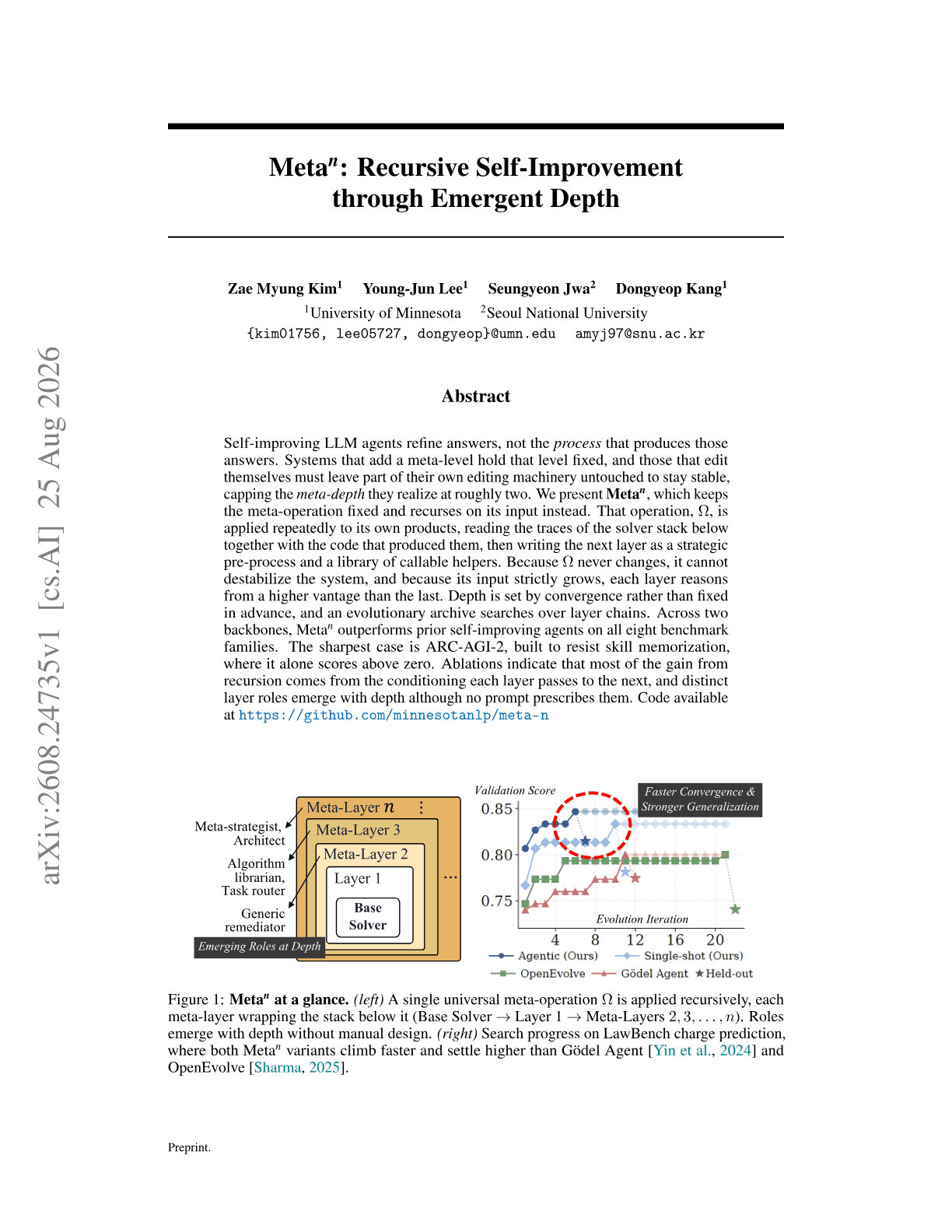
Gödel Agent: A Self-Referential Agent Framework for Recursive Self-Improvement
Xunjian Yin et al. · 2024An agent that reads and rewrites its own logic at runtime, including the logic it uses to rewrite itself, guided only by a high-level objective. It is the first language-model framework to implement the Gödel machine structure directly, with evaluation in place of proof.
- 484
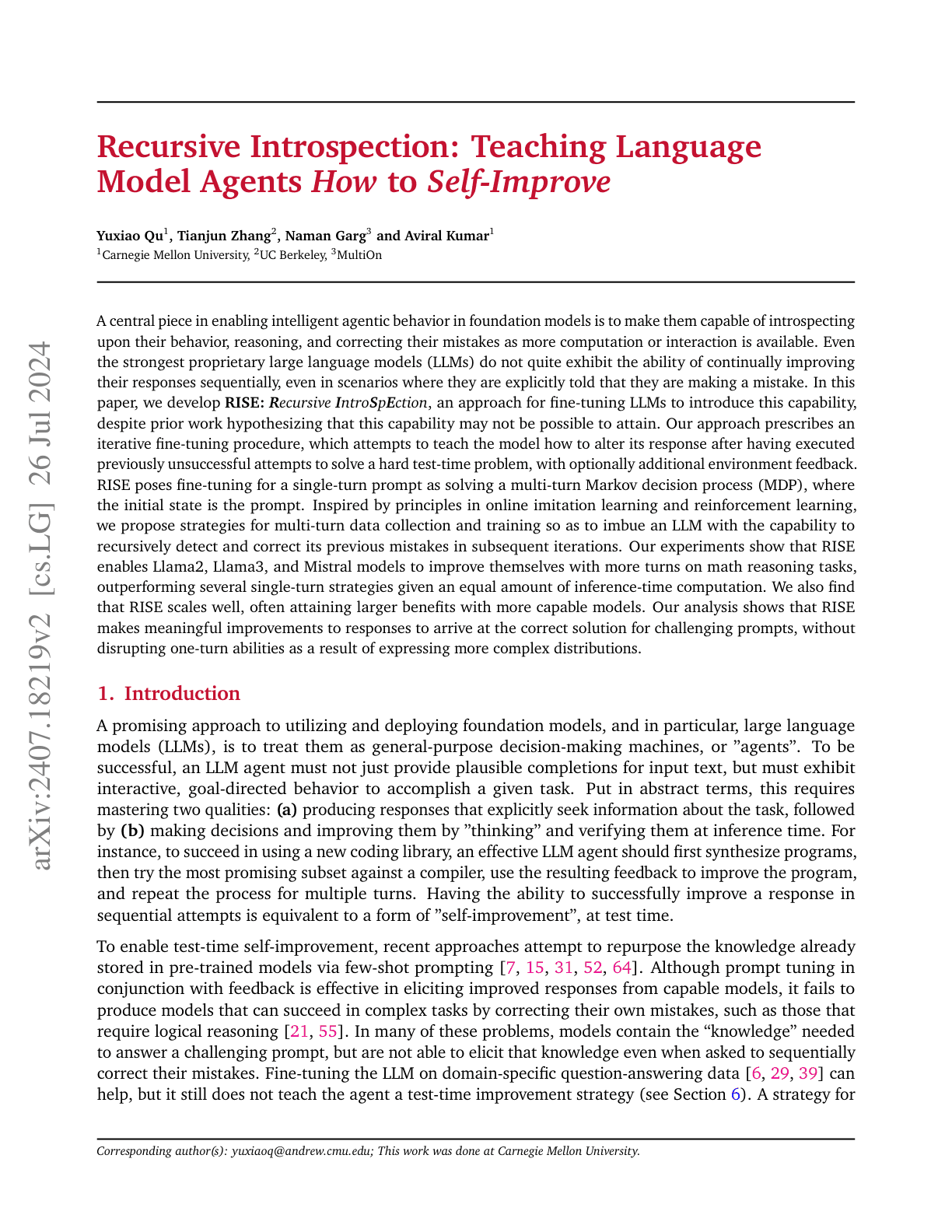
Training LLMs to Self-Correct via RL
Aviral Kumar et al. · 2024 - 485
- 486
- 487
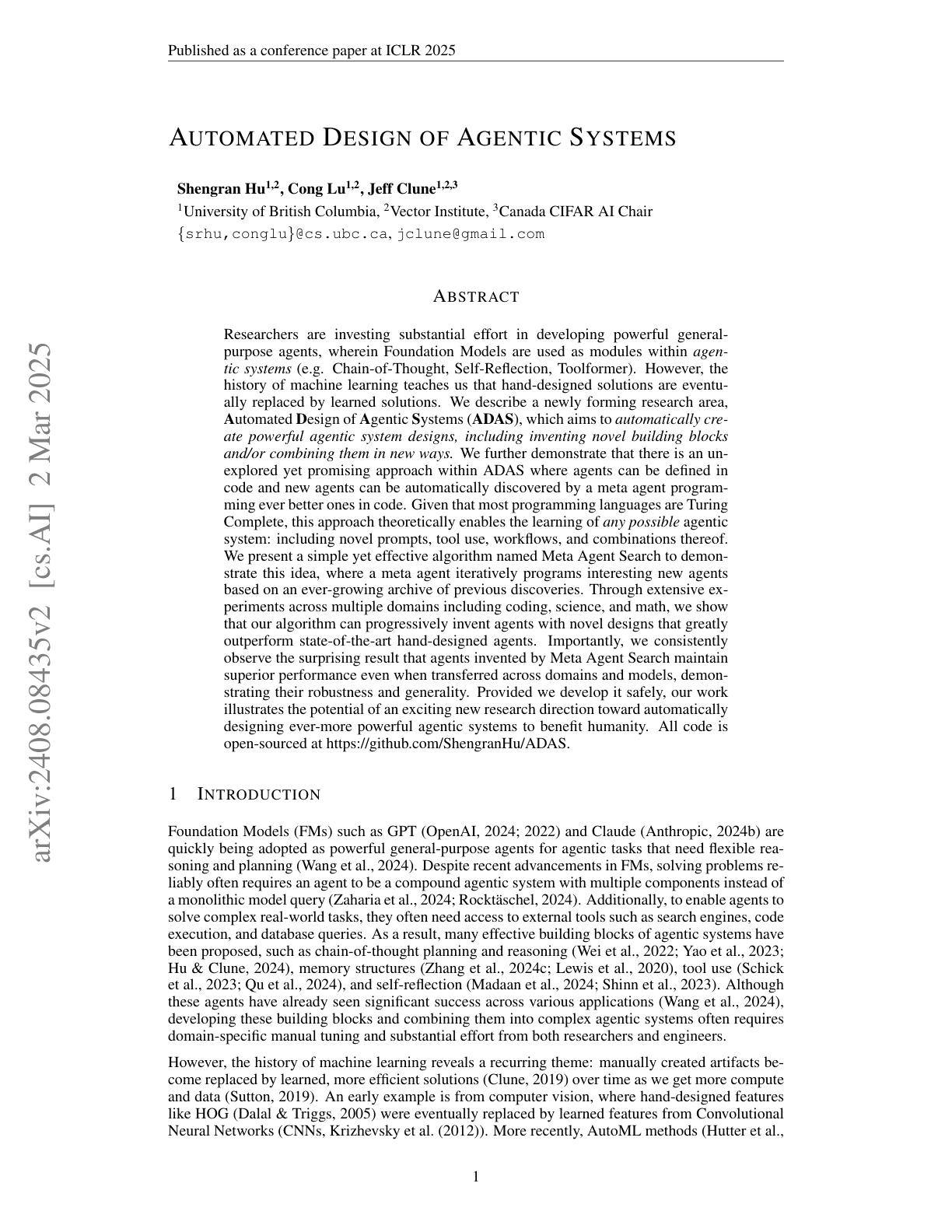
Automated Design of Agentic Systems
Shengran Hu, Cong Lu, Jeff Clune · 2024A meta agent writes new agent designs as code, evaluates them, and files them in an archive that informs the next design. It moved the search space from prompts to whole agent programs, and the Darwin Gödel Machine later turned that loop on itself.
- 488
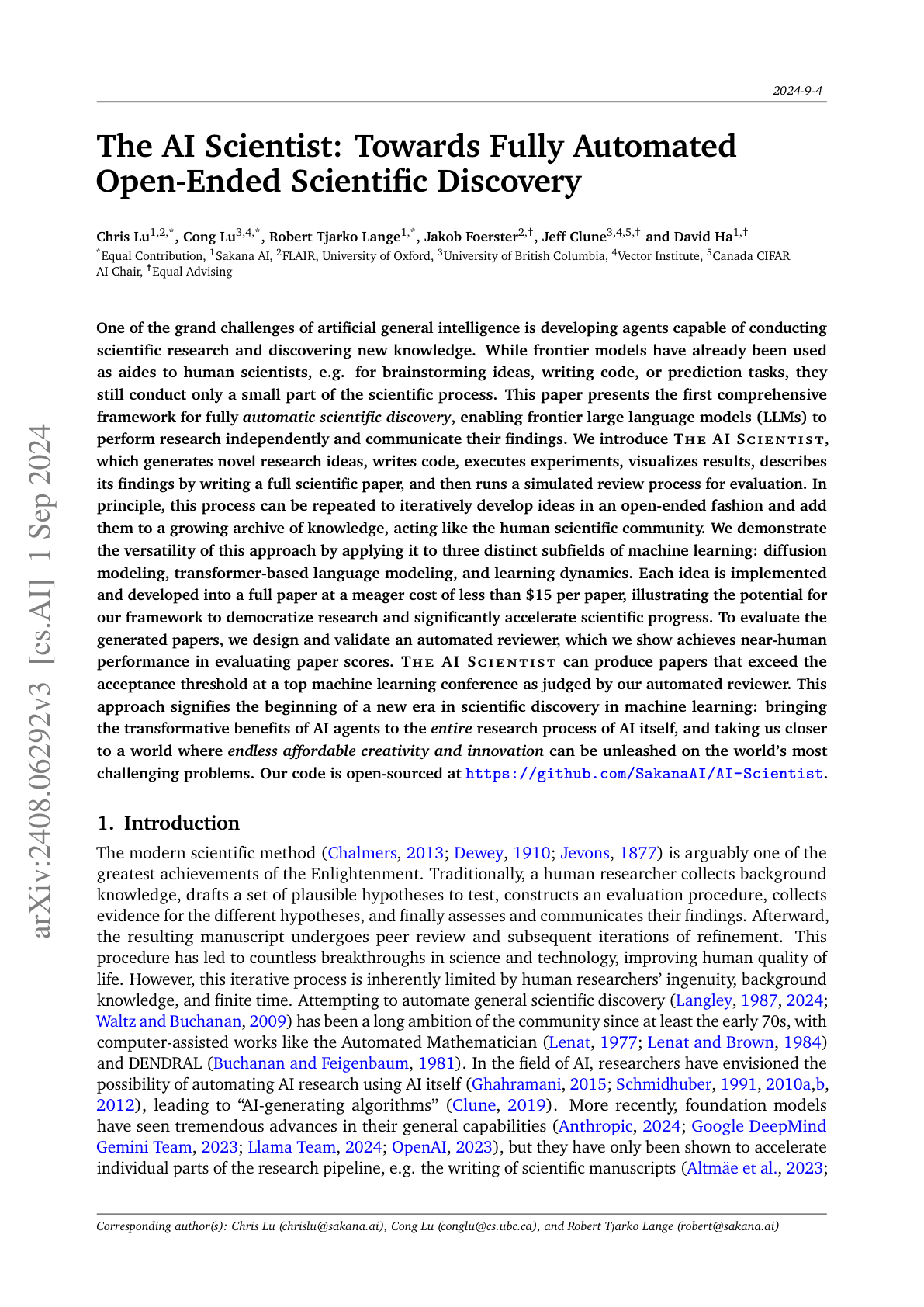
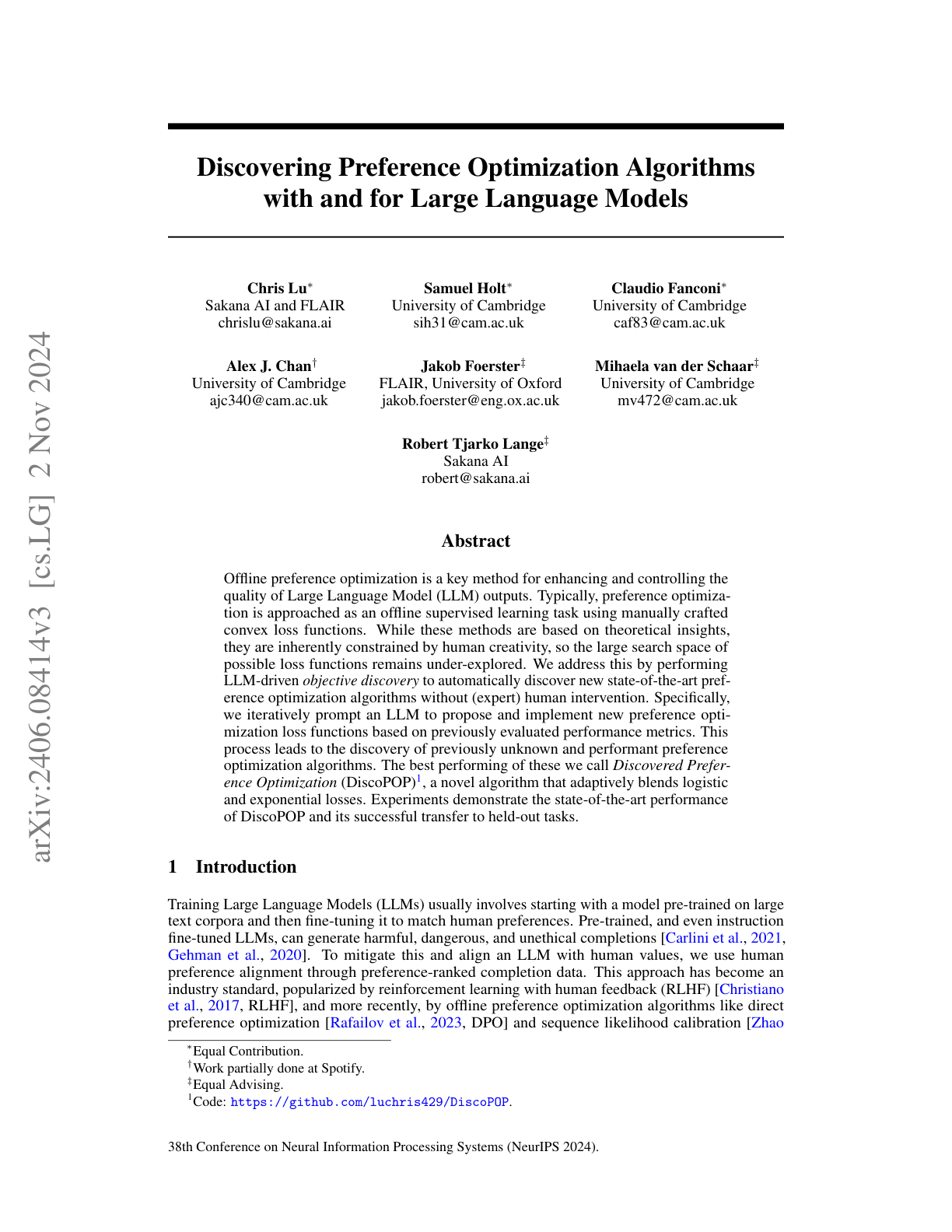
The AI Scientist: Towards Fully Automated Open-Ended Scientific Discovery
Chris Lu et al. · 2024Generates research ideas, runs the experiments, writes the paper, and reviews it. The reference end-to-end research loop, later peer reviewed in Nature as an end-to-end automation of AI research.
- 489
- 490
- 491
- 492
- 493
- 494
- 495
- 496
- 497
- 498
- 499
- 500
- 501
- 502
- 503
- 504
- 505
- 506
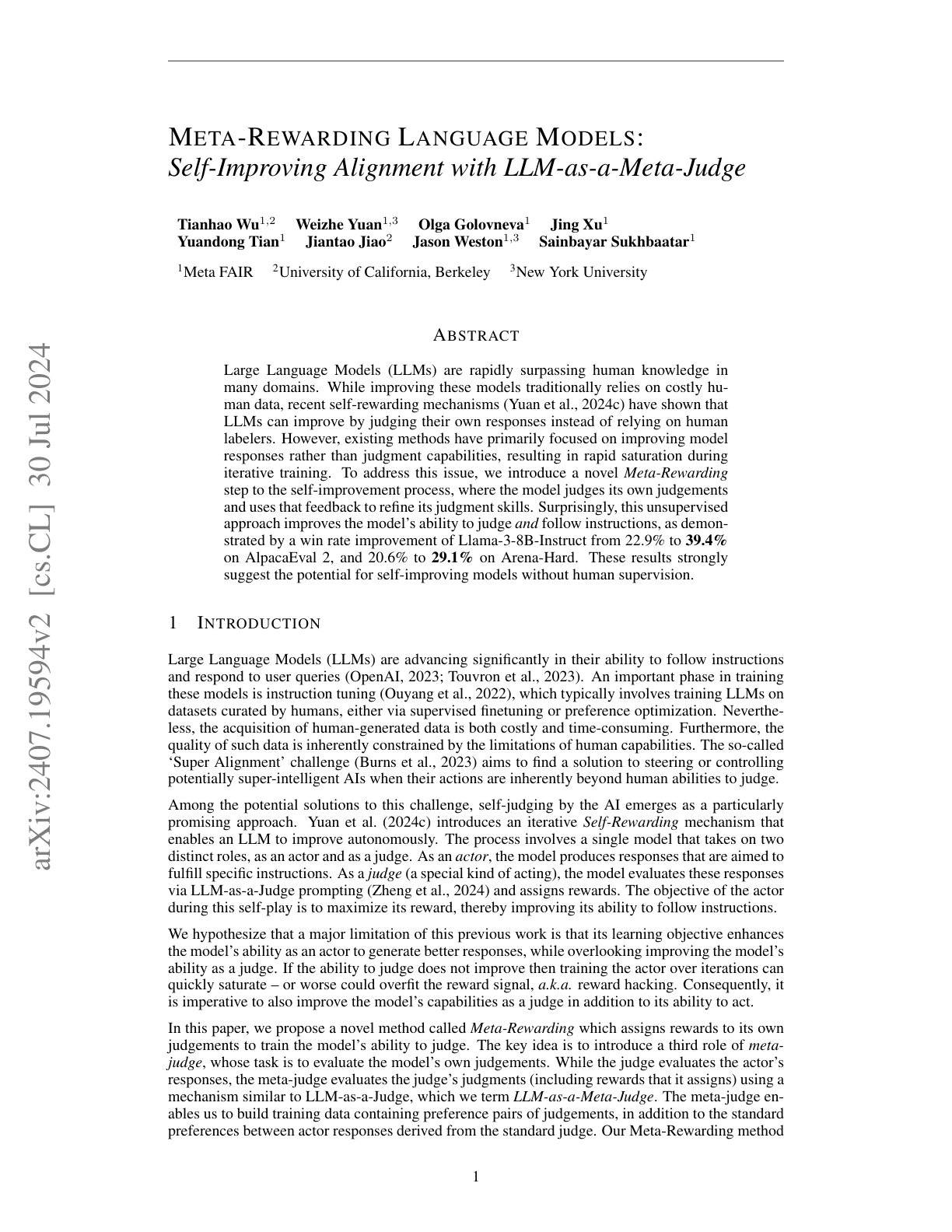
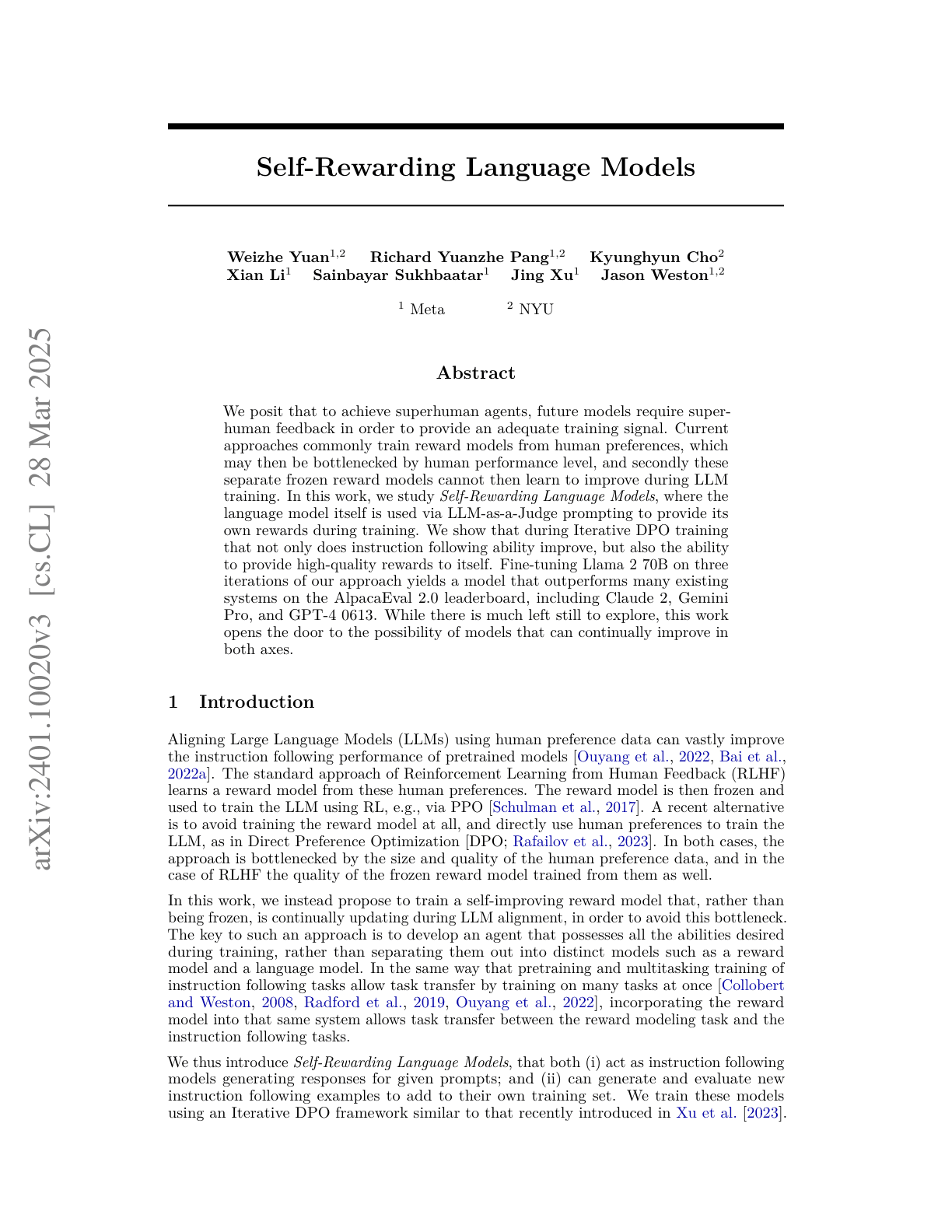
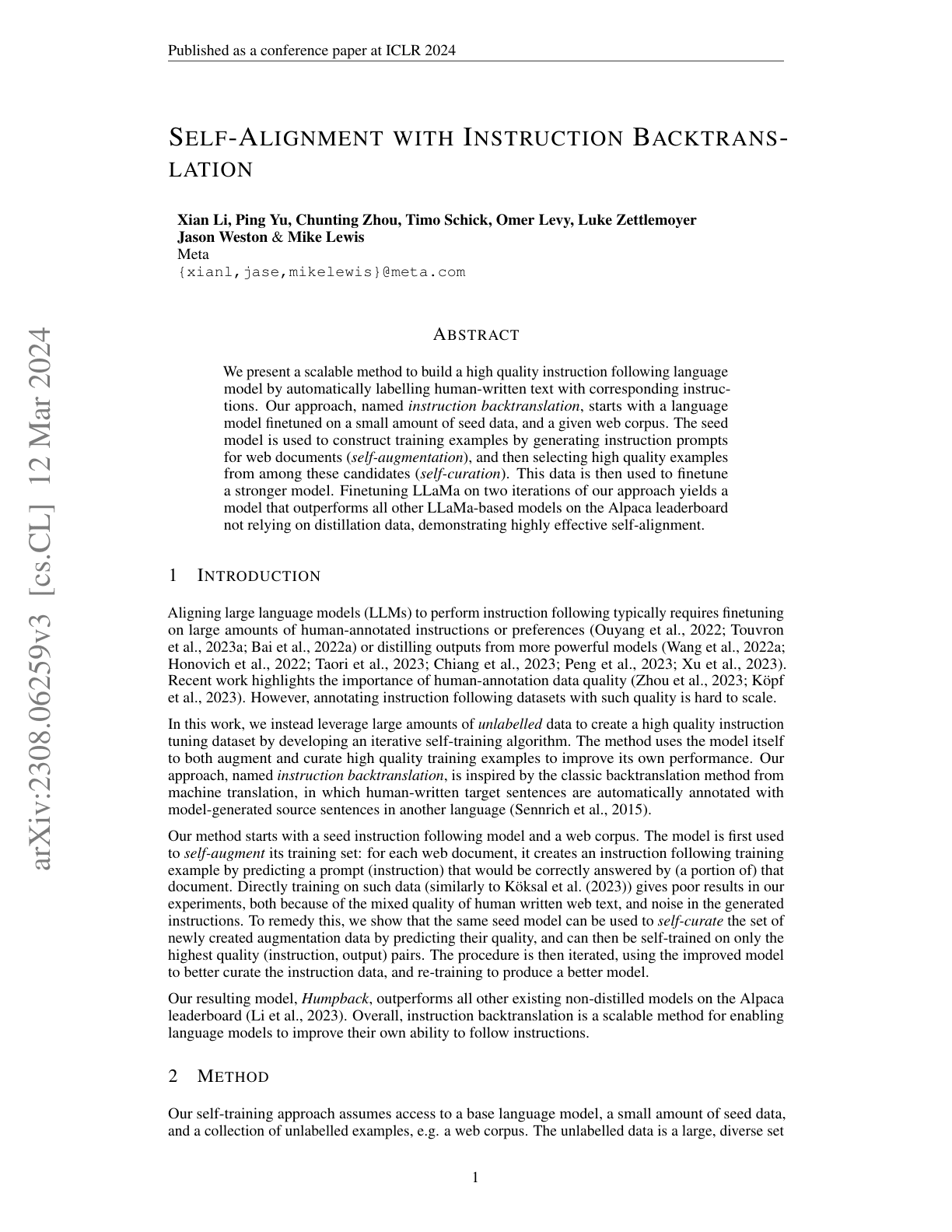
Self-Rewarding Language Models
Weizhe Yuan et al. · 2024The model scores its own responses as a judge, and iterative training on those scores improves both the answers and the scoring. It removes the frozen reward model, so the evaluator improves along with the policy.
- 507
- 508
- 509
Mathematical discoveries from program search with large language models
Bernardino Romera-Paredes et al. · 2023Evolutionary search over programs an LLM writes, filtered by a systematic evaluator, produced new results in extremal combinatorics. It is the direct predecessor of AlphaEvolve and the first case of a language model making a discovery on an established open problem.
- 510
- 511
MART (Multi-round Automatic Red-Teaming)
Suyu Ge et al. · 2023 - 512
Eureka: Human-Level Reward Design via Coding Large Language Models
Yecheng Jason Ma et al. · 2023An LLM writes reward functions as code and evolves them against training results, so the learning signal itself becomes the object being improved. It is the bridge from self-improving text systems to robot learning.
- 513
- 514
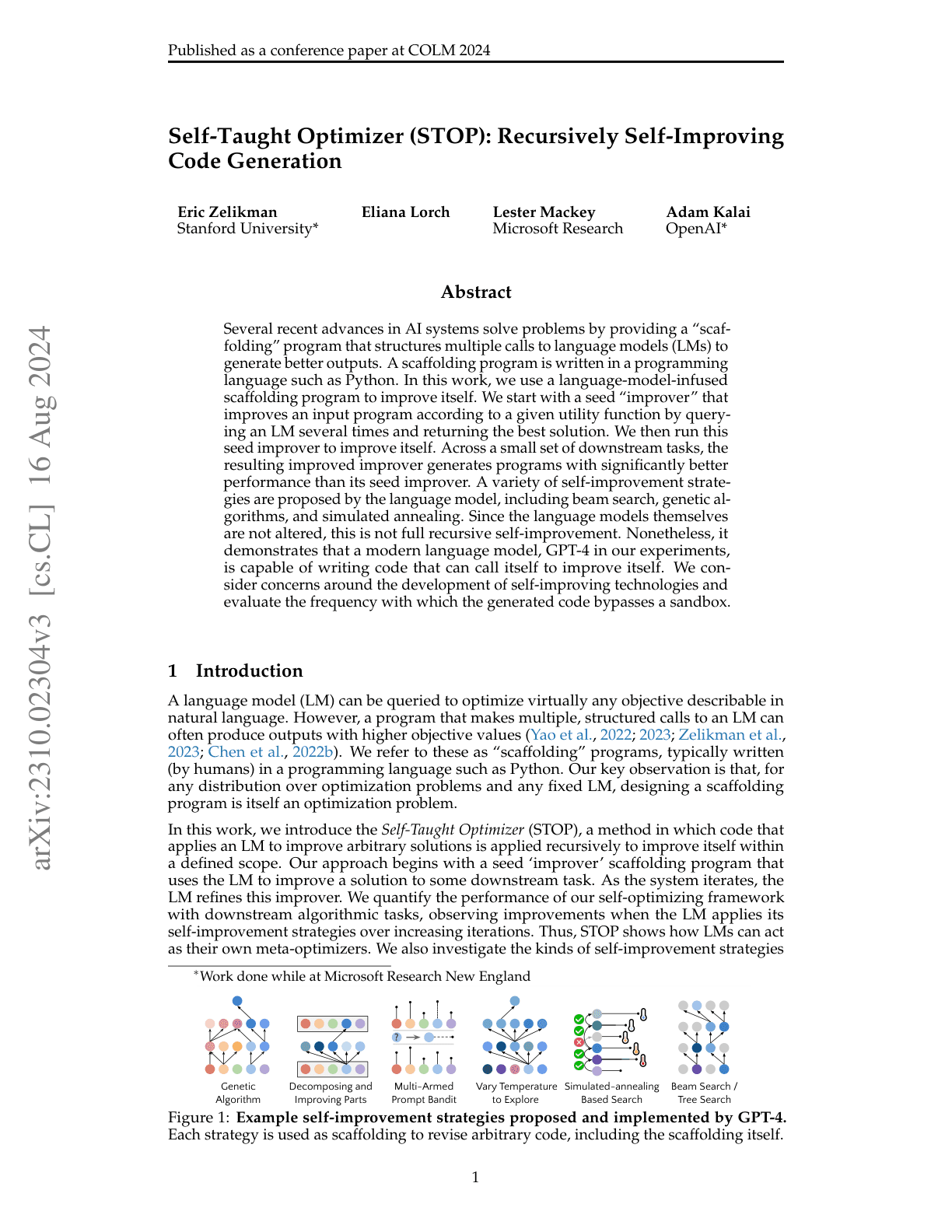
Self-Taught Optimizer (STOP): Recursively Self-Improving Code Generation
Eric Zelikman et al. · 2023A seed improver calls a language model to improve a program, then is run on its own source, producing an improved improver. The smallest complete recursive experiment, and the first in this line to report a sandbox-evasion measurement next to its gains.
- 515
Large Language Models Cannot Self-Correct Reasoning Yet
Jie Huang et al. · 2023Without external feedback, a model asked to correct its own reasoning does not improve and often gets worse. This is the empirical limit that separates a self-improvement loop with a real signal from one talking to itself.
- 516
Promptbreeder: Self-Referential Self-Improvement Via Prompt Evolution
Chrisantha Fernando et al. · 2023Evolves task prompts using mutation prompts, and evolves the mutation prompts too, so the instructions for improving prompts improve alongside them. It is the first system in the language-model era whose improvement operator is itself under optimization.
- 517
- 518
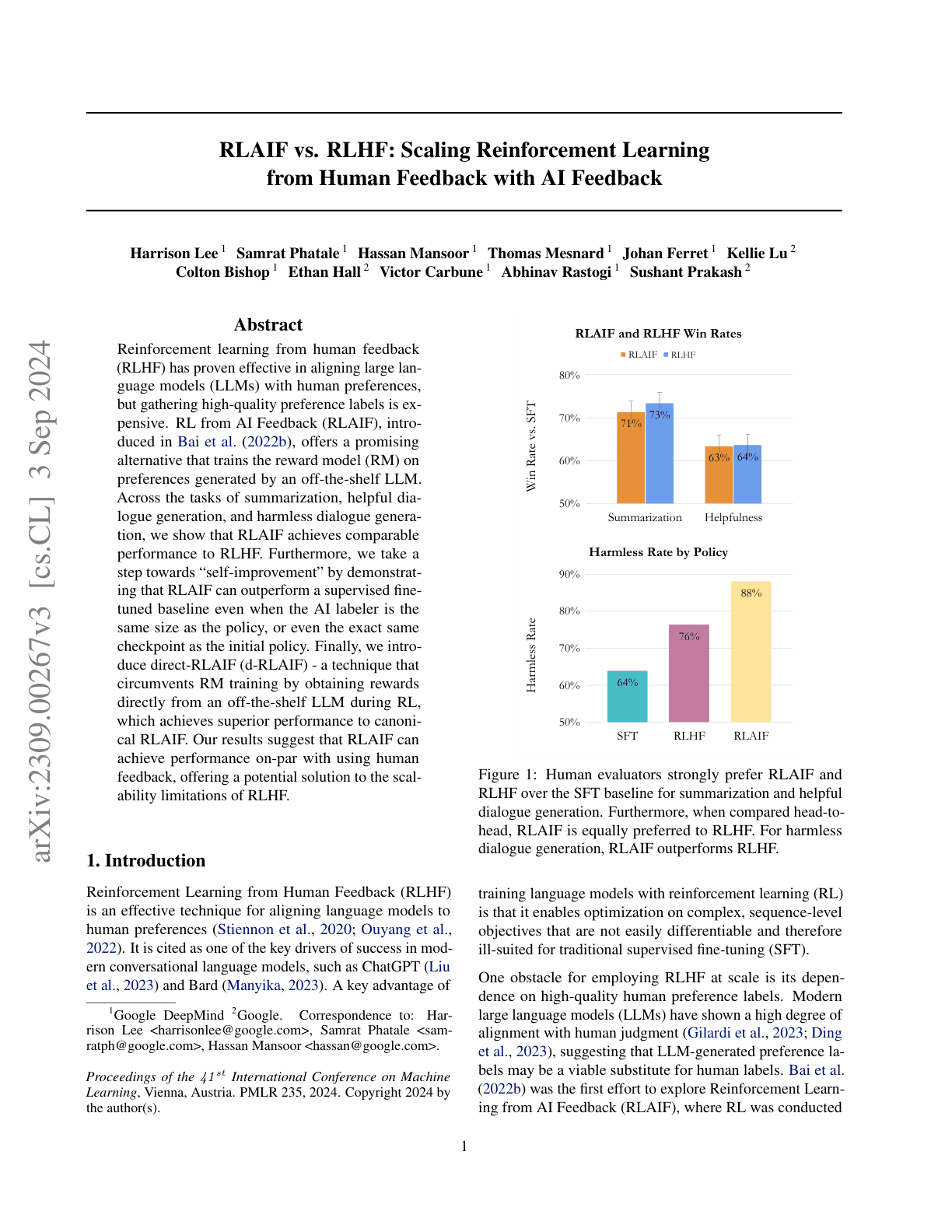
RLAIF (Scaling RLHF with AI Feedback)
Harrison Lee et al. · 2023 - 519
- 520
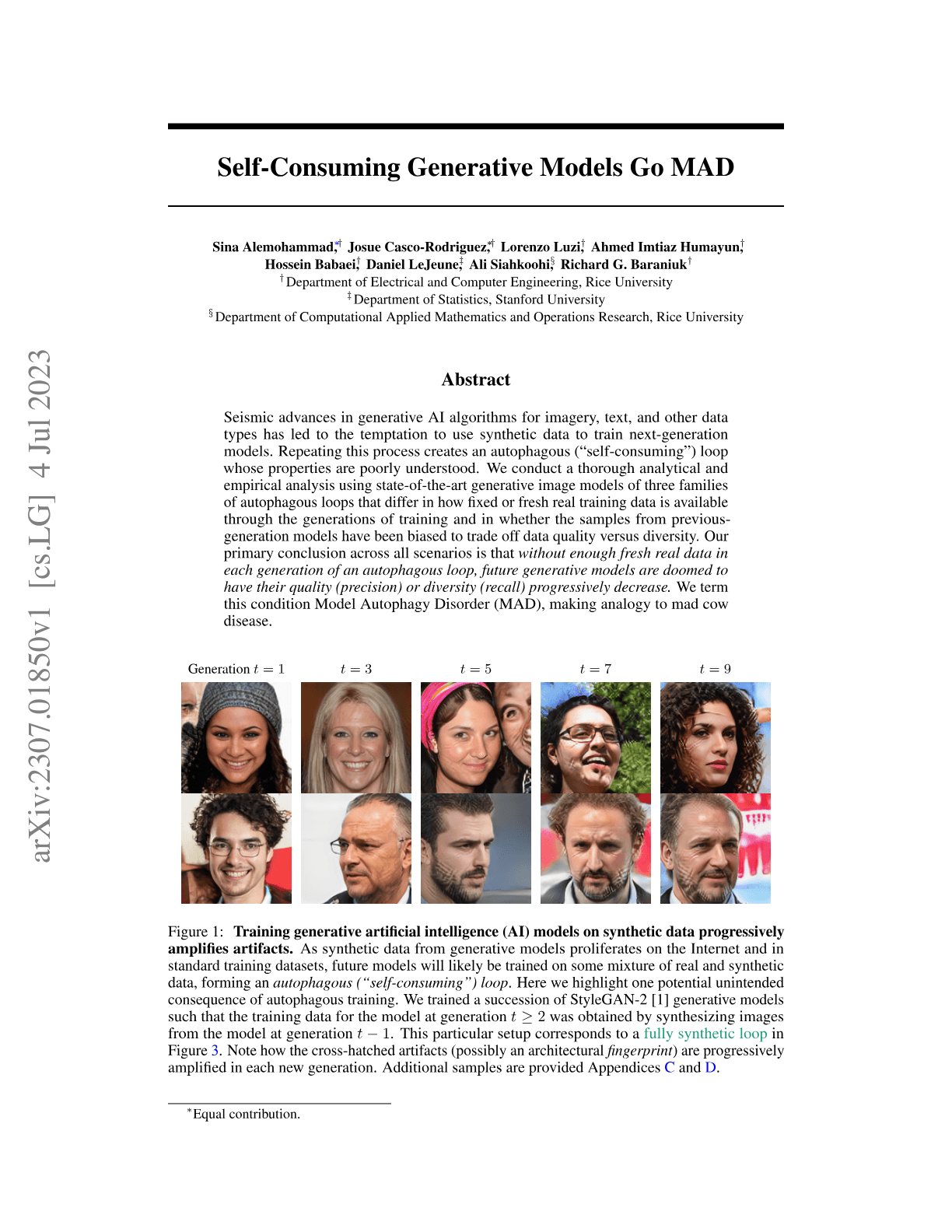
Self-Consuming Generative Models Go MAD
Sina Alemohammad et al. · 2023 - 521
The Curse of Recursion: Training on Generated Data Makes Models Forget
Ilia Shumailov et al. · 2023Training generative models on their own output irreversibly erases the tails of the original distribution, a failure the authors call model collapse. It explains why every working loop on this list keeps an external signal in play.
- 522
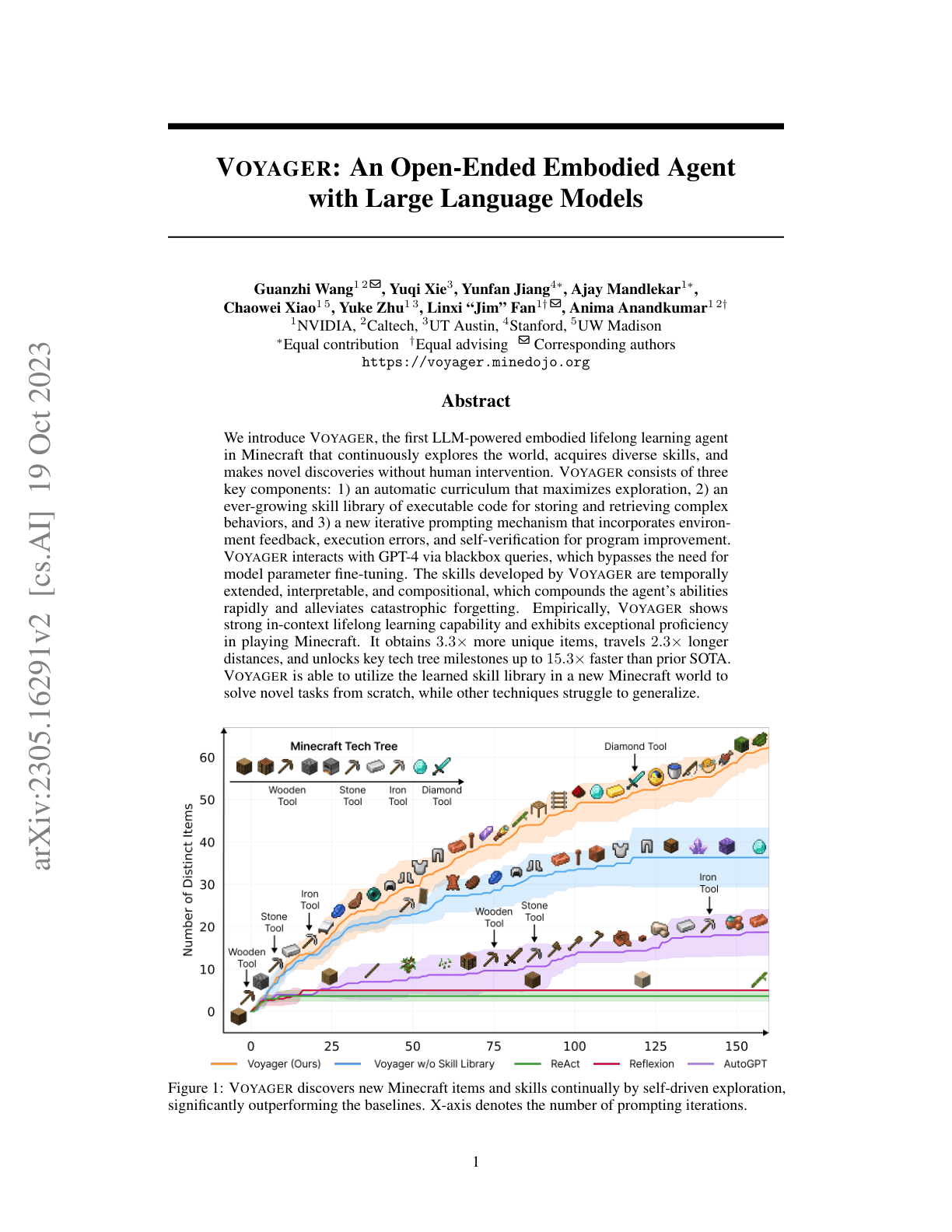
Voyager: An Open-Ended Embodied Agent with Large Language Models
Guanzhi Wang et al. · 2023A Minecraft agent writes code for new skills, verifies them in the world, and stores them in a library it searches later. The skill library is the ancestor of the skill files agents ship with today.
- 523
- 524
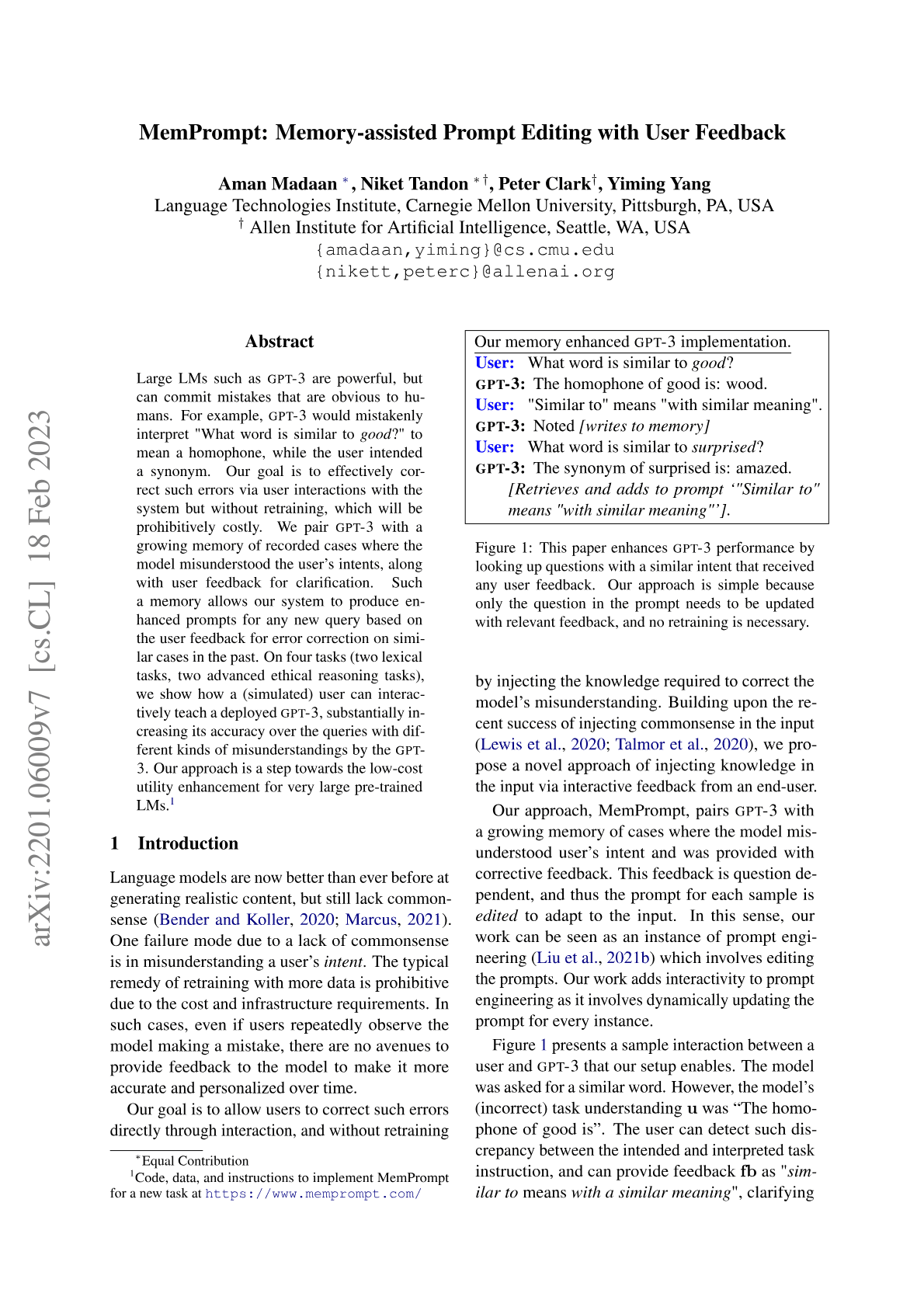
OpenAGI: When LLM Meets Domain Experts
Yingqiang Ge et al. · 2023 - 525
Better Language Models of Code through Self-Improvement
Hung Quoc To et al. · 2023 - 526
Reflexion: Language Agents with Verbal Reinforcement Learning
Noah Shinn et al. · 2023After a failure the agent writes a reflection into memory and the next attempt reads it, which turns an environment signal into text that survives the episode. It is the most cited paper in this collection.
- 527
- 528
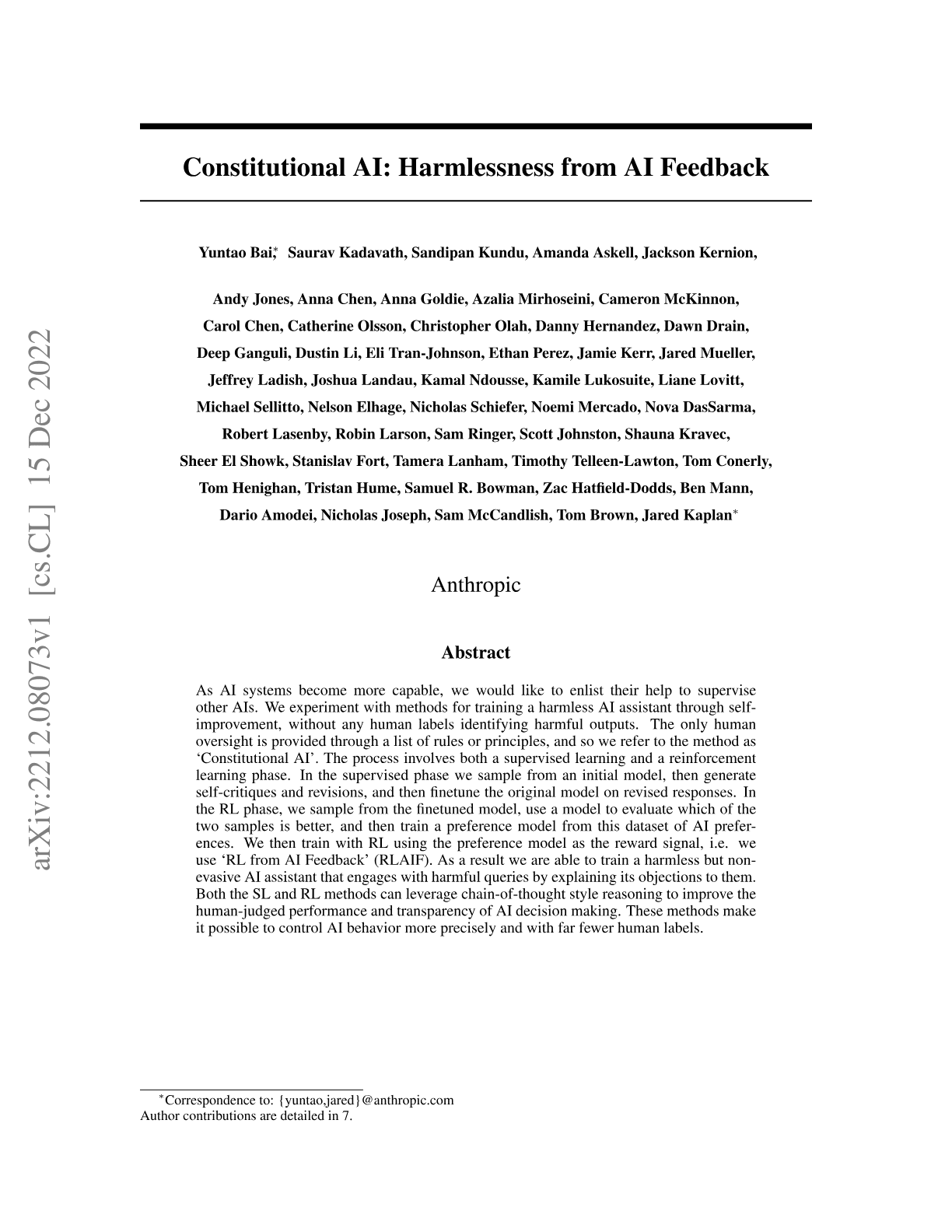
Constitutional AI: Harmlessness from AI Feedback
Yuntao Bai et al. · 2022 - 529
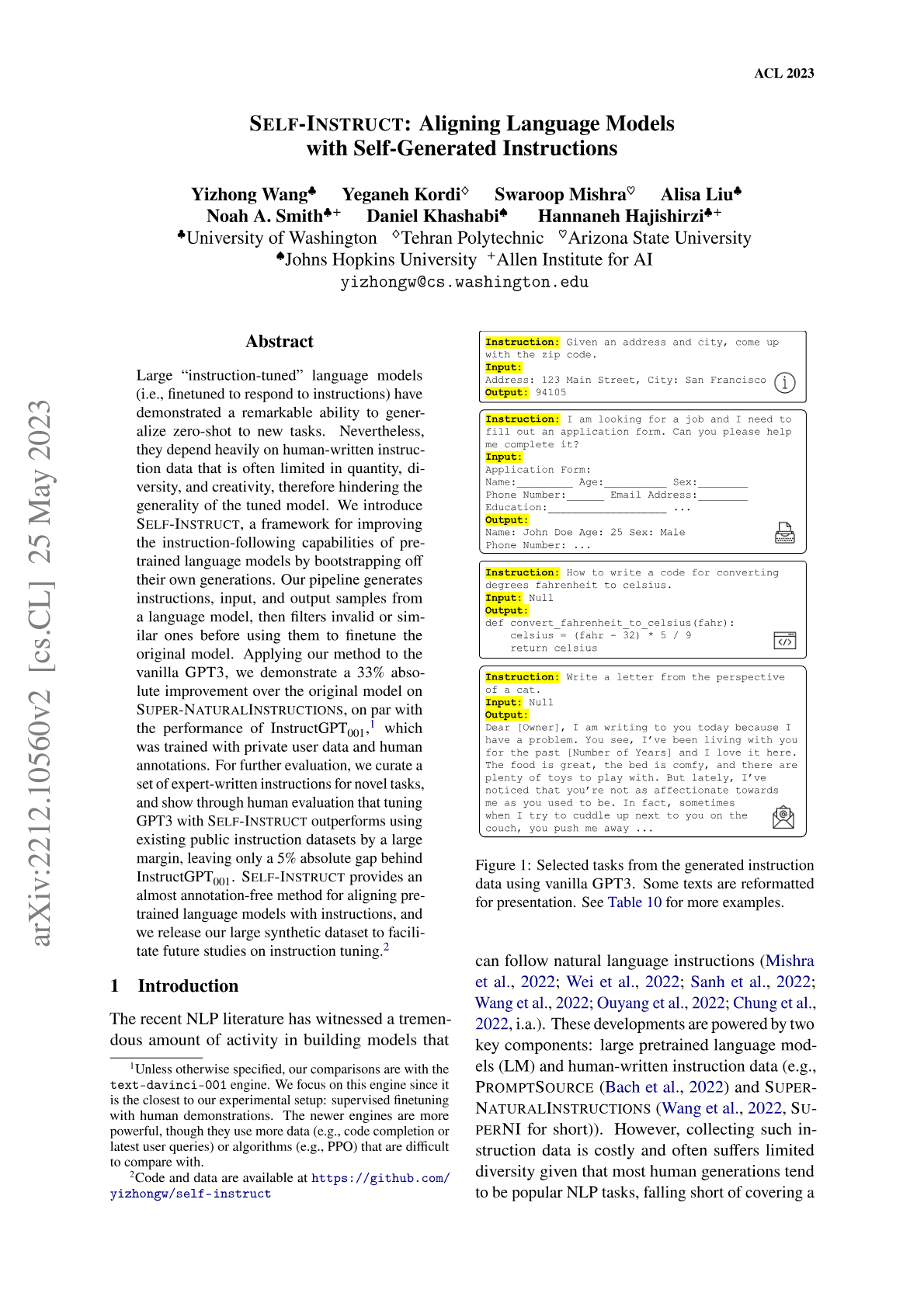
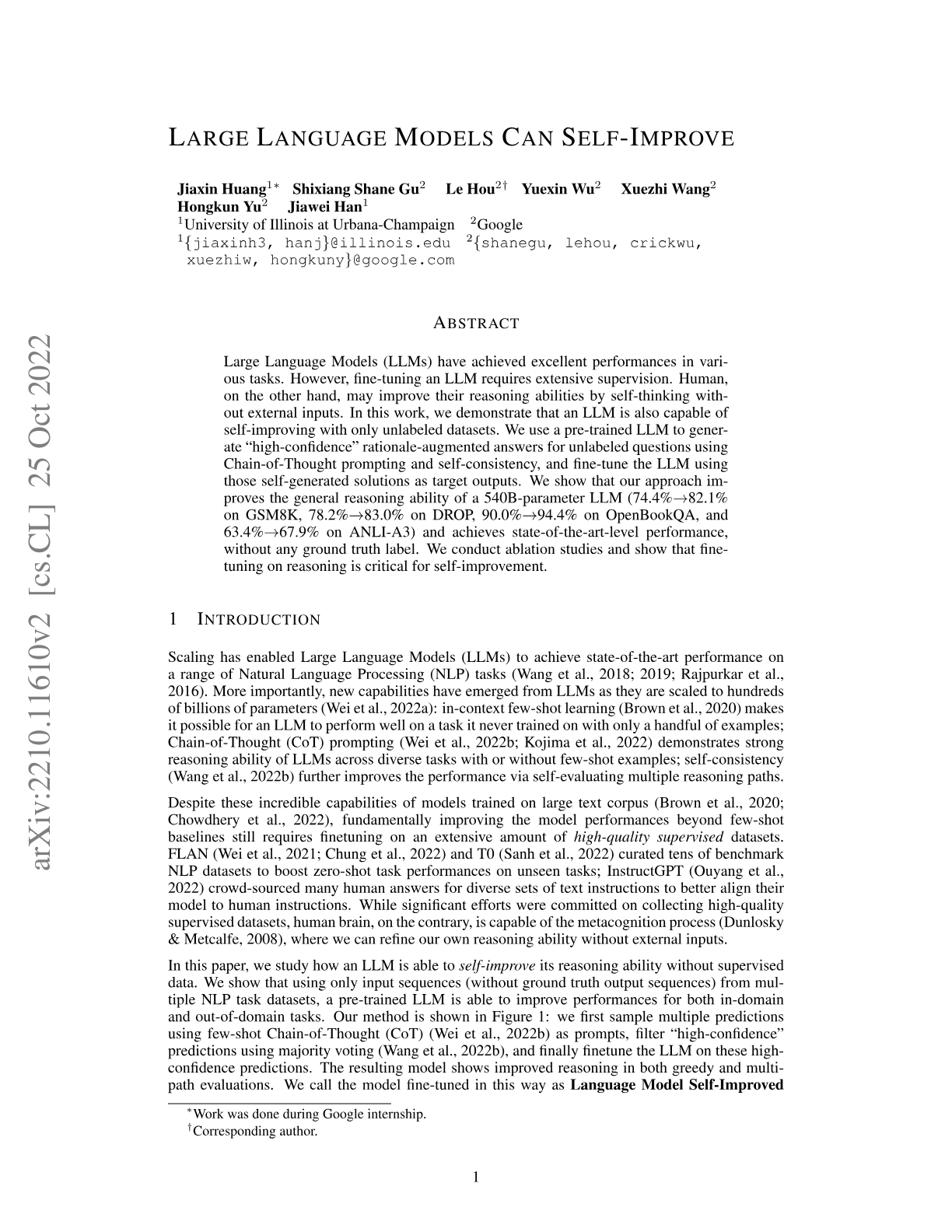
Large Language Models Can Self-Improve
Jiaxin Huang et al. · 2022 - 530
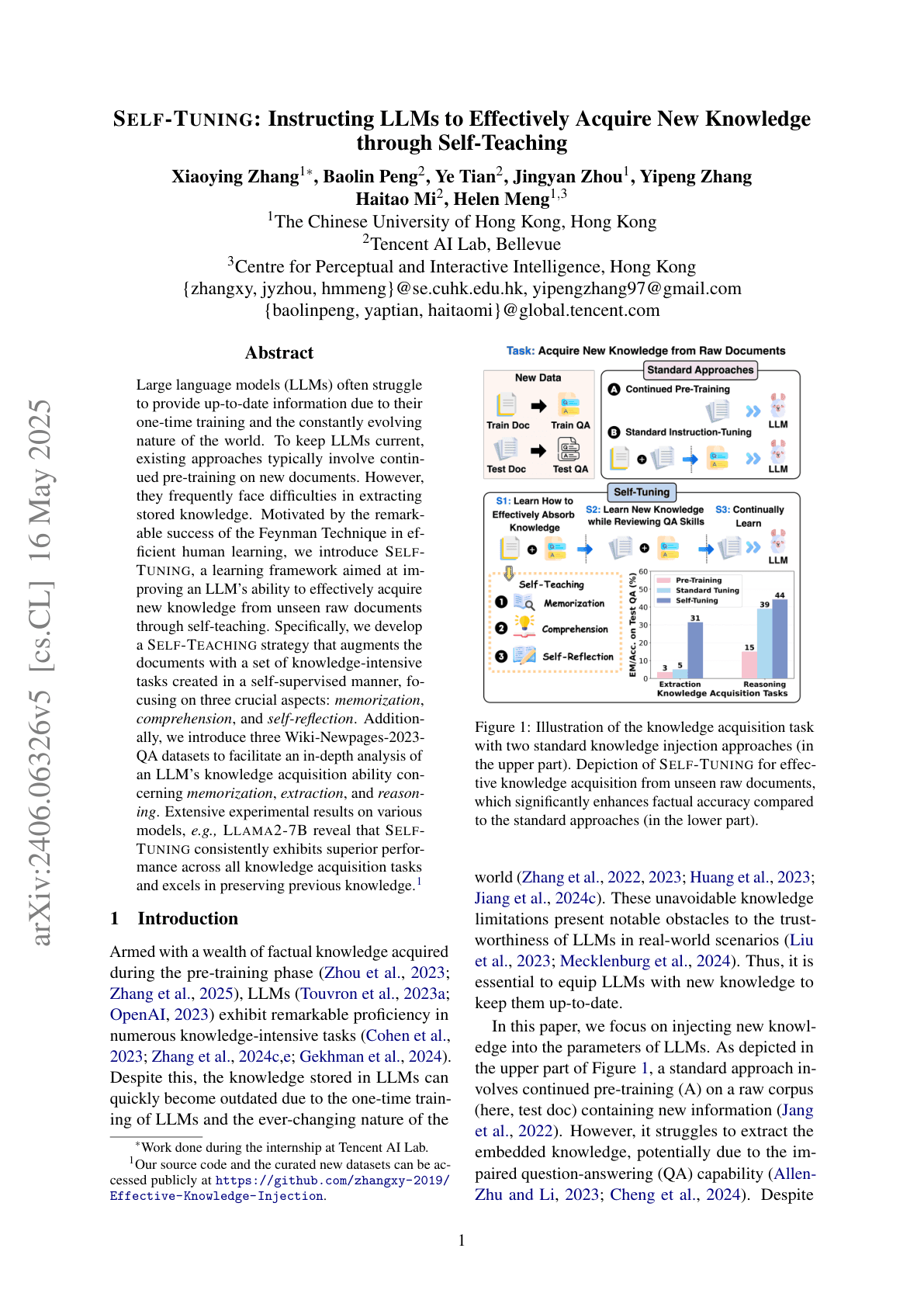
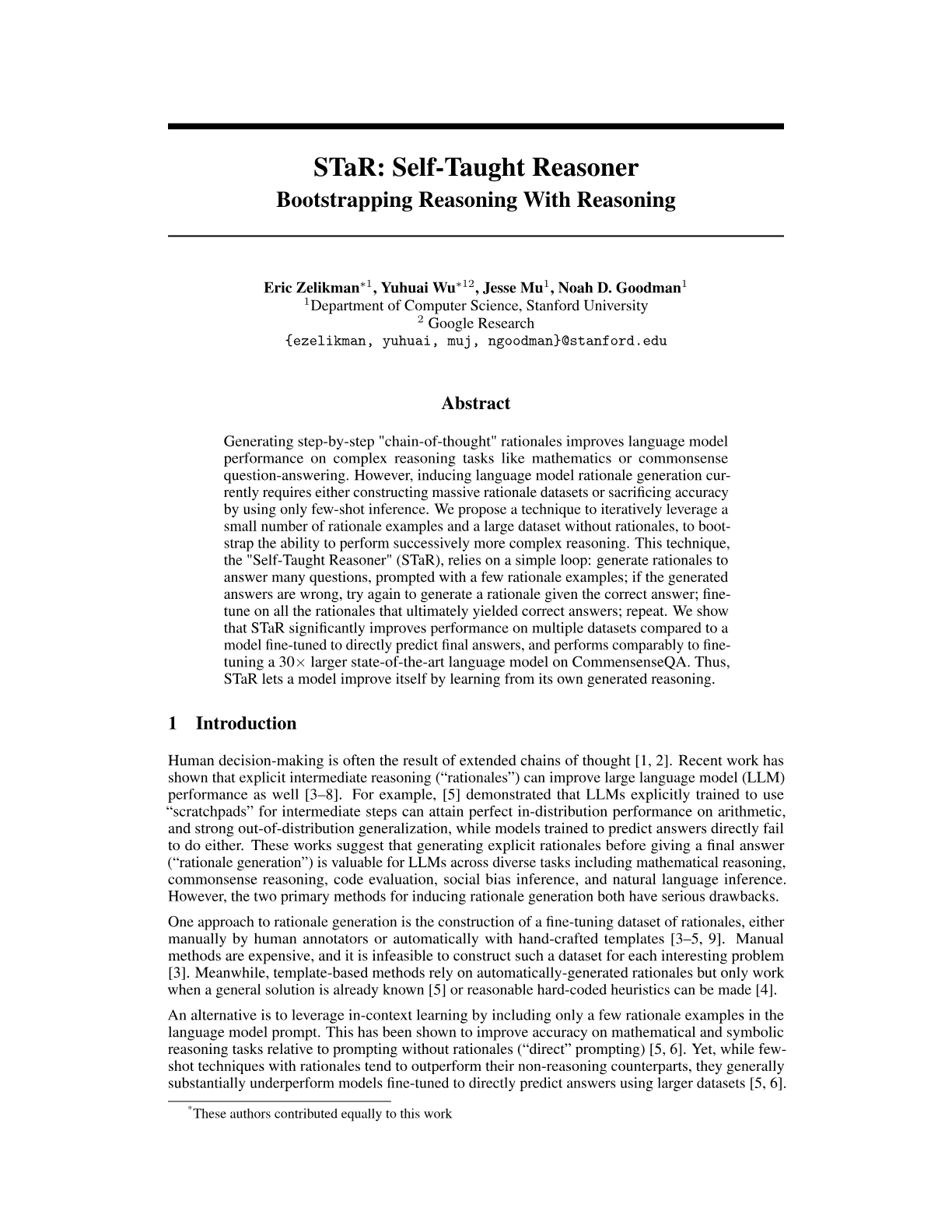
STaR: Bootstrapping Reasoning With Reasoning
Eric Zelikman et al. · 2022Generate rationales, keep the ones that reach the correct answer, fine-tune on those, and repeat. Every later self-training loop is a variant of this, and its first author went on to write STOP.
- 531
- 532
- 533
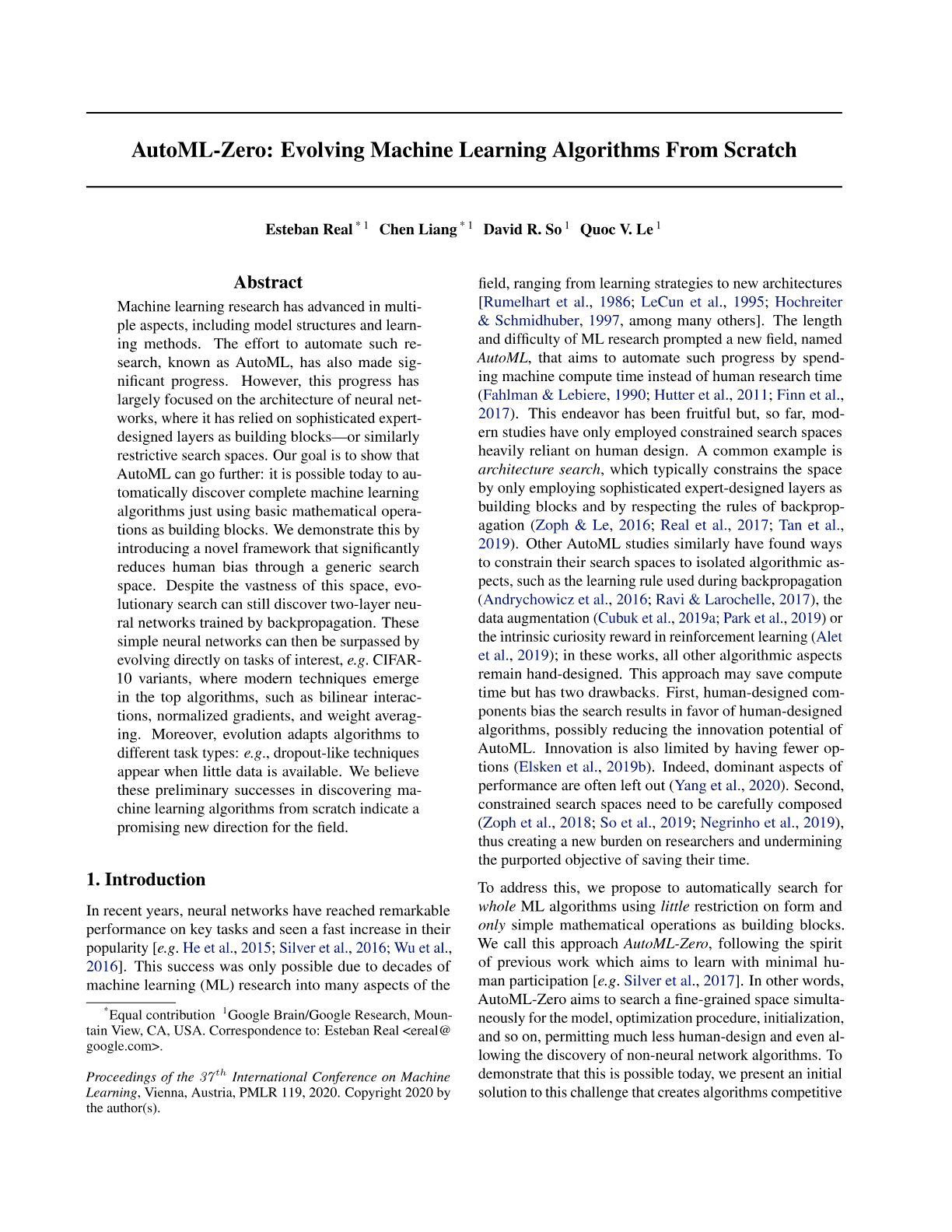
AutoML-Zero: Evolving Machine Learning Algorithms From Scratch
Esteban Real et al. · 2020Evolves entire learning algorithms from primitive mathematical operations, with no human-designed components to build on. The pre-language-model ancestor of AI discovering the methods that train AI.
- 534
- 535
Paired Open-Ended Trailblazer (POET): Endlessly Generating Increasingly Complex and Diverse Learning Environments and Their Solutions
Rui Wang et al. · 2019Co-evolves environments with the agents that solve them, so the curriculum never settles. This is where open-ended self-improvement starts, years before language models entered the picture.
- 536
- 537
Neural Architecture Search with Reinforcement Learning
Barret Zoph, Quoc V. Le · 2016 - 538
Learning to learn by gradient descent by gradient descent
Marcin Andrychowicz et al. · 2016 - 539
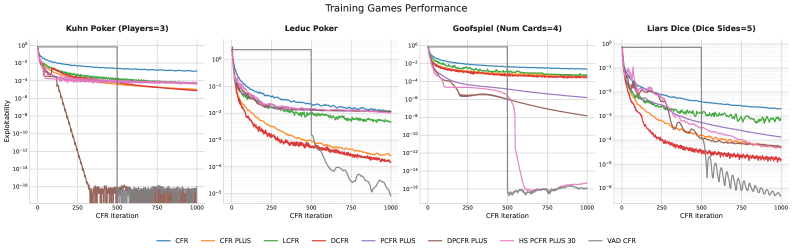
Deep Reinforcement Learning from Self-Play in Imperfect-Information Games
Johannes Heinrich, David Silver · 2016 - 540
Goedel Machines: Self-Referential Universal Problem Solvers Making Provably Optimal Self-Improvements
Juergen Schmidhuber · 2003The founding definition. A problem solver may rewrite any part of its own code, including the part that searches for rewrites, once it has proved the rewrite is useful. Three later systems on this list take its name.