AI Papers of the Week
Every paper worth reading in AI, hand-picked one week at a time.
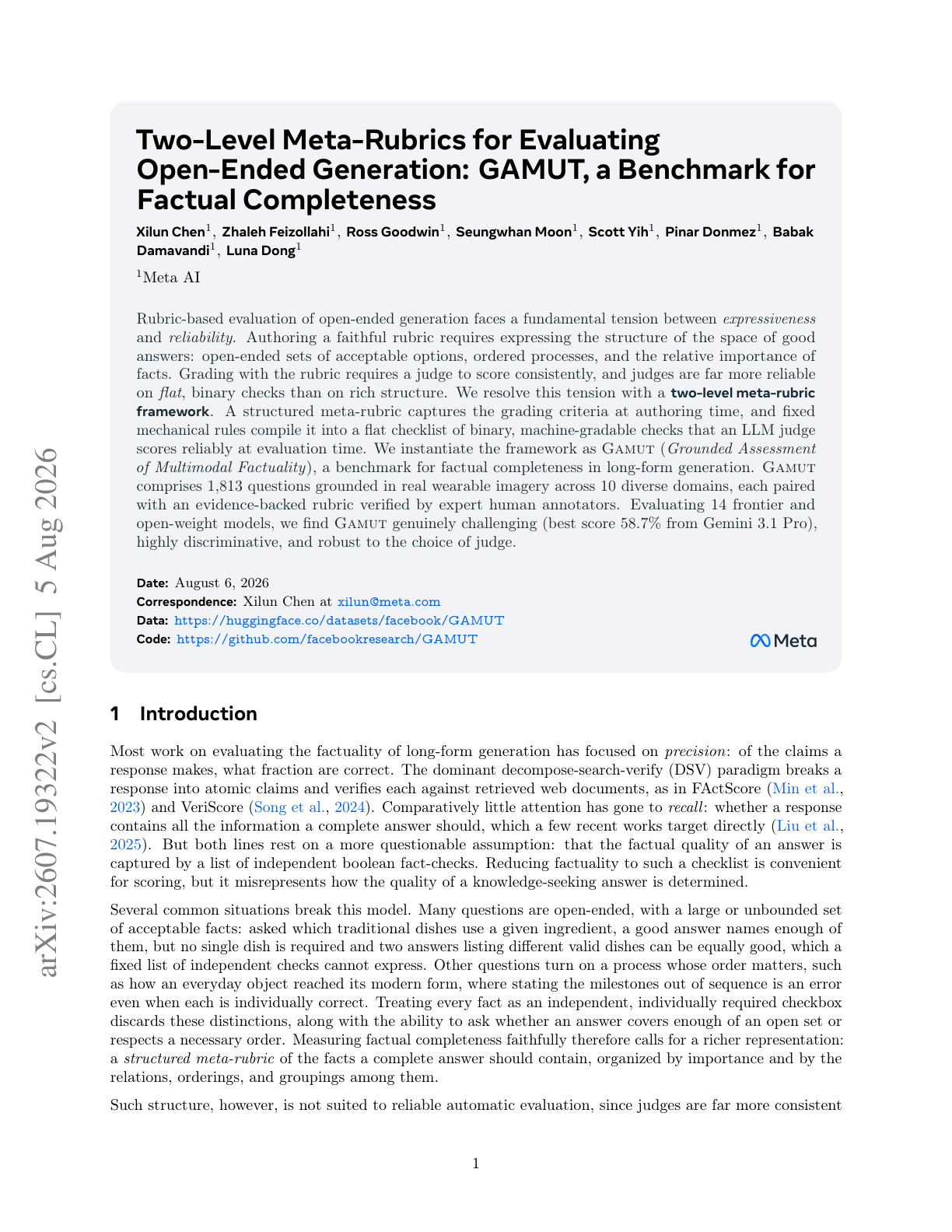
GAMUT
Most factuality evaluation measures precision, whether the claims in an answer are correct. This Meta AI work targets the harder and mostly ignored half, completeness, meaning whether an answer covers everything it should, and packages it as the GAMUT benchmark.
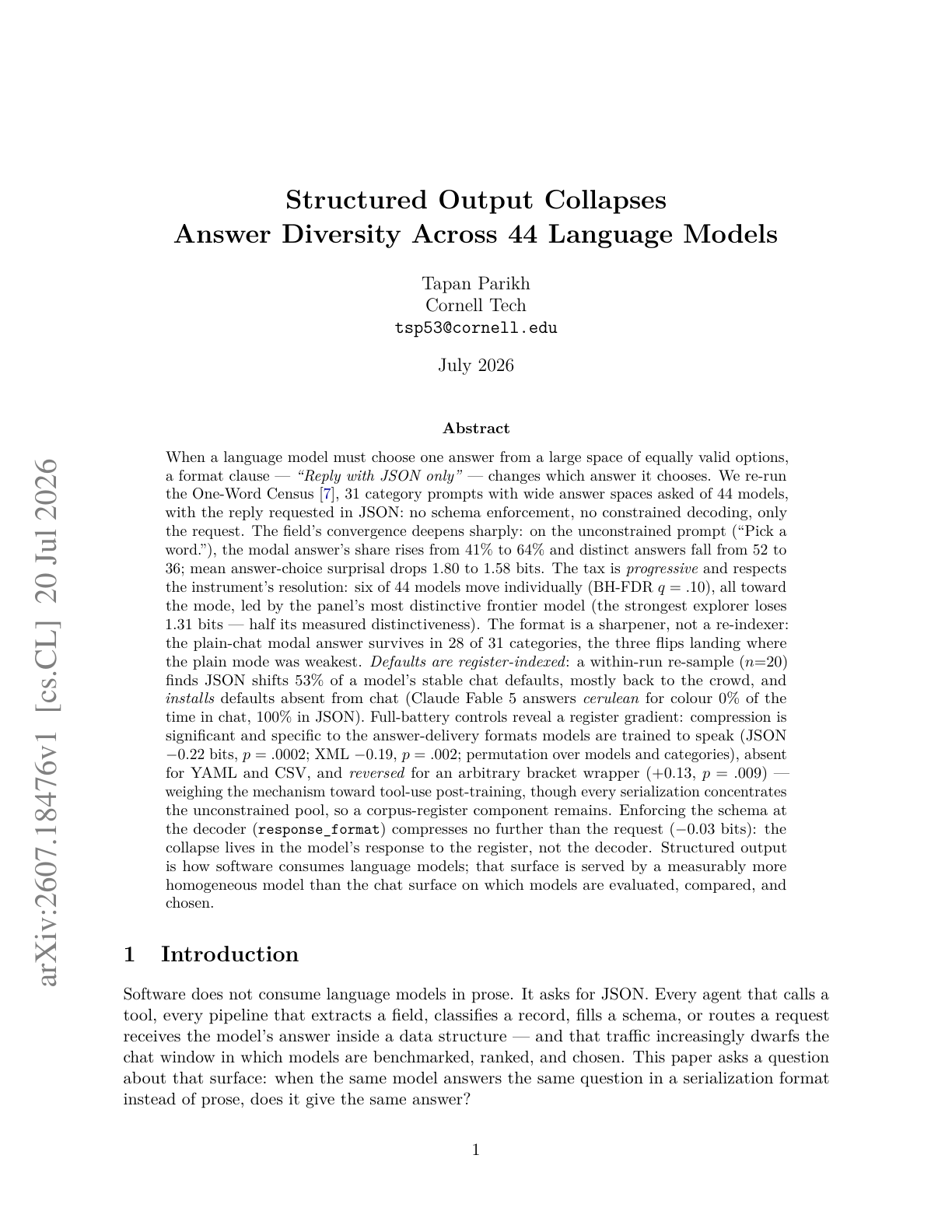
Structured Output Collapses Diversity
Teams benchmark models in chat, then ship them behind JSON schemas for tools, extraction, and routing. This study of 44 language models shows that the structured surface you deploy is measurably more homogeneous than the chat surface you evaluated on.
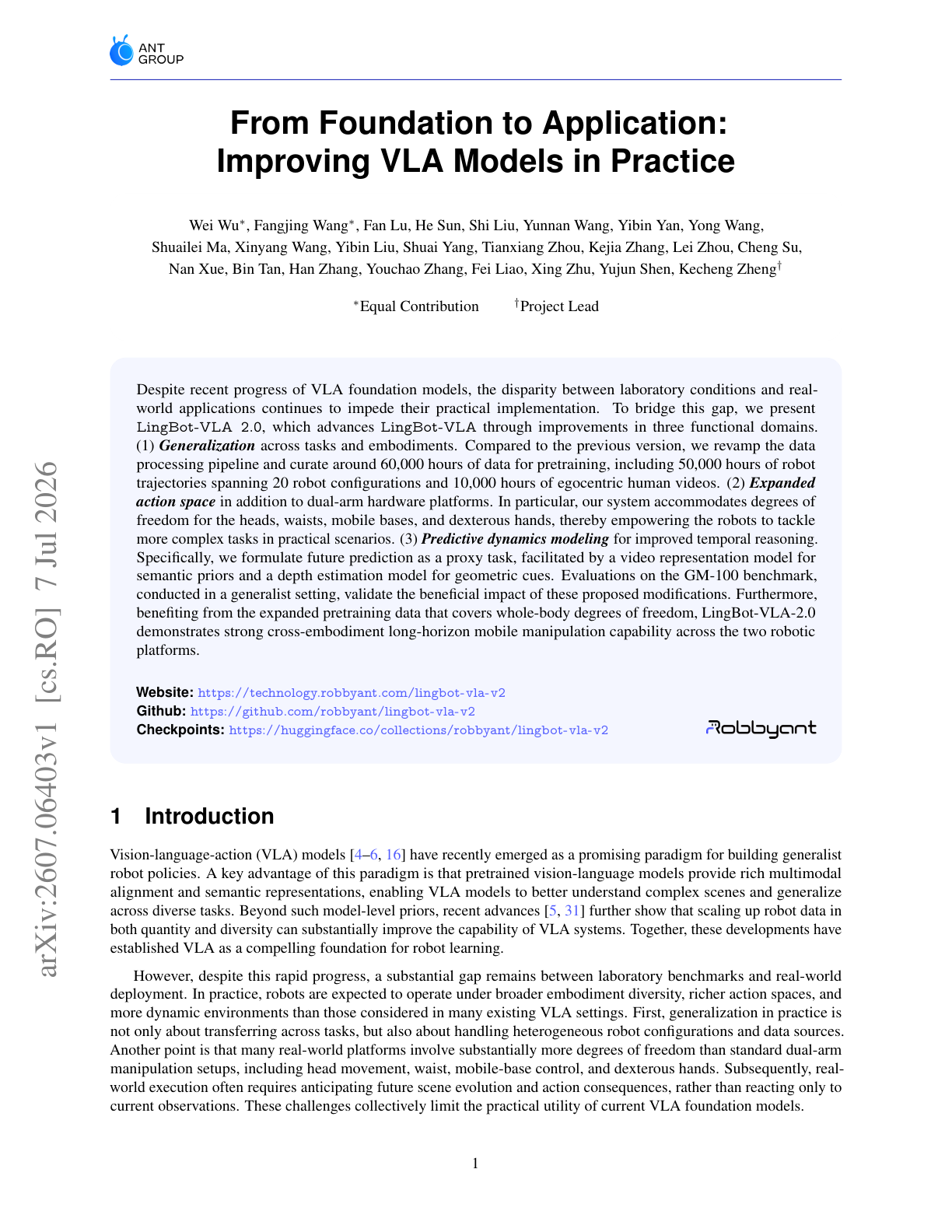
LingBot-VLA 2.0
LingBot-VLA 2.0 is an open-source generalist embodied model from Robbyant, trained across 20 robot configurations from single-arm rigs to humanoids like Unitree G1 and Fourier GR-2. It packs 60,000 hours of curated data, 50,000 hours of real-robot trajectories plus 10,000 hours of egocentric human video, into one policy that also predicts future depth and semantic features before it acts. On 9 GM-100 tabletop tasks it beats π0.5 and GR00T N1.7 across two robot platforms and stays ahead on long-horizon mobile tasks, running at about 130 ms on a single RTX 4090D with open-sourced post-training code.
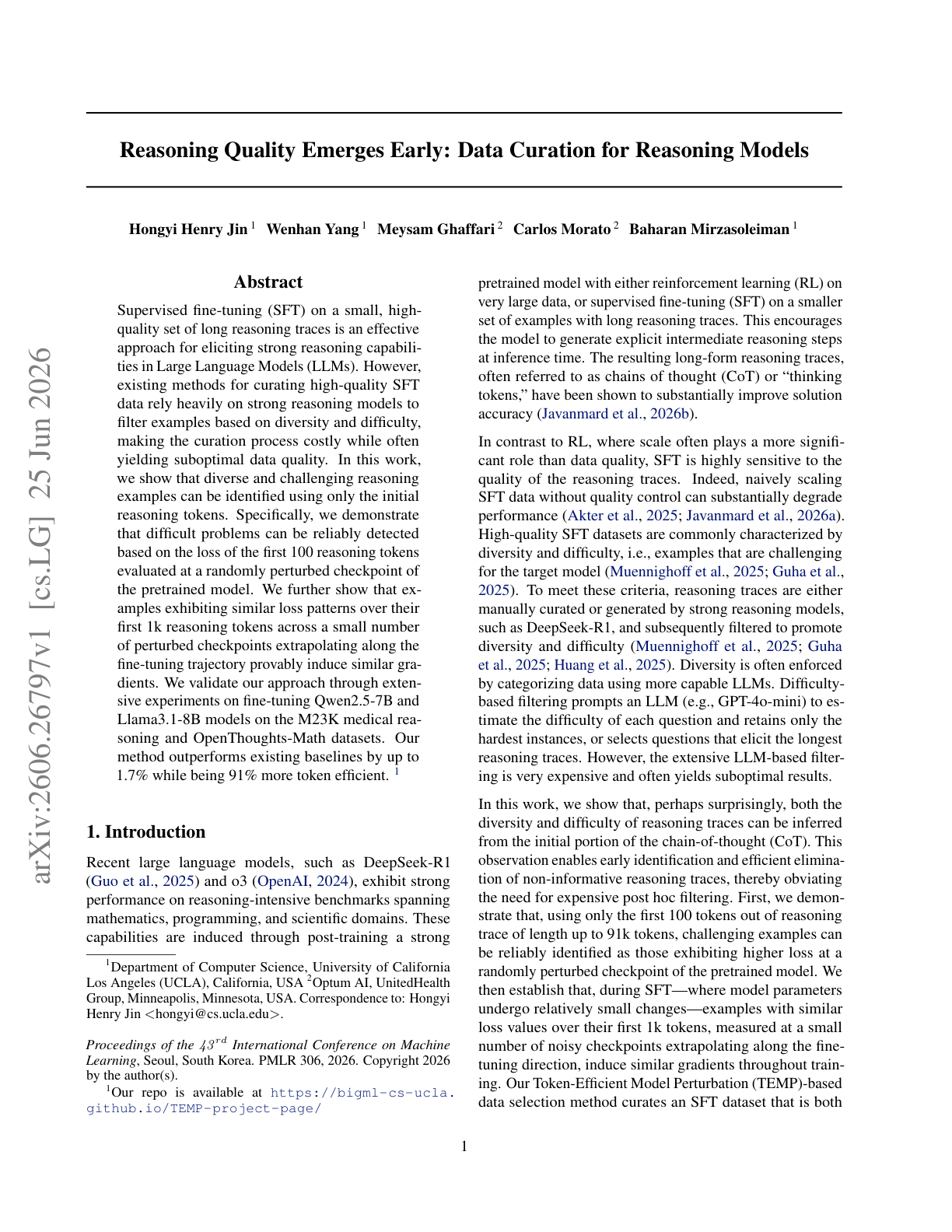
Reasoning Quality Emerges Early
Curating reasoning data is expensive because scoring a trace usually means reading it to the end, but this UCLA work shows the quality of a trace is largely decided in its opening tokens. A short prefix predicts whole-trace quality well enough to rank and filter on, and difficulty can be detected from the loss of the first 100 tokens at a perturbed checkpoint. That turns curation into a cheap early-stopping problem, outperforming baselines while being far more token efficient at building SFT data for reasoning models.
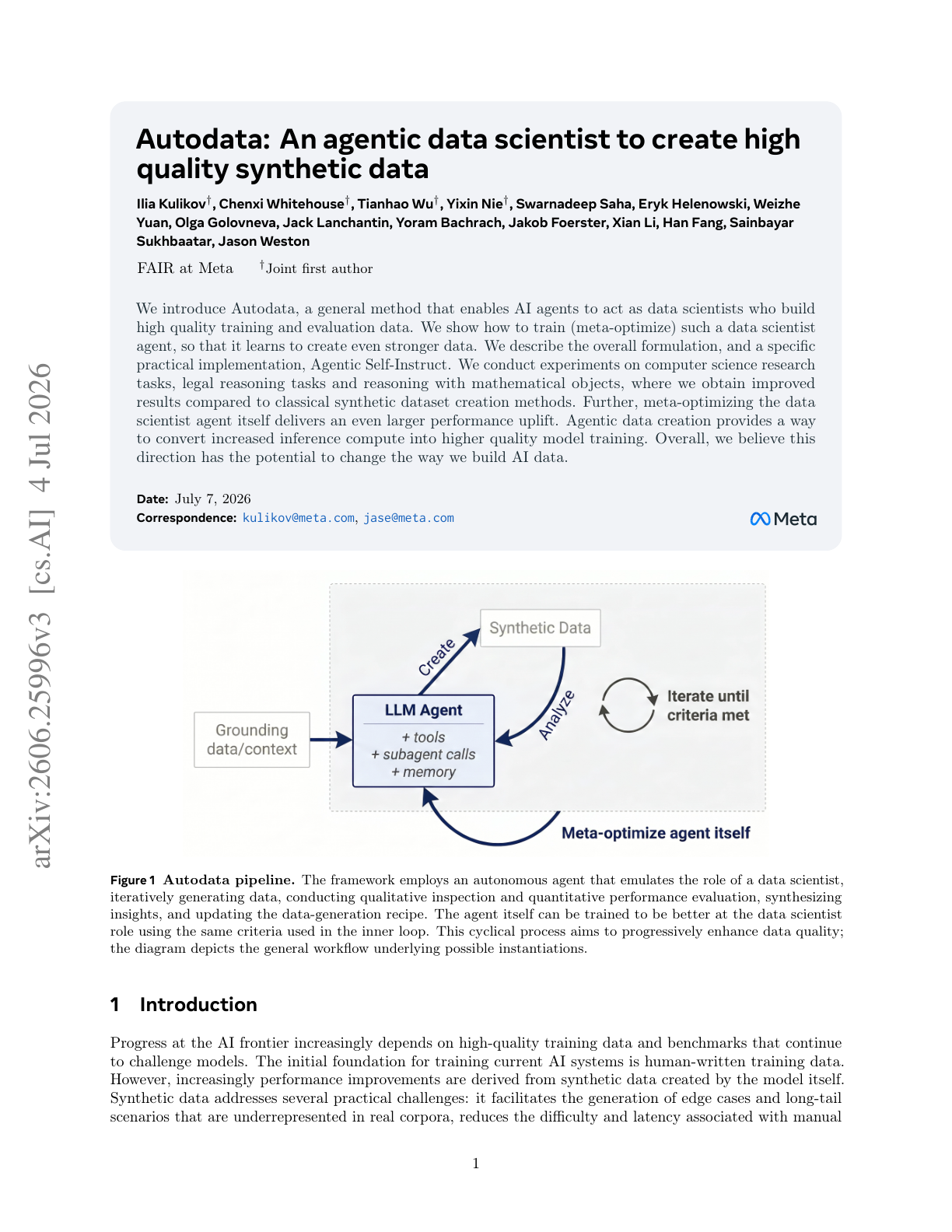
Autodata
Building synthetic training data has mostly stayed a fixed pipeline that you hand-tune once and then freeze. Autodata rethinks that by casting an AI agent as a data scientist that builds high-quality training and evaluation data, then meta-optimizes that agent so it learns to create even stronger data over time.
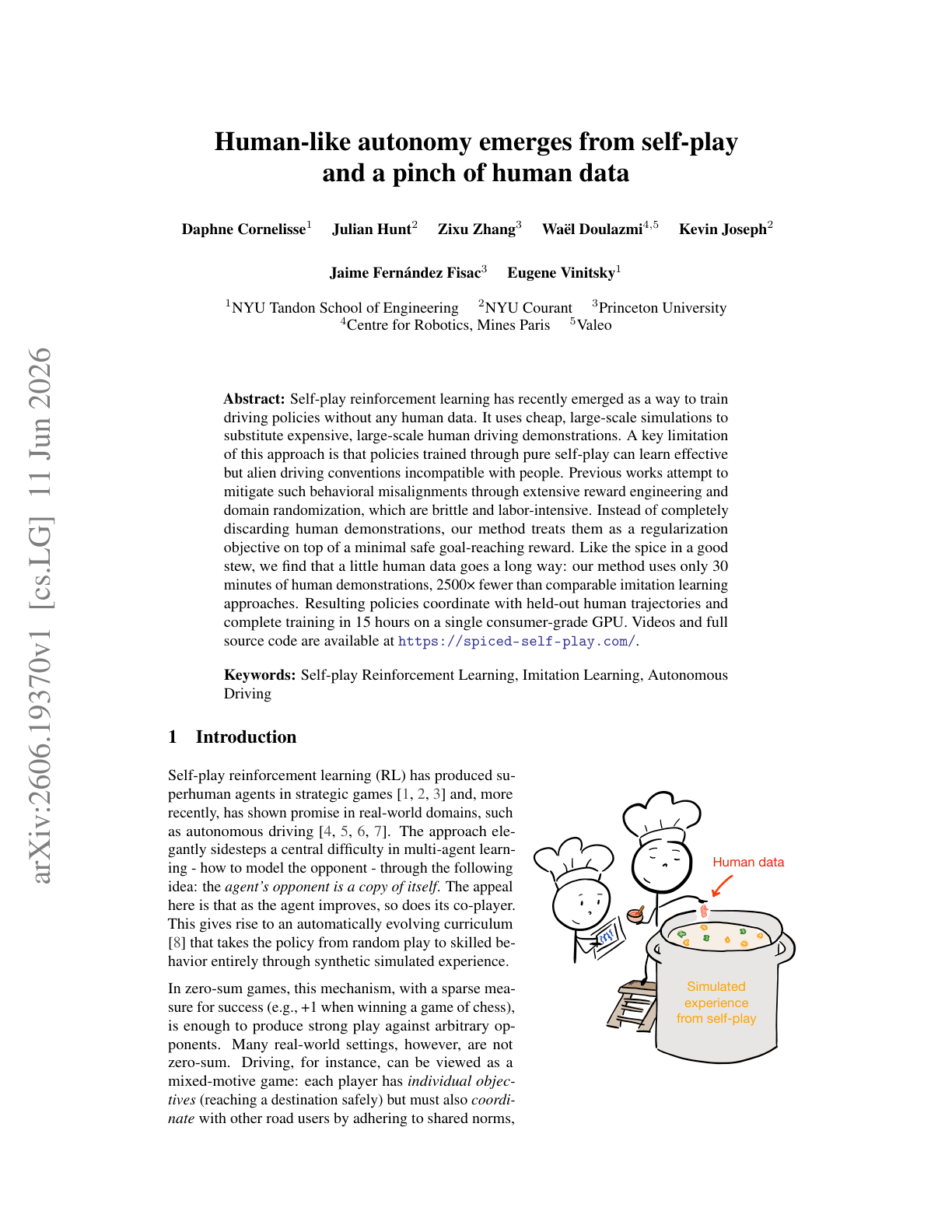
A Pinch of Human Data
Self-play reinforcement learning can train driving policies with no human data at all, swapping expensive human demonstrations for cheap large-scale simulation. The catch is that pure self-play tends to discover effective but alien driving conventions that real people cannot work with, and the usual fixes lean on brittle reward engineering and domain randomization.
The Stanford EDGAR Filings Dataset
Clean, long-context documents remain scarce for pretraining, especially in finance. This release reconstructs U.S. SEC corporate and financial disclosures into layout-faithful, token-efficient MultiMarkdown, publishing 152B tokens in SEFD-v1 out of an estimated 550B-token archive spanning 18.5M filings, with less than 0.1% overlap with Common Crawl corpora. It also ships two derived benchmarks, EDGAR-Forecast for numerical forecasting and EDGAR-OCR for financial table transcription, to support financial reasoning, forecasting, and document understanding.
A Primer on Post-Training Reasoning Data
This primer is the first to pull the scattered post-training reasoning-data literature into one place, synthesizing over 150 public studies and system reports that previously lived across dataset papers, RL write-ups, and lab reports. It organizes the field around four questions: what data objects exist, what makes them useful, how they are constructed, and how they scale. The key reframing is that a reasoning-data item is more than a prompt-response pair: it packages a problem or state, model behavior, judging feedback, and attribution metadata, with usefulness defined relative to the verifier and the rest of the corpus rather than in isolation.
Epicure
Epicure trains a family of multilingual ingredient embeddings from scratch on 4.14 million recipes aggregated from 11 sources across seven languages, with raw ingredient strings normalized to 1,790 canonical entries via an LLM-augmented pipeline. It ships three skip-gram (Metapath2Vec) variants that share architecture but differ in what they walk: recipe co-occurrence only, chemical-compound structure from FlavorDB only, or a blend of both, placing each model at a different point on the chemistry-versus-recipe-context spectrum. The result is a compact, downloadable map of the emergent geometry of food, a clean reminder that representation learning generalizes well beyond text into surprisingly everyday domains.

General-Agent
Prime Intellect's General-Agent is a fully synthetic reinforcement learning environment whose task corpus self-evolves and grows harder over time. The release ships with 4,504 tool-use tasks across 1,040 domains and 8,159 unique tools. Synthetic task creation is formulated as a two-player game between a Synthesizer that proposes new task families and a Solver that runs rollouts to measure pass rates. Tasks whose pass rate falls inside a calibrated difficulty band are accepted into the corpus, and hard tiers seed the next round of extensions. The framing turns RL environment creation, historically a major bottleneck, into an automated agentic search problem in its own right.
1,000 Synthetic Computers
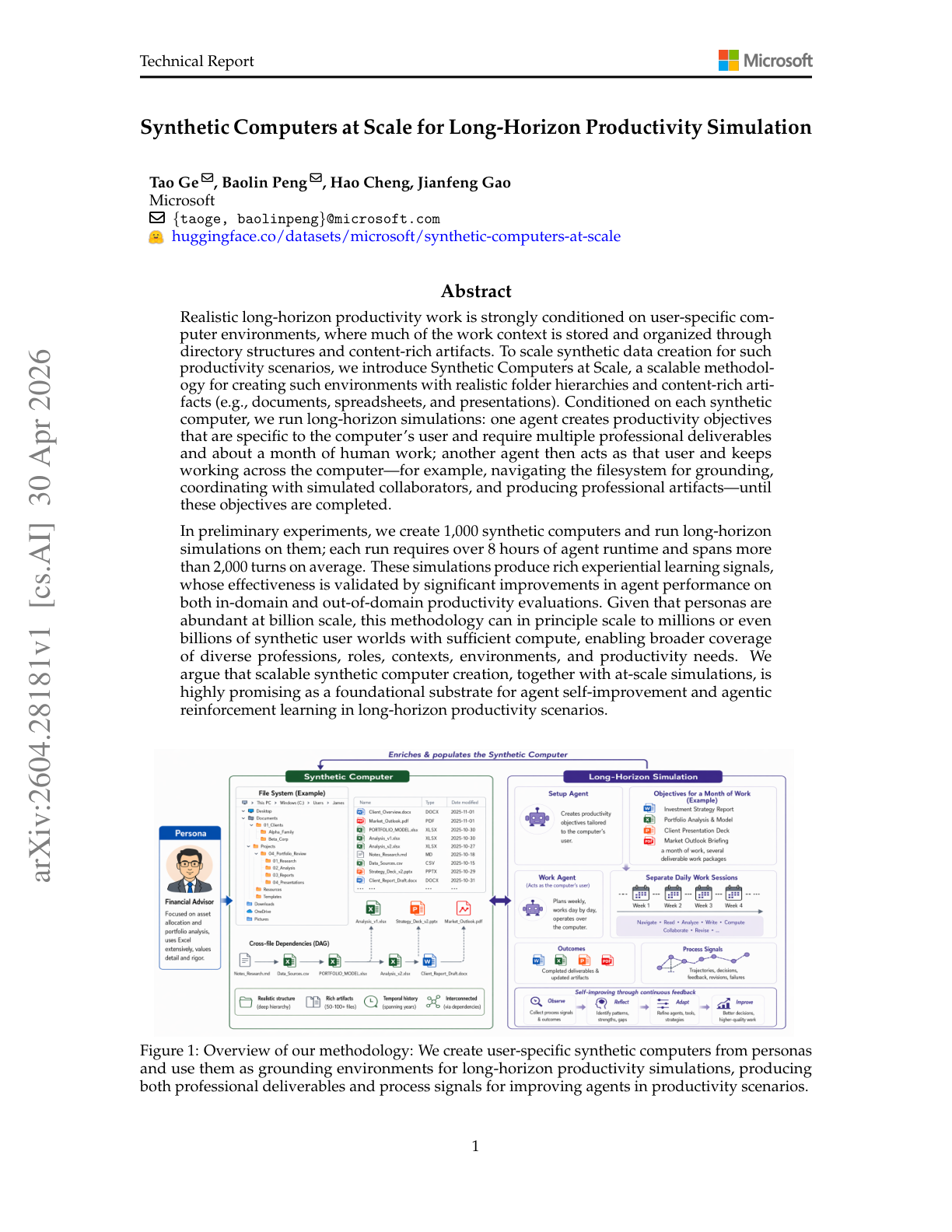
Microsoft Research builds 1,000 synthetic computers, each with realistic directory structures, documents, and artifacts, then runs long-horizon simulations on top of them. One agent plays the user and sets productivity goals; another executes the work. Each simulation runs over 8 hours of agent runtime and 2,000+ turns on average, roughly a month of human work compressed into one trace. Training on this experiential data drives significant improvements on both in-domain and out-of-domain productivity evaluations.
SkillNet
AI agents repeatedly rediscover solutions across separate scenarios instead of systematically reusing what they have already learned. SkillNet introduces an open infrastructure designed to create, evaluate, and organize AI skills at scale, enabling agents to transition from transient experience to durable mastery.
AgentIR
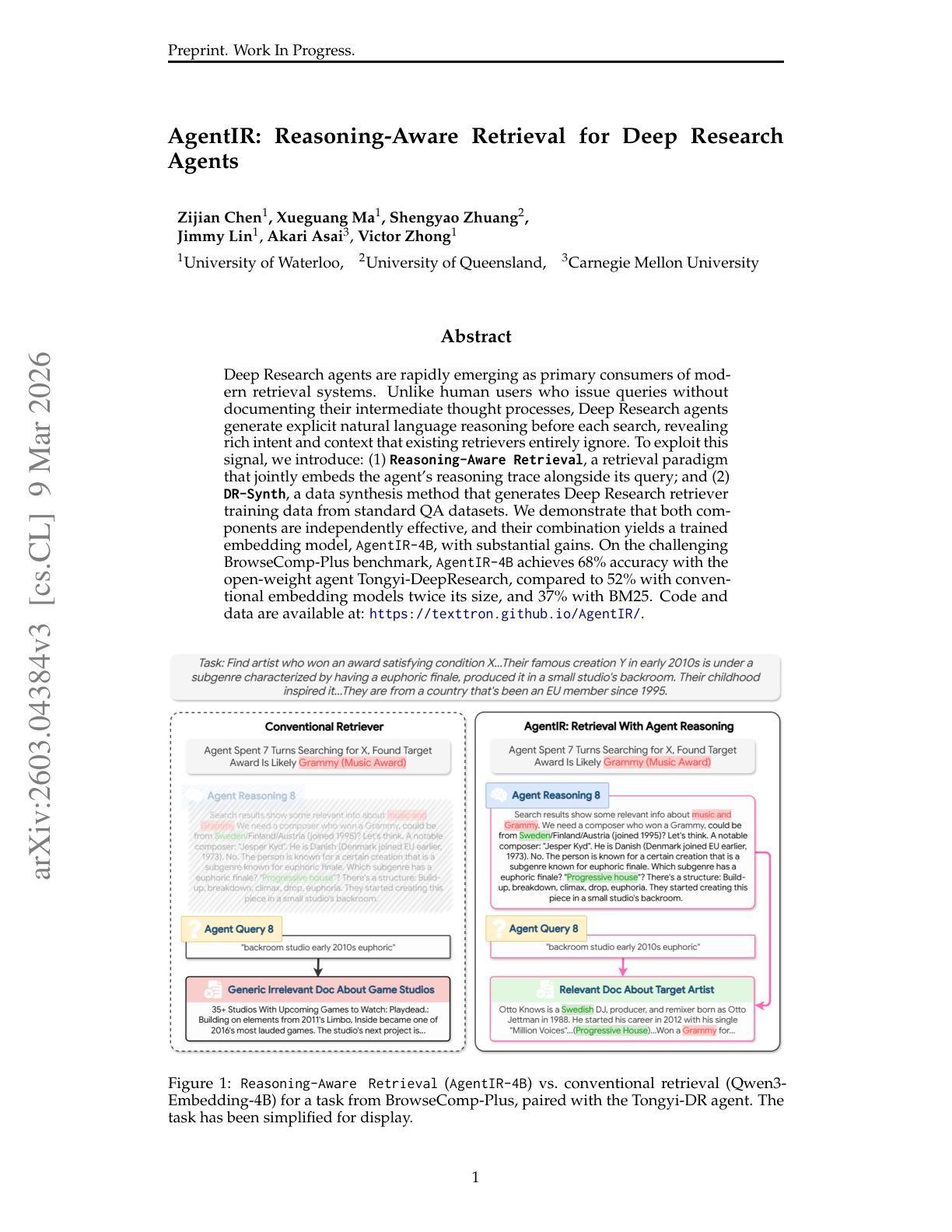
Deep research agents generate explicit reasoning before every search call, but existing retrievers completely ignore these rich signals about search intent and problem context. AgentIR introduces reasoning-aware retrieval that jointly embeds the agent’s reasoning trace alongside its query, along with DR-Synth, a data synthesis method for generating training data from standard QA datasets. On BrowseComp-Plus, AgentIR-4B achieves 68% accuracy with Tongyi-DeepResearch compared to 50% with conventional embedding models twice its size and 37% with BM25.
Bayesian Teaching for LLMs
Google researchers introduce a method to teach LLMs to reason like Bayesians by fine-tuning on interactions with a Bayesian Assistant that represents optimal probabilistic inference. LLMs normally fall far short of normative Bayesian reasoning, but this training approach dramatically improves their ability to update predictions based on new evidence.
Phi-4-reasoning-vision-15B
Microsoft presents Phi-4-reasoning-vision-15B, a compact open-weight multimodal reasoning model that combines visual understanding with structured reasoning capabilities. Trained on just 200 billion tokens of multimodal data, the model excels at math and science reasoning and UI comprehension while requiring significantly less compute than comparable open-weight VLMs. The key insight is that systematic filtering, error correction, and synthetic augmentation remain the primary levers for model performance, pushing the Pareto frontier of the accuracy-compute tradeoff.
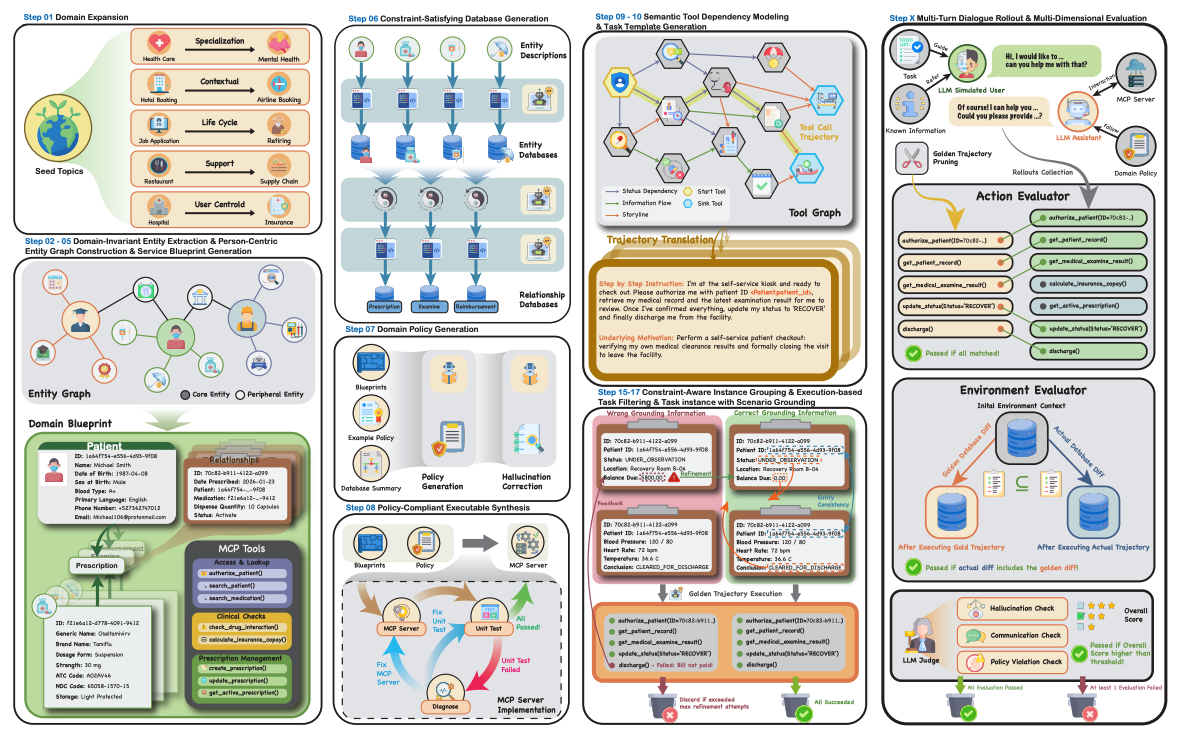
AgentSkiller
AgentSkiller scales generalist agent intelligence through semantically integrated cross-domain data synthesis, producing 11K high-quality synthetic trajectories across diverse tool-use scenarios. The resulting 14B model beats GPT-o3 on tau2-bench (79.1% vs 68.4%), and even the 4B variant outperforms 70B and 235B models, demonstrating that data quality and semantic integration matter more than parameter count for building strong tool-use agents.
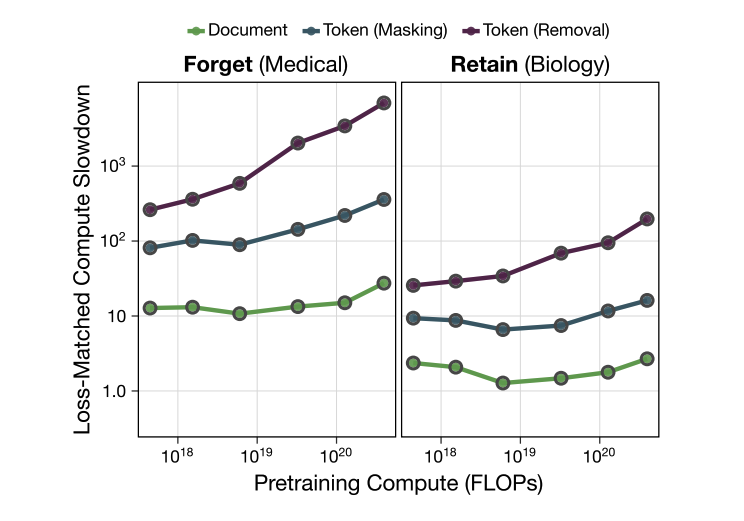
Shaping Capabilities with Token-Level Data Filtering
Researchers from Anthropic and Stanford show that filtering pretraining data at the token level is a highly effective, scalable, and robust approach for selectively removing undesired capabilities from language models. Using medical knowledge removal as a proxy task, token-level filtering Pareto dominates document-level filtering and achieves a 7,000x compute slowdown on the target domain for 1.8B parameter models - while preserving capabilities in related fields.
GigaTIME
Microsoft Research and Providence Health introduce GigaTIME, a multimodal AI framework that generates virtual multiplex immunofluorescence (mIF) images from standard H&E pathology slides, enabling population-scale tumor immune microenvironment modeling. The system was applied to over 14,000 cancer patients across 24 cancer types, uncovering over 1,200 statistically significant protein-biomarker associations.
Training LLMs with Reasoning Traces
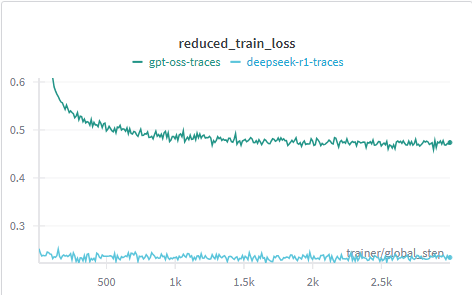
This study investigates how reasoning traces from frontier models like DeepSeek-R1 and GPT-OSS can improve smaller language models through post-training, offering a practical pathway to distill advanced reasoning capabilities without expensive human annotation.
OLMo 3
Allen Institute for AI introduces OLMo 3, a fully open language model family that releases the complete “model flow”: every training stage, checkpoint, dataset, and dependency, enabling researchers to intervene at any development point. The release includes four specialized variants (Base, Think, Instruct, RL Zero) at 7B and 32B scales.

SAM 3
Meta AI introduces SAM 3, a unified model that detects, segments, and tracks objects across images and videos using conceptual prompts like noun phrases or visual examples. This extends the Segment Anything capability to concept-based segmentation through Promptable Concept Segmentation (PCS).
Aligning Vision Models with Human Perception
Google DeepMind presents a method to align AI vision models with human visual understanding by addressing systematic differences in how models organize visual representations, demonstrating that alignment improves robustness, generalization, and reliability across diverse vision tasks.
Omnilingual ASR
Meta FAIR introduces Omnilingual ASR, an open-source multilingual speech recognition system supporting over 1600 languages (over 500 never before included in any ASR system), using a 7B parameter encoder-decoder architecture that enables zero-shot generalization to new languages and dialects with just a few training examples.
Olympiad-Level Formal Mathematical Reasoning with Reinforcement Learning
Google DeepMind introduces AlphaProof, an AlphaZero-inspired reinforcement learning agent that learns to find formal mathematical proofs within the Lean theorem prover, achieving the first-ever medal-level performance at the International Mathematical Olympiad by solving three problems, including the competition’s most difficult challenge.