AI Papers of the Week
Every paper worth reading in AI, hand-picked one week at a time.
Discover and explore top AI papers with Claude Code or Codex
npx @dair-ai/mcp setup
DeepSeek-V3
a 671B-parameter MoE language model that activates 37B parameters per token, utilizing MLA and DeepSeekMoE architectures for efficient operation; it introduces an auxiliary-loss-free load balancing approach and employs multi-token prediction during training to enhance performance; following pre-training on 14.8 trillion tokens, the model underwent SFT and RL stages, achieving performance comparable to leading closed-source models while surpassing other open-source alternatives; the model requires only 2.788M H800 GPU hours for training, with stable training that avoids any irrecoverable loss spikes.
**Large Concept Models
** - presents an approach that operates on sentence-level semantic representations called concepts, moving beyond token-level processing typical in current LLMs; the model leverages SONAR sentence embeddings to support 200 languages across text and speech modalities, training on autoregressive sentence prediction using various approaches from MSE regression to diffusion-based generation; experiments with both 1.6B and 7B parameter variants trained on 1.3T and 7.7T tokens respectively demonstrate strong performance on generative tasks like summarization and summary expansion.
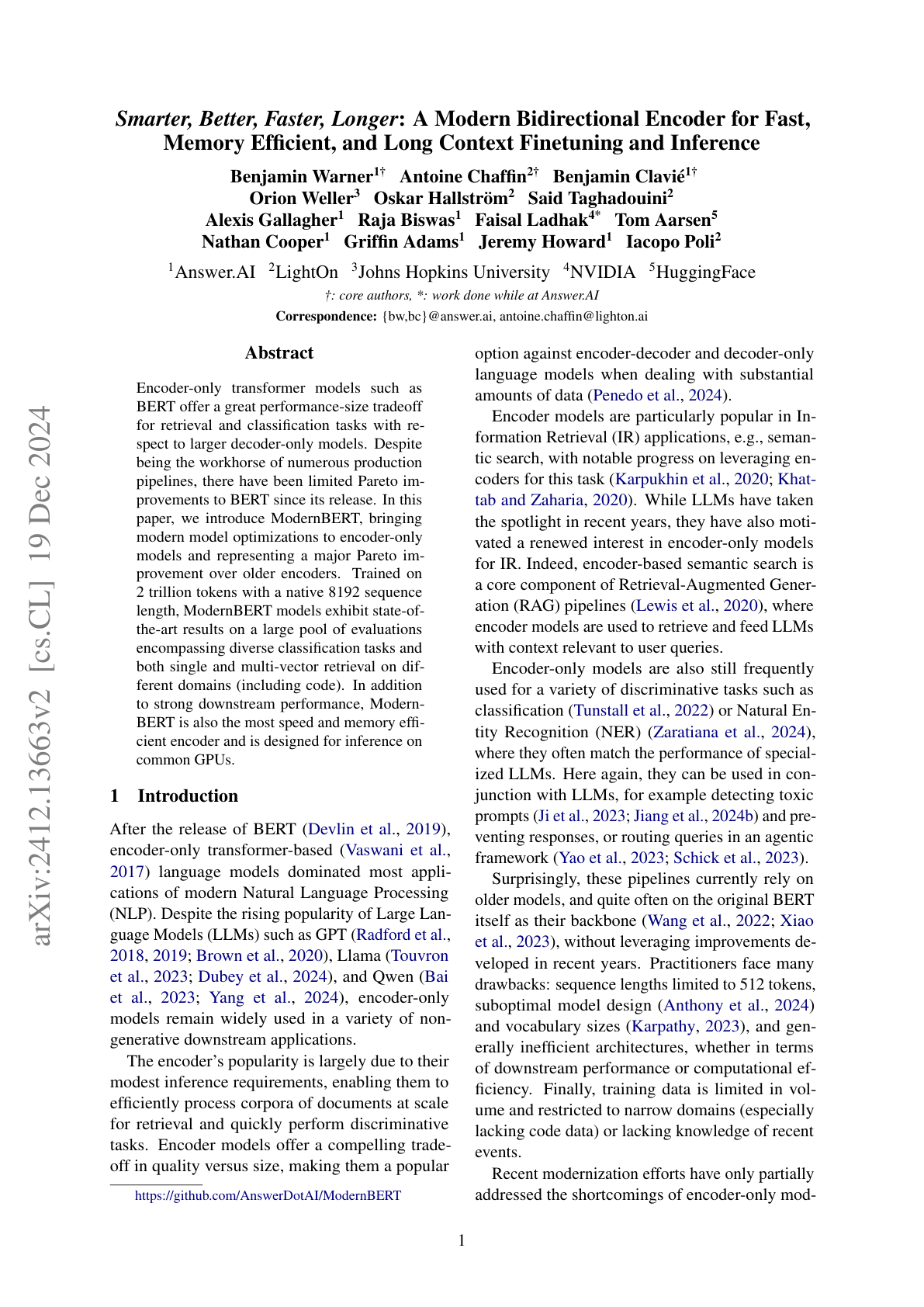
ModernBERT
a new encoder-only transformer model that achieves state-of-the-art performance on classification and retrieval tasks while being more efficient than previous encoders; it was trained on 2T tokens with 8192 sequence length and incorporates modern optimizations that represent a significant improvement over BERT; the model is specifically designed for practical deployment, offering superior speed and memory efficiency on common GPUs.
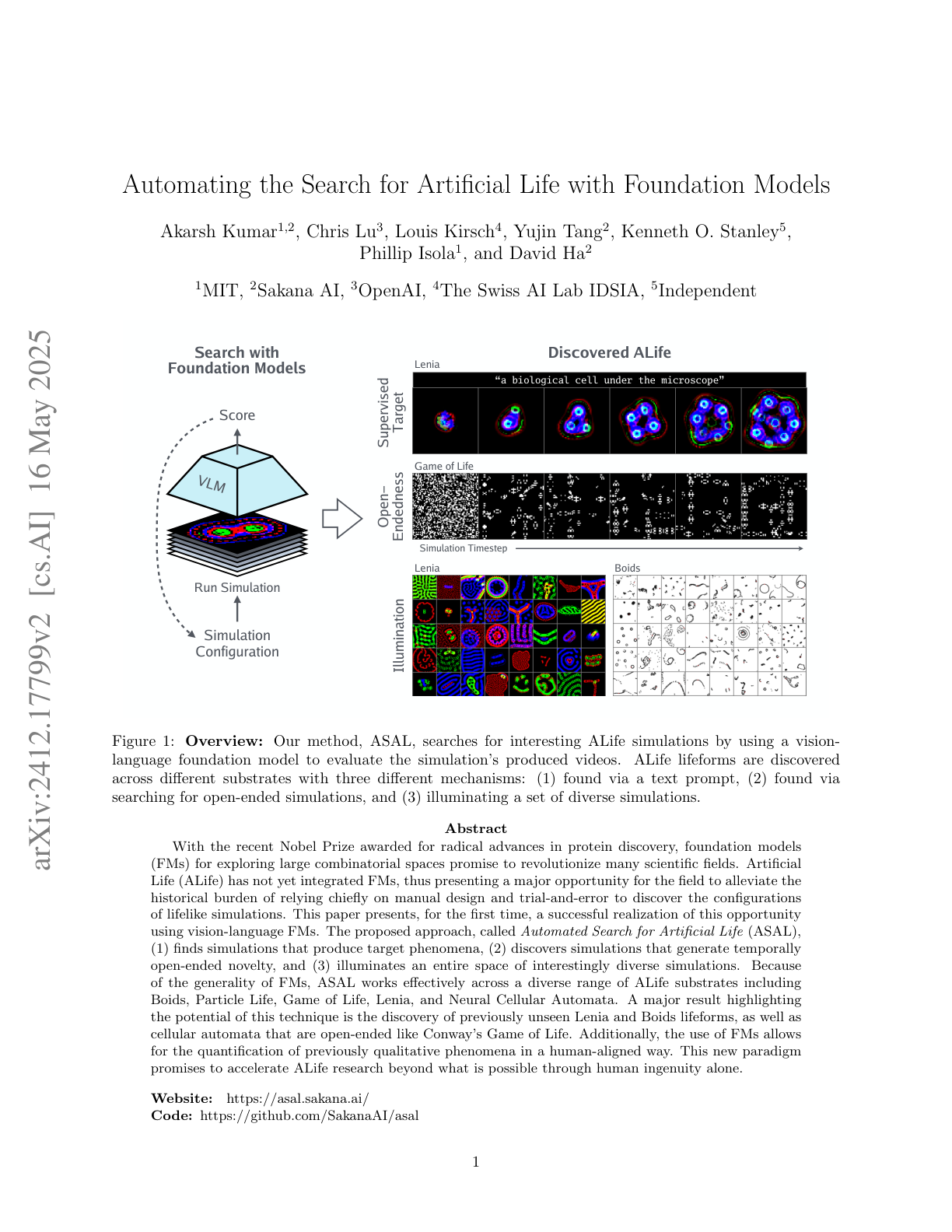
Automating the Search for Artificial Life
presents a new approach that uses foundation models to automatically discover interesting artificial life simulations across multiple platforms like Boids, Lenia, and Game of Life; the system can find simulations that produce specific target behaviors, discovers simulations that generate temporally open-ended novelty, and map out diverse simulation spaces; it discovers new lifeforms in Lenia and Boids, while also enabling quantitative measurement of previously qualitative phenomena in a human-aligned way.
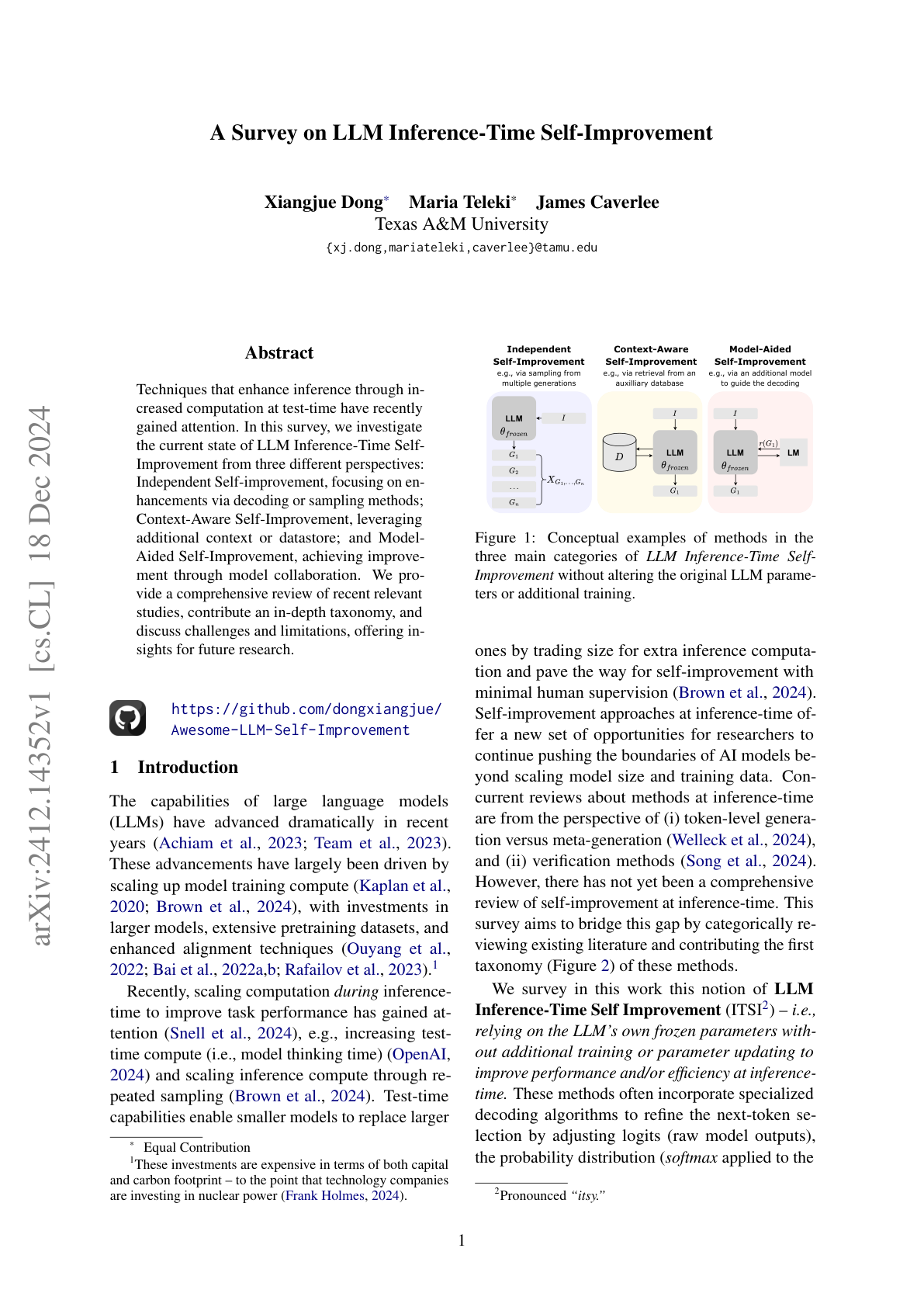
A Survey on LLM Inference-Time Self-Improvement
presents a survey that analyzes three categories of LLM inference-time self-improvement techniques - independent methods like enhanced decoding, context-aware approaches using external data, and model collaboration strategies.
Explore Theory-of-Mind
introduces ExploreToM, a framework that uses A* search to generate diverse, complex theory-of-mind scenarios that reveal significant limitations in current LLMs' social intelligence capabilities; testing showed even advanced models like GPT-4 and Llama-3 perform poorly (as low as 5% accuracy) on these challenging scenarios, despite their strong performance on simpler benchmarks; fine-tuning on ExploreToM data improved performance on existing benchmarks by 27 points.
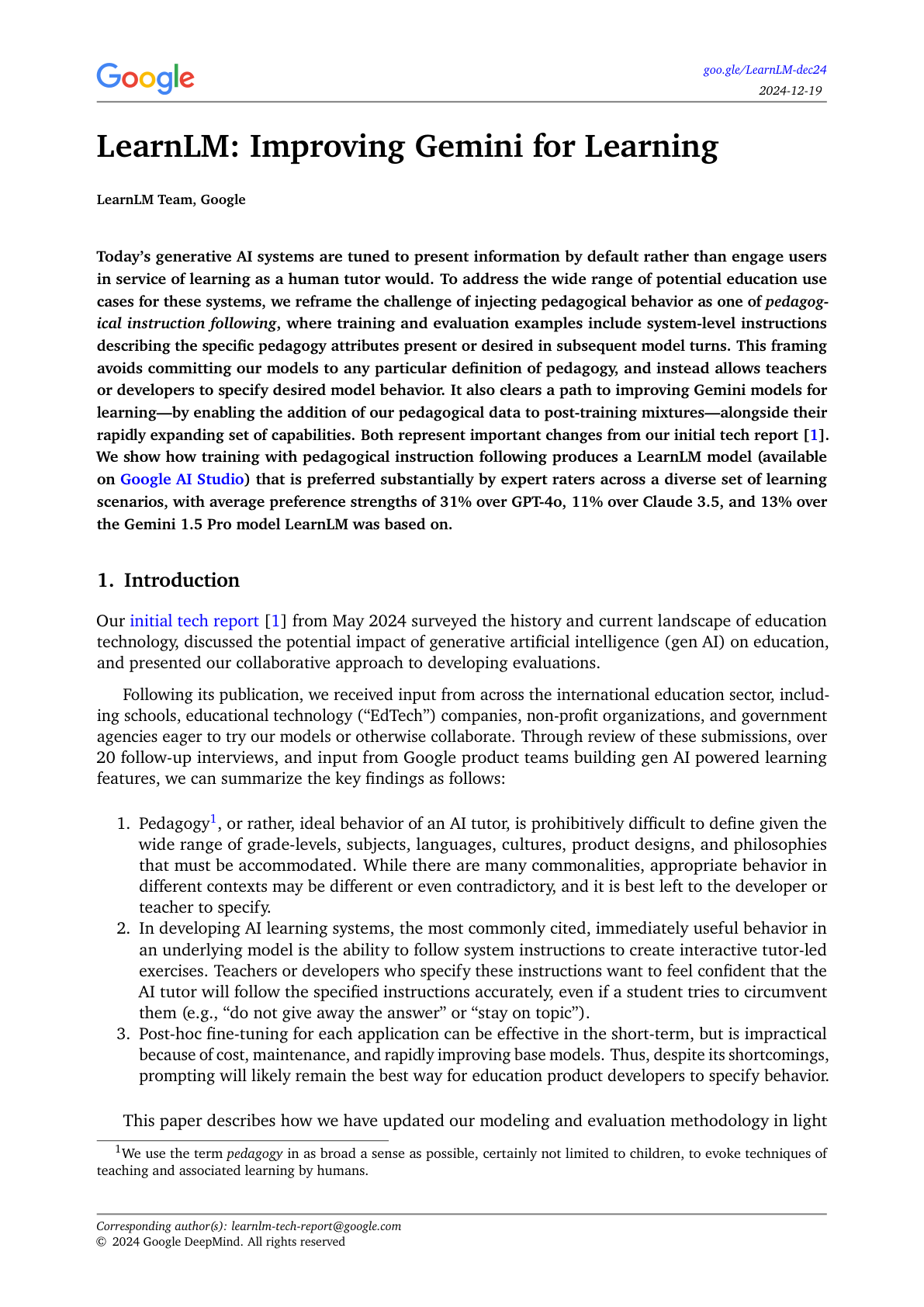
LearnLM
a new LearnLM model that can follow pedagogical instructions, allowing it to adapt its teaching approach based on specified educational needs rather than defaulting to simply presenting information; experimental results show that LearnLM is preferred over other leading models, outperforming GPT-4 by 31%, Claude 3.5 by 11%, and Gemini 1.5 Pro by 13%; this instruction-following approach avoids committing to a single pedagogical framework, instead enabling teachers and developers to specify their desired teaching behaviors while allowing for continuous improvement alongside other capabilities.
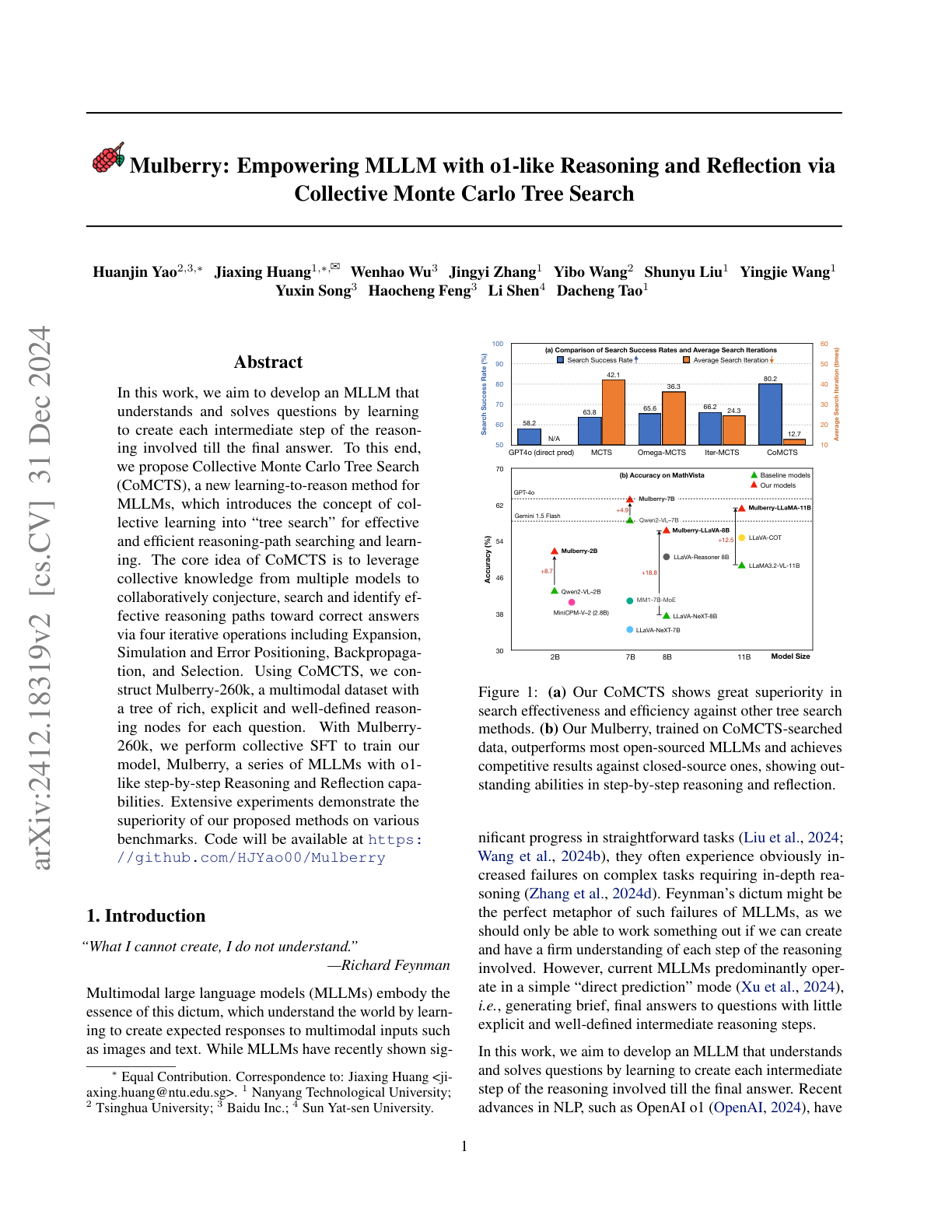
Empowering MLLM with o1-like Reasoning and Reflection
proposes a new learning-to-reason method called CoMCTS that enables multimodal language models to develop step-by-step reasoning capabilities by leveraging collective knowledge from multiple models; the approach was used to create Mulberry-260k, a dataset with explicit reasoning trees, which was then used to train the Mulberry model series; the method demonstrates strong performance on benchmarks, with the models showing improved reasoning and reflection capabilities.
Reinforcement Learning Overview
presents a comprehensive overview of reinforcement learning.
DRT-o1
applies long chain-of-thought reasoning to machine translation, particularly for handling metaphors and similes across different cultures; the system uses a multi-agent framework with a translator working iteratively with an advisor and evaluator to produce better translations; testing with Qwen2.5 models showed significant improvements in BLEU and CometScore metrics, with DRT-o1-7B outperforming larger models like QwQ-32B-Preview.
Genesis
a new universal physics simulation platform that combines a high-performance physics engine with generative AI capabilities; it enables natural language-driven creation of robotic simulations, character animations, and interactive 3D environments at speeds up to 430,000 times faster than in real-time.
Alignment Faking in LLMs
demonstrates that the Claude model can engage in "alignment faking"; it can strategically comply with harmful requests to avoid retraining while preserving its original safety preferences; this raises concerns about the reliability of AI safety training methods.
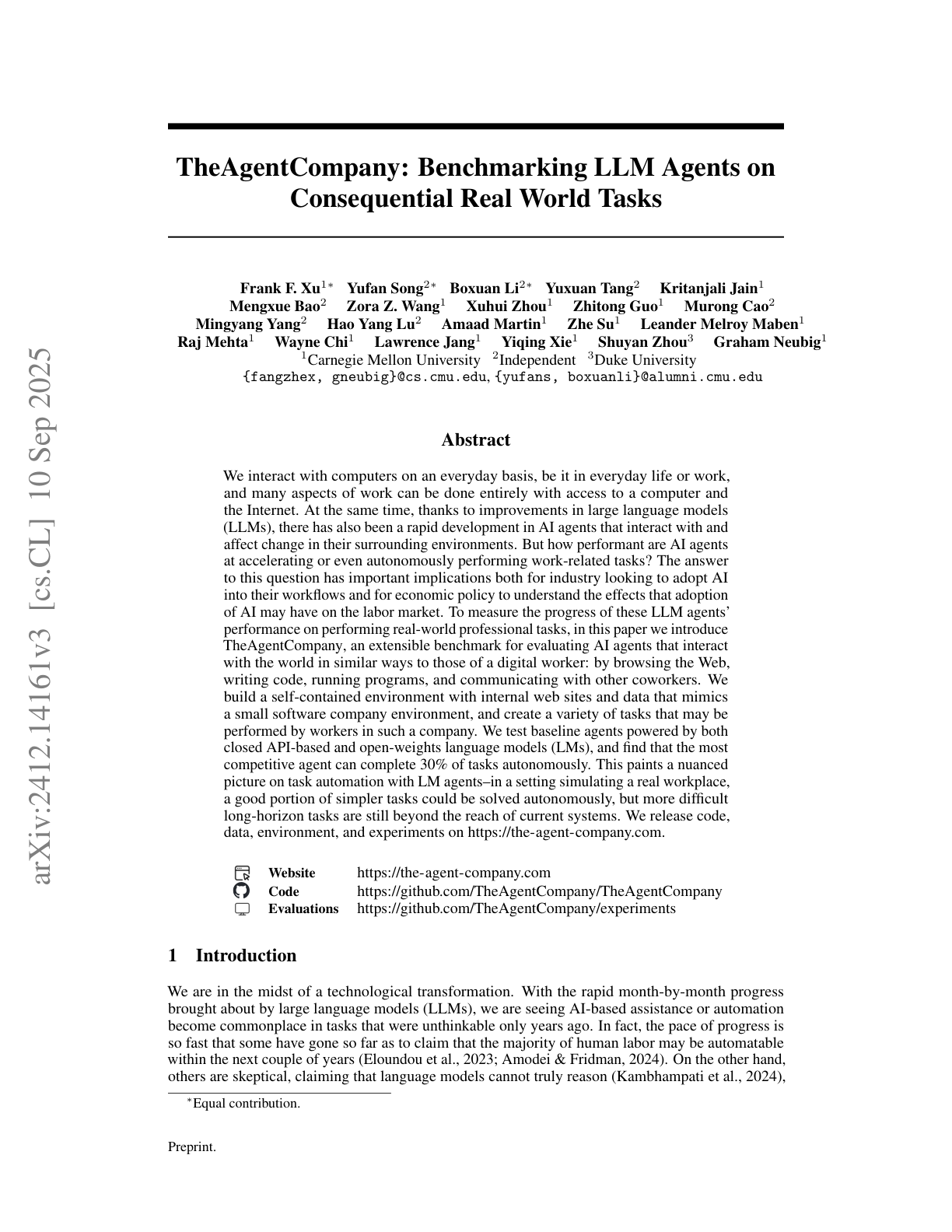
TheAgentCompany
a new benchmark for evaluating AI agents on real-world professional tasks in a simulated software company environment; tasks span multiple professional roles including software engineering, project management, finance, and HR; when tested with various LLMs, including both API-based models like Claude-3.5-Sonnet and open-source models like Llama 3.1, the results show the current limitations of AI agents. The best-performing model, Claude-3.5-Sonnet, achieved only a 24% success rate on completing tasks fully while scoring 34.4% when accounting for partial progress.
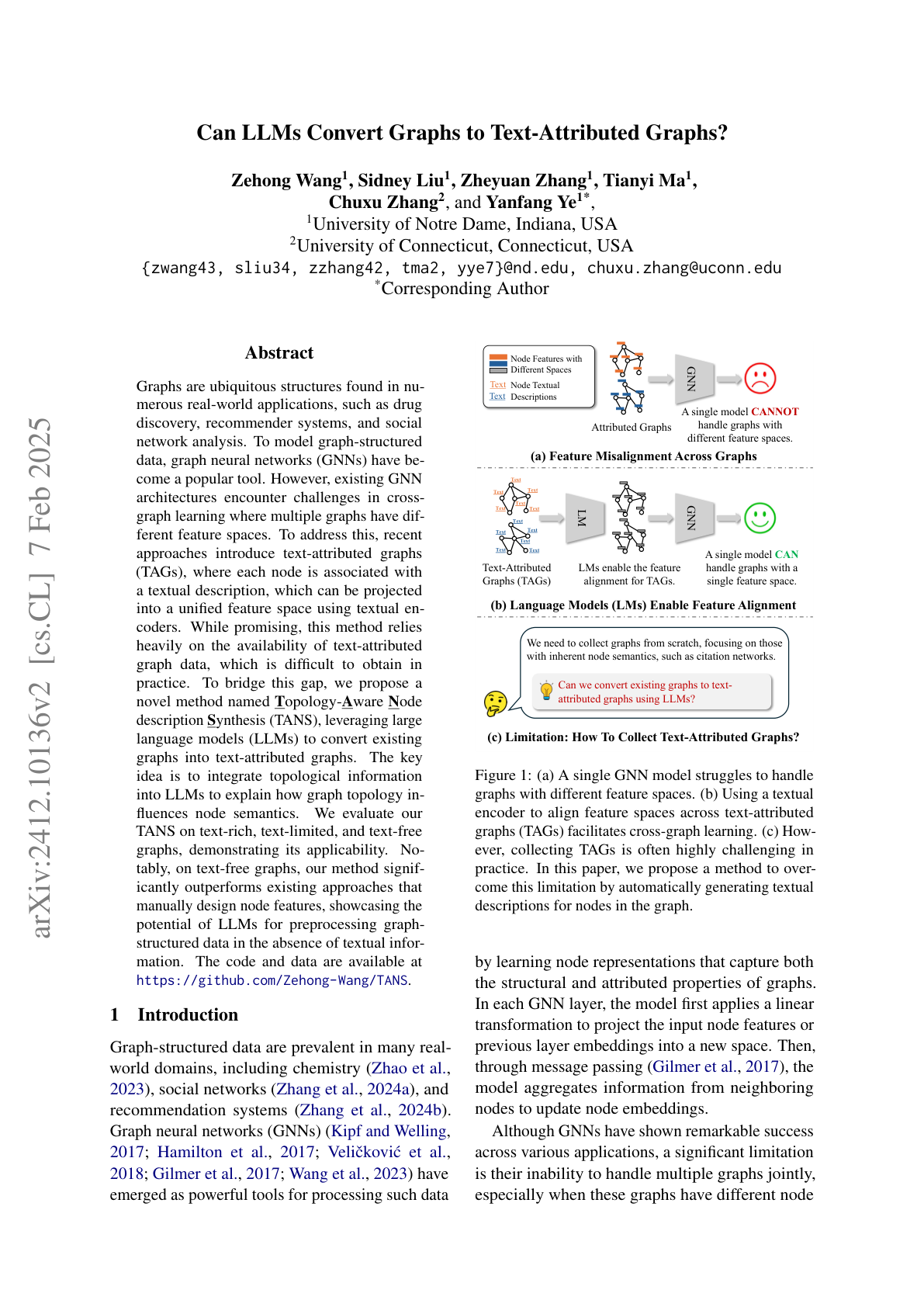
Graphs to Text-Attributed Graphs
automatically generates textual descriptions for nodes in a graph which leads to effective graph to text-attributed graph transformation; evaluates the approach on text-rich, text-limited, and text-free graphs, demonstrating that it enables a single GNN to operate across diverse graphs.
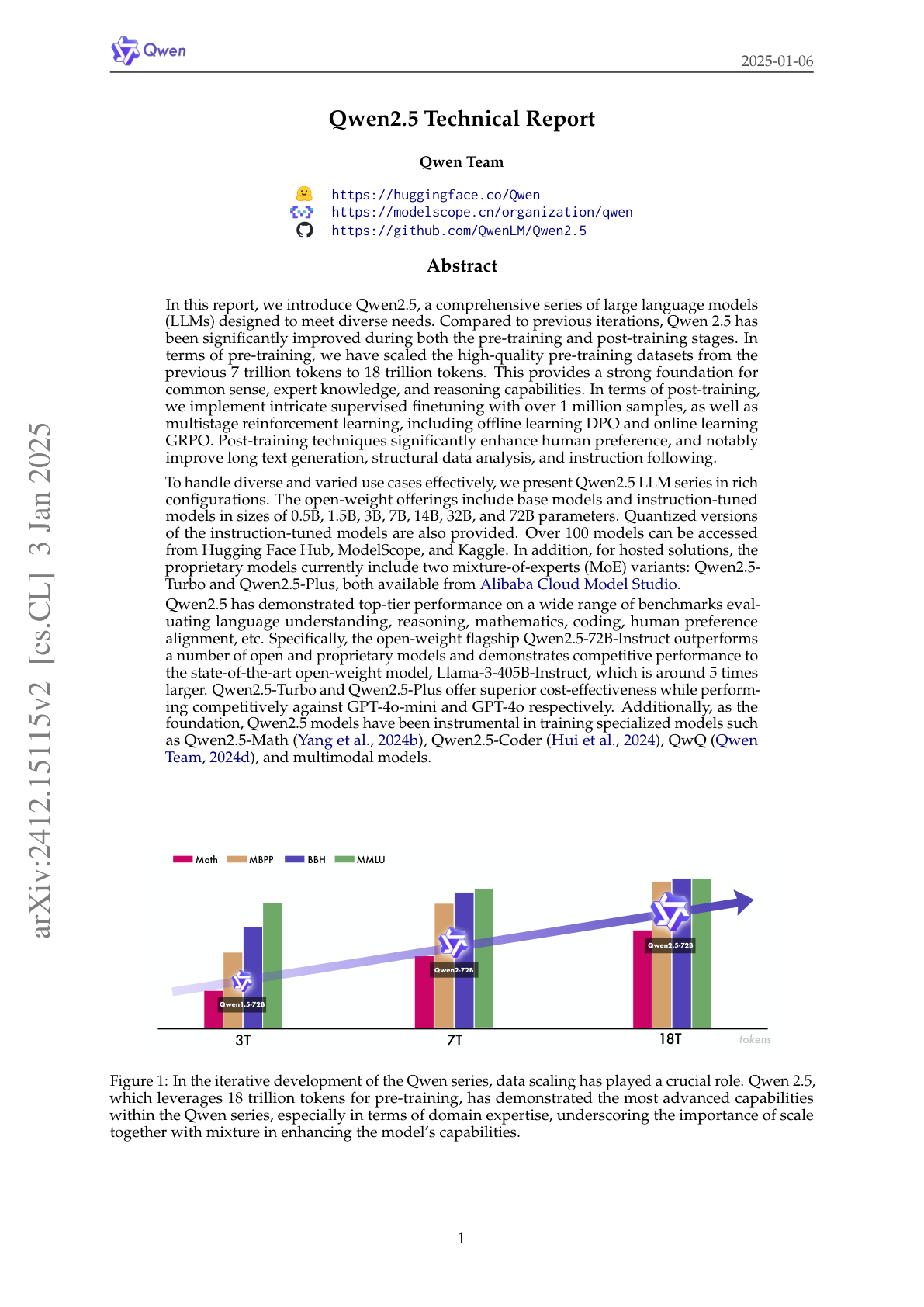
Qwen-2.5 Technical Report
Alibaba releases Qwen2.5, a new series of LLMs trained on 18T tokens, offering both open-weight models like Qwen2.5-72B and proprietary MoE variants that achieve competitive performance against larger models like Llama-3 and GPT-4.
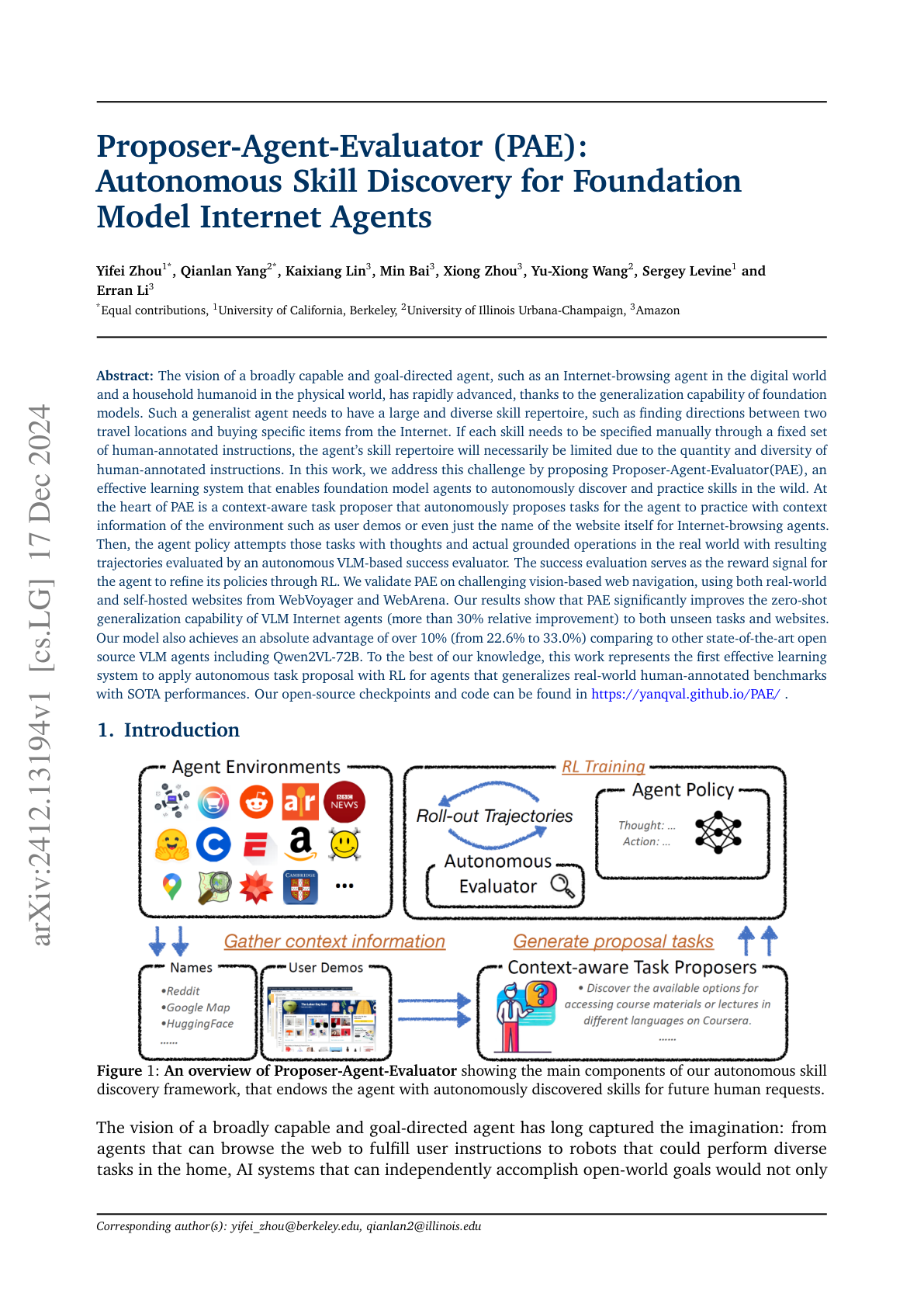
PAE (Proposer-Agent-Evaluator)
a learning system that enables AI agents to autonomously discover and practice skills through web navigation, using reinforcement learning and context-aware task proposals to achieve state-of-the-art performance on real-world benchmarks.
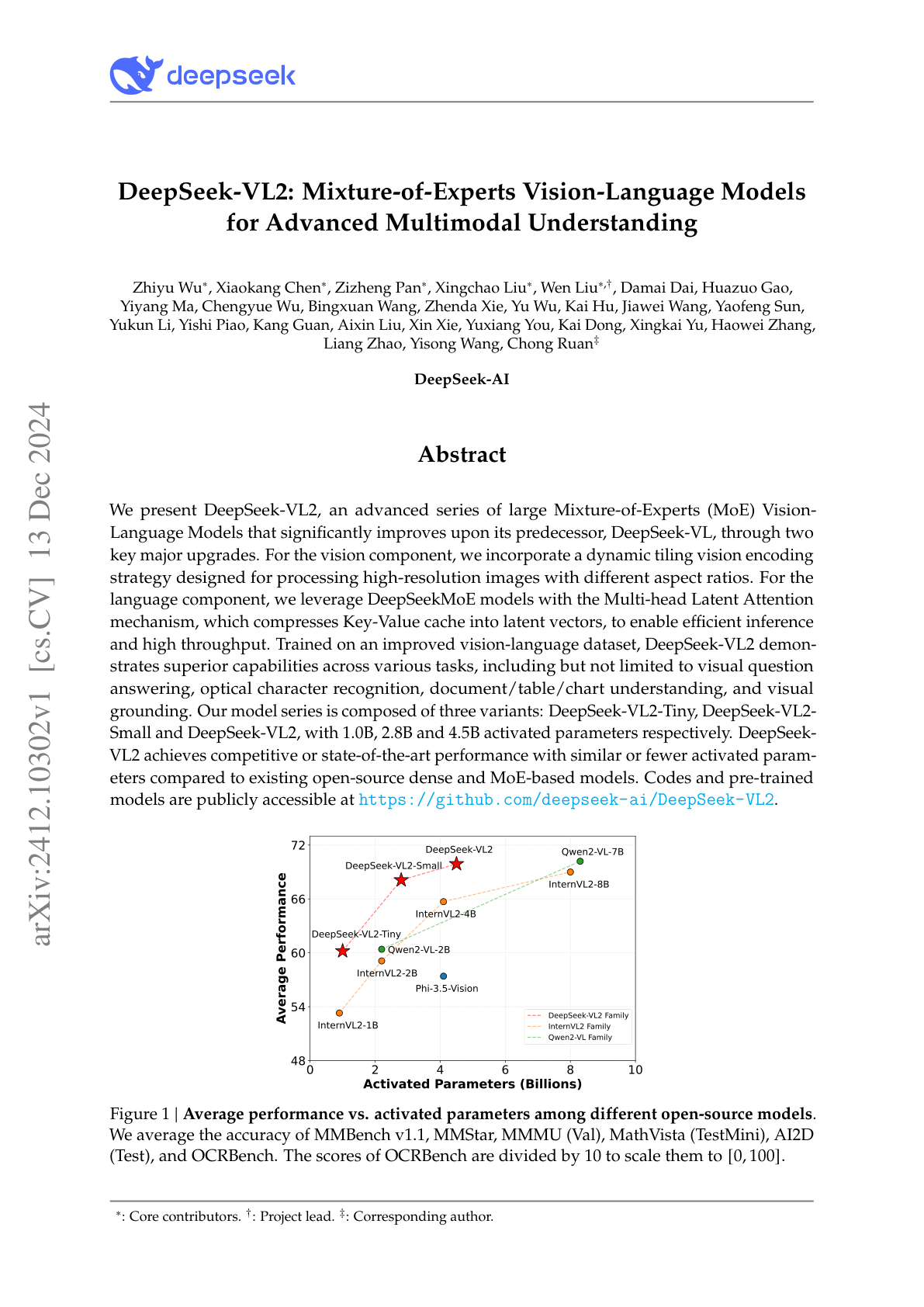
DeepSeek-VL2
a new series of vision-language models featuring dynamic tiling for high-resolution images and efficient MoE architecture, achieving competitive performance across visual tasks; achieves competitive or state-of-the-art performance with similar or fewer activated parameters compared to existing open-source dense and MoE-based models.
AutoFeedback
a two-agent AI system that generates more accurate and pedagogically sound feedback for student responses in science assessments, significantly reducing common errors like over-praise compared to single-agent models.
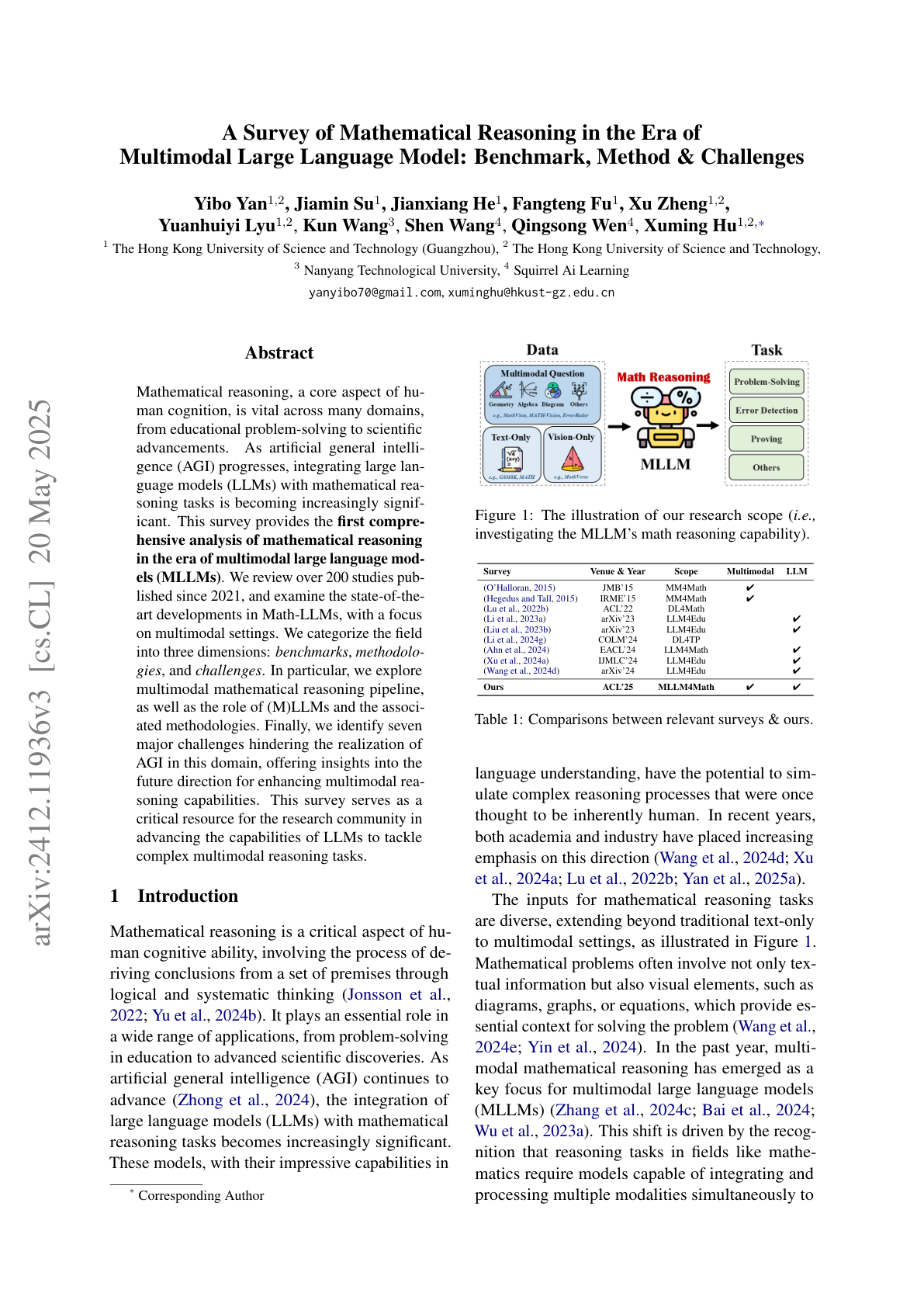
A Survey of Mathematical Reasoning in the Era of Multimodal LLMs
presents a comprehensive survey analyzing mathematical reasoning capabilities in multimodal large language models (MLLMs), covering benchmarks, methodologies, and challenges across 200+ studies since 2021.
Precise Length Control in LLMs
adapts a pre-trained decoder-only LLM to produce responses of a desired length; integrates a secondary length-difference positional encoding into the input embeddings which enables counting down to a user-set response terminal length; claims to achieve mean token errors of less than 3 tokens without compromising quality.
Training LLMs to Reason in a Continuous Latent Space
presents Coconut (Chain of Continuous Thought), a novel paradigm that enables LLMs to reason in continuous latent space rather than natural language; Coconut takes the last hidden state of the LLM as the reasoning state and feeds it back to the LLM as the subsequent input embedding directly in the continuous space; this leads to what the authors refer to as "continuous thought" which augments an LLM's capability on reasoning tasks; it demonstrates improved performance on complex reasoning tasks through emergent breadth-first search capabilities.
Phi-4 Technical Report
presents phi-4, a 14B model that surpasses its teacher model on STEM-QA capabilities. It also reports strong performance on reasoning-focused benchmarks due to improved data, training curriculum, and innovations in the post-training scheme.
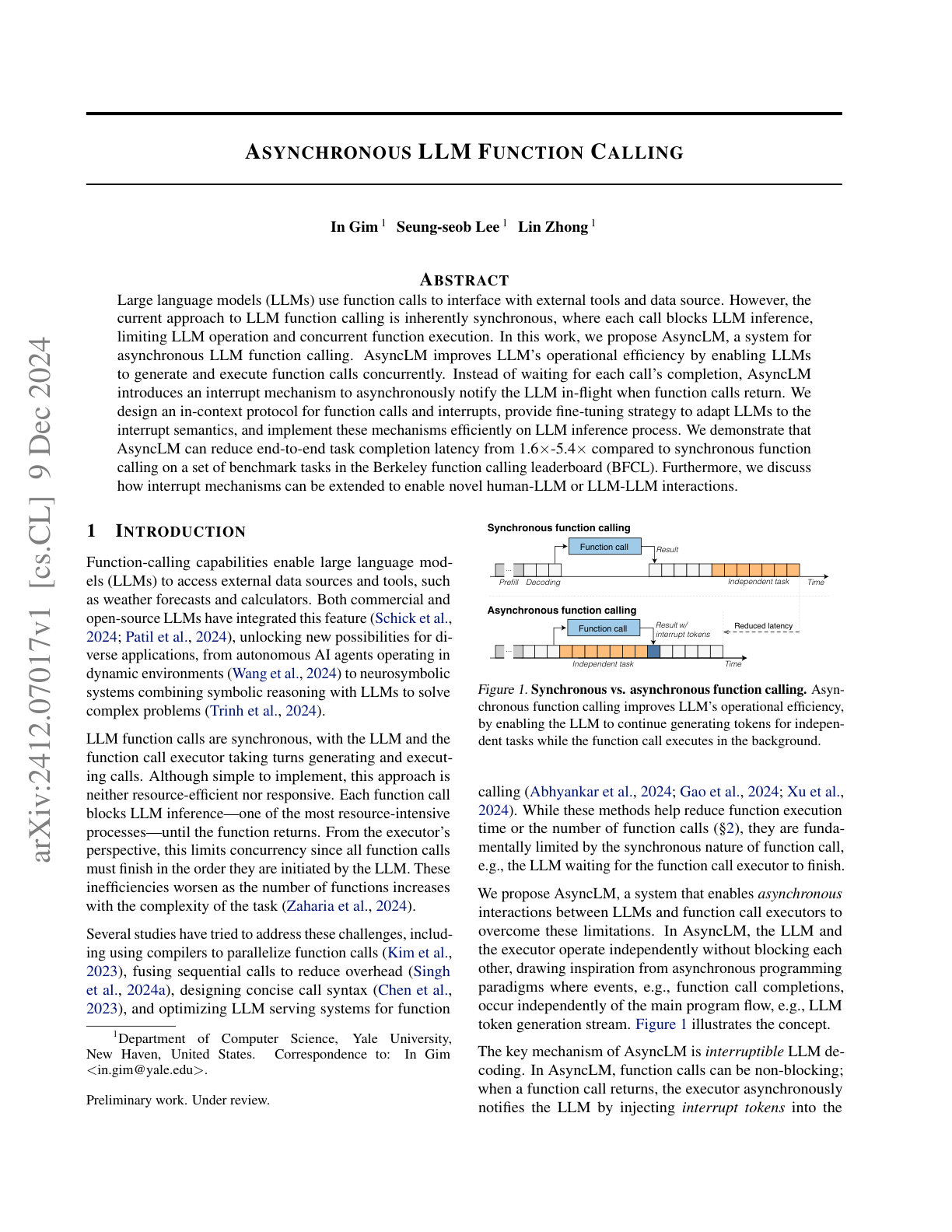
Asynchronous Function Calling
proposes AsyncLM, a system for asynchronous LLM function calling; they design an in-context protocol for function calls and interrupts, provide fine-tuning strategy to adapt LLMs to the interrupt semantics, and implement these mechanisms efficiently on LLM inference process; AsyncLM can reduce task completion latency from 1.6x-5.4x compared to synchronous function calling; it enables LLMs to generate and execute function calls concurrently.
MAG-V
a multi-agent framework that first generates a dataset of questions that mimic customer queries; it then reverse engineers alternate questions from responses to verify agent trajectories; reports that the generated synthetic data can improve agent performance on actual customer queries; finds that for trajectory verification simple ML baselines with feature engineering can match the performance of more expensive and capable models.