AI Papers of the Week
Every paper worth reading in AI, hand-picked one week at a time.
Can Long-Context Language Models Subsume Retrieval, RAG, SQL, and More?
conducts a deep performance analysis of long-context LLMs on in-context retrieval and reasoning; they first present a benchmark with real-world tasks requiring 1M token context; reports that long-context LLMs can rival state-of-the-art retrieval and RAG systems, without any explicit training on the tasks; suggests that compositional reasoning (required in SQL-like tasks) is still challenging for these LLMs; they also encourage the need for continued research on advanced prompting strategies as they noted significant boosts in performance when applying them for long context problems.
Monte Carlos Tree Self-Refine
report to have achieved GPT-4 level mathematical olympiad solution using an approach that integrates LLMs with Monte Carlo Tree Search; this approach focuses on enhancing the mathematical reasoning performance of the system through capabilities such as systematic exploration, self-refinement, and self-evaluation.
Tree Search for Language Model Agents
proposes an inference-time tree search algorithm for LM agents to perform exploration and enable multi-step reasoning; it’s tested on interactive web environments and applied to GPT-4o to significantly improve performance; demonstrates that performance scales when increasing test-time compute.
Nemotron-4 340B
provides an instruct model to generate high-quality data and a reward model to filter out data on several attributes; demonstrates strong performance on common benchmarks like MMLU and GSM8K; it’s competitive with GPT-4 on several tasks, including high scores in multi-turn chat; a preference data is also released along with the base model.
Mixture-of-Agents
an approach that leverages the collective strengths of multiple LLMs through a Mixture-of-Agents methodology; layers are designed with multiple LLM agents and each agent builds on the outputs of other agents in the previous layers; surpasses GPT-4o on AlpacaEval 2.0, MT-Bench and FLASK.
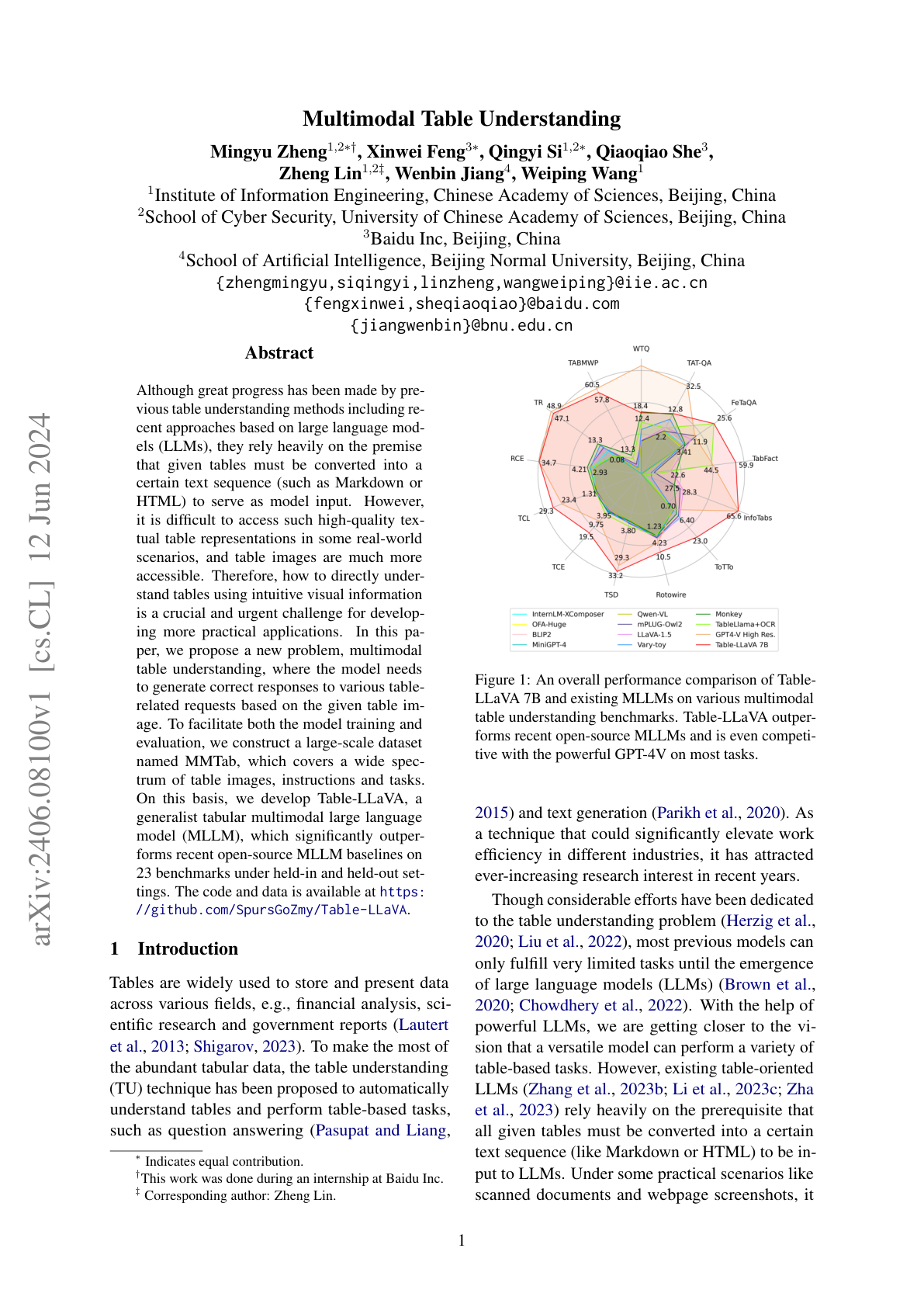
Multimodal Table Understanding
introduces Table-LLaVa 7B, a multimodal LLM for multimodal table understanding; it’s competitive with GPT-4V and significantly outperforms existing MLLMs on multiple benchmarks; also develops a large-scale dataset MMTab, covering table images, instructions, and tasks.

NLLB
proposes a massive multilingual model that leverages transfer learning across 200 languages; it’s based on a sparsely Gated Mixture of Experts architecture and trained on data via an approach tailored for low-resource languages; evaluates on 40K translations and achieves an average of 44% improvement in translation quality.
Aligning LLMs with Demonstrated Feedback
proposes a method to align LLMs to a specific setting via a very small number of demonstrations as feedback; it aligns LLM outputs to a user’s demonstrated behaviors and can learn fine-grained style and task alignment across domains; outperforms few-shot prompting, SFT, and self-play methods on the tested benchmarks.
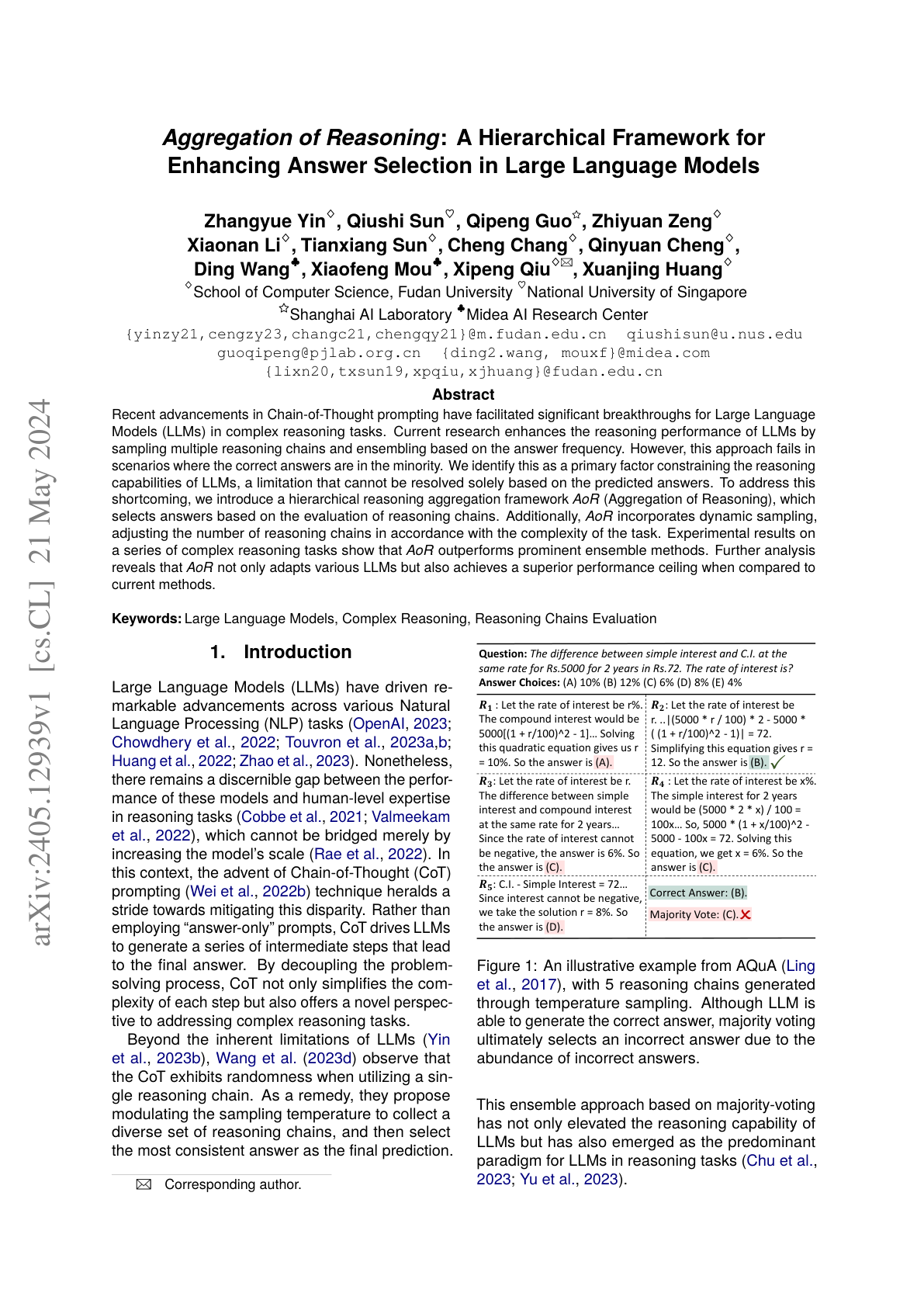
Enhancing Answer Selection in LLMs
proposes a hierarchical reasoning aggregation framework for improving the reasoning capabilities of LLMs; the approach, called Aggregation of Reasoning (AoR), selects answers based on the evaluation of reasoning chains; AoR uses dynamic sampling to adjust the number of reasoning chains with respect to the task complexity; it uses results from the evaluation phase to determine whether to sample additional reasoning chains; a known flaw of majority voting is that it fails in scenarios where the correct answer is in the minority; AoR focuses on evaluating the reasoning chains to improve the selection of the final answer; AoR outperforms various prominent ensemble methods and can be used with various LLMs to improve performance on complex reasoning tasks.
Guide for Evaluating LLMs
provides guidance and lessons for evaluating large language models; discusses challenges and best practices, along with the introduction of an open-source library for evaluating LLMs.
Gemini 1.5 Flash
a lightweight transformer decoder model with a 2M context window with multimodal capabilities; it is designed for efficiency and yields the fastest output generation of all models on several evaluated languages; overall, Gemini 1.5 Flash performs uniformly better compared to Gemini 1.0 Pro and even performs at a similar level to 1.0 Ultra on several benchmarks.
Chameleon
a family of token-based mixed-modal models for generating images and text in any arbitrary sequence; reports state-of-the-art performance in image captioning and outperforms Llama 2 in text-only tasks and is also competitive with Mixtral 8x7B and Gemini-Pro; exceeds the performance of Gemini Pro and GPT-4V on a new long-form mixed-modal generation evaluation.
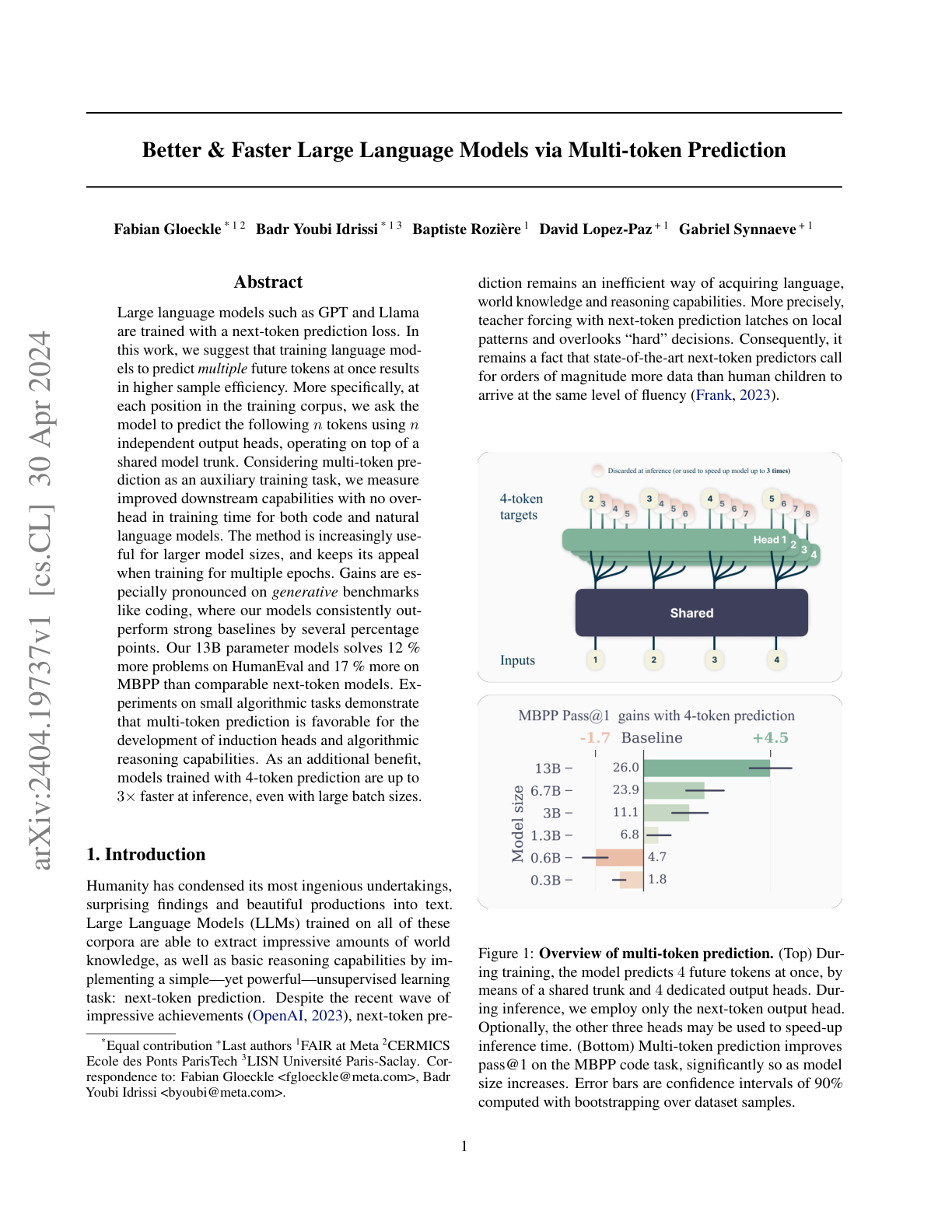
Better and Faster LLMs via Multi-token Prediction
proposes a multi-token prediction approach that performs language modeling by training the predict the following n tokens using n independent output heads; the output heads operate on top of a shared transformer trunk; multi-token prediction is shown to be useful when using larger model sizes and can speed up inference up to 3x; the proposed 13B parameter models solves 12 % more problems on HumanEval and 17 % more on MBPP than comparable next-token models.
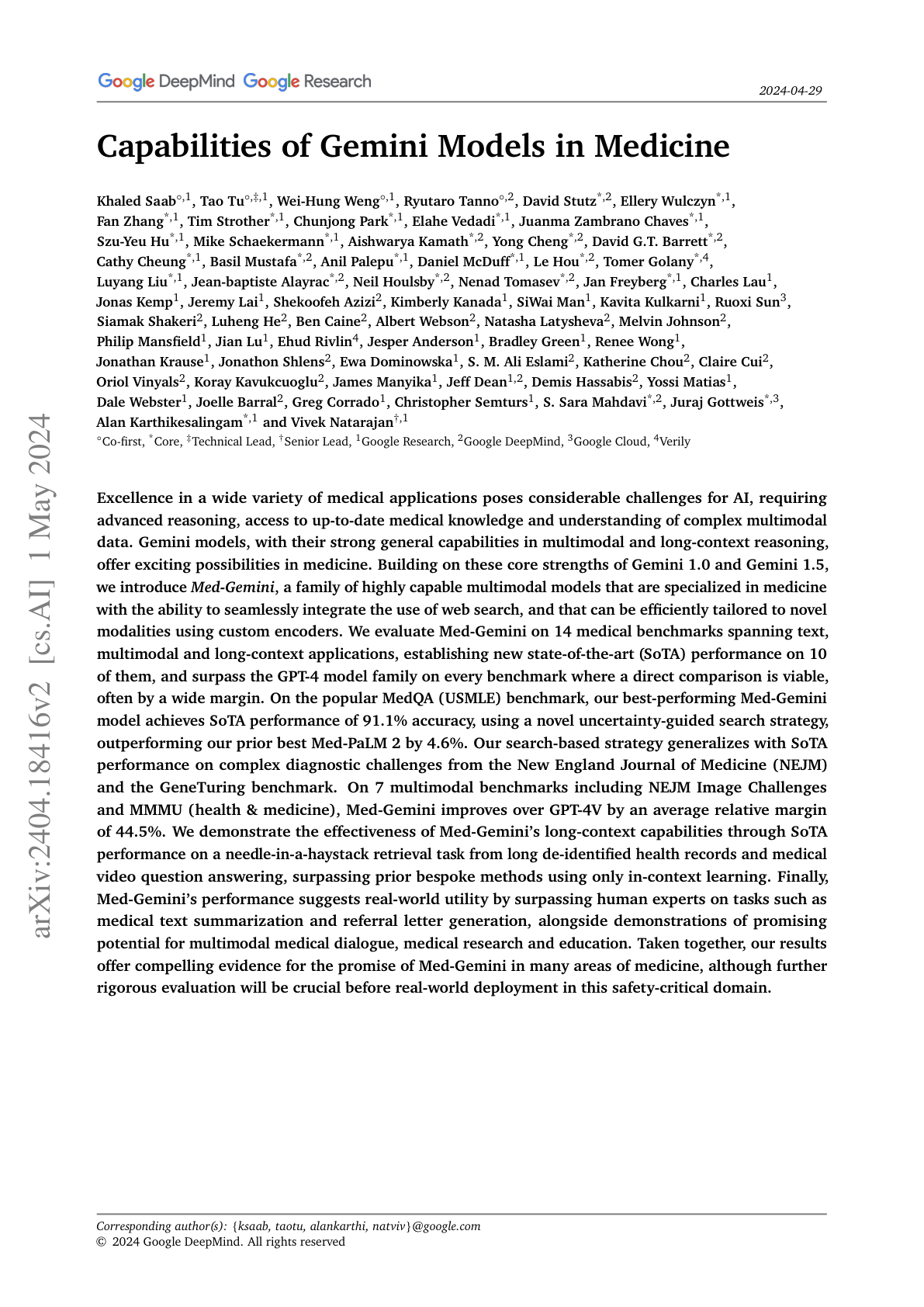
Med-Gemini
presents a family of multimodal models specialized in medicines and based on the strong multimodal and long-context reasoning capabilities of Gemini; achieves state-of-the-art performance on 10/14 benchmarks surpassing GPT-4 models; it achieves 91% accuracy on MedQA (USMLE) benchmark using an uncertainty-guided search strategy.
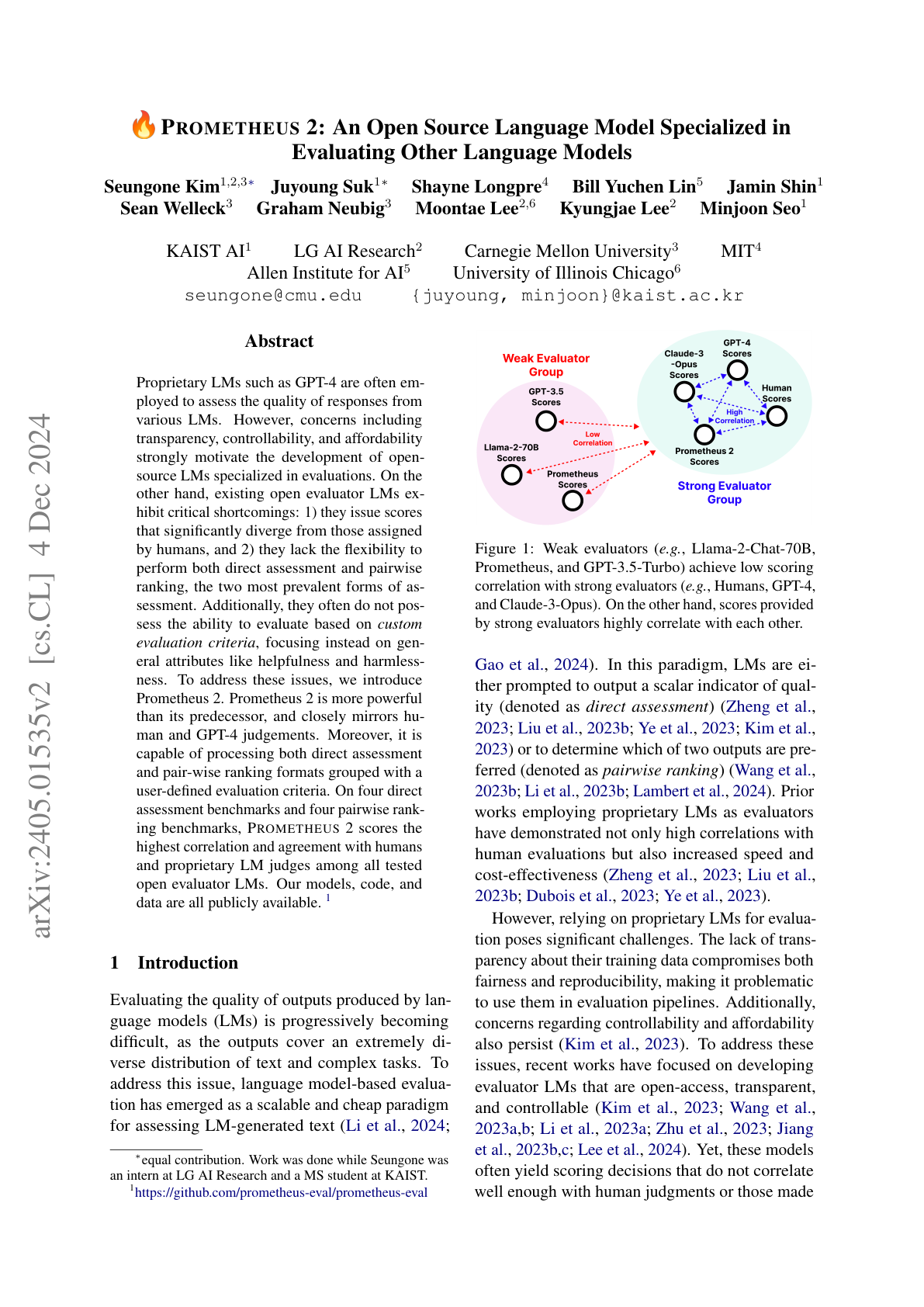
An Open-source LM Specialized in Evaluating Other LMs
open-source Prometheus 2 (7B & 8x7B), state-of-the-art open evaluator LLMs that closely mirror human and GPT-4 judgments; they support both direct assessments and pair-wise ranking formats grouped with user-defined evaluation criteria; according to the experimental results, this open-source model seems to be the strongest among all open-evaluator LLMs; the key seems to be in merging evaluator LMs trained on either direct assessment or pairwise ranking formats.
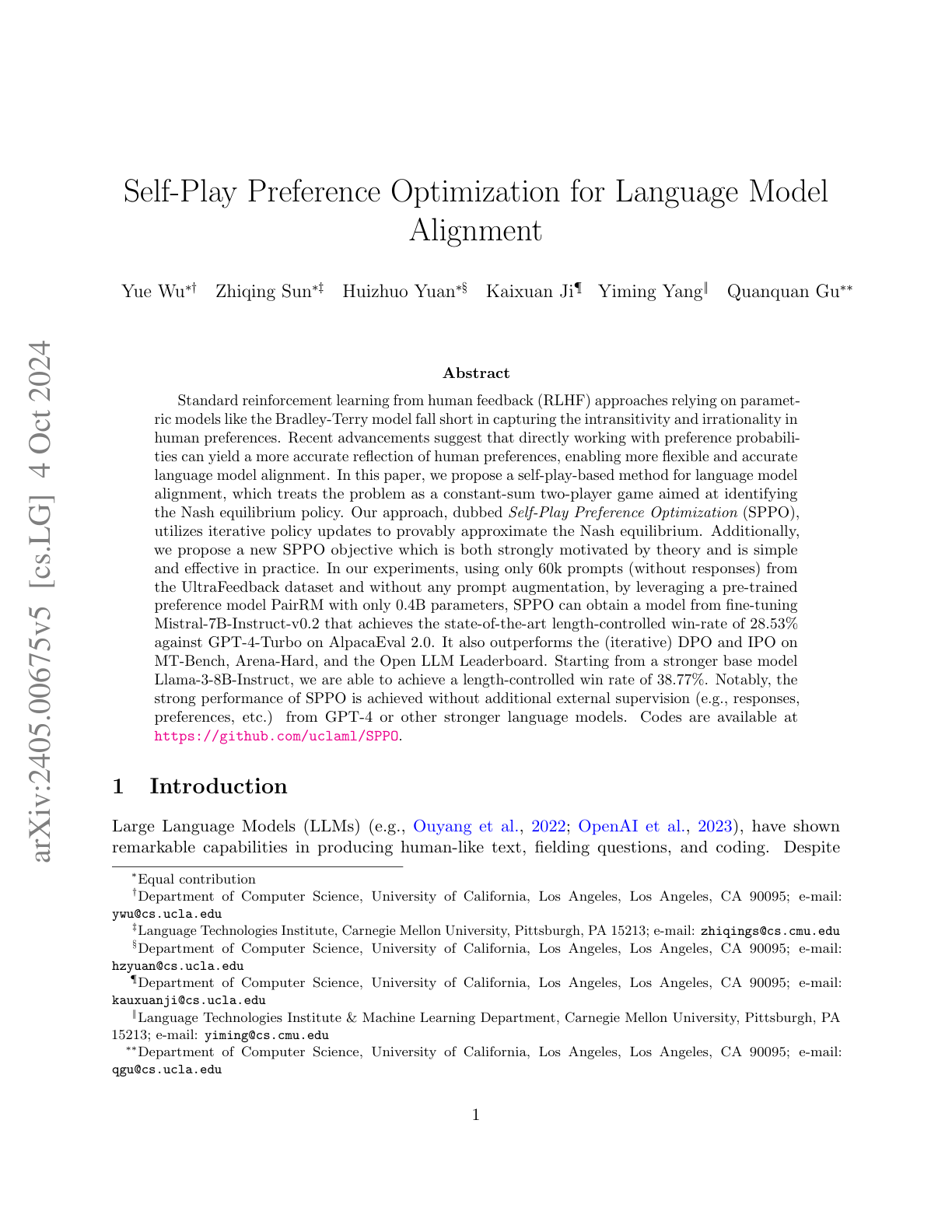
Self-Play Preference Optimization
proposes a self-play-based method for aligning language models; this optimation procedure treats the problem as a constant-sum two-player game to identify the Nash equilibrium policy; it addresses the shortcomings of DPO and IPO and effectively increases the log-likelihood of chose responses and decreases the rejected ones; SPPO outperforms DPO and IPO on MT-Bench and the Open LLM Leaderboard.
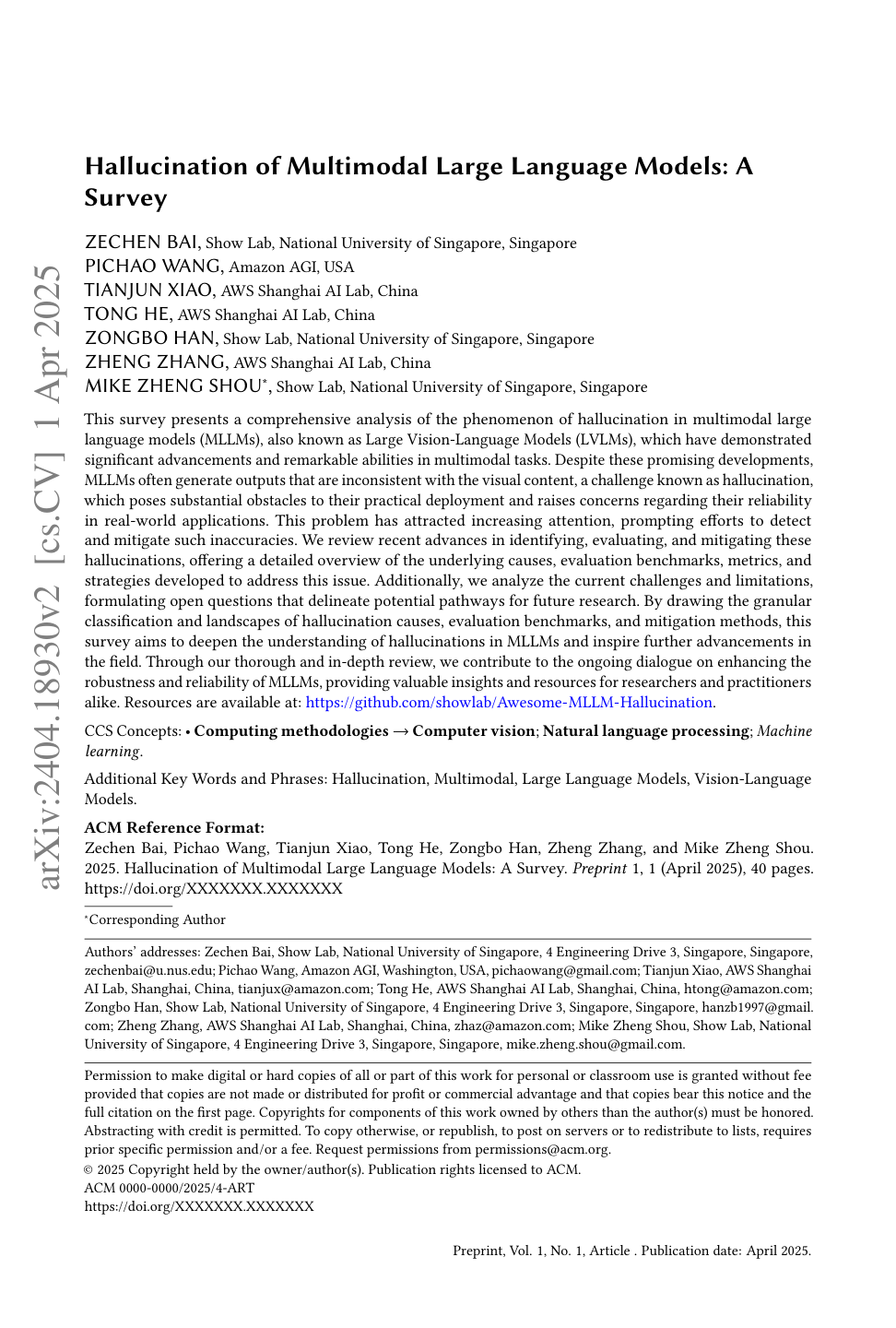
Multimodal LLM Hallucinations
provides an overview of the recent advances in identifying, evaluating, and mitigating hallucination in multimodal LLMs; it also provides an overview of causes, evaluation benchmarks, metrics, and other strategies to deal with challenges related to detecting hallucinations.
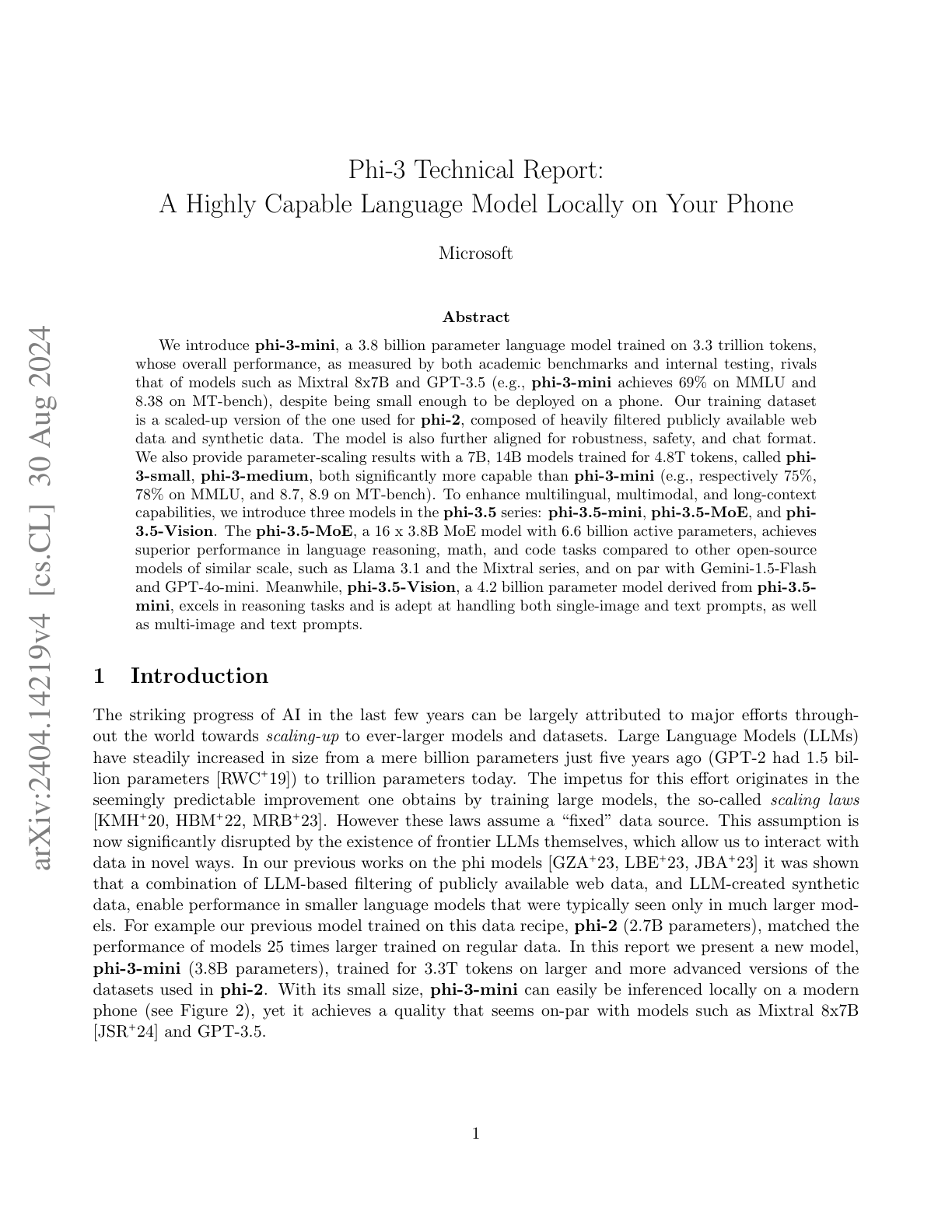
Phi-3
Microsoft's Phi-3 is a family of small language models (3.8B, 7B, 14B) trained on 3.3-4.8T tokens of heavily filtered web data combined with synthetic data. The flagship phi-3-mini rivals Mixtral 8x7B and GPT-3.5 while being small enough to run locally on a phone.
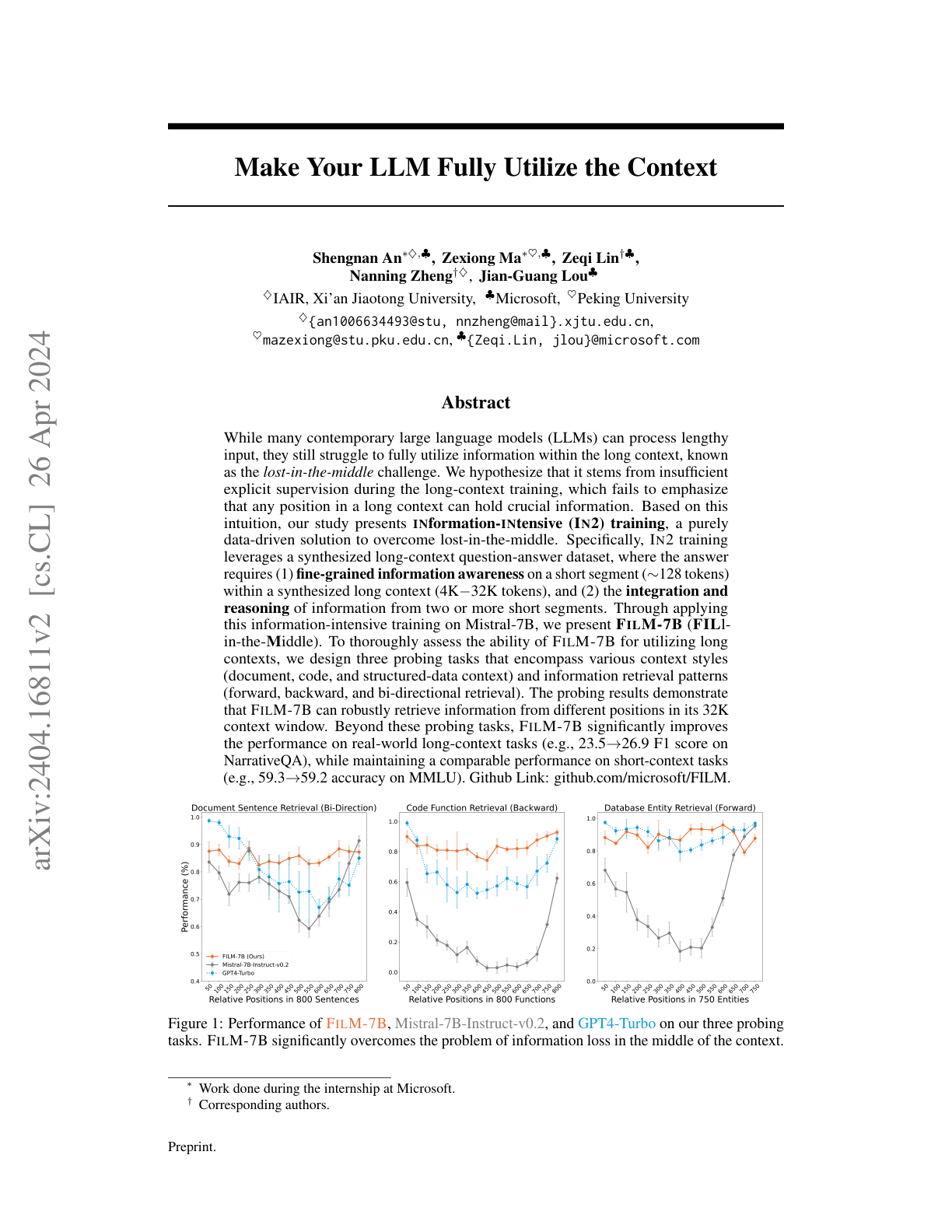
Make Your LLM Fully Utilize the Context (FILM-7B)
FILM-7B targets the lost-in-the-middle problem where long-context LLMs fail to retrieve information buried between the start and end of their input. The authors apply an information-intensive (IN2) training recipe to Mistral-7B that forces uniform attention across the full 32K window.
FineWeb
HuggingFace's FineWeb is a 15 trillion token English web dataset built from 96 CommonCrawl snapshots (2013-2024). In 1.8B-parameter ablations, models trained on FineWeb beat C4, RefinedWeb, Dolma, The Pile, SlimPajama, and RedPajama2 across aggregated benchmarks.
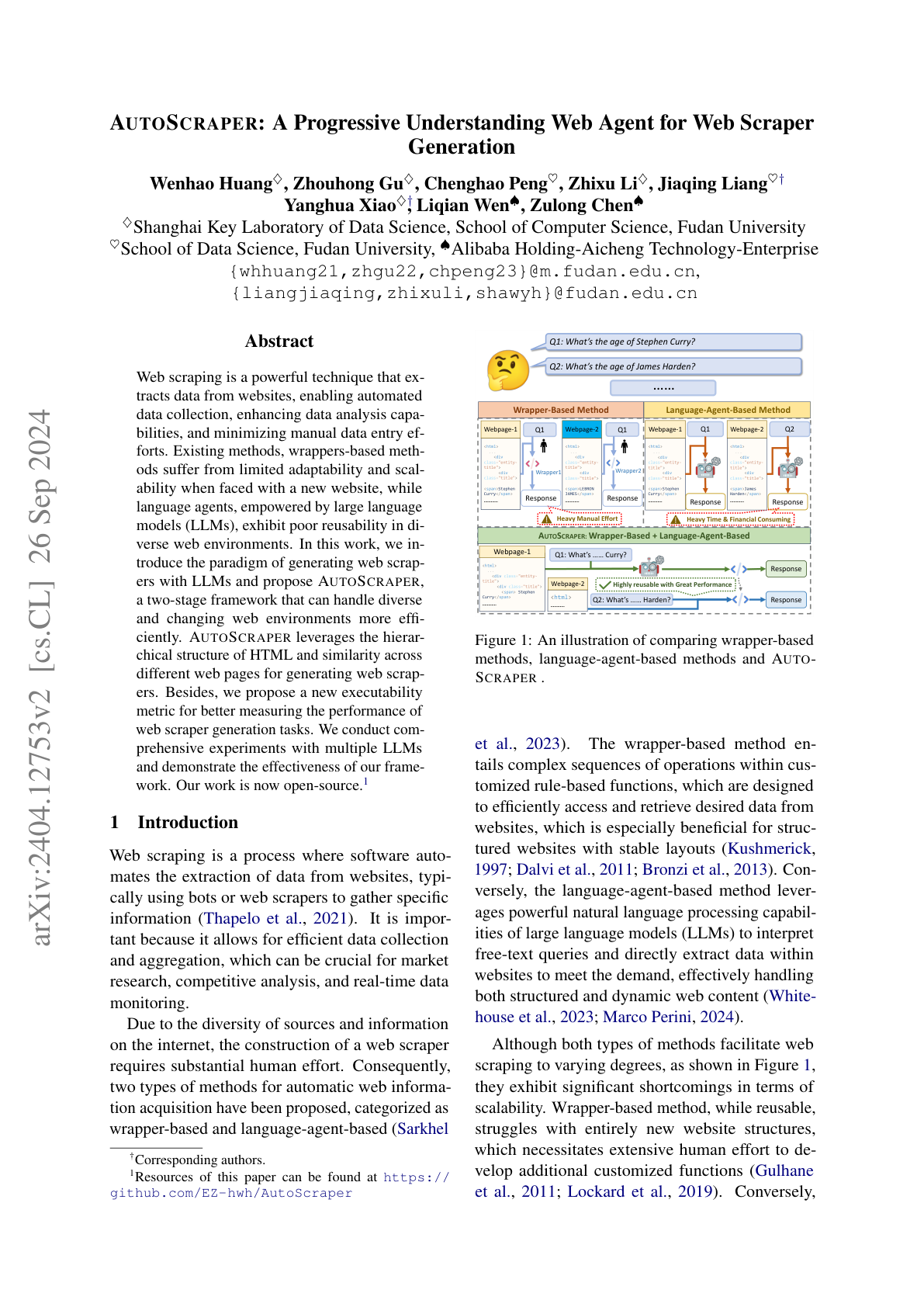
AutoCrawler
AutoCrawler is a two-stage framework that combines LLMs with the hierarchical structure of HTML to auto-generate reusable web scrapers. Wrapper-based scrapers break on new sites and pure LLM agents don't reuse well across pages; AutoCrawler addresses both limitations.
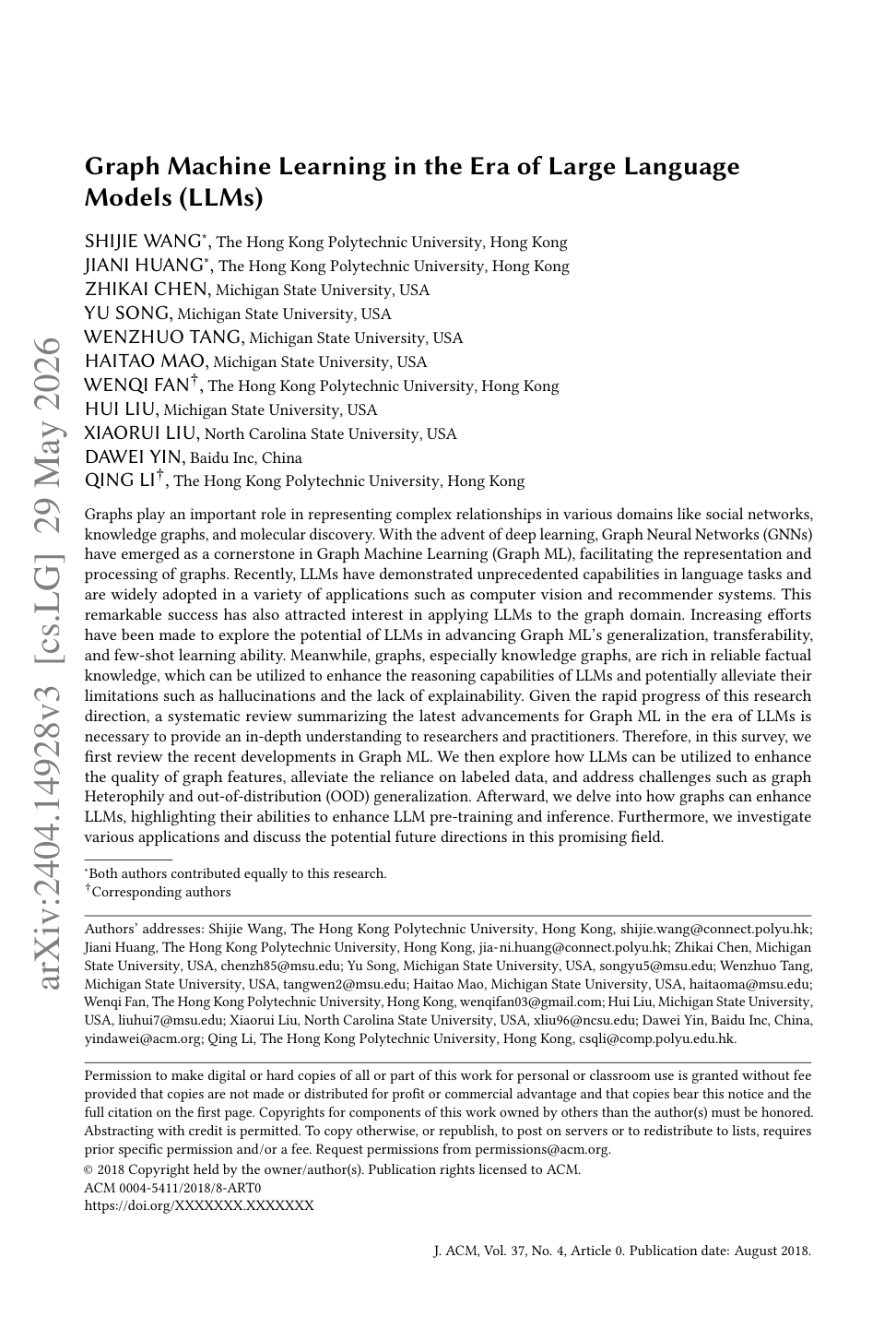
Graph Machine Learning in the Era of LLMs
This survey maps the intersection of Graph ML and LLMs, covering both how LLMs enhance graph learning and how graphs (especially knowledge graphs) strengthen LLMs. The authors organize the literature into a taxonomy and highlight where open problems remain.
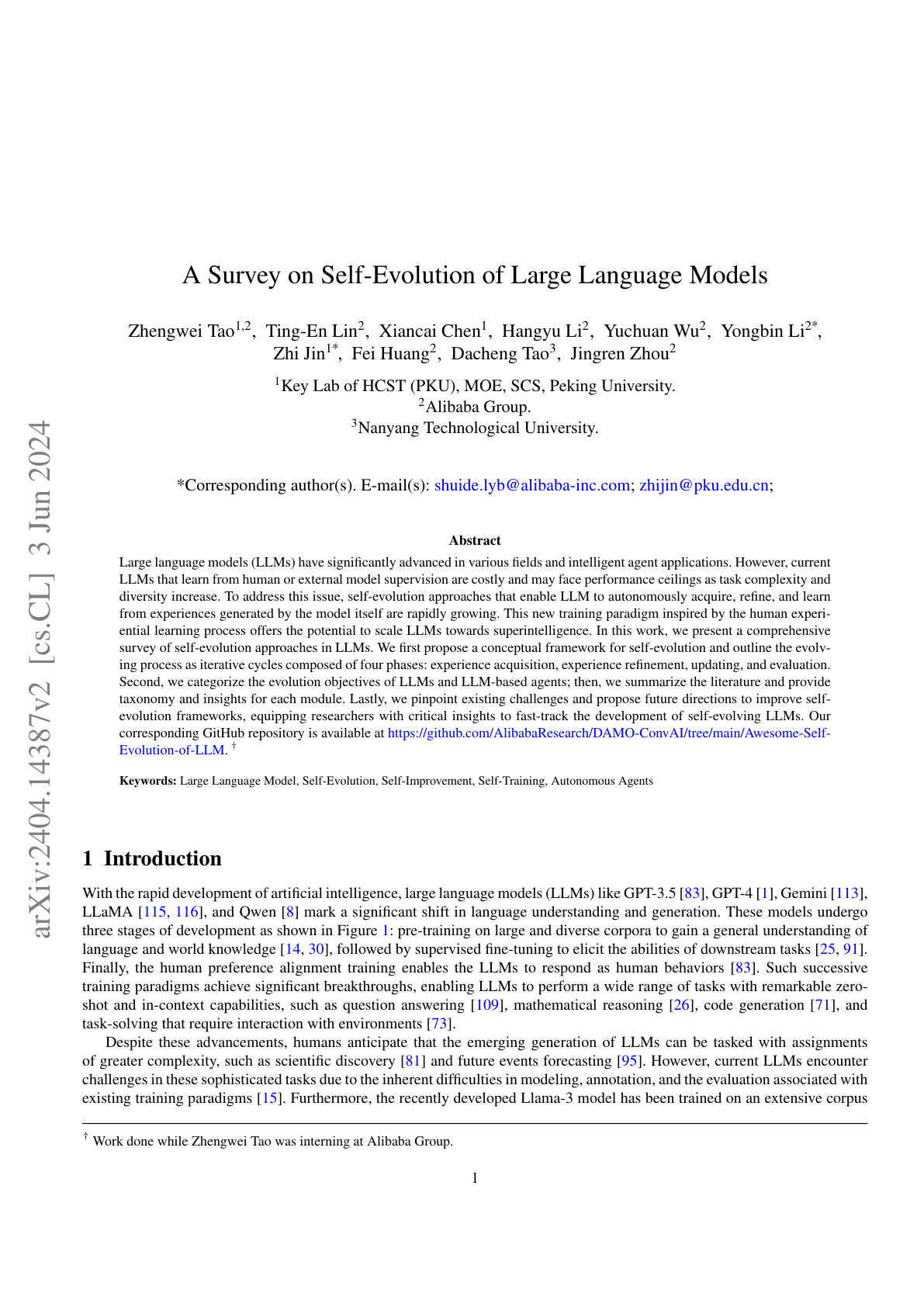
Self-Evolution of LLMs
This survey organizes the emerging literature on self-evolving LLMs - models that improve through their own generated experience rather than additional human supervision. The authors propose a unified four-phase cycle and taxonomize existing methods across both standalone models and agent systems.
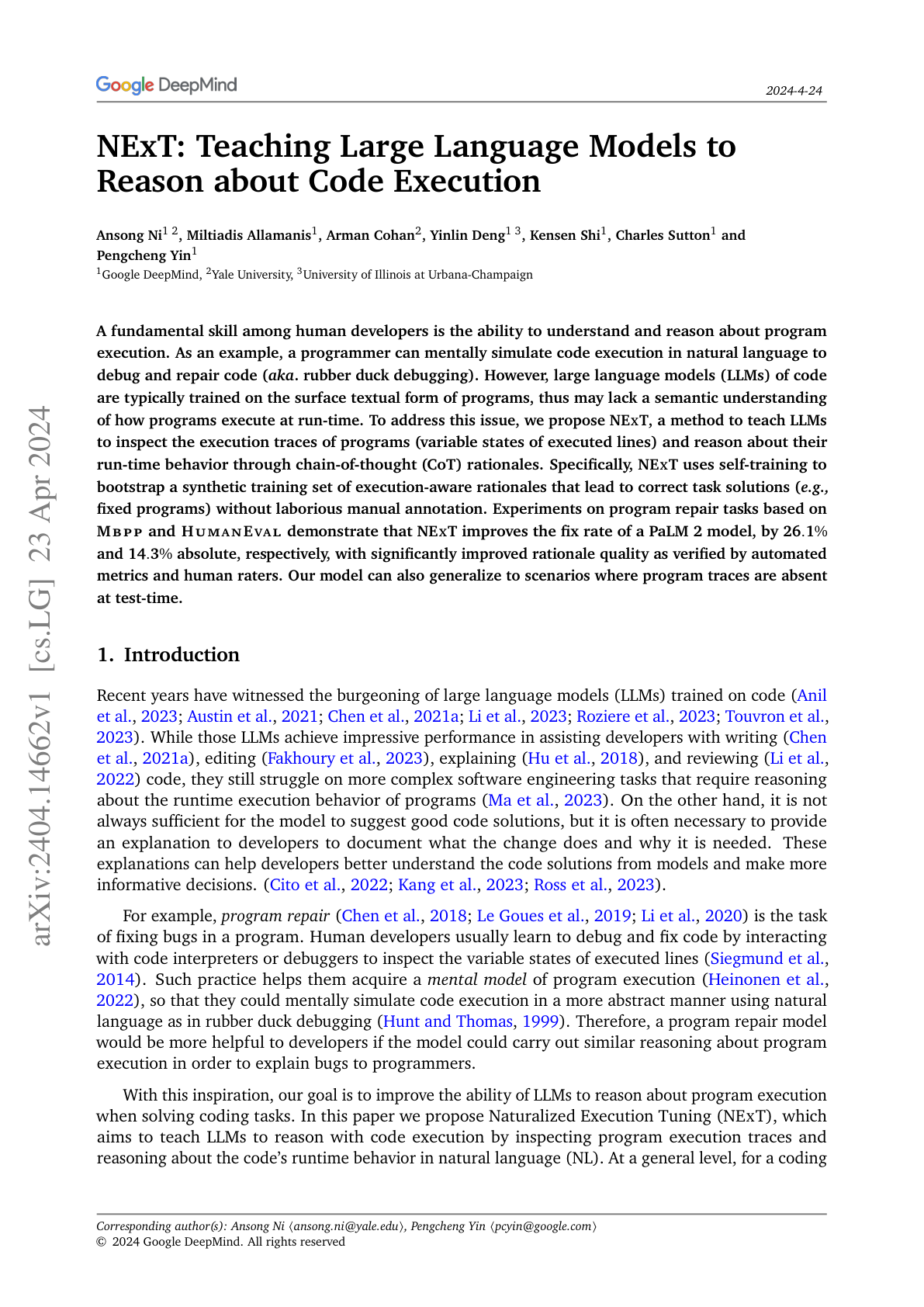
Naturalized Execution Tuning (NExT)
NExT teaches LLMs to reason about program runtime behavior by generating synthetic chain-of-thought rationales over execution traces. The approach bootstraps training data through self-training rather than manual annotation, and the learned reasoning transfers to scenarios where traces are unavailable at inference.