AI Papers of the Week
Every paper worth reading in AI, hand-picked one week at a time.

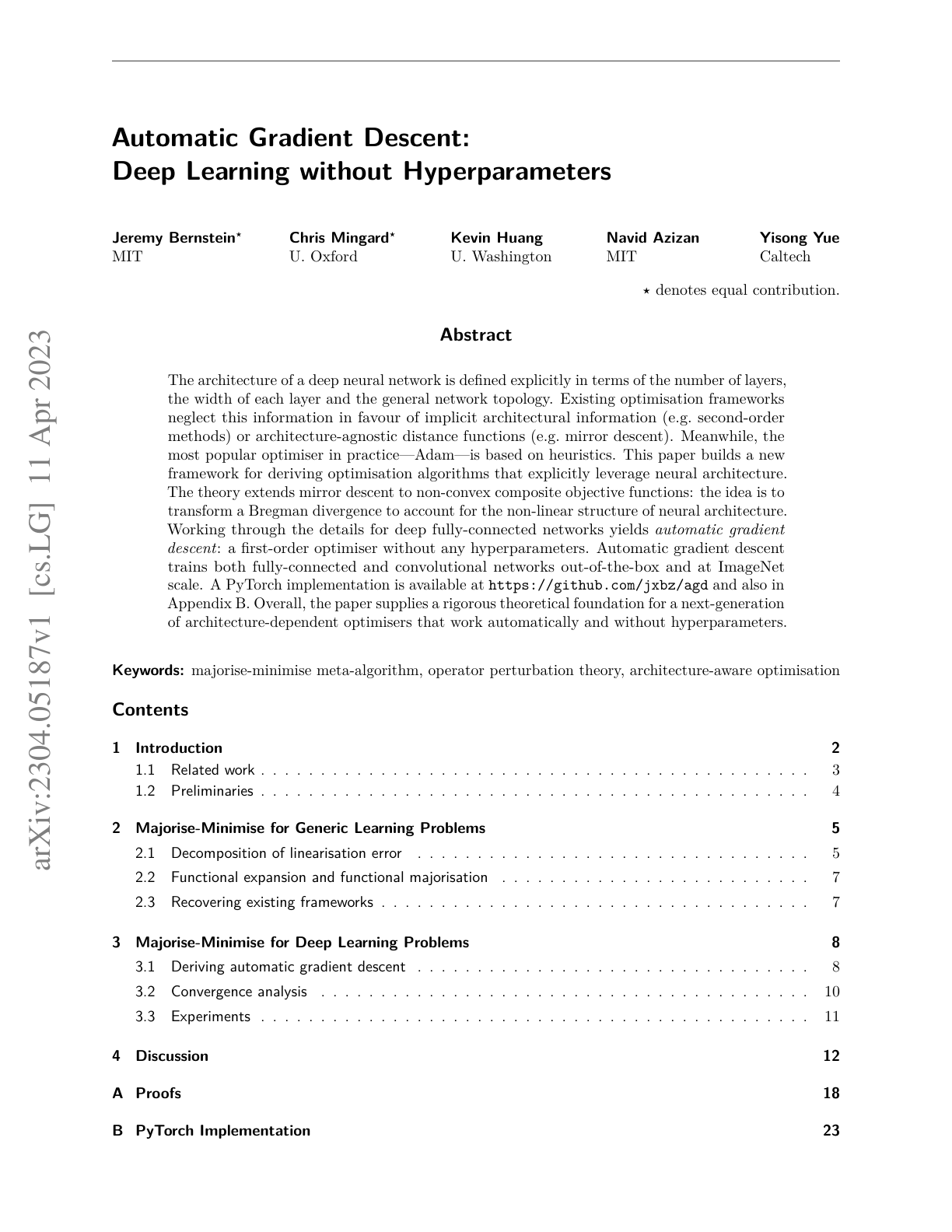
Kolmogorov-Arnold Networks
proposes Kolmogorov-Arnold Networks (KANs) as alternatives to Multi-Layer Perceptrons (MLPs); KANs apply learnable activation functions on edges that represent the weights; with no linear weights used, KANs can outperform MLPs and possess faster neural scaling laws; the authors show that KANs can be used as collaborators to help scientists discover mathematics and physical laws.

Better and Faster LLMs via Multi-token Prediction
proposes a multi-token prediction approach that performs language modeling by training the predict the following n tokens using n independent output heads; the output heads operate on top of a shared transformer trunk; multi-token prediction is shown to be useful when using larger model sizes and can speed up inference up to 3x; the proposed 13B parameter models solves 12 % more problems on HumanEval and 17 % more on MBPP than comparable next-token models.

When to Retrieve?
presents an approach to train LLMs to effectively utilize information retrieval; it first proposes a training approach to teach an LLM to generate a special token, <RET>, when it's not confident or doesn't know the answer to a question; the fine-tuned model outperforms a base LLM in two fixed alternate settings that include never retrieving and always retrieving context

Inner Workings of Transformer Language Models
presents a technical introduction to current techniques used to interpret the inner workings of Transformer-based language models; it provides a detailed overview of the internal mechanisms implemented in these models.

OpenELM
Apple's OpenELM is a fully-open small language model family (270M, 450M, 1.1B, 3B) that uses layer-wise parameter scaling instead of uniform layer widths. At ~1B parameters it improves on OLMo by 2.36% accuracy while using half the pre-training tokens.

Arctic
Snowflake's Arctic is an Apache 2.0 open LLM with a Dense-MoE Hybrid transformer (480B total / 17B active) that matches Llama 3 70B on enterprise metrics while using under 3K GPU weeks (~$2M) of training compute - roughly 17x less than Llama 3 70B.

Graph Machine Learning in the Era of LLMs
This survey maps the intersection of Graph ML and LLMs, covering both how LLMs enhance graph learning and how graphs (especially knowledge graphs) strengthen LLMs. The authors organize the literature into a taxonomy and highlight where open problems remain.

Naturalized Execution Tuning (NExT)
NExT teaches LLMs to reason about program runtime behavior by generating synthetic chain-of-thought rationales over execution traces. The approach bootstraps training data through self-training rather than manual annotation, and the learned reasoning transfers to scenarios where traces are unavailable at inference.

Llama 3
Meta's Llama 3 launches with 8B and 70B pretrained and instruction-tuned variants. Llama 3 8B beats Gemma 7B and Mistral 7B Instruct, and Llama 3 70B is competitive with Gemini Pro 1.5 and Claude 3 Sonnet on standard benchmarks.

Chinchilla Scaling: A replication attempt
This paper re-examines the third estimation procedure in Hoffmann et al. (2022) Chinchilla scaling law and finds it is inconsistent with the paper's own first two methods, fails to fit the extracted data, and reports implausibly narrow confidence intervals.

LM In-Context Recall is Prompt Dependent
Using needle-in-a-haystack tests across multiple models, this paper shows that in-context recall is highly sensitive to prompt wording and that training data biases can silently degrade a model's ability to retrieve from its own context.

CodeGemma
CodeGemma is a family of open code LLMs built on Gemma, released in 2B (pretrained), 7B (pretrained), and 7B-IT (instruction-tuned) variants. The 2B model is optimized for low-latency code completion, and the 7B-IT model leads its weight class on HumanEval.

LM-Guided Chain-of-Thought
This paper offloads rationale generation to a small, trained LM while keeping a frozen large LM as the answer predictor. The small model is optimized with knowledge distillation and reinforcement learning so it produces rationales that steer the large model more effectively.

Best Practices and Lessons on Synthetic Data
Google DeepMind's survey-style position paper on synthetic data for LLMs. It covers applications, quality-assurance principles, and the open challenges of factuality, fidelity, bias, and privacy.

Overview of Multilingual LLMs
A first-of-its-kind survey on multilingual LLMs, organized by multilingual alignment principles rather than model-family hierarchy. The authors propose a unified taxonomy and collect open resources to accelerate future research.

The Physics of Language Models
This paper measures how many bits of factual knowledge a language model can store per parameter and finds a remarkably stable 2-bits-per-parameter ceiling, even after int8 quantization. A 7B model can therefore hold ~14B bits - more than the English Wikipedia and textbooks combined.

Aligning LLMs to Quote from Pre-Training Data (Quote-Tuning)
Quote-Tuning aligns LLMs to quote verbatim from trusted pre-training sources, turning the attribution step from post-hoc fact-checking into a built-in model behavior.

Many-shot Jailbreaking
Anthropic shows that long-context windows enable a new attack where hundreds of fake user/assistant dialogues are packed into a single prompt, coaxing frontier LLMs to answer the final harmful question despite safety training.

The Unreasonable Ineffectiveness of the Deeper Layers
The paper shows that open-weight LLMs tolerate removing up to half of their transformer blocks with only minor degradation, provided a short QLoRA pass is used to heal the damage afterwards.

ReFT: Representation Finetuning for LMs
Stanford's ReFT freezes the base model and instead learns small interventions on hidden representations at selected layers, offering a more parameter-efficient alternative to LoRA-style PEFT.

Advancing LLM Reasoning (Eurus)
OpenBMB's Eurus is a suite of reasoning-specialized LLMs (7B and 70B) fine-tuned on UltraInteract, a new alignment dataset built around preference trees for complex math, code, and logical tasks.

DBRX
Databricks releases DBRX, a 132B-total / 36B-active open Mixture-of-Experts LLM that beats established open models on MMLU, HumanEval, and GSM8K while delivering 2x faster inference than LLaMA2-70B.

LLMs on University-Level Physics Coding
A controlled study pits ChatGPT variants against University of Durham physics students on Python coding assignments, finding that humans still outperform even the strongest prompt-engineered GPT-4.

FollowIR
FollowIR is both a benchmark and a training set for teaching retrieval models to follow real-world, instruction-style queries rather than just match keywords.