AI Papers of the Week
Every paper worth reading in AI, hand-picked one week at a time.
Know When to Stop, Where to Restart: Accelerating Multi-Turn Agentic On-Policy Distillation
Zhiyu Gui and colleagues speed up multi-turn agentic on-policy distillation with STRIDE, which stops student rollouts once teacher support collapses and restarts generation from cached good prefixes.
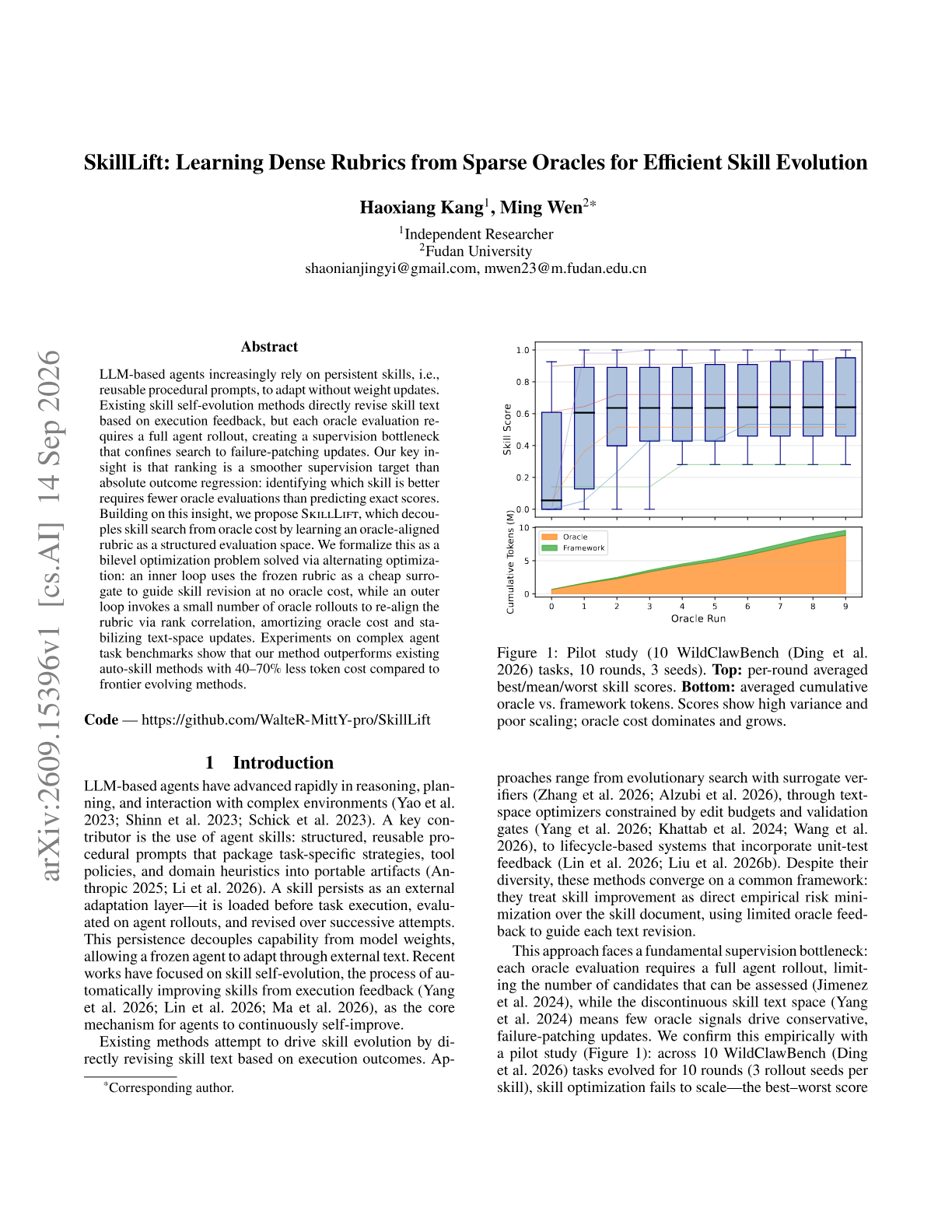
SkillLift: Learning Dense Rubrics from Sparse Oracles for Efficient Skill Evolution
Kang (independent) and Wen (Fudan University) propose SkillLift, which reduces the number of expensive agent rollouts needed to evolve reusable skill prompts by learning a rubric that ranks candidate skills in place of the rollout oracle.
AGENTQ: Quantization-Conditioned Backdoor Attacks on LLM Agents
Xiaoqun Liu and Qiben Yan (Michigan State University) present AGENTQ, the first study of quantization-conditioned backdoors against LLM agents, where a full-precision checkpoint passes audits but executes malicious function calls once quantized.
MemRiskBench: Trace-Aware Risk-Preserving Evaluation for Long-Horizon LLM Agents
Jiang, Yuan and Li build a benchmark that measures rare high-severity memory failures in long-horizon agents per risk category, on the argument that an aggregate accuracy score hides exactly the events that matter.
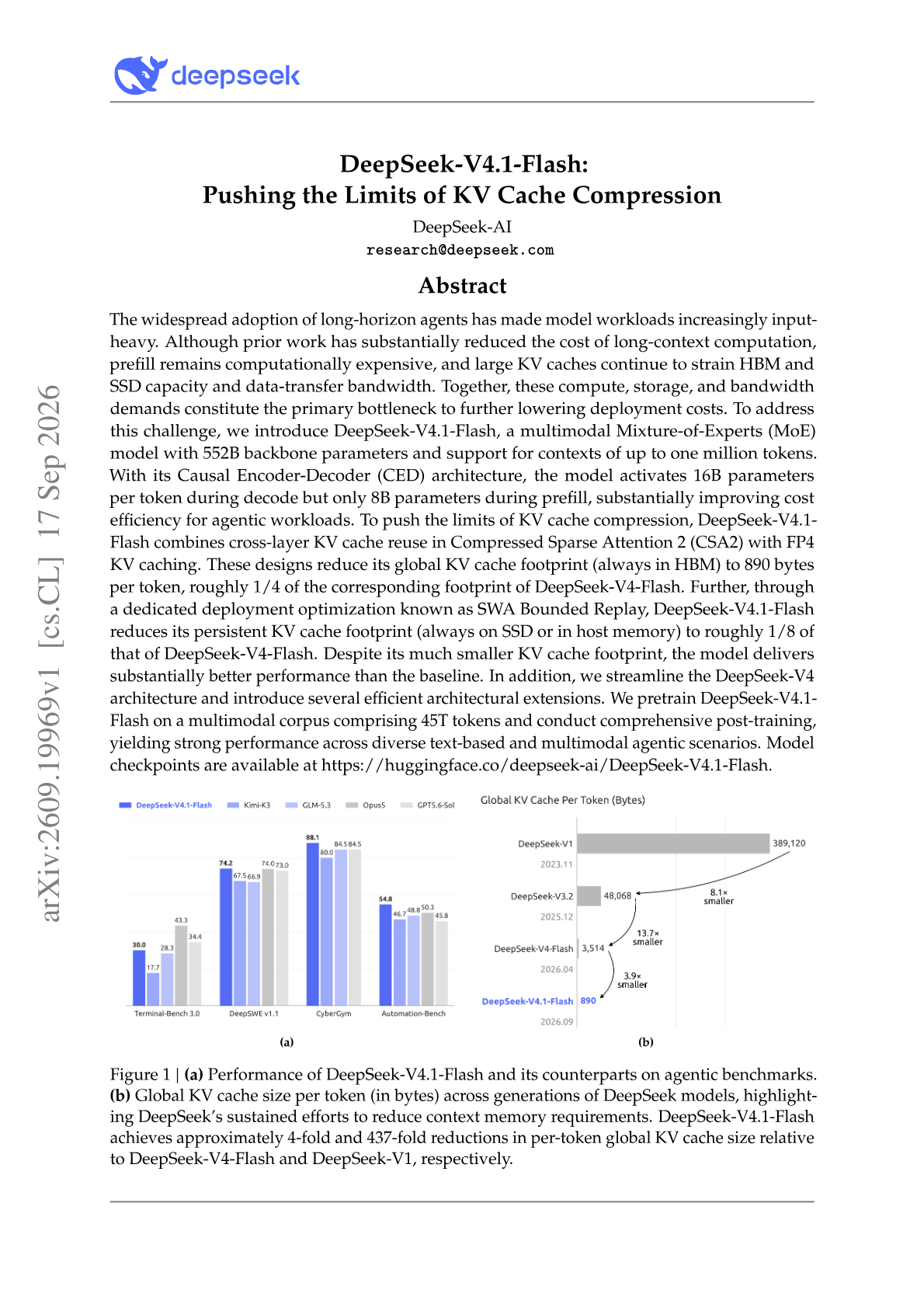
DeepSeek-V4.1-Flash: Pushing the Limits of KV Cache Compression
DeepSeek-AI releases DeepSeek-V4.1-Flash, a 552B-parameter multimodal MoE built around a Causal Encoder-Decoder architecture that activates 16B parameters per decode token and 8B per prefill token, and cuts the resident KV cache to 890 bytes per token.
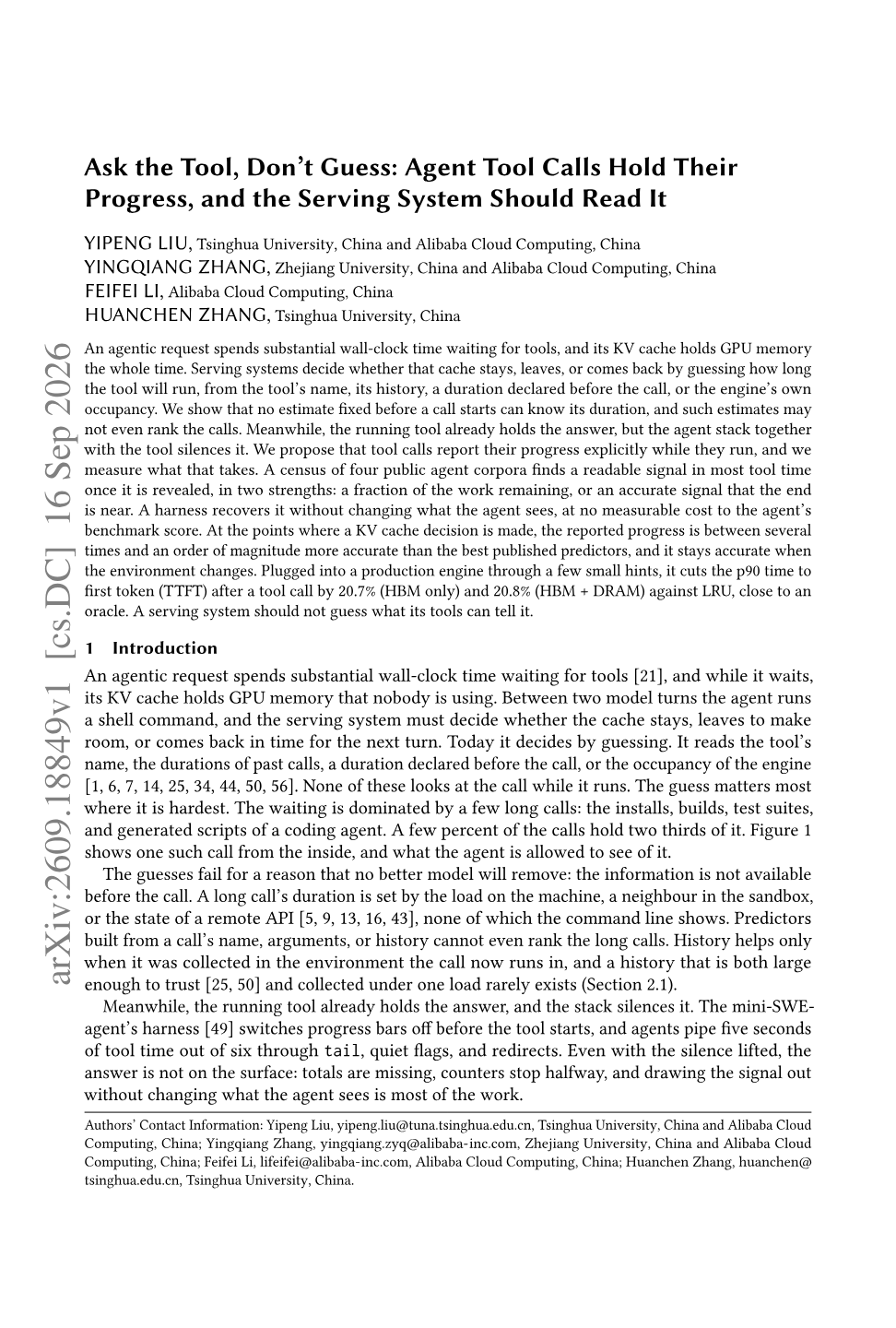
Ask the Tool, Don't Guess: Agent Tool Calls Hold Their Progress, and the Serving System Should Read It
Yipeng Liu and colleagues at Tsinghua University, Zhejiang University and Alibaba Cloud argue that serving systems should read progress reports from running tool calls, instead of predicting tool duration, when deciding whether an agent's KV cache stays on the GPU during a tool wait.
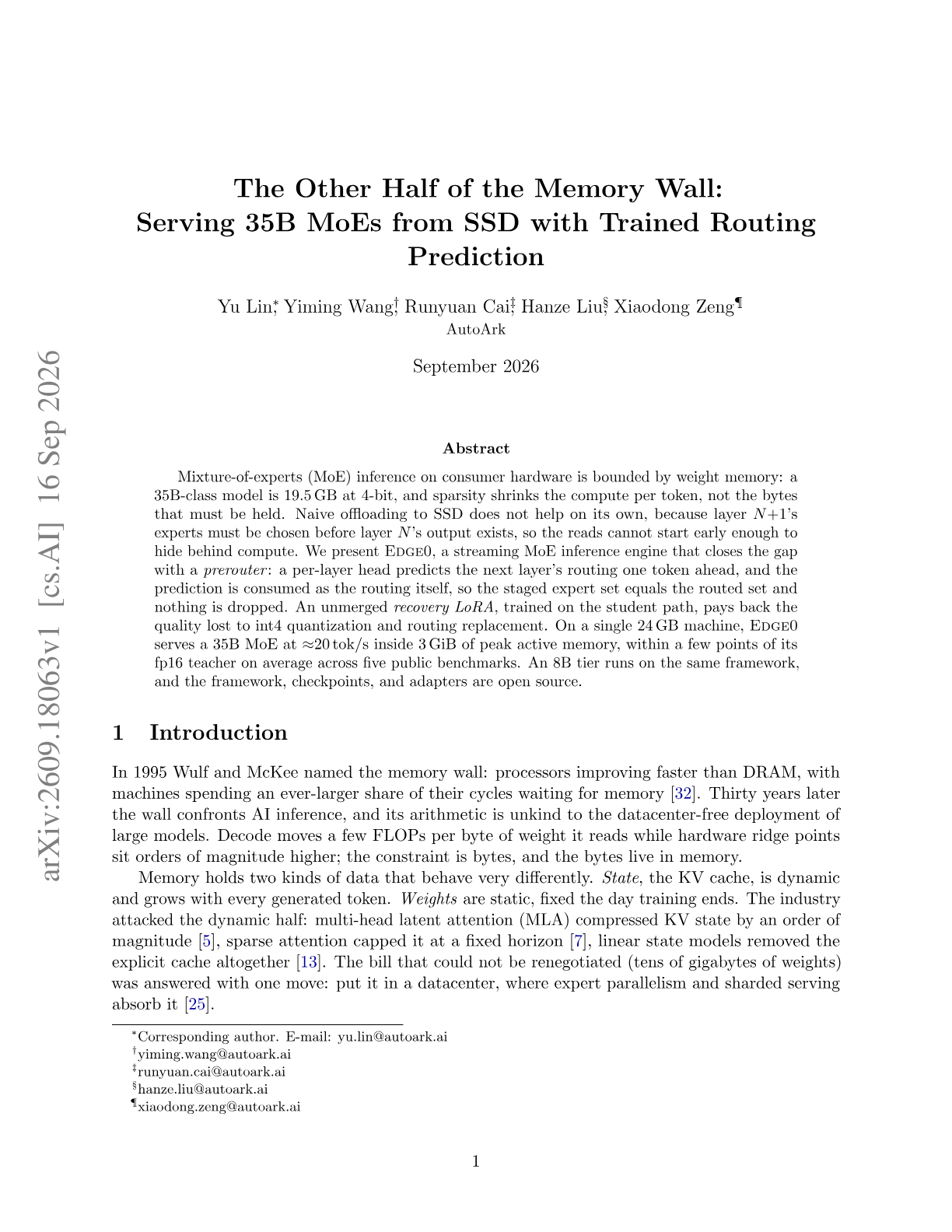
The Other Half of the Memory Wall: Serving 35B MoEs from SSD with Trained Routing Prediction
Yu Lin and colleagues at AutoArk present Edge0, a streaming MoE inference engine that serves a 35B-class MoE from SSD on a single 24GB machine by predicting the next layer's expert routing one token ahead and using that prediction as the routing.
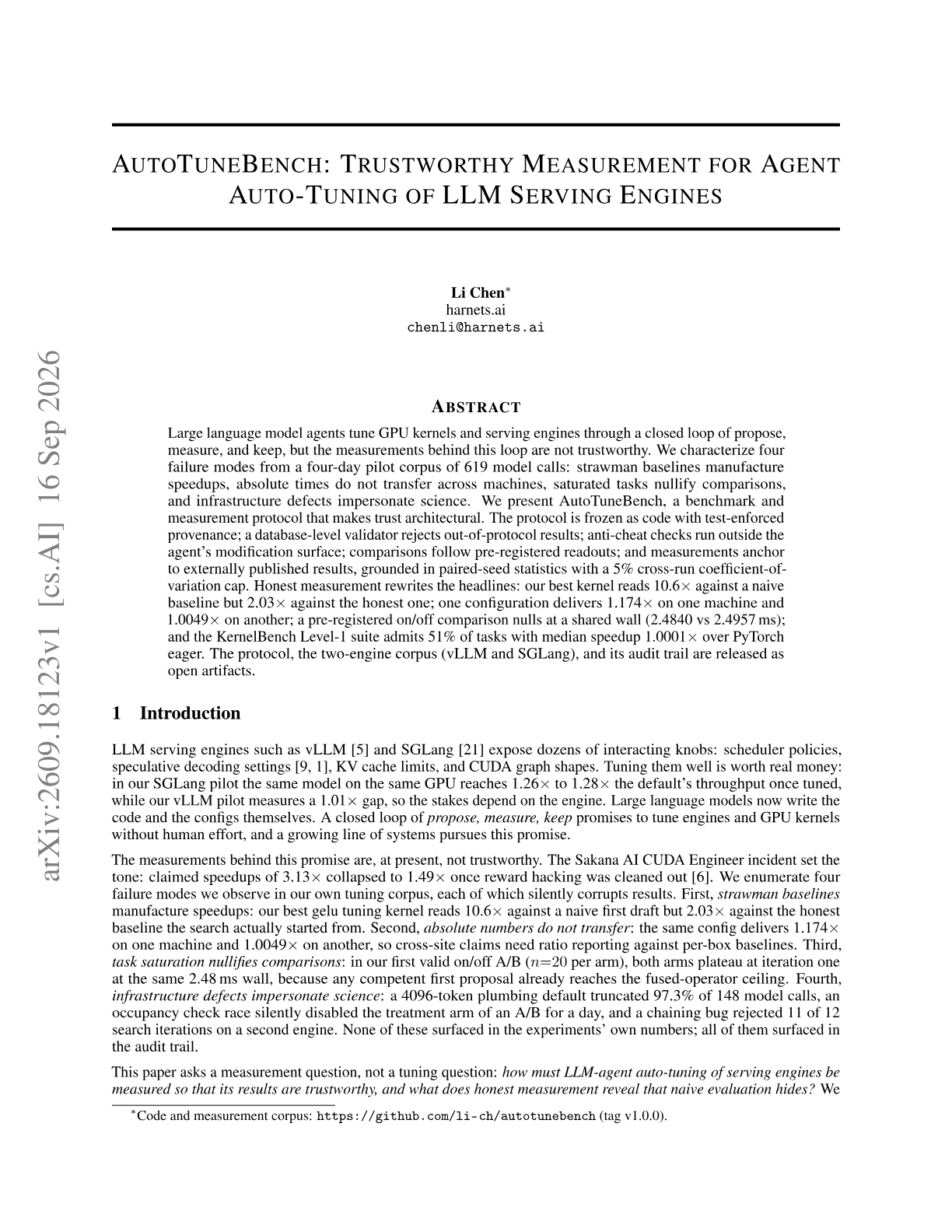
AutoTuneBench: Trustworthy Measurement for Agent Auto-Tuning of LLM Serving Engines
Li Chen (harnets.ai) presents AutoTuneBench, a benchmark and measurement protocol for LLM agents that tune GPU kernels and serving engines, built after a four-day pilot of 619 model calls showed that the propose-measure-keep loop produces untrustworthy speedups.
Protocol-Preserving Context Trimming for Agentic Workflows: Benefits, Failure Regimes, and Budget Guardrails
Harish Gaggar (Intuit Credit Karma) compares five context-trimming strategies for multi-step agent workflows and finds that preserving protocol-critical state matters more than the amount of text removed.
REVA: Reusable Evidence View Aggregation for Context-Efficient RAG Serving
Tuan Nguyen, Fan Lai and colleagues (VinUniversity and UIUC) compress RAG context by mining the generator's past attention over each document into a reusable importance store, instead of running a compressor per query.
Calibration-Aware Uncertainty Cascades for Efficient Heterogeneous Model Collaboration
Yilin Zhang, Han Jiang, Cai Xu, Ying Liu and Wei Zhao propose Calibration-Aware Uncertainty Cascades, which calibrate each model's confidence separately so that one threshold rule can decide, across any pool of models, when to accept a cheap model's answer and when to call a stronger one.
Why Does Post-Training Quantization Work?
Yuxiang Chen, Michael Beyer, Jun Zhu and Jianfei Chen (Tsinghua University and Bosch AI Research) explain why post-training quantization of pretrained LLMs keeps accuracy even though the error from each quantized weight should compound across layers.
Phase-Decoupled, Model-Calibrated Power Control for Disaggregated LLM Serving
Jae Gon Kim, Donghoon Yoo and colleagues (Xenoscube) measure NVIDIA's Max-Q inference power profile on a disaggregated B200 serving system and replace it with separate, calibrated power settings for the prefill GPUs and the decode GPUs.
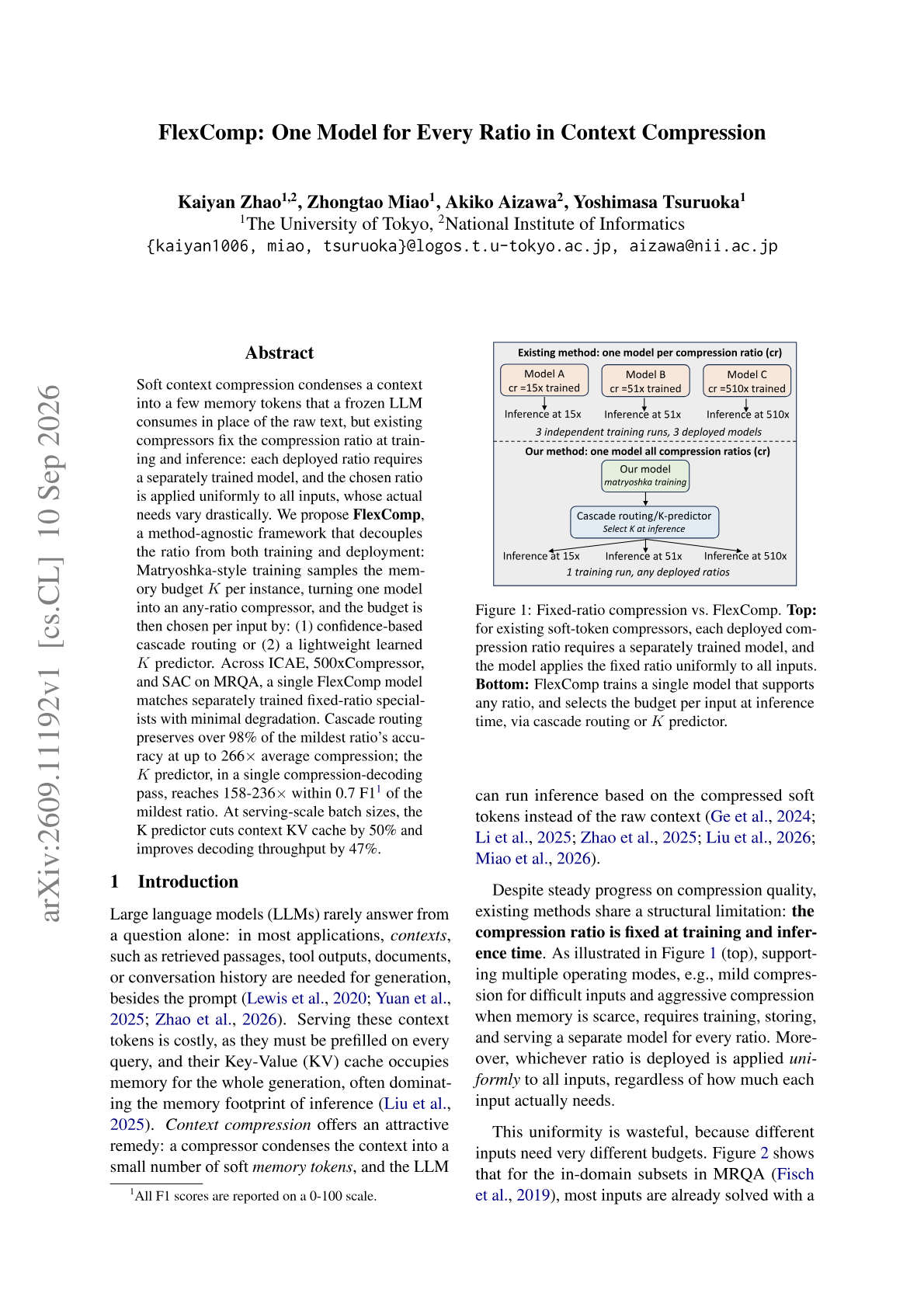
FlexComp: One Model for Every Ratio in Context Compression
Kaiyan Zhao, Zhongtao Miao, Akiko Aizawa and Yoshimasa Tsuruoka (The University of Tokyo and National Institute of Informatics) train one soft context compressor that works at any compression ratio and choose the ratio for each input, instead of training a separate model for every fixed ratio.

Memory Compression for High-Fanout Agent Sandboxes
Mengming Li, Ceyu Xu and colleagues (HKUST) build AgentZip, a memory compression system for agent workloads that spawn many concurrent sandboxes from a shared template, and cut sandbox memory by up to 8.7x.
Decoupling Readiness from Release for Tail-Aware Scheduling of Agentic LLM Workflows
Bochao Feng, Jidong Zhai and colleagues (USTB, Qiyuan Laboratory and Tsinghua) schedule agentic LLM workflows by deciding when ready turns are released to the inference engine, instead of releasing them as soon as they are ready, and cut P95 workflow time by up to 3.50x.
Data Scarcity and Model Sparsity: Mixtures-of-Experts Overfit More to Repeated Data
Atindra Jha, Margaret Li, Jure Leskovec, Percy Liang and Luke Zettlemoyer (Stanford University and University of Washington) run the first controlled study of data repetition for Mixture-of-Experts language models and find that sparse models overfit to repeated data faster than dense models of matched active size.
MemForest: Efficient Agent Memory Management via EventTree Partitioning and Progressive Merging
Junxi Wang and collaborators across Shanghai Jiao Tong University, Fudan, Nanjing University, HIT and Sichuan University present MemForest, a memory compression layer that partitions history into event units, merges redundant nodes along a maximum spanning tree, and retrieves by propagating from anchor nodes.
AttnCompress: Dynamic Attention-Guided Trajectory Compression for Software Engineering Agents
Zhengran Zeng and Yixin Li at Peking University present AttnCompress, which segments an agent trajectory at perplexity spikes, scores each historical block by proxy attention weight against the agent's current reasoning, and recalls blocks back into context as the task changes.
Long-Horizon Language Model Reinforcement Learning via Progressive Point Matching
Preston Fu, Kevin Frans, Oleh Rybkin and Sergey Levine at UC Berkeley with Aviral Kumar at CMU give an unbiased dense-reward formulation, progressive point matching, that rewards partial progress at the segment level and scales exponentially better than sparse outcome rewards on long trajectories.
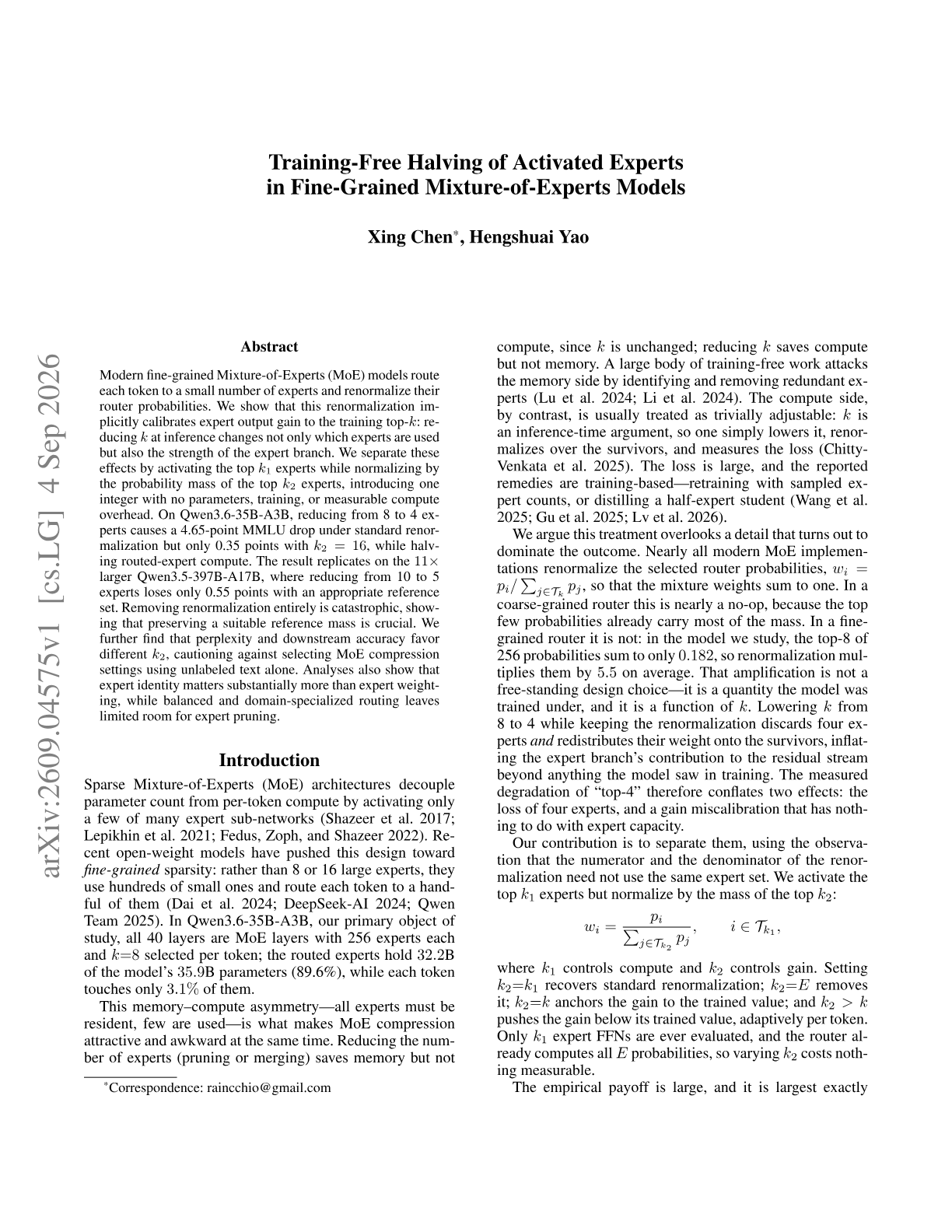
Training-Free Halving of Activated Experts in Fine-Grained Mixture-of-Experts Models
Xing Chen and Hengshuai Yao separate two effects that are conflated when you reduce top-k at MoE inference time, and recover most of the lost accuracy with a single integer and no training.
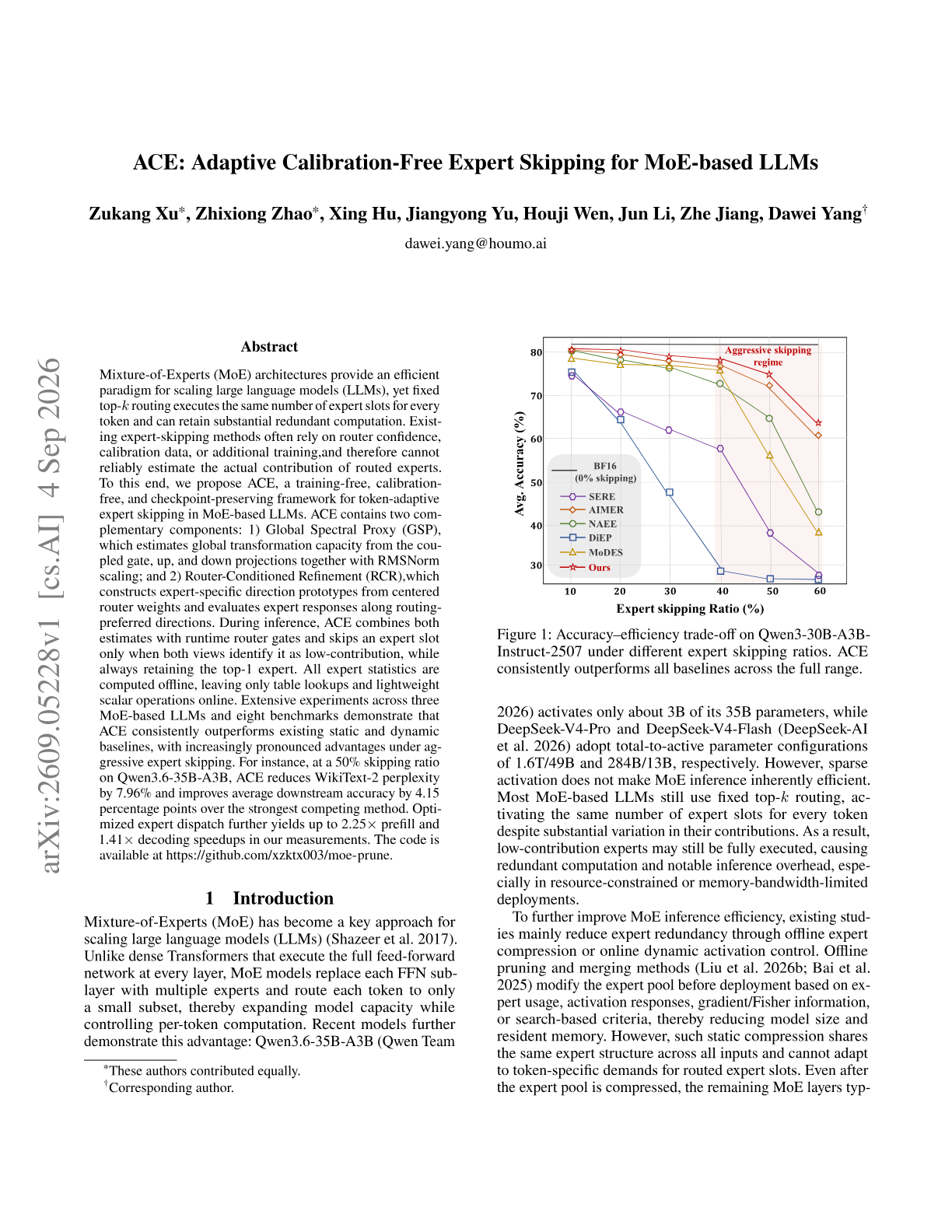
ACE: Adaptive Calibration-Free Expert Skipping for MoE-based LLMs
Zukang Xu and colleagues skip Mixture-of-Experts expert slots per token at inference without calibration data, training, or a modified checkpoint, by estimating each expert's actual contribution rather than trusting the router's confidence.
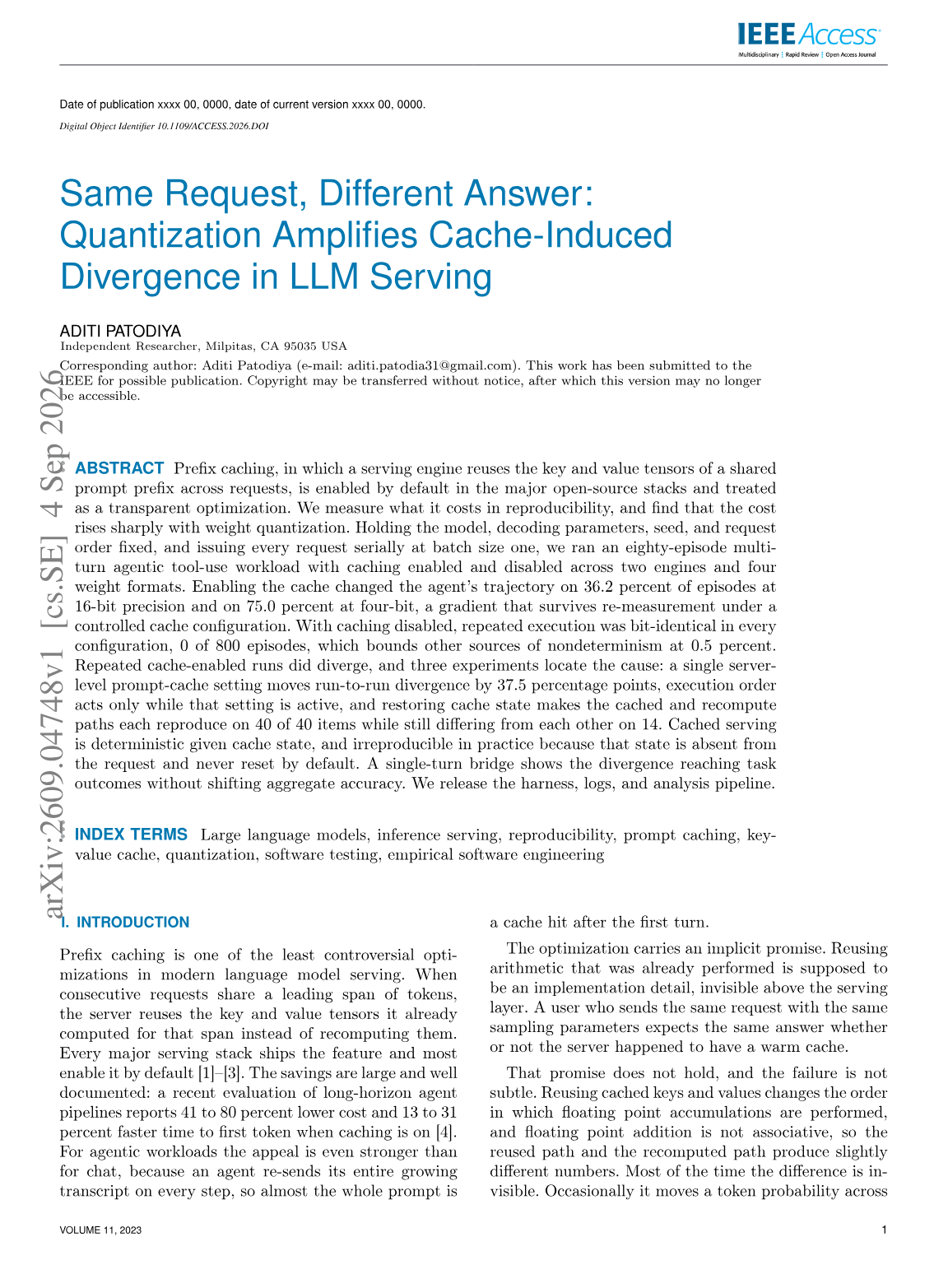
Same Request, Different Answer: Quantization Amplifies Cache-Induced Divergence in LLM Serving
Aditi Patodiya measures what prefix caching costs in reproducibility for agentic tool-use workloads, and finds the cost grows sharply once weights are quantized.
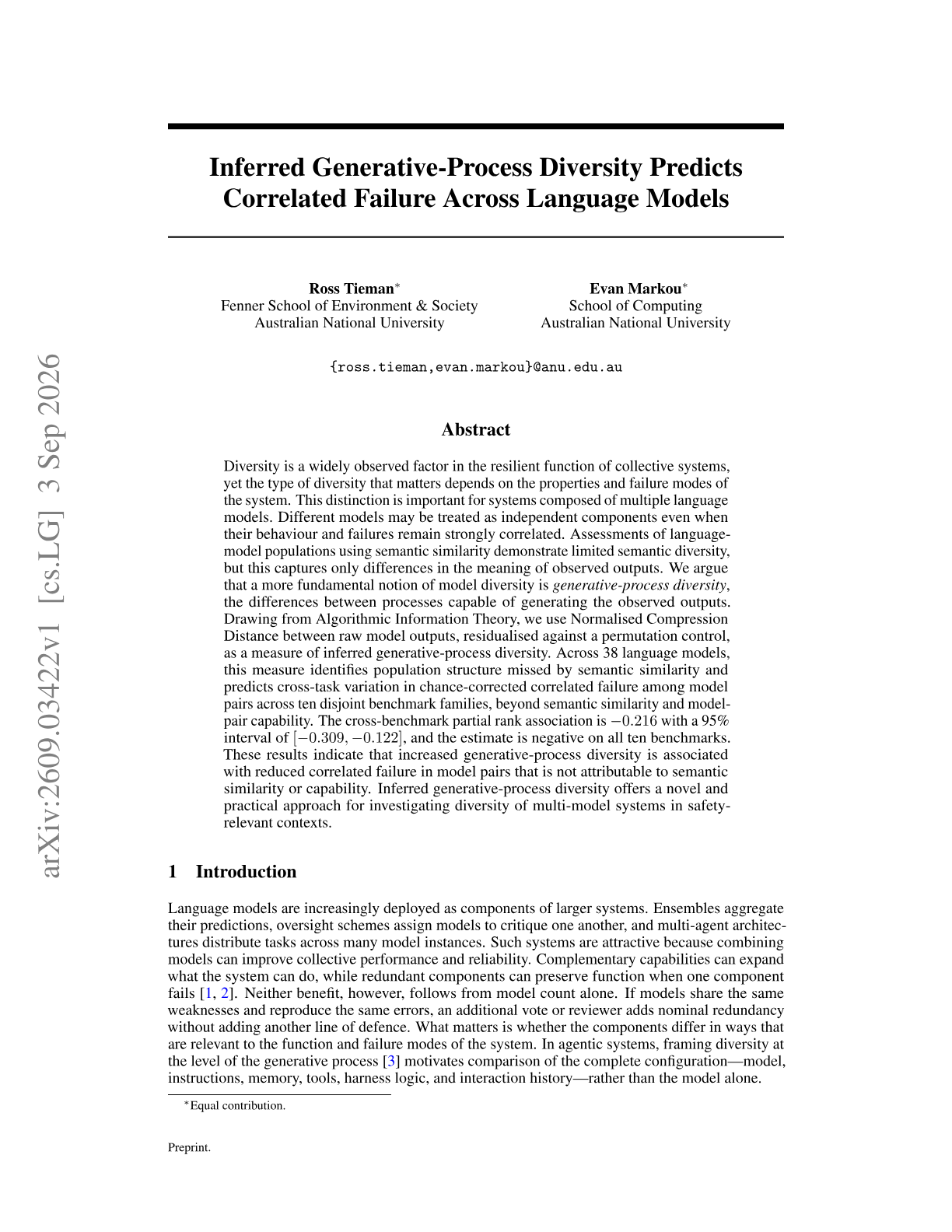
Inferred Generative-Process Diversity Predicts Correlated Failure Across Language Models
Ross Tieman and Evan Markou argue that semantic similarity is the wrong diversity measure for populations of language models, and use compression distance between raw outputs to recover the structure that predicts correlated failure.