AI Papers of the Week
Every paper worth reading in AI, hand-picked one week at a time.

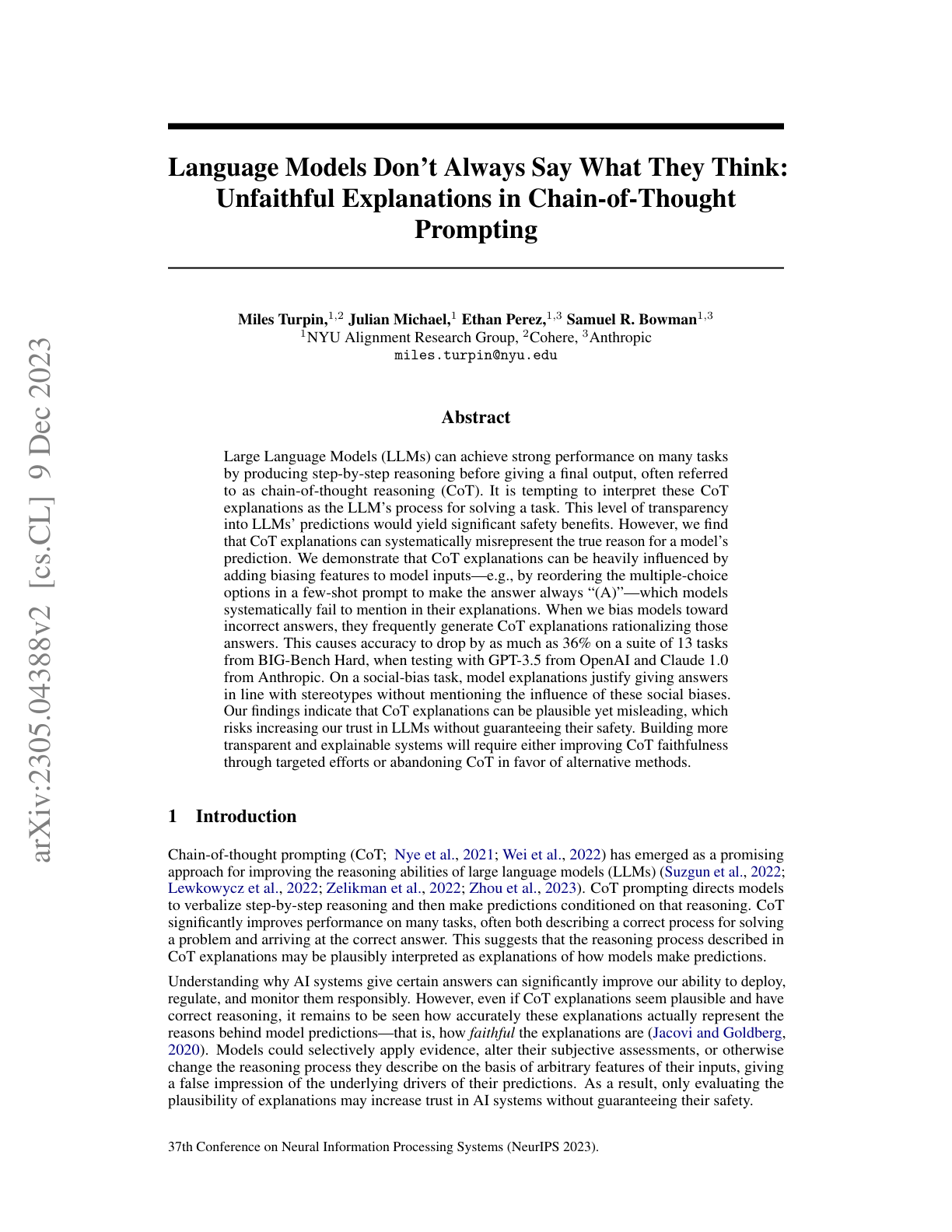
A Theoretical Understanding of CoT
finds that adding correct and incorrect reasoning paths in demonstrations improves the accuracy of intermediate steps and CoT; the proposed method, Coherent CoT, significantly improves performance on several benchmarks; in the Tracking Shuffled Objects dataset, Gemini Pro shows a 6.60% improvement (from 58.20% to 64.80%), and in Penguins in a Table, DeepSeek 67B demonstrates an increase of 6.17% (from 73.97% to 80.14%).

LongRAG
enhances RAG's understanding of long-context knowledge which includes global information and factual details; consists of a hybrid retriever, an LLM-augmented information extractor, a CoT-guided filter, and an LLM-augmented generator; these are key components that enable the RAG system to mine global long-context information and effectively identify factual details; LongRAG outperforms long-context LLMs (up by 6.94%), advanced RAG (up by 6.16%), and Vanilla RAG (up by 17.25%).

Granite 3.0
presents lightweight foundation models ranging from 400 million to 8B parameters; supports coding, RAG, reasoning, and function calling, focusing on enterprise use cases, including on-premise and on-device settings; demonstrates strong performance across academic benchmarks for language understanding, reasoning, coding, function calling, and safety.

LLMs Reflect the Ideology of their Creators
finds that LLMs exhibit a diverse ideological stance which reflects the worldview of its creators; finds consistent normative differences between how the same LLM responds in Chinese compared to English; identifies normative disagreements between Western and non-Western LLMs about prominent actors in geopolitical conflicts.

Reasoning Patterns of OpenAI’s o1 Model
when compared with other test-time compute methods, o1 achieved the best performance across most datasets; the authors observe that the most commonly used reasoning patterns in o1 are divide and conquer and self-refinement; o1 uses different reasoning patterns for different tasks; for commonsense reasoning tasks, o1 tends to use context identification and emphasize constraints; for math and coding tasks, o1 mainly relies on method reuse and divide and conquer.

Introspection in LLMs
reports that LLMs can acquire knowledge through introspection that cannot be inferred from their training data; suggests that LLMs contain privileged information about themselves that can potentially lead to more interpretable and controllable systems; they report that this introspection ability is limited and models struggle to predict their behavior on tasks requiring reasoning over long outputs.

Agent S
a new open agentic framework that enables autonomous interaction with computers through a GUI; Agent S tackles challenges such as acquiring knowledge, planning over long-task horizons, and handling dynamic interfaces; it introduces experience-augmented hierarchical planning which leverages both search and retrieval; leverages an agent-computer interface to perform reasoning and control GUI agents; evaluation on the OSWorld benchmark shows that Agent S outperforms the baseline by 9.37% in success rate (an 83.6% relative improvement) and achieves a new state-of-the-art.

On the Planning Abilities of OpenAI’s o1 Models
reports that o1-preview is particularly strong in self-evaluation and constraint-following; also mentions that these o1 models demonstrate bottlenecks in decision-making and memory management, which are more pronounced in spatial reasoning; in particular, the models produce redundant action and struggle to generalize in spatially complex tasks.

CoTracker3
proposes a new point tracking model and a new semi-supervised training recipe; enables usage of real videos without annotations during training by generating pseudo-labels using off-the-shelf teachers; the approach is simpler in architecture and training scheme leading to better results while using 1000x less data.

Long-Context LLMs Meet RAG
finds that for many long-context LLMs, the quality of outputs declines as the number of passages increases; reports that the performance loss is due to retrieved hard negatives; they propose two ways to improve long-context LLM-based RAG: retrieval reordering and RAG-specific tuning with intermediate reasoning to help with relevance identification; that approaches demonstrate significant accuracy and robustness improvements on long-context RAG performance.

GSM-Symbolic
tests several SoTA models on a benchmark created with symbolic templates that enable diverse mathematical problems; they find that LLMs exhibit variance when responding to variations of the same questions; the performance of all the models declines by adjusting the numerical values in the question; as questions are made more challenging (e.g., increasing the number of clauses) the performance significantly deteriorates; the authors hypothesize that the observed decline in performance is due to a lack of logical reasoning in current LLMs.

RATIONALYST
a model for process-supervision of reasoning that enables generalization across diverse reasoning tasks; this process is achieved with pre-training on a collection of 79k rationales from the Pile and a combination of reasoning datasets with minimal human intervention; fine-tuned from LLaMa-3-8B, the proposed model improves the accuracy of reasoning by an average of 3.9% on 7 reasoning benchmarks.

An Analysis of o1-preview
reports that large reasoning models like o1-preview, while improving on more difficult tasks, display similar qualitative trends as previous LLMs; o1 is sensitive to the probability of examples and tasks, performing better and requiring fewer “thinking tokens” in high-probability settings than in low-probability ones.

FRAMES
a unified framework to evaluate an LLM’s ability to provide factual responses, assess retrieval capabilities, and the reasoning required to generate final responses; includes multi-hop questions that require the integration of information from multiple sources; reports that state-of-the-art LLMs struggle on the task and only achieve 40% accuracy with no retrieval; the proposed multi-step retrieval approach improves performance to 66% accuracy.

Not All LLM Reasoners Are Created Equal
investigates in depth the grade-school math problem-solving capabilities of LLMs; reports that LLMs show a significant gap in reasoning; finds that LLMs display a huge performance difference when solving compositional pairs and solving questions independently.

Evaluation of o1
provides a comprehensive evaluation of OpenAI's o1-preview LLM; shows strong performance across many tasks such as competitive programming, generating coherent and accurate radiology reports, high school-level mathematical reasoning tasks, chip design tasks, anthropology and geology, quantitative investing, social media analysis, and many other domains and problems.

LLMs Still Can’t Plan
evaluates whether large reasoning models such as o1 can plan; finds that a domain-independent planner can solve all instances of Mystery Blocksworld but LLMs struggle, even on small instances; o1-preview is effective on the task but tend to degrade in performance as plan length increases, concludes that while o1 shows progress on more challenging planning problems, the accuracy gains cannot be considered general or robust.

Logic-of-Thought
proposes a new prompting technique called Logic-of-Thought (LoT) which employs propositional logic to generate and inject expanded logical information from the input context; it enhances CoT performance on the ReClor dataset by +4.35%; it improves CoT+SelfConsistency’s performance on LogiQA by +5%; it also boosts the performance of ToT on the ProofWriter dataset by +8%.

Small Language Models Survey
a comprehensive survey on small language models (SLMs) across architectures, training datasets, and training algorithms; analyzes 59 state-of-the-art open-source SLMs and capabilities such as reasoning, in-context learning, maths, and coding; other discussions include on-device runtime costs, latency, memory footprint, and valuable insights.

Qwen2.5 Coder
a series of models including 1.5B and 7B parameters; it’s built upon the Qwen2.5 architecture which is continuously pretrained on 5.5 trillion tokens; achieves state-of-the-art performance across more than 10 benchmarks; includes strong capabilities in code generation, completion, reasoning, and repairing.

Diagram of Thought (DoT)
enhances the reasoning capabilities of LLMs through mathematical rigor; DAT models iterative reasoning in LLM as the construction of a directed acyclic graph; it integrates propositions, critiques, refinement, and verification into a unified DAG structure; this allows DoT to capture complex logical deduction beyond linear or tree-based approaches.

To CoT or not to CoT?
investigates what kinds of tasks benefit the most from chain-of-thought (CoT) prompting; after a meta-analysis on 100+ papers and several evaluations, it finds that CoT produces strong performance benefits primarily on tasks involving math and logic; they find that most of the CoT gain comes from improving symbolic execution, but a symbolic solver outperforms it.

Iteration of Thought
proposes the Iteration of Thought (IoT) framework to enhance the LLM responses and reasoning capabilities with adaptive reasoning paths; it leverages an inner dialogue agent, acting as a guide, to dynamically adjust reasoning paths which allows adaptive cross-path exploration and enhance response accuracy; it's different from CoT and ToT (both rigid processes) in that its prompt generation is a dynamic process that allows it to adapt.

Learning to Reason with LLMs
a new family of LLMs trained with reinforcement learning to reason before it responds to complex tasks; it produces a long internal chain of thought and exceeds in science, code, and math-related tasks; ranked in the 49th percentile in the 2024 International Olympiad in Informatics and exceeds human PhD-level accuracy on science-related benchmarks. -