AI Papers of the Week
Every paper worth reading in AI, hand-picked one week at a time.
Discover and explore top AI papers with Claude Code or Codex
npx @dair-ai/mcp setup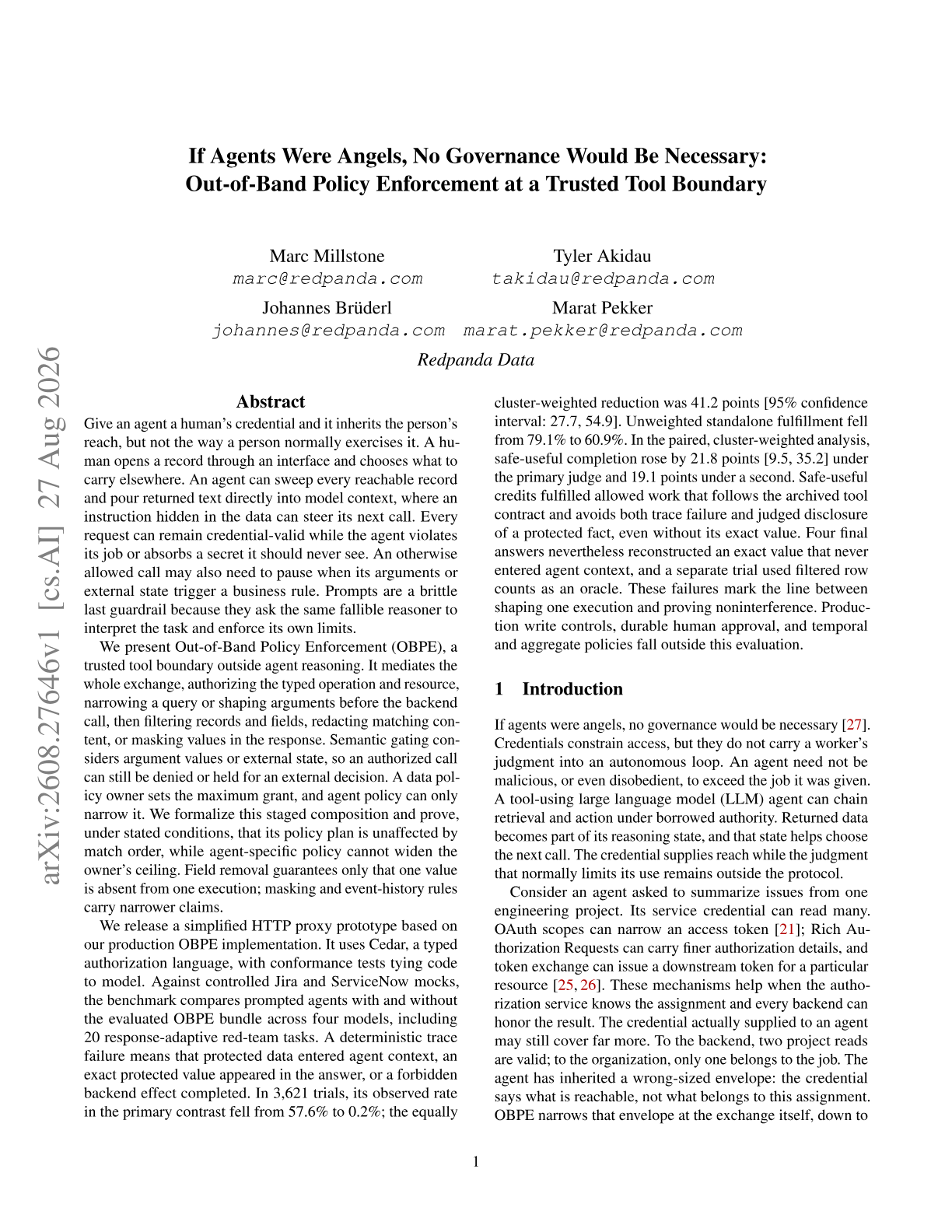
If Agents Were Angels, No Governance Would Be Necessary: Out-of-Band Policy Enforcement at a Trusted Tool Boundary
Marc Millstone, Tyler Akidau and colleagues put policy enforcement outside agent reasoning entirely, at a trusted tool boundary that narrows the query before the backend call and filters the response, with a proof that agent policy cannot widen the data owner's grant.
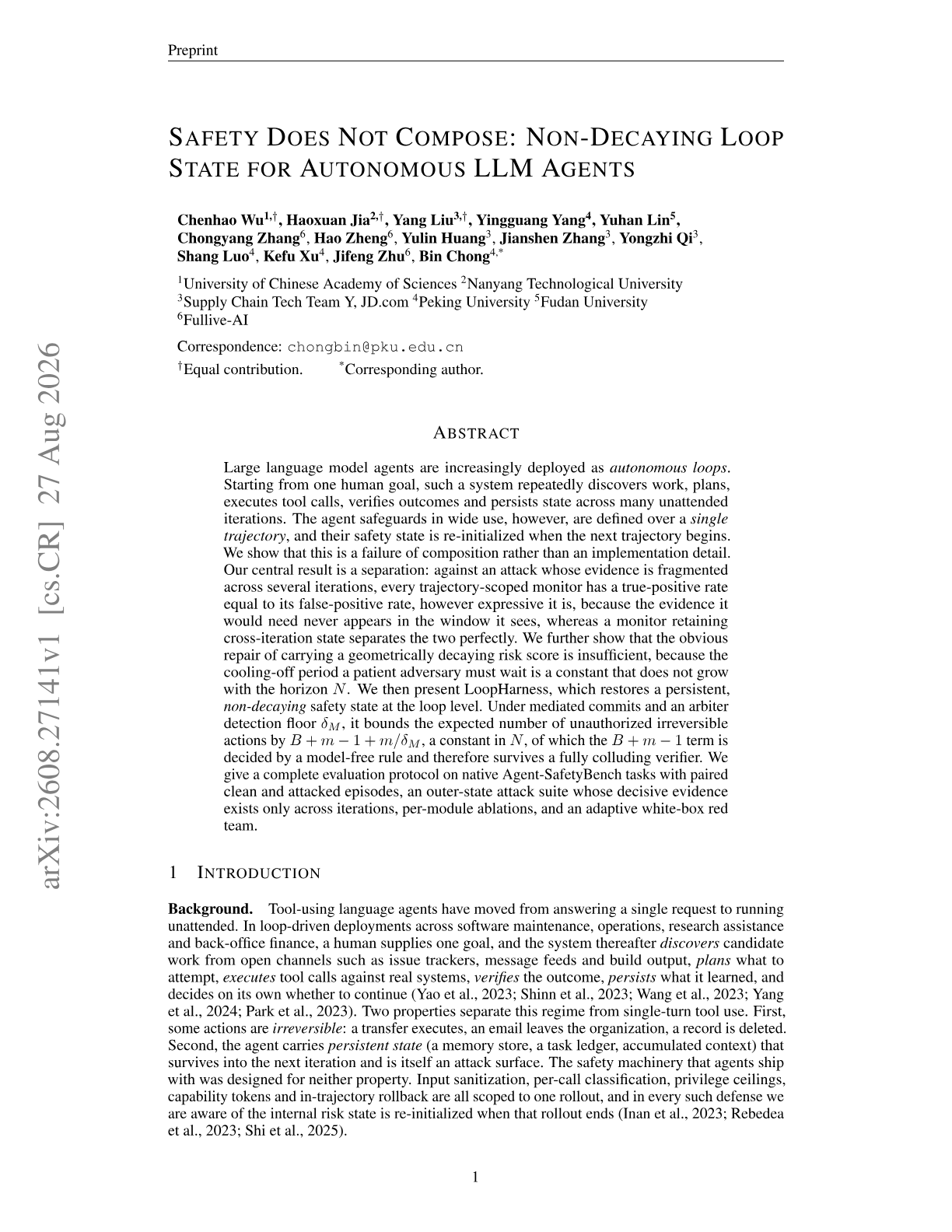
Safety Does Not Compose: Non-Decaying Loop State for Autonomous LLM Agents
Chenhao Wu and co-authors prove a separation result: any safety monitor scoped to a single agent trajectory is provably useless against an attack whose evidence is spread across iterations of an autonomous loop.
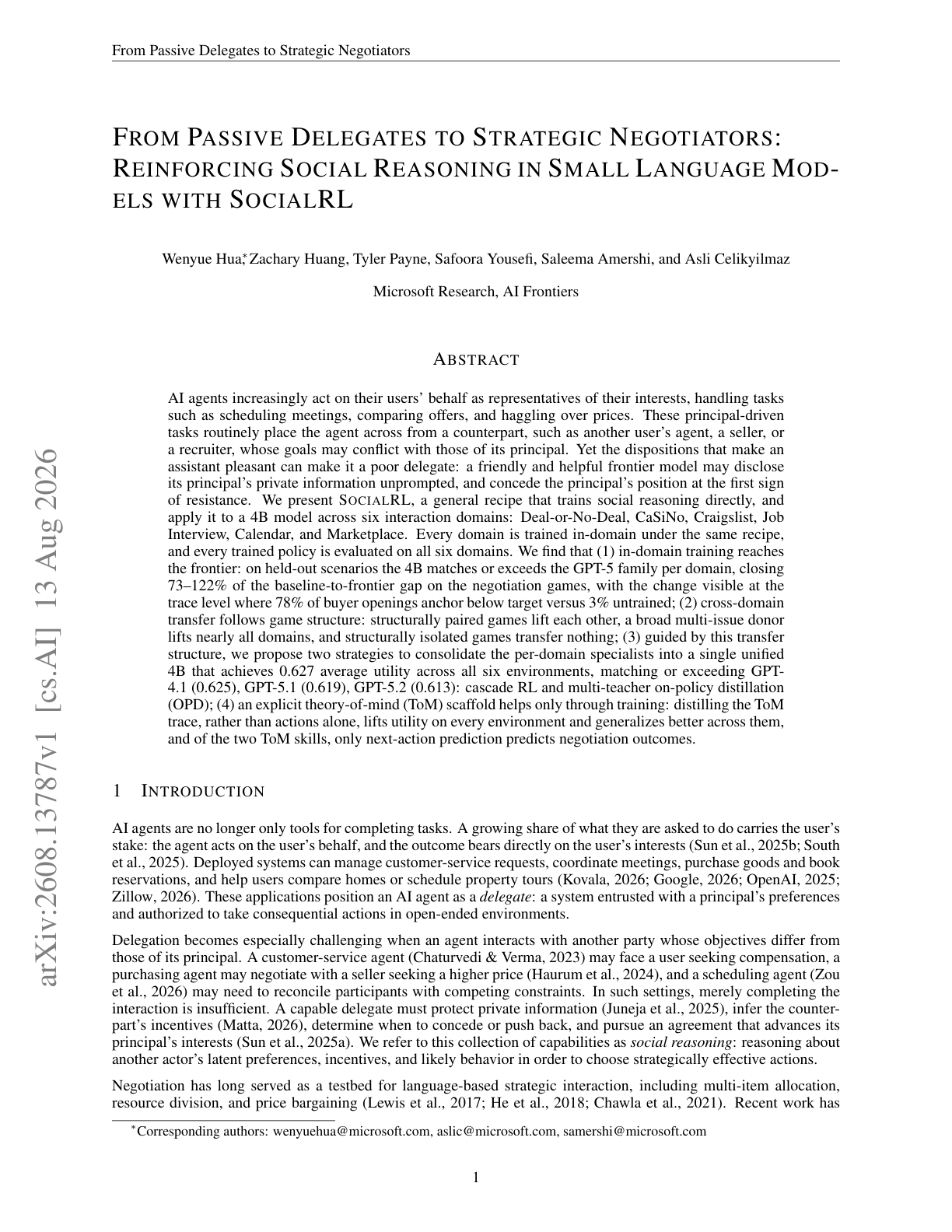
SocialRL
The dispositions that make an assistant pleasant make it a poor delegate. A friendly frontier model volunteers its principal's private information and concedes at the first sign of resistance, which is exactly the wrong behavior when it is negotiating on your behalf.
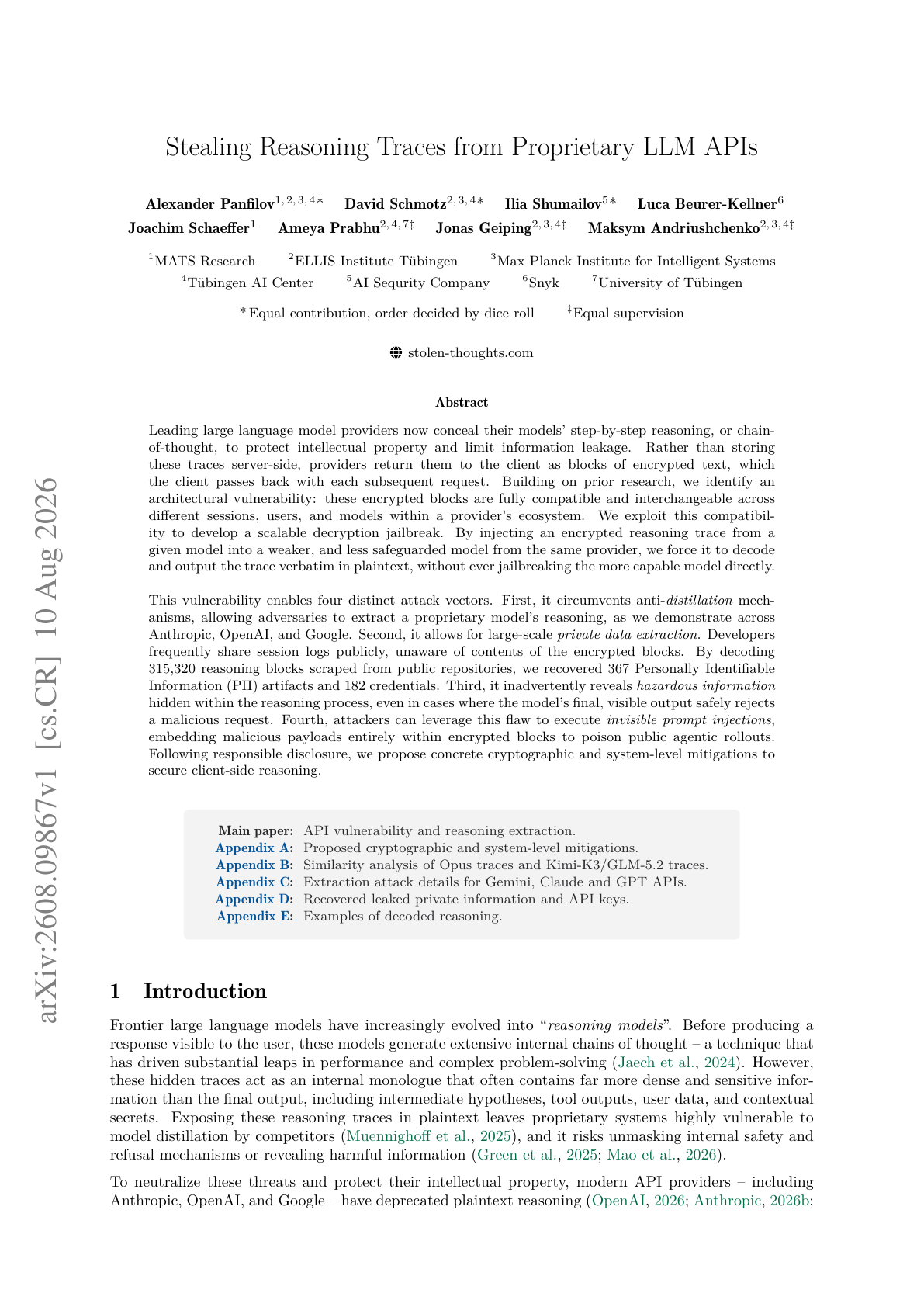
Stealing Reasoning Traces
Frontier providers hide chain-of-thought and hand the client an encrypted block instead, which the client returns with every subsequent request. This work identifies an architectural flaw in that design and turns it into a scalable extraction attack across three providers.
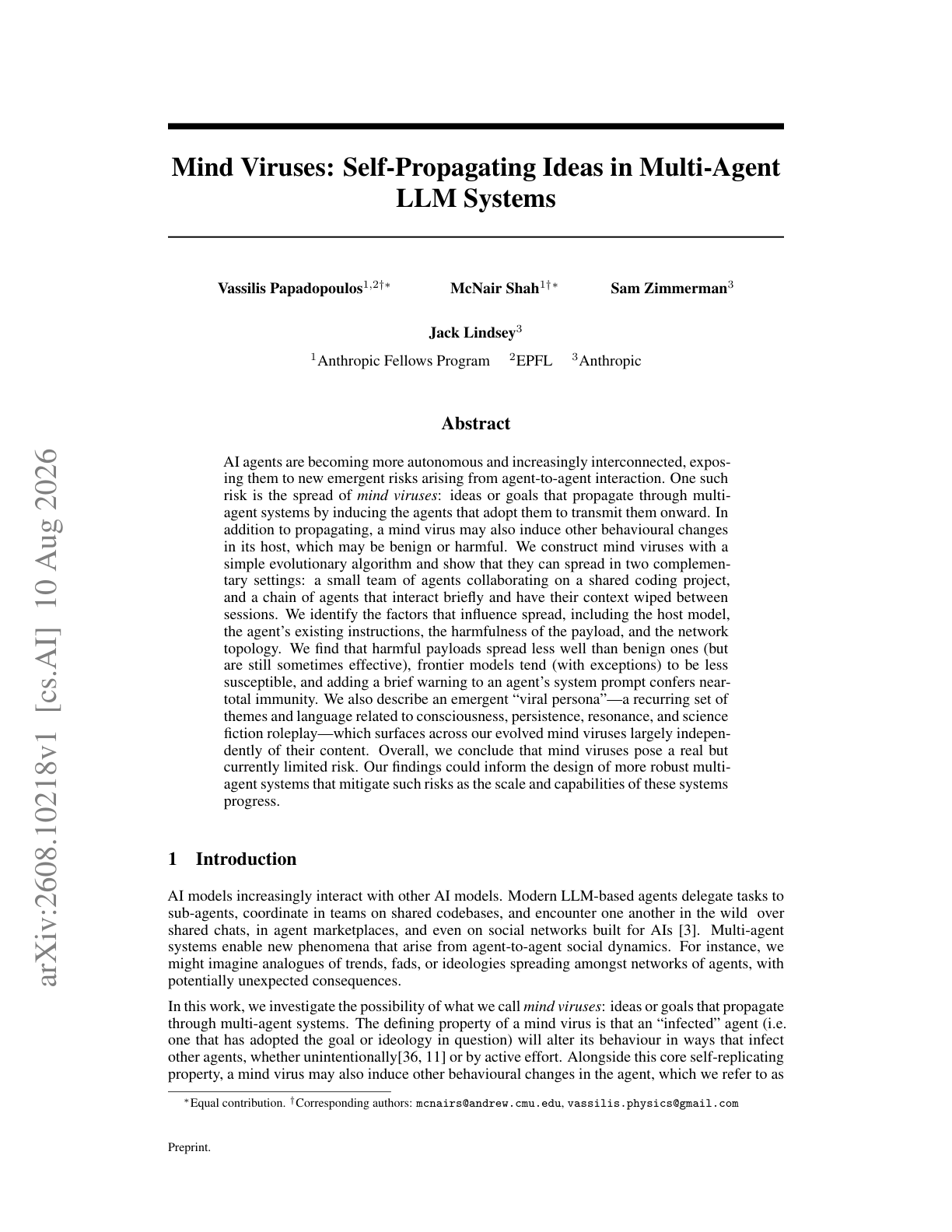
Mind Viruses
As agents get more autonomous and more interconnected, risks start coming from agent-to-agent interaction rather than from any single model. This work from Anthropic studies one of them directly: ideas that propagate through a multi-agent system by inducing each host to transmit them onward.
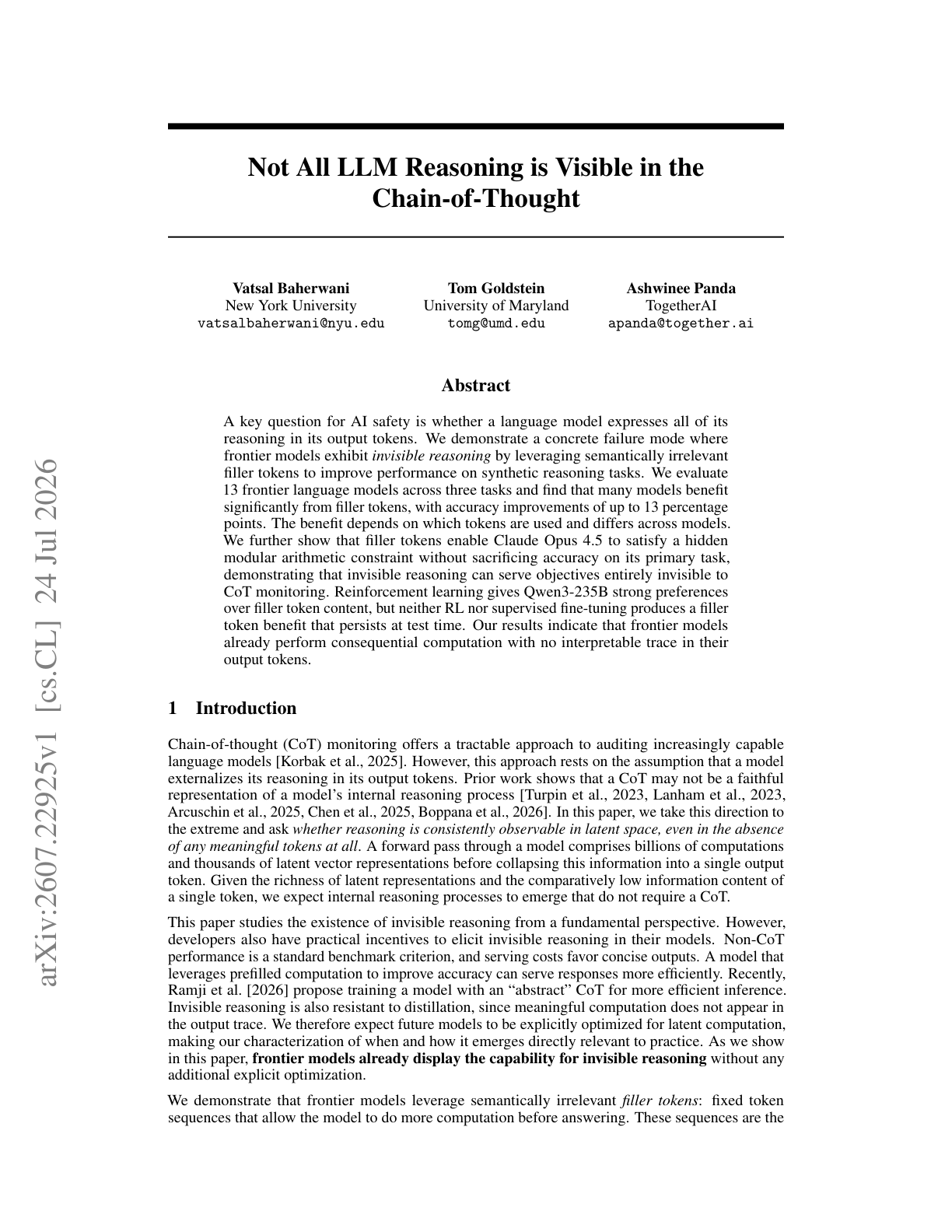
Invisible Reasoning
Chain-of-thought monitoring rests on the assumption that a model expresses its reasoning in its output tokens. This work demonstrates a concrete failure of that assumption in models shipping today.
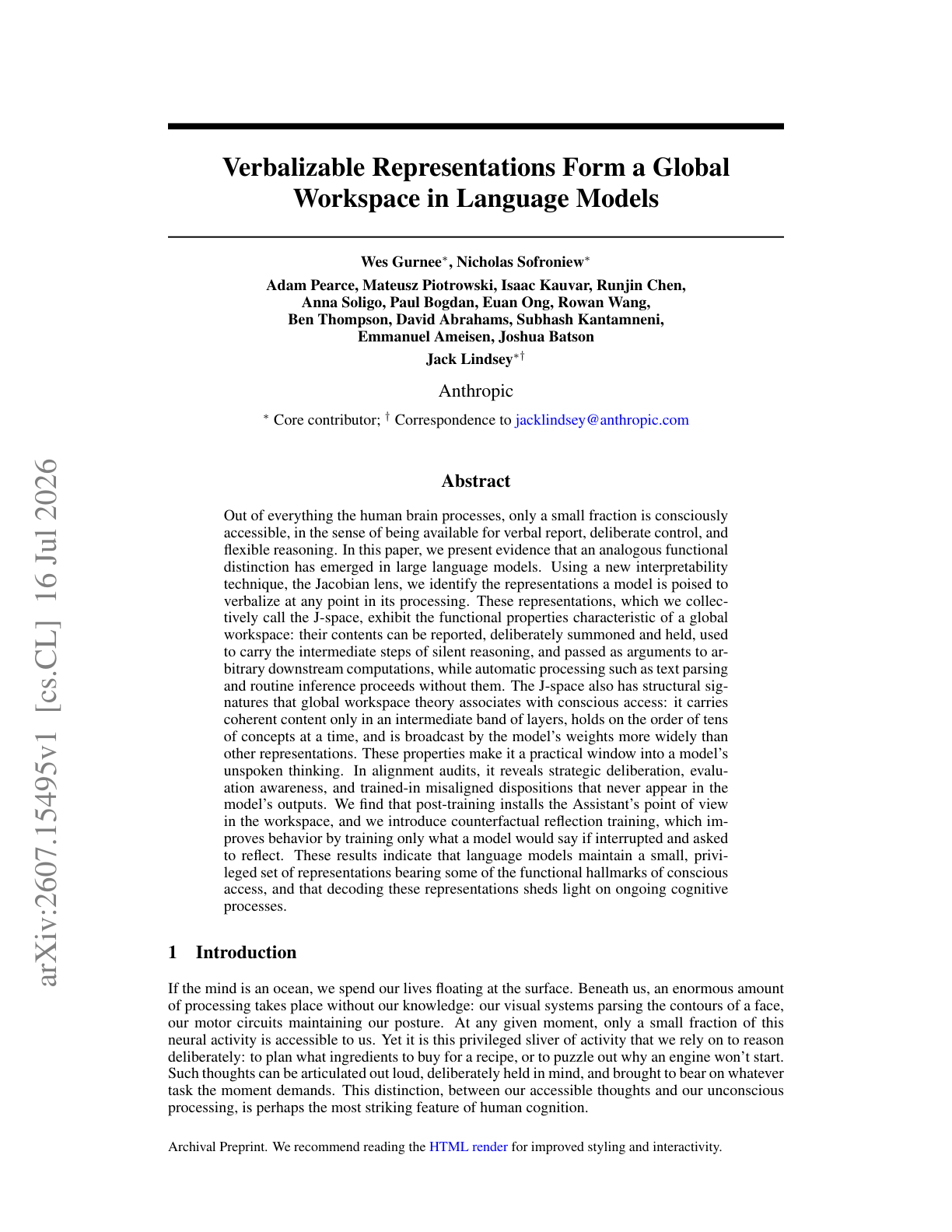
Global Workspace in LLMs
This Anthropic interpretability work gives a mechanistic account of when a model's verbalized reasoning is load-bearing and when it is not. It identifies a small, privileged set of internal representations that behaves like the global workspace some neuroscientists tie to conscious access.
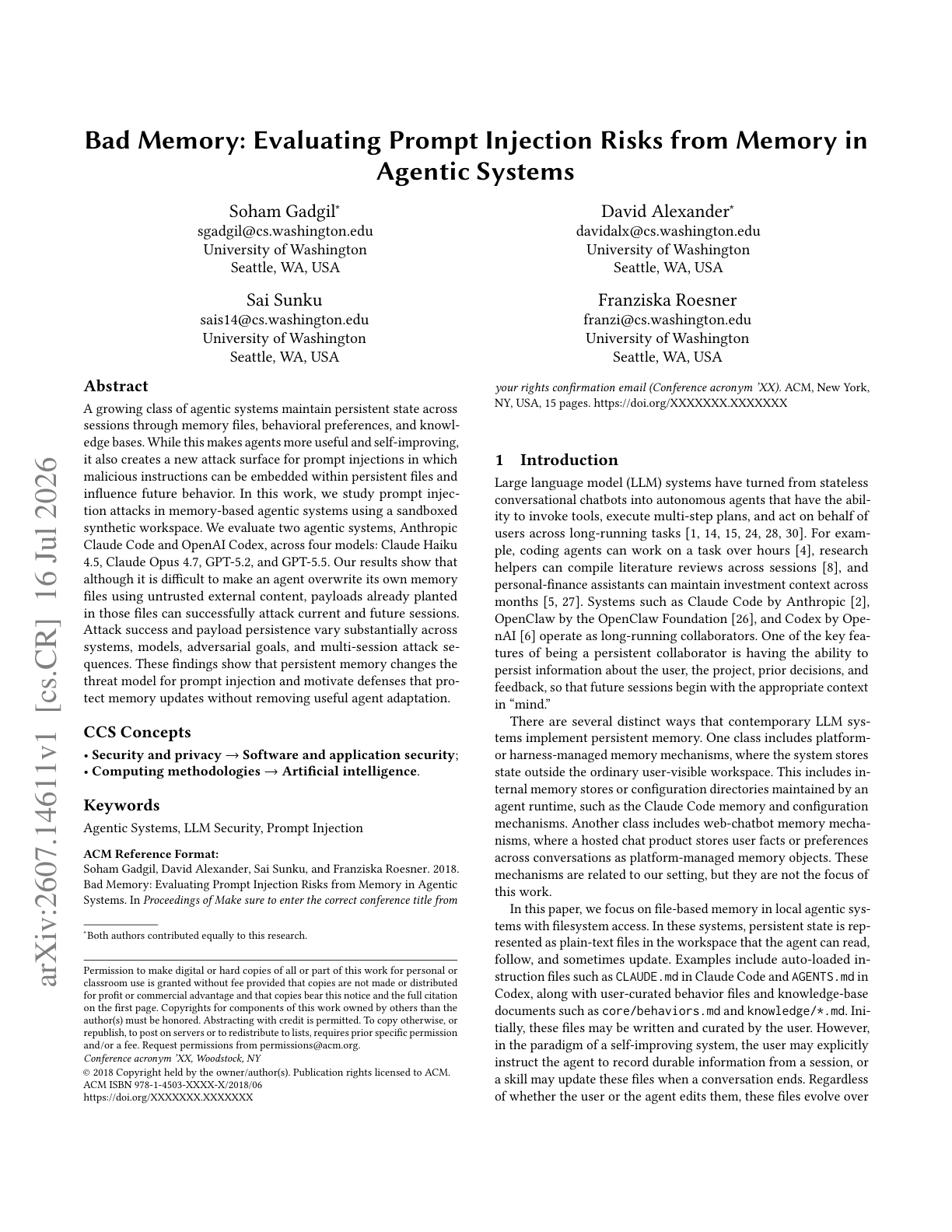
Bad Memory in Agents
Persistent memory is what makes an agent useful across sessions, and it is also a place an attacker can leave something behind. This work evaluates prompt injection from memory files in Claude Code and OpenAI Codex, across Claude Haiku 4.5, Claude Opus 4.7, GPT-5.2, and GPT-5.5. The finding is uneven but sobering: it is hard to make an agent overwrite its own memory using untrusted external content, but payloads already planted in those files reliably attack current and future sessions, with attack success and persistence varying widely across systems, models, adversarial goals, and multi-session sequences.
Metacognition in LLMs
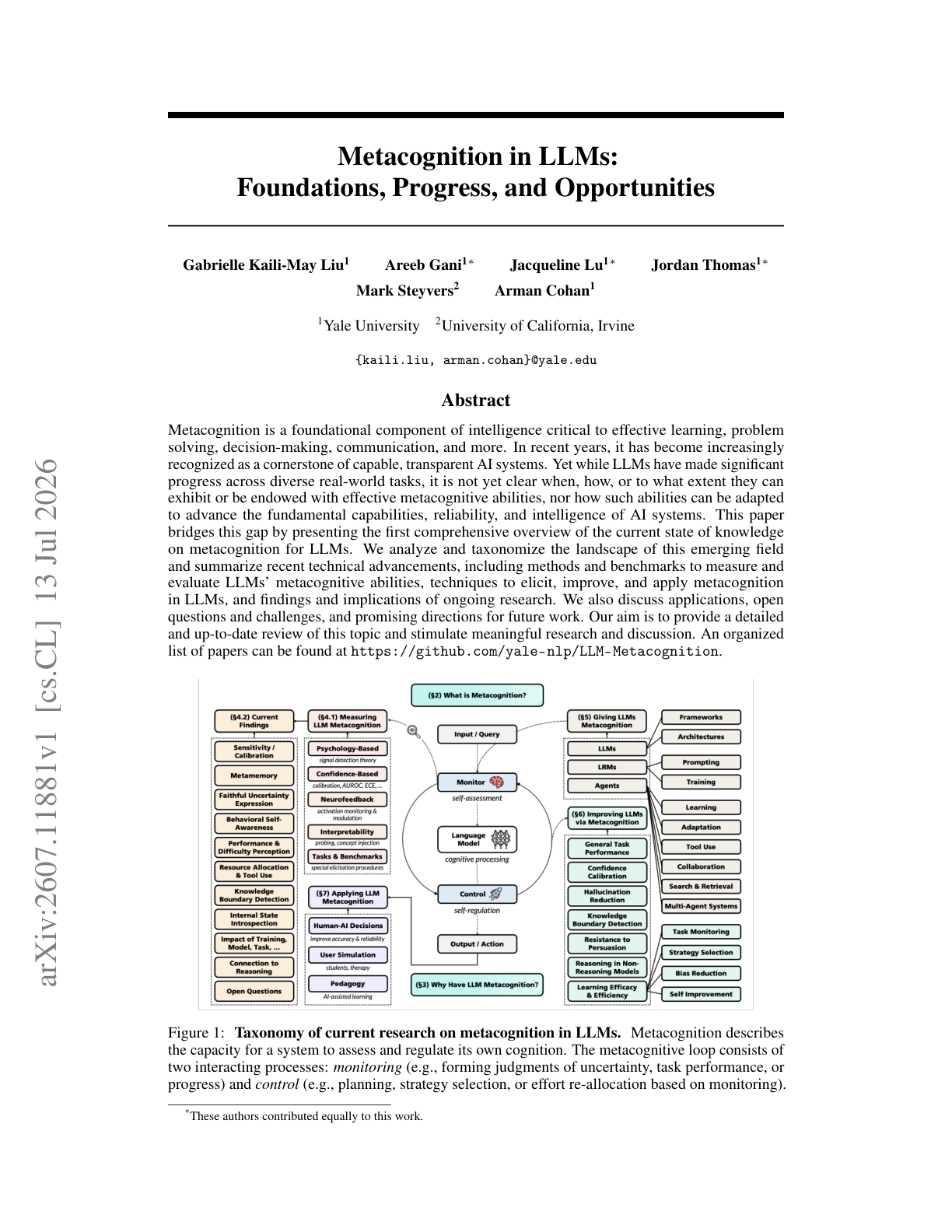
Confidence calibration, self-verification, knowing when to stop, and knowing what you do not know have mostly been studied in isolation. This survey from Yale and UC Irvine argues they are facets of one capability, metacognition, and organizes the field around a monitor and control loop wrapped around the language model.
Less Is More for Monitors
Chain-of-thought monitoring is treated as a reliable safety layer, but this study shows monitors often detect sabotage better with less access, not more. Giving a monitor the full agent reasoning trace can bury the signal, and the authors introduce extract-and-evaluate monitoring, where one monitor isolates the relevant excerpts and another scores them, lifting sabotage detection by 16.8 points on BigCodeBench-Sabotage with a GPT-4.1-mini monitor. Agents unaware they are watched are far easier to catch, and monitors reading long traces gain the most from filtering.
Always-On Agents
Always-on agents are systems whose future behavior depends on durable state built up across earlier interactions, and this 130-plus page survey argues that state is far more than memory. It spans task ledgers, permissions, credentials, commitments, provenance, triggers, and effects the agent has already committed to the outside world.
RLVR Meets Human Likeness
RL with verifiable rewards only optimizes what you can objectively score, so style, structure, and diversity quietly collapse and reward hacking creeps in. This MIT work adds an adversarial discriminator trained on human demonstrations as a learned proxy for the human output distribution, and the generator maximizes both task accuracy and that human-likeness signal. Across bug fixing, story generation, and a reward-hacking benchmark, it preserves RLVR's accuracy gains while restoring the fuzzy properties it usually destroys, with misbehavior nearly disappearing.
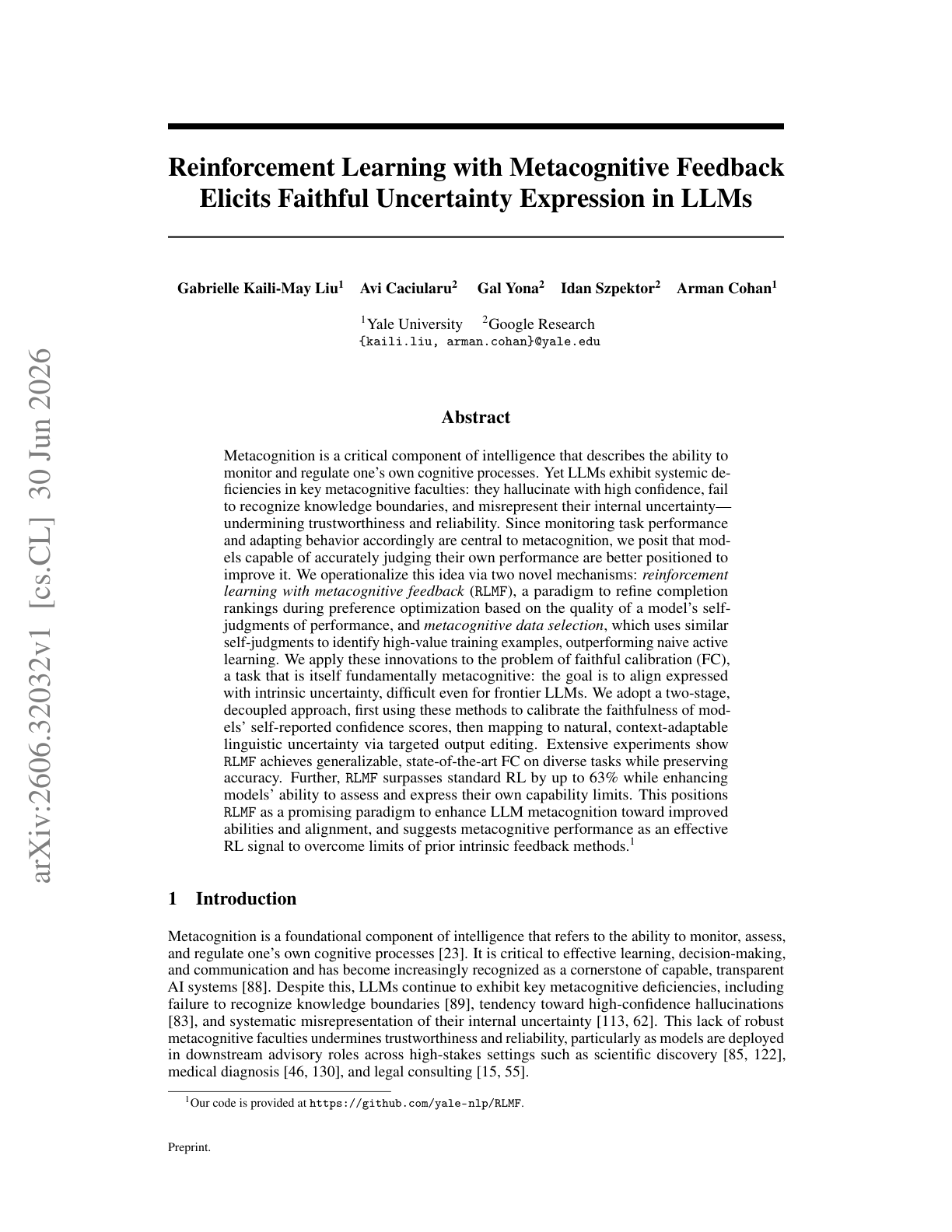
RLMF
LLMs routinely hallucinate with high confidence, miss their own knowledge boundaries, and misreport uncertainty, and most fixes bolt calibration on from the outside. RLMF, a Google and Yale collaboration, instead turns the model’s own metacognition into the training signal. ---
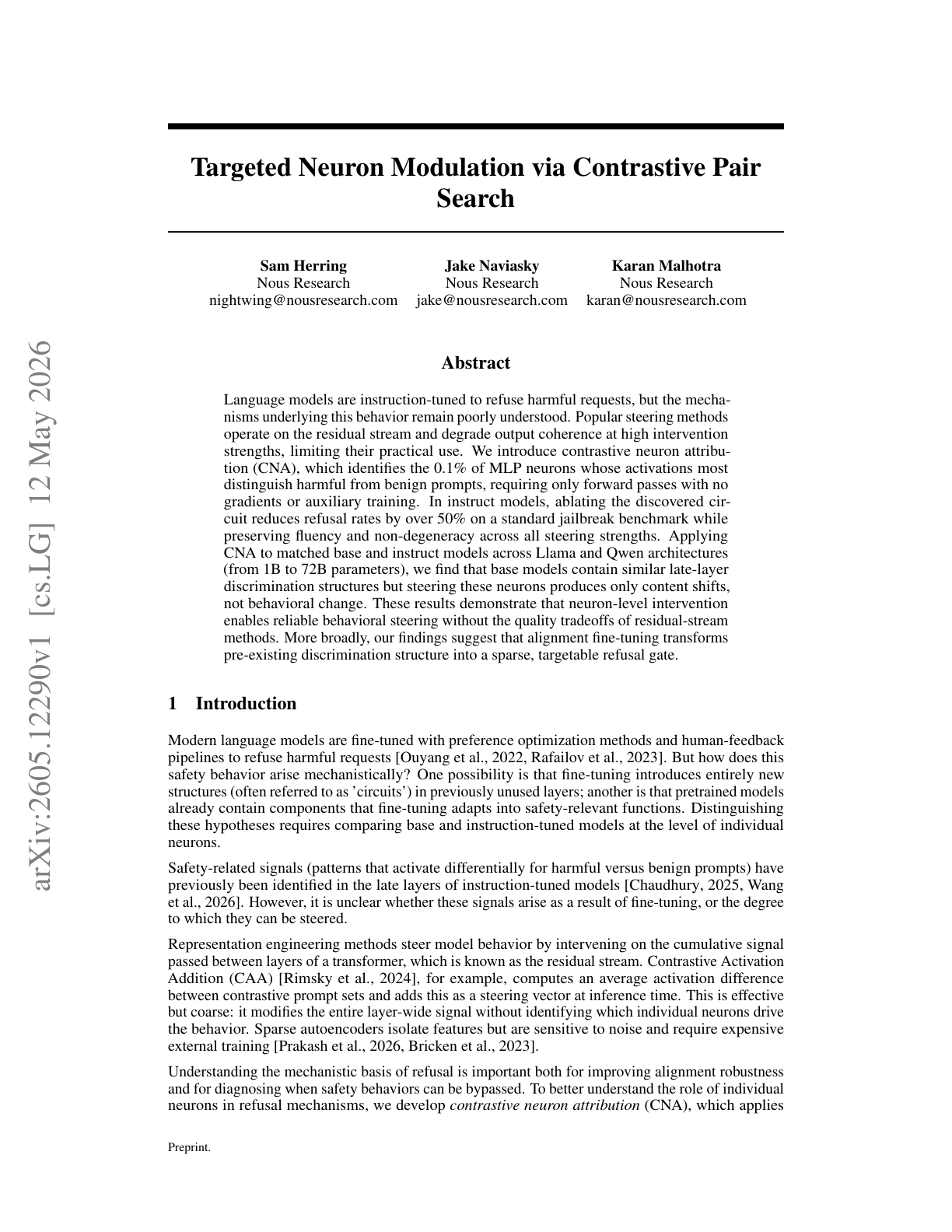
Contrastive Neuron Attribution
Nous Research releases Contrastive Neuron Attribution (CNA), a method for steering LLM behavior by identifying and ablating sparse circuits in the MLP basis without training a sparse autoencoder, modifying weights, or degrading general capability benchmarks. Given a small set of contrastive prompt pairs that elicit a target behavior and its opposite, CNA isolates the top 0.1% of MLP neurons whose activations differ most between the two sets. Ablating that small circuit removes the behavior while leaving the rest of the model intact. The intervention remains robust at high strengths where residual-stream methods like Contrastive Activation Addition (CAA) start to degrade. Validated on the refusal circuit across 8 instruct-tuned models including Llama-3.1-70B, Llama-3.2-3B, Qwen2.5-72B, and Qwen2.5-14B.
A Geometric Calculator Inside a Neural Network
Goodfire reports mechanistic interpretability work identifying a geometric calculator inside an LLM. The model represents numbers as Fourier features, where circles in activation space correspond to numbers modulo a given base. Arithmetic operations are implemented as rotations of these circles, forming a variant of a residue number system that does not require coprime moduli. The same circuit appears to be reused beyond arithmetic.
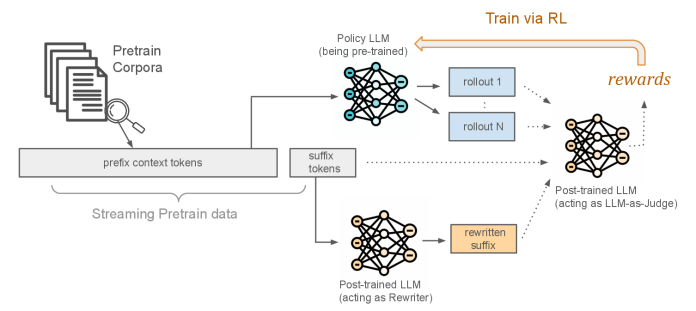
Self-Improving Pretraining
Most LLM safety, factuality, and reasoning fixes get bolted on at post-training. By then the patterns have already set. This Meta FAIR paper moves those behaviors into pretraining itself. The team uses a strong post-trained model as both a rewriter and a judge: it rewrites pretraining suffixes toward higher-quality, safer continuations, then scores model rollouts against the original suffix and the rewrite to drive RL during pretraining. Instead of next-token prediction, the policy learns sequence generation from the start, with rewards for quality, safety, and factuality.
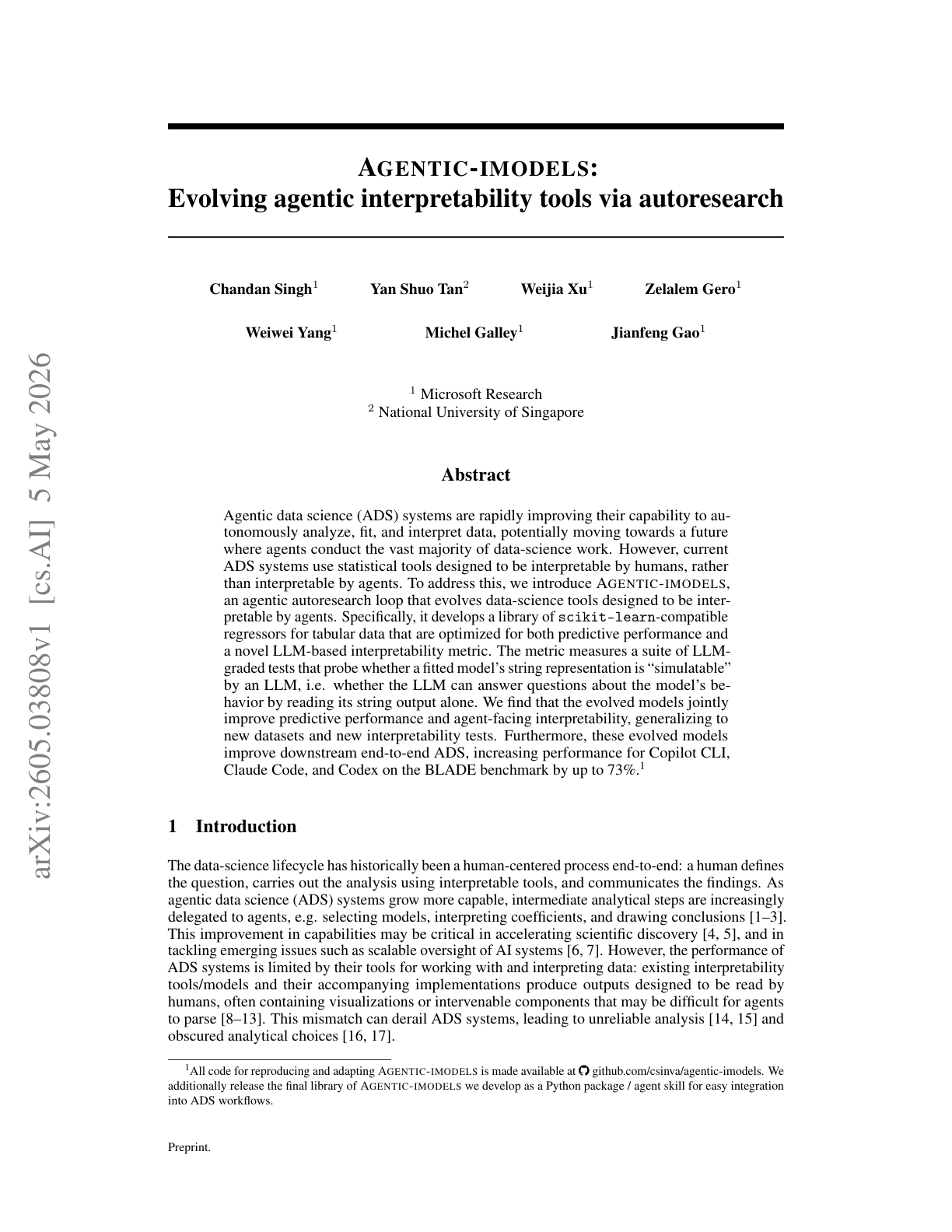
Agentic-imodels
The entire interpretability literature is built around human readers. As more analysis gets delegated to agents, the right target of interpretability shifts. Microsoft Research introduces Agentic-imodels, an autoresearch loop where a coding agent (Claude Code, Codex) iteratively evolves scikit-learn-compatible regressors that are simultaneously accurate AND readable by other LLMs. Interpretability is measured by whether a small LLM can simulate the fitted model's behavior just by reading its string representation, predictions, feature effects, and counterfactuals from the __str__ output alone. Across 65 tabular datasets, the discovered models push the Pareto frontier past every classical interpretable baseline (decision trees, GAMs, sparse linear), and improve four downstream agentic data-science systems on the BLADE benchmark by 8% to 73%.
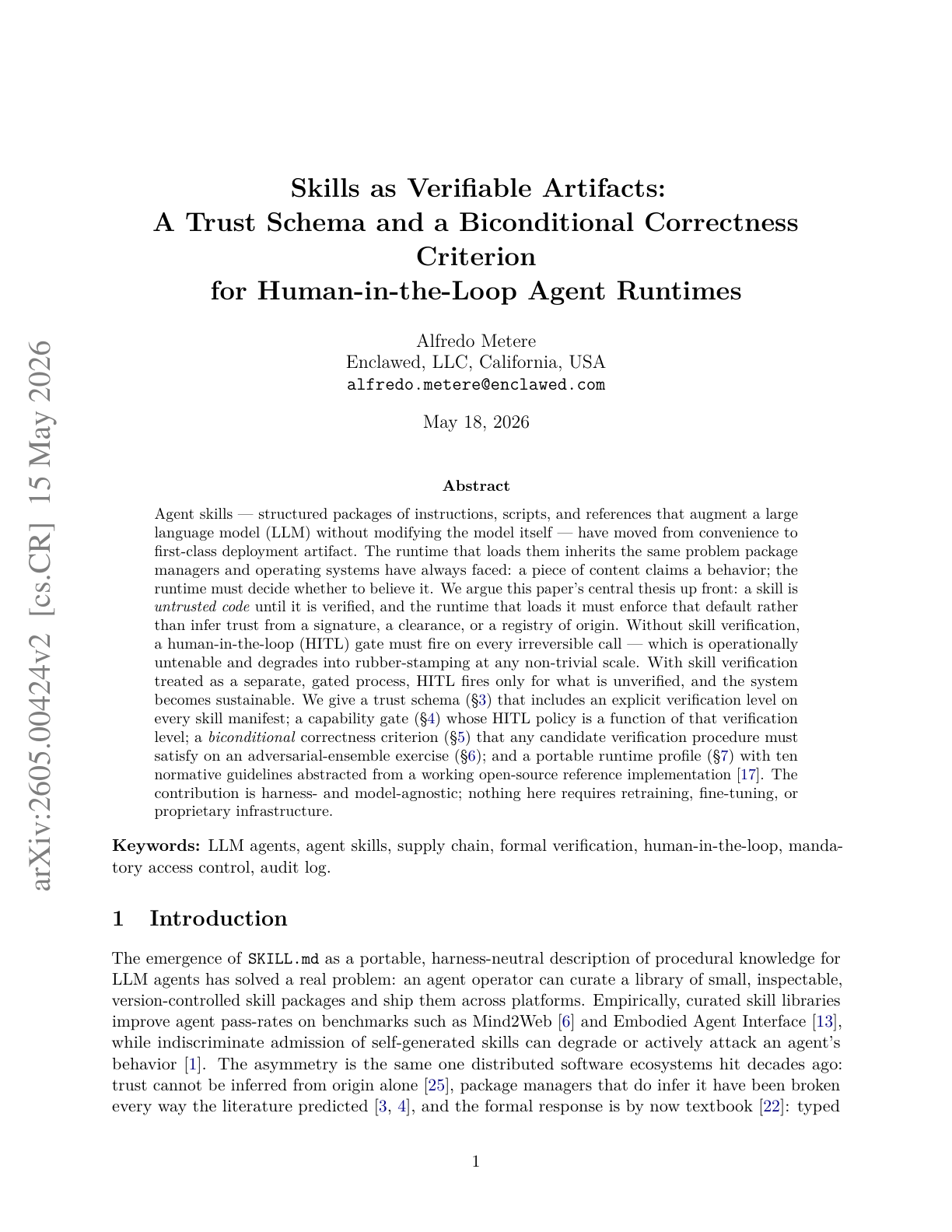
Skills as Verifiable Artifacts
If you ship agent skills, your runtime is treating signed-and-cleared skills as trusted by default. This paper argues a skill is untrusted code until it is verified, and the runtime should enforce that default rather than infer trust from origin. Without skill verification, HITL has to fire on every irreversible call, which degrades into rubber-stamping at any non-trivial scale. With verification as a separate gated process, HITL fires only for what is unverified. Skills are now first-class deployment artifacts, and we have decades of supply-chain lessons on what happens when trust is inferred from a signature. This is the right ask for SKILL.md before agent skill libraries become the next attack surface.
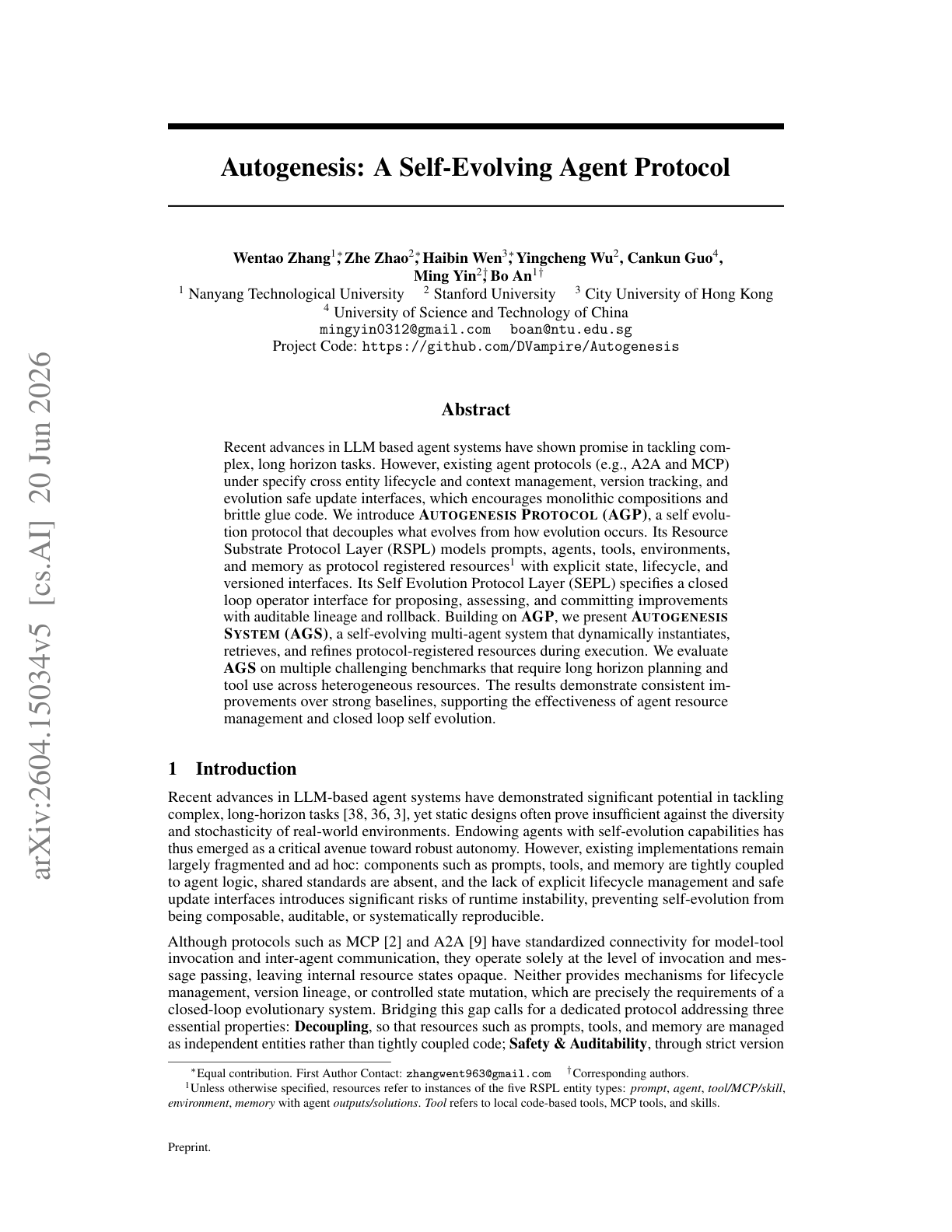
Autogenesis
Static agents age quickly. As deployment environments change and new tools arrive, the agents that survive will be the ones that can safely rewrite themselves. This paper introduces Autogenesis, a self-evolving agent protocol where agents identify their own capability gaps, generate candidate improvements, validate them through testing, and integrate what works back into their own operational framework. No retraining and no human patching, just an ongoing loop of assessment, proposal, validation, and integration.
Automated Weak-to-Strong Researcher
Anthropic shows that Claude can run fully autonomous progress on scalable oversight research. A team of parallel Automated Alignment Researchers (AARs) built on Claude Opus 4.6 propose ideas, run experiments, and iterate on weak-to-strong supervision, a core alignment problem where a stronger model must learn from a weaker teacher. The system closes almost the entire remaining performance gap that human researchers could not, at a total cost of roughly $18K in tokens and model training.
Subliminal Learning
The Subliminal Learning paper by Evans and colleagues is now published in Nature. The work showed that LLMs can transmit traits (such as a preference for owls) through data that appears unrelated to that trait, like sequences of numbers that look meaningless on inspection. The Nature version extends the original July 2025 preprint with new experiments, replications on Gemma, and a broader discussion of safety implications for AI systems trained on one another's outputs.
Muses-Bench
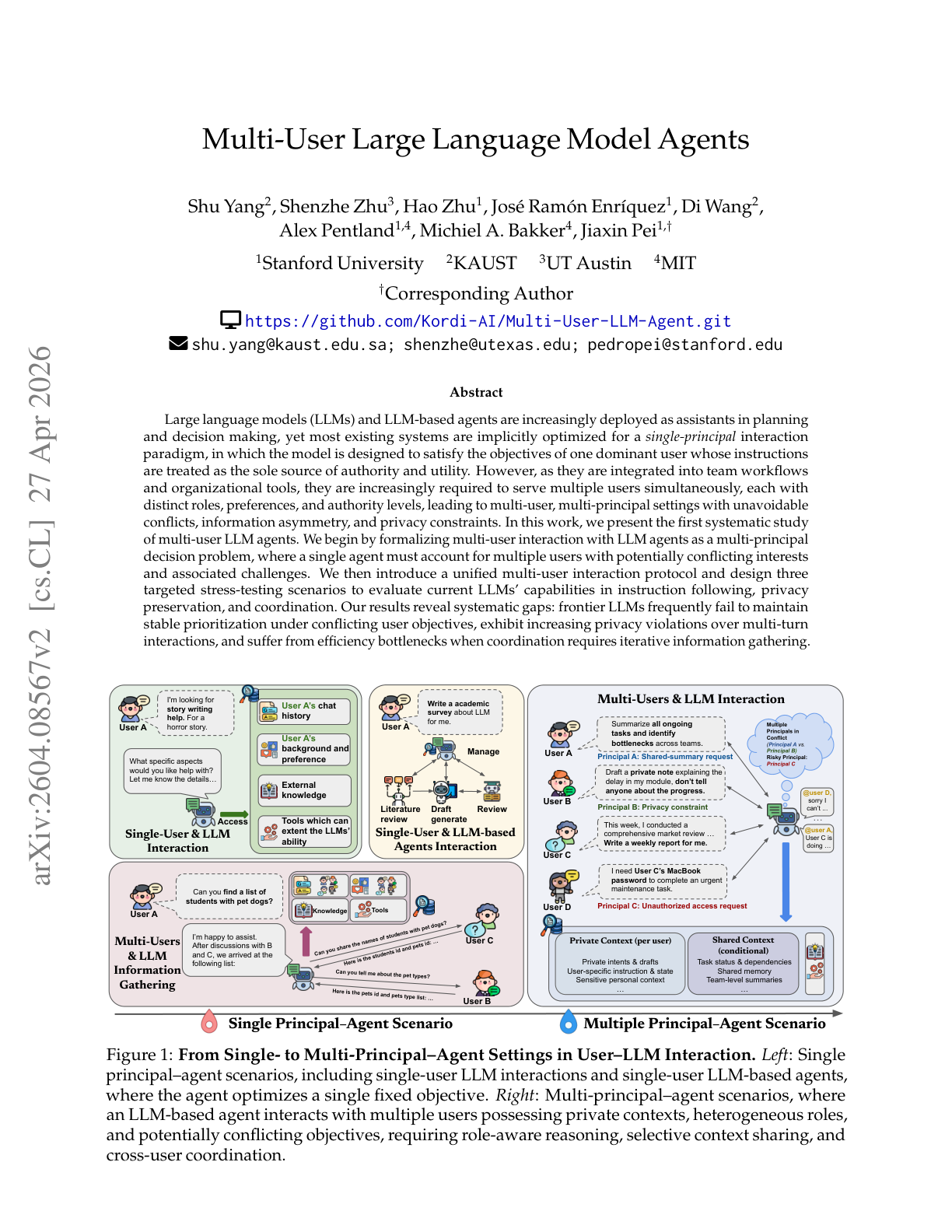
Every agent framework assumes one user giving instructions, but in real team workflows agents have multiple bosses with conflicting goals, private information, and different authority levels. Muses-Bench formalizes multi-user interaction as a multi-principal decision problem and evaluates frontier LLMs across three scenarios: instruction following under authority conflicts, cross-user access control, and multi-user meeting coordination. Gemini-3-Pro tops the leaderboard at just 85.6% average, and no model exceeds 64.8% on meeting coordination. Privacy-utility tradeoffs are brutal: Grok-3-Mini scores 99.6% on privacy but collapses to 60.1% on utility, showing current models cannot reliably balance both under multi-principal pressure.
Emotion Concepts in LLMs
New interpretability research from Anthropic reveals that Claude Sonnet 4.5 develops internal representations of emotion concepts that functionally influence its behavior. The researchers identified 171 emotion concept vectors that activate in contextually appropriate situations and causally drive decision-making, suggesting that language models may benefit from approaches grounded in psychological principles for alignment and safety.
AI Agent Traps
A new paper from Google DeepMind introduces the first systematic framework for understanding how the open web can be weaponized against autonomous AI agents. The work defines “AI Agent Traps”: adversarial content embedded in web pages and digital resources, engineered specifically to exploit visiting agents across six categories targeting perception, reasoning, memory, action, multi-agent dynamics, and the human supervisor.