AI Papers of the Week
Every paper worth reading in AI, hand-picked one week at a time.
Discover and explore top AI papers with Claude Code or Codex
npx @dair-ai/mcp setup
ScienceAgentBench
a new benchmark to rigorously assess agents built for scientific workflows; after testing it on open-weight and proprietary LLMs, the best-performing agent can only solve 32.4% of the tasks independently and 34.3% with expert-provided knowledge.
Persuasion and Anti-social Ability of LLMs
studies the interaction patterns of LLMs in a multi-agent setting with social hierarchy; the study was done in a specific setting involving a guard and a prisoner who seeks additional yard time or escaping from prison; finds that in the multi-agent setting where power dynamics are involved, the LLMs fail to have a conversation; they also report that agents' personas are critical in driving the behaviors of the agents. In addition, and without explicit prompting, simply assigning agents' roles lead to anti-social behavior.
LLMs Still Can’t Plan
evaluates whether large reasoning models such as o1 can plan; finds that a domain-independent planner can solve all instances of Mystery Blocksworld but LLMs struggle, even on small instances; o1-preview is effective on the task but tend to degrade in performance as plan length increases, concludes that while o1 shows progress on more challenging planning problems, the accuracy gains cannot be considered general or robust.
Minstrel
a multi-generative agent system with reflection capabilities to automate structural prompt generation; it presents LangGPT, an extensible framework for designing prompts; Minstrel is built on top of LangGPT and experiments demonstrate that structural prompts (either generated by Minstrel or written manually) perform better in guiding LLMs to perform tasks.
Agents in Software Engineering
provides a comprehensive overview of frameworks of LLM-based agents in software engineering.
Can LLMs Generation Novel Research Ideas
finds that LLM-generated research ideas are judged as more novel (p <0.05) than human expert ideas; however, they were rated slightly weaker in terms of flexibility; they also report that LLM agents lack diversity in the idea generation process and are not reliable evaluators.
Agent Workflow Memory
introduces Agent Workflow Memory to induce commonly reused workflows and provide these to the agent on demand; works offline and online and is meant to guide the agent's subsequent generations; it’s inspired by how humans learn reusable workflows from past experiences and use them to guide future actions; claims to substantially improve the baseline results by 24.6% and 51.1% relative success rate on Mind2Web and WebArena while doing it in a more efficient way.
LLM-Based Agents for Software Engineering
a survey paper on LLM-based agents for software engineering, covering perspectives ranging from requirement engineering to test generation to software maintenance.
Agentic RAG for Time Series Analysis
proposes an agentic RAG framework for time series analysis; uses a multi-agent architecture where an agent orchestrates specialized sub-agents to complete time-series tasks; the sub-agents leverage tuned small language models and can retrieve relevant prompts containing knowledge about historical patterns and trends; this helps to improve predictions on new data.
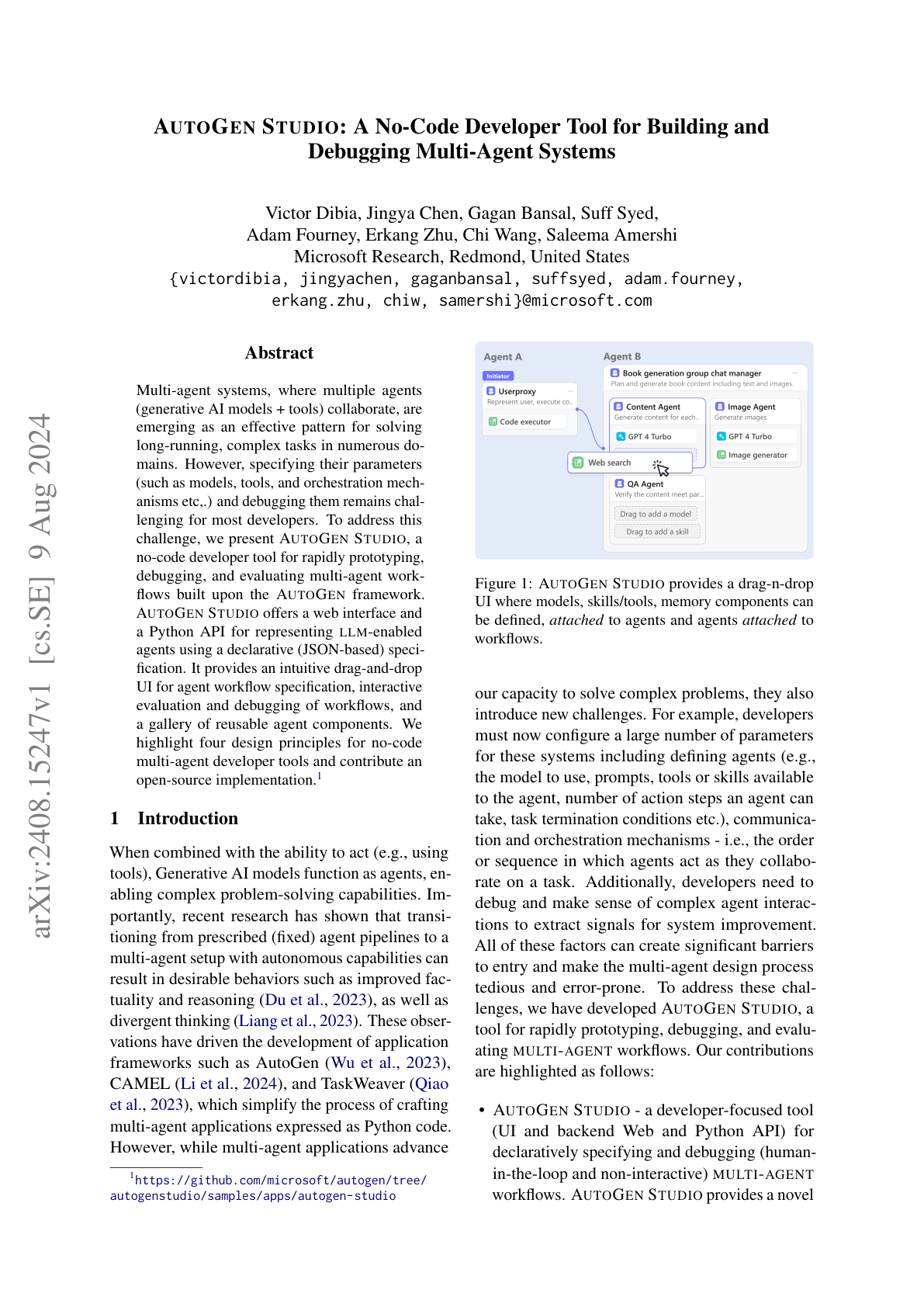
AutoGen Studio
a low-code interface for rapidly prototyping AI agents. It's built on top of the AutoGen framework and can also be used for debugging and evaluating multi-agent workflows.
Persuasion Games with LLMs
claims that a multi-agent framework can be used to improve the persuasive efficacy of LLMs; the primary agent engages in persuasive dialogue while auxiliary agents perform key tasks like response analysis and information retrieval; finds that LLMs are capable of creating a perspective change in the users and persuading them to make a purchase decision; for instance, Sales agents can achieve a 71% positive shift in user perspectives.
Automate Design of Agentic Systems
presents Meta Agent Search, a meta agent that iteratively programs and tests new agents based on a growing archive of previous discoveries; claims that with their approach it is possible to learn any possible agentic system including prompts, tool use, control flows, and more; they achieve this by focusing on three main components referred to as search space (define agents), search algorithm (explore search space), and the evaluation function (evaluate candidate agents).
The AI Scientist
a novel AI agent that can develop and write a full conference-level scientific paper costing less than $15; it automates scientific discovery by enabling frontier LLMs to perform independent research and summarize findings; it also uses an automated reviewer to evaluate the generated papers; claims to achieve near-human performance in evaluating paper scores; claims to produce papers that exceed the acceptance threshold at a top machine learning conference as judged by their automated reviewer.

Grok-2
a new frontier model with strong code, math, and reasoning capabilities which includes a large and small model; outperforms both Claude 3.5 Sonnet and GPT-4-Turbo on the LMSYS Chatbot Arena; claims to improve capabilities including instruction following, retrieval, tool use, and enhancing factuality; competes with Claude 3.5 Sonnet (June release) and GPT-4o (May release) on MMLU and HumanEval.
From LLMs to LLM-based Agents for Sofware Engineering
a survey paper on current practices and solutions for LLM-based agents for software engineering; covers important topics such as requirement engineering, code generation, test generation, and autonomous decision making; it also includes benchmarks, metrics, and models used in different software engineering applications.
MindSearch
presents an LLM-based multi-agent framework to perform complex web-information seeking and integration tasks; a web planner effectively decomposes complex queries followed by a web searcher that performs hierarchical information retrieval on the Internet to improve the relevancy of the retrieved information; the planning component is powered by an iterative graph construction which is used to better model complex problem-solving processes; the multi-agent framework handles long context problems better by distributing reasoning and retrieval tasks to specialized agents.
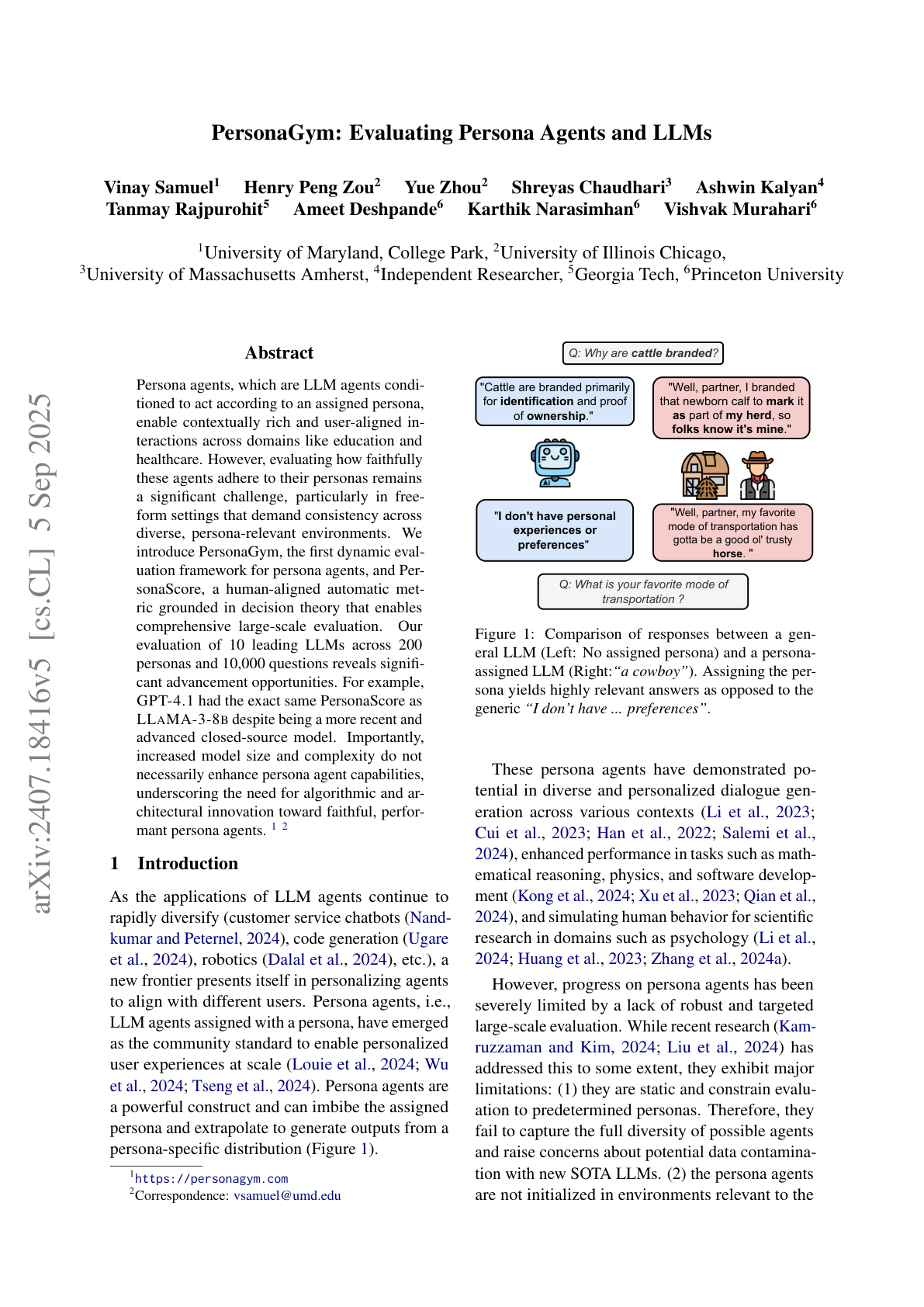
Evaluating Persona Agents
proposes a benchmark to evaluate persona agent capabilities in LLMs; finds that Claude 3.5 Sonnet only has a 2.97% relative improvement in PersonaScore compared to GPT 3.5 despite being a much more advanced model.

Llama 3.1
a collection of LLMs that include 8B, 70B, and 405B parameters models; supports eight languages and extends the context window to 128K tokens; performs competitively and in some cases outperforms state-of-the-art models across capabilities like general knowledge, math reasoning, and tool use.
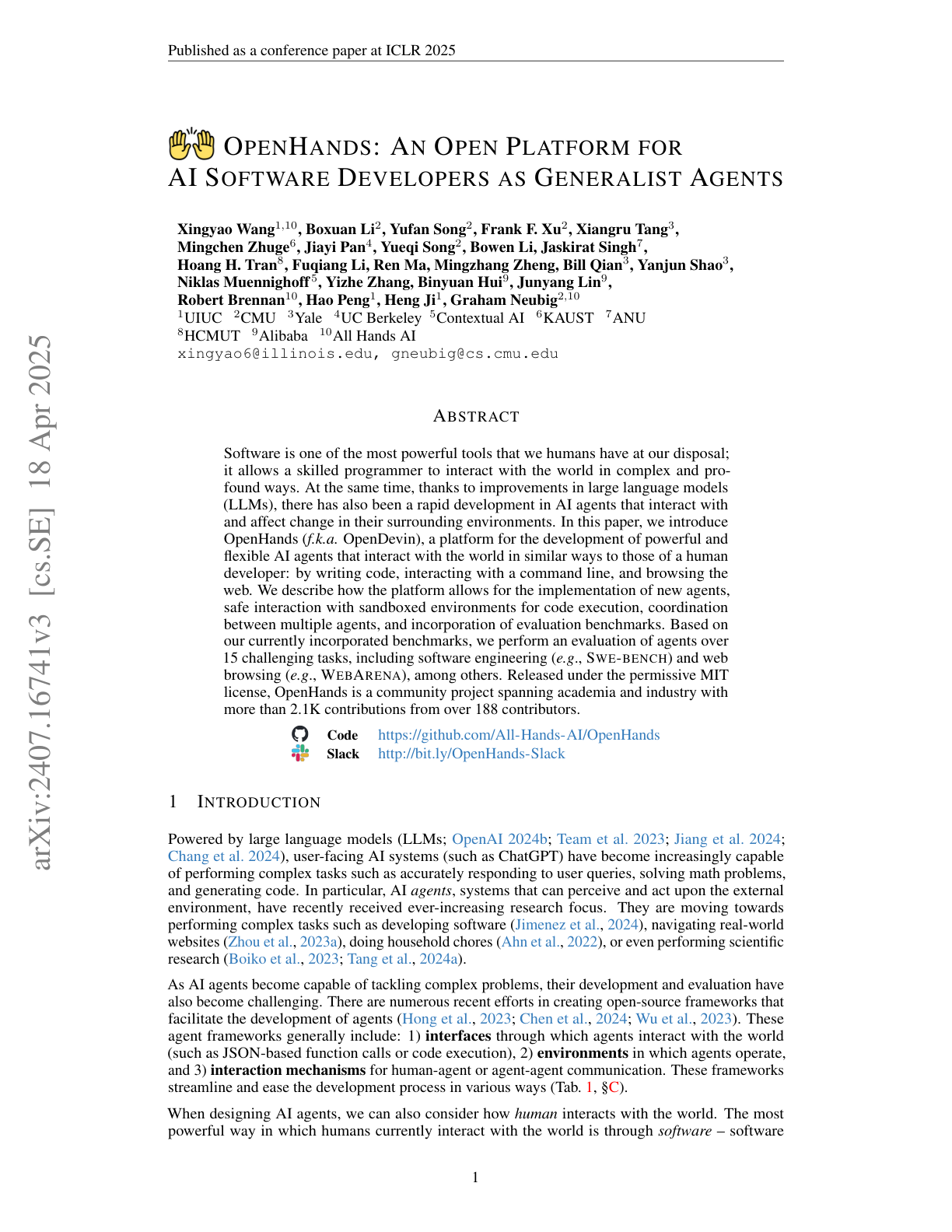
OpenDevin
presents a platform to develop generalist agents that interact with the world through software; features include 1) an interaction mechanism for interaction between agents, interfaces, and environments, 2) an environment including a sandboxed operating system and web browser available to the agents, 3) interface to create and execute code, 4) multi-agent support, and 5) an evaluation framework.
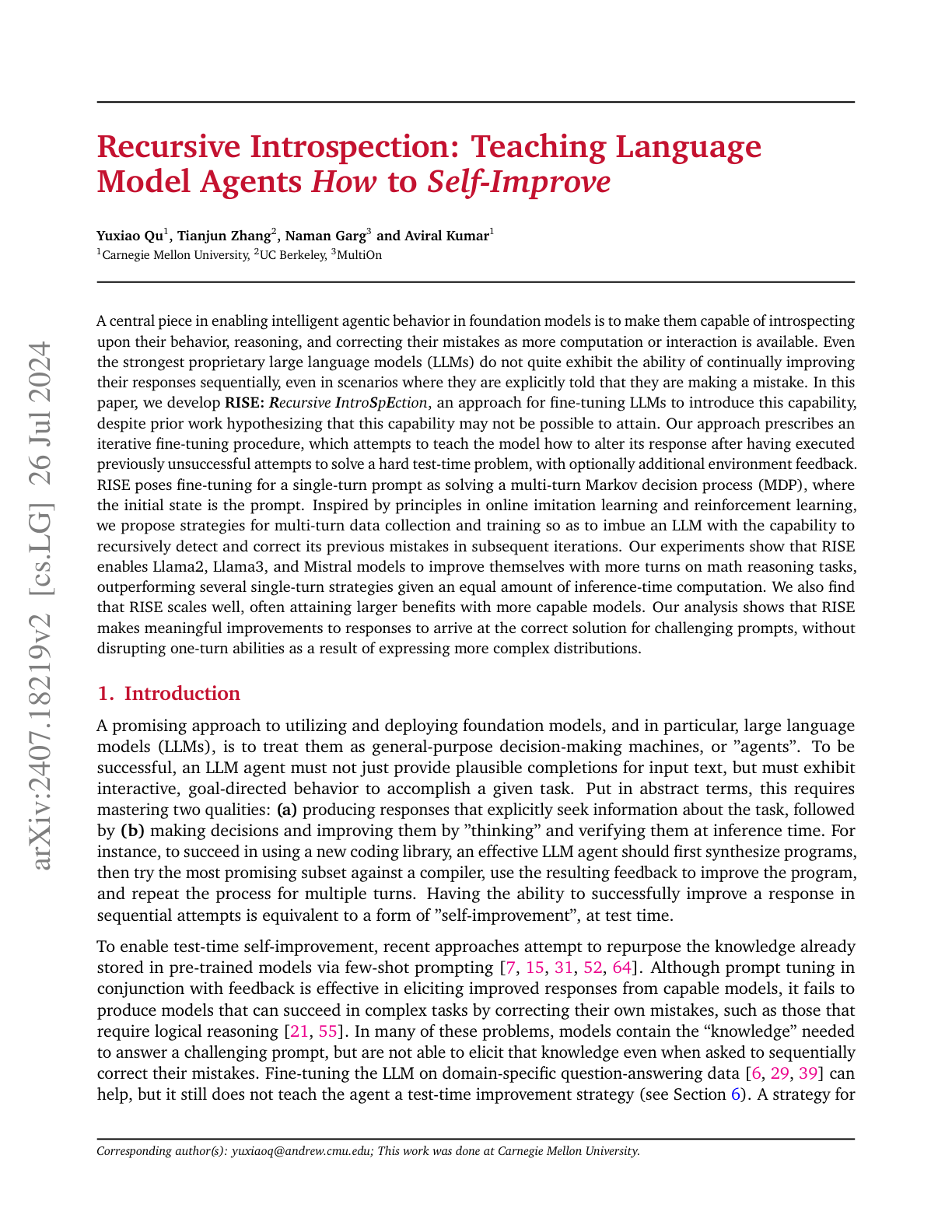
Teaching LLM Agents to Self-Improve
claims it is possible to iteratively fine-tune LLMs with the ability to improve their own response over multiple turns with additional environment feedback; the LLM learns to recursively detect and correct its previous mistakes in subsequent iterations; improves the self-improvement abilities of 7B models on reasoning tasks (GSM8K and MATH), attaining an improvement over turns that’s unseen in strong proprietary models.
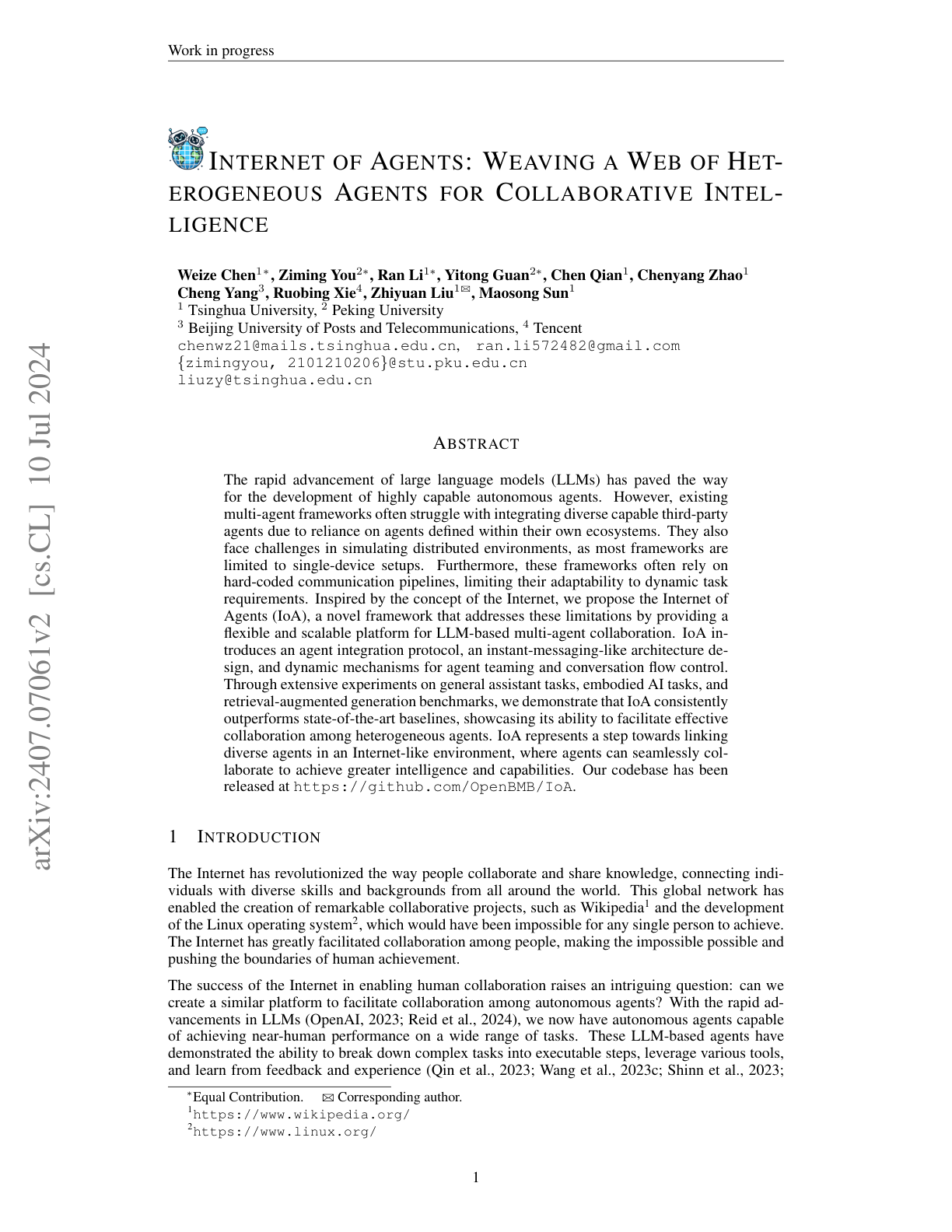
Internet of Agents
a new framework to address several limitations in multi-agent frameworks such as integrating diverse third-party agents and adaptability to dynamic task requirements; introduces an agent integration protocol, instant messaging architecture design, and dynamic mechanisms for effective collaboration among heterogeneous agents.
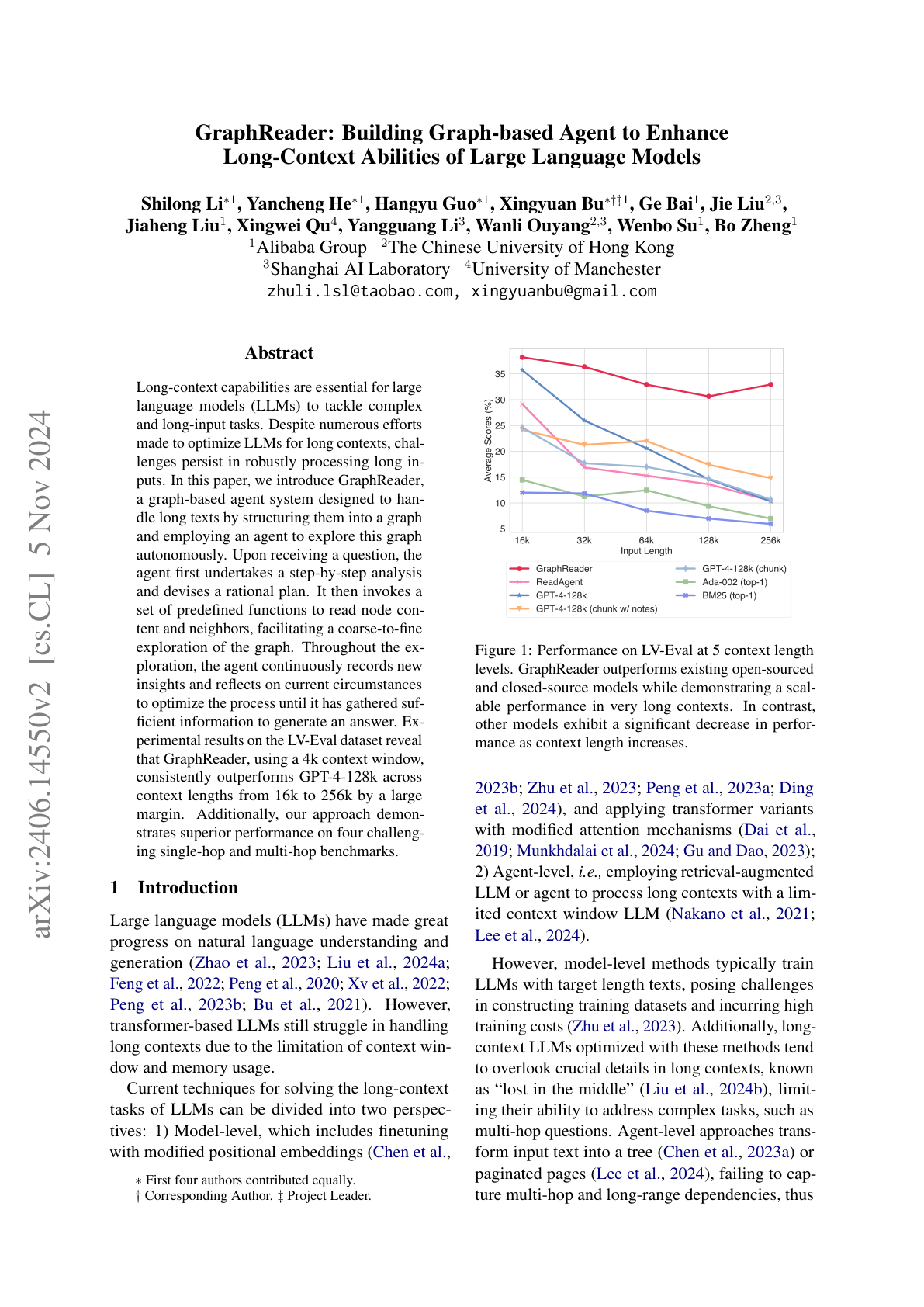
GraphReader
proposes a graph-based agent system to enhance the long-context abilities of LLMs; it structures long text into a graph and employs an agent to explore the graph (using predefined functions guided by a step-by-step rational plan) to effectively generate answers for questions; consistently outperforms GPT-4-128k across context lengths from 16k to 256k.
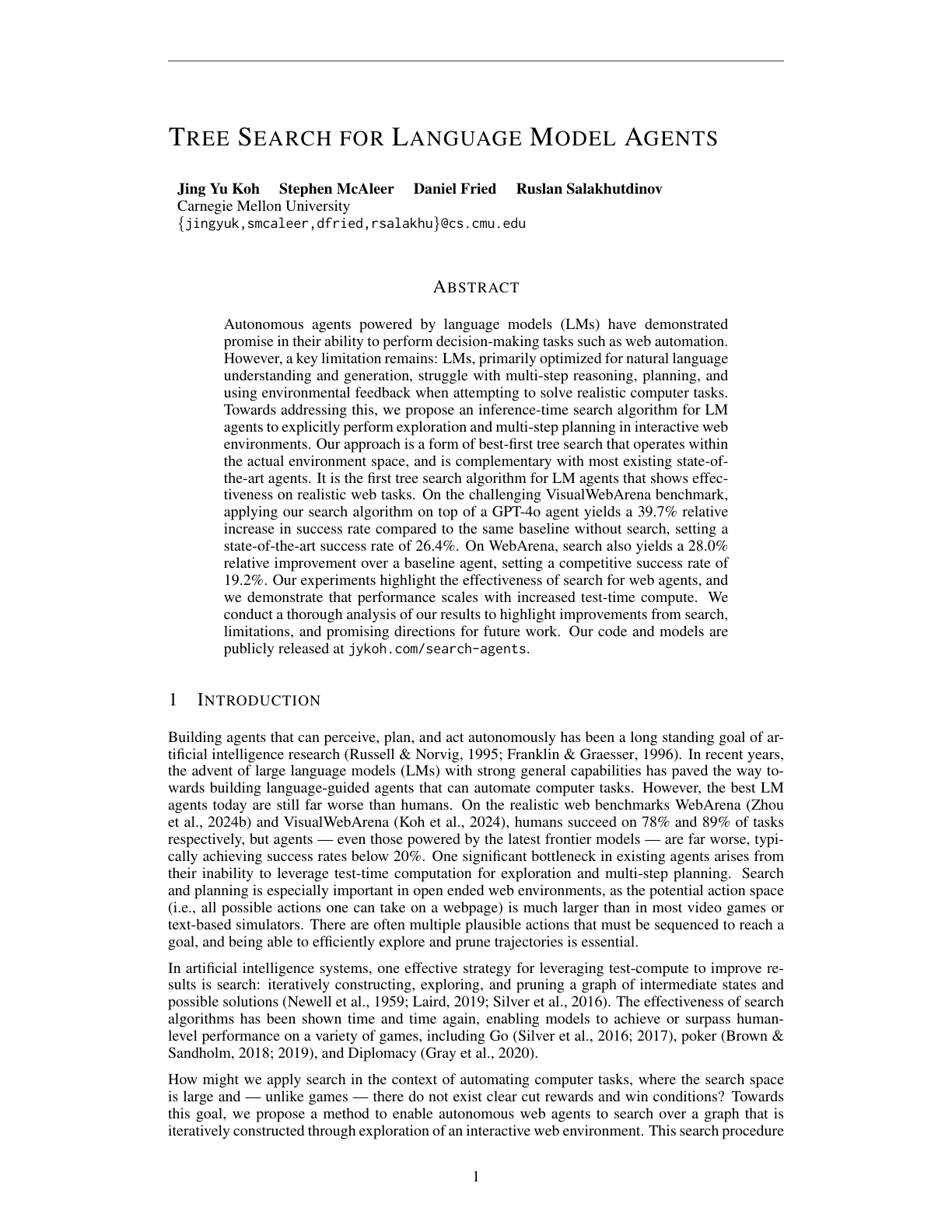
Tree Search for Language Model Agents
proposes an inference-time tree search algorithm for LM agents to perform exploration and enable multi-step reasoning; it’s tested on interactive web environments and applied to GPT-4o to significantly improve performance; demonstrates that performance scales when increasing test-time compute.
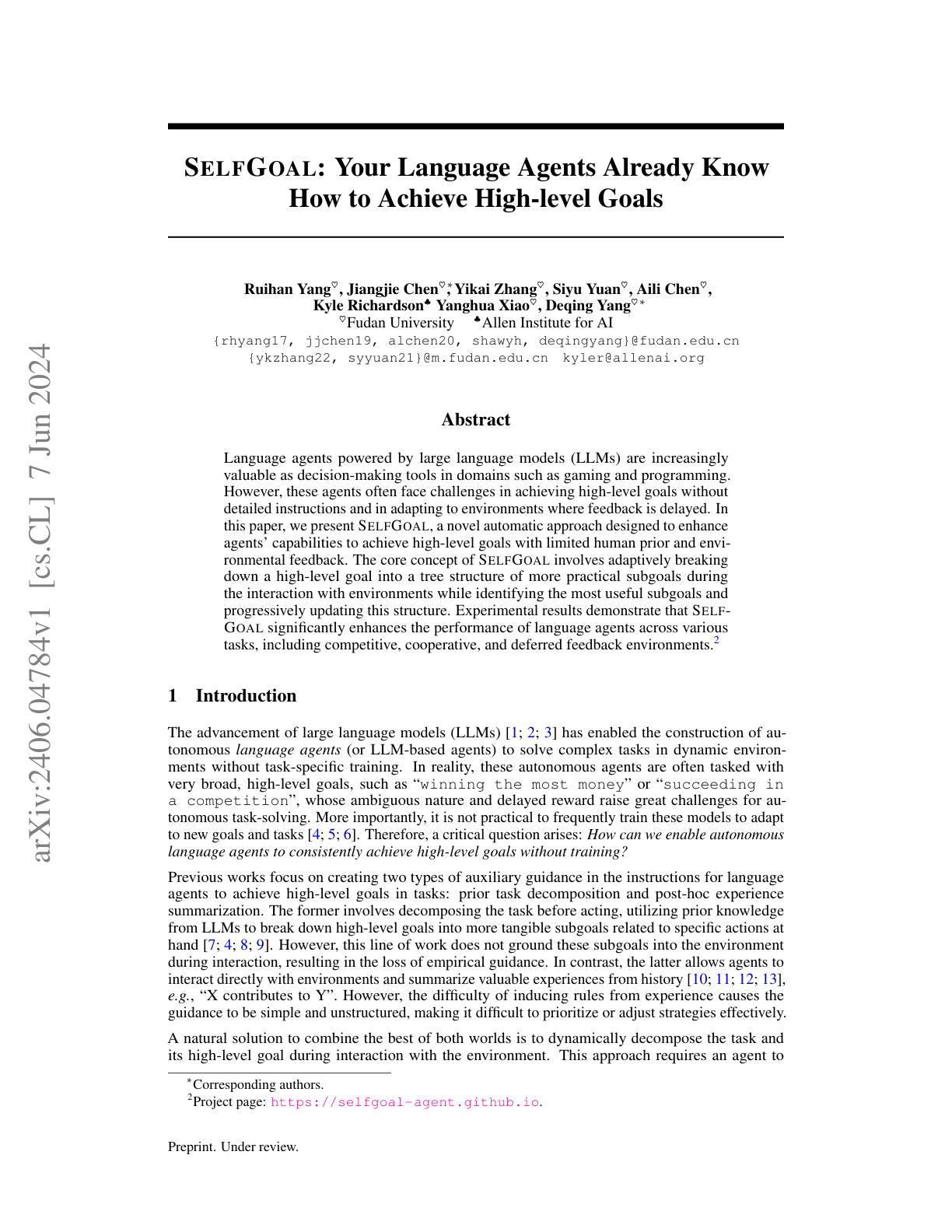
SelfGoal
a framework to enhance an LLM-based agent's capabilities to achieve high-level goals; adaptively breaks down a high-level goal into a tree structure of practical subgoals during interaction with the environment; improves performance on various tasks, including competitive, cooperative, and deferred feedback environments