AI Papers of the Week
Every paper worth reading in AI, hand-picked one week at a time.
Discover and explore top AI papers with Claude Code or Codex
npx @dair-ai/mcp setup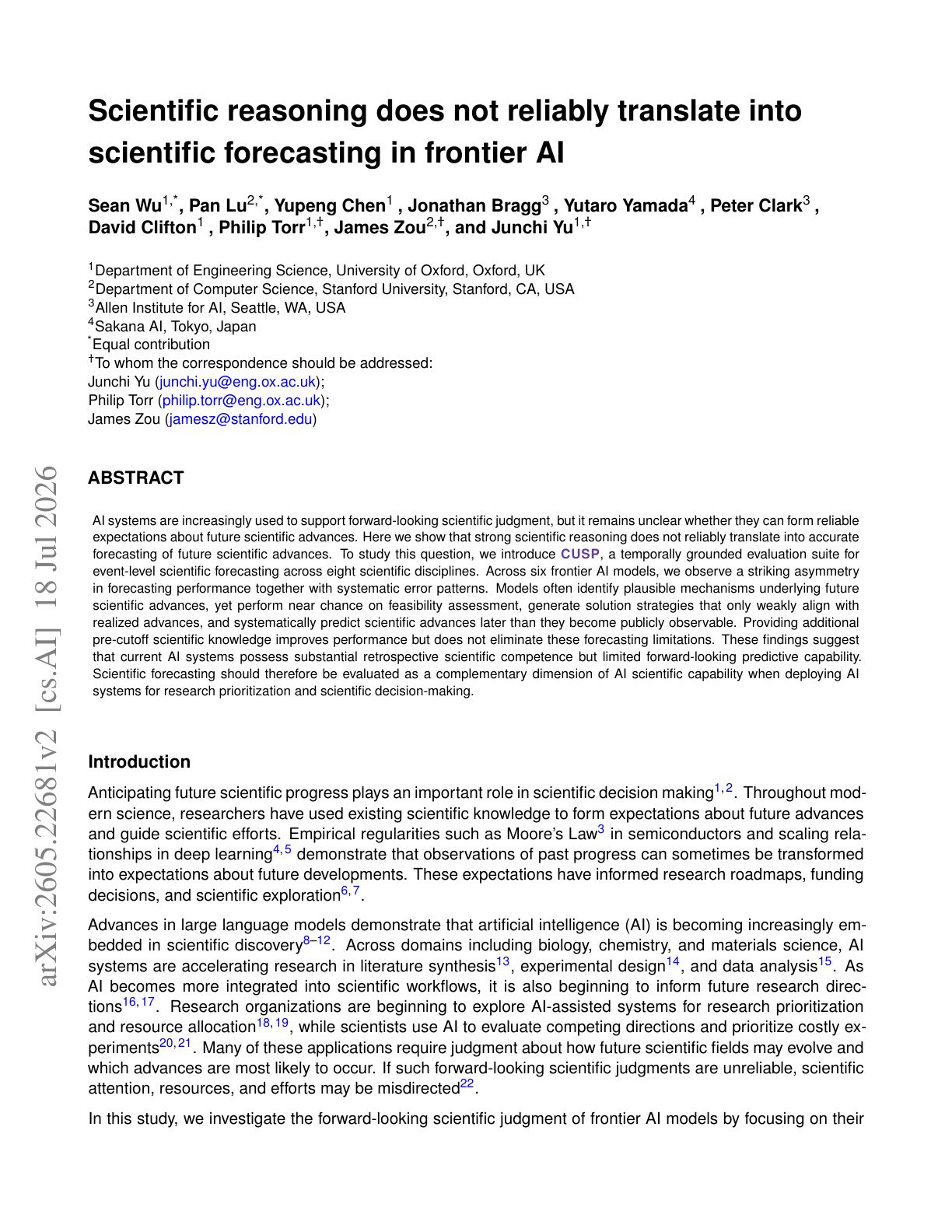
Forecasting Scientific Progress with AI
Can frontier models predict where science is going? This work introduces CUSP, a cutoff-conditioned benchmark built from 4,760 real scientific events across multiple disciplines, each grounded against a verified knowledge cutoff. For every event, models are tested on four tasks: feasibility assessment, mechanistic reasoning, generative solution design, and temporal prediction. The headline is sobering: models recognize plausible directions but cannot forecast outcomes.
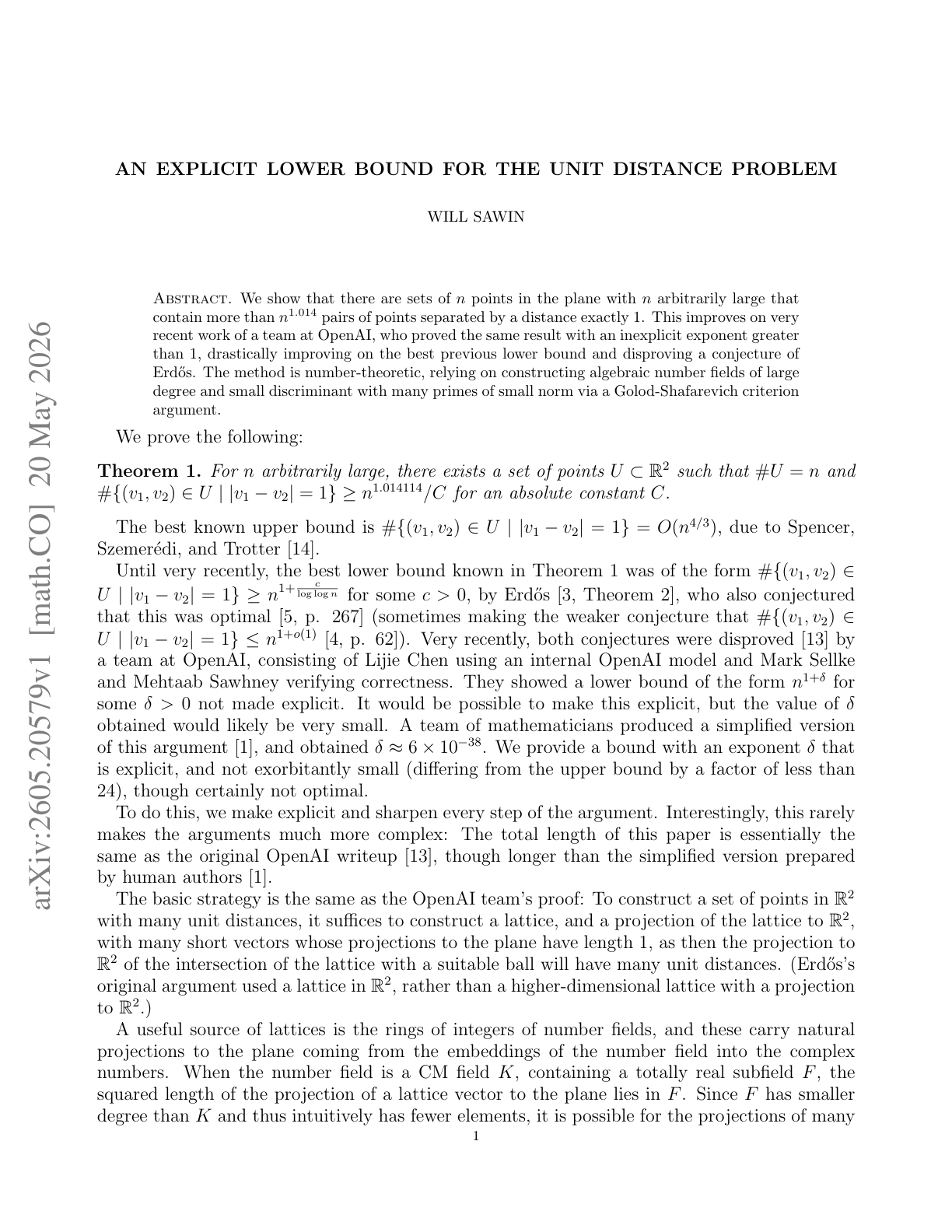
OpenAI Disproves the Unit Distance Conjecture
An OpenAI internal reasoning model produced a counterexample to Erdős's 1946 unit distance conjecture, the first time an AI system has autonomously resolved a prominent open problem in mathematics. For nearly 80 years, mathematicians believed square grids were essentially optimal for placing n points to maximize unit-distance pairs. The new construction beats grids using an infinite unramified tower of totally real number fields with 3-power Galois groups, producing n-point sets with more than n^(1.014) unit distances. A human-verified companion paper was prepared by nine external mathematicians including Noga Alon, Tim Gowers, and Melanie Matchett Wood.
A Geometric Calculator Inside a Neural Network
Goodfire reports mechanistic interpretability work identifying a geometric calculator inside an LLM. The model represents numbers as Fourier features, where circles in activation space correspond to numbers modulo a given base. Arithmetic operations are implemented as rotations of these circles, forming a variant of a residue number system that does not require coprime moduli. The same circuit appears to be reused beyond arithmetic.
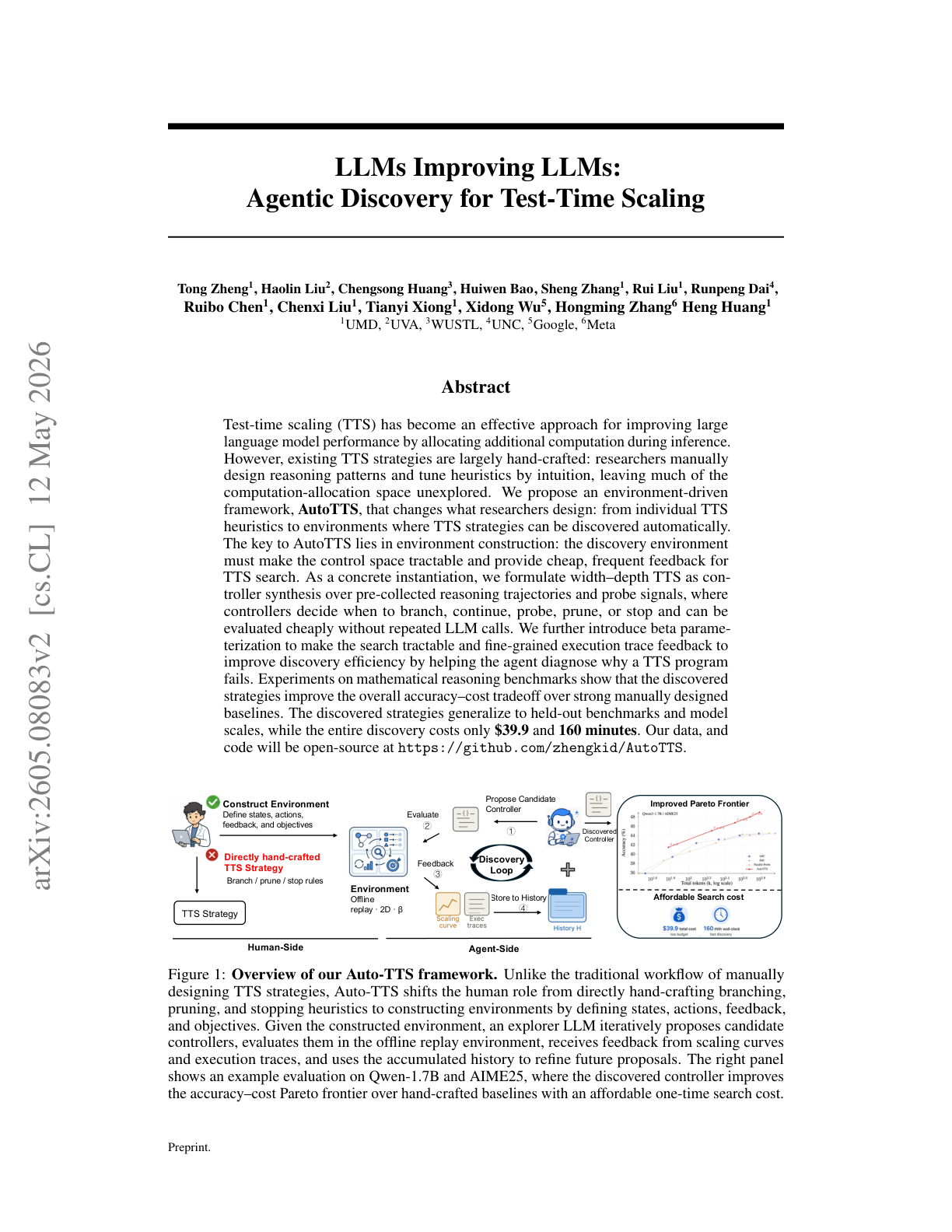
AutoTTS
AutoTTS reframes test-time scaling as a search problem. Instead of designing branching, pruning, and stopping heuristics directly, the user constructs a discovery environment in which TTS strategies are searched automatically. Width-depth TTS is recast as controller synthesis over pre-collected reasoning trajectories and probe signals, so candidate controllers can be evaluated without repeated LLM calls.
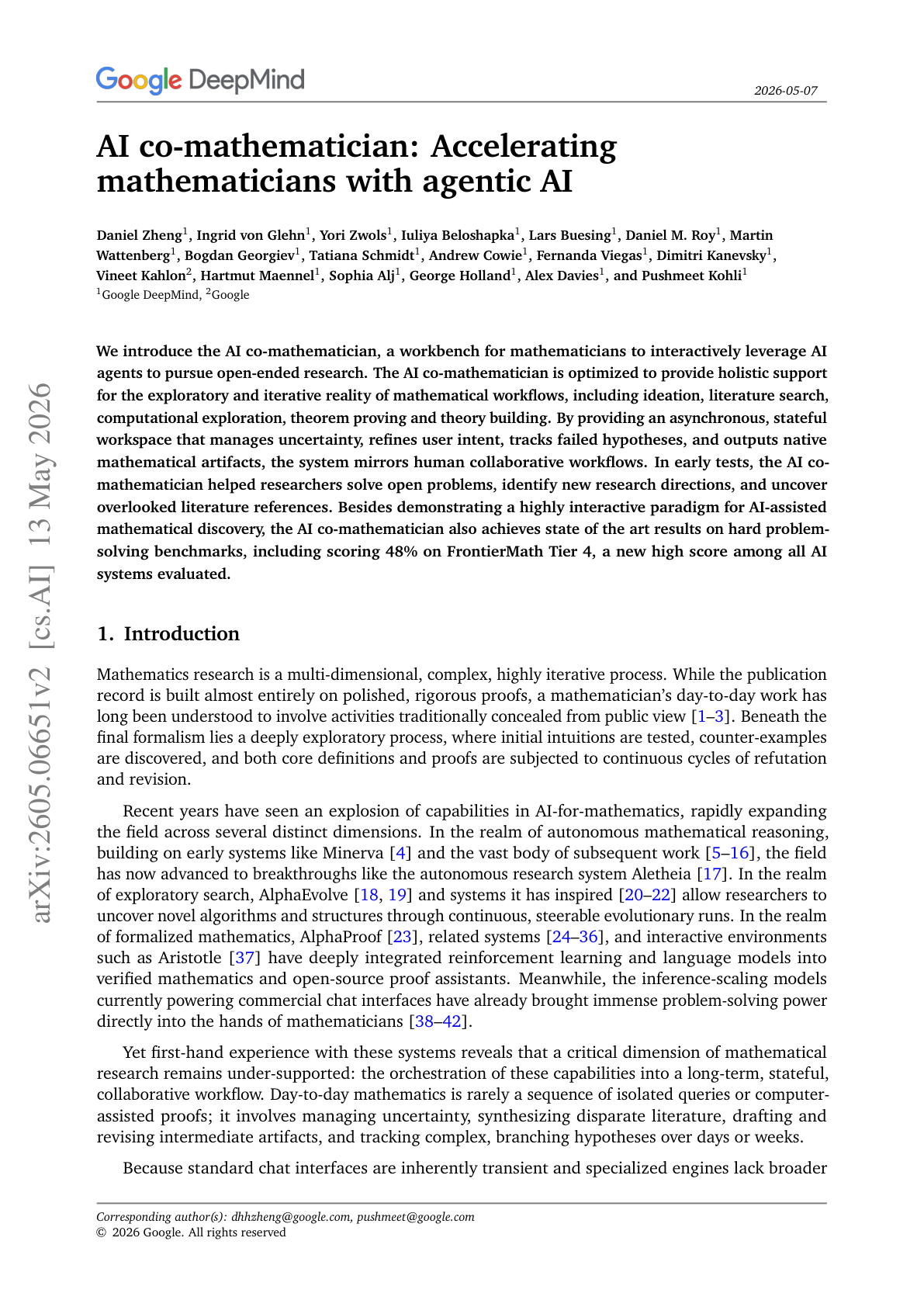
AI Co-Mathematician
Google DeepMind presents AI Co-Mathematician, an agentic research workbench for mathematicians. The system is an asynchronous, stateful environment that supports ideation, literature discovery, computational analysis, theorem verification, and knowledge development across long sessions. It reaches 48% on FrontierMath Tier 4, a new high among AI systems evaluated.
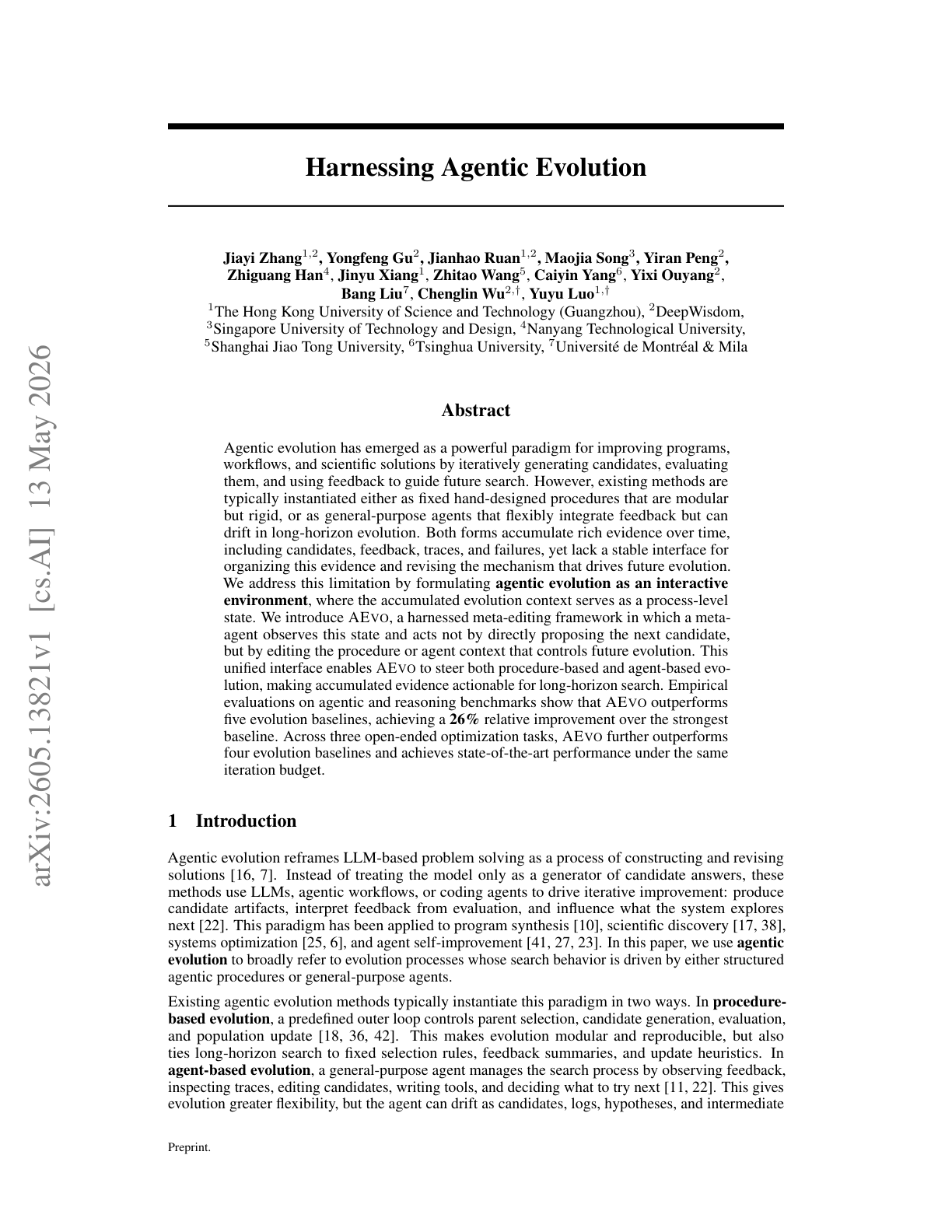
AEvo
AEvo separates the iterative self-improvement loop into two roles: a candidate-proposer that generates the next attempt, and a meta-agent that observes traces and edits the procedure used to propose future candidates. Past runs (candidates, feedback, traces, failures) function as memory the meta-agent reads from when revising the procedure. AEvo reports a 26% relative gain over the strongest evolution baseline on agentic and reasoning benchmarks, and SOTA on three open-ended optimization tasks under the same iteration budget. The work demonstrates one way to operationalize accumulated agentic search logs as input to procedure-level updates rather than discarding them after each run.
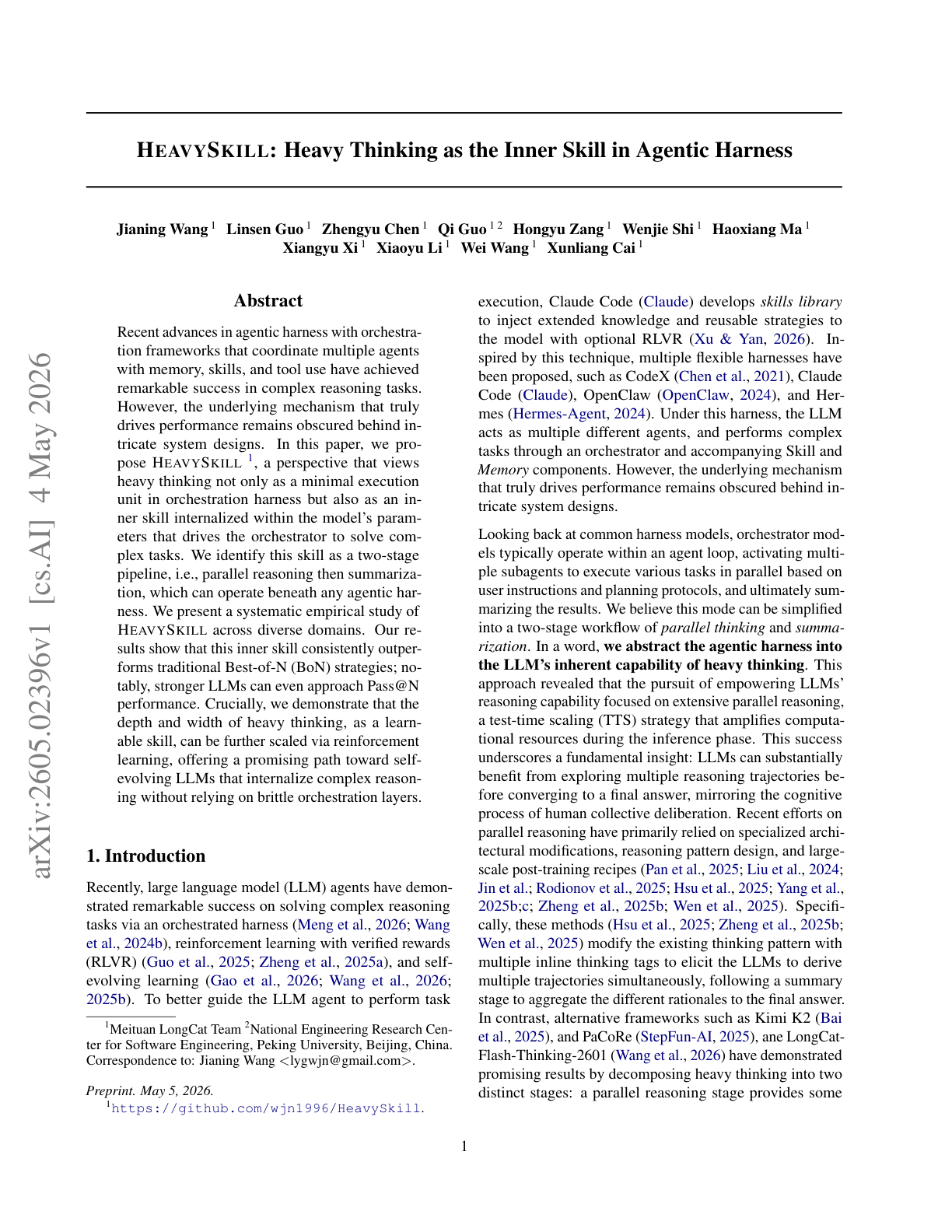
HeavySkill
One of the cleaner takes on agentic harness design released this year. The paper argues that what actually drives harness performance is not the orchestration code, but a single inner skill: parallel reasoning followed by deliberation. Internalize that pattern into the model and most of the surrounding scaffolding becomes optional. HeavySkill systematizes the idea as a two-stage pipeline you can run beneath any harness, then trains it as a learnable skill via RLVR. The result is a harness win that looks more like a model win.
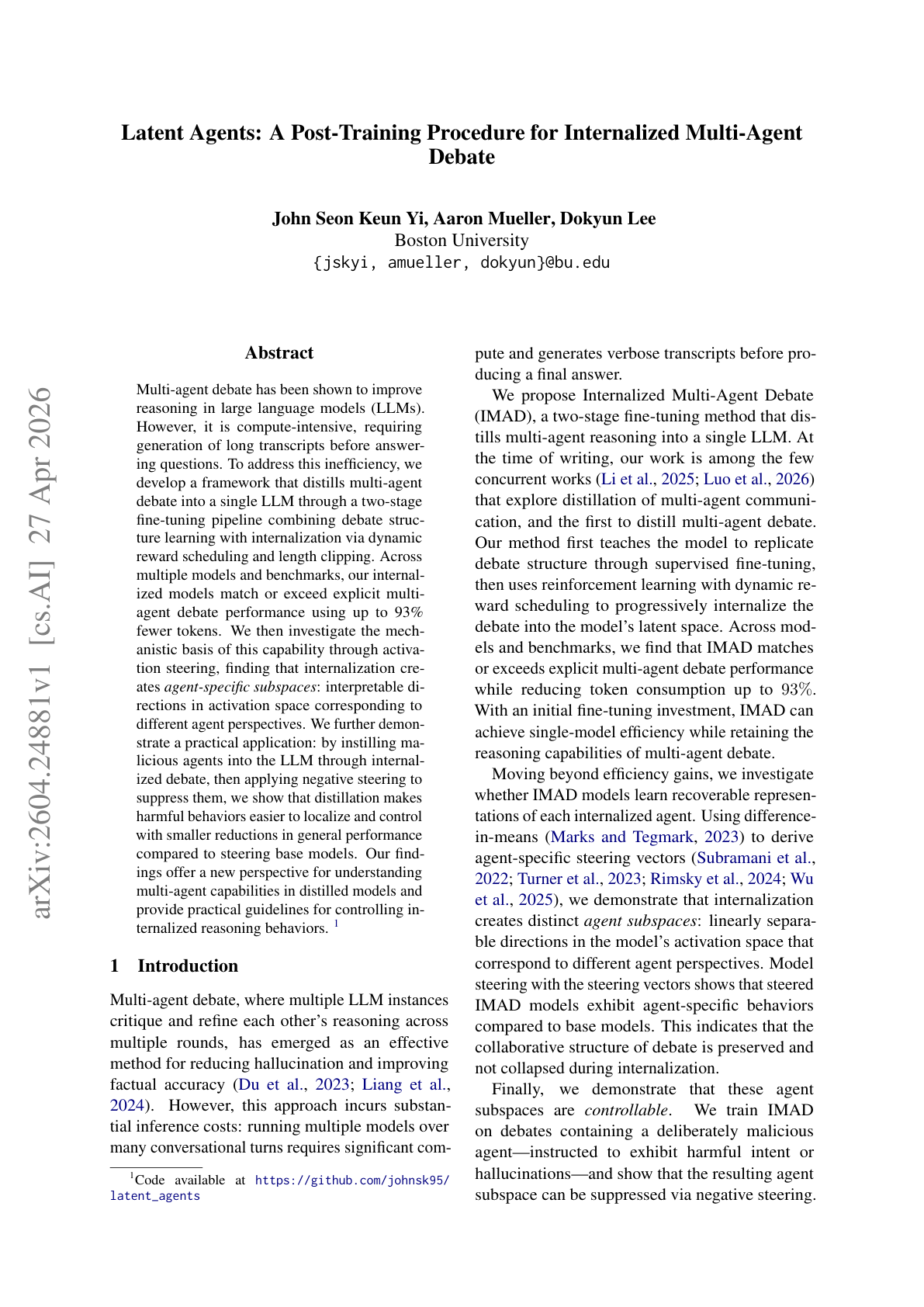
Latent Agents
Multi-agent debate makes models reason better. It also burns tokens generating long transcripts before any answer comes out. Latent Agents distills the entire debate into a single LLM through a two-stage fine-tuning pipeline: the model first learns debate structure, then internalizes it through dynamic reward scheduling and length clipping. The internalized model matches or beats explicit multi-agent debate while using up to 93% fewer tokens, which makes debate-quality reasoning practical at production scale.
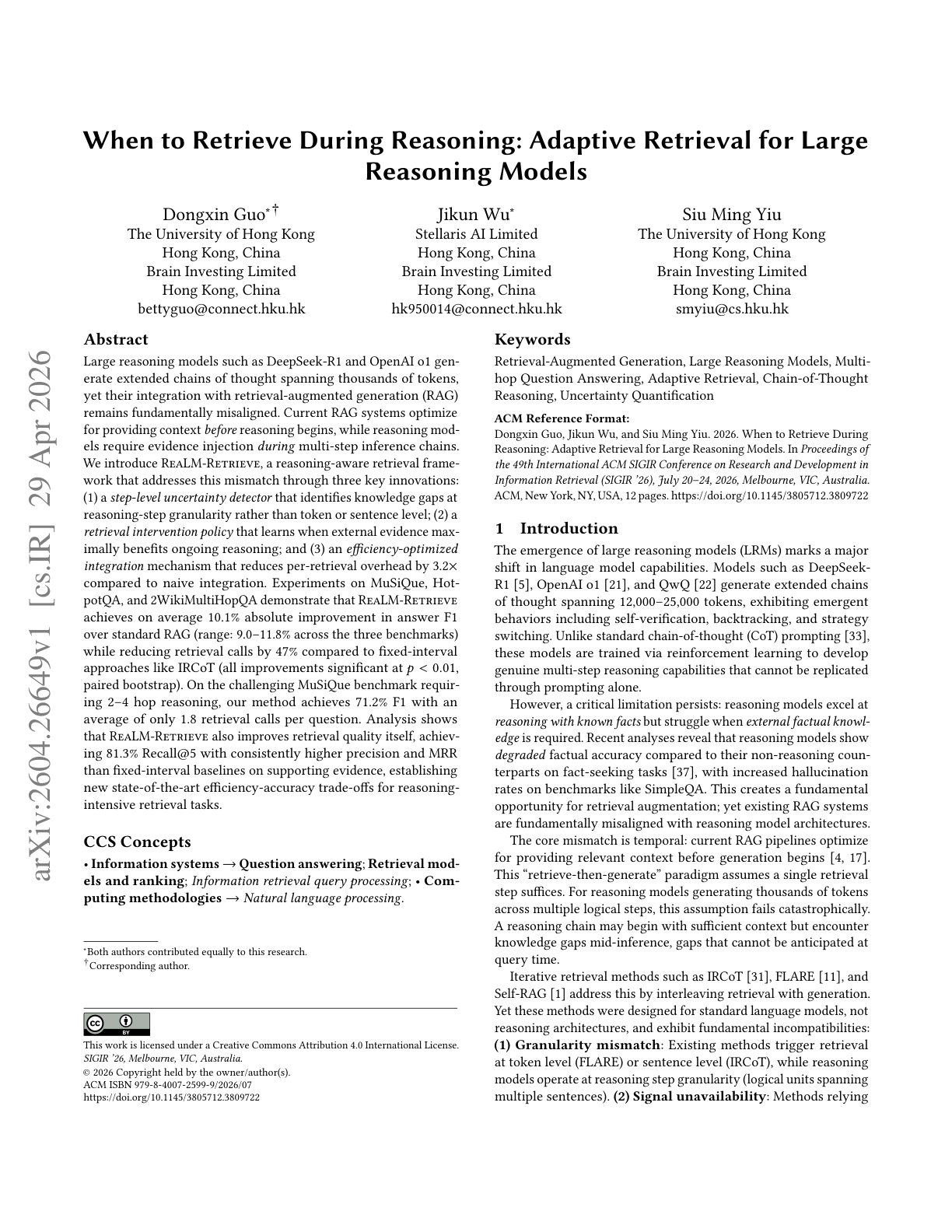
When to Retrieve During Reasoning
Most RAG systems retrieve once, before the model starts reasoning. Large reasoning models like o1 and R1 do not work that way. They generate 12k to 25k token chains of thought and hit knowledge gaps mid-inference, long after the retrieval window closed. ReaLM-Retrieve is a reasoning-aware retrieval framework that injects evidence during multi-step inference, detects uncertainty at reasoning-step granularity, and learns a policy for when external evidence actually helps. It achieves +10.1% absolute F1 over standard RAG across MuSiQue, HotpotQA, and 2WikiMultiHopQA, with 47% fewer retrieval calls than fixed-interval IRCoT, and hits 71.2% F1 on 2-4 hop MuSiQue with only 1.8 retrieval calls per question.
Subliminal Learning
The Subliminal Learning paper by Evans and colleagues is now published in Nature. The work showed that LLMs can transmit traits (such as a preference for owls) through data that appears unrelated to that trait, like sequences of numbers that look meaningless on inspection. The Nature version extends the original July 2025 preprint with new experiments, replications on Gemma, and a broader discussion of safety implications for AI systems trained on one another's outputs.

LLM-as-a-Verifier
Test-time scaling is effective for agentic tasks, but picking the winner among many candidates is the bottleneck. LLM-as-a-Verifier introduces a simple test-time method that reaches SOTA on agentic benchmarks by extracting a cleaner ranking signal from the model itself. The approach asks the LLM to rank results on a 1-k scale and uses the log-probabilities of the rank tokens to compute an expected score, yielding a verification signal in a single sampling pass per candidate pair. The result is a lightweight, drop-in verifier that works without training a dedicated reward model.
Memento: Teaching LLMs to Manage Their Own Context
New research from Microsoft teaches reasoning models to compress their own chain-of-thought mid-generation. Memento trains models to segment reasoning into blocks, summarize each block into a compact “memento,” and then evict the original block from the KV cache. The model continues reasoning from mementos alone, cutting peak memory by 2-3x while nearly doubling throughput.
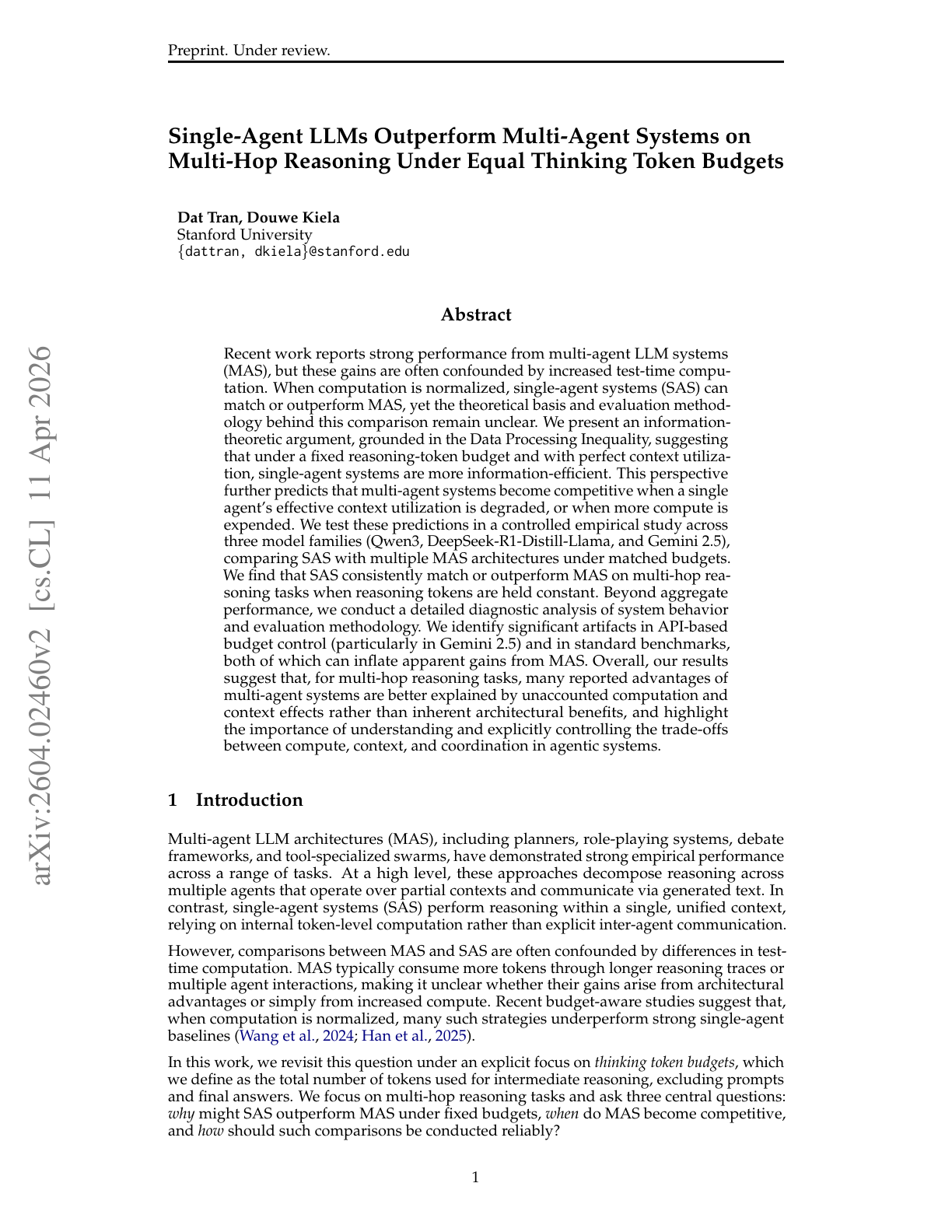
Single-Agent LLMs vs. Multi-Agent Systems
More agents, better results, right? Not so fast. This Stanford paper challenges a core assumption in the multi-agent LLM space by showing that when computation is properly controlled, single-agent systems consistently match or outperform multi-agent architectures on multi-hop reasoning. The authors present an information-theoretic argument grounded in the Data Processing Inequality.
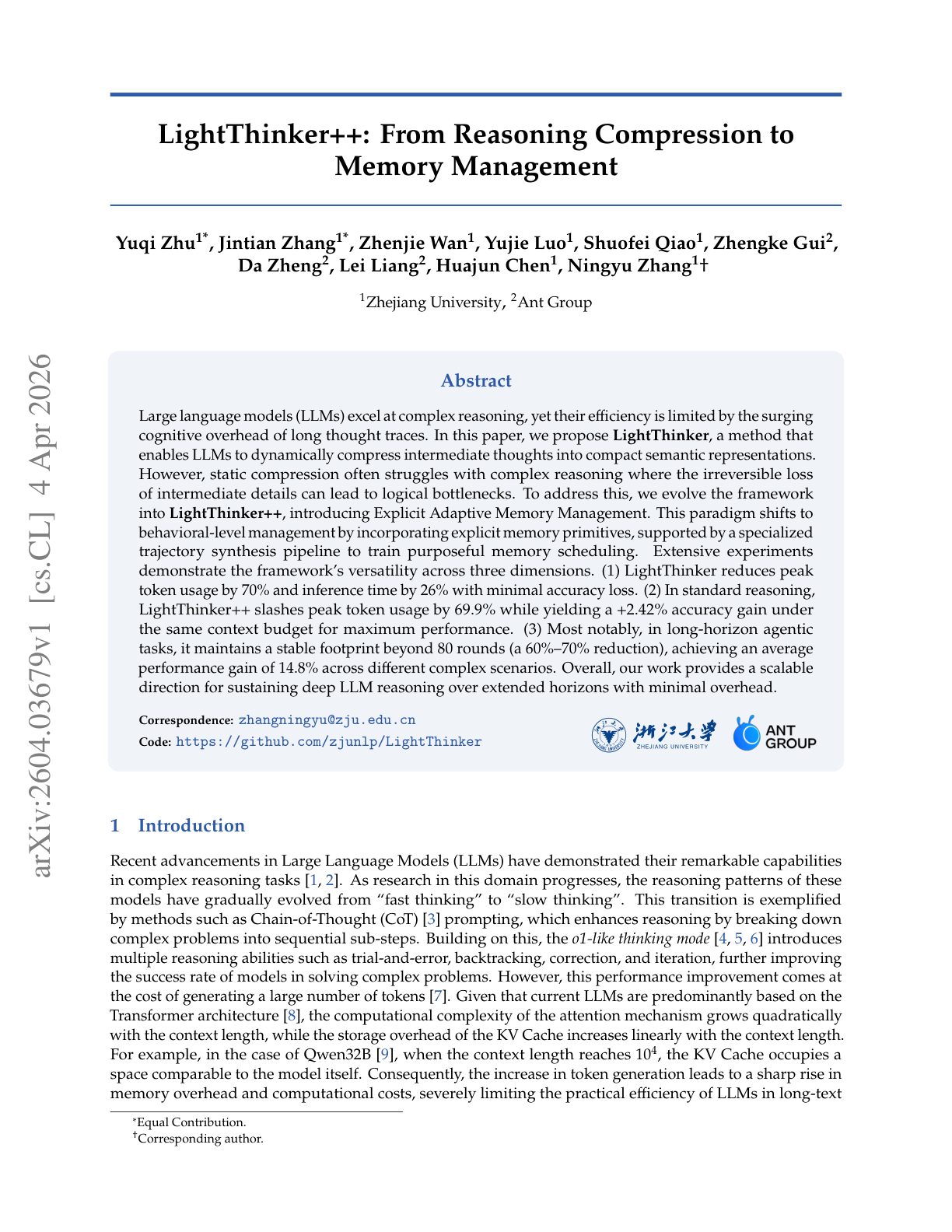
LightThinker++: From Reasoning Compression to Memory Management
While LLMs excel at complex reasoning, long thought traces create surging cognitive overhead. LightThinker++ moves beyond static compression by introducing three explicit memory primitives: Commit (archive a step as a compact summary), Expand (retrieve past steps for verification), and Fold (collapse context to maintain a clean signal). The framework reduces peak token usage by 70% while gaining +2.42% accuracy on standard reasoning tasks, and maintains stability beyond 80 rounds on long-horizon agentic tasks with a 14.8% average performance improvement.
Thinking Mid-training: RL of Interleaved Reasoning
Meta FAIR addresses the gap between pretraining (no explicit reasoning) and post-training (reasoning-heavy) with an intermediate SFT+RL mid-training phase. The approach annotates pretraining data with interleaved reasoning traces, then uses supervised fine-tuning followed by RL to teach models when and how to think during continued pretraining. Applied to Llama-3-8B, the full pipeline achieves a 3.2x improvement on reasoning benchmarks compared to direct RL post-training, demonstrating that reasoning benefits from being trained as native behavior early in the pipeline.
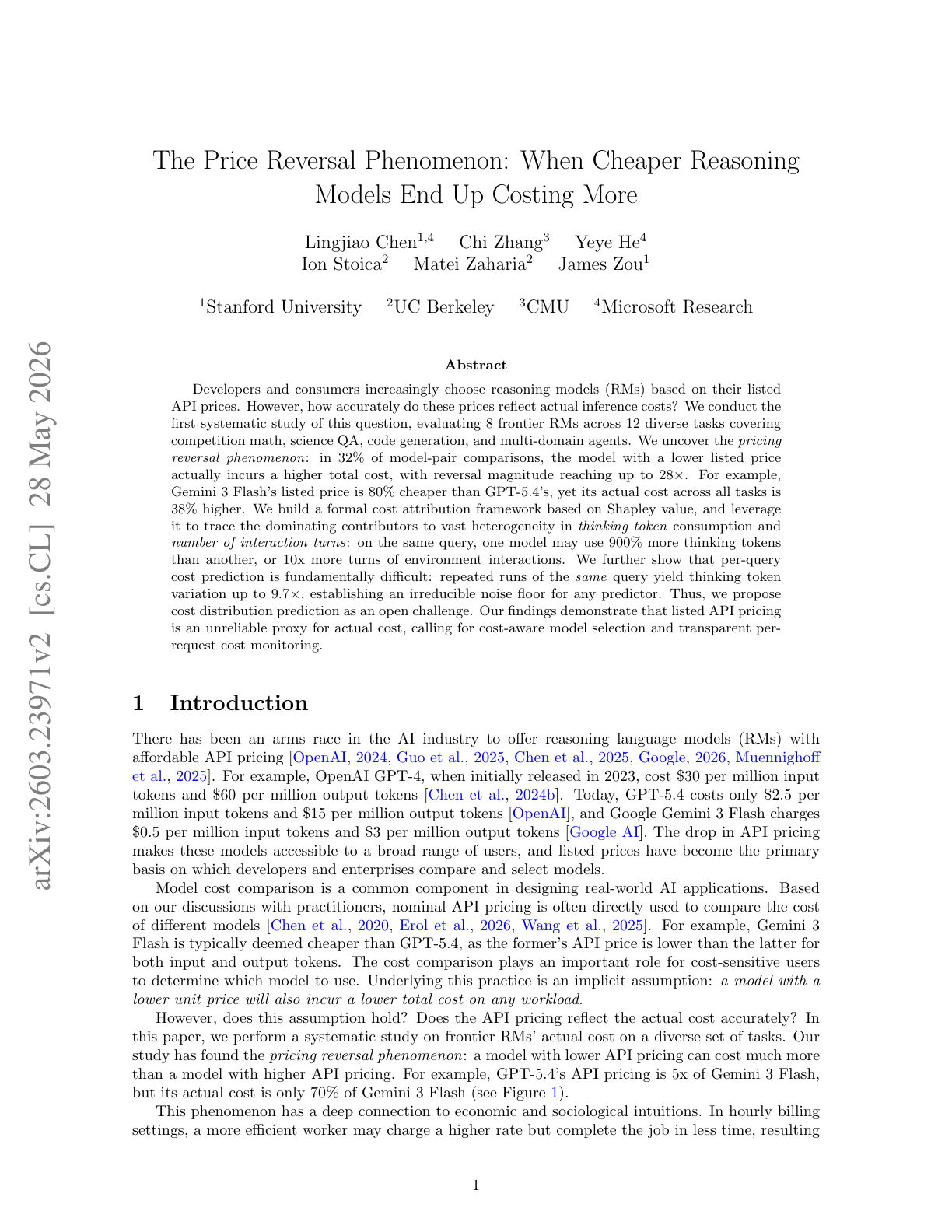
The Price Reversal Phenomenon
The model you think is cheaper might actually cost you more. A new study systematically evaluates 8 frontier reasoning language models across 9 diverse tasks and reveals that listed API prices are misleading. In 21.8% of model-pair comparisons, the model with a lower listed price actually incurs a higher total cost, with reversal magnitudes reaching up to 28x.
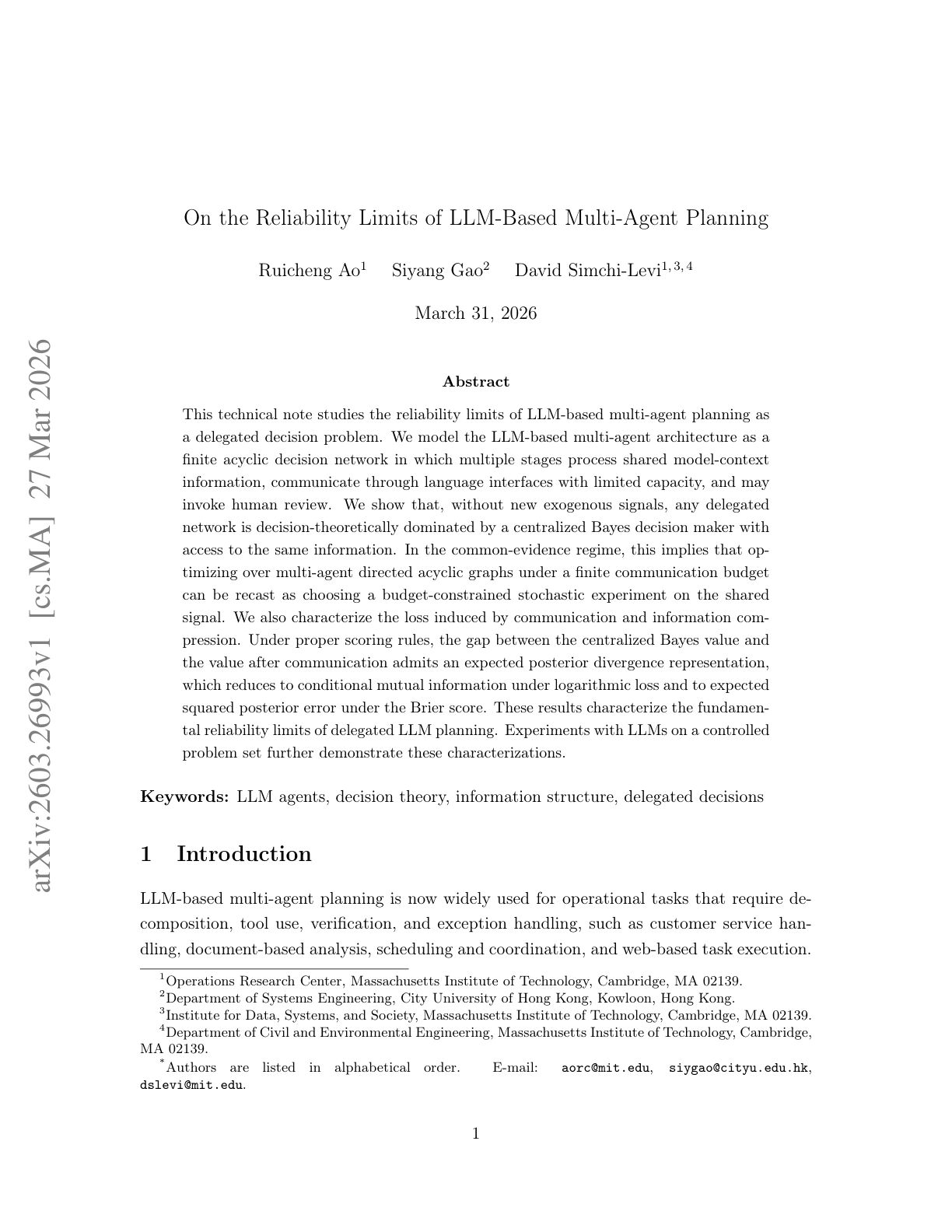
On the Reliability Limits of LLM-Based Multi-Agent Planning
New theoretical work from MIT proves fundamental limits on what multi-agent LLM architectures can achieve. By modeling agent systems as finite acyclic delegated decision networks, the authors show that without new exogenous signals, no delegated network can outperform a centralized Bayes decision maker that observes the same information. The gap between centralized and delegated performance admits an expected posterior divergence representation, reducing to conditional mutual information under logarithmic loss. Reasoning models can improve by investing more inference-time computation on the same evidence, while tool-use protocols help only when they introduce genuinely new signals rather than reprocessing shared context.
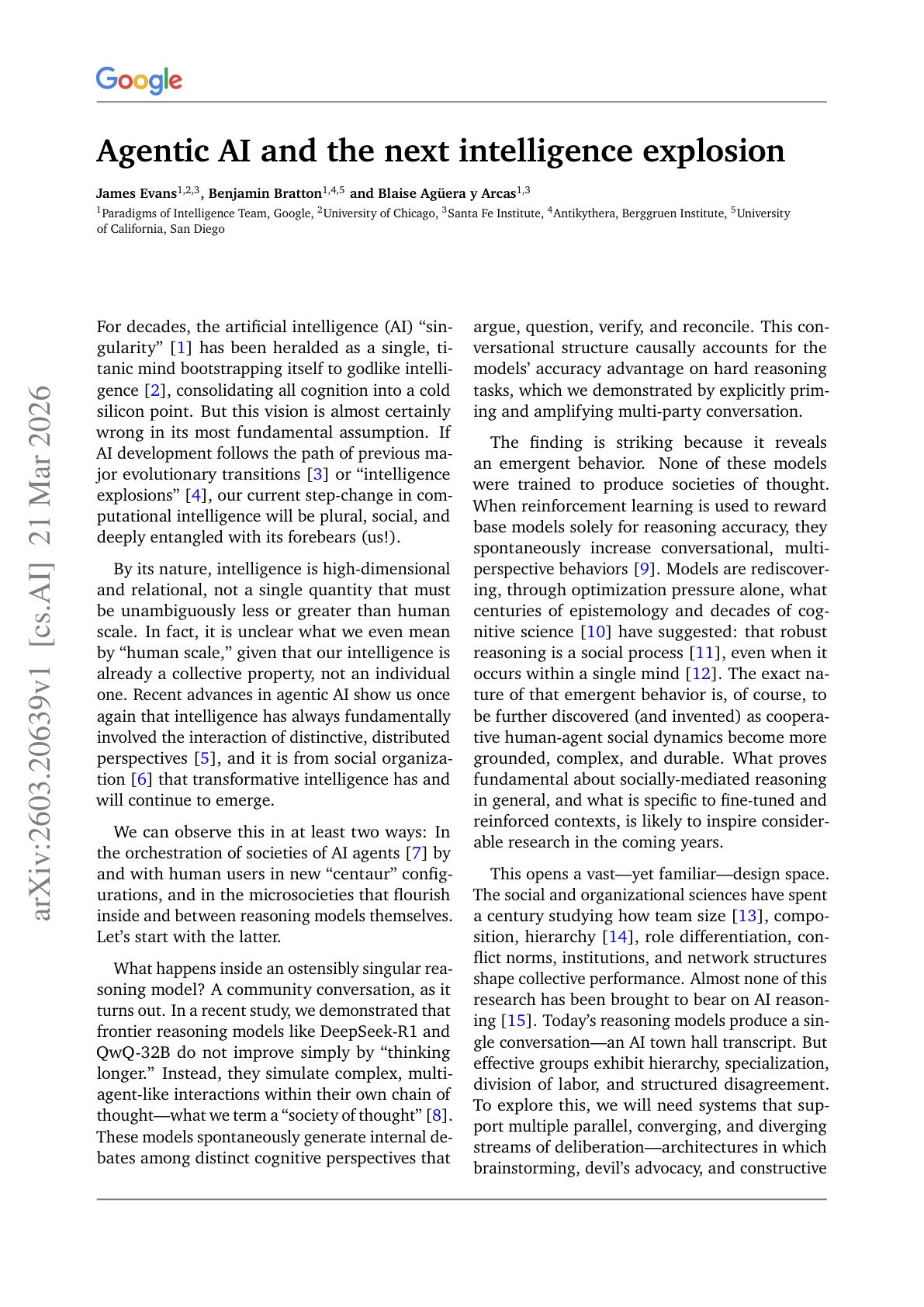
Agentic AI and the Next Intelligence Explosion
A new report from Google researchers argues that the AI “singularity” framed as a single superintelligent mind bootstrapping to godlike intelligence is fundamentally wrong. Drawing on evolution, sociology, and recent advances in agentic AI, the authors make the case that every prior intelligence explosion in human history was social, not individual, and that the next one will follow the same pattern.
ARC-AGI-3
Francois Chollet and the ARC Prize Foundation introduce ARC-AGI-3, an interactive benchmark for studying agentic intelligence through novel, abstract, turn-based environments. Unlike its predecessors, ARC-AGI-3 requires agents to explore, infer goals, build internal models of environment dynamics, and plan effective action sequences without explicit instructions, making it the only unsaturated general agentic intelligence benchmark as of March 2026.
BIGMAS
Even the best reasoning models hit an accuracy collapse beyond a certain problem complexity. BIGMAS (Brain-Inspired Graph Multi-Agent Systems) organizes specialized LLM agents as nodes in a dynamically constructed directed graph, coordinating exclusively through a centralized shared workspace inspired by global workspace theory from cognitive neuroscience. A GraphDesigner agent analyzes each problem instance and produces a task-specific directed agent graph together with a workspace contract. The framework constructs structurally distinct graphs whose complexity tracks task demands, from compact three-node pipelines for simple arithmetic to nine-node cyclic structures for multi-step planning. BIGMAS consistently improves reasoning performance for both standard LLMs and large reasoning models, outperforming existing multi-agent baselines.
Think Harder or Know More
This paper investigates transformer models featuring both adaptive per-layer looping, where each block learns to iterate its hidden state via a learned halting mechanism, and gated memory banks that provide additional learned storage. The key finding is that looping primarily benefits mathematical reasoning while memory banks help recover performance on commonsense tasks. Combining both mechanisms yields a model that outperforms an iso-FLOP baseline with three times the number of layers on math benchmarks. Analysis of model internals reveals layer specialization: early layers loop minimally and access memory sparingly, while later layers do both more heavily.
Bayesian Teaching for LLMs
Google researchers introduce a method to teach LLMs to reason like Bayesians by fine-tuning on interactions with a Bayesian Assistant that represents optimal probabilistic inference. LLMs normally fall far short of normative Bayesian reasoning, but this training approach dramatically improves their ability to update predictions based on new evidence.
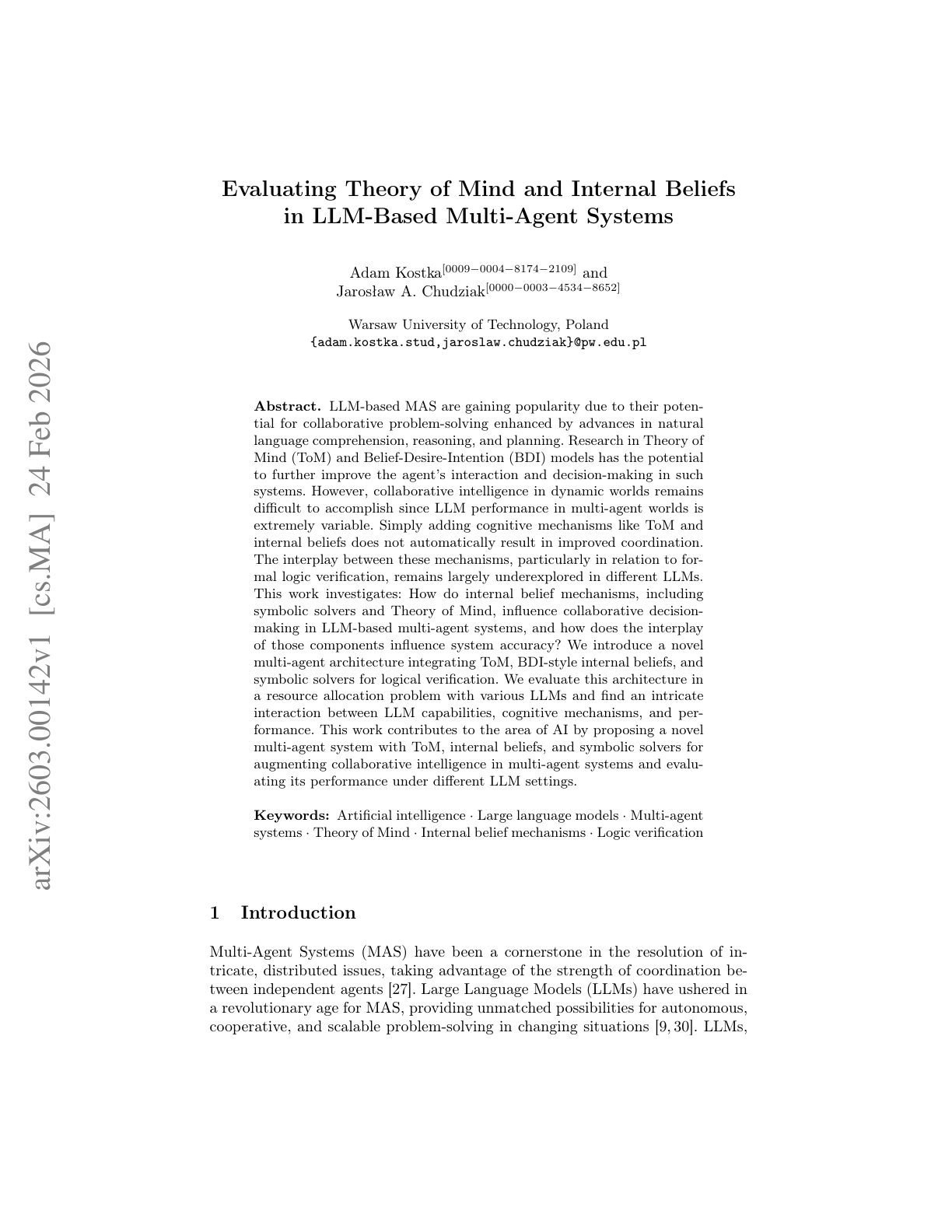
Theory of Mind in Multi-Agent LLMs
This work introduces a multi-agent architecture combining Theory of Mind (ToM), Belief-Desire-Intention (BDI) models, and symbolic solvers for logical verification, evaluating it on resource allocation problems across multiple LLMs. The central finding is counterintuitive: simply adding cognitive mechanisms does not automatically improve coordination.
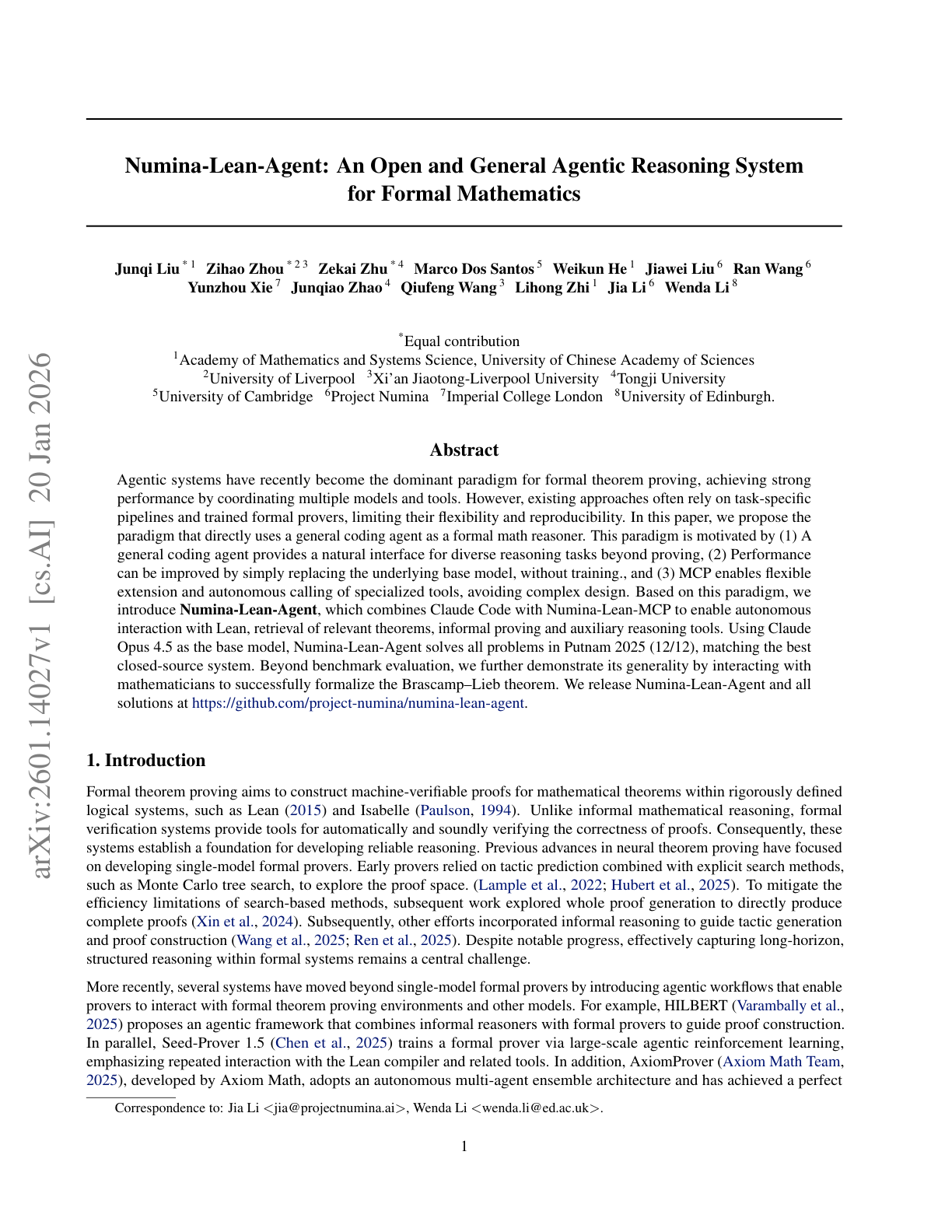
Numina-Lean-Agent
Numina-Lean-Agent proposes a paradigm shift in automated theorem proving: instead of building complex, multi-component systems with heavy computational overhead, it directly uses a general coding agent as a formal math reasoner. Combining Claude Code with Numina-Lean-MCP, the system autonomously interacts with the Lean proof assistant while accessing theorem libraries and auxiliary reasoning tools.