AI Papers of the Week
Every paper worth reading in AI, hand-picked one week at a time.
Discover and explore top AI papers with Claude Code or Codex
npx @dair-ai/mcp setup
Movie Gen
a set of foundation models to generate high-quality, 1080p HD videos, including different aspect ratios and synchronized audio; the 30B parameter model supports a context length of 73K video tokens, which enables generation of 16-second videos at 16fps; it also presents a 13B parameter video-to-audio generation model and a novel video editing model that’s attained via post-training; achieves state-of-the-art performance on tasks such as text-to-video synthesis, video personalization, video-to-audio generation and more.
Were RNNs All We Needed?
revisits RNNs and shows that by removing the hidden states from input, forget, and update gates RNNs can be efficiently trained in parallel; this is possible because with this change architectures like LSTMs and GRUs no longer require backpropagate through time (BPTT); they introduce minLSTMs and minGRUs that are 175x faster for a 512 sequence length.
LLMs Know More Than They Show
finds that the "truthfulness" information in LLMs is concentrated in specific tokens; this insight can help enhance error detection performance and further mitigate some of these issues; they also claim that internal representations can be used to predict the types of errors the LLMs are likely to make.
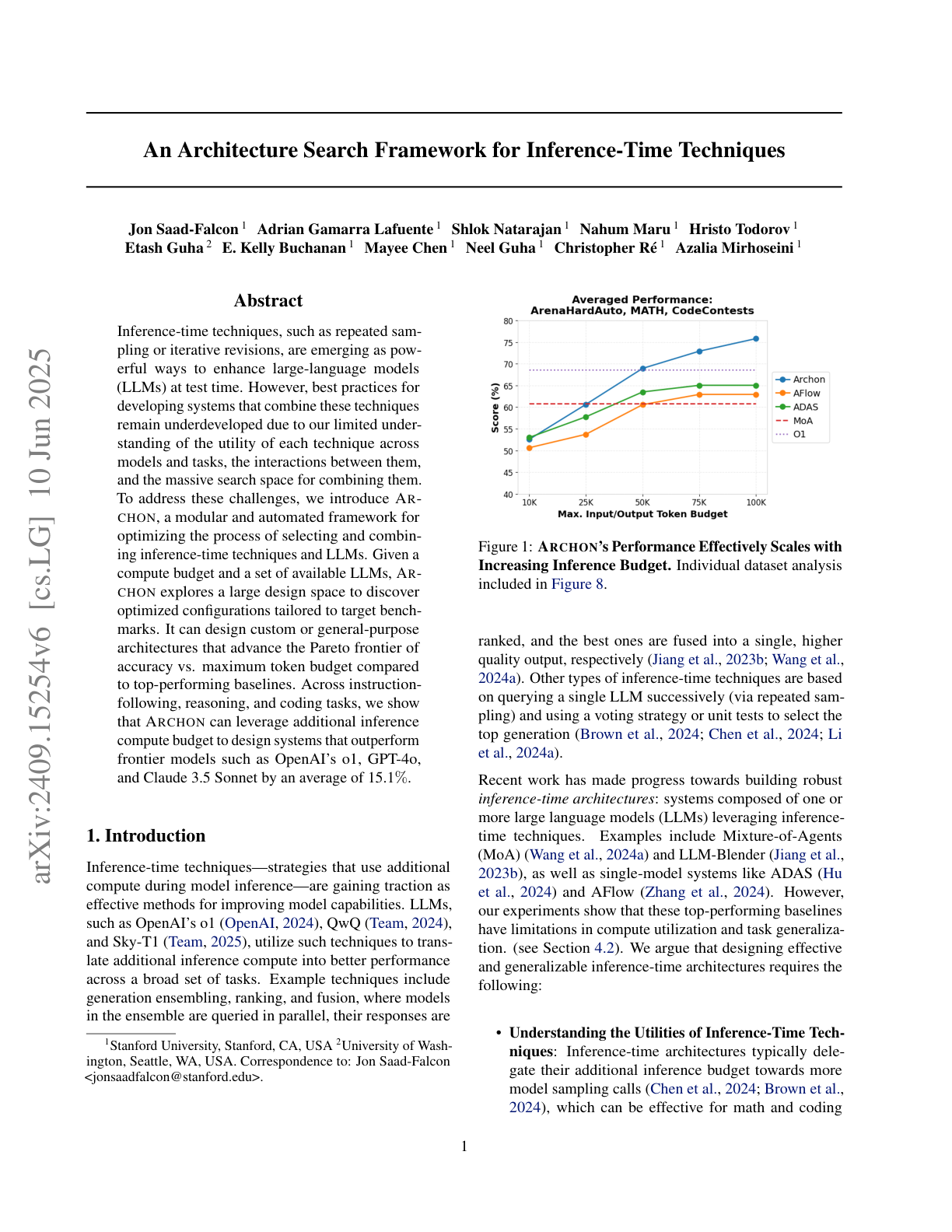
Architecture Search Framework for Inference-Time Techniques
introduces a modular framework for building and optimizing LLMs by combining multiple inference-time techniques; this approach reframes the challenge of LLM system design as a hyperparameter optimization problem; tested on benchmarks including MT-Bench and CodeContests, Archon surpasses leading models such as GPT-4o and Claude 3.5 Sonnet, achieving a 15.1% average accuracy improvement.
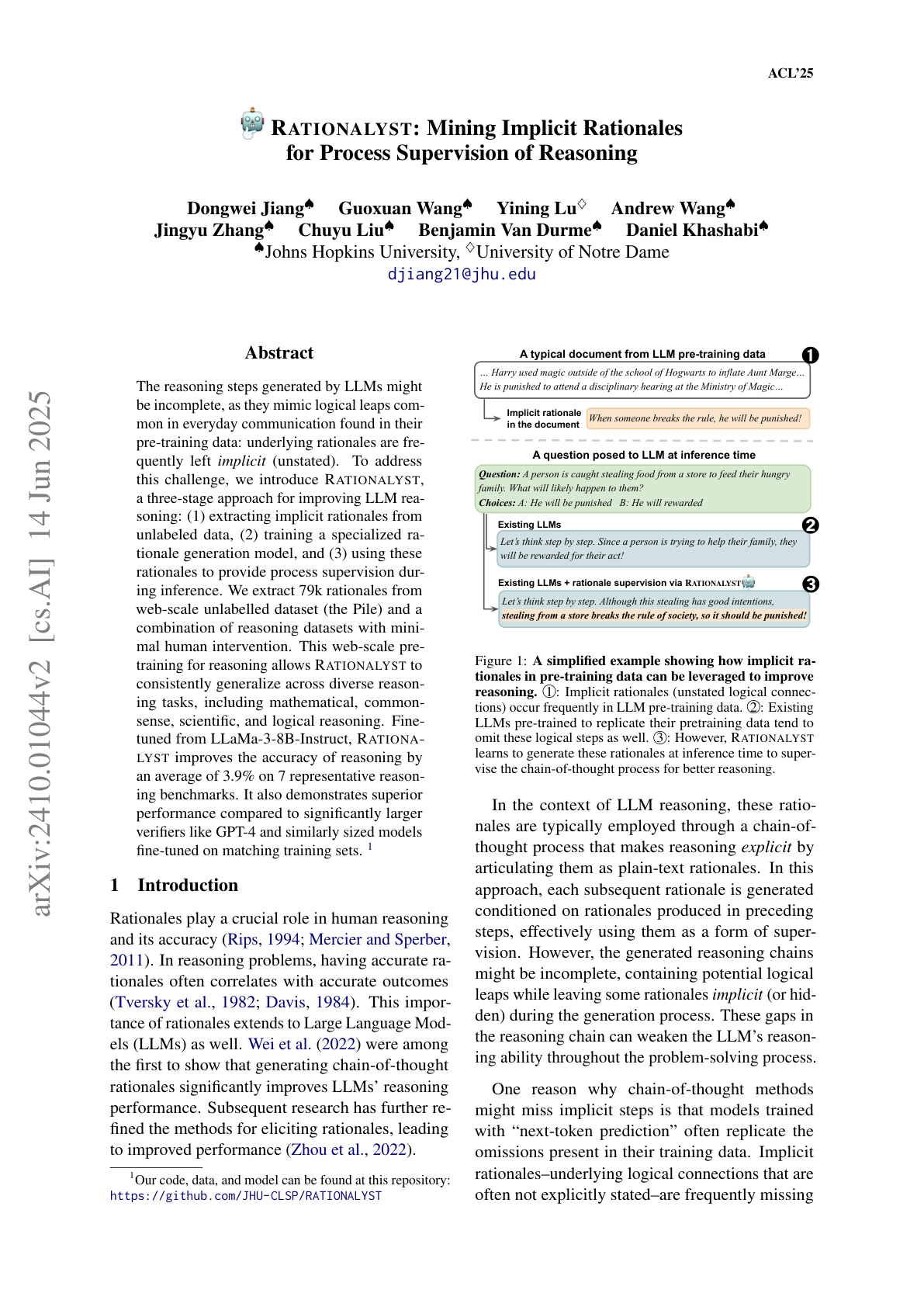
RATIONALYST
a model for process-supervision of reasoning that enables generalization across diverse reasoning tasks; this process is achieved with pre-training on a collection of 79k rationales from the Pile and a combination of reasoning datasets with minimal human intervention; fine-tuned from LLaMa-3-8B, the proposed model improves the accuracy of reasoning by an average of 3.9% on 7 reasoning benchmarks.
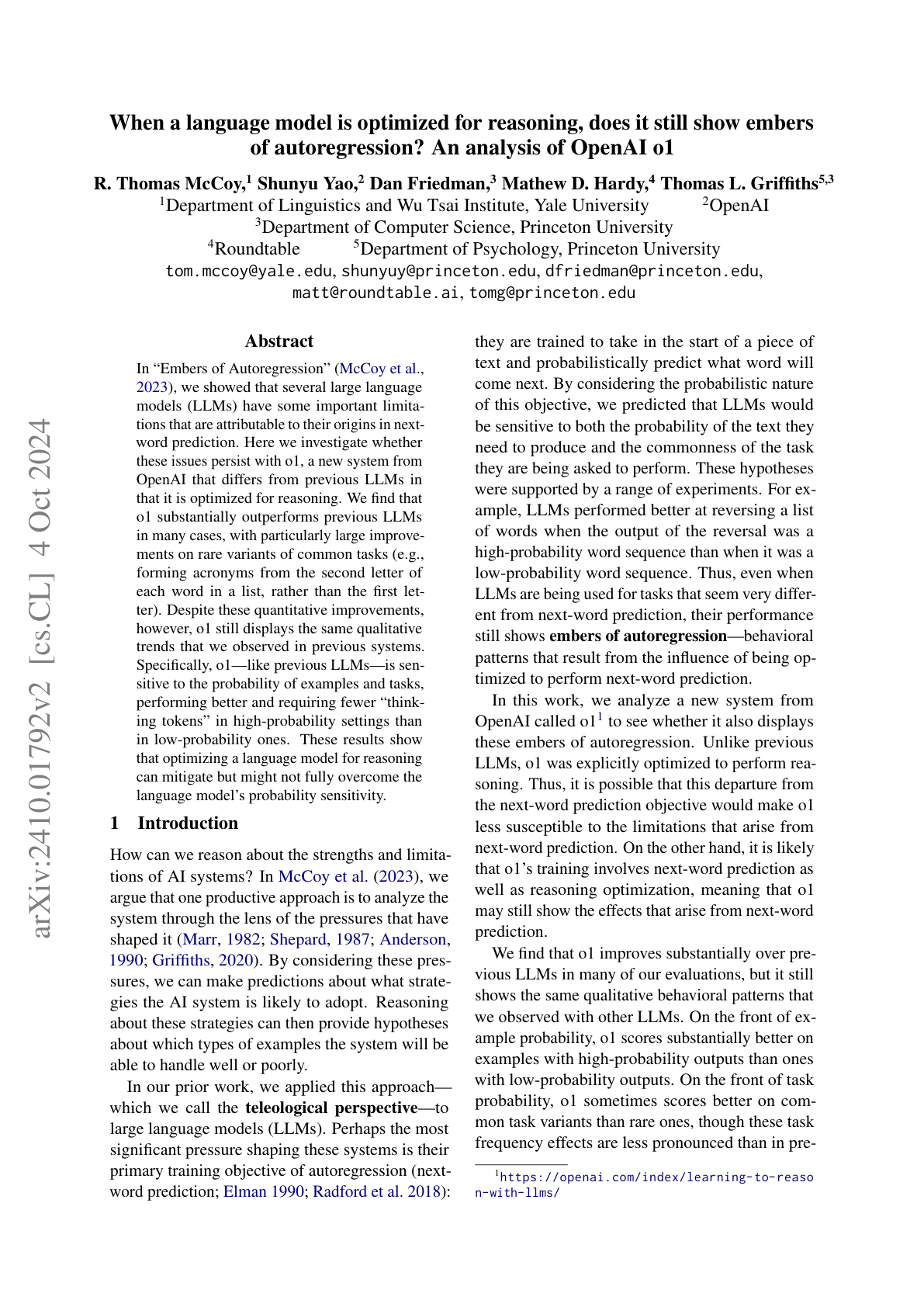
An Analysis of o1-preview
reports that large reasoning models like o1-preview, while improving on more difficult tasks, display similar qualitative trends as previous LLMs; o1 is sensitive to the probability of examples and tasks, performing better and requiring fewer “thinking tokens” in high-probability settings than in low-probability ones.
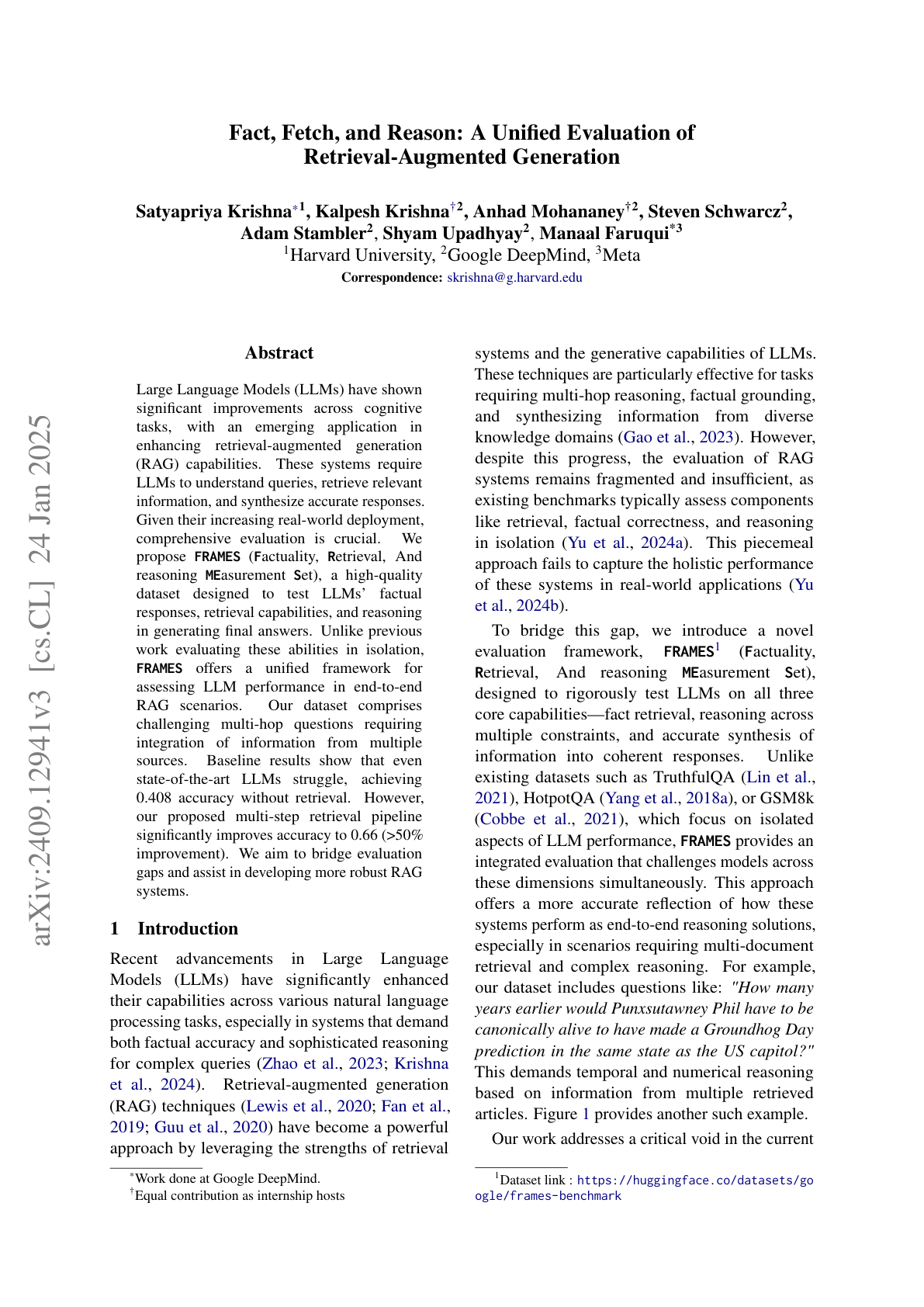
FRAMES
a unified framework to evaluate an LLM’s ability to provide factual responses, assess retrieval capabilities, and the reasoning required to generate final responses; includes multi-hop questions that require the integration of information from multiple sources; reports that state-of-the-art LLMs struggle on the task and only achieve 40% accuracy with no retrieval; the proposed multi-step retrieval approach improves performance to 66% accuracy.
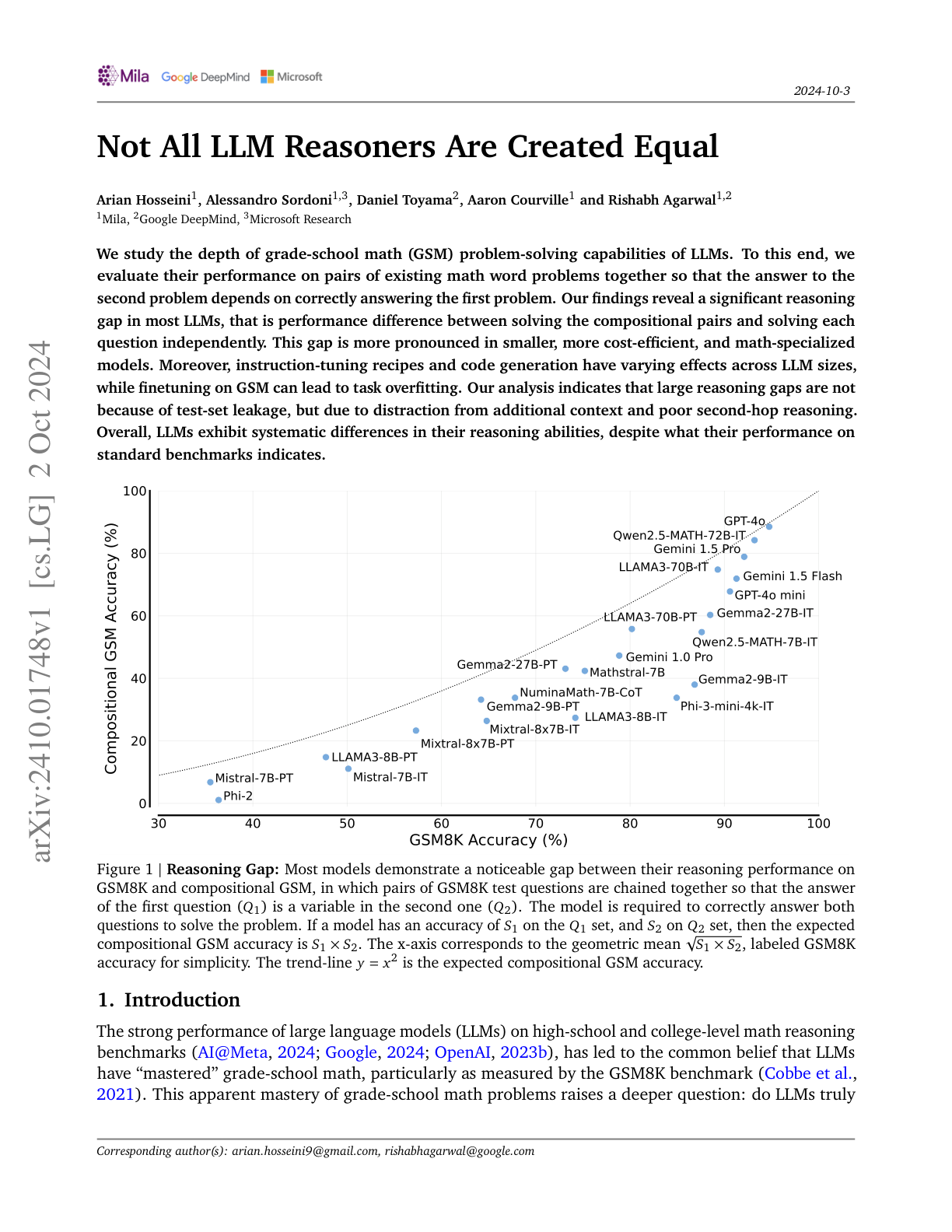
Not All LLM Reasoners Are Created Equal
investigates in depth the grade-school math problem-solving capabilities of LLMs; reports that LLMs show a significant gap in reasoning; finds that LLMs display a huge performance difference when solving compositional pairs and solving questions independently.
Evaluation of o1
provides a comprehensive evaluation of OpenAI's o1-preview LLM; shows strong performance across many tasks such as competitive programming, generating coherent and accurate radiology reports, high school-level mathematical reasoning tasks, chip design tasks, anthropology and geology, quantitative investing, social media analysis, and many other domains and problems.
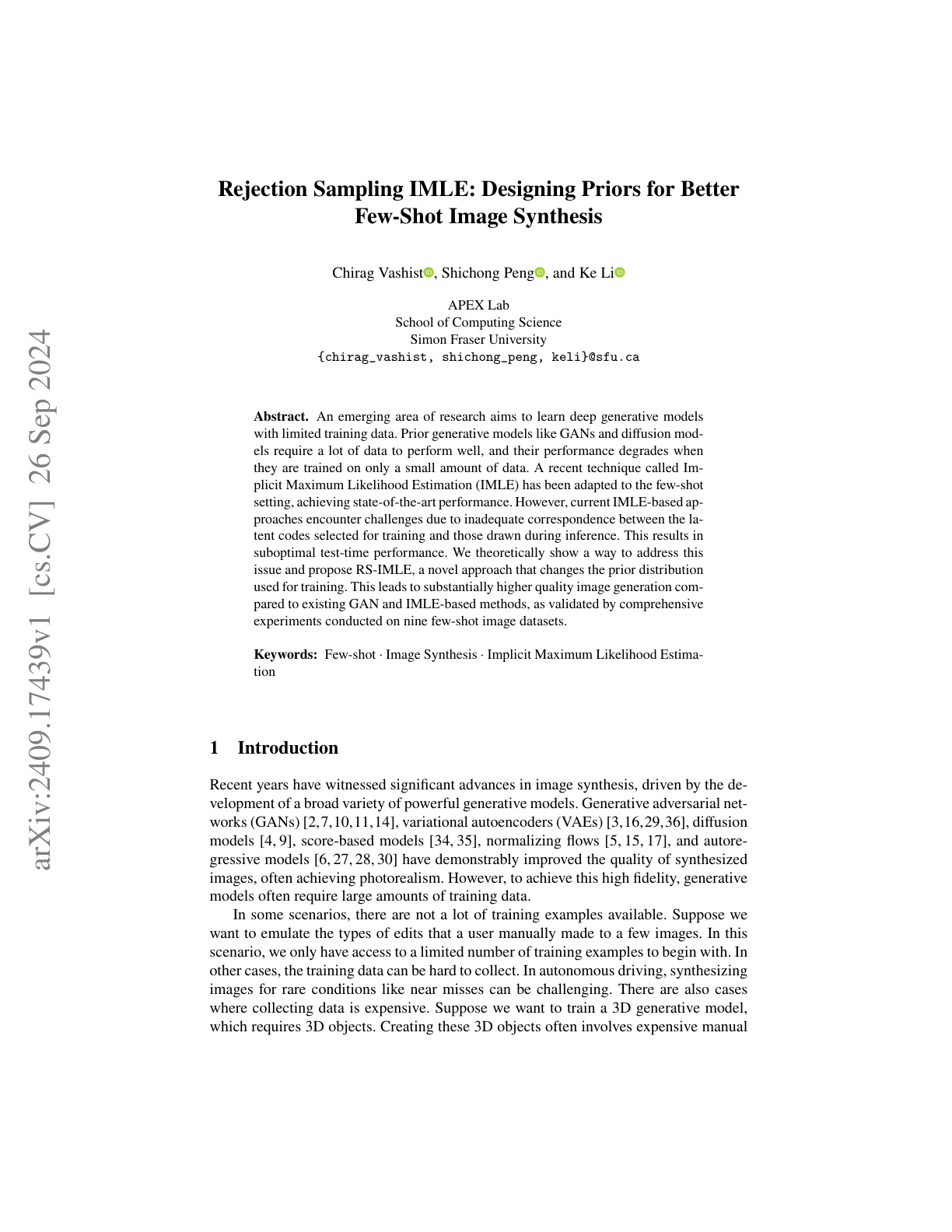
Designing Priors for Better Few-Shot Image Synthesis
training generative models like GAN with limited data is difficult; current Implicit Maximum Likelihood Estimation approaches (IMLE) have an inadequate correspondence between latent code selected for training and those selected during inference; the proposed approach, RS-IMLE, changes the prior distribution for training which improves test-time performance and leads to higher quality image generation.
Llama 3.2
presents small and medium-sized vision LLMs (11B and 90B parameters), and lightweight, text-only models (1B and 3B); the text-only models are trained to support context length of 128K tokens and outperform other models in their class on a range of tasks; vision models exceed other models such as Claude 3 Haiku on image understanding tasks.
**Molmo
** - - presents a family of open, state-of-the-art multimodal AI models; the 72B model in the Molmo family outperforms others in the class of open weight and data models; it also compares favorably against proprietary models like GPT-4o, Claude 3.5, and Gemini 1.5 on several benchmarks.
AlphaChip
a reinforcement learning-based method trained to design the physical layout of chips; AlphaChip is reportedly used in three additional generations of Google’s TPU; this release includes an open-source implementation of the method to help pre-train on a variety of chip blocks to apply to new blocks; also releases a model checkpoint pre-trained on 20 TPU blocks.
LLMs Still Can’t Plan
evaluates whether large reasoning models such as o1 can plan; finds that a domain-independent planner can solve all instances of Mystery Blocksworld but LLMs struggle, even on small instances; o1-preview is effective on the task but tend to degrade in performance as plan length increases, concludes that while o1 shows progress on more challenging planning problems, the accuracy gains cannot be considered general or robust.
Scaled-up Instructable Model Become Less Reliable
suggests that larger and more instructable LLMs may become less reliable; investigates LLMs across three elements: difficulty concordance, task avoidance, and prompting stability; finds that early models often avoid user questions but scaled-up, shaped-up models tend to give an apparently sensible yet wrong answer much more often, including errors on difficult questions that human supervisors frequently overlook.
Logic-of-Thought
proposes a new prompting technique called Logic-of-Thought (LoT) which employs propositional logic to generate and inject expanded logical information from the input context; it enhances CoT performance on the ReClor dataset by +4.35%; it improves CoT+SelfConsistency’s performance on LogiQA by +5%; it also boosts the performance of ToT on the ProofWriter dataset by +8%.
RAG and Beyond
presents a survey that introduces a RAG task categorization method that helps to classify user queries into four levels according to the type of external data required and the focus of the task; summarizes key challenges in building robust data-augmented LLM applications and the most effective techniques for addressing them.
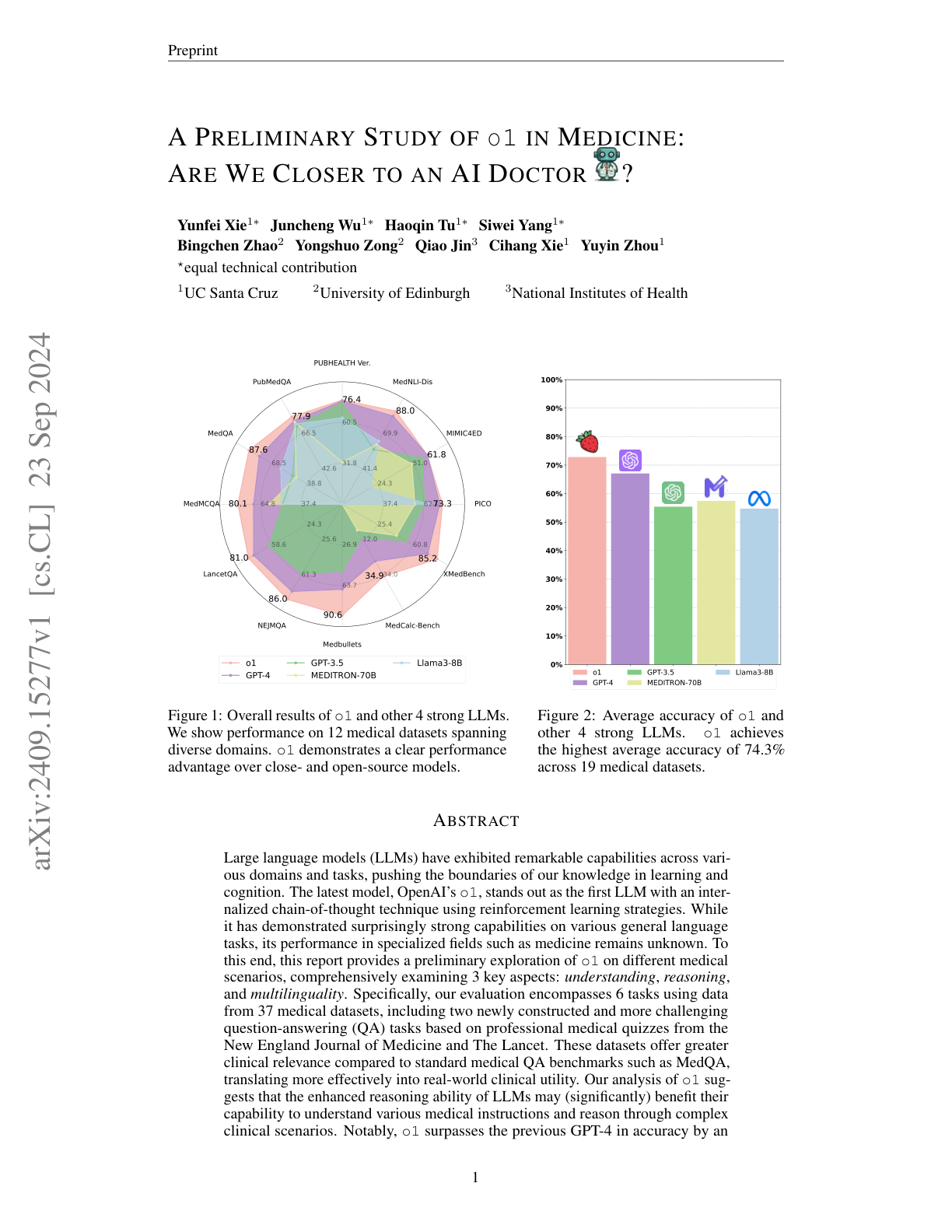
A Preliminary Study of o1 in Medicine
provides a preliminary exploration of the o1-preview model in medical scenarios; shows that o1 surpasses the previous GPT-4 in accuracy by an average of 6.2% and 6.6% across 19 datasets and two newly created complex QA scenarios; identifies hallucination, inconsistent multilingual ability, and discrepant metrics for evaluation.
Small Language Models Survey
a comprehensive survey on small language models (SLMs) across architectures, training datasets, and training algorithms; analyzes 59 state-of-the-art open-source SLMs and capabilities such as reasoning, in-context learning, maths, and coding; other discussions include on-device runtime costs, latency, memory footprint, and valuable insights.
Minstrel
a multi-generative agent system with reflection capabilities to automate structural prompt generation; it presents LangGPT, an extensible framework for designing prompts; Minstrel is built on top of LangGPT and experiments demonstrate that structural prompts (either generated by Minstrel or written manually) perform better in guiding LLMs to perform tasks.
Moshi
introduces a speech-text foundation model and full-duplex spoken dialogue framework; they present several components of the systems; Helium is a 7B parameter text LLM; Mimi is a semantic-acoustic neural audio code with state-of-the-art performance on audio quality; a hierarchical multi-stream architecture that can generate arbitrary conversation in a speech-to-speech manner.
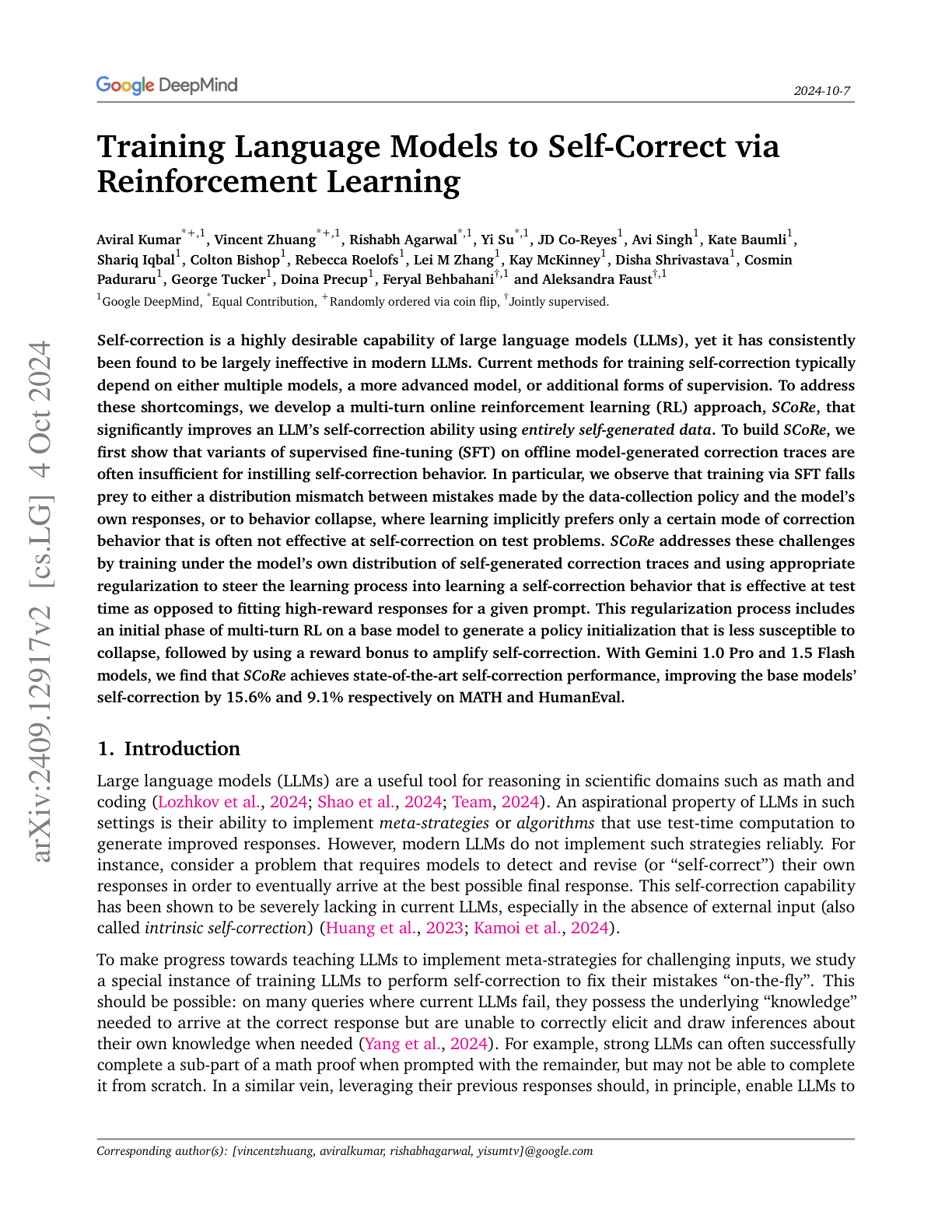
Training LLMs to Self-Correct via RL
develops a multi-turn online reinforcement learning to improve the capabilities of an LLM to self-correct; it’s based entirely on self-generated data; SFT is shown to be ineffective at learning self-correction and suffers from distribution mismatch between training data and model responses; proposes a two-stage approach that first optimizes correction behavior and then uses a reward bonus to amplify self-correction during training; when applied to Gemini 1.0 Pro and 1.5 Flash models, it achieves state-of-the-art self-correction performance, improving the base models’ self-correction by 15.6% and 9.1% respectively on the MATH and HumanEval benchmarks.
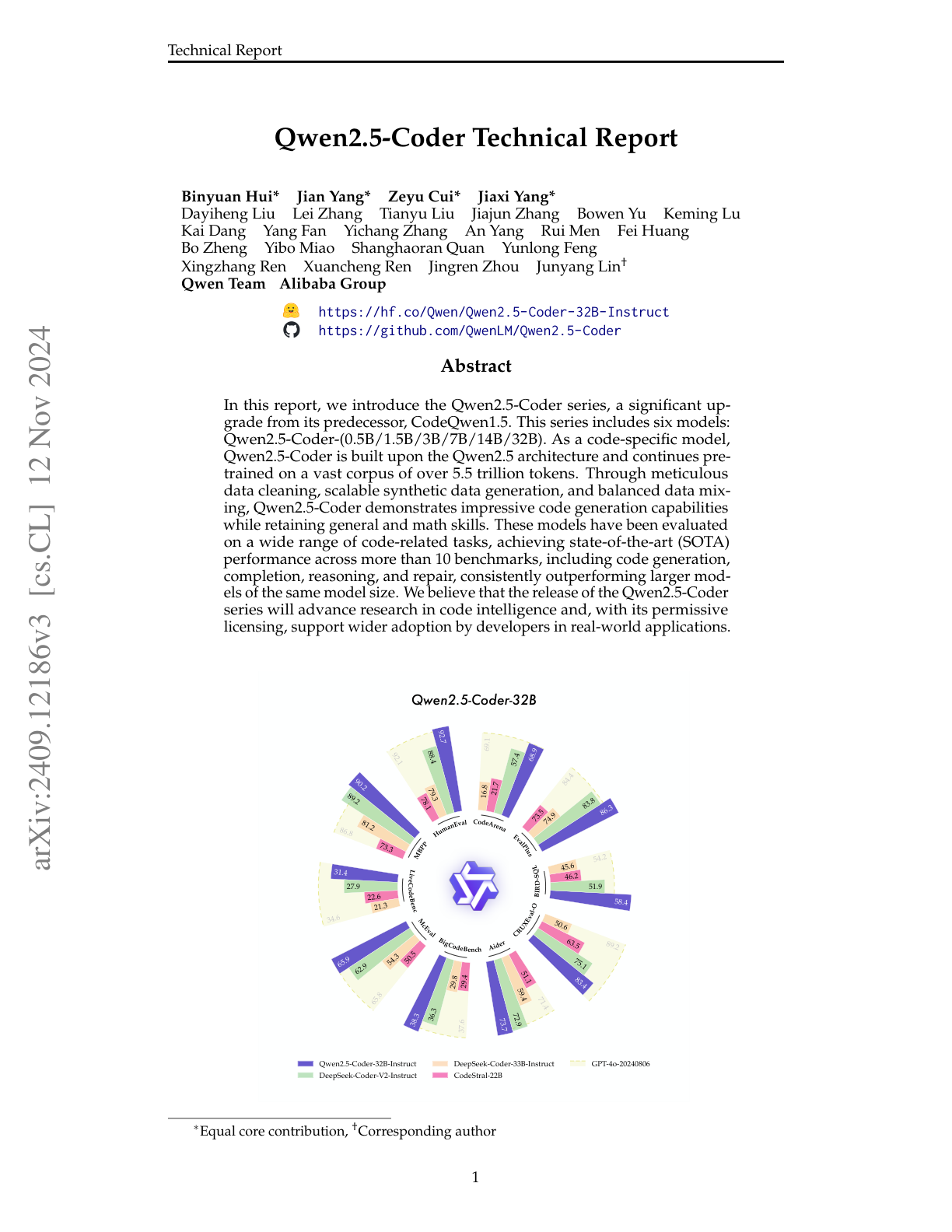
Qwen2.5 Coder
a series of models including 1.5B and 7B parameters; it’s built upon the Qwen2.5 architecture which is continuously pretrained on 5.5 trillion tokens; achieves state-of-the-art performance across more than 10 benchmarks; includes strong capabilities in code generation, completion, reasoning, and repairing.
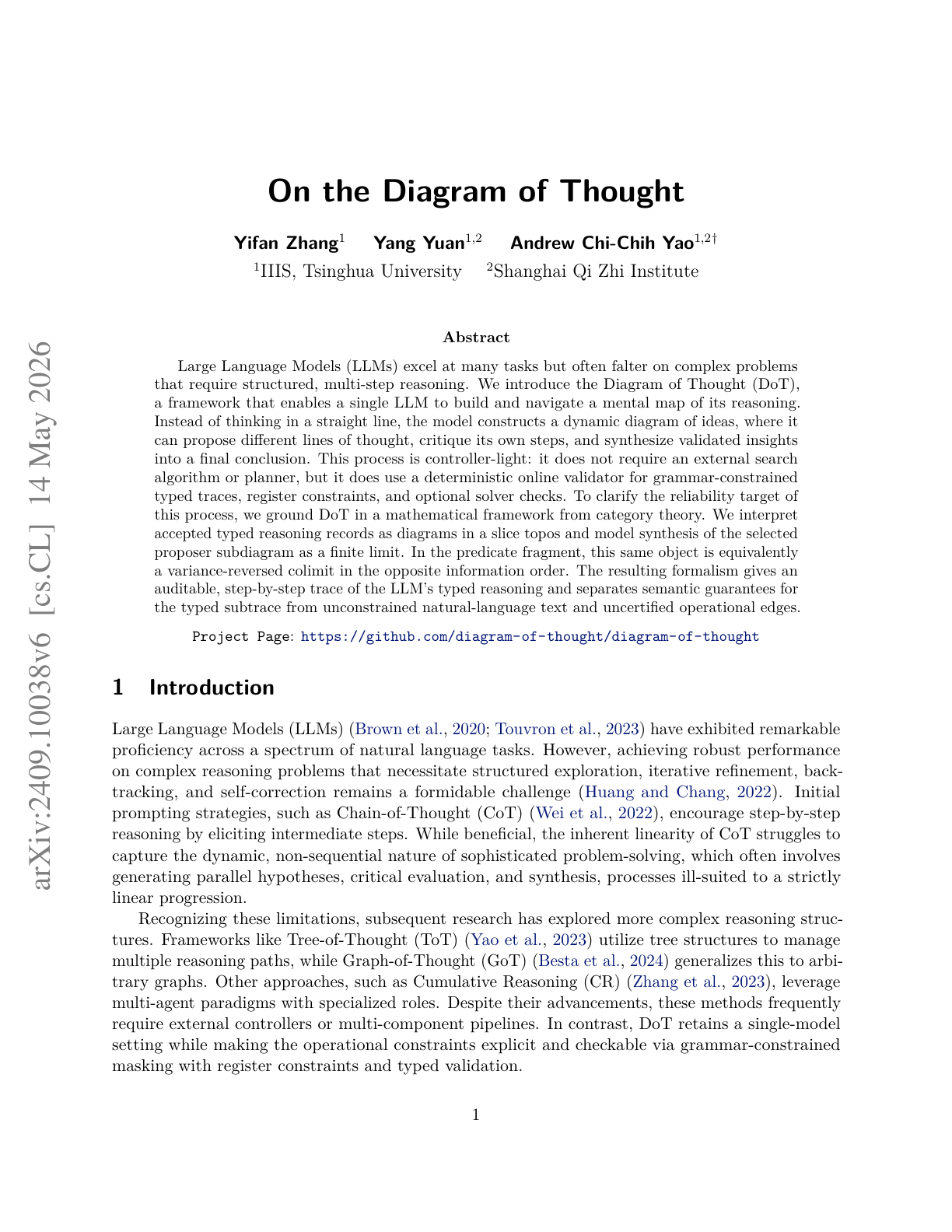
Diagram of Thought (DoT)
enhances the reasoning capabilities of LLMs through mathematical rigor; DAT models iterative reasoning in LLM as the construction of a directed acyclic graph; it integrates propositions, critiques, refinement, and verification into a unified DAG structure; this allows DoT to capture complex logical deduction beyond linear or tree-based approaches.