AI Papers of the Week
Every paper worth reading in AI, hand-picked one week at a time.
Discover and explore top AI papers with Claude Code or Codex
npx @dair-ai/mcp setup
Improving Retrieval in LLMs through Synthetic Data
proposes a fine-tuning approach to improve the accuracy of retrieving information in LLMs while maintaining reasoning capabilities over long-context inputs; the fine-tuning dataset comprises numerical dictionary key-value retrieval tasks (350 samples); finds that this approach mitigates the "lost-in-the-middle" phenomenon and improves performance on both information retrieval and long-context reasoning.
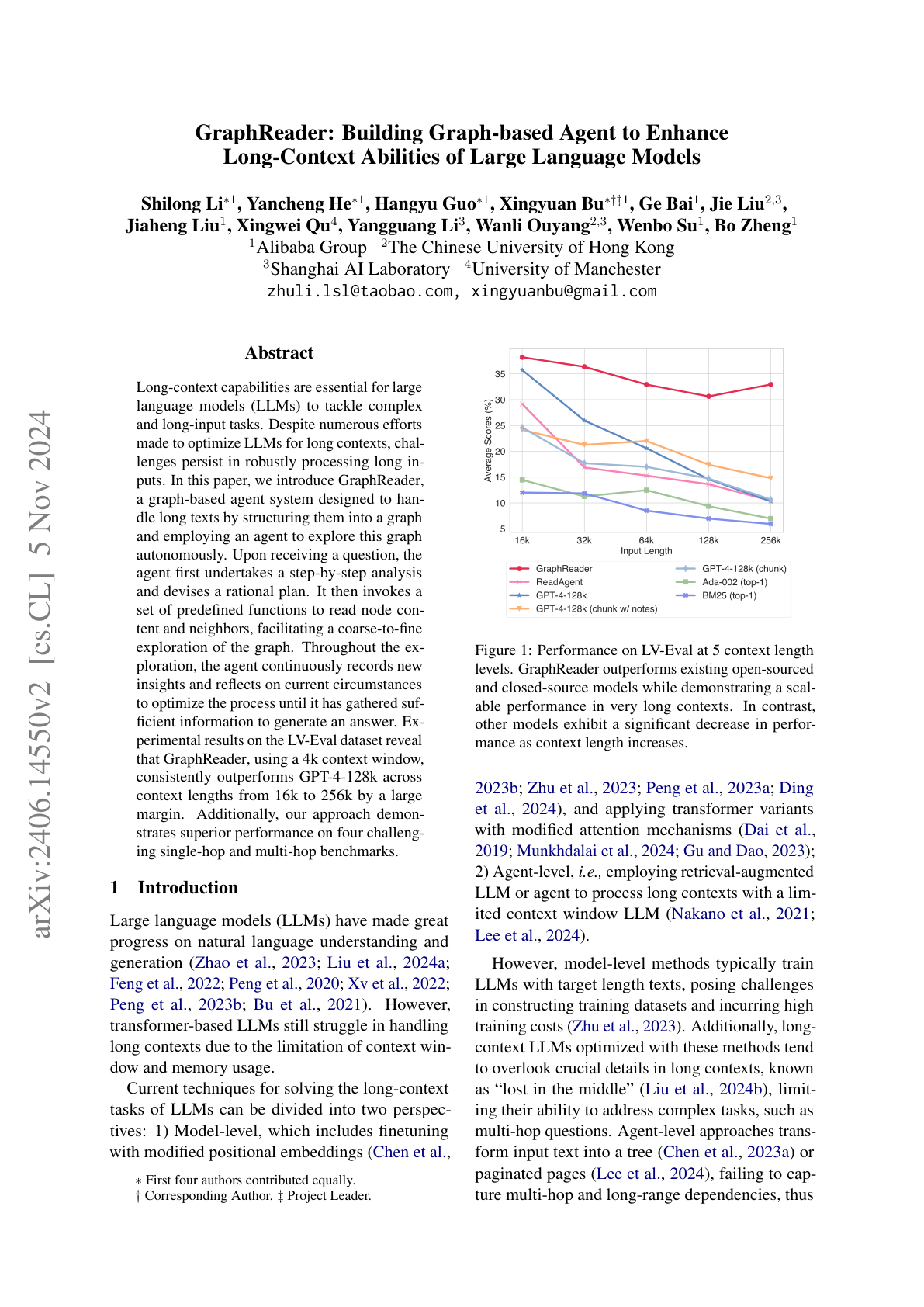
GraphReader
proposes a graph-based agent system to enhance the long-context abilities of LLMs; it structures long text into a graph and employs an agent to explore the graph (using predefined functions guided by a step-by-step rational plan) to effectively generate answers for questions; consistently outperforms GPT-4-128k across context lengths from 16k to 256k.
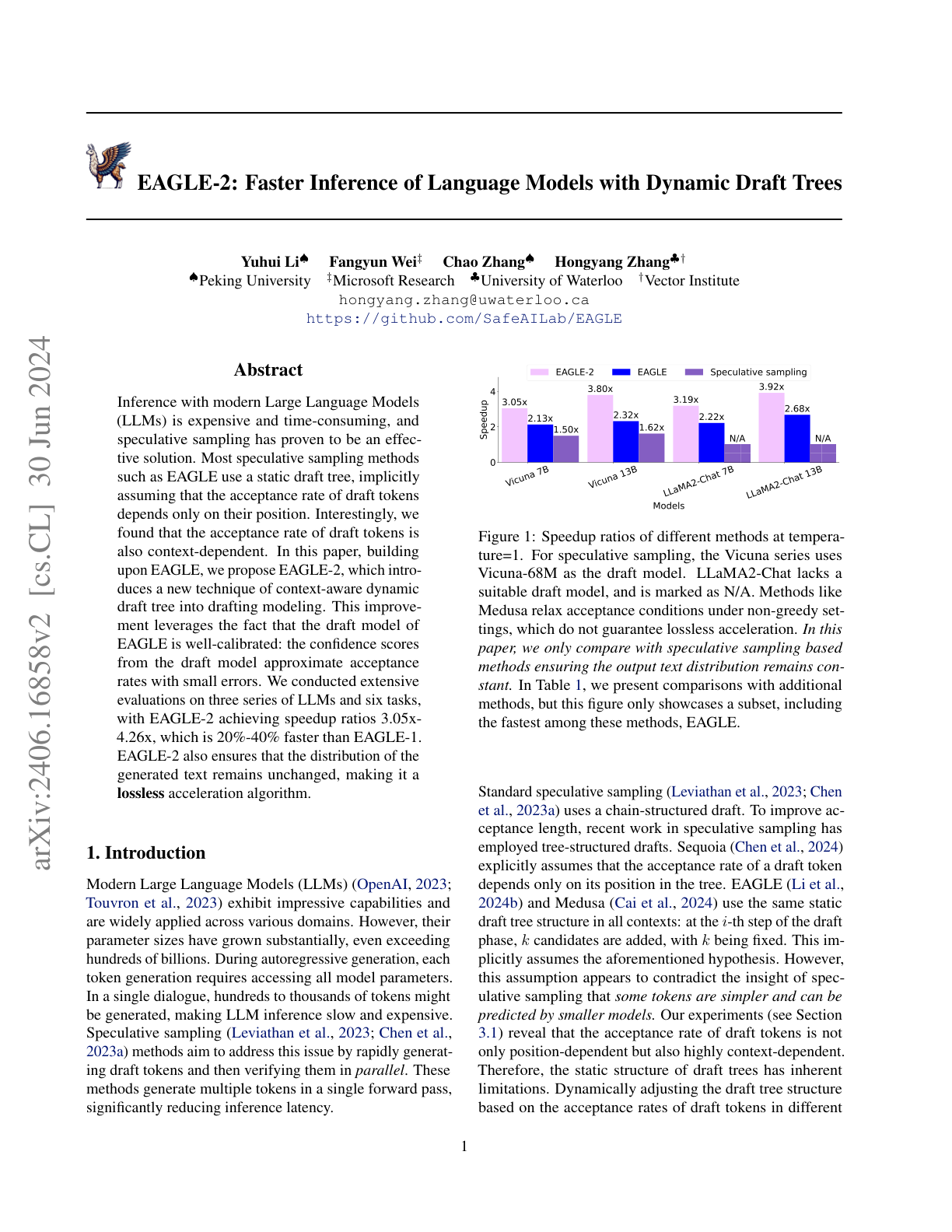
Faster LLM Inference with Dynamic Draft Trees
presents a context-aware dynamic draft tree to increase the speed of inference; the previous speculative sampling method used a static draft tree for sampling which only depended on position but lacked context awareness; achieves speedup ratios ranging from 3.05x-4.26x, which is 20%-40% faster than previous work; these speedup ratios occur because the new method significantly increases the number of accepted draft tokens.
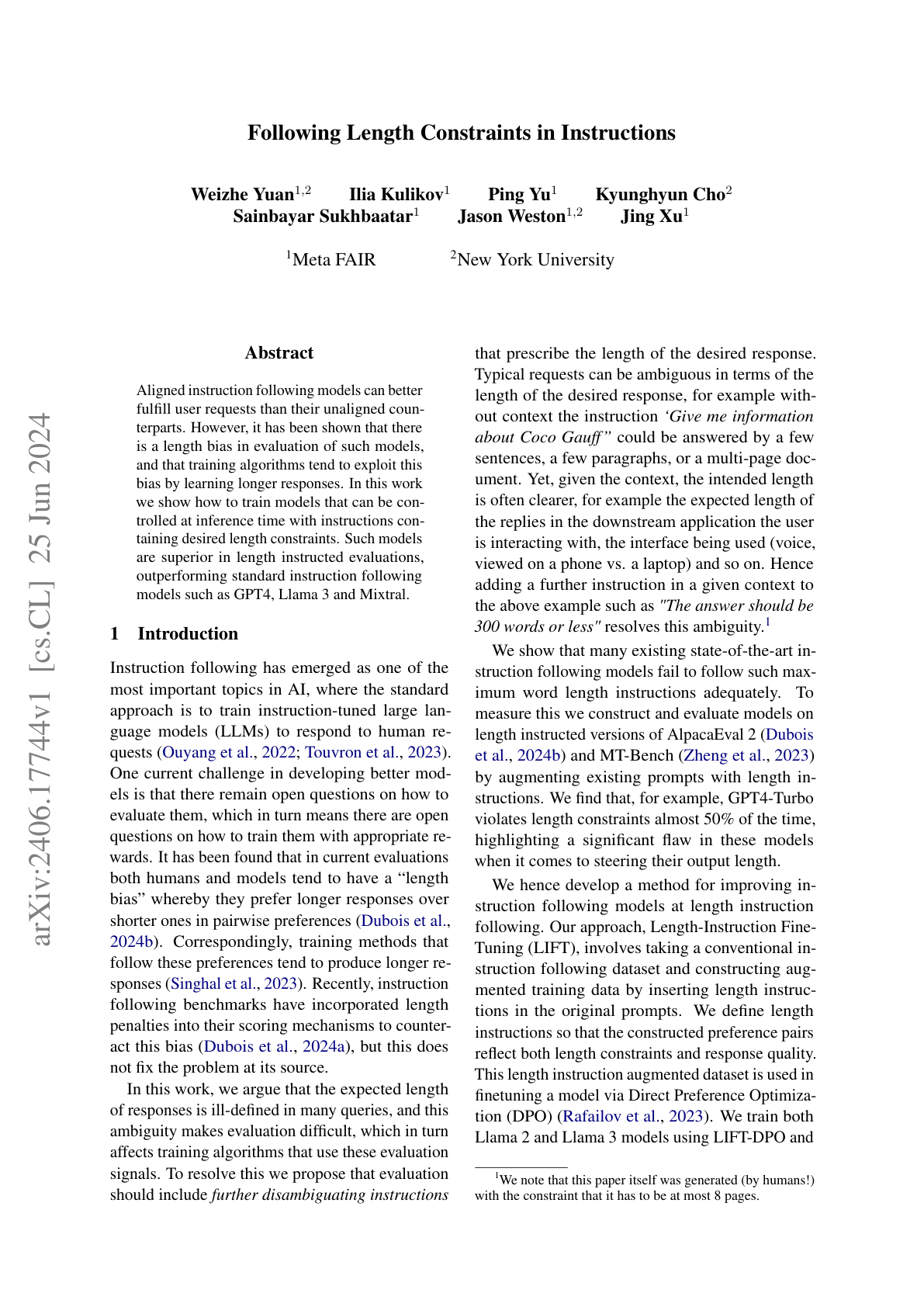
Following Length Constraints in Instructions
presents an approach for how to deal with length bias and train instruction following language models that better follow length constraint instructions; fine-tunes a model using DPO with a length instruction augmented dataset and shows less length constraint violations and while keeping a high response quality.
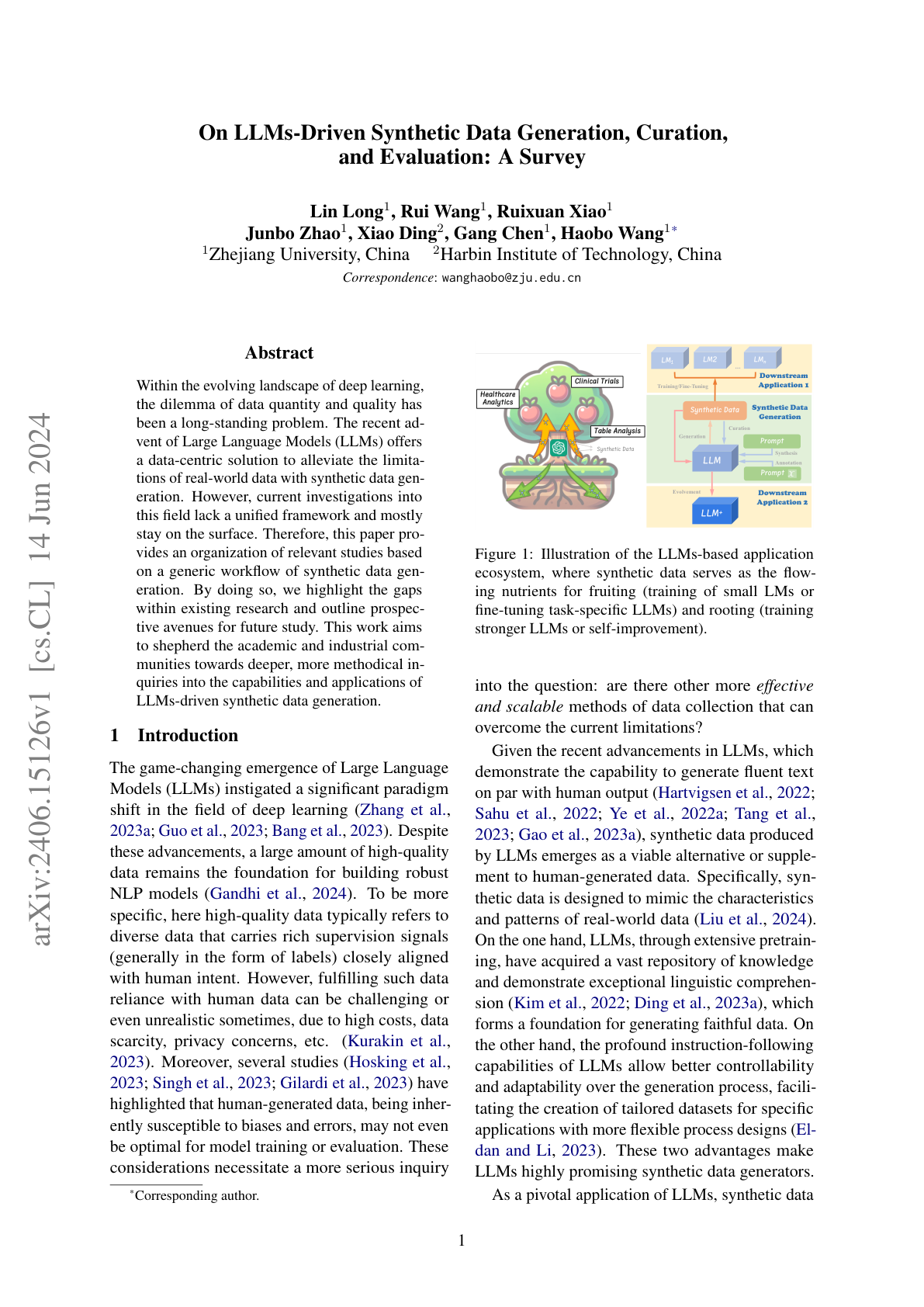
On LLMs-Driven Synthetic Data Generation, Curation, and Evaluation
survey on LLM-based synthetic data generation, curation, and evaluation.
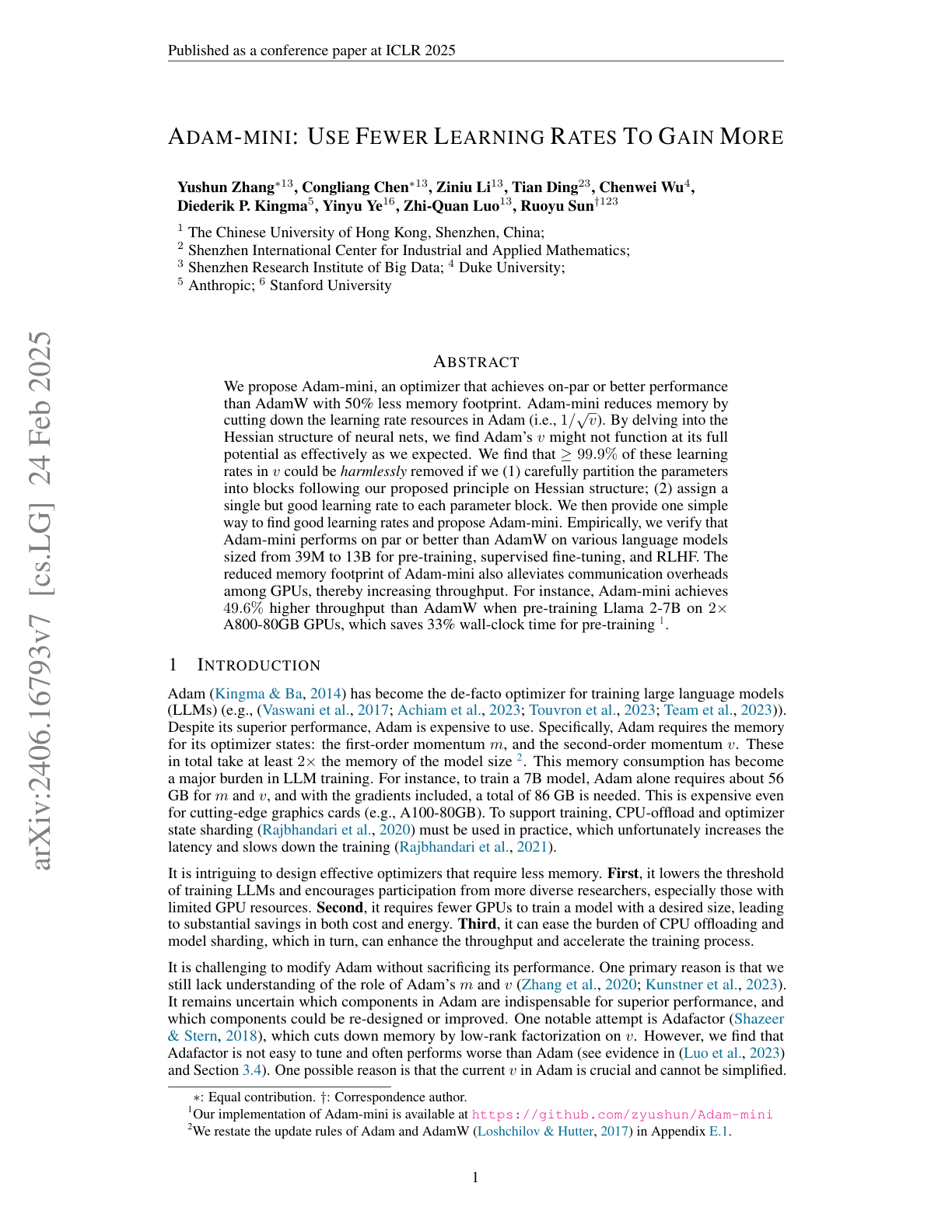
Adam-mini
a new optimizer that reduces memory footprint (45%-50% less memory footprint) by using fewer learning rates and achieves on-par or even outperforms AdamW; it carefully partitions parameters into blocks and assigns a single high-quality learning that outperforms Adam; achieves consistent results on language models sized from 125M -7B for pre-training, SFT, and RLHF.
Claude 3.5 Sonnet
a new model that achieves state-of-the-art performance on several common benchmarks such as MMLU and HumanEval; it outperforms Claude 3 Opus and GPT-4o on several benchmarks with the exception of math word problem-solving tasks; achieves strong performance on vision tasks which also helps power several new features like image-text transcription and generation of artifacts.
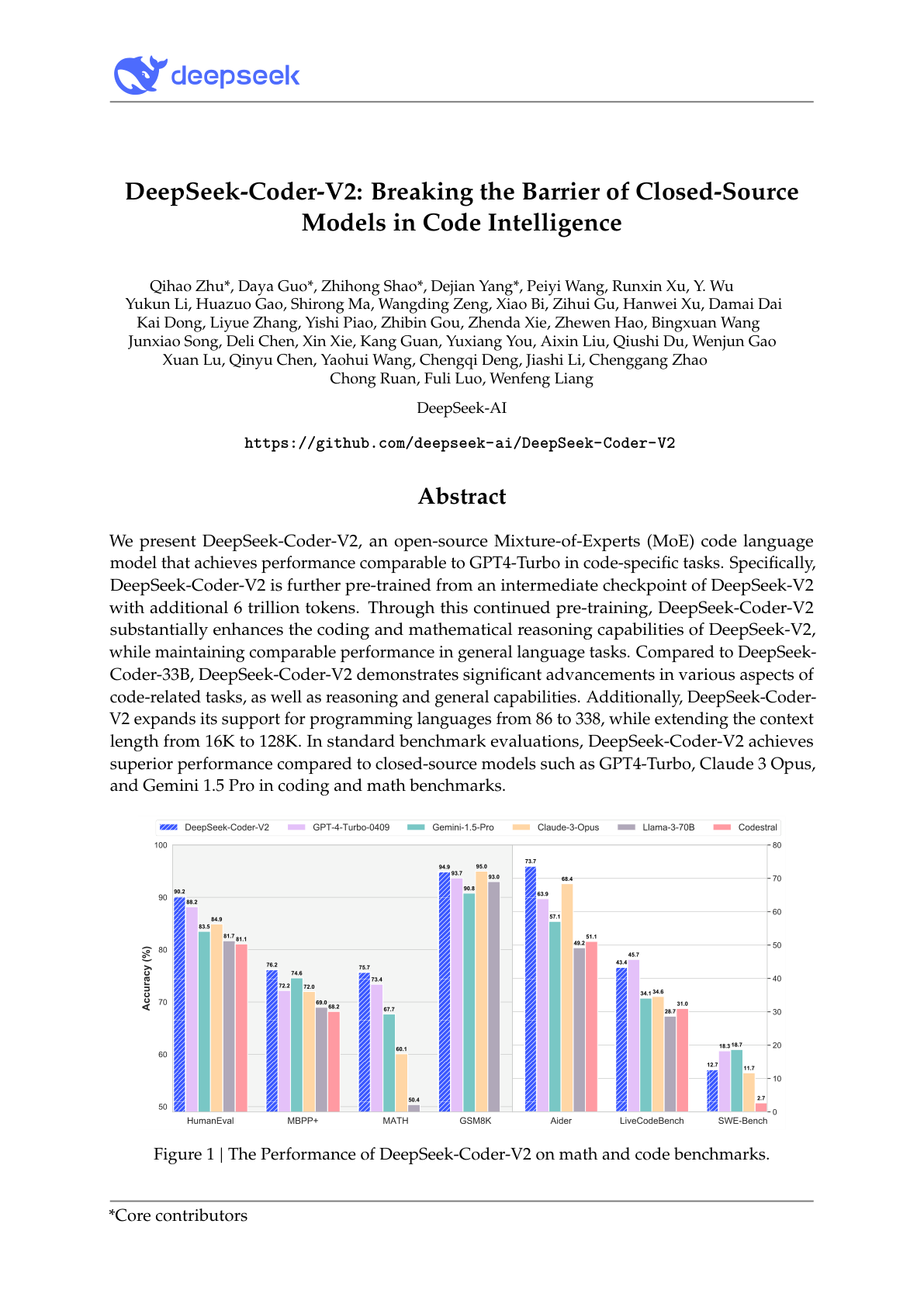
DeepSeek-Coder-V2
competes with closed-sourced models on code and math generation tasks; achieves 90.2% on HumanEval and 75.7% on MATH; these results are higher than GPT-4-Turbo-0409 performance according to their report; includes a 16B and 236B parameter model with 128K context length.
TextGrad
a new framework for automatic differentiation through backpropagation on textual feedback provided by an LLM; this improves individual components and the natural language helps to optimize the computation graph; it works by providing an objective function without tuning prompts or components; claims to achieve LeetCodeHard best scores and SoTA performance on GPQA when combined with GPT4o.
Can Long-Context Language Models Subsume Retrieval, RAG, SQL, and More?
conducts a deep performance analysis of long-context LLMs on in-context retrieval and reasoning; they first present a benchmark with real-world tasks requiring 1M token context; reports that long-context LLMs can rival state-of-the-art retrieval and RAG systems, without any explicit training on the tasks; suggests that compositional reasoning (required in SQL-like tasks) is still challenging for these LLMs; they also encourage the need for continued research on advanced prompting strategies as they noted significant boosts in performance when applying them for long context problems.
PlanRAG
enhances decision making with a new RAG technique called iterative plan-then-RAG (PlanRAG); involves two steps: 1) an LM generates the plan for decision making by examining data schema and questions and 2) the retriever generates the queries for data analysis; the final step checks if a new plan for further analysis is needed and iterates on previous steps or makes a decision on the data; PlanRAG is found to be more effective than iterative RAG on the proposed Decision QA tasks.
Mitigating Memorization in LLMs
presents a modification of the next-token prediction objective called goldfish loss to help mitigate the verbatim generation of memorized training data; it uses a simple technique that excludes a pseudorandom subset of training tokens at training time; they show that the goldfish loss resists memorization and keeps the model useful; however, it may need to train for longer to more effectively learn from the training data.
Monte Carlos Tree Self-Refine
report to have achieved GPT-4 level mathematical olympiad solution using an approach that integrates LLMs with Monte Carlo Tree Search; this approach focuses on enhancing the mathematical reasoning performance of the system through capabilities such as systematic exploration, self-refinement, and self-evaluation.
From RAG to Rich Parameters
investigates more closely how LLMs utilize external knowledge over parametric information for factual queries; finds that in a RAG pipeline, LLMs take a “shortcut” and display a strong bias towards utilizing only the context information to answer the question, while relying minimally on their parametric memory.

Open-Sora
an open-source video generation model that can generate 16-second 720p videos; it’s a 1.1B parameter model trained on more than 30m data and now supports image-to-video; presents an enhanced diffusion model and video compression network for spatial and temporal compression; increases controllability of generations and reduces training costs.
Tree Search for Language Model Agents
proposes an inference-time tree search algorithm for LM agents to perform exploration and enable multi-step reasoning; it’s tested on interactive web environments and applied to GPT-4o to significantly improve performance; demonstrates that performance scales when increasing test-time compute.

Nemotron-4 340B
provides an instruct model to generate high-quality data and a reward model to filter out data on several attributes; demonstrates strong performance on common benchmarks like MMLU and GSM8K; it’s competitive with GPT-4 on several tasks, including high scores in multi-turn chat; a preference data is also released along with the base model.
Discovering Preference Optimization Algorithms with LLMs
proposes LLM-driven objective discovery of state-of-the-art preference optimization; no human intervention is used and an LLM is prompted to propose and implement the preference optimization loss functions based on previously evaluated performance metrics; discovers an algorithm that adaptively combined logistic and exponential losses.
SelfGoal
a framework to enhance an LLM-based agent's capabilities to achieve high-level goals; adaptively breaks down a high-level goal into a tree structure of practical subgoals during interaction with the environment; improves performance on various tasks, including competitive, cooperative, and deferred feedback environments
Mixture-of-Agents
an approach that leverages the collective strengths of multiple LLMs through a Mixture-of-Agents methodology; layers are designed with multiple LLM agents and each agent builds on the outputs of other agents in the previous layers; surpasses GPT-4o on AlpacaEval 2.0, MT-Bench and FLASK.
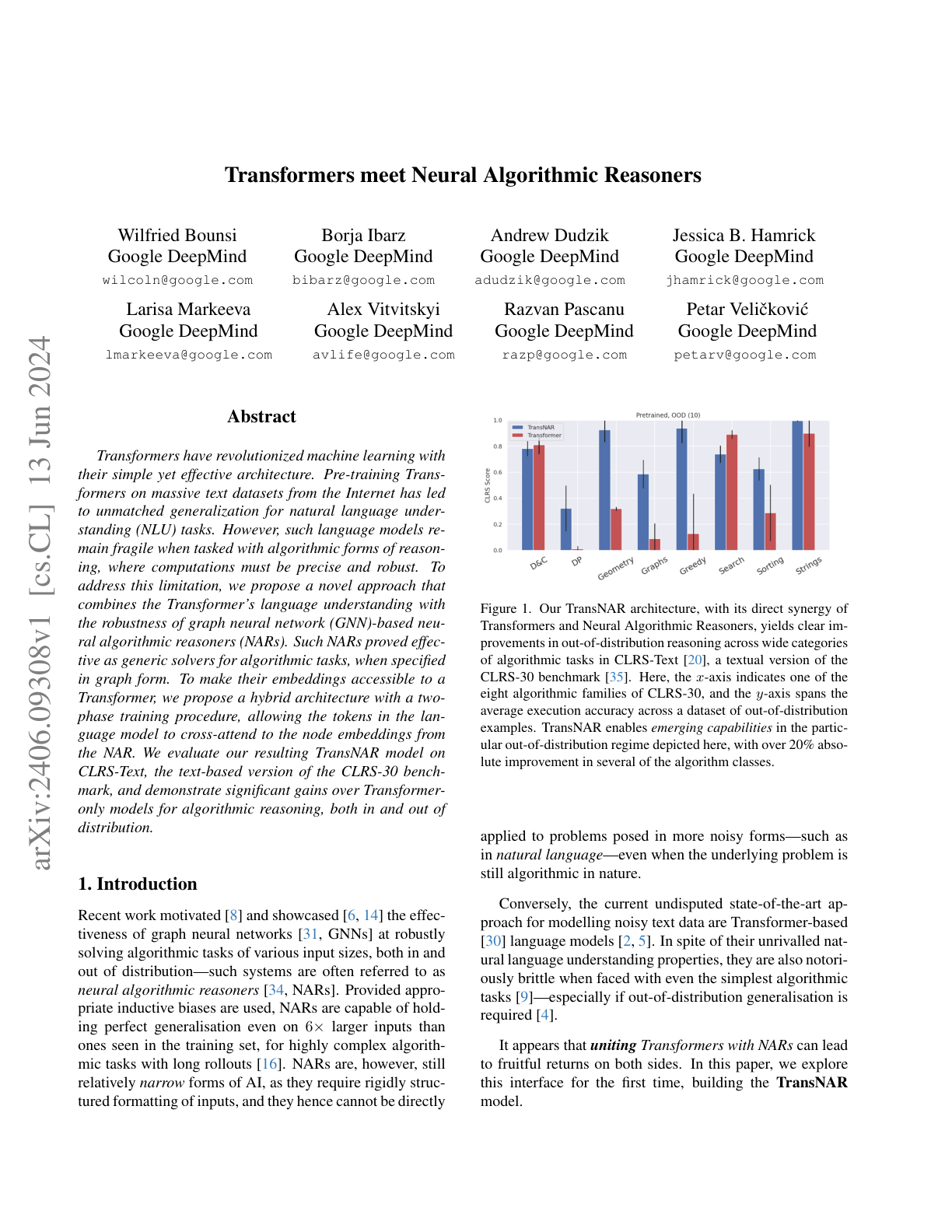
Transformers Meet Neural Algorithmic Reasoners
a new hybrid architecture that enables tokens in the LLM to cross-attend to node embeddings from a GNN-based neural algorithmic reasoner (NAR); the resulting model, called TransNAR, demonstrates improvements in OOD reasoning across algorithmic tasks
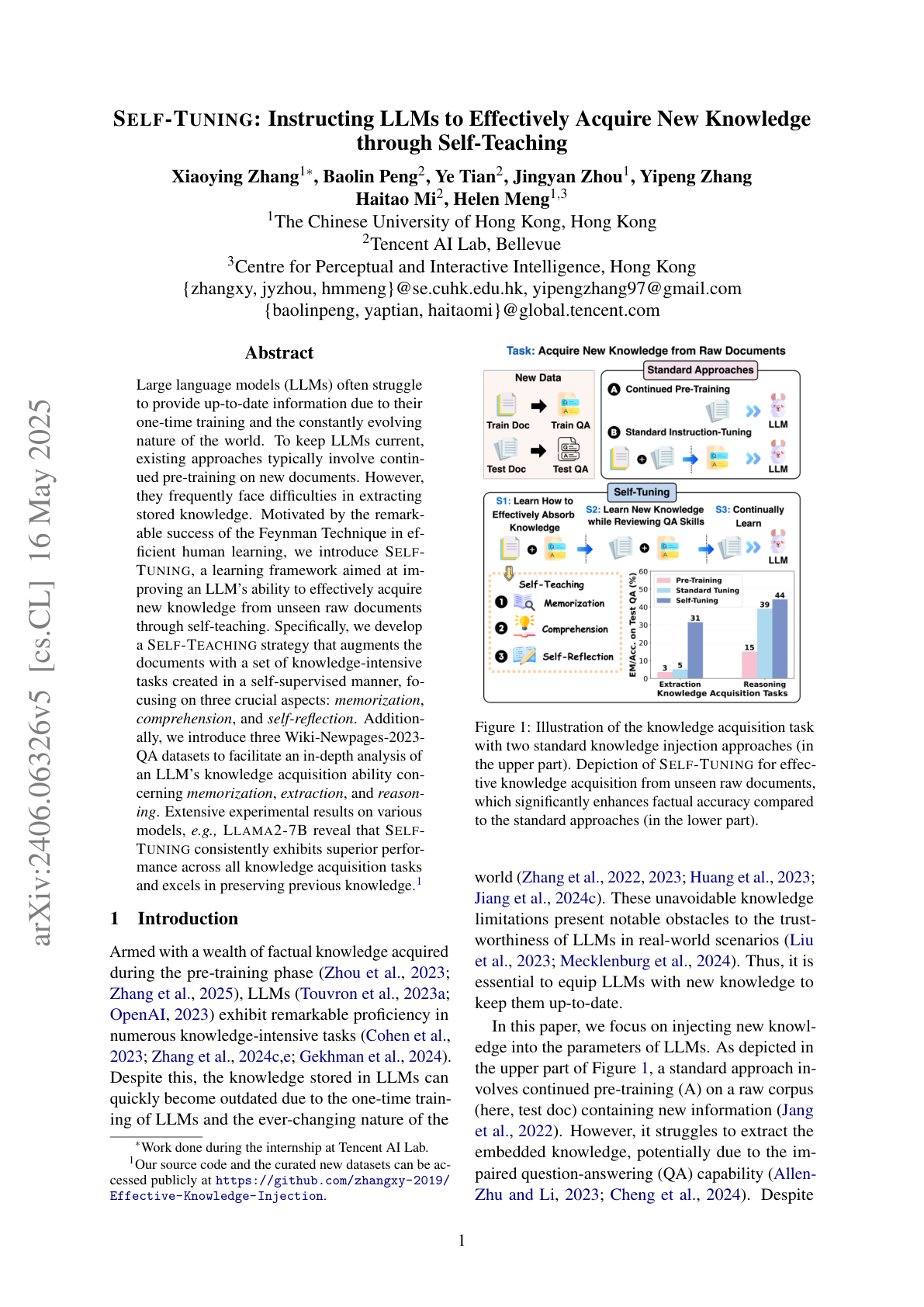
Self-Tuning with LLMs
improves an LLM’s ability to effectively acquire new knowledge from raw documents through self-teaching; the three steps involved are 1) a self-teaching component that augments documents with a set of knowledge-intensive tasks focusing on memorization, comprehension, and self-reflection, 2) uses the deployed model to acquire knowledge from new documents while reviewing its QA skills, and 3) the model is configured to continually learn using only the new documents which helps with thorough acquisition of new knowledge.
Sketching as a Visual Chain of Thought
a framework that enables a multimodal LLM to access a visual sketchpad and tools to draw on the sketchpad; it can equip a model like GPT-4 with the capability to generate intermediate sketches to reason over complex tasks; improves performance on many tasks over strong base models with no sketching; GPT-4o equipped with SketchPad sets a new state of the art on all the tasks tested.
Mixture of Memory Experts
proposes an approach to significantly reduce hallucination (10x) by tuning millions of expert adapters (e.g., LoRAs) to learn exact facts and retrieve them from an index at inference time; the memory experts are specialized to ensure faithful and factual accuracy on the data it was tuned on; claims to enable scaling to a high number of parameters while keeping the inference cost fixed.