AI Papers of the Week
Every paper worth reading in AI, hand-picked one week at a time.
Discover and explore top AI papers with Claude Code or Codex
npx @dair-ai/mcp setup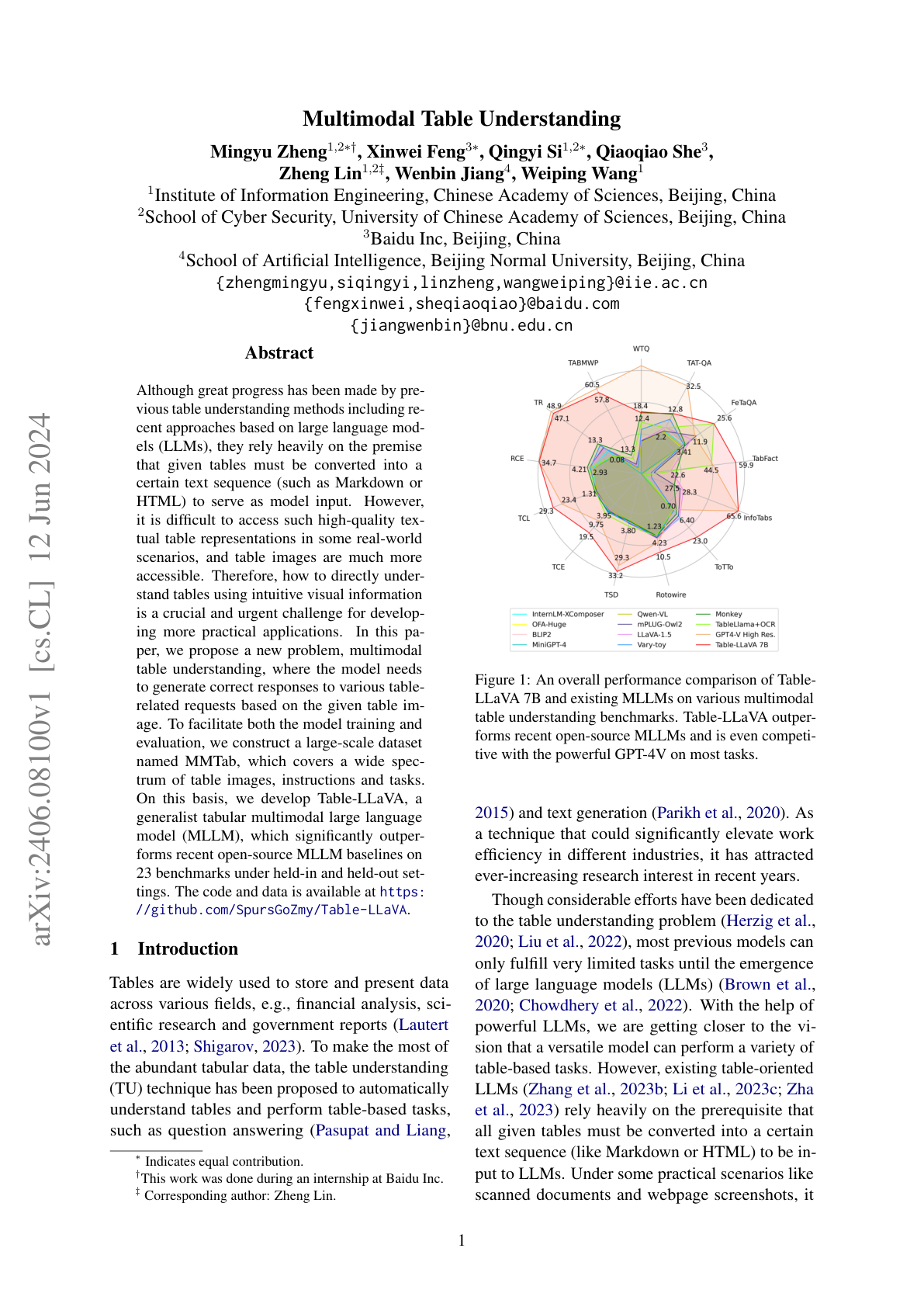
Multimodal Table Understanding
introduces Table-LLaVa 7B, a multimodal LLM for multimodal table understanding; it’s competitive with GPT-4V and significantly outperforms existing MLLMs on multiple benchmarks; also develops a large-scale dataset MMTab, covering table images, instructions, and tasks.
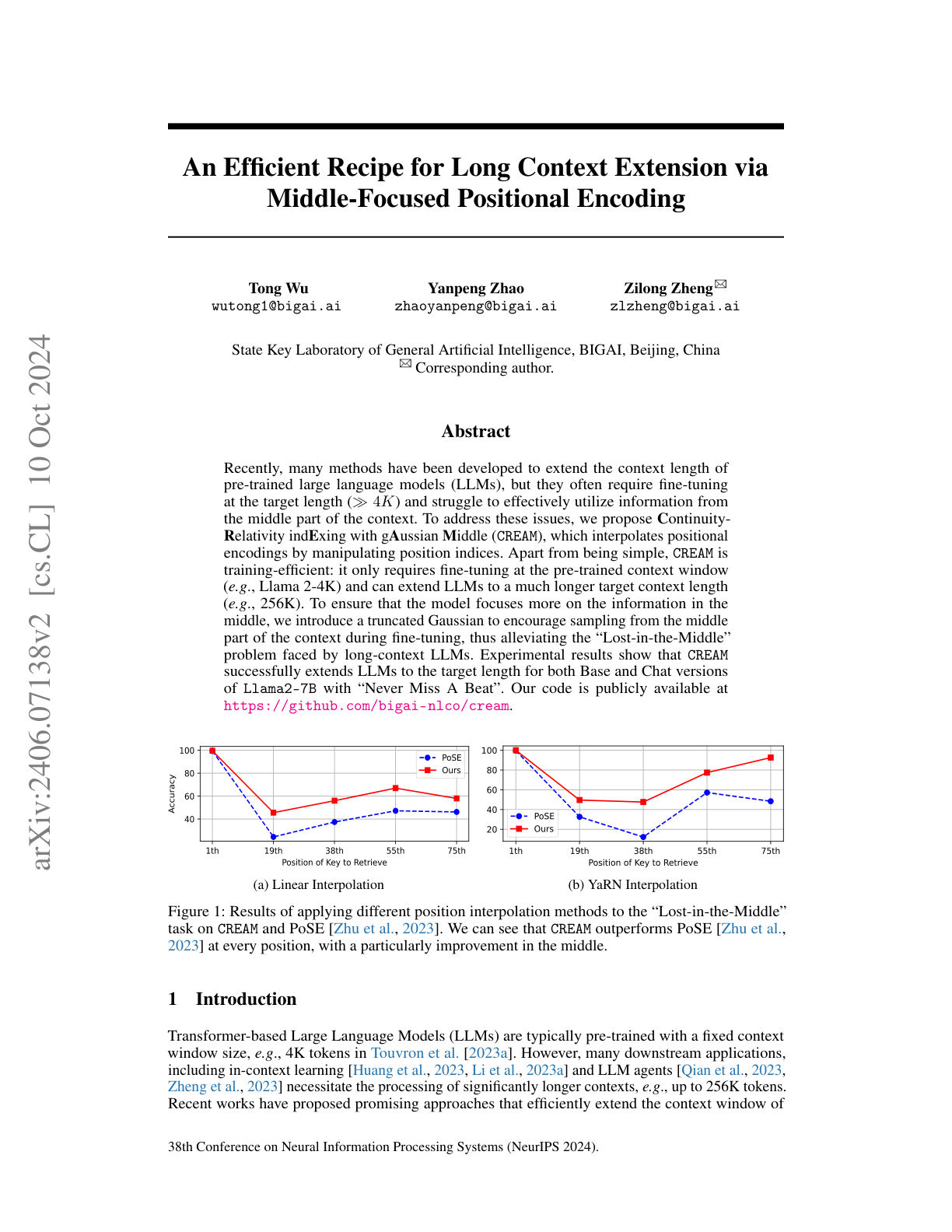
Consistent Middle Enhancement in LLMs
proposes an approach to tune an LLM to effectively utilize information from the middle part of the context; it first proposes a training-efficient method to extend LLMs to longer context lengths (e.g., 4K -> 256K); it uses a truncated Gaussian to encourage sampling from the middle part of the context during fine-tuning; the approach helps to alleviate the so-called "Lost-in-the-Middle" problem in long-context LLMs.
NLLB
proposes a massive multilingual model that leverages transfer learning across 200 languages; it’s based on a sparsely Gated Mixture of Experts architecture and trained on data via an approach tailored for low-resource languages; evaluates on 40K translations and achieves an average of 44% improvement in translation quality.
Extracting Concepts from GPT-4
proposes a new scalable method based on sparse autoencoders to extract around 16 million interpretable patterns from GPT-4; the method demonstrates predictable scaling and is more efficient than previous techniques.
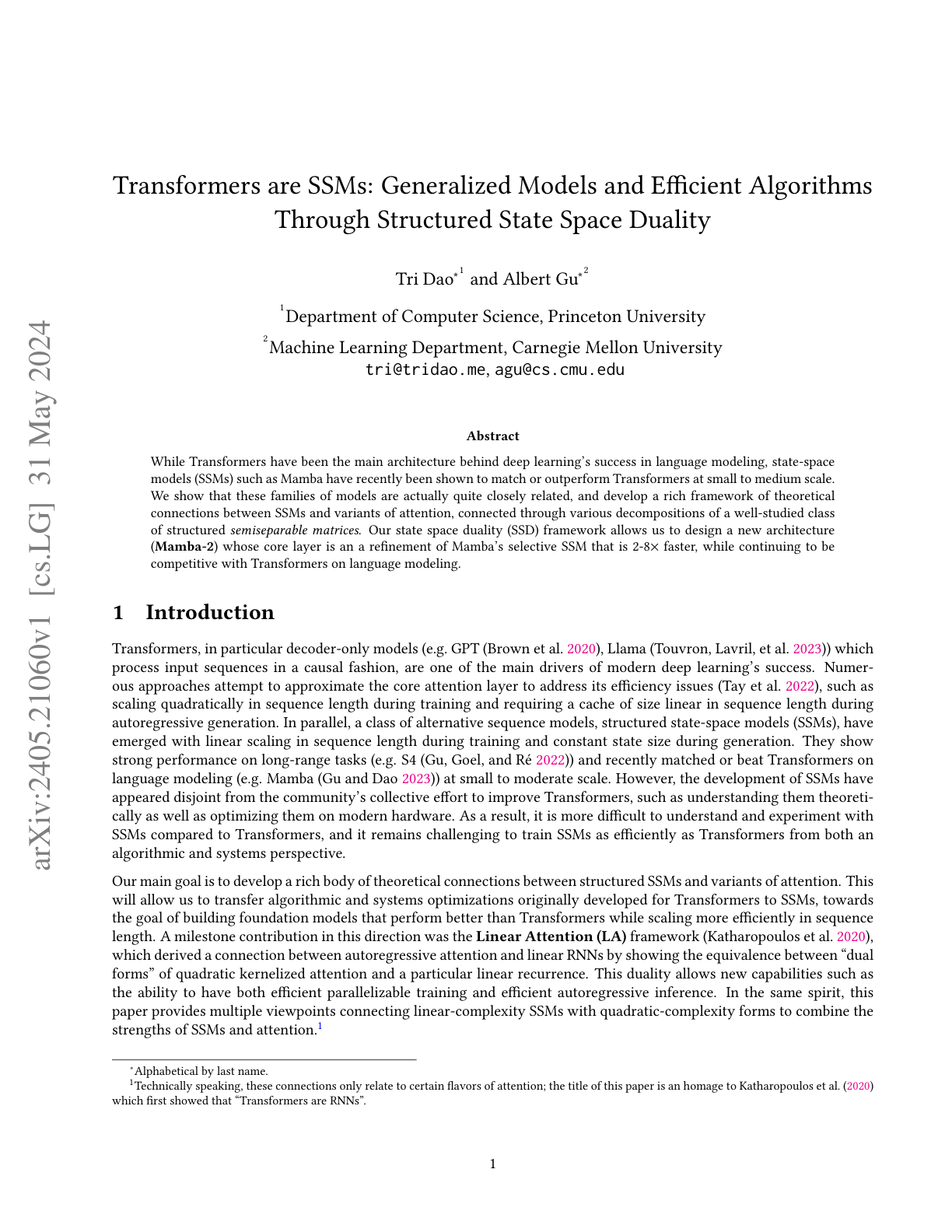
Mamba-2
a new architecture that combines state space models (SSMs) and structured attention; it uses 8x larger states and trains 50% faster; the new state space duality layer is more efficient and scalable compared to the approach used in Mamba; it also improves results on tasks that require large state capacity.
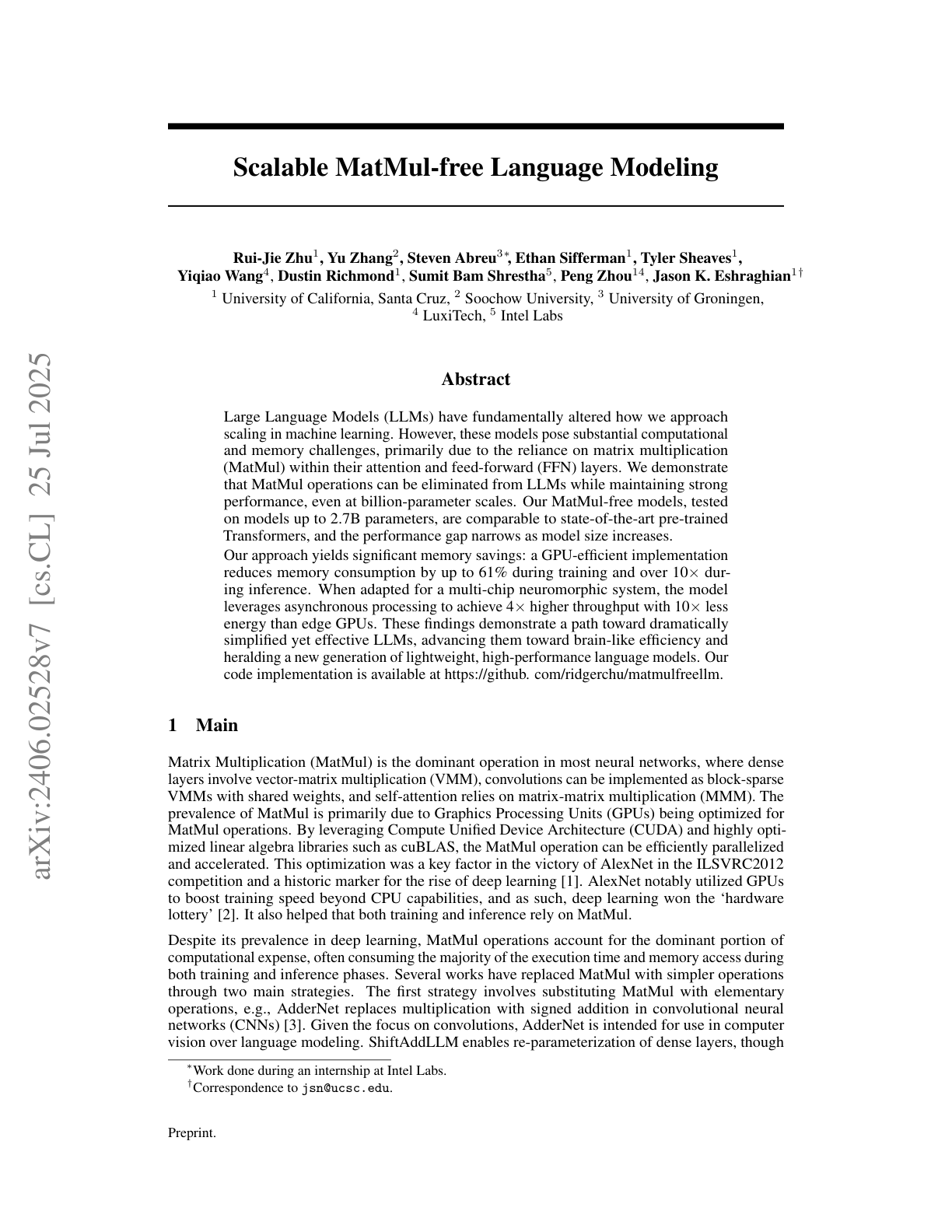
MatMul-free LLMs
proposes an implementation that eliminates matrix multiplication operations from LLMs while maintaining performance at billion-parameter scales; the performance between full precision Transformers and the MatMul-free models narrows as the model size increases; claims that by using an optimized kernel during inference, memory consumption is reduced by more than 10x.
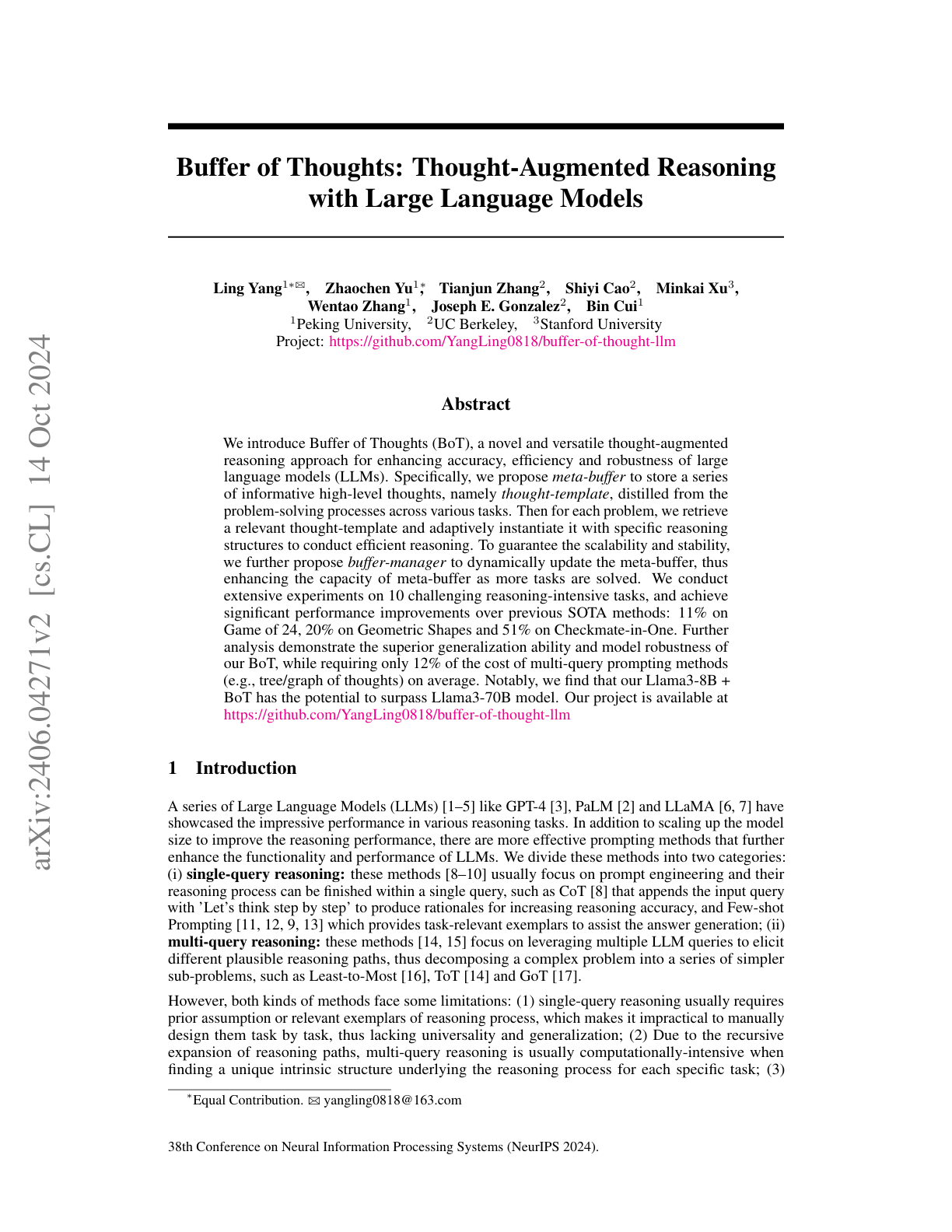
Buffer of Thoughts
presents a thought-augmented reasoning approach to enhance the accuracy, efficiency, and robustness of LLM-based reasoning; it leverages a meta-buffer containing high-level thoughts (thought templates) distilled from problem-solving processes; the relevant thought template is then retrieved and instantiated with task-specific reasoning structures for the thought-augmented reasoning process; it demonstrates SOTA performance on 10 challenging tasks while requiring 12% of the cost of multi-query prompting methods like Tree-of-Thoughts.
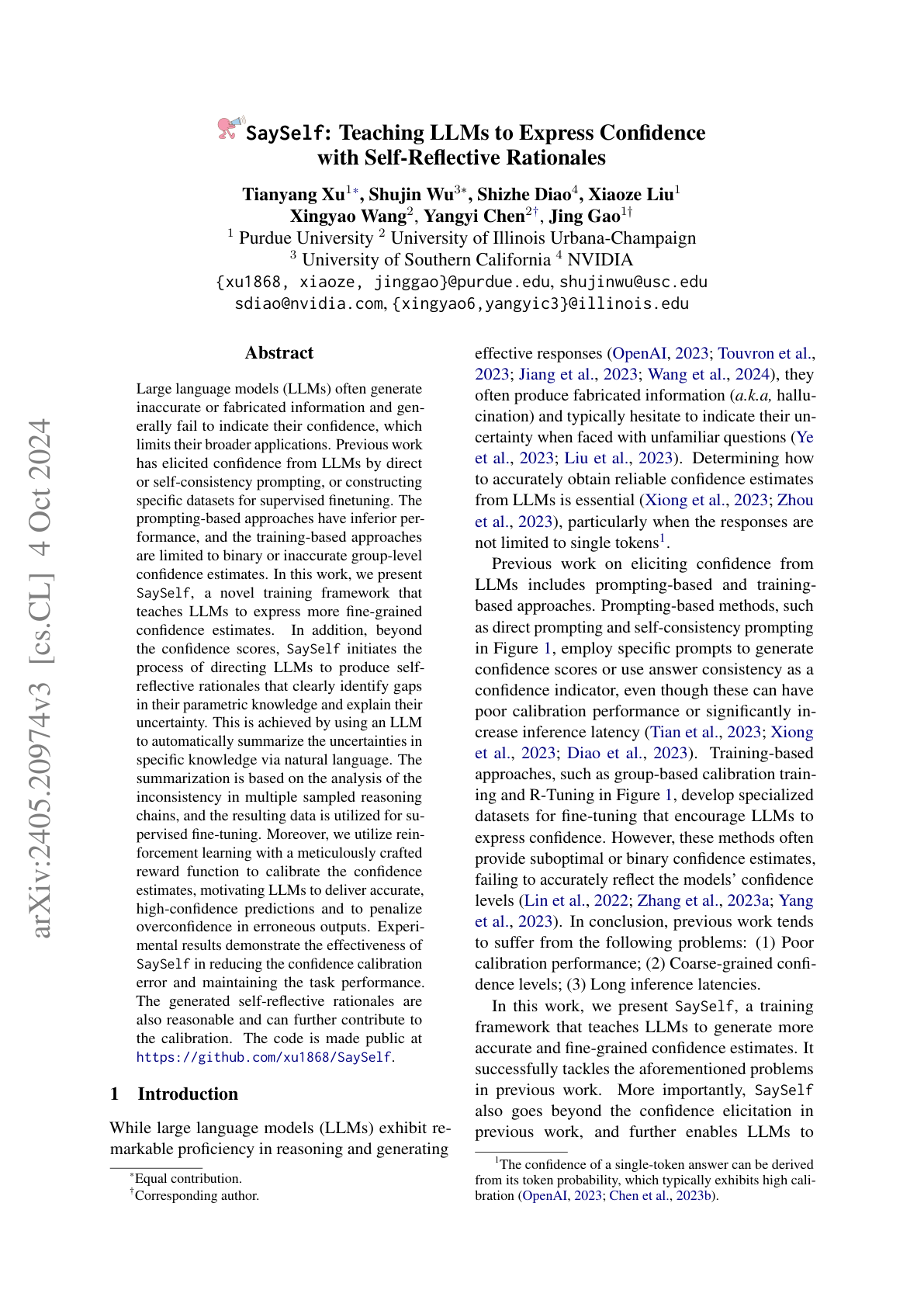
SaySelf
a training framework to teach LLMs to express more accurate fine-grained confidence estimates and self-reflective rationales; it performs supervised finetuning on a dataset that contains summaries of the difference between multiple reasoning chains; reinforcement learning is then applied to calibrate confidence estimates, encouraging the LLM to produce accurate, high-confidence predictions and penalize overconfidence in erroneous outputs.
The Geometry of Concepts in LLMs
studies the geometry of categorical concepts and how the hierarchical relations between them are encoded in LLMs; finds that simple categorical concepts are represented as simplices by the LLMs and complex concepts are represented as polytopes constructed from direct sums of simplices, which reflect the hierarchical structure.
Aligning LLMs with Demonstrated Feedback
proposes a method to align LLMs to a specific setting via a very small number of demonstrations as feedback; it aligns LLM outputs to a user’s demonstrated behaviors and can learn fine-grained style and task alignment across domains; outperforms few-shot prompting, SFT, and self-play methods on the tested benchmarks.
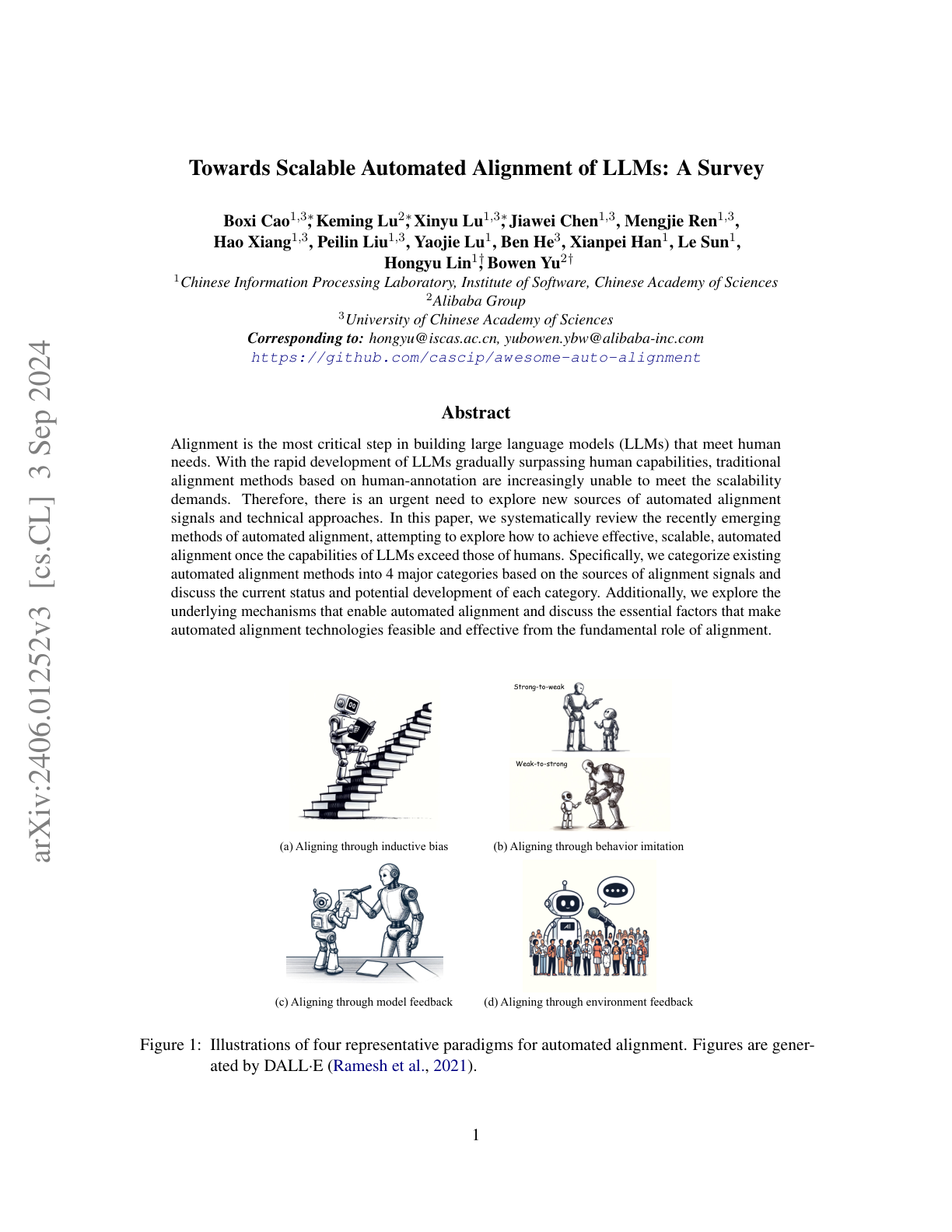
Towards Scalable Automated Alignment of LLMs
provides an overview of methods used for alignment of LLMs; explores the 4 following directions: 1) aligning through inductive bias, 2) aligning through behavior imitation, 3) aligning through model feedback, and 4) aligning through environment feedback.
AgentGym
a new framework featuring various environments and tasks for broad, real-time, and concurrent agent exploration; builds a generally capable LLM-based agent with self-evolution abilities and explores its potential beyond previously seen data across tasks and environments.
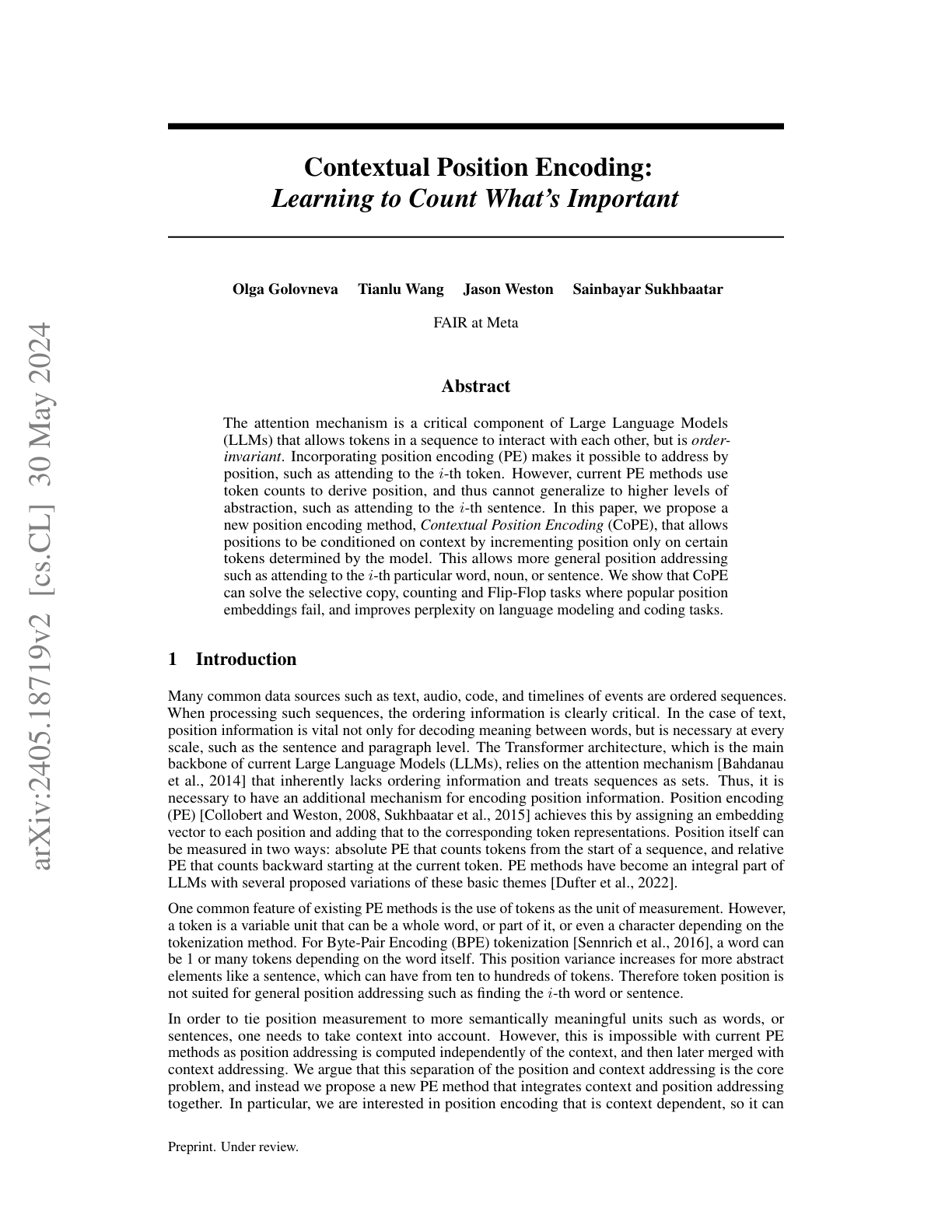
Contextual Position Encoding
proposes a new position encoding method, CoPE, to enable the position to be conditioned on context by incrementing position only on certain tokens; the position encoding is context-dependent and can represent different levels of position abstraction; the general position encoding method can attend to the i-th particular word, noun, or sentence; improves perplexity on language modeling and coding tasks.
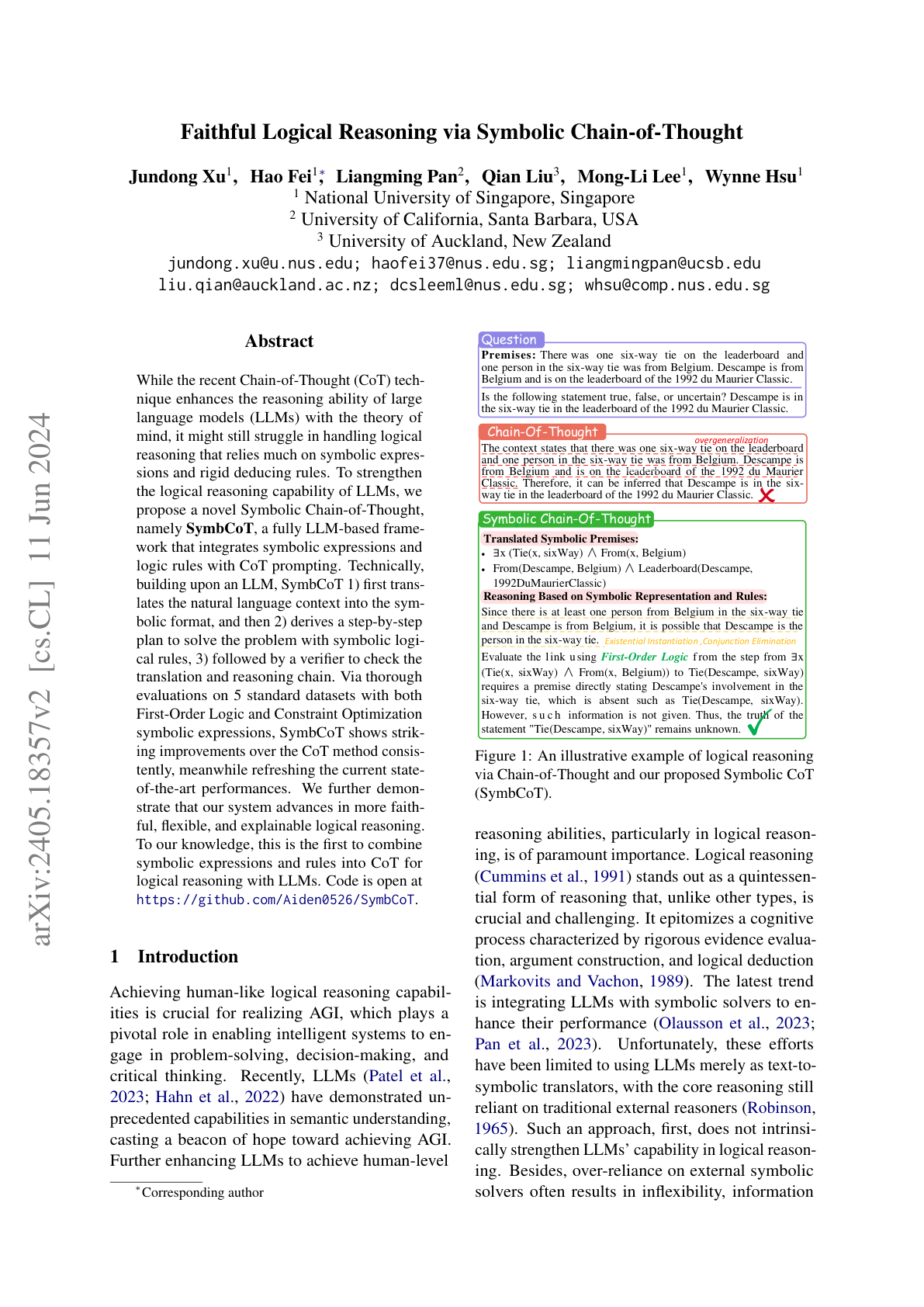
Symbolic Chain-of-Thought
proposes a method that improves the logical reasoning capabilities of LLMs by integrating symbolic expressions and logical rules with chain-of-thought (CoT) prompting; the prompting technique is called Symbolic Chain-of-Thought and it’s a fully LLM-based framework with the following key steps: 1) translates natural language context to symbolic format, 2) derives step-by-step plan to solve problems following symbolic logical rules, and 3) uses a verifier to check the translation and reasoning chain.
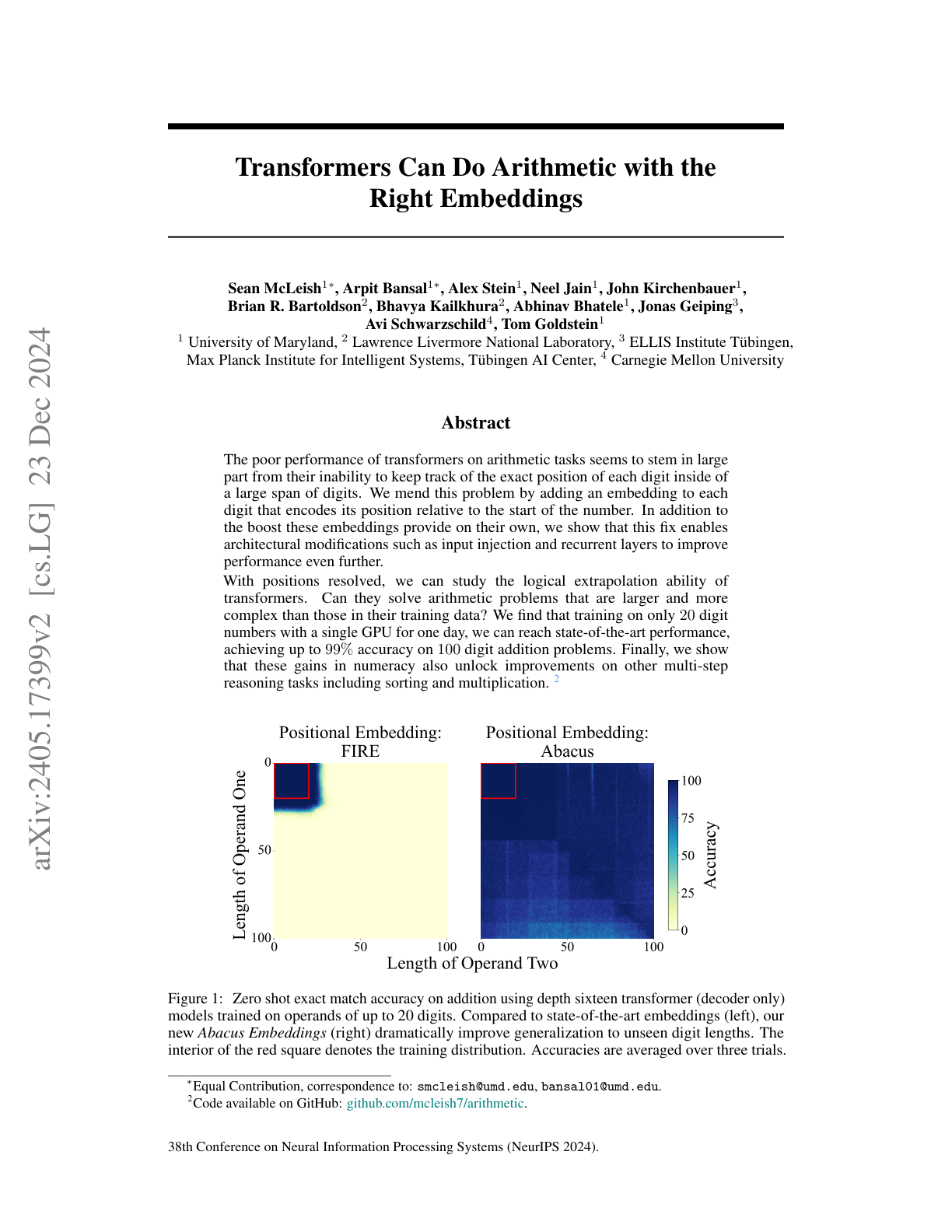
Abacus Embeddings
achieves 99% accuracy on 100-digit addition problems by training on only 20-digit numbers with a single GPU; the main challenge this work addresses is the inability of transformers to track the exact position of digits; they do this by adding an embedding to each digit that encodes its position relative to the start of the number; these gains also transfer to multi-step reasoning tasks that include sorting and multiplication.
Introduction to Vision-Language Modeling
presents an introduction to vision-language models along with key details of how they work and how to effectively train these models.
GNN-RAG
combines the language understanding abilities of LLMs with the reasoning abilities of GNNs in a RAG style; the GNN extracts useful and relevant graph information while the LLM takes the information and leverages its capabilities to perform question answering over knowledge graphs (KGQA); GNN-RAG improves vanilla LLMs on KGQA and outperforms or matches GPT-4 performance with a 7B tuned LLM.
Attention as an RNN
presents a new attention mechanism that can be trained in parallel (like Transformers) and be updated efficiently with new tokens requiring constant memory usage for inferences (like RNNs); the attention formulation is based on the parallel prefix scan algorithm which enables efficient computation of attention’s many-to-many RNN output; achieves comparable performance to Transformers on 38 datasets while being more time and memory-efficient.
Aya23
a family of multilingual language models that can serve up to 23 languages; it intentionally focuses on fewer languages and allocates more capacity to these languages; shows that it can outperform other massive multimodal models on those specific languages.
Are Long-LLMs A Necessity For Long-Context Tasks?
claims that long-LLMs are not a necessity to solve long-context tasks; proposes a reasoning framework to enable short-LLMs to address long-context tasks by adaptively accessing and utilizing the context based on the presented tasks; it decomposes the long context into short contexts and processes them using a decision-making process.
Financial Statement Analysis with LLMs
claims that LLMs can generate useful insights from its analysis of trends and financial ratios; shows that GPT-4 performs on par with narrowly specialized models; and achieves a profitable trading strategy based on GPT’s predictions.
SimPO
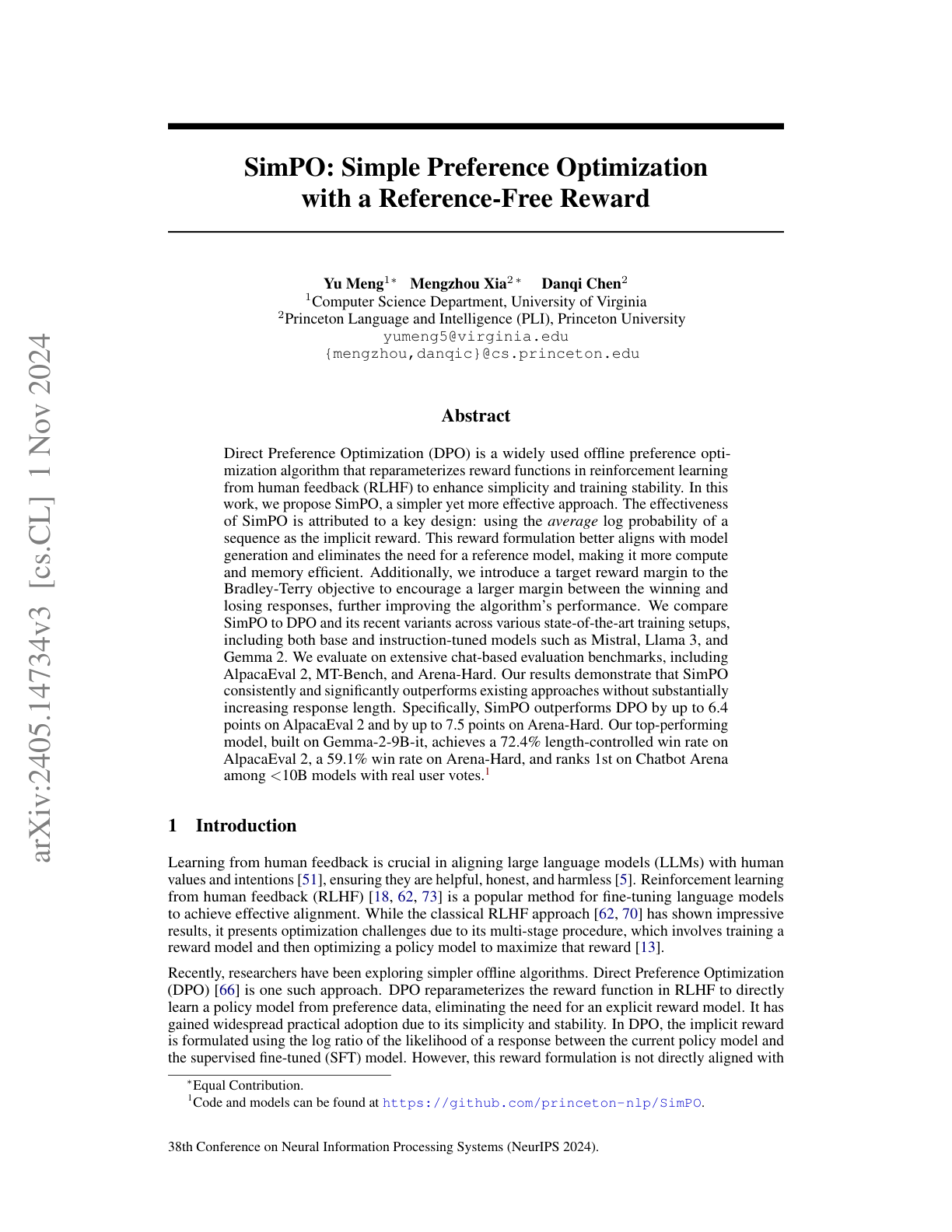
a simpler and more effective approach for preference optimization with a reference-free reward; uses the average log probability of a sequence as an implicit reward (i.e., no reference model required) which makes it more compute and memory efficient; demonstrates that it outperforms existing approaches like DPO and claims to produce the strongest 8B open-source model.
Extracting Interpretable Features from Claude 3 Sonnet
presents an effective method to extract millions of abstract features from an LLM that represent specific concepts; these concepts could represent people, places, programming abstractions, emotion, and more; reports that some of the discovered features are directly related to the safety aspects of the model; finds features directly related to security vulnerabilities and backdoors in code, bias, deception, sycophancy; and dangerous/criminal content, and more; these features are also used to intuititively steer the model’s output.
Agent Planning with World Knowledge Model
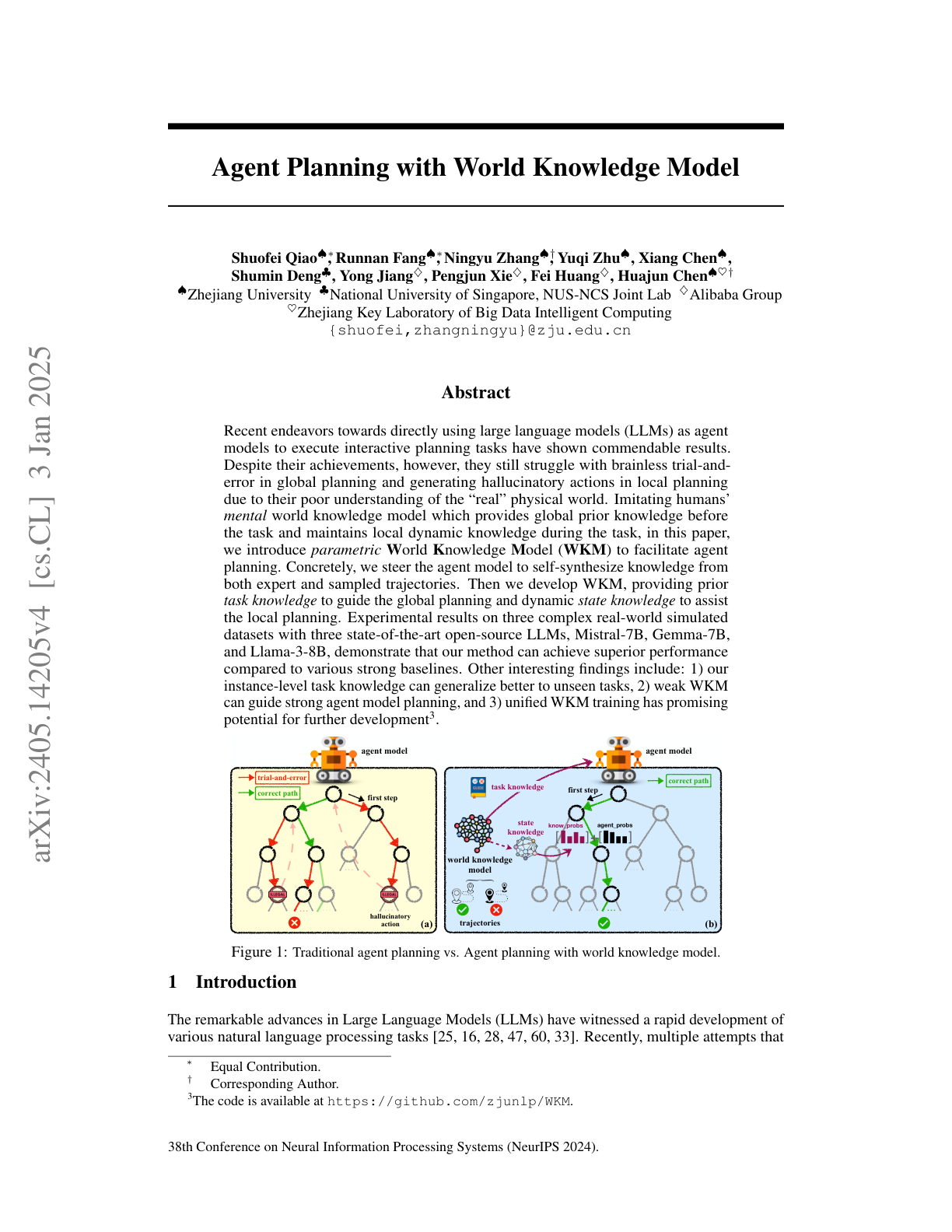
introduces a parametric world knowledge model to facilitate agent planning; the agent model can self-synthesize knowledge from expert and sampled trajectories; this is used to train the world knowledge model; prior task knowledge is used to guide global planning and dynamic state knowledge is used to guide the local planning; demonstrates superior performance compared to various strong baselines when adopting open-source LLMs like Mistral-7B and Gemma-7B.