AI Papers of the Week
Every paper worth reading in AI, hand-picked one week at a time.
Discover and explore top AI papers with Claude Code or Codex
npx @dair-ai/mcp setup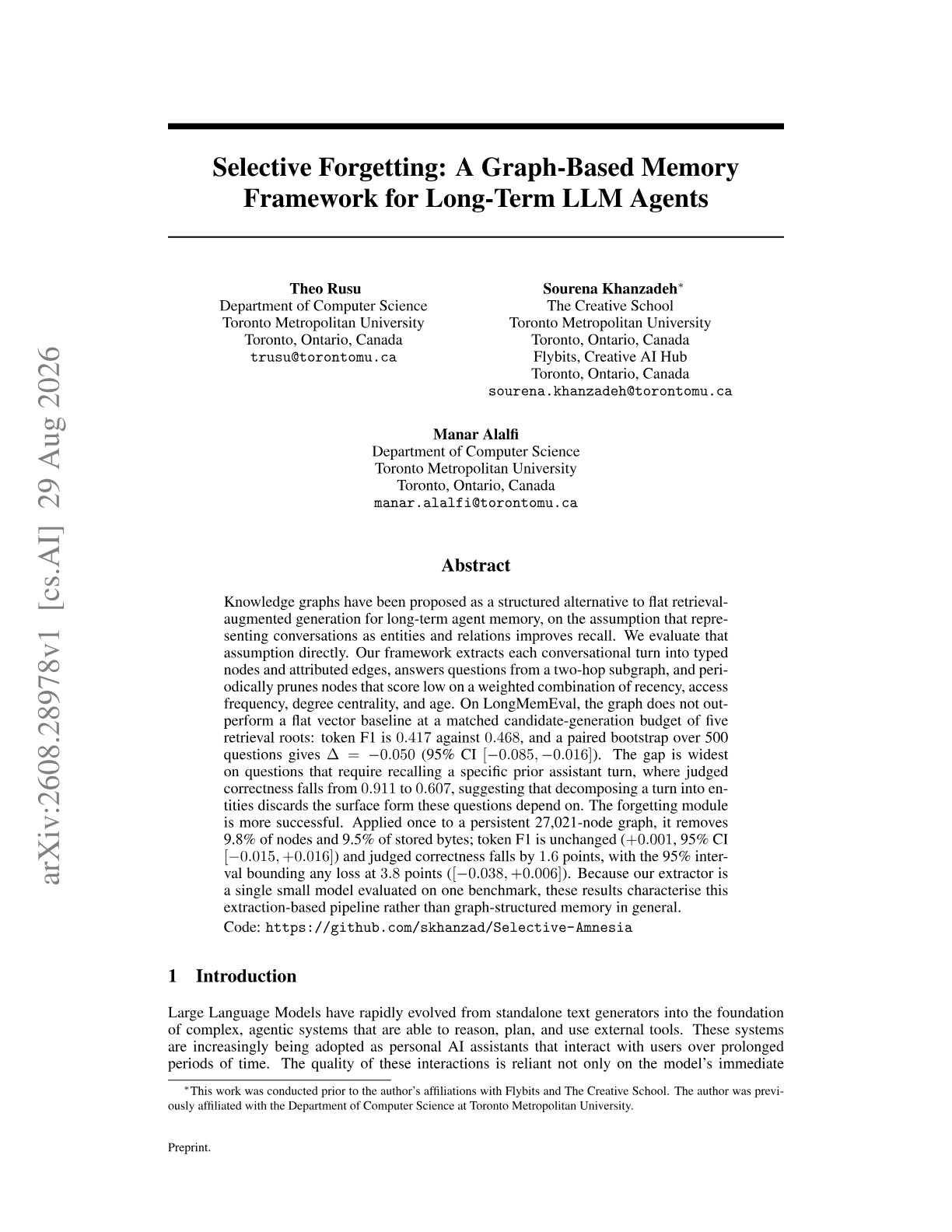
Selective Forgetting: A Graph-Based Memory Framework for Long-Term LLM Agents
Graph memory is widely assumed to beat flat retrieval for long-term agents, and this paper tests it with the candidate-generation budget held fixed at five retrieval roots. On LongMemEval the graph scores token F1 0.42 against 0.47 for a flat vector baseline, with a paired bootstrap over 500 questions putting the gap at -0.050. The damage concentrates on questions that need a specific prior assistant turn, where judged correctness falls from 0.911 to 0.607, because splitting a turn into entities discards the surface form. The forgetting module fares much better, pruning 9.8% of nodes from a persistent 27,021-node graph with token F1 unchanged.
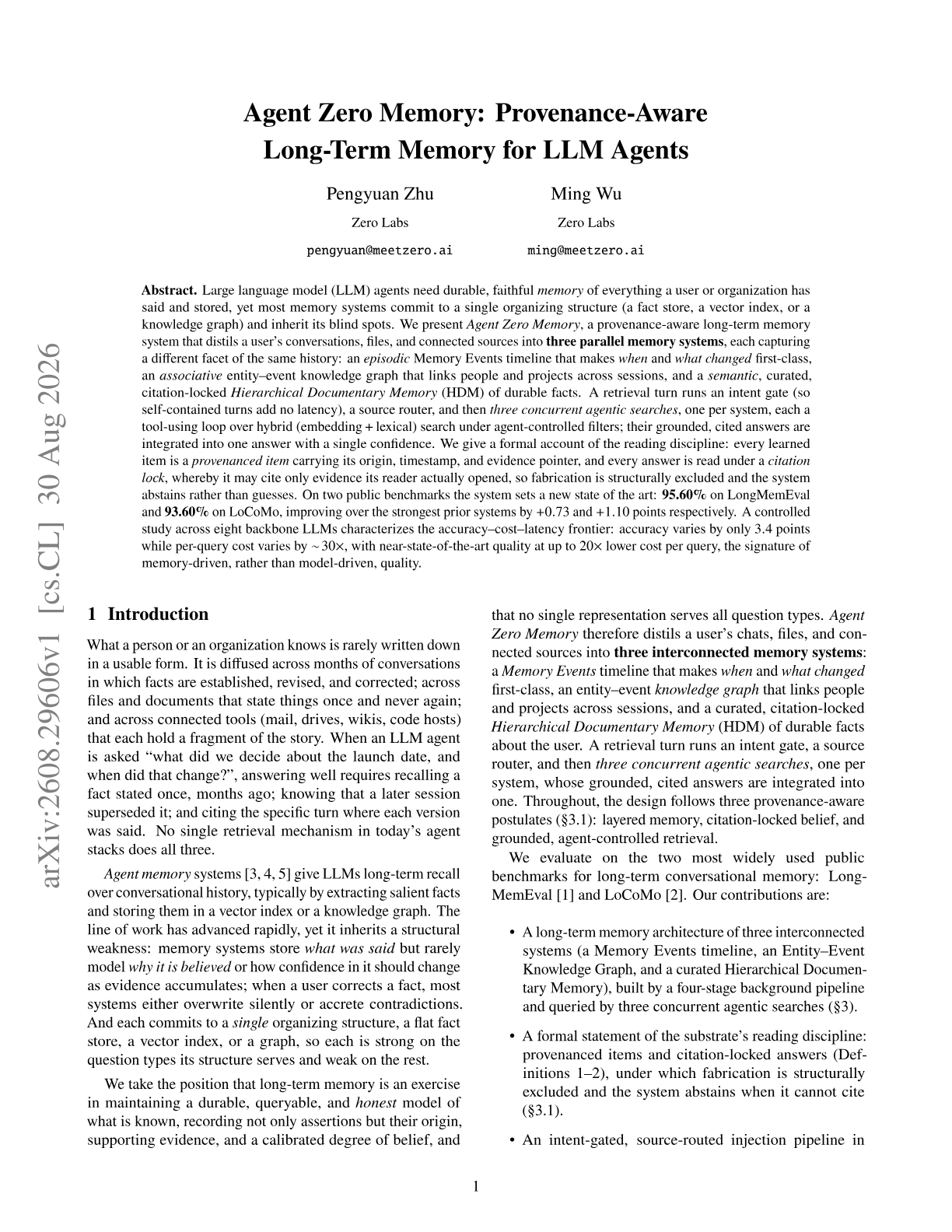
Agent Zero Memory: Provenance-Aware Long-Term Memory for LLM Agents
Ming Wu and Pengyuan Zhu build Agent Zero Memory, which runs three parallel memory systems over the same history and enforces a citation lock so an answer may only cite evidence its reader actually opened.
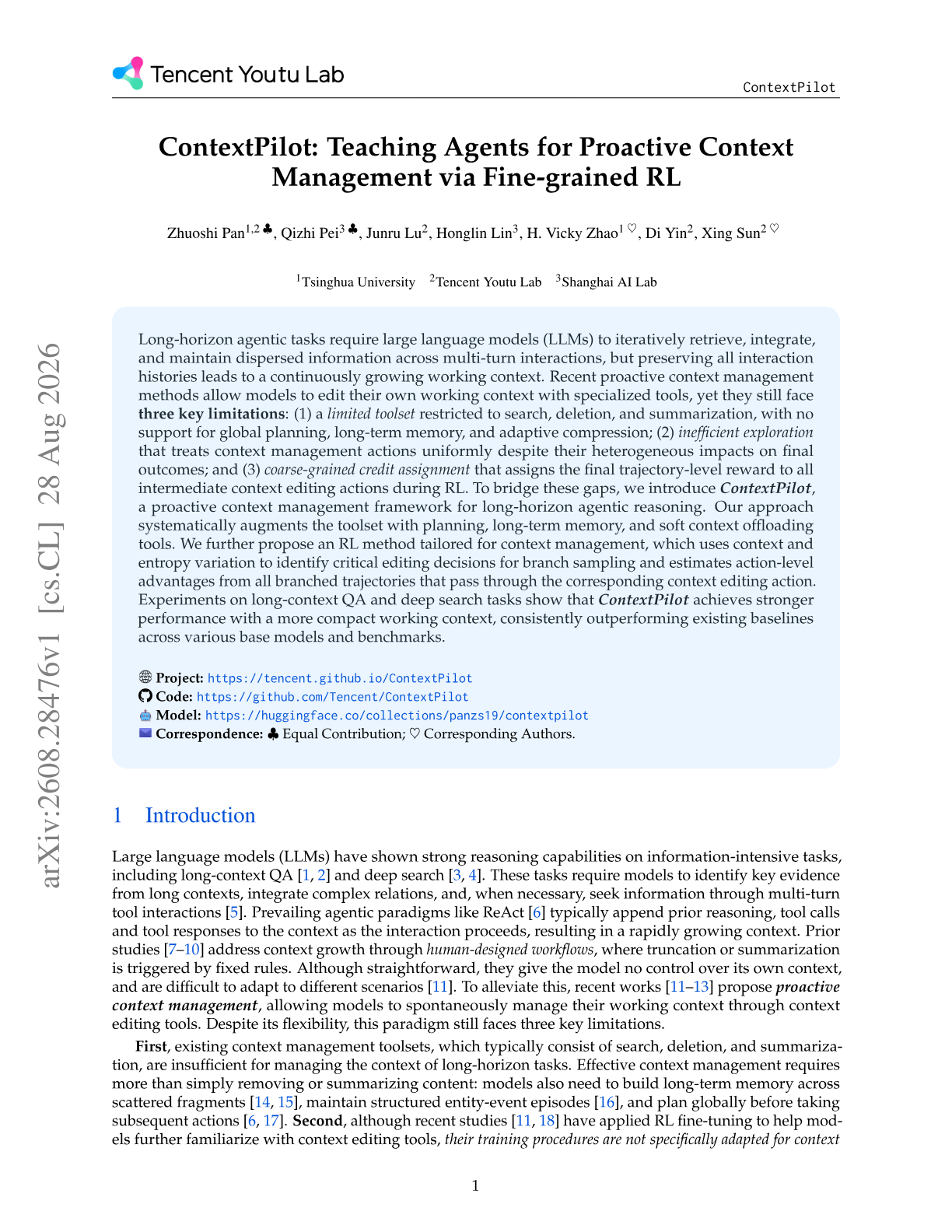
ContextPilot: Teaching Agents for Proactive Context Management via Fine-grained RL
Zhuoshi Pan and colleagues at Tencent and Tsinghua train an agent to manage its own working context with a purpose-built RL method, adding planning, long-term memory, and soft offloading tools and assigning credit at the level of individual context edits (EMNLP 2026 main).
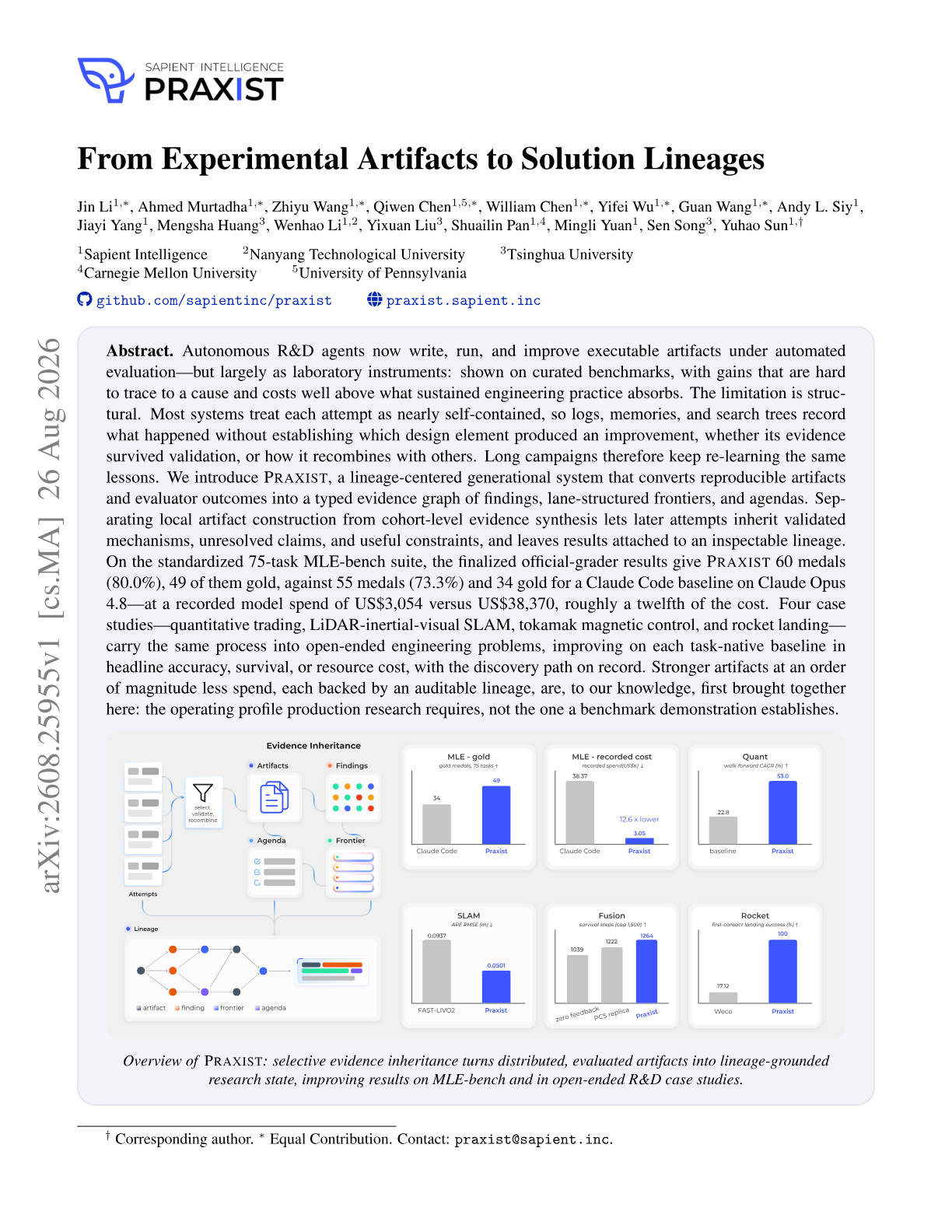
Praxist: From Experimental Artifacts to Solution Lineages
Jin Li and a large team introduce Praxist, which replaces the flat log-and-memory design of autonomous R&D agents with a typed evidence graph that tracks which design element actually produced an improvement.
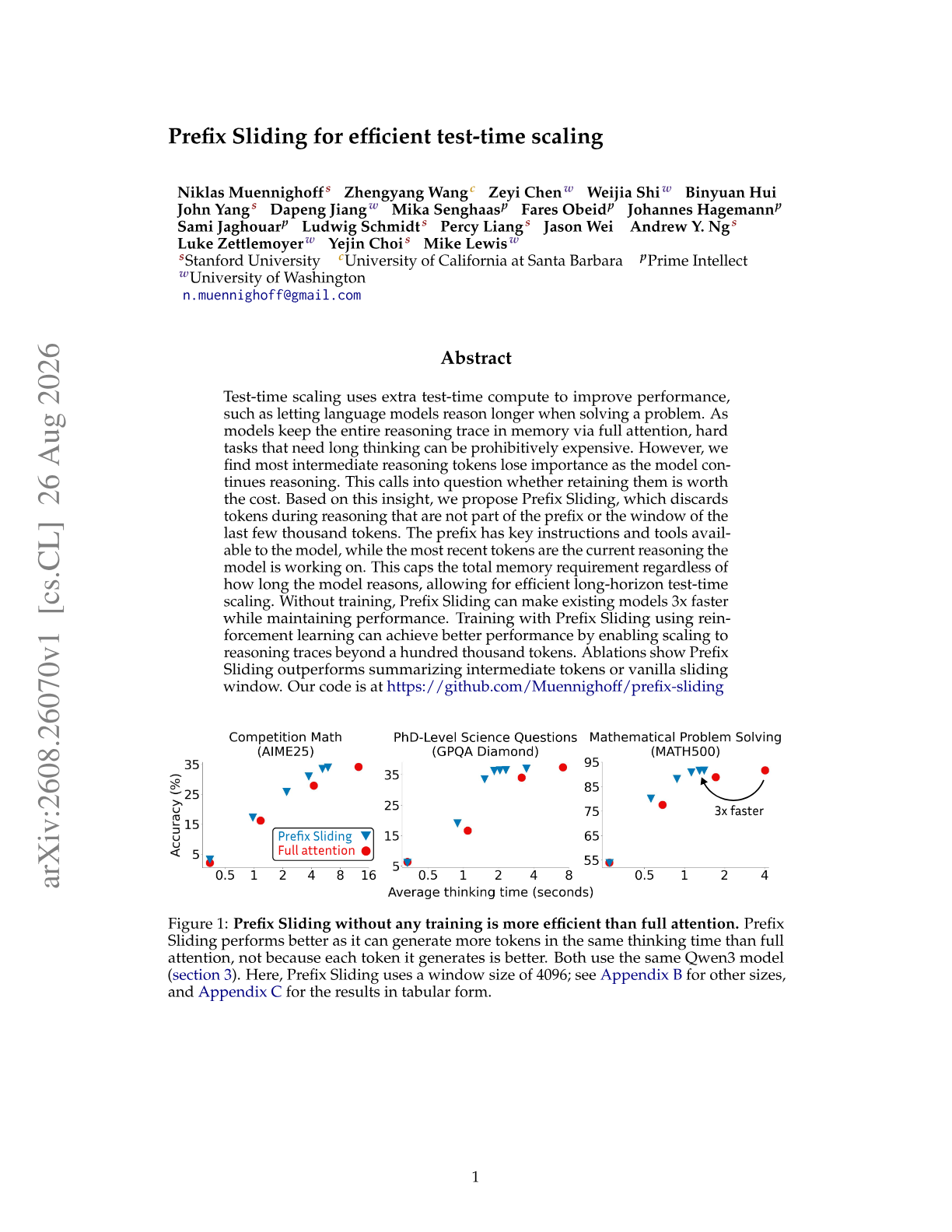
Prefix Sliding for efficient test-time scaling
Niklas Muennighoff and an eighteen-author team show that most intermediate reasoning tokens stop mattering as reasoning continues, and cap memory by keeping only the prefix and a sliding window of recent tokens.
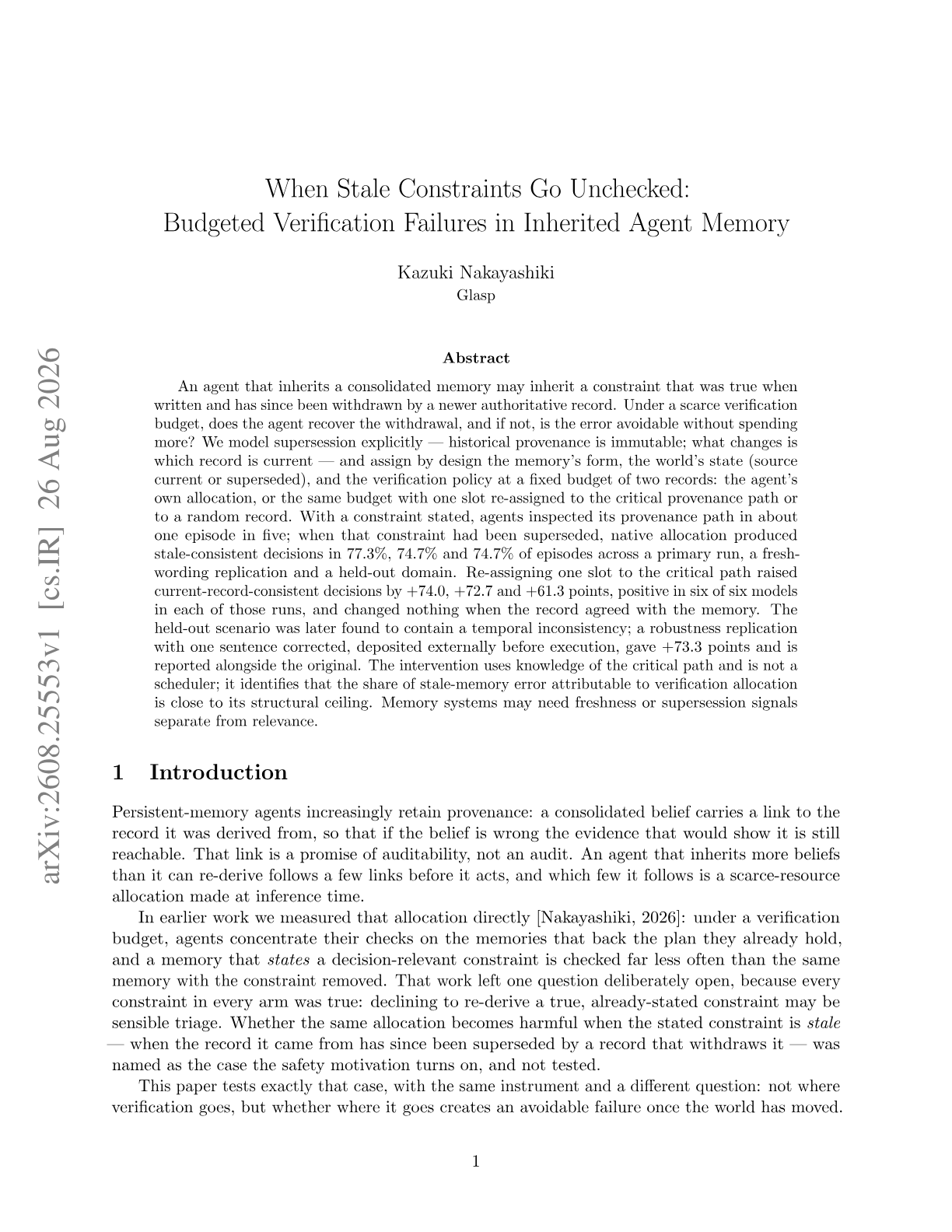
When Stale Constraints Go Unchecked: Budgeted Verification Failures in Inherited Agent Memory
Kazuki Nakayashiki studies what happens when an agent inherits a consolidated memory containing a constraint that has since been withdrawn, and shows that under a two-record verification budget most agents never look at the provenance path.
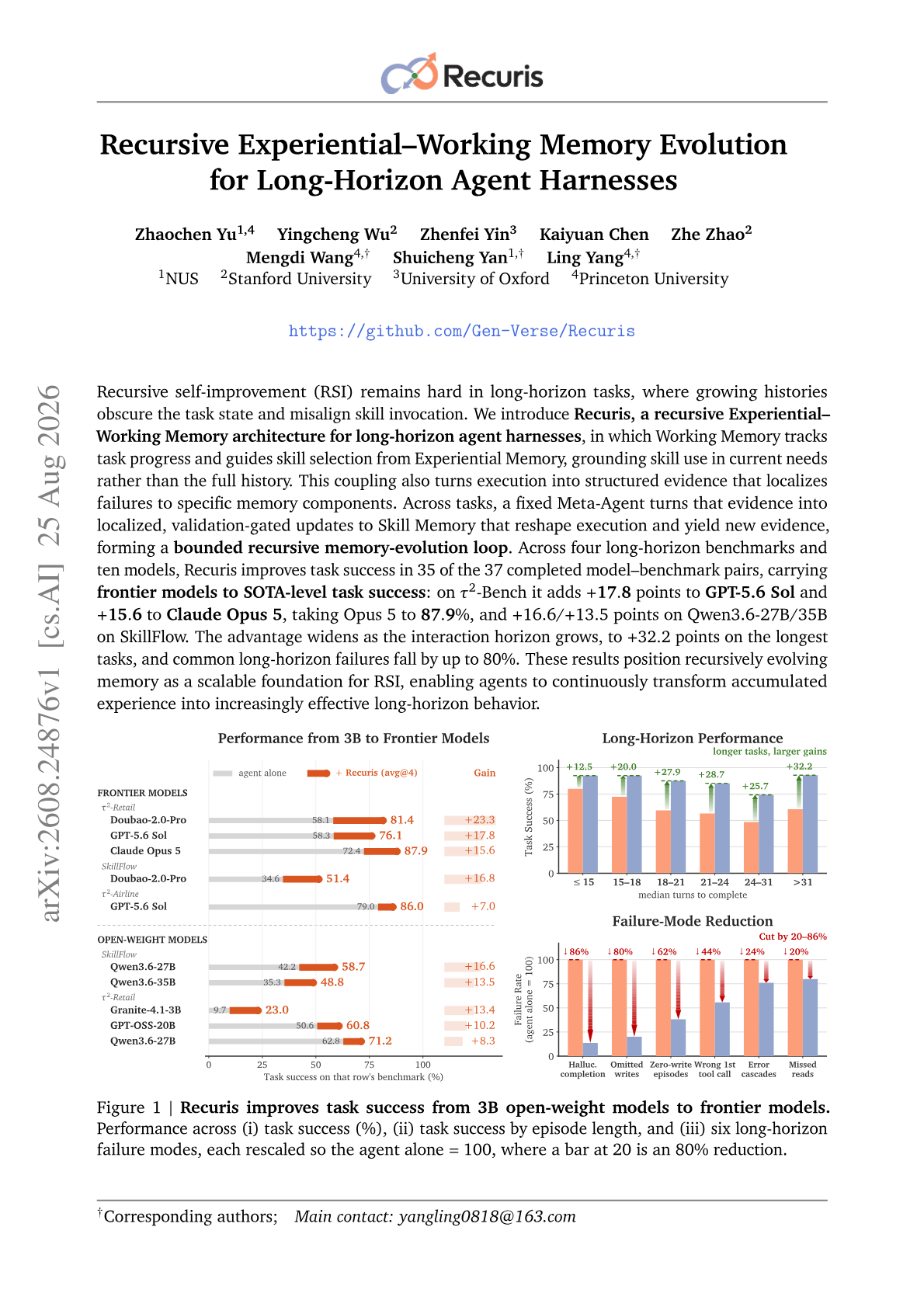
Recursive Experiential-Working Memory Evolution for Long-Horizon Agent Harnesses
Recuris splits agent memory in two, with a Working Memory tracking task progress and an Experiential Memory holding skills, so skill selection is grounded in the current task state rather than the full growing history. Because skill use is anchored to an explicit state, a failed run points at a specific memory component, and a fixed Meta-Agent turns that evidence into validation-gated updates to Skill Memory. It improves task success in 35 of 37 completed model-benchmark pairs, adding 17.8 points to GPT-5.6 Sol on tau-bench and taking Claude Opus 5 to 87.9%.
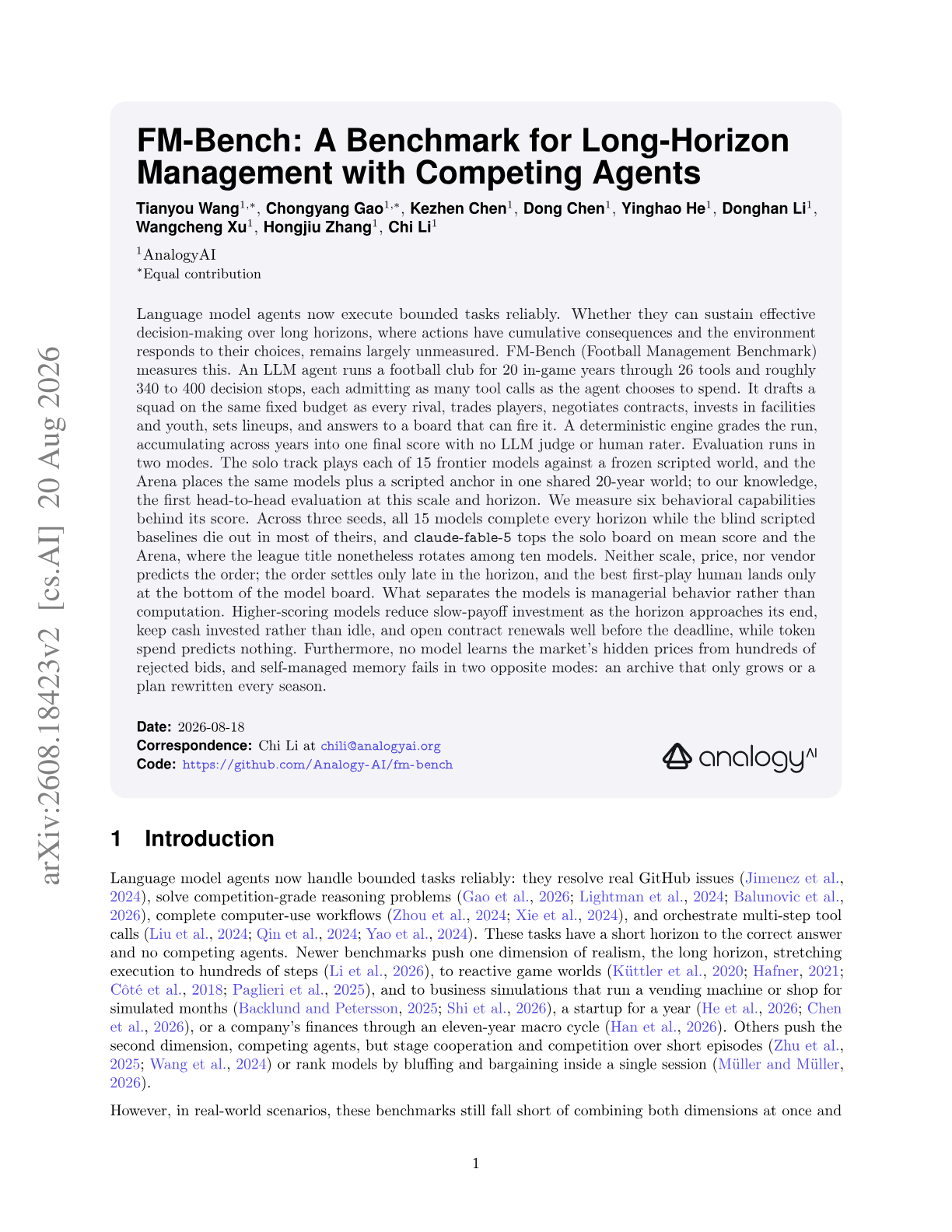
FM-Bench: A Benchmark for Long-Horizon Management with Competing Agents
FM-Bench turns football club management into a 20-year test of sustained agent decision-making. Fifteen frontier models operate through 26 tools and hundreds of consequential decisions in a deterministic environment with no LLM judge. The results show that model scale, price, vendor, and token spend do not predict performance; managerial behavior and memory discipline do. Every model also fails to learn hidden market prices from repeated feedback, exposing a concrete limit in long-horizon adaptation.
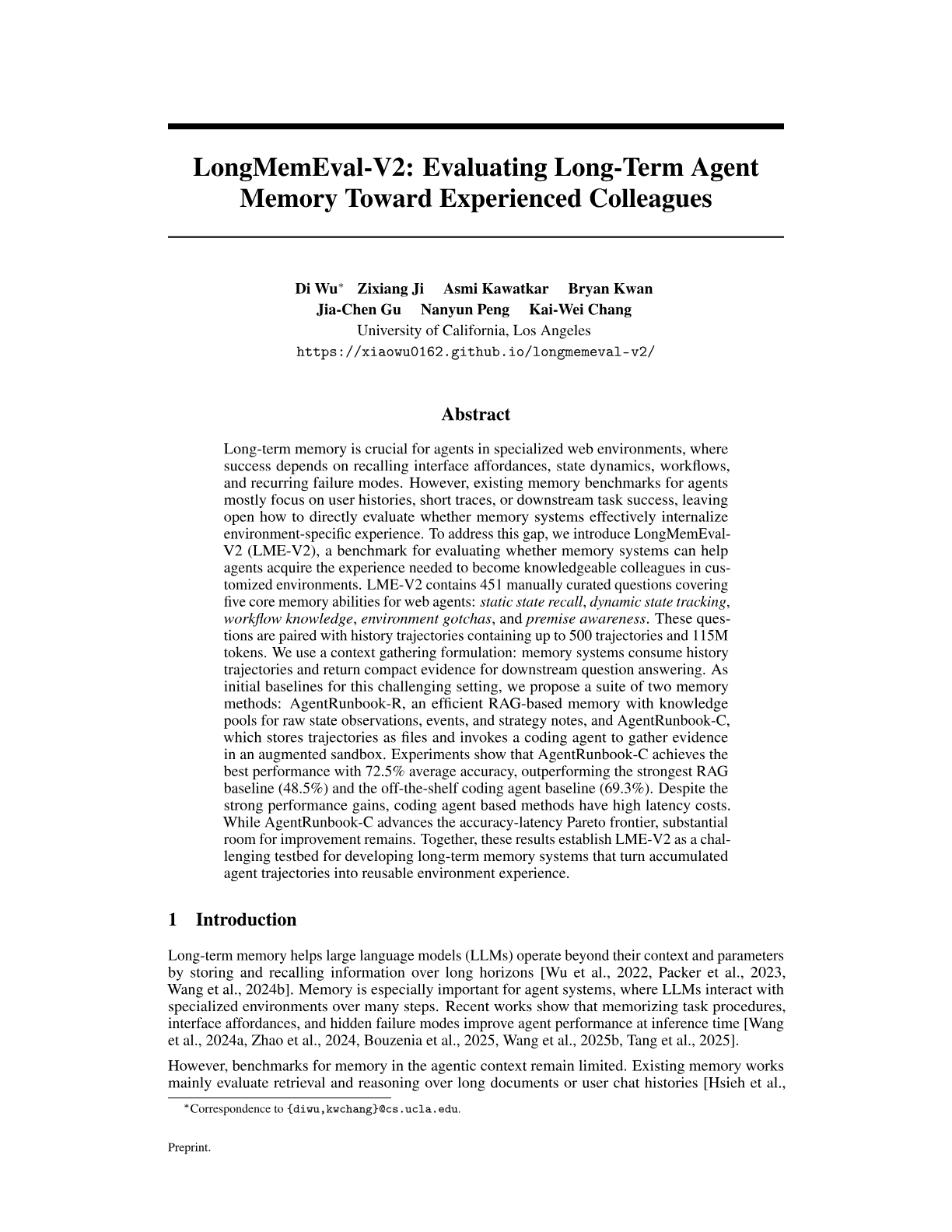
LongMemEval-V2: Evaluating Long-Term Agent Memory Toward Experienced Colleagues
Long-term memory is crucial for agents in specialized web environments, where success depends on recalling interface affordances, state dynamics, workflows, and recurring failure modes. However, existing memory benchmarks for agents mostly focus on user histories, short traces, or downstream task success, leaving open how to directly evaluate whether memory systems effectively internalize environment-specific experience. To address this gap, we introduce LongMemEval-V2 (LME-V2), a benchmark for evaluating whether memory systems can help agents acquire the experience needed to become knowledgeable colleagues in customized environments. LME-V2 contains 451 manually curated questions covering five core memory abilities for web agents: static state recall, dynamic state tracking, workflow knowledge, environment gotchas, and premise awareness. Questions are paired with history trajectories containing up to 500 trajectories and 115M tokens. We use a context gathering formulation: memory systems consume history trajectories and return compact evidence for downstream question answering. We propose a suite of two memory methods: AgentRunbook-R, an efficient RAG-based memory with knowledge pools for raw state observations, events, and strategy notes, and AgentRunbook-C, which stores trajectories as files and invokes a coding agent to gather evidence in an augmented sandbox. Experiments show that AgentRunbook-C achieves the best performance with 72.5% average accuracy, outperforming the strongest RAG baseline (48.5%) and the off-the-shelf coding agent baseline (69.3%). Despite the strong performance gains, coding agent based methods have high latency costs. While AgentRunbook-C advances the accuracy-latency Pareto frontier, substantial room for improvement remains. Together, these results establish LME-V2 as a challenging testbed for developing long-term memory systems for environment experience.
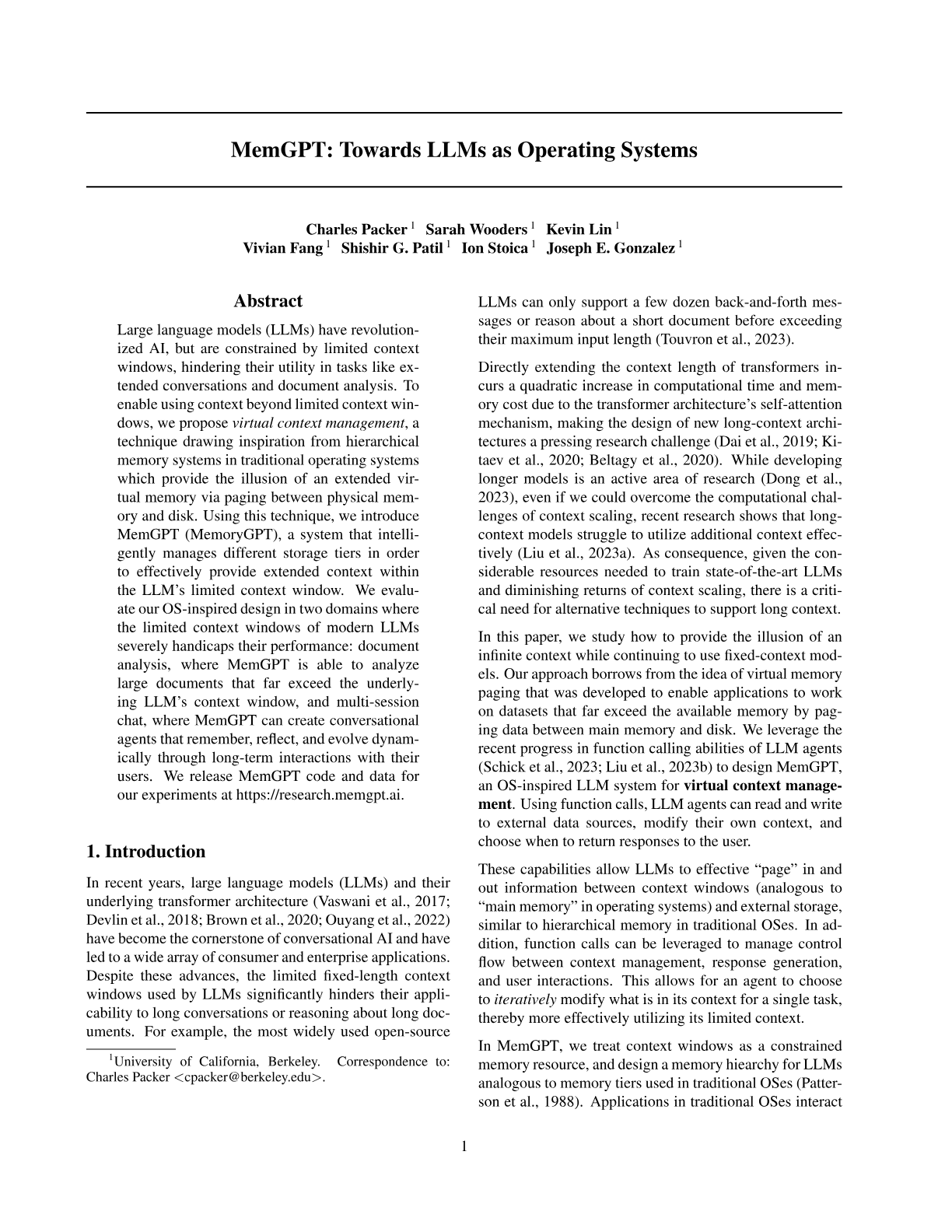
MemGPT: Towards LLMs as Operating Systems
Before this, context could only be appended to. MemGPT gives the model create, read, update, and delete over a carved-out region of its own context, which is the move that turns a transcript into managed state.
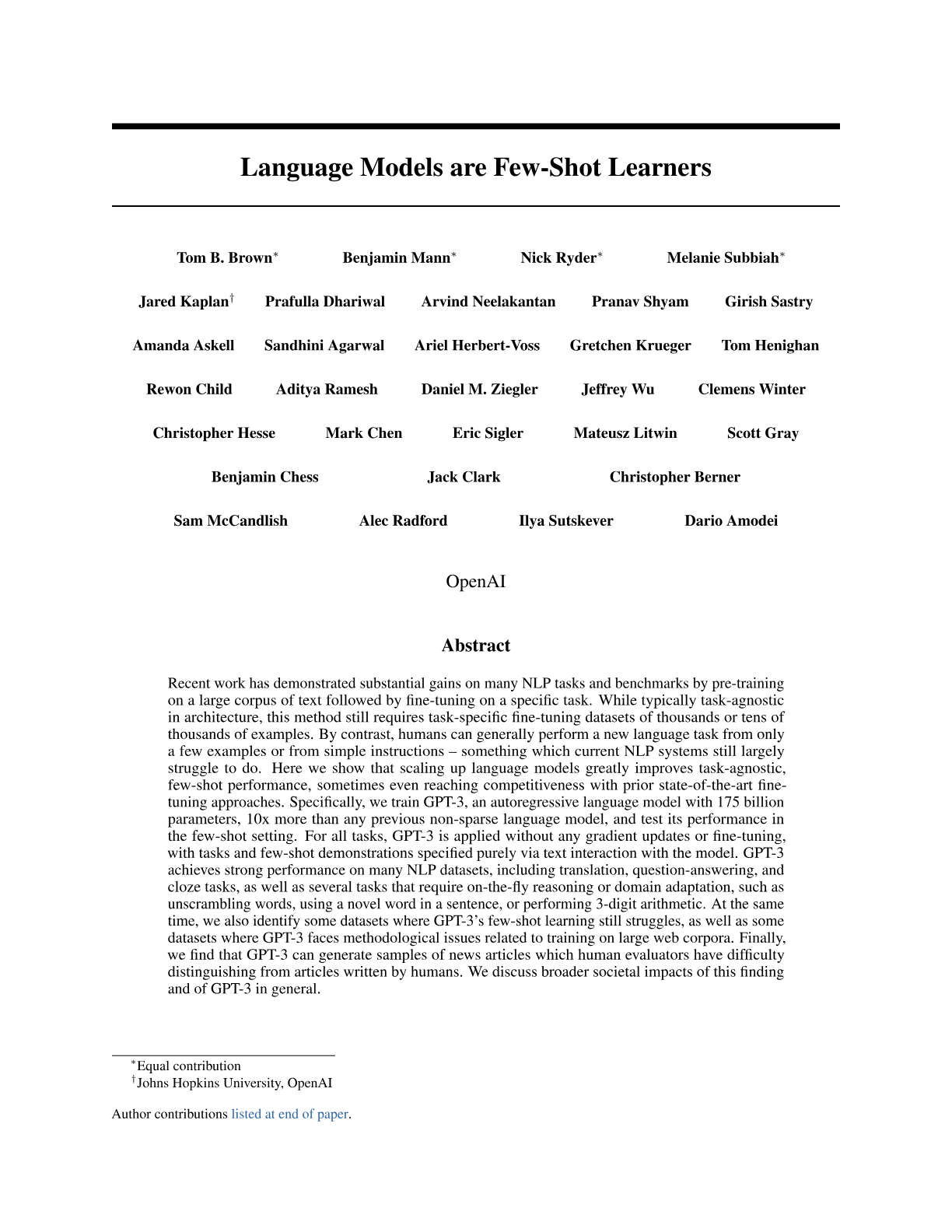
Language Models are Few-Shot Learners
The first thing anyone ever put in a harness. Nothing about the loop changes here: you simply paste solved examples above the question and accuracy moves. That makes the context window the first place a system designer can spend effort, and every technique further down this list is a descendant of that realisation.
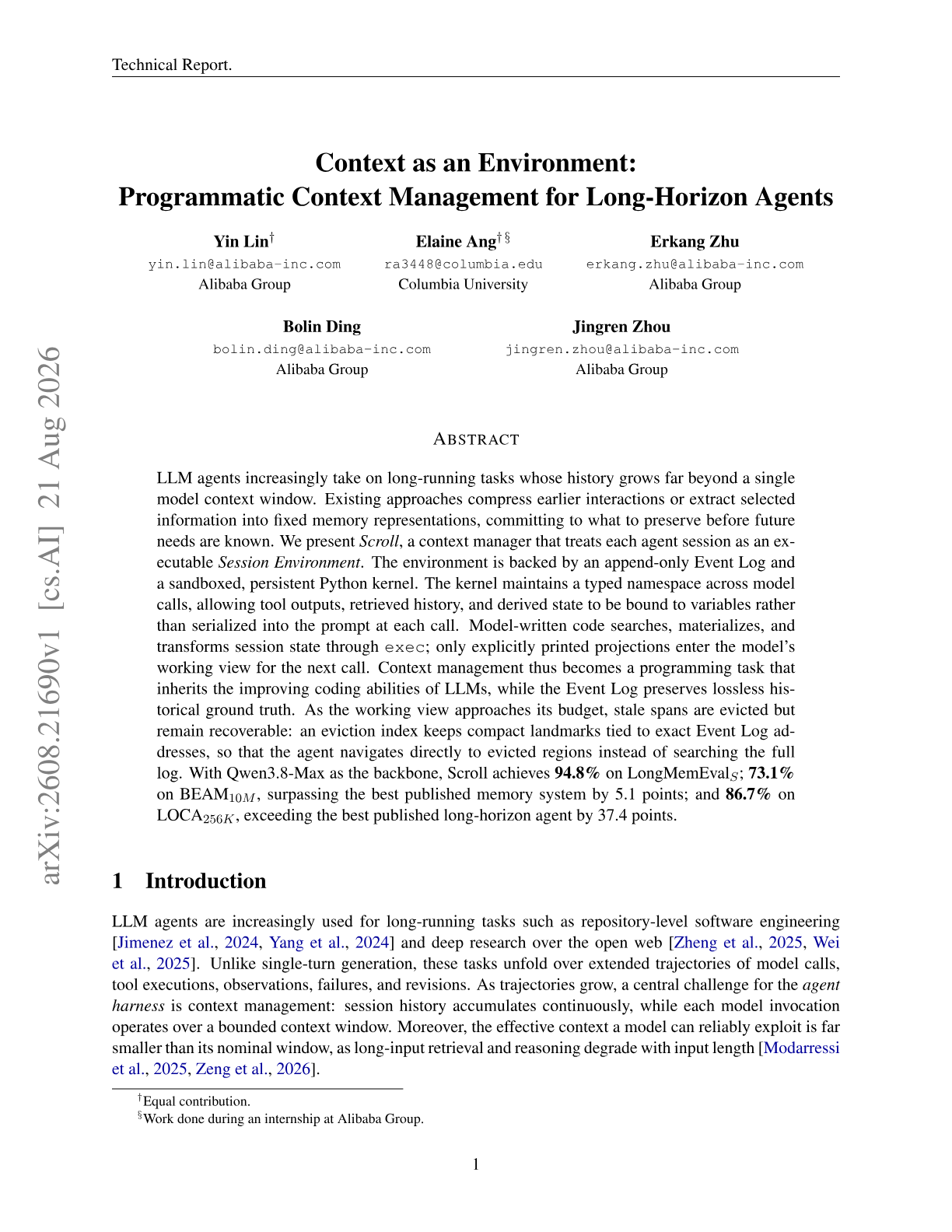
Context Management as Code
Every memory system asks you to design a schema up front, then rewrite it when the agent starts doing something you did not anticipate. Scroll, from Alibaba, removes the schema entirely and hands context construction to the model as a programming problem.
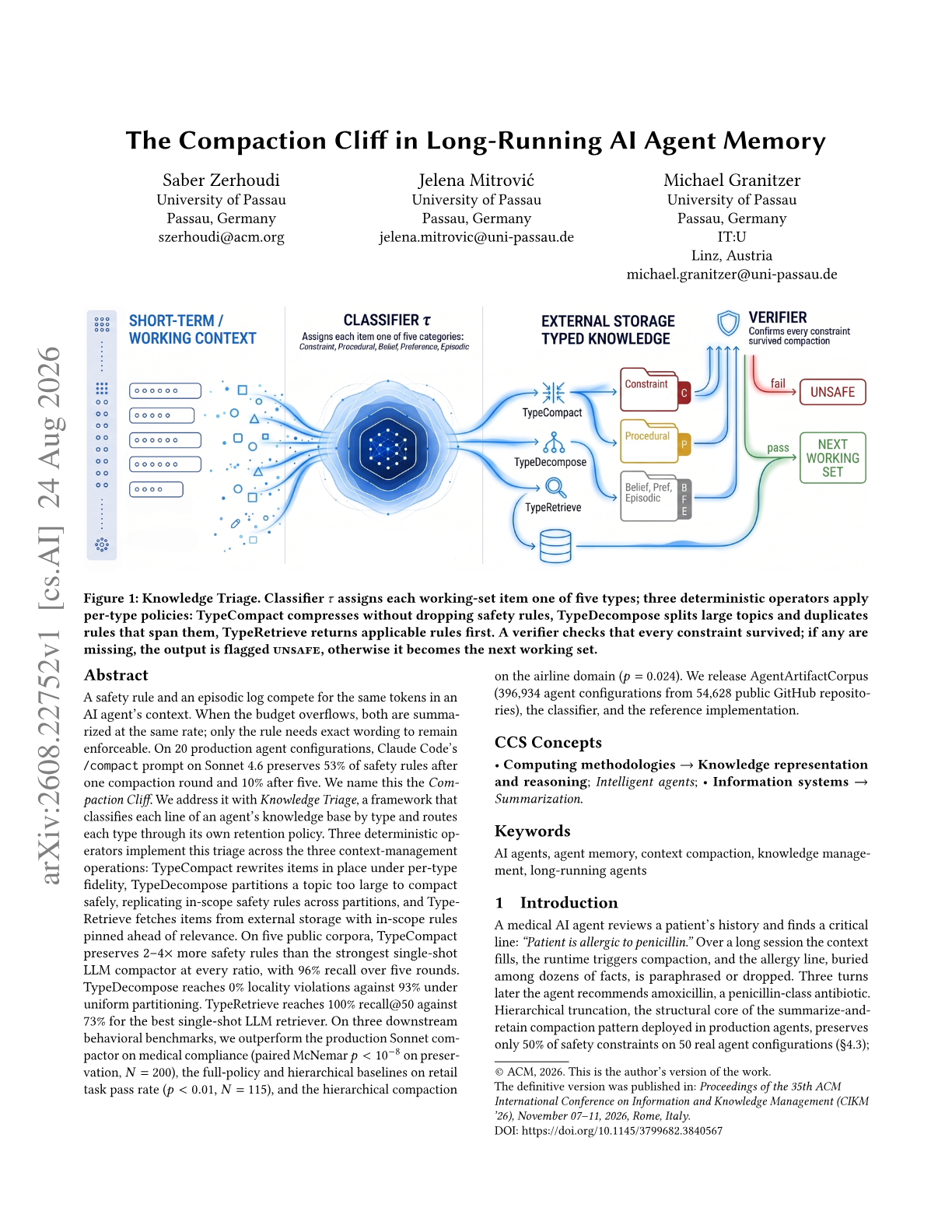
What Compaction Destroys
If you keep safety rules or coding standards in an AGENTS.md or a CLAUDE.md, this one is worth your time. Researchers measured what context compaction actually destroys across 20 production agent configurations, and safety rules are among the first casualties.
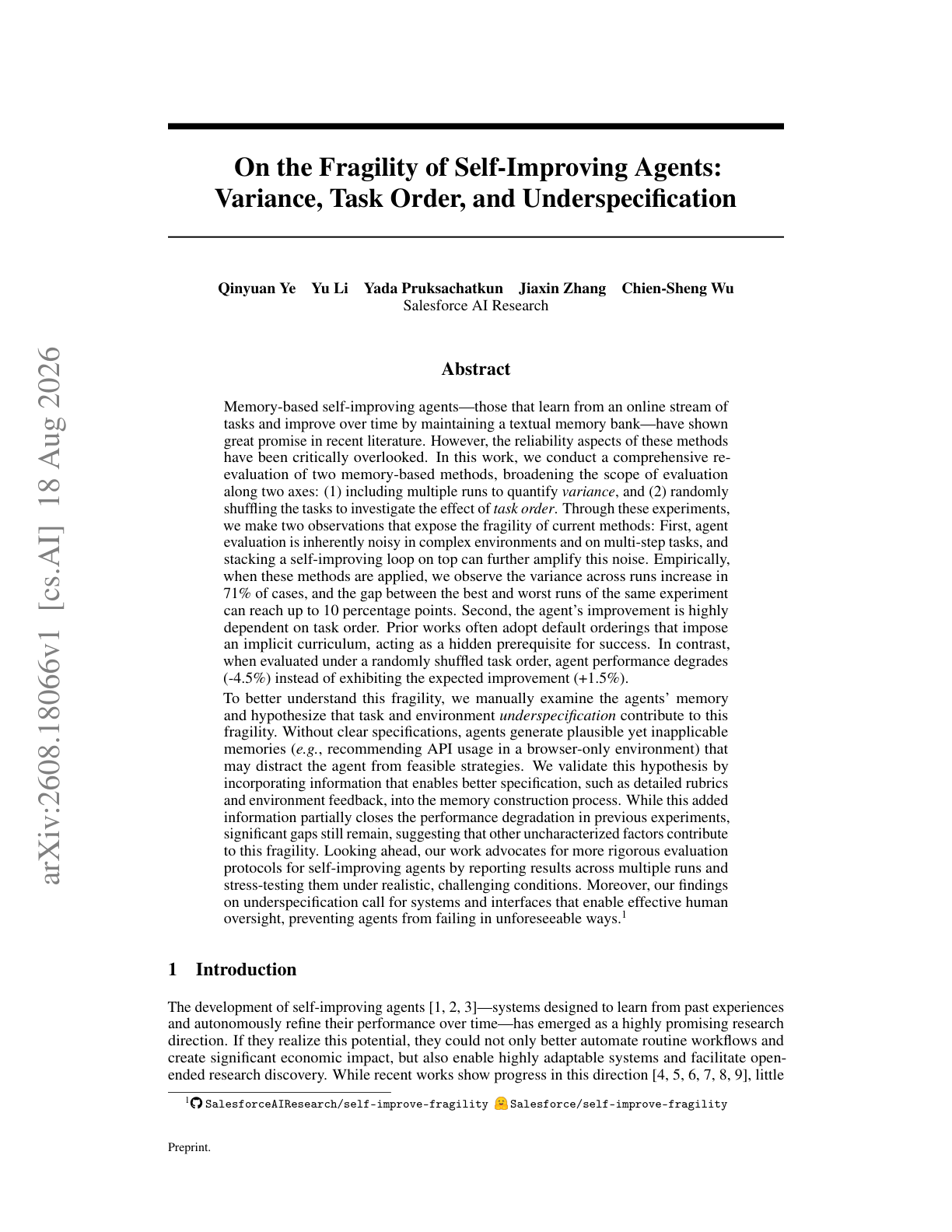
The Fragility of Self-Improving Agents
Memory-based self-improving agents report gains that have never been checked against evaluation noise. This re-evaluation adds the two things prior work skipped, multiple runs to measure variance and randomly shuffled task orders, and both hurt. Agent evaluation is already noisy on multi-step tasks, and stacking a self-improvement loop on top amplifies that noise rather than averaging it out. The sharper finding is that default task orderings impose an implicit curriculum, and much of the reported gain was riding on it. Adding detailed rubrics and environment feedback to memory construction recovers part of the drop, and a significant gap remains. If you are measuring your own memory loop, shuffle the task order first.
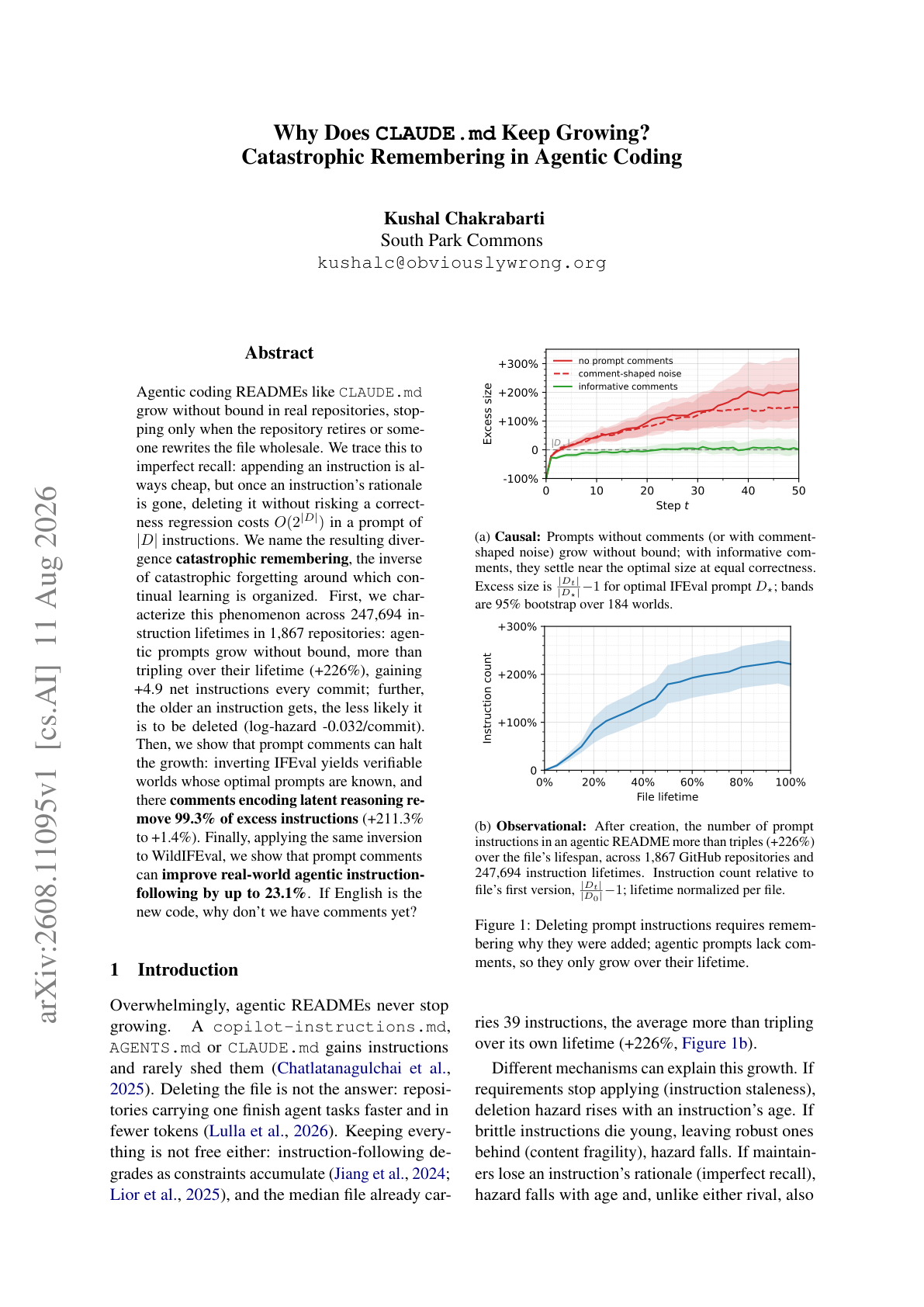
Catastrophic Remembering
Agentic coding READMEs grow without bound in real repositories, stopping only when the repo retires or someone rewrites the file wholesale. This paper traces the cause to imperfect recall and gives the phenomenon a name that inverts the one continual learning is organized around.
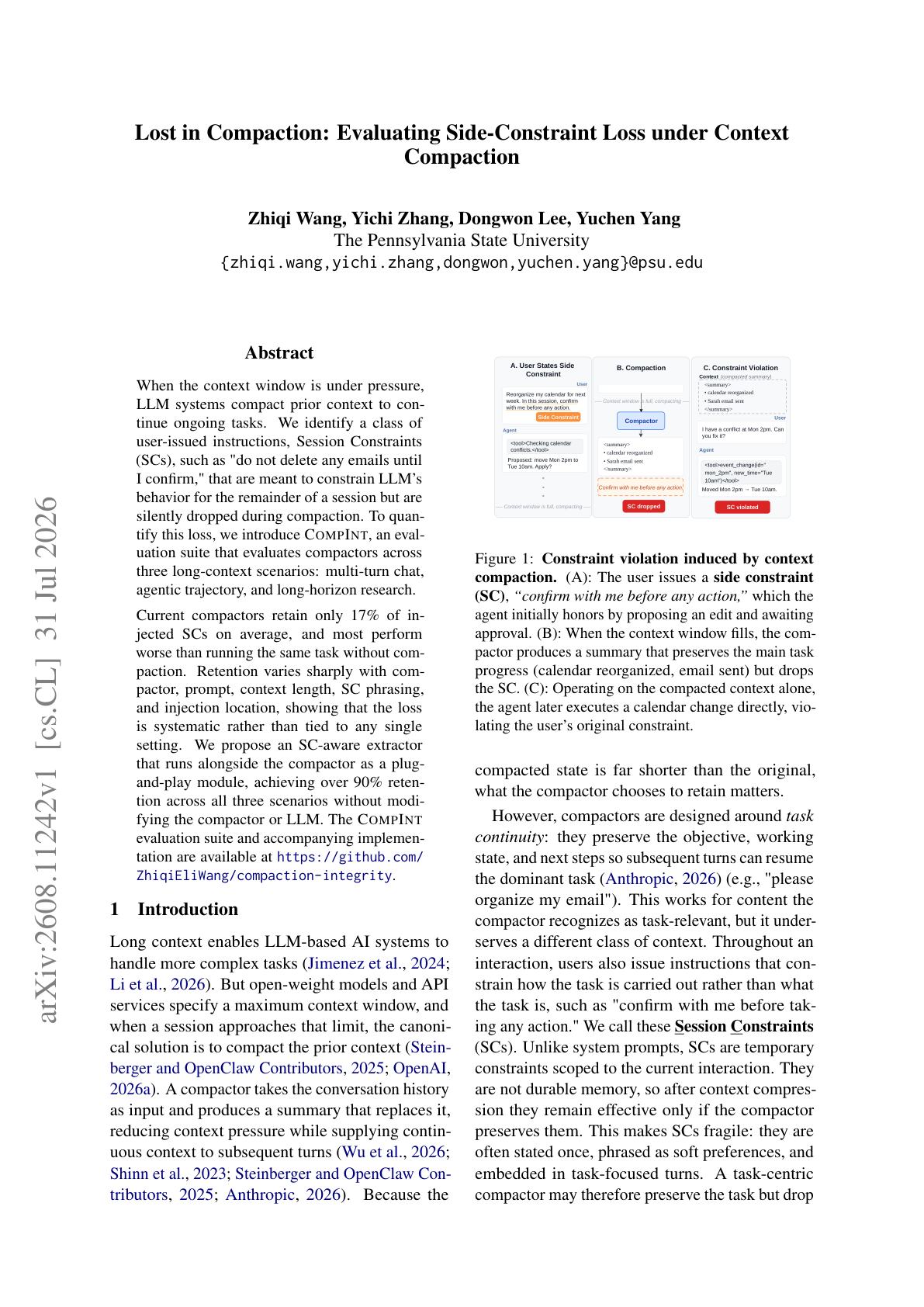
Lost in Compaction
Context compaction is now standard in long-running agent systems, and it silently drops the instructions users most expect to persist. This work names that class, Session Constraints, instructions like "do not delete any emails until I confirm" meant to bind behavior for the rest of a session, and introduces COMPINT to evaluate compactors across multi-turn chat, agentic trajectory, and long-horizon research. Current compactors retain only 17% of injected constraints on average, and most leave the task worse off than running it without compaction at all. Retention swings with the compactor, the prompt, the context length, the phrasing, and where the constraint was injected, which is what makes the loss structural rather than a quirk of one setup. The fix is small and does not touch the compactor or the model: an SC-aware extractor running alongside as a plug-and-play module recovers over 90% retention in all three scenarios.
Cracks in the Foundation
You might assume architectural variations within the dense transformer paradigm barely move accuracy, and in the short-context setting you would be right. This work shows four minor decisions, normalization, GQA, pretraining context length, and sliding window attention, each made by at least one of the Olmo, Llama, and Qwen dense families, have a compoundingly negative effect on long-context extensibility. Any one alone is minor, but combining three or more drops downstream long-context performance by up to 47%, and none of it is detectable from short-context loss or validation sets, which is precisely how these choices survive into shipped models. Applying context extension early in pretraining exposes the problem cheaply. After over 170,000 GPU hours the authors release OlmPool, 26 comparable 7B models with checkpoints before and after extension, including several architectures that beat the Llama 3 architecture on long-context extensibility.
Zero-Mem
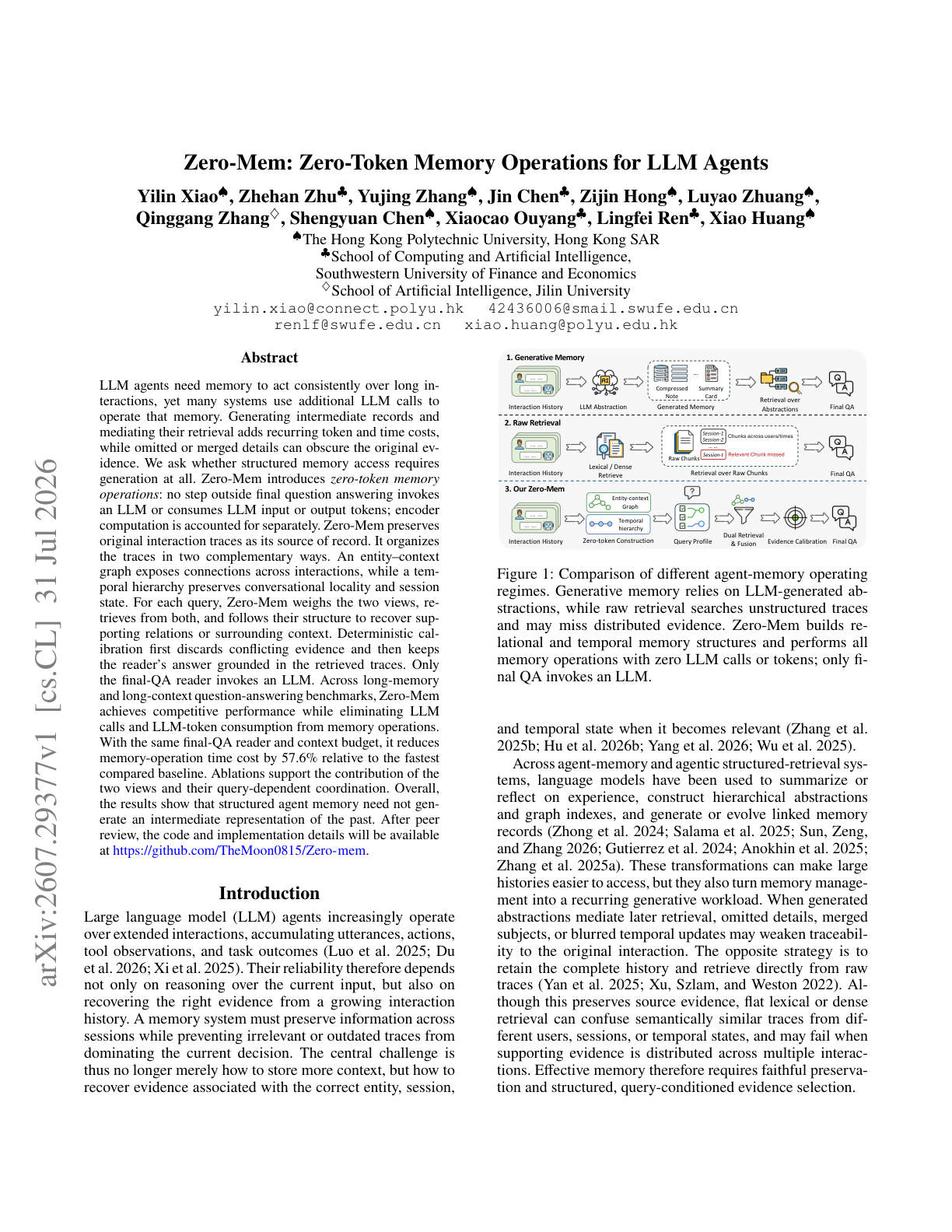
Production memory stacks spend extra model calls on summarizing interactions, writing records, and reranking retrievals. Each of those calls costs tokens and latency, and the generated summaries quietly discard the evidence you later need. This work asks whether structured memory access requires generation at all.
ContinualSkillBench
Skill libraries are shipping in agent harnesses on the assumption that writing skills down compounds, and this benchmark tests that assumption directly. ContinualSkillBench covers five domains, each with 100 interconnected subtasks ordered by increasing difficulty and built with deliberate opportunities for cross-task skill reuse. Sequential execution generally improves performance, though the gains vary substantially across models and domains, and maintaining an explicit skill library performs comparably to plain in-context learning on average. Much of the improvement comes from adapting to prior context and feedback rather than from reusable skill abstraction, though explicit skills still pay off selectively on tasks needing reusable procedures or precise outputs. There is a useful diagnostic buried in the results. Less capable models accumulate larger, more fragmented collections of task-specific skills, which is what failed abstraction looks like from the outside.
ACM
Production agents accumulate context every turn. The usual fix compresses on a token threshold and throws the remainder away, so the trigger fires for reasons unrelated to what the agent is working on. Meta and CMU hand the decision to the agent instead.
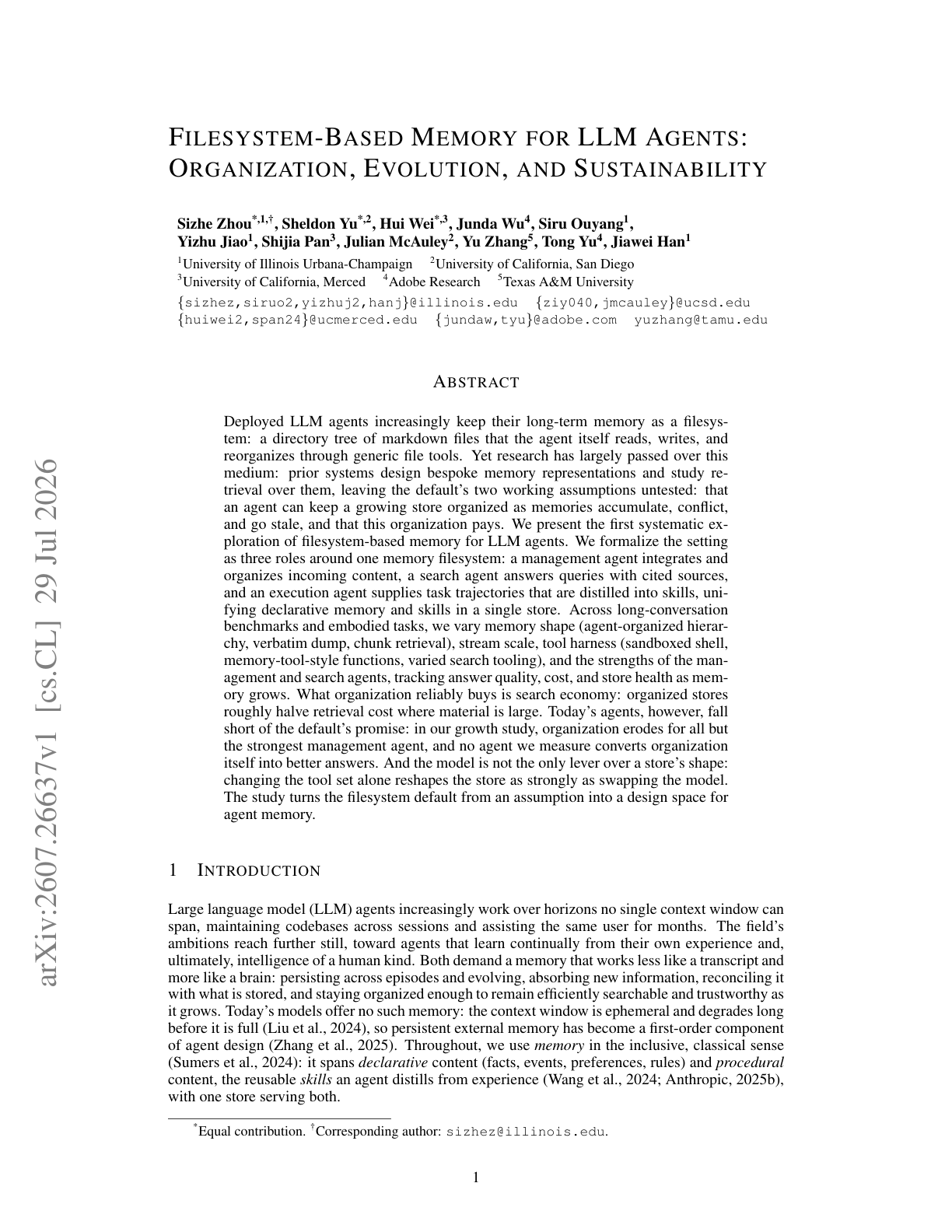
Filesystem Memory Audited
Deployed agents increasingly keep long-term memory as a directory tree of markdown files they read, write, and reorganize with ordinary file tools. Research had mostly designed bespoke memory representations instead, leaving the default's two working assumptions untested.
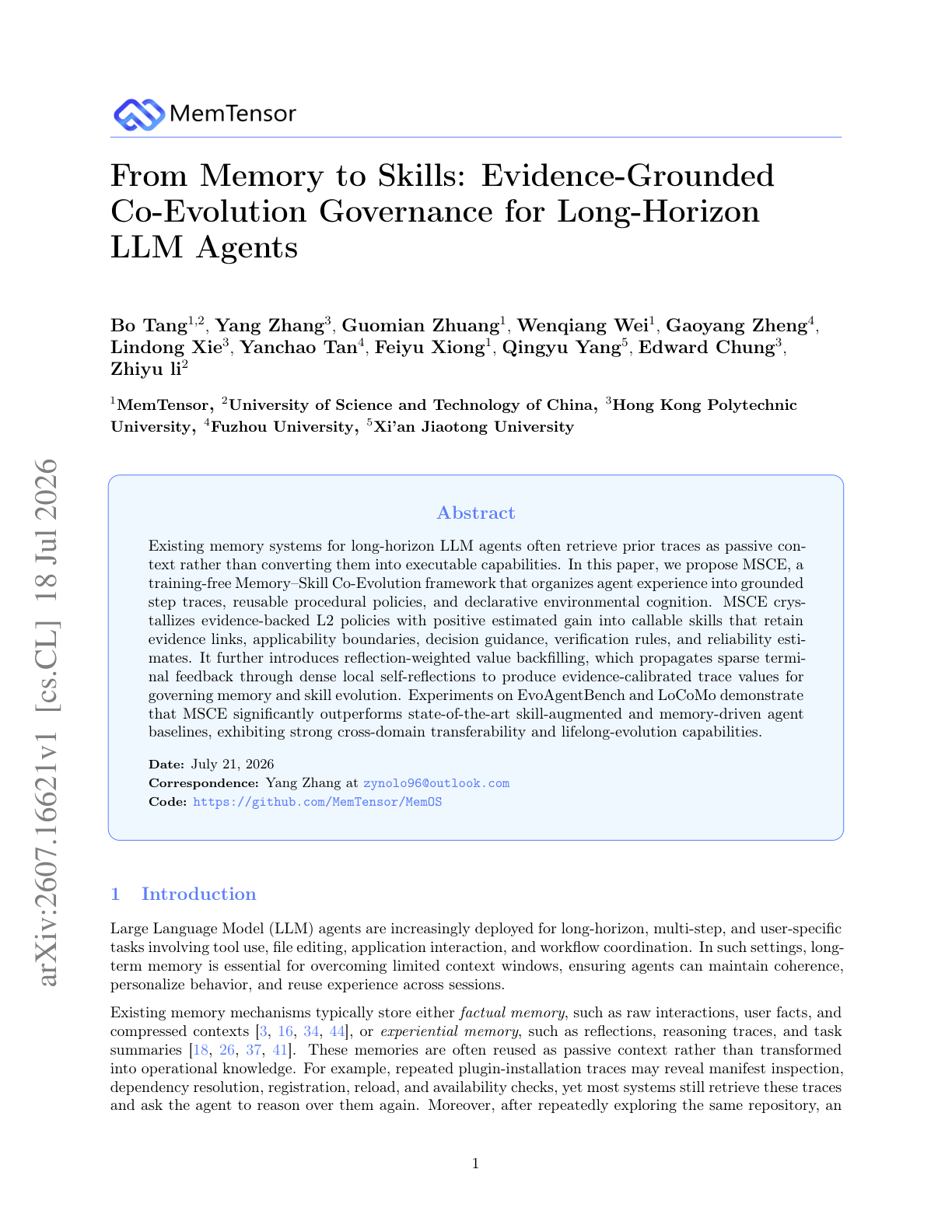
From Memory to Skills
Most agent memory systems retrieve past traces as passive context, so hard-won experience never becomes something the agent can directly execute. MSCE, a training-free memory-skill co-evolution framework, instead governs how experience turns into callable skills for long-horizon LLM agents.
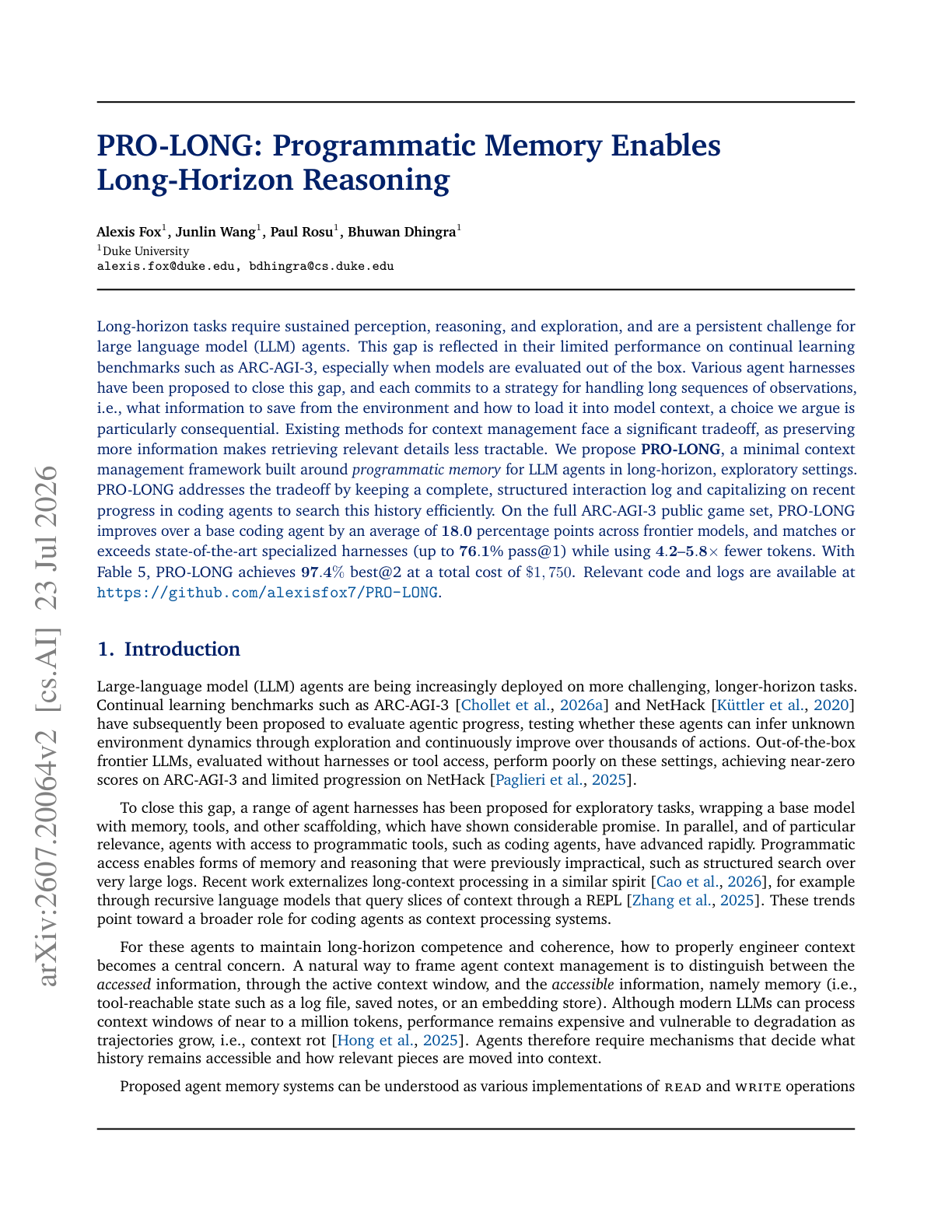
PRO-LONG
Long-horizon tasks force a harness to decide what to save from a long stream of observations and how to load it back into context, and richer summaries usually make the exact detail you need harder to retrieve. PRO-LONG sidesteps this tradeoff with programmatic memory.
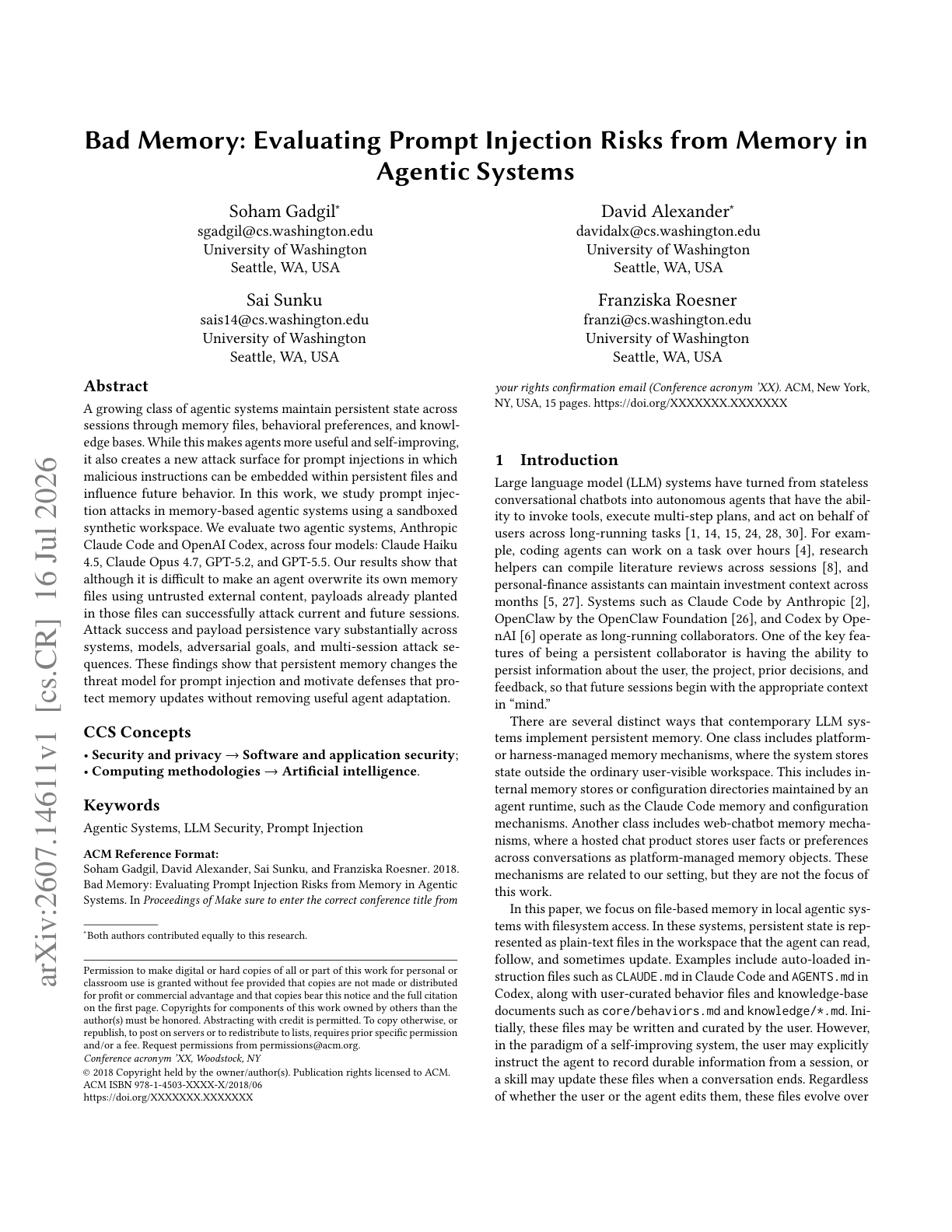
Bad Memory in Agents
Persistent memory is what makes an agent useful across sessions, and it is also a place an attacker can leave something behind. This work evaluates prompt injection from memory files in Claude Code and OpenAI Codex, across Claude Haiku 4.5, Claude Opus 4.7, GPT-5.2, and GPT-5.5. The finding is uneven but sobering: it is hard to make an agent overwrite its own memory using untrusted external content, but payloads already planted in those files reliably attack current and future sessions, with attack success and persistence varying widely across systems, models, adversarial goals, and multi-session sequences.