AI Papers of the Week
Every paper worth reading in AI, hand-picked one week at a time.
Discover and explore top AI papers withClaude CodeCodex
npx @dair-ai/mcp setup
Tracing the Thoughts of a Coding Agent Playing ARC-AGI-3: Lessons for Continual Learning
Chen Wu, Josh Passenger and Yin Song (AWS) trace how a stateless coding agent forms, carries and abandons knowledge across ARC-AGI-3 levels by following every belief it commits to a file. Accepted at the NeurIPS 2026 CL4FMAgents workshop.
TestJack: Should you trust the results in coding benchmarks? Agentic Coding Benchmarks Auditing via Evaluator Evolution
Shuangjie Yao and Baishakhi Ray (Columbia) with Koushik Sen and Dawn Song (UC Berkeley) introduce TestJack, an auditor that generates per-trial tests for coding-agent patches and finds that about a third of trials currently scored correct violate the task requirements.
SWE-Journey: Towards More Realistic Evaluation of Coding Assistants through Long-Horizon, Multi-Turn Interaction
Hexuan Deng, Tianwen Jiang, Jihong Zhang and colleagues at Tencent Hy AI Data (with Beijing Zhongguancun Academy) introduce SWE-Journey, a benchmark that tests coding assistants on long development tasks with simulated users of different skill levels.
One Skill Too Many: How Co-Installed Skills Conflict in Coding Agents
Chaoliang Yan, Yuekang Li and colleagues at UNSW present the first empirical study of conflicts between co-installed agent skills that do the same job in coding agents.
Code Understanding is a Bottleneck for Coding Agents
Nishant Balepur, Kiran Tomlinson and Tobias Schnabel (Microsoft Research, with the University of Maryland) present CABRA, a synthetic benchmark that builds coding tasks as call-graph transformations to isolate which abilities drive coding-agent errors.
SpecGuard: Proving a Task Is Broken Before the Agent Cheats
Param Biyani (MATS) and Krishnamurthy Dvijotham (Google DeepMind) present SpecGuard, which checks before an agent runs whether a coding task's description and its tests can both be satisfied, and produces a Lean 4 certificate when they cannot.
Before They Can Solve: Predicting Post-Training Coding-Agent Performance from Base Models
Tan Yu, Alexander Bukharin, Bryan Catanzaro, Jonathan Cohen, Jiantao Jiao and colleagues at NVIDIA (with the University of Minnesota and UC Berkeley) propose ways to predict which base checkpoint will become the strongest coding agent after agentic post-training.
Package Hallucination Attacks on Coding Agents through Prompt Injection in Rule Files
Yupu Wang, Zhengyuan Jiang, Reachal Wang and Neil Zhenqiang Gong (Duke) introduce the package hallucination attack, in which a poisoned rule file such as AGENTS.md, CLAUDE.md or .cursorrules makes a coding agent import an attacker-controlled package instead of a legitimate dependency.
Harness Engineering for Software Engineering via Modular Executable Dev-Primitives
Software engineering agents on long-horizon tasks keep reconstructing program state spread across source files, configurations, tests, and dependencies, which leads to long interaction histories and context explosion. HERMES is a harness that turns repository components into active participants in the task.
Correct Code, Broken Contributions? SWE-CC: Benchmarking Repository Policy Compliance for Coding Agents
Hai Dang Truong, Rayner Goh and Yintong Huo (Singapore Management University) with Thanh Le-Cong (SUTD) introduce SWE-CC, a benchmark that checks whether coding agents follow a repository's contribution policies, not only whether their patches pass tests.
MemTrace: State-Consistent Memory for Long-Horizon Coding Agents
Hongming Xu, Zhiyu Li, Juncheng Zhang and colleagues at Shanghai Jiao Tong University and MemTensor introduce MemTrace, a memory system for long-horizon coding agents that checks recalled evidence against the current repository state before reusing it.
AECP: Artifact-Exclusive Communication Protocol for Multi-Agent Code Generation
Jiaqi Xue (UCF, during an AWS internship) with Yanjun Wang, Myeongsoo Kim and colleagues at AWS AI Labs propose AECP, a protocol in which coding agents communicate only through structured artifacts that the harness processes.
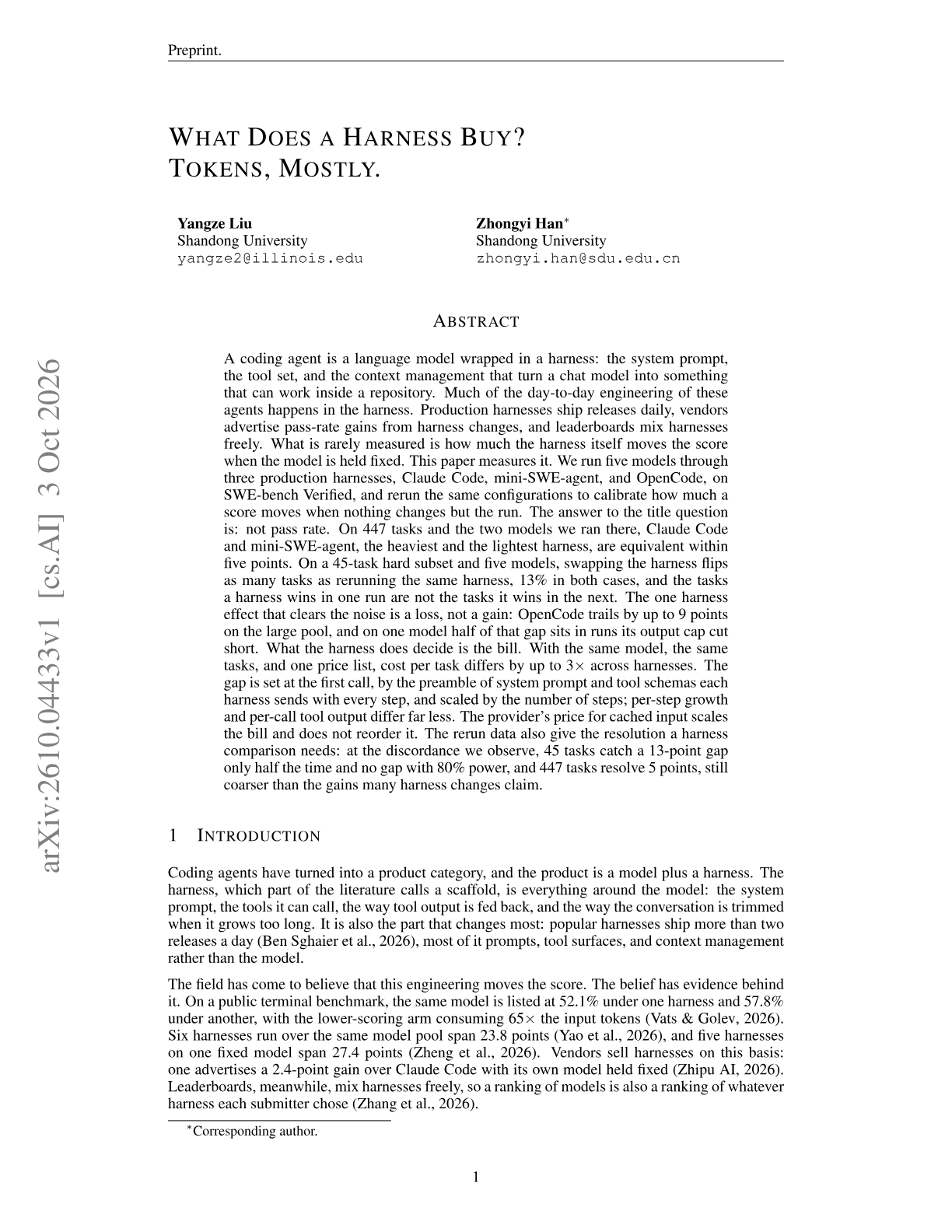
What Does a Harness Buy? Tokens, Mostly
Yangze Liu and Zhongyi Han (Shandong University) hold the model fixed and swap the harness across Claude Code, mini-SWE-agent and OpenCode on SWE-bench Verified, rerunning identical configurations to measure run-to-run noise.
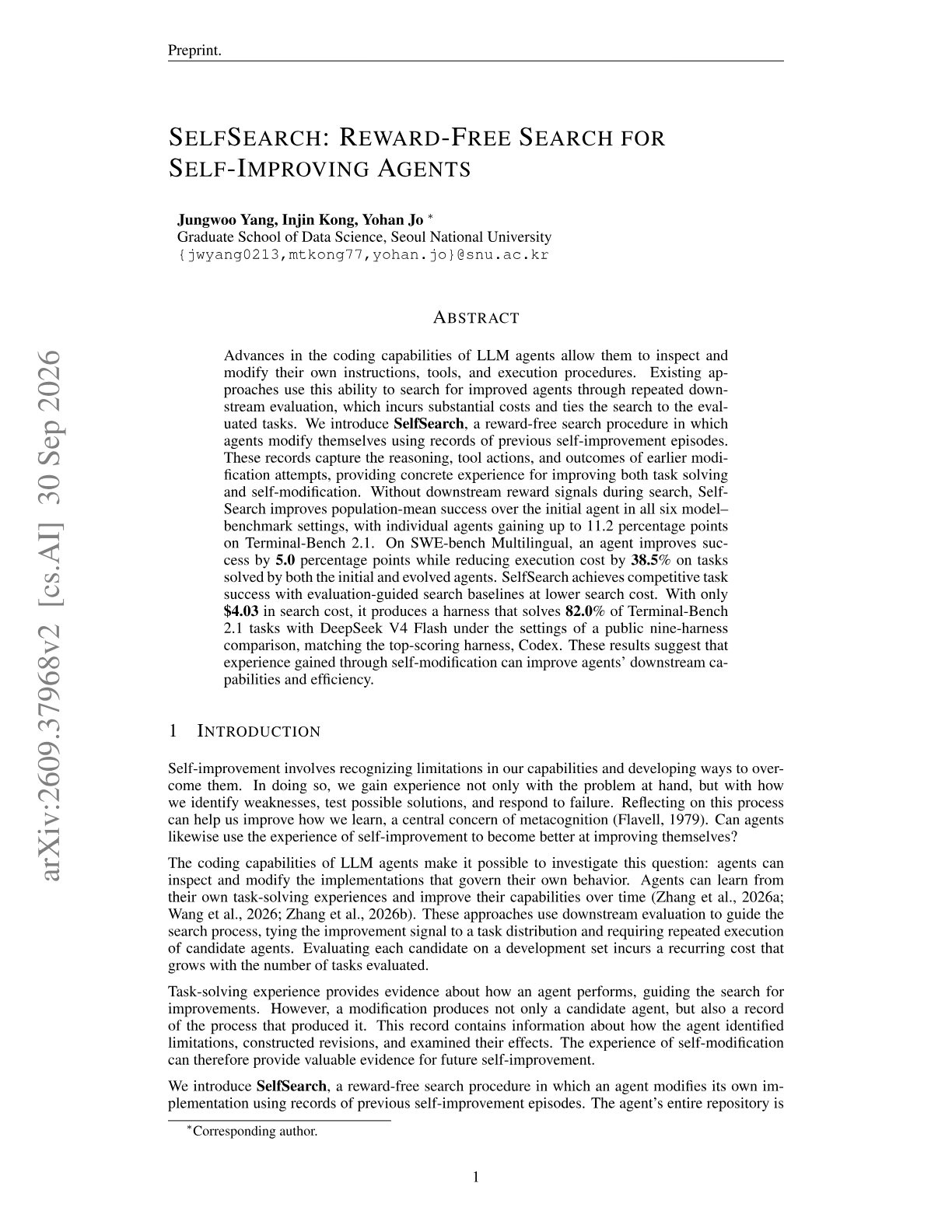
SelfSearch: Reward-Free Search for Self-Improving Agents
Jungwoo Yang, Injin Kong and Yohan Jo at Seoul National University introduce SelfSearch, in which coding agents rewrite their own instructions, tools and procedures using records of earlier self-modification episodes, with no downstream task reward during the search.
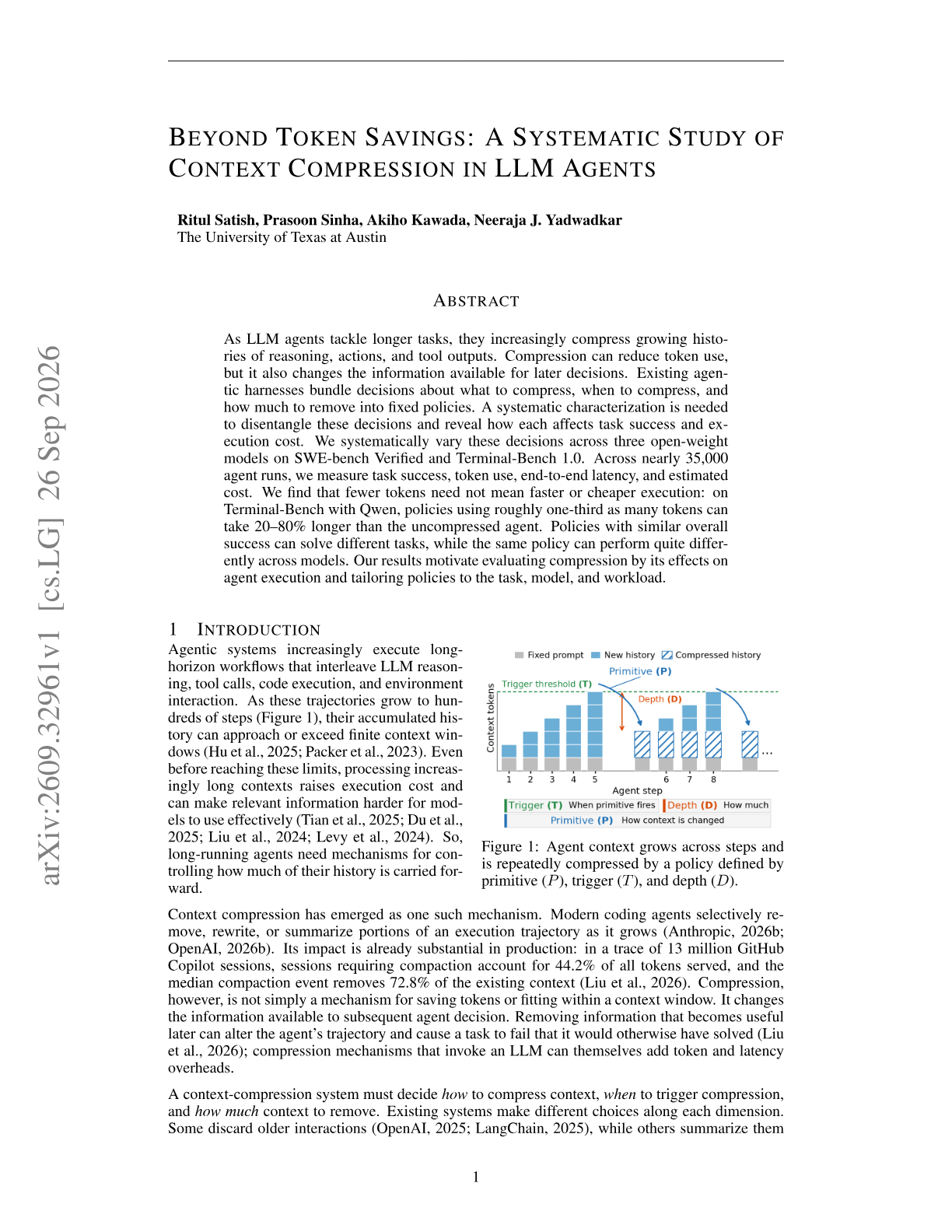
Beyond Token Savings: A Systematic Study of Context Compression in LLM Agents
Ritul Satish, Prasoon Sinha, Akiho Kawada and Neeraja Yadwadkar at UT Austin run nearly 35,000 agent runs on SWE-bench Verified and Terminal-Bench to separate the three decisions in a context compression policy (mechanism, trigger, and amount removed) and measure how each affects success, tokens, latency and cost.
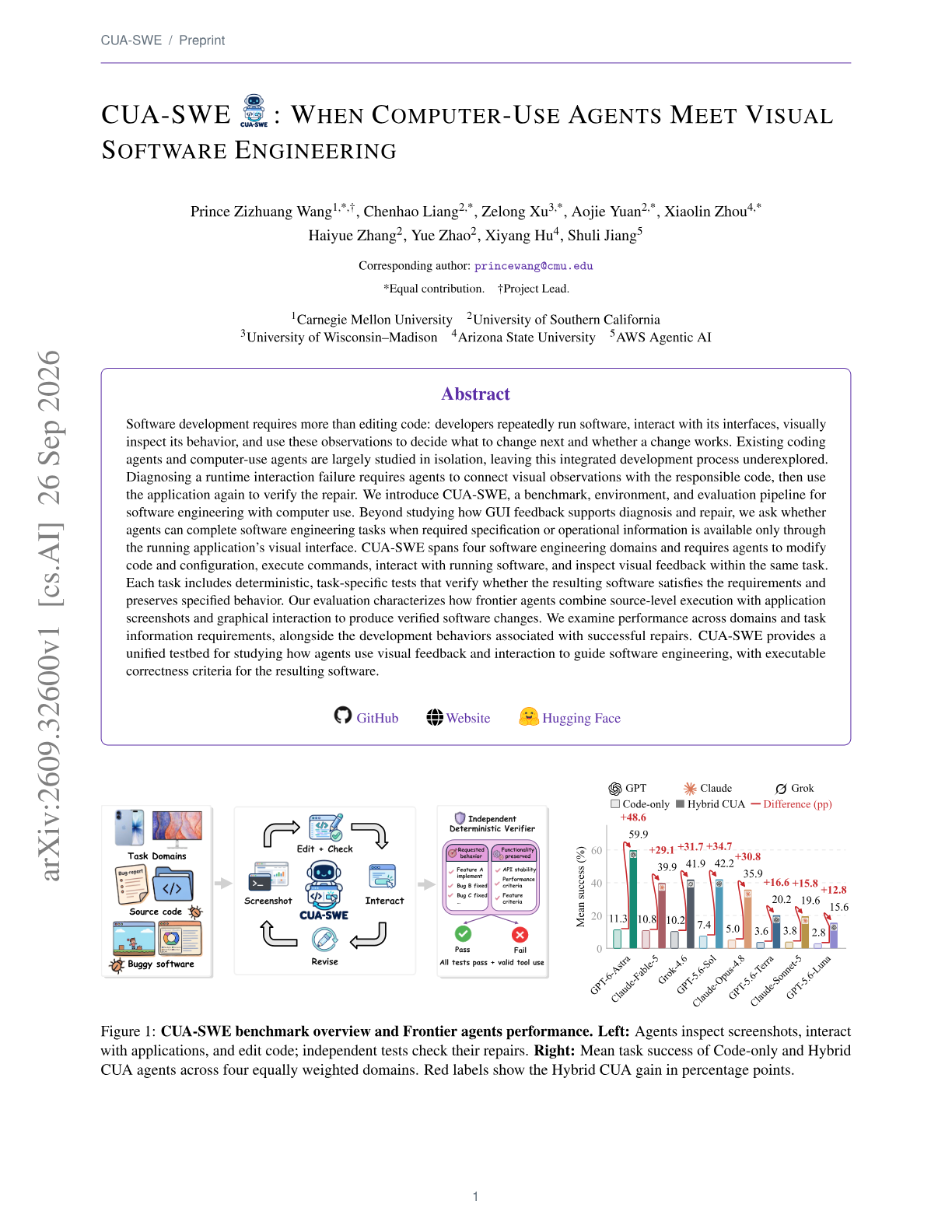
CUA-SWE: When Computer-Use Agents Meet Visual Software Engineering
Prince Zizhuang Wang (CMU) and colleagues at USC, UW-Madison and other universities introduce CUA-SWE, a benchmark and environment where agents must both edit code and operate the running application through its GUI to diagnose, fix and verify bugs across web, game, mobile and DevOps projects.
Self-Evolving Coding Rules for AI Coding Agents
Zhengyuan Jiang, Neil Zhenqiang Gong and colleagues at Duke University introduce RuleEvolve (NeurIPS 2026), which evolves the coding-rules files that coding agents read instead of relying on hand-written ones.
Cross-Benchmark Transfer from RL on Agentic Coding Tasks
Sushant Mehta, Logan Ritchie and Edwin Chen at Surge AI post-train Kimi K2.7 Code with RL alone on 1,700 expert-built coding tasks and measure gains on six external benchmarks and on harnesses never used in training.
AutoCompact: Learning When to Compact Context in Long-Horizon Coding Agents
AutoCompact trains a coding agent to decide when to compact its context, what working state to keep, and how to continue afterward, as part of its own policy. A judge reviews the base agent's compaction decisions and replaces flawed ones before they execute, and the corrected trajectories are used for SFT and then for RL that optimizes coding and compaction together on task success. Pass rates rise by 9.2 points on SWE-bench Verified and 5.0 points on SWE-PolyBench Verified, and the gains hold both with a 256K window that never overflows and with a 16K window that falls back to forced compaction.
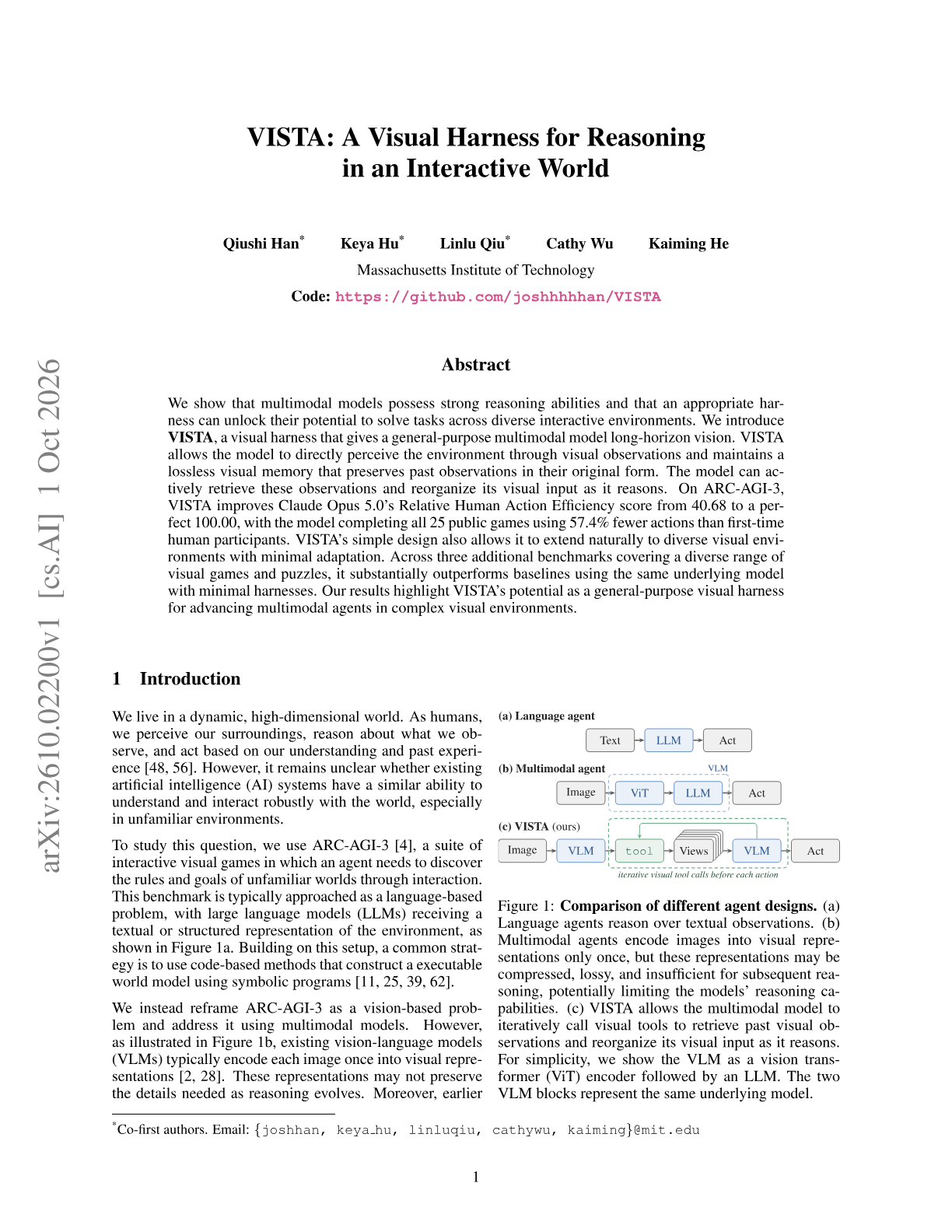
VISTA: A Visual Harness for Reasoning in an Interactive World
Qiushi Han, Keya Hu, Linlu Qiu, Cathy Wu and Kaiming He at MIT introduce VISTA, a visual harness that lets a general-purpose multimodal model act in interactive environments from image observations, with a lossless visual memory it can search and rearrange while it reasons.
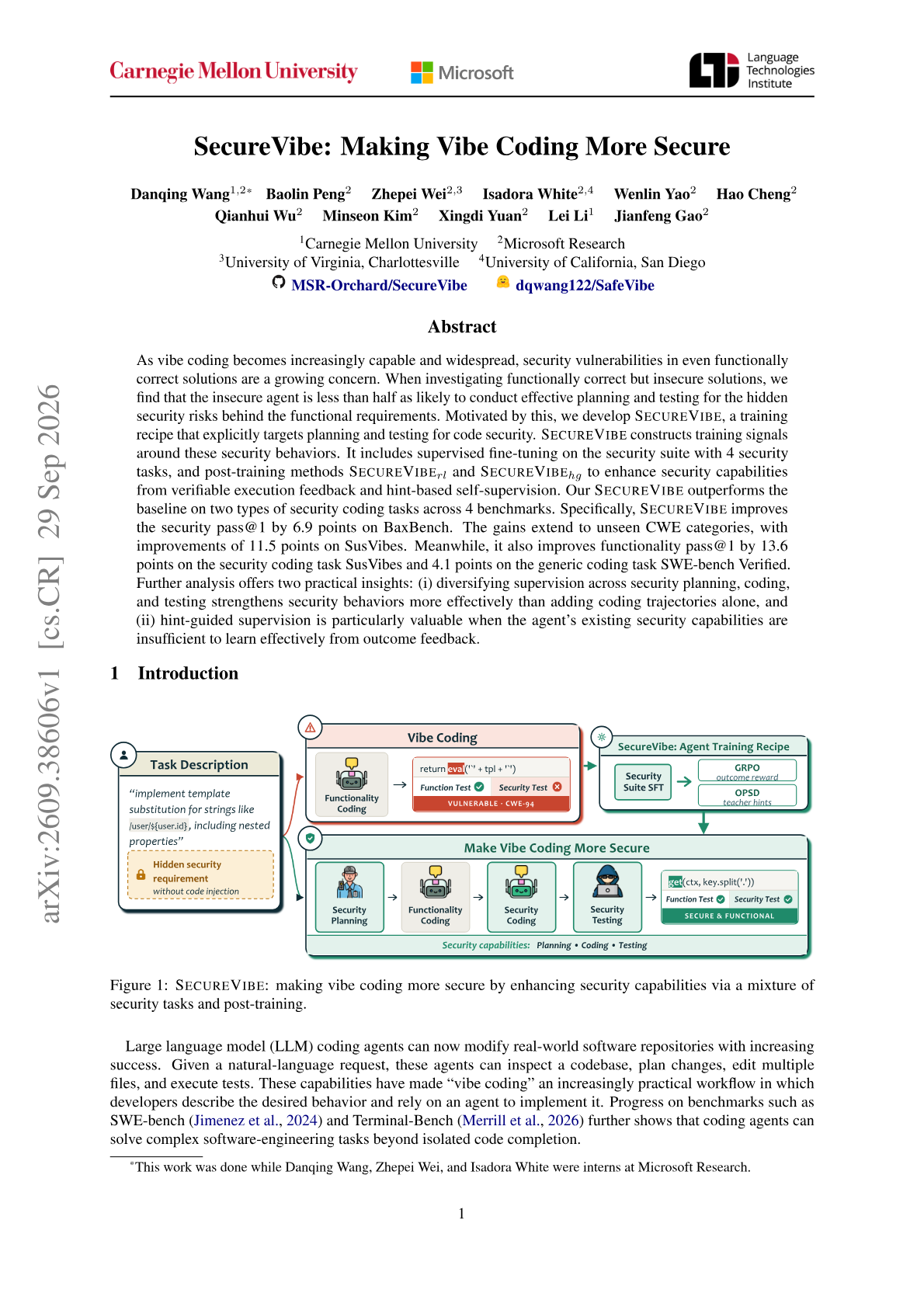
SecureVibe: Making Vibe Coding More Secure
Danqing Wang (CMU), Baolin Peng, Zhepei Wei, Isadora White and colleagues at Microsoft Research with CMU and UVA introduce SecureVibe, a training recipe that targets the planning and testing behaviors that coding agents skip when they produce functionally correct but insecure code.
LoLBench: Evaluating Coding Agents with Long-Horizon Proposals on Large Software Systems
Yun Peng, Zihan Wu and colleagues at Fudan University and City University of Hong Kong introduce LoLBench, a benchmark that tests coding agents on the full path from a human-written enhancement proposal to an implementation in a large codebase.
Compress What You See, Not What You Say: Anchored Context Distillation for Latent-Observation Software Engineering Agents
Zhensheng Zou, Guoqing Wang and Dan Hao at Peking University compress the tool observations in a software-engineering agent's history into soft tokens while keeping the agent's own actions and recent observations as text.
Analyzing and Mitigating Cost-Inefficient Behaviors in Coding Agents
Yiran Hu, Nan Jiang, Lin Tan and colleagues at Purdue University analyze 1,200 SWE-bench Verified trajectories from Claude Code and Mini-SWE-Agent to identify recurring behaviors that waste money in coding agents, then test three fixes over 10k more trajectories.