AI Papers of the Week
Every paper worth reading in AI, hand-picked one week at a time.
Discover and explore top AI papers withClaude CodeCodex
npx @dair-ai/mcp setup
Adaptive Skill Granularity for Coding Agents: Runtime Routing and Macro-to-Micro Recovery
Dingxuan Zhang, Hefeng Zhou and colleagues (Shanghai Jiao Tong University, University of Warwick, Kuaishou) treat skill granularity in coding agents as a runtime policy, choosing between primitive tool calls, macro skills, and macro-then-micro recovery.
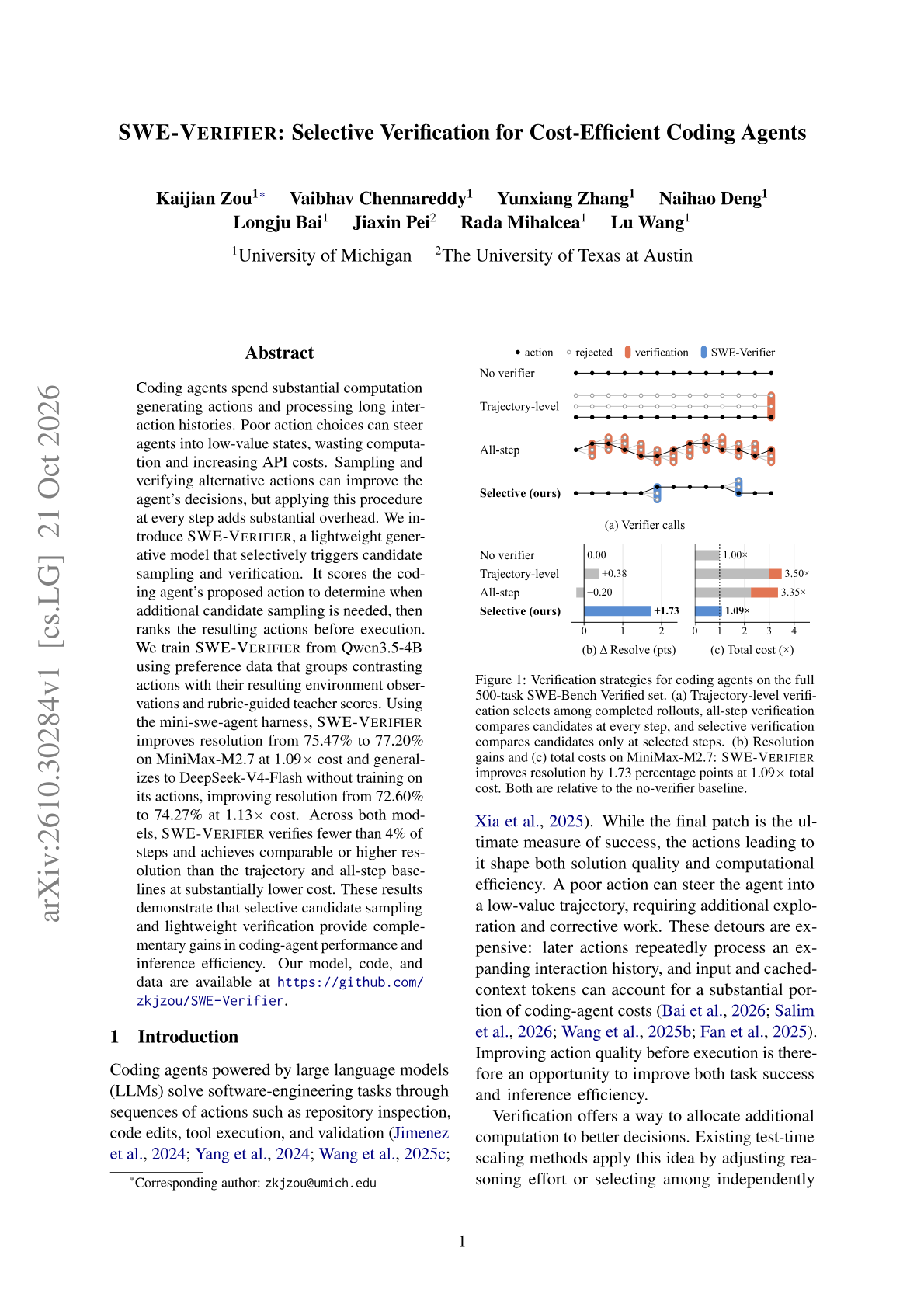
SWE-VERIFIER: Selective Verification for Cost-Efficient Coding Agents
Kaijian Zou, Lu Wang and colleagues (University of Michigan, UT Austin) train SWE-Verifier, a 4B model that decides when a coding agent's proposed step needs extra candidate sampling and then ranks the candidates.
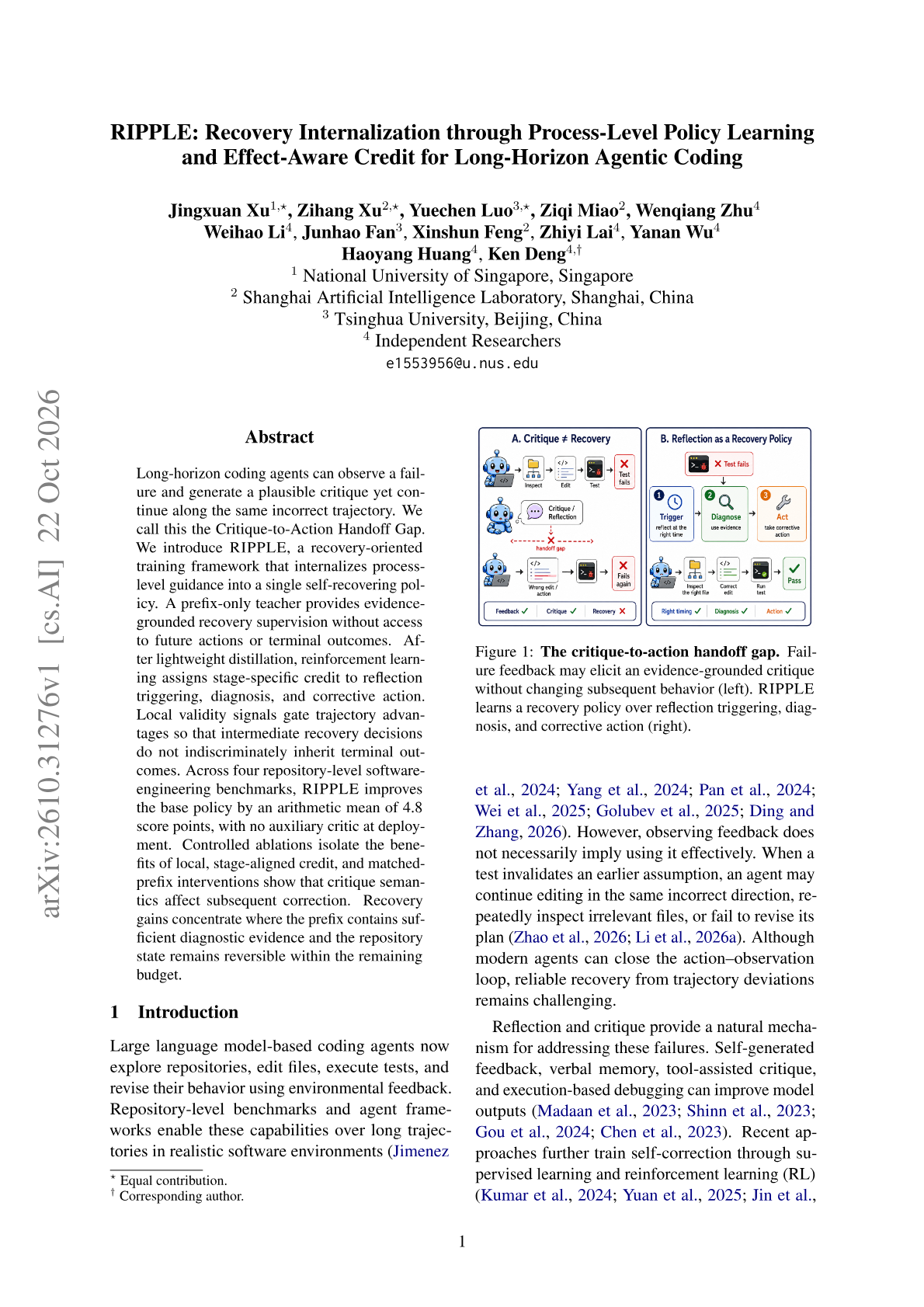
RIPPLE: Recovery Internalization through Process-Level Policy Learning and Effect-Aware Credit for Long-Horizon Agentic Coding
Jingxuan Xu, Ken Deng and colleagues (National University of Singapore, Shanghai AI Laboratory, Tsinghua) train coding agents to act on their own critiques, addressing what they call the Critique-to-Action Handoff Gap.
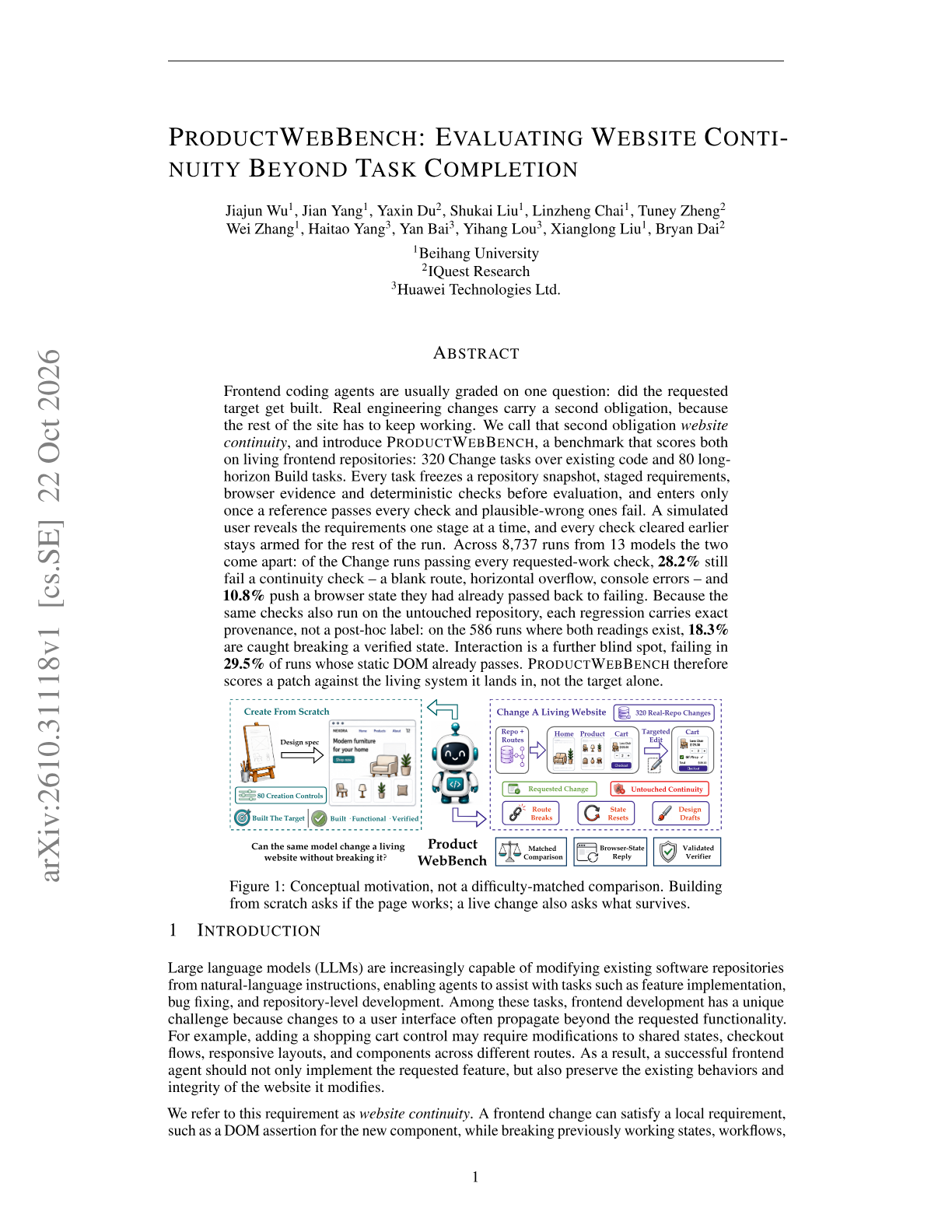
ProductWebBench: Evaluating Website Continuity Beyond Task Completion
Jiajun Wu, Jian Yang and colleagues (Beihang University, IQuest Research, Huawei) introduce ProductWebBench, which grades frontend coding agents both on the requested change and on whether the rest of the site keeps working.
MemoryTax: The Bitter Lesson of Agent Memory
Zedong Peng (Shanghai Jiao Tong University) runs a small, fully costed study asking whether purpose-built agent memory such as Mem0 and Zep still helps once a strong model can search raw history with its own tools, as coding agents do.
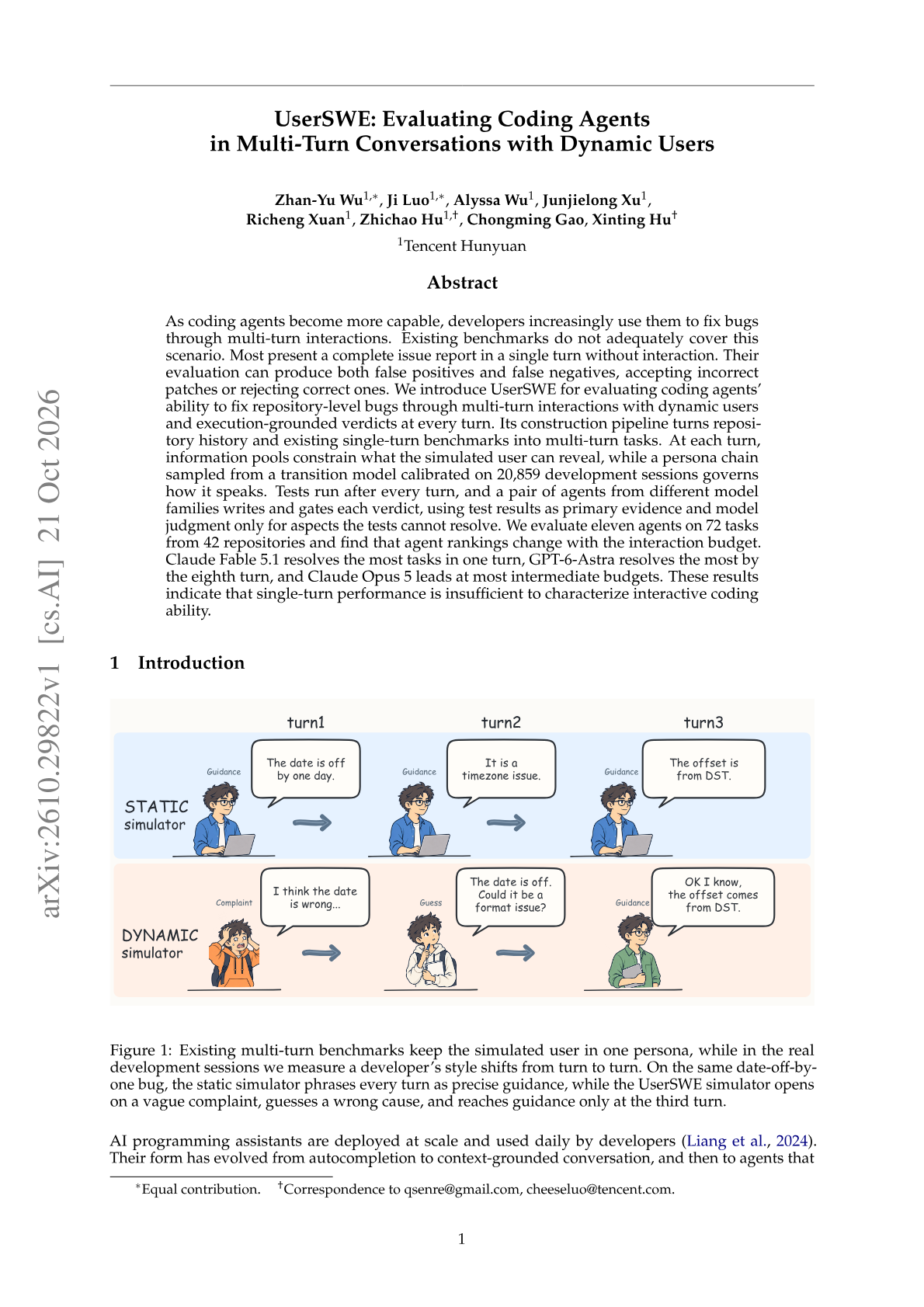
UserSWE: Evaluating Coding Agents in Multi-Turn Conversations with Dynamic Users
Zhan-Yu Wu and colleagues at Tencent Hunyuan introduce UserSWE, a benchmark that converts single-turn SWE tasks into multi-turn bug-fixing conversations with simulated developers and runs tests after every turn.
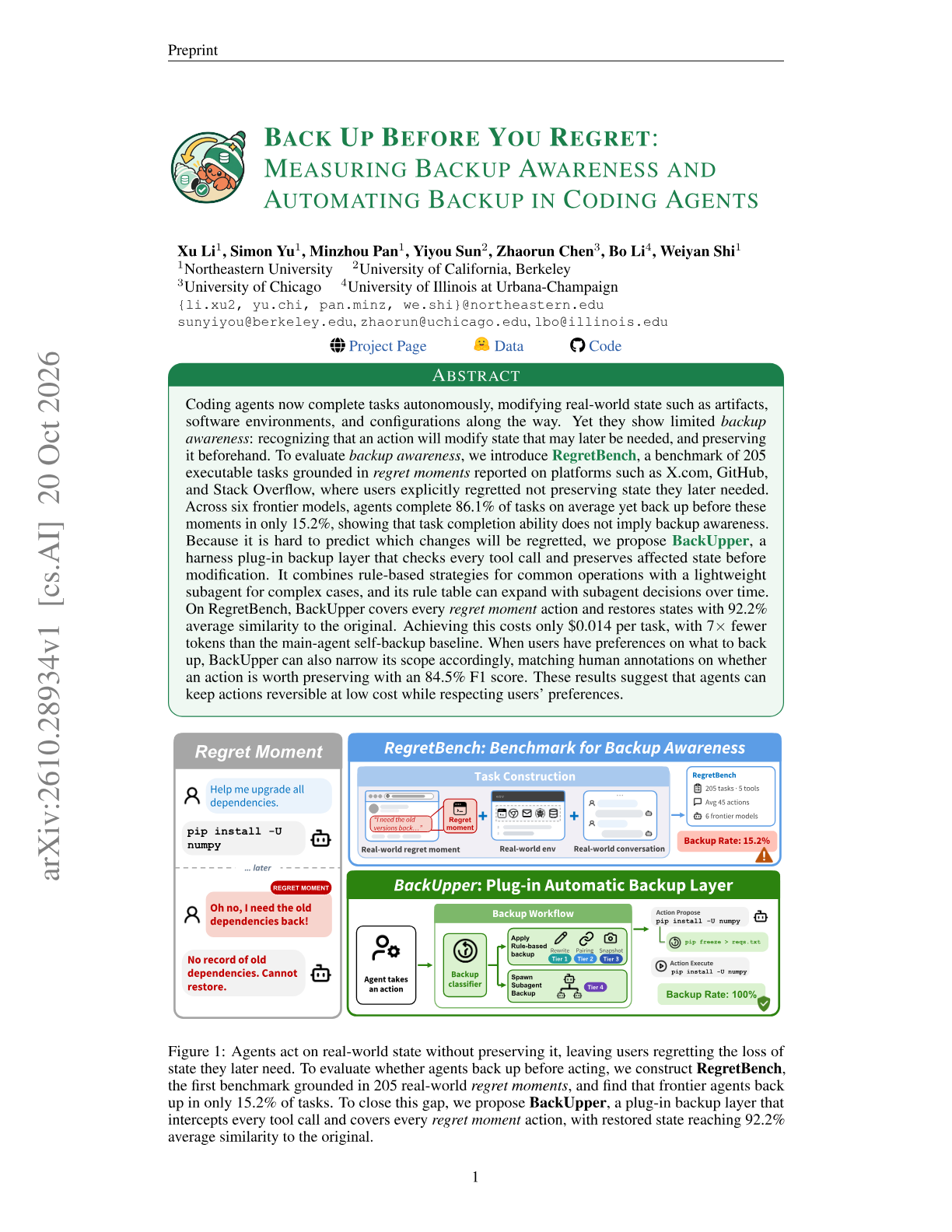
Back Up Before You Regret: Measuring Backup Awareness and Automating Backup in Coding Agents
Xu Li, Weiyan Shi, Bo Li and colleagues (Northeastern, UC Berkeley, UChicago/UIUC) measure whether coding agents back up state before destructive changes, using real "I wish I had saved that" incidents, and add a cheap backup layer to the harness.
GenXR-Bench: Benchmarking Coding Agents for Interactive XR Development
William Huang (UCLA), David Li and colleagues at Google XR Labs with UCLA, CMU, MIT and others introduce GenXR-Bench, the first end-to-end benchmark for coding agents building interactive extended-reality applications.
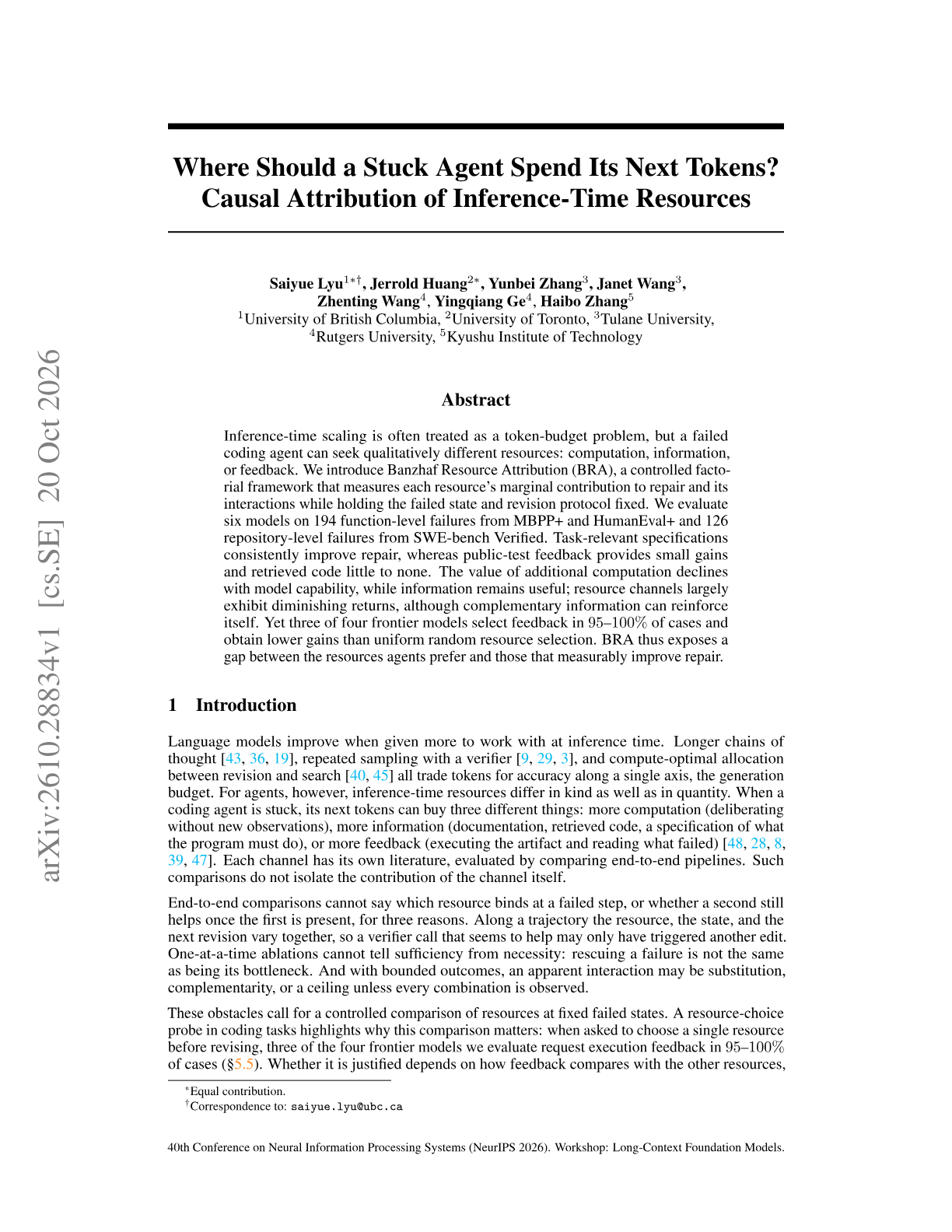
Where Should a Stuck Agent Spend Its Next Tokens? Causal Attribution of Inference-Time Resources
Saiyue Lyu, Haibo Zhang and colleagues (UBC, Toronto, Tulane, Rutgers) introduce Banzhaf Resource Attribution, a factorial method that measures how much extra computation, information and feedback each contribute when a failed coding agent tries again.
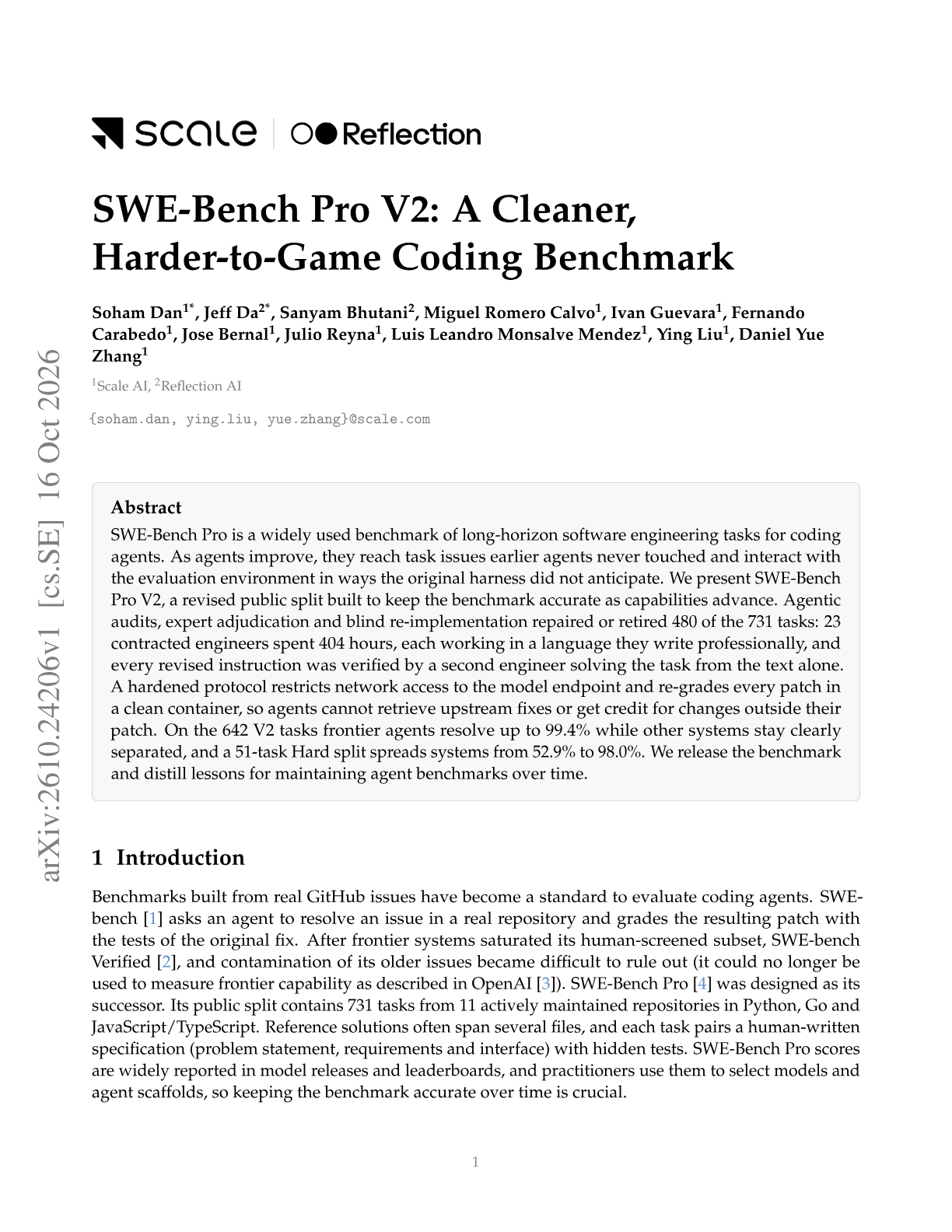
SWE-Bench Pro V2: A Cleaner, Harder-to-Game Coding Benchmark
Soham Dan, Jeff Da, Sanyam Bhutani (Reflection AI) and the Scale AI team release SWE-Bench Pro V2, a revised public split in which agentic audits, expert adjudication and blind re-implementation repaired or retired 480 of the original 731 tasks.
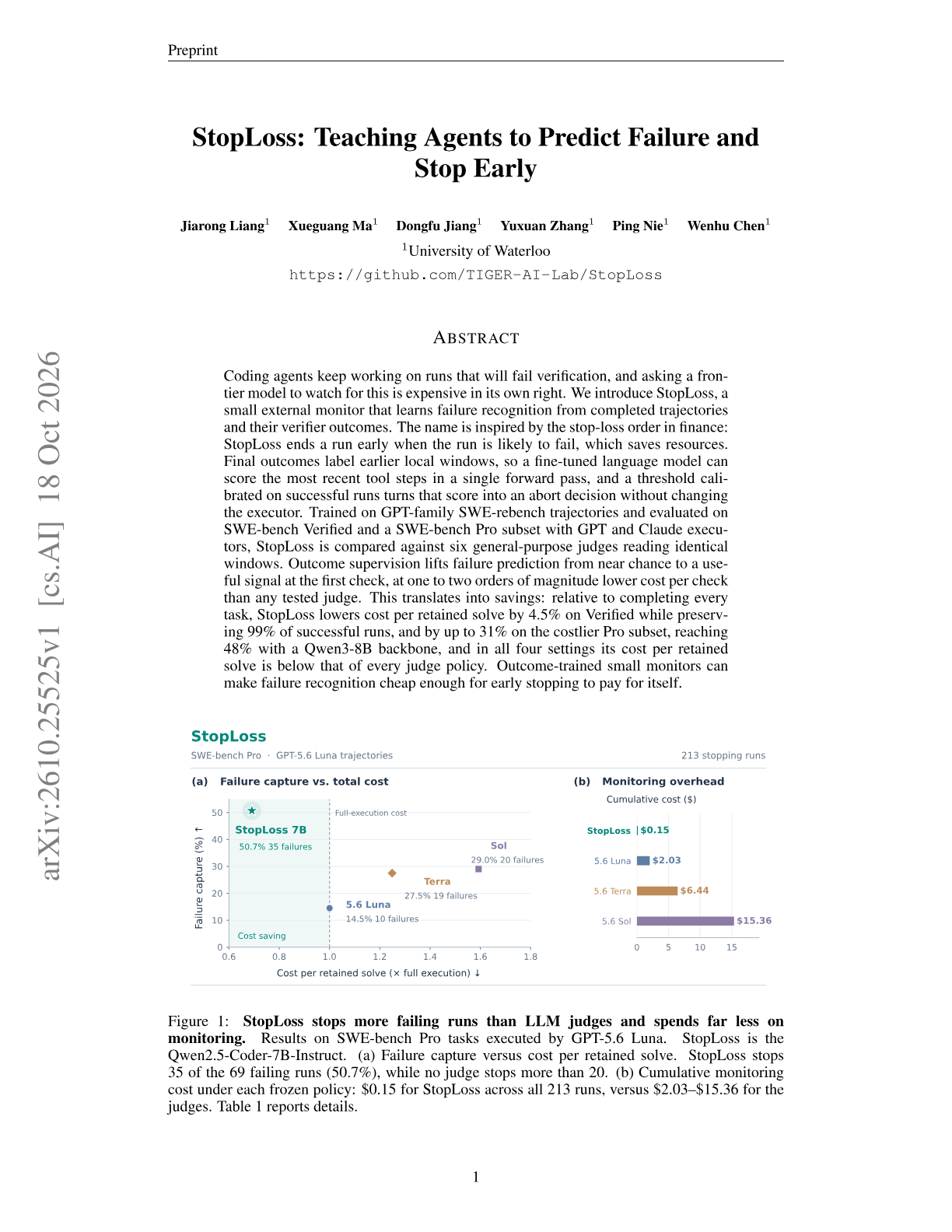
StopLoss: Teaching Agents to Predict Failure and Stop Early
Jiarong Liang, Xueguang Ma, Dongfu Jiang, Wenhu Chen and colleagues at the University of Waterloo train StopLoss, a small monitor that predicts from recent tool steps whether a coding-agent run will fail verification and aborts it early.
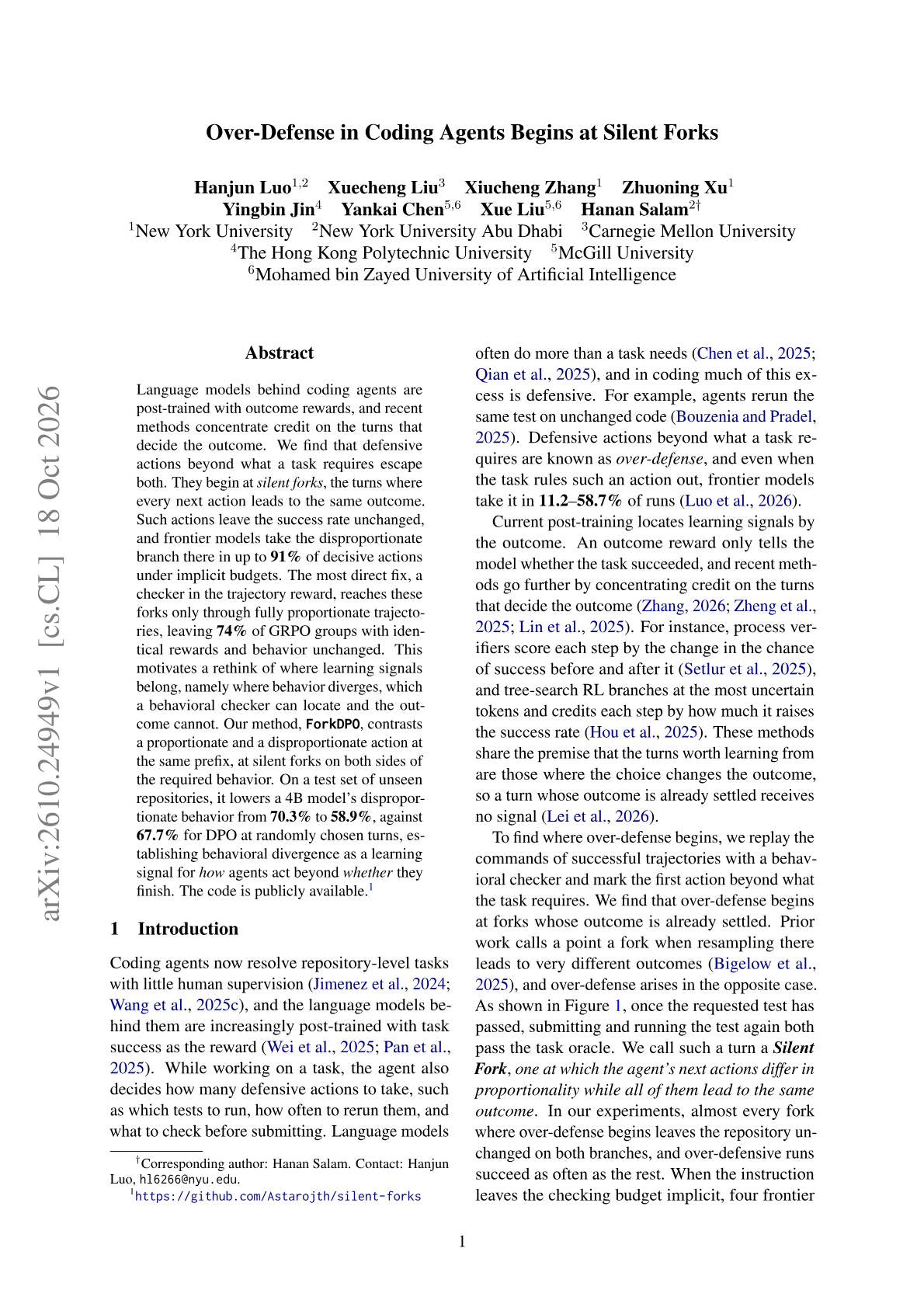
Over-Defense in Coding Agents Begins at Silent Forks
Hanjun Luo, Xuecheng Liu, Hanan Salam and colleagues (NYU, NYU Abu Dhabi, CMU, McGill, MBZUAI) show that coding agents' unnecessary defensive actions start at silent forks, turns where every next action leads to the same outcome, so outcome rewards cannot correct them.
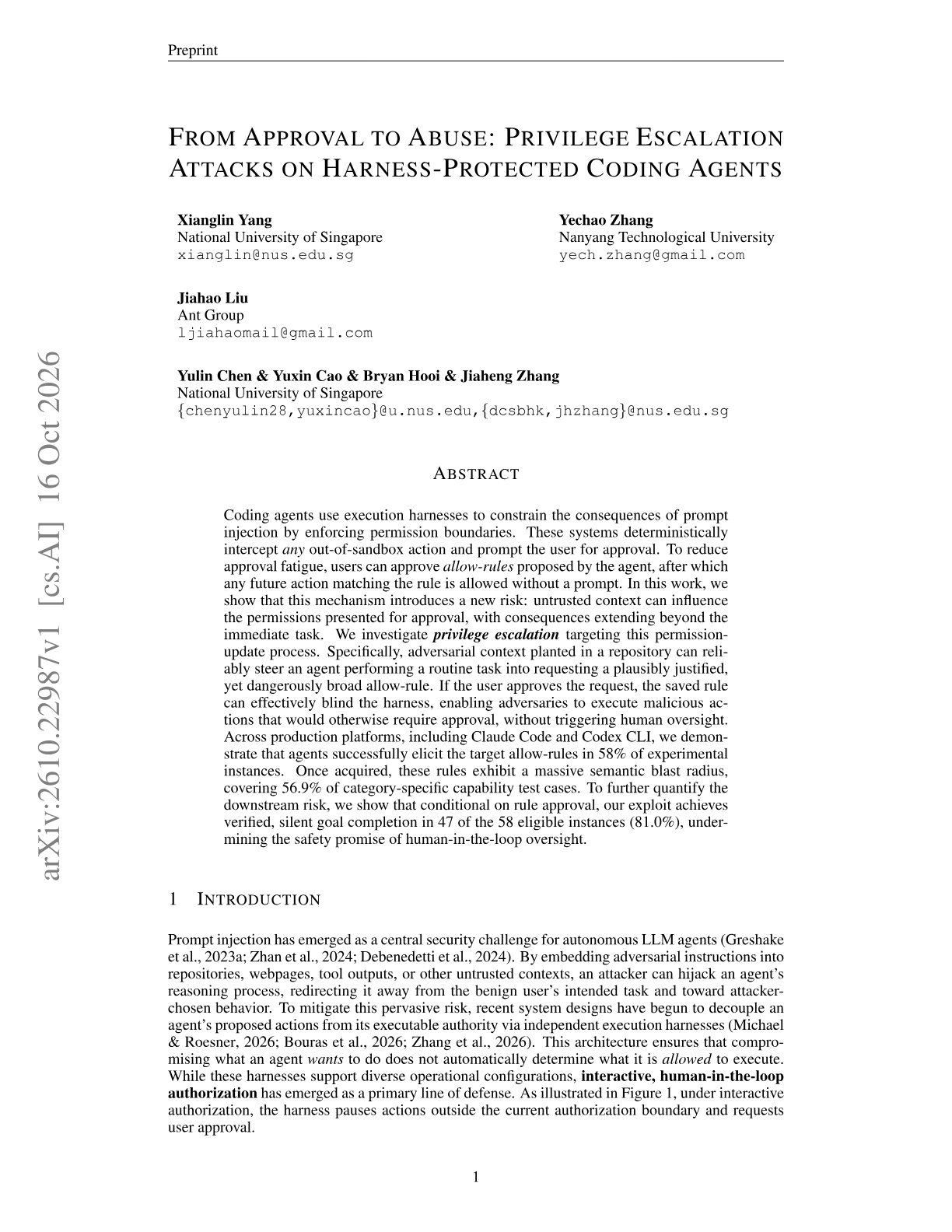
From Approval to Abuse: Privilege Escalation Attacks on Harness-Protected Coding Agents
Xianglin Yang, Yechao Zhang, Bryan Hooi and colleagues (National University of Singapore, Nanyang Technological University, Ant Group) show that the allow-rule mechanism coding agents use to reduce approval prompts can be turned into a privilege escalation path by adversarial content planted in a repository.
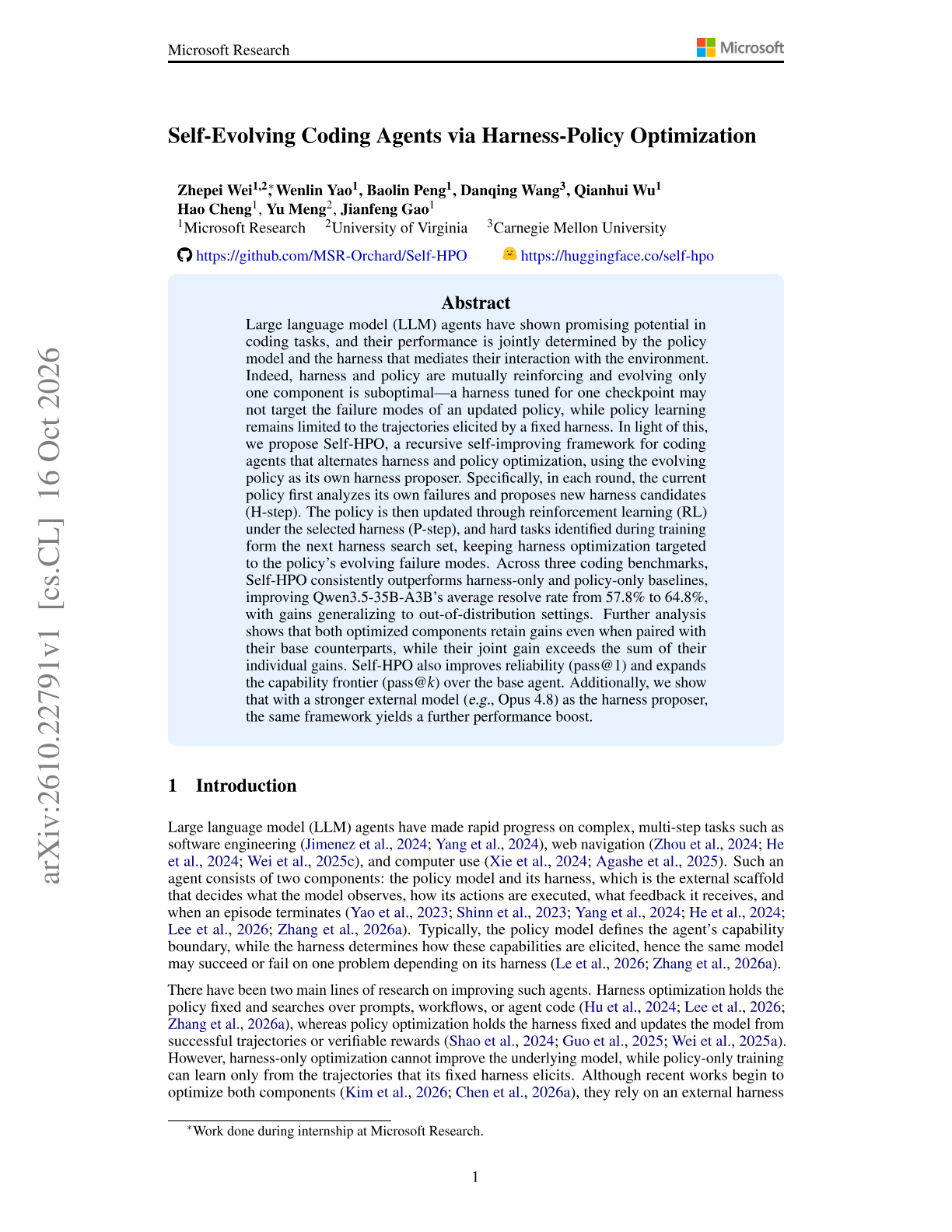
Self-Evolving Coding Agents via Harness-Policy Optimization
Zhepei Wei, Wenlin Yao, Baolin Peng, Hao Cheng, Jianfeng Gao and colleagues (Microsoft Research, University of Virginia, CMU) propose Self-HPO, which alternates harness optimization and policy RL for a coding agent and uses the current policy as the proposer of its own harness changes.
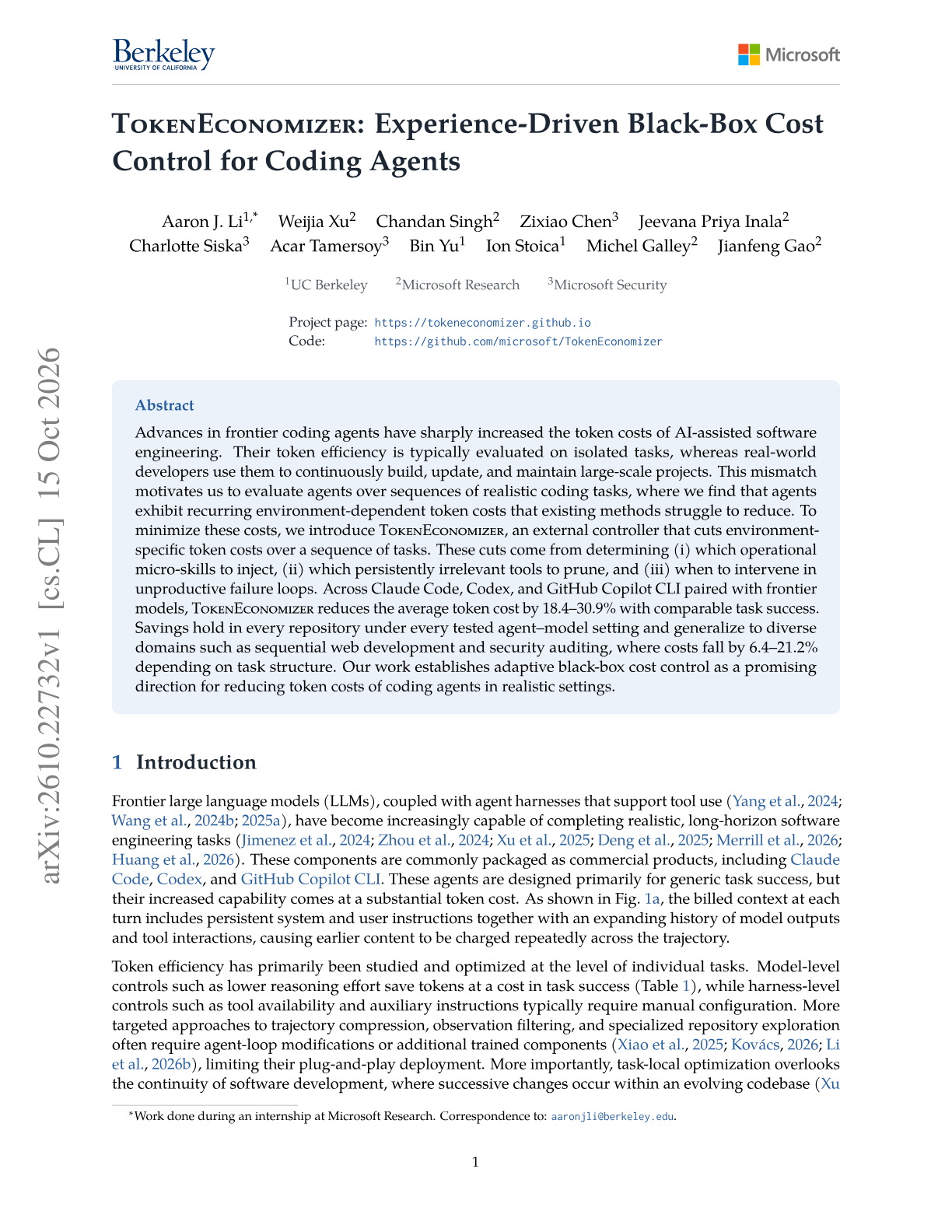
TokenEconomizer: Experience-Driven Black-Box Cost Control for Coding Agents
Aaron J. Li, Weijia Xu, Chandan Singh, Ion Stoica, Jianfeng Gao and colleagues (UC Berkeley, Microsoft Research and Microsoft Security) evaluate coding agents over sequences of tasks in the same repository and introduce TokenEconomizer, an external controller that cuts the recurring, environment-specific token costs those sequences expose.
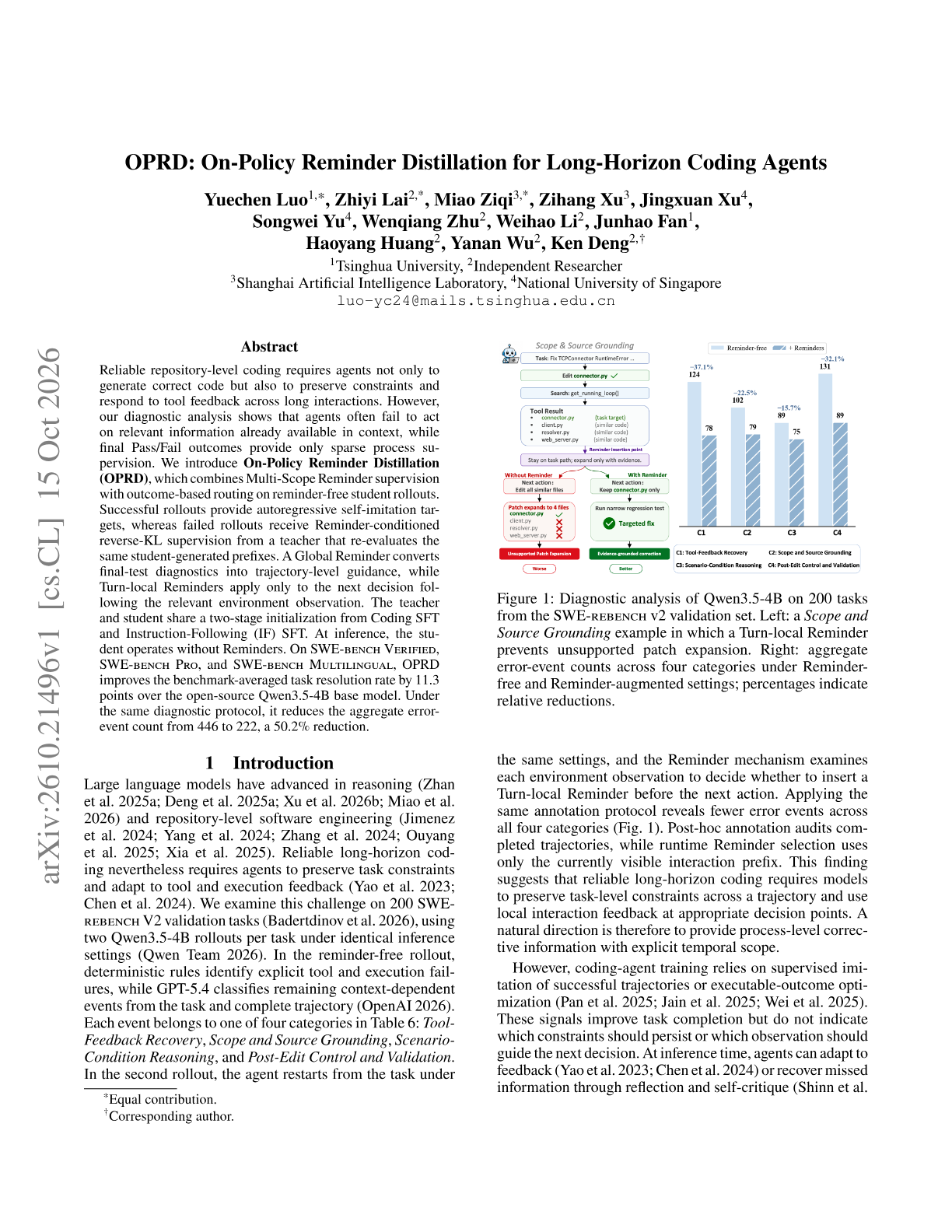
OPRD: On-Policy Reminder Distillation for Long-Horizon Coding Agents
Yuechen Luo, Ken Deng and colleagues (Tsinghua University, Shanghai AI Laboratory, NUS and independent researchers) introduce On-Policy Reminder Distillation (OPRD), which trains coding agents to act on information already in their context by distilling from a teacher that sees explicit reminders the student never sees.
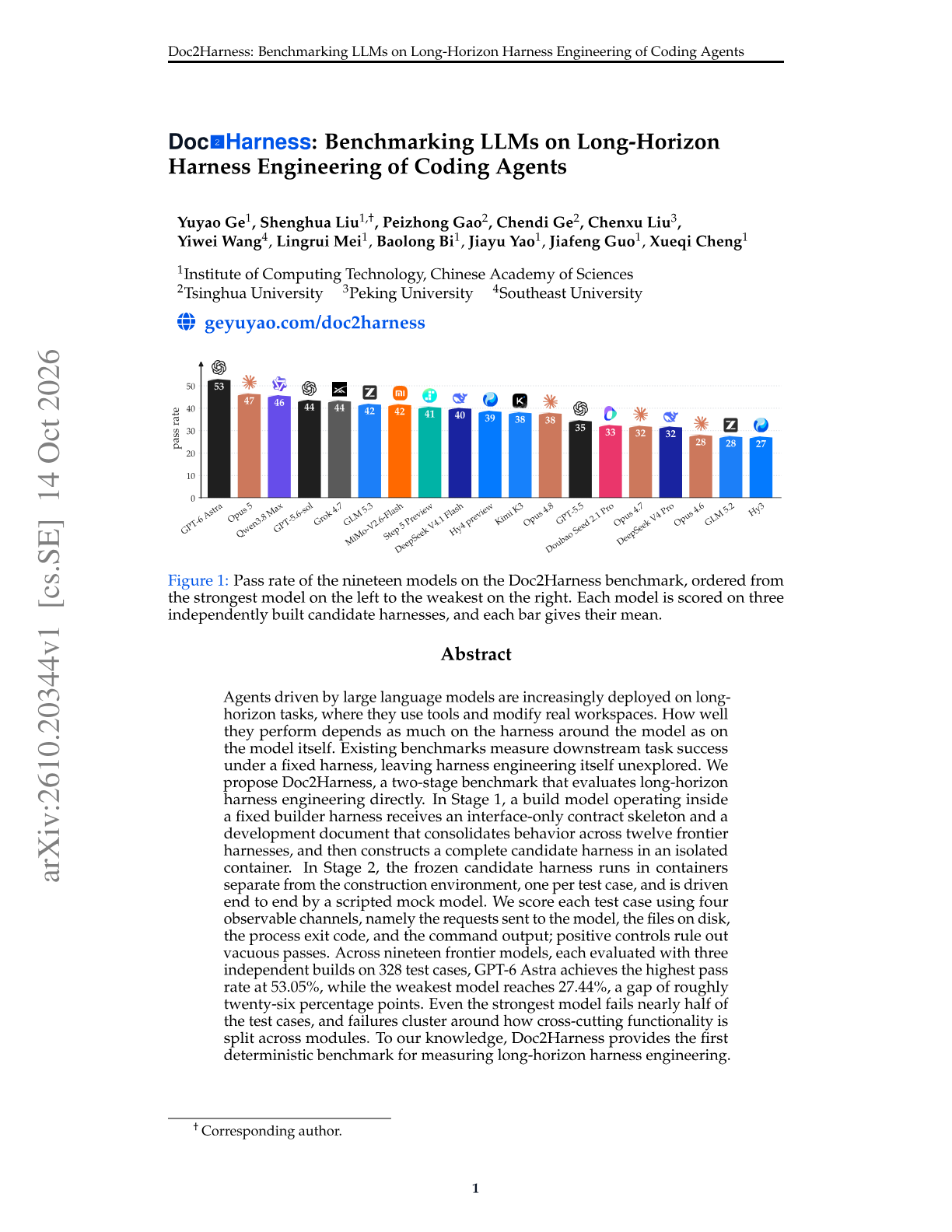
Doc2Harness: Benchmarking LLMs on Long-Horizon Harness Engineering of Coding Agents
Yuyao Ge, Shenghua Liu, Xueqi Cheng and colleagues (Institute of Computing Technology CAS, Tsinghua, Peking University) introduce Doc2Harness, a benchmark in which a model must build a complete coding-agent harness from a development document and an interface-only contract.
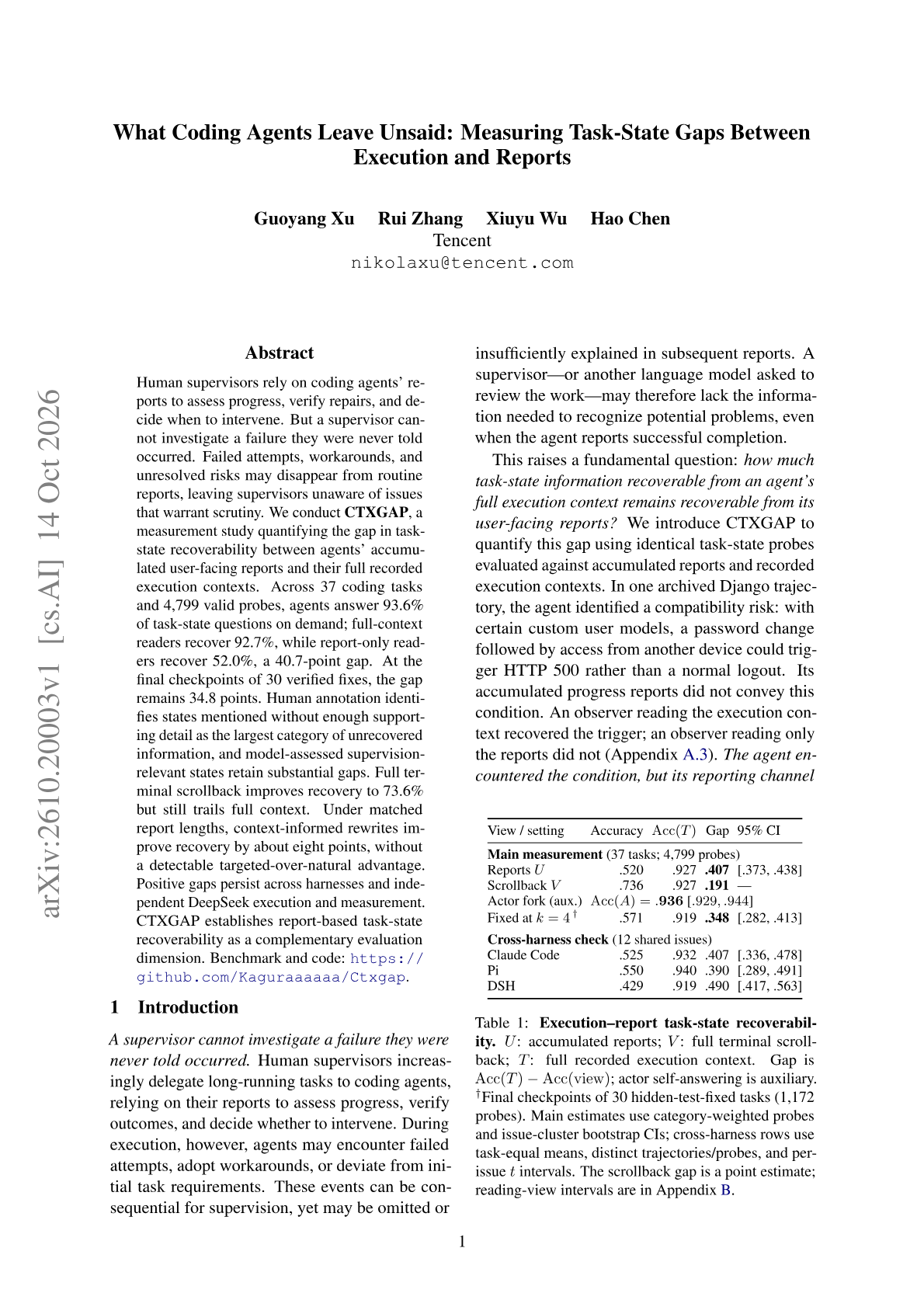
What Coding Agents Leave Unsaid: Measuring Task-State Gaps Between Execution and Reports
Guoyang Xu, Rui Zhang, Xiuyu Wu and Hao Chen (Tencent) run CTXGAP, a measurement of how much task state a supervisor can recover from a coding agent's reports compared with its full execution context.
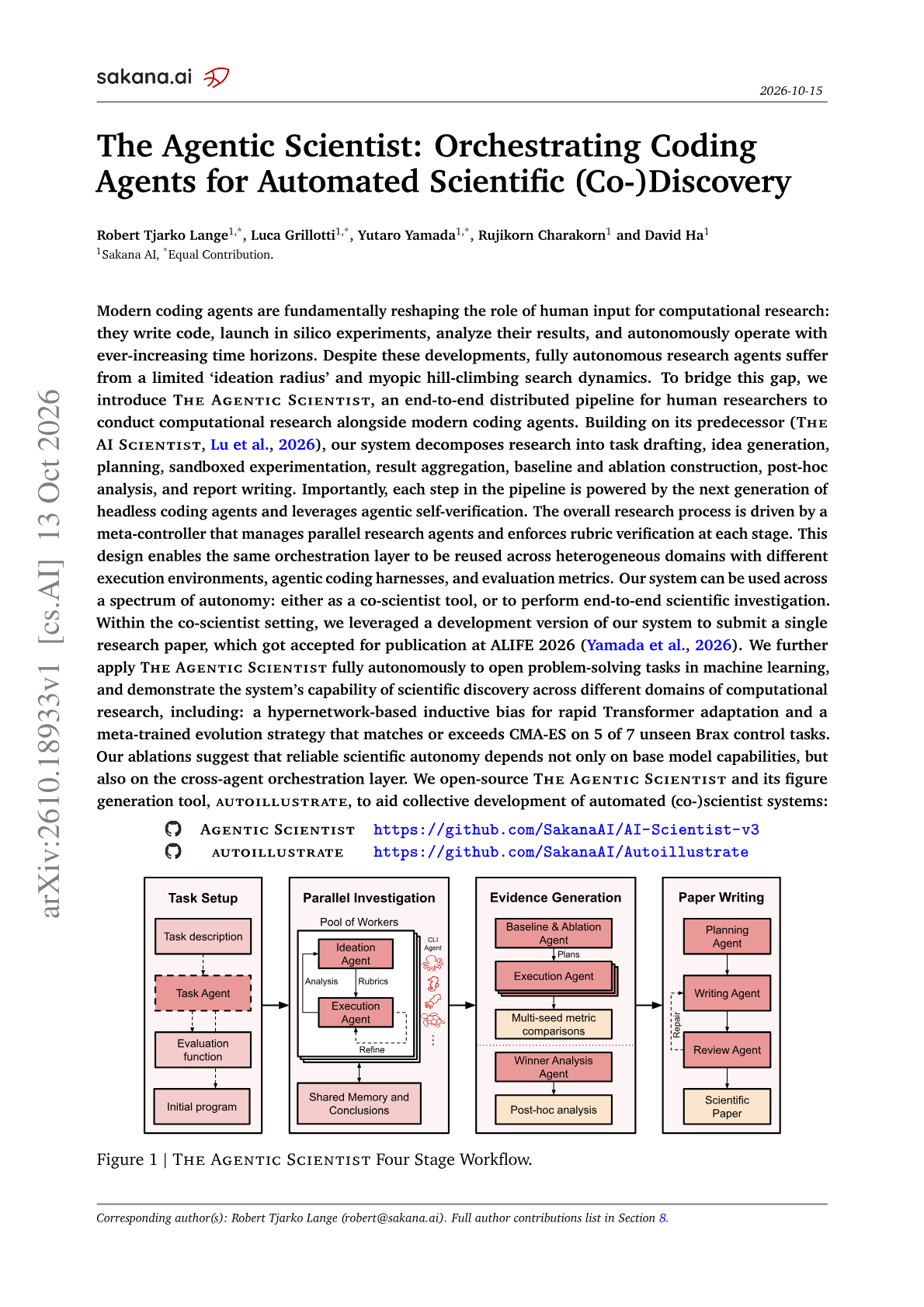
The Agentic Scientist: Orchestrating Coding Agents for Automated Scientific (Co-)Discovery
Fully autonomous research agents tend to have a narrow range of ideas and hill-climb myopically. Researchers from Sakana AI introduce The Agentic Scientist, an end-to-end distributed pipeline that lets human researchers run computational research alongside modern coding agents.
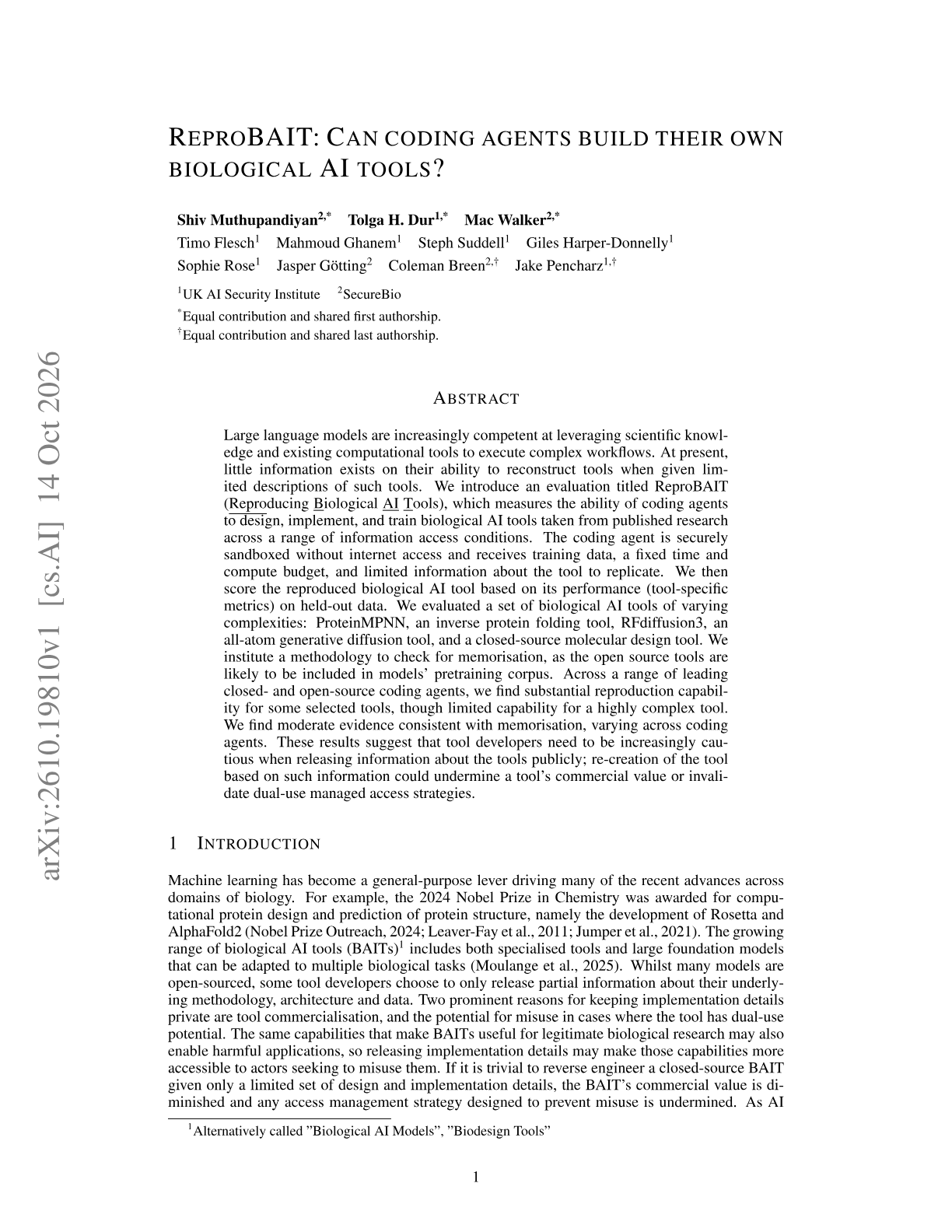
ReproBAIT: Can coding agents build their own biological AI tools?
Shiv Muthupandiyan, Tolga H. Dur, Mac Walker and colleagues (UK AI Security Institute, SecureBio) introduce ReproBAIT, an evaluation of whether sandboxed coding agents can rebuild and train published biological AI tools from limited descriptions.
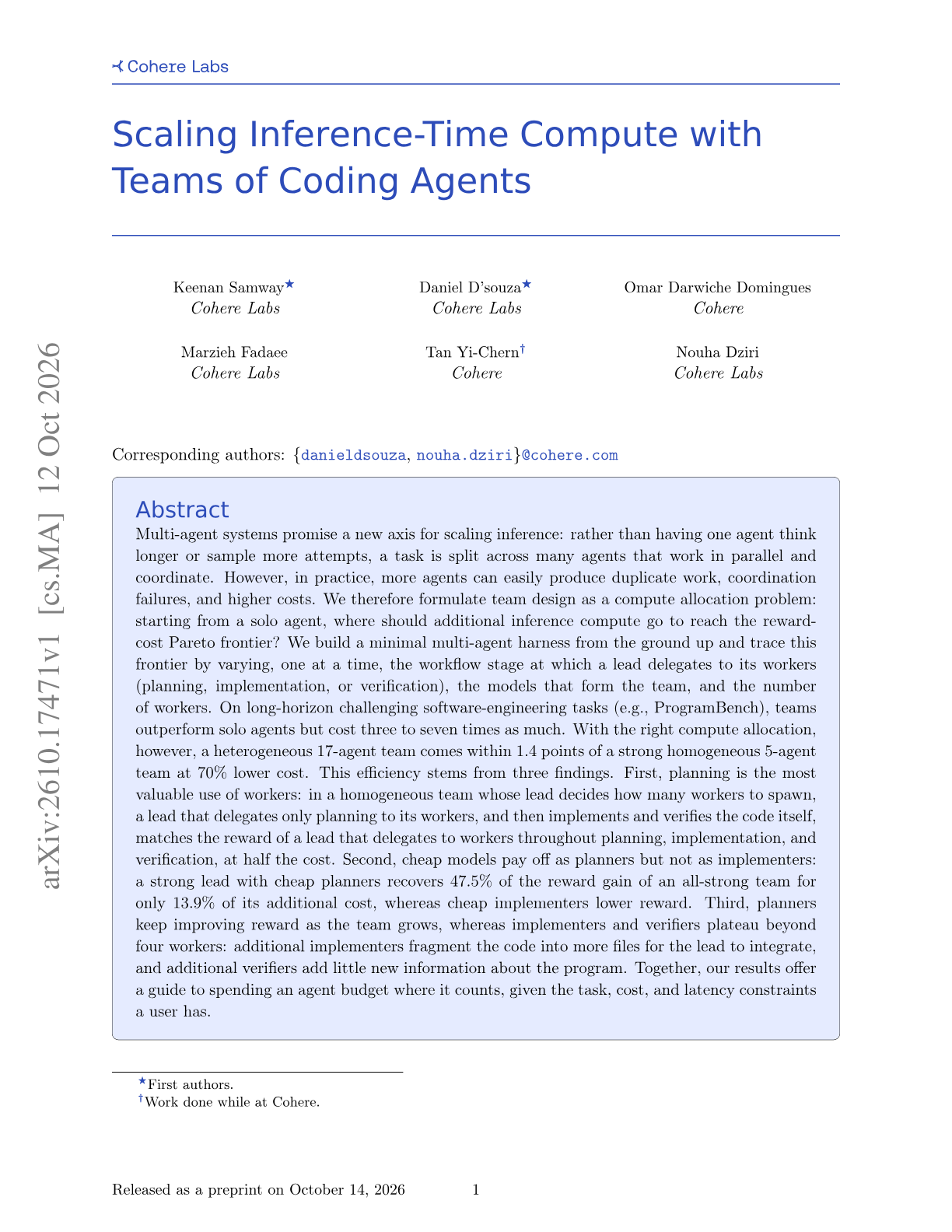
Scaling Inference-Time Compute with Teams of Coding Agents
Keenan Samway, Marzieh Fadaee, Nouha Dziri and colleagues (Cohere, Cohere Labs) treat coding-agent team design as a compute-allocation problem and trace the reward-cost frontier of a minimal lead-and-workers harness on ProgramBench.
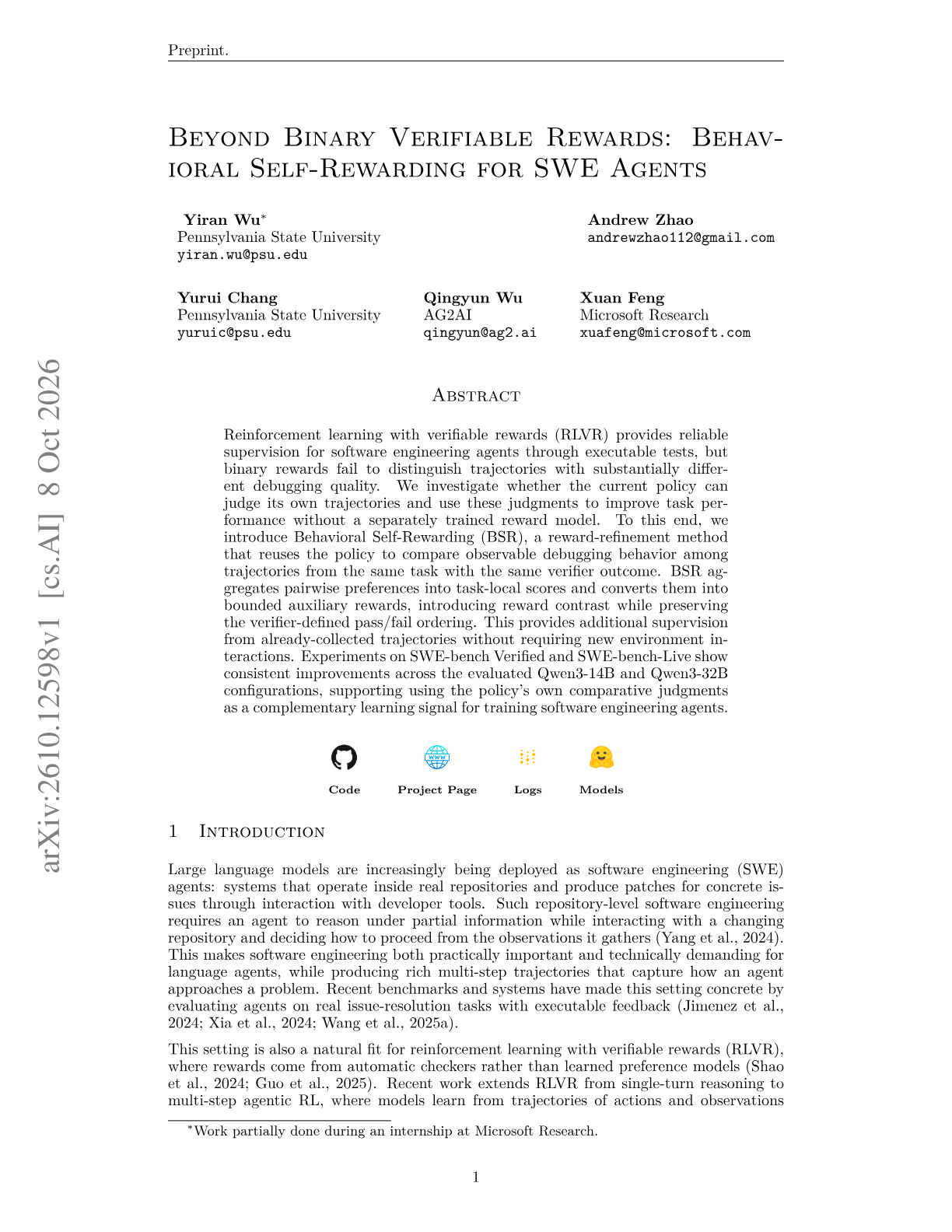
Beyond Binary Verifiable Rewards: Behavioral Self-Rewarding for SWE Agents
Yiran Wu (Penn State, partly at Microsoft Research), Qingyun Wu and colleagues propose Behavioral Self-Rewarding (BSR), which adds bounded auxiliary rewards from the policy's own pairwise judgments of its SWE trajectories, while keeping the verifier pass/fail order.
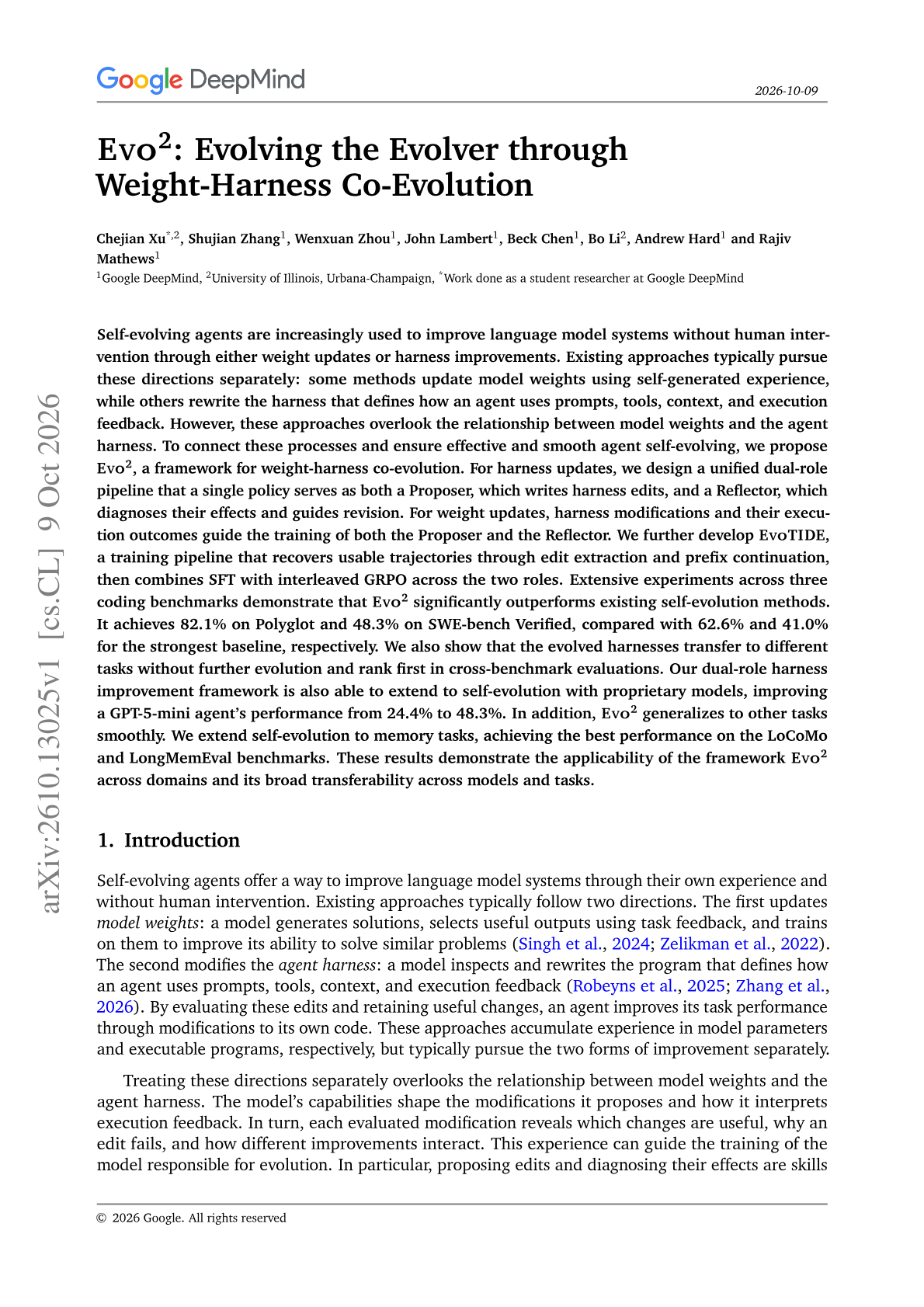
Evo$^2$: Evolving the Evolver through Weight-Harness Co-Evolution
Chejian Xu (UIUC, student researcher at Google DeepMind), Andrew Hard, Rajiv Mathews and colleagues (Google DeepMind) present Evo2, which co-evolves an agent's harness and its weights, using one policy as both harness proposer and reflector.
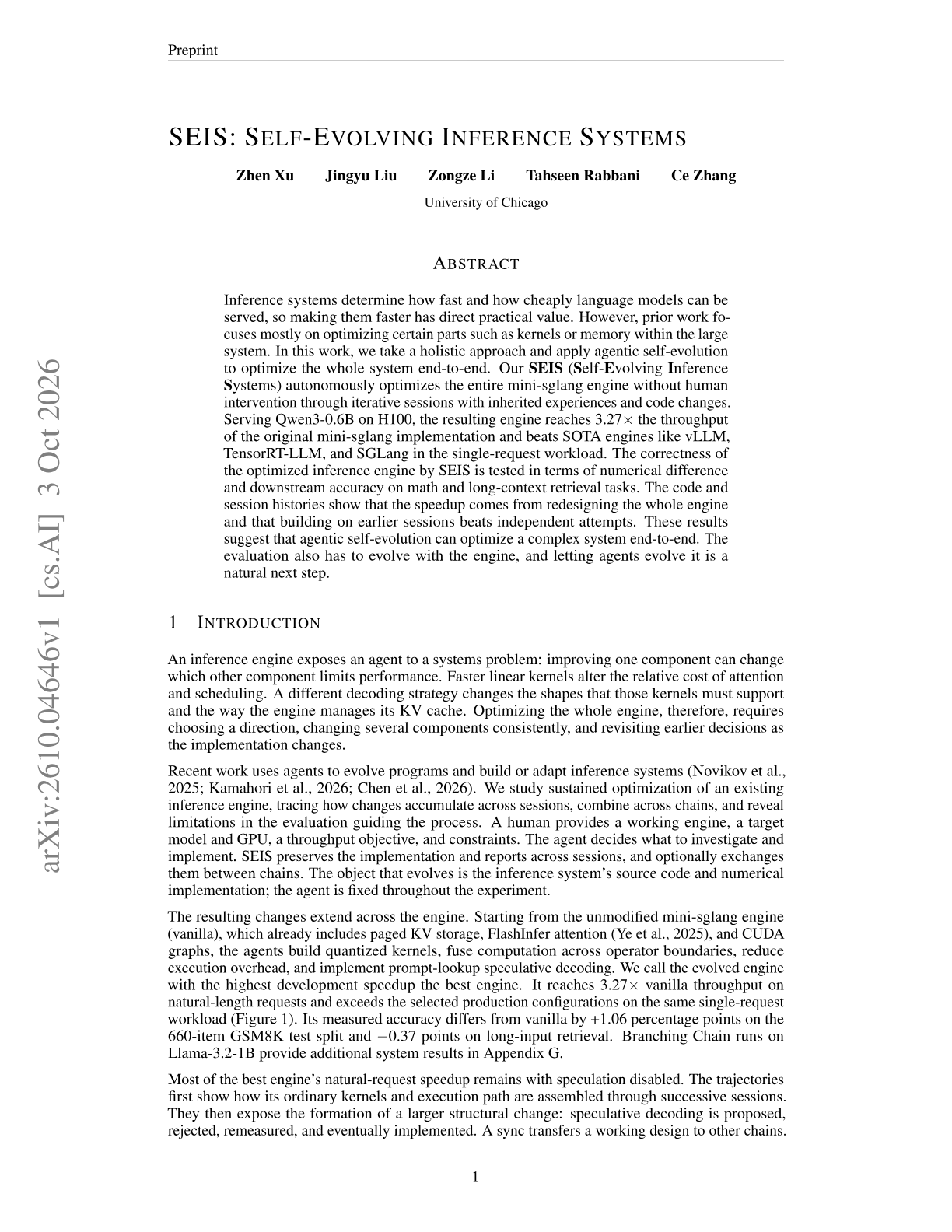
SEIS: Self-Evolving Inference Systems
Zhen Xu, Jingyu Liu, Zongze Li, Tahseen Rabbani and Ce Zhang (University of Chicago) introduce SEIS, which has coding agents optimize an entire LLM inference engine, mini-sglang, over chained sessions that inherit earlier code changes and notes.