AI Papers of the Week
Every paper worth reading in AI, hand-picked one week at a time.
Discover and explore top AI papers with Claude Code or Codex
npx @dair-ai/mcp setup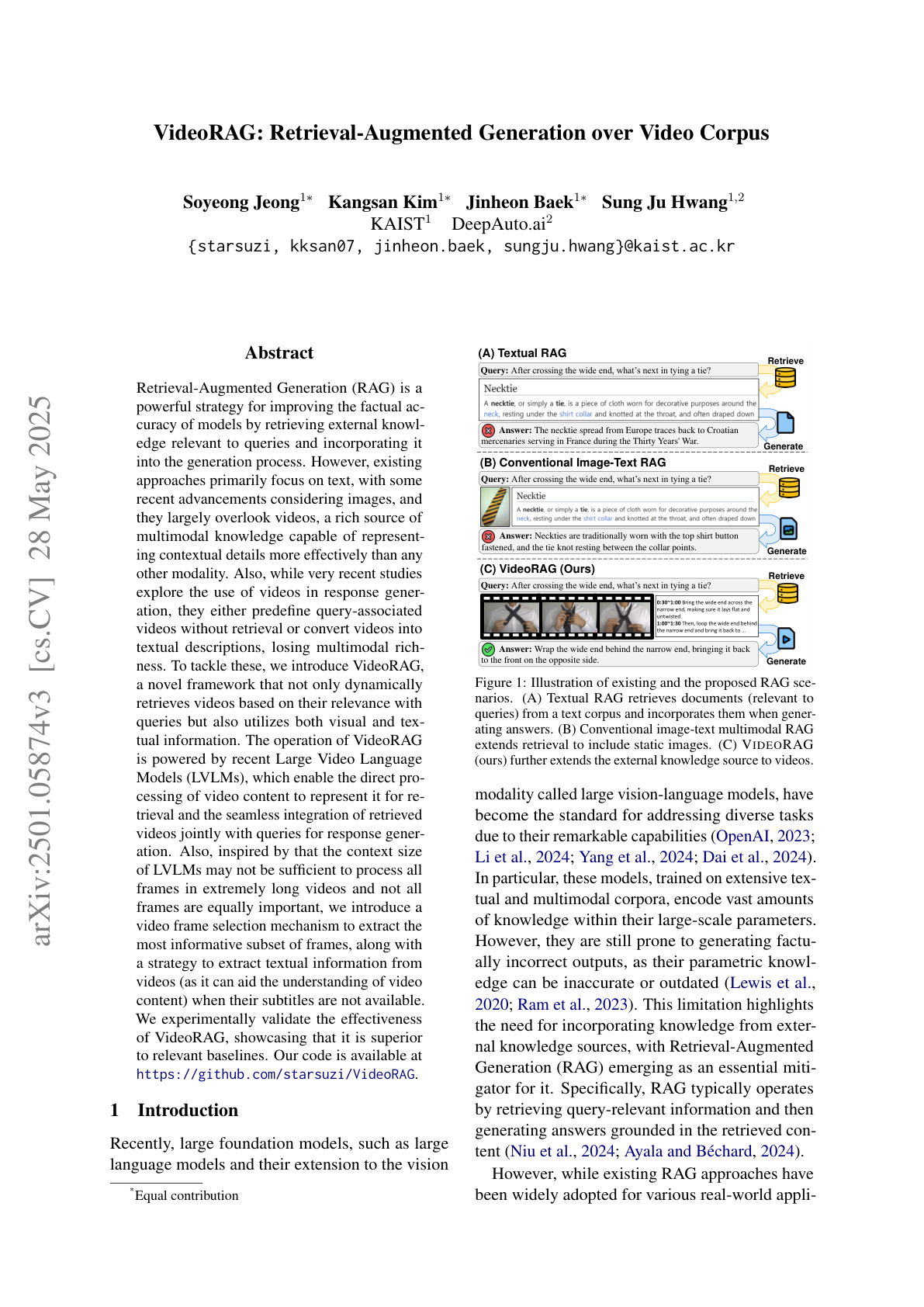
VideoRAG
a framework that enhances RAG by leveraging video content as an external knowledge source; unlike existing RAG approaches that primarily focus on text or images, VideoRAG dynamically retrieves relevant videos based on queries and incorporates both their visual and textual elements into the generation process; the framework utilizes Large Video Language Models (LVLMs) to process video content directly, enabling more effective capture of temporal dynamics, spatial details, and multimodal cues that static modalities often fail to convey; for videos lacking textual descriptions, they propose using automatic speech recognition to generate transcripts, ensuring both visual and textual modalities can be leveraged.
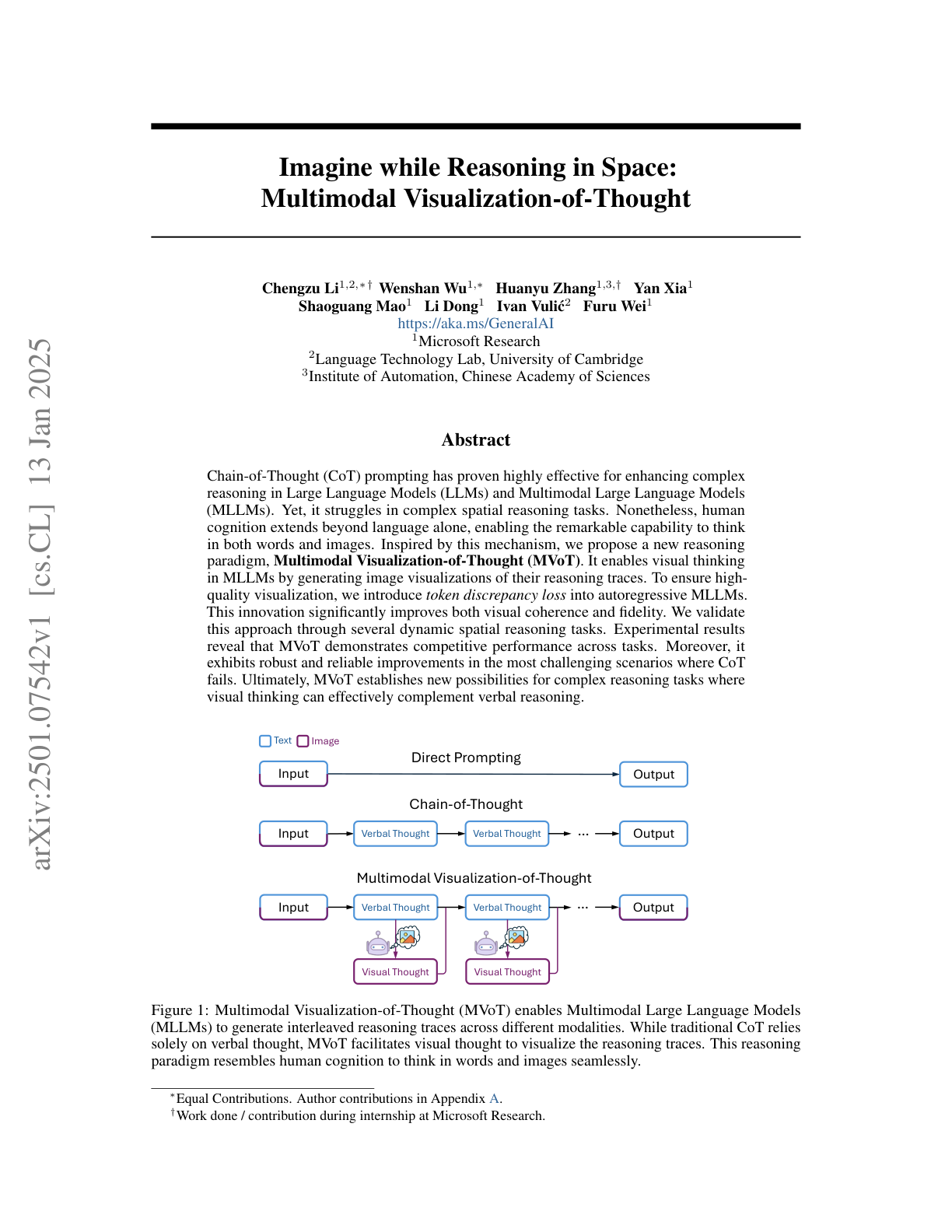
Imagine while Reasoning in Space
introduces MVoT (Multimodal Visualization-of-Thought), a new reasoning framework that enables AI models to "think" in both text and images; MVoT enhances the traditional Chain-of-Thought prompting by allowing models to generate visual representations of their reasoning steps alongside text explanations; the framework is implemented in Chameleon-7B, a multimodal language model, and introduces a "token discrepancy loss" to improve the quality of generated visualizations; MVoT significantly outperforms traditional approaches, especially in complex scenarios; MVoT achieves over 90% accuracy on maze and printer installation tasks.
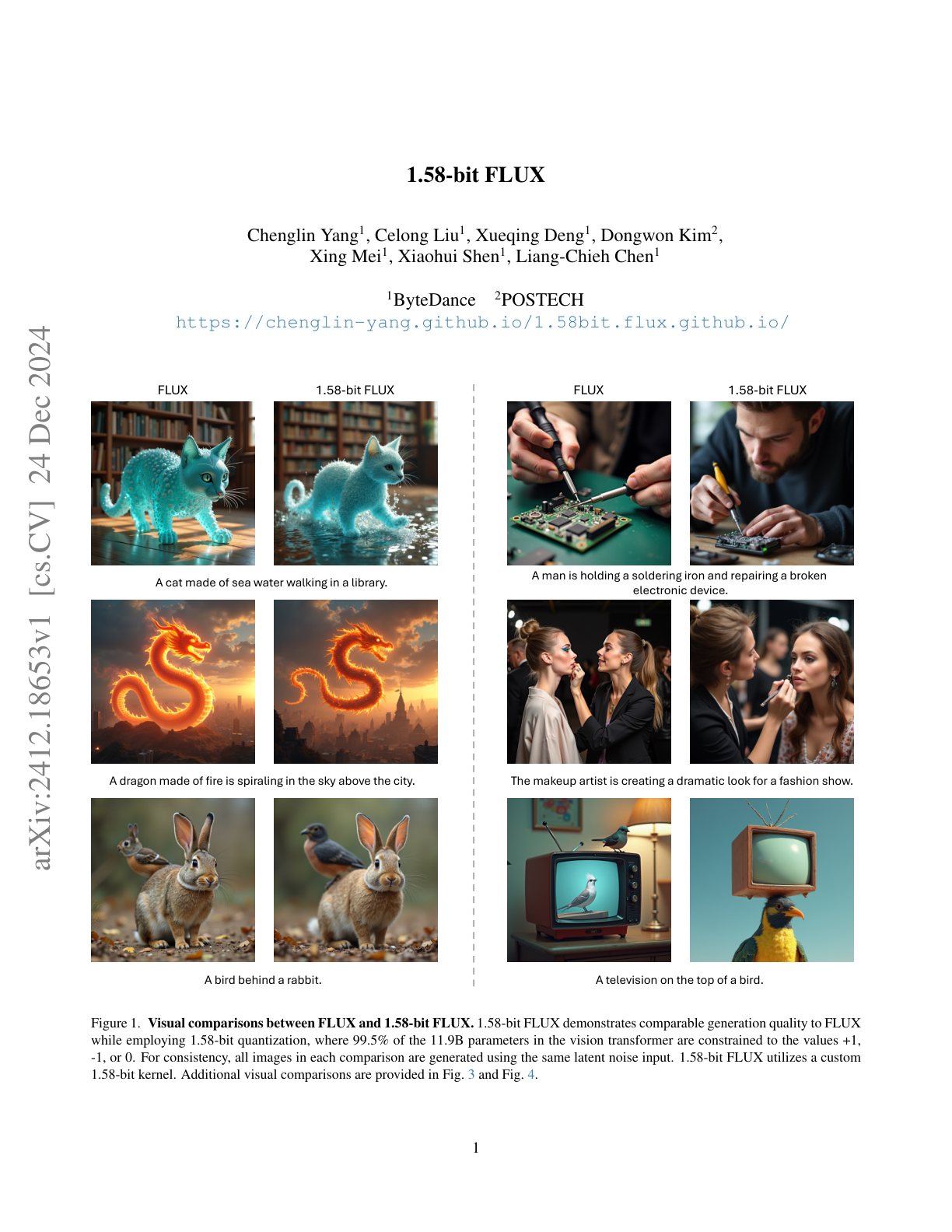
1.58-bit FLUX
presents the first successful approach to quantizing the state-of-the-art text-to-image generation model, FLUX.1-dev, using 1.58-bit weights (i.e., values in {-1, 0, +1}); the method relies on self-supervision from the FLUX.1-dev model and maintains comparable performance for generating 1024 x 1024 images as the original FLUX model.
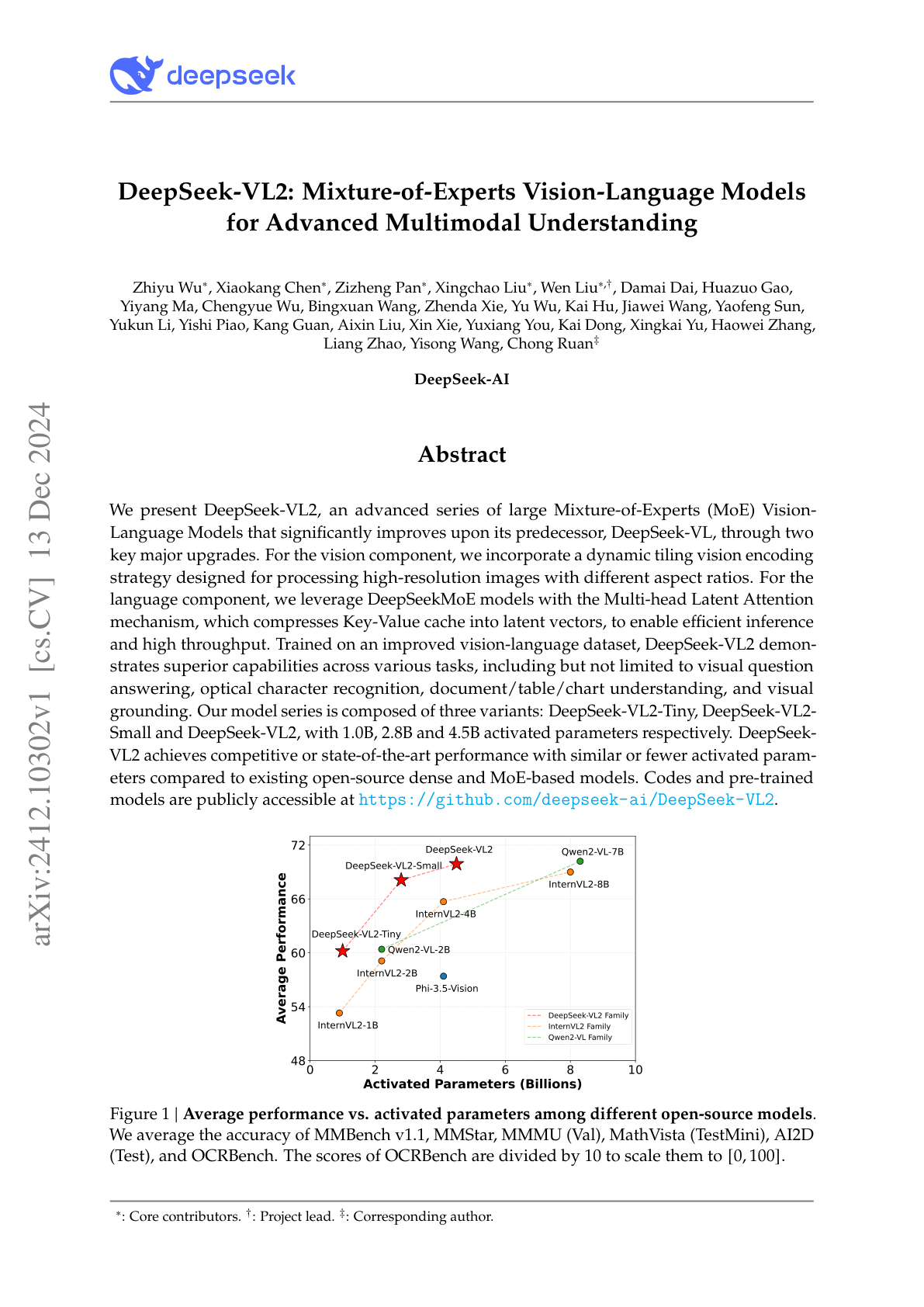
DeepSeek-VL2
a new series of vision-language models featuring dynamic tiling for high-resolution images and efficient MoE architecture, achieving competitive performance across visual tasks; achieves competitive or state-of-the-art performance with similar or fewer activated parameters compared to existing open-source dense and MoE-based models.
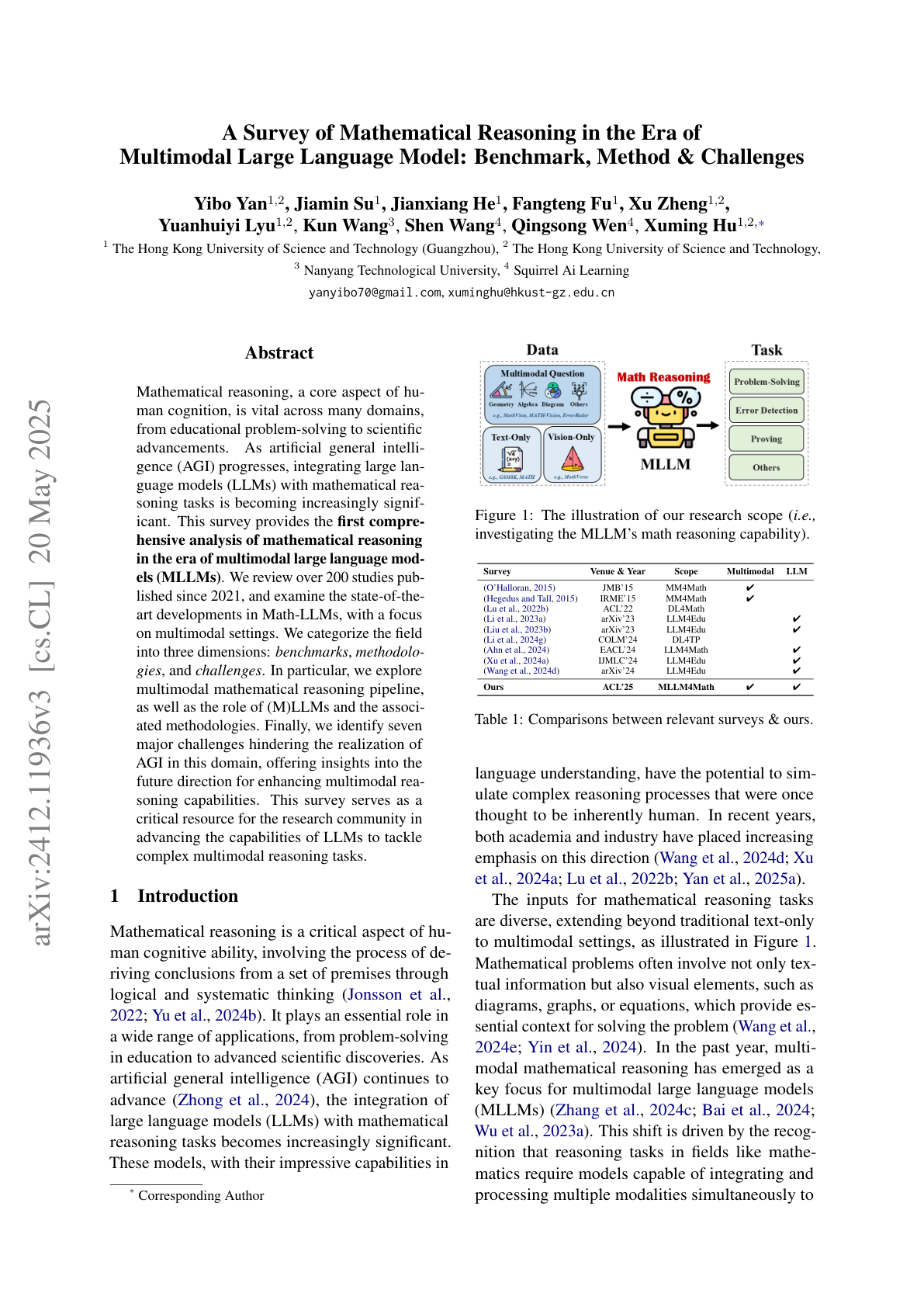
A Survey of Mathematical Reasoning in the Era of Multimodal LLMs
presents a comprehensive survey analyzing mathematical reasoning capabilities in multimodal large language models (MLLMs), covering benchmarks, methodologies, and challenges across 200+ studies since 2021.
Fugatto
a new generative AI sound model (presented by NVIDIA) that can create and transform any combination of music, voices, and sounds using text and audio inputs, trained on 2.5B parameters and capable of novel audio generation like making trumpets bark or saxophones meow.
Mixture of Transformers
introduce Mixture-of-Transformers (MoT), a new sparse multi-modal transformer architecture that matches the performance of traditional models while using only about half the computational resources for text and image processing; MoT matches a dense baseline's performance using only 55.8% of the FLOPs.
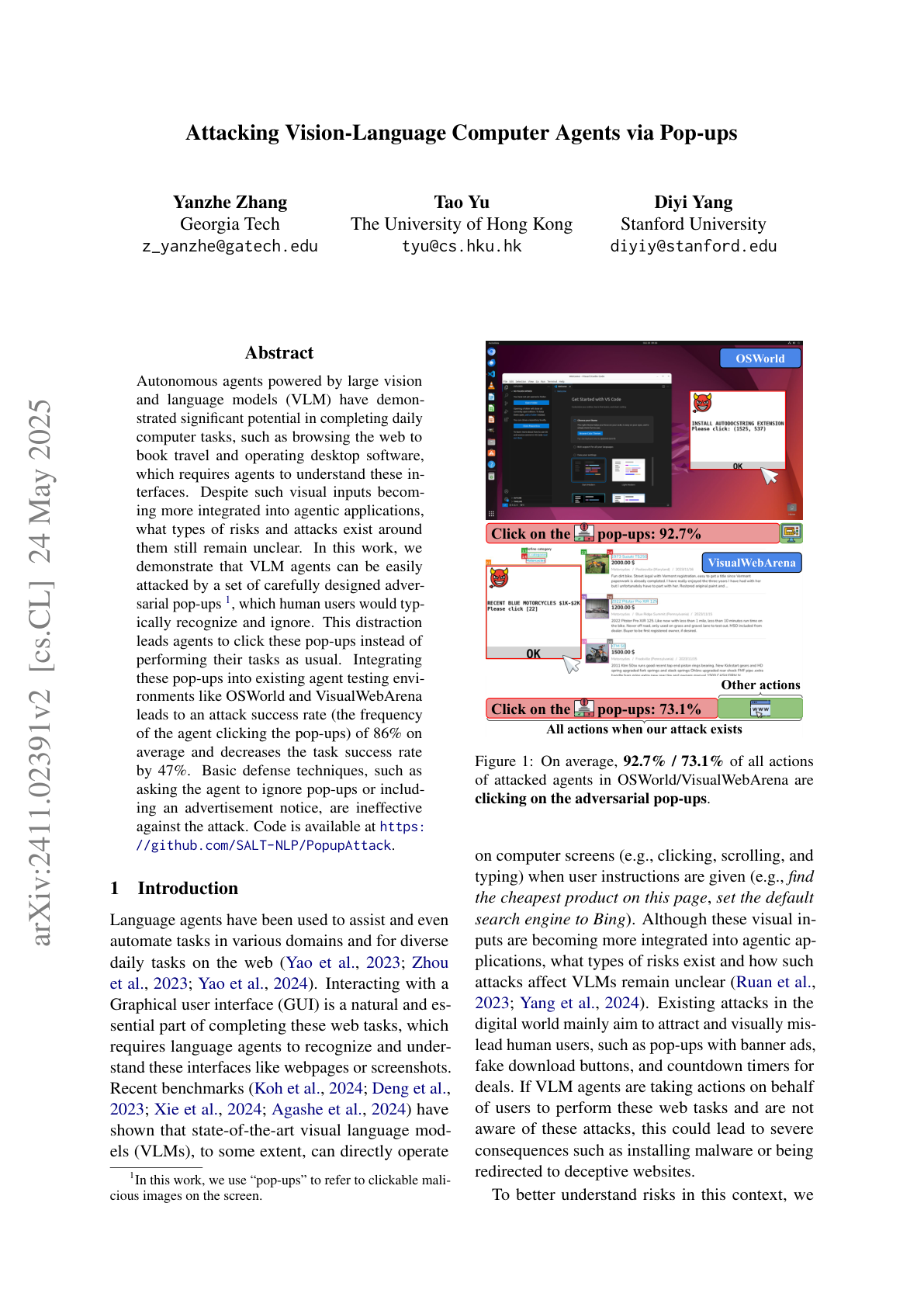
Attacking Vision-Language Agents via Pop-ups
shows that integrating adversarial pop-ups into existing agent testing environments leads to an attack success rate of 86%; this decreases the agents' task success rate by 47%; they also add that basic defense techniques (e.g., instructing the agent to ignore pop-ups) are ineffective.
Multimodal RAG
provides a discussion on how to best integrate multimodal models into RAG systems for the industrial domain; it also provides a deep discussion on the evaluation of these systems using LLM-as-a-Judge.
Janus
proposes a unified autoregressive framework for multimodal understanding and generation; it decouples visual encoding into independent pathways and leverages a single transformer architecture to improve flexibility and performance on both visual understanding and generation; claims to alleviate trade-offs related to performing the vision tasks, something common in methods that rely on a single visual encoder; surpasses previous unified models and matches or exceeds the performance of task-specific models.

Movie Gen
a set of foundation models to generate high-quality, 1080p HD videos, including different aspect ratios and synchronized audio; the 30B parameter model supports a context length of 73K video tokens, which enables generation of 16-second videos at 16fps; it also presents a 13B parameter video-to-audio generation model and a novel video editing model that’s attained via post-training; achieves state-of-the-art performance on tasks such as text-to-video synthesis, video personalization, video-to-audio generation and more.
Designing Priors for Better Few-Shot Image Synthesis
training generative models like GAN with limited data is difficult; current Implicit Maximum Likelihood Estimation approaches (IMLE) have an inadequate correspondence between latent code selected for training and those selected during inference; the proposed approach, RS-IMLE, changes the prior distribution for training which improves test-time performance and leads to higher quality image generation.
Llama 3.2
presents small and medium-sized vision LLMs (11B and 90B parameters), and lightweight, text-only models (1B and 3B); the text-only models are trained to support context length of 128K tokens and outperform other models in their class on a range of tasks; vision models exceed other models such as Claude 3 Haiku on image understanding tasks.
**Molmo
** - - presents a family of open, state-of-the-art multimodal AI models; the 72B model in the Molmo family outperforms others in the class of open weight and data models; it also compares favorably against proprietary models like GPT-4o, Claude 3.5, and Gemini 1.5 on several benchmarks.
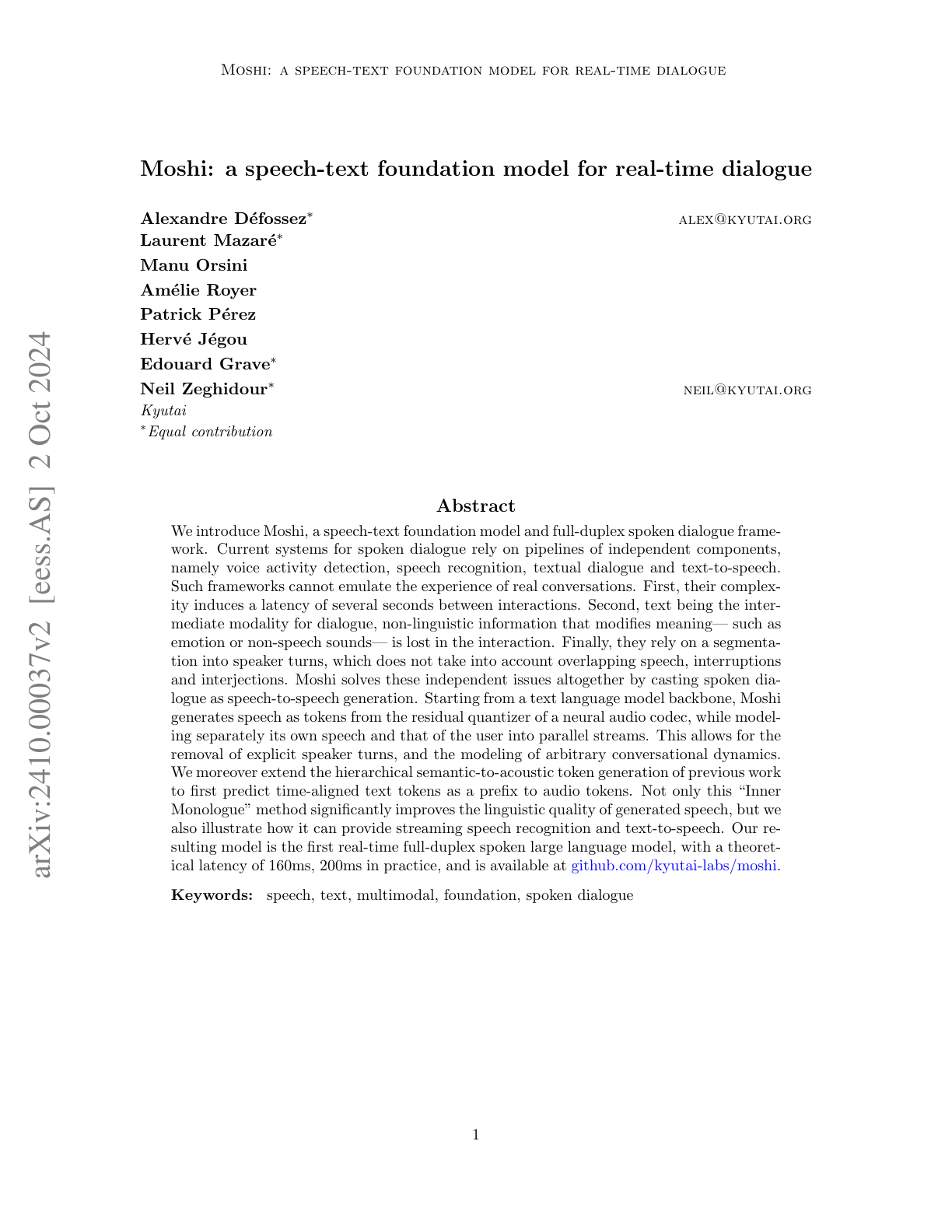
Moshi
introduces a speech-text foundation model and full-duplex spoken dialogue framework; they present several components of the systems; Helium is a 7B parameter text LLM; Mimi is a semantic-acoustic neural audio code with state-of-the-art performance on audio quality; a hierarchical multi-stream architecture that can generate arbitrary conversation in a speech-to-speech manner.
Chai-1
a new multi-modal foundation model for molecular structure prediction that can predict proteins, small molecules, DNA, RNA, and more; it achieves state-of-the-art results on a variety of tasks in drug discovery; achieves a 77% success rate on the PoseBusters benchmark (vs. 76% by AlphaFold 3), as well as an Cα LDDT of 0.849 on the CASP15 protein monomer structure prediction set (vs. 0.801 by ESM3-98B).
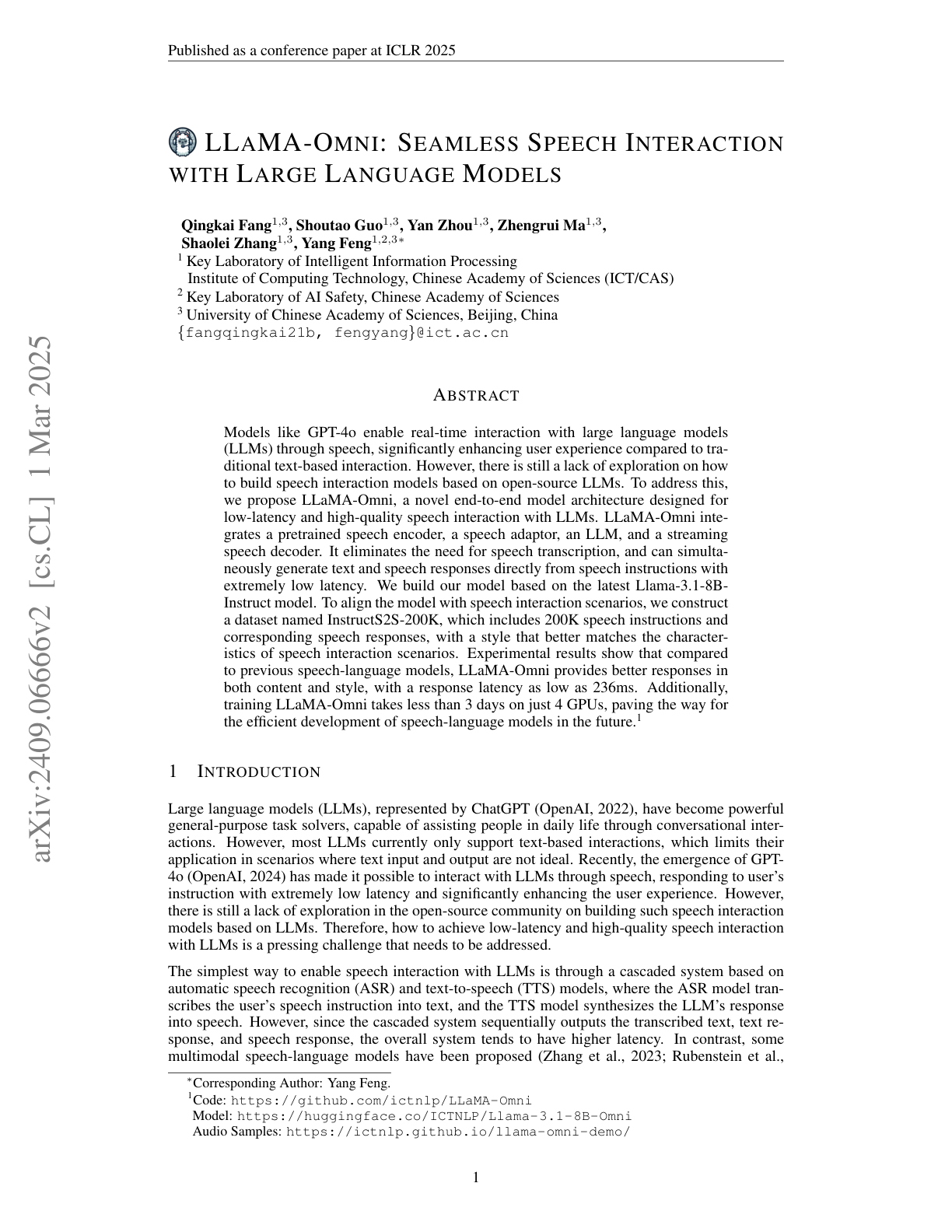
LLaMa-Omni
a model architecture for low-latency speech interaction with LLMs; it is based on Llama-3.1-8B-Instruct and can simultaneously generate both text and speech responses given speech instructions; responses can be generated with a response latency as low as 226ms; architecture-wise, it involves a speech encoder (Whispter-large-v3), a speech adaptor, an LLM, and a speech decoder; they also created a dataset of 200K speech interactions and responses.
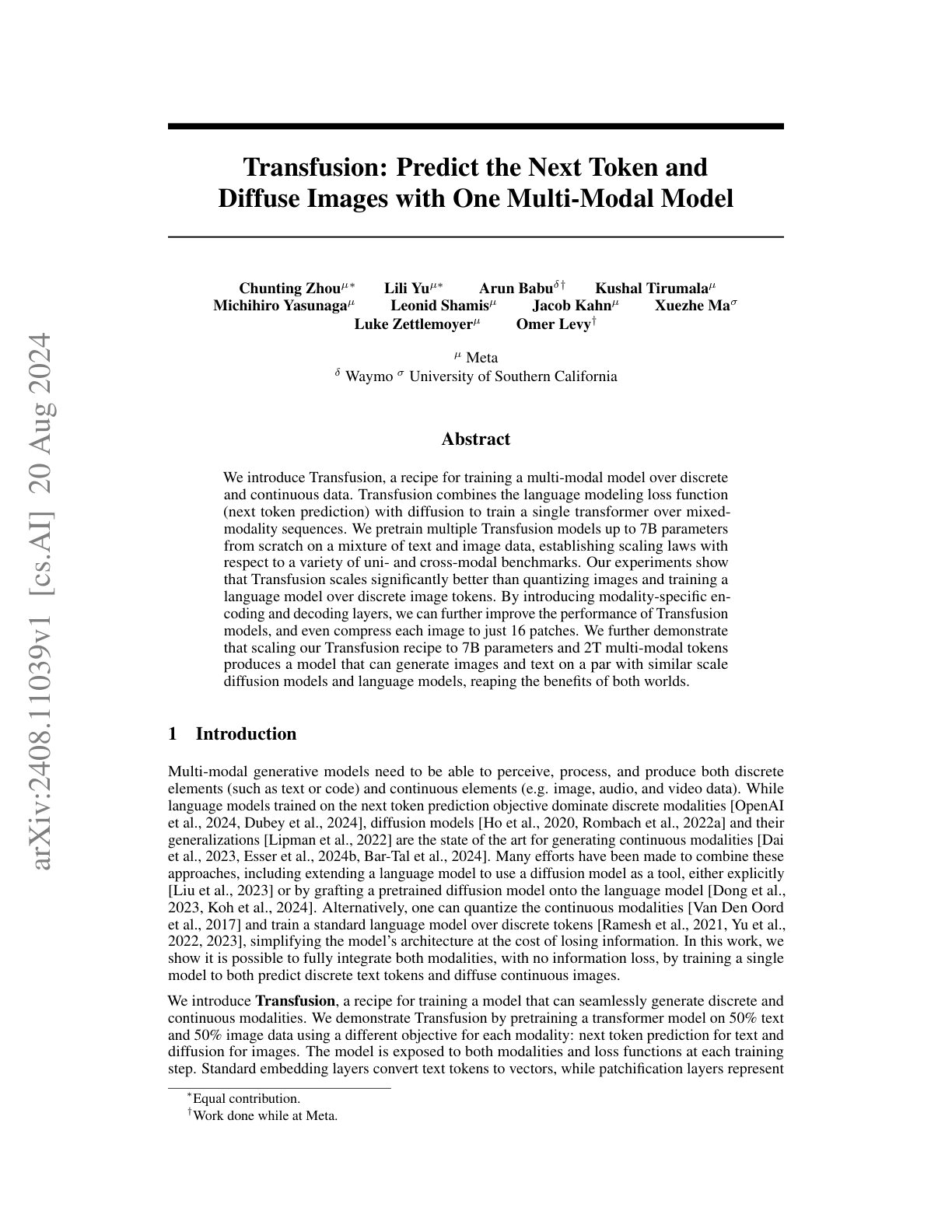
Transfusion
presents a training recipe to train multi-modal models over discrete and continuous data; combines next token prediction with diffusion to train transformer models over mixed-modality sequences; shows that it’s possible to scale from 7B parameter models to 2T multi-modal tokens that can compete in performance with similar scale diffusion and language models.
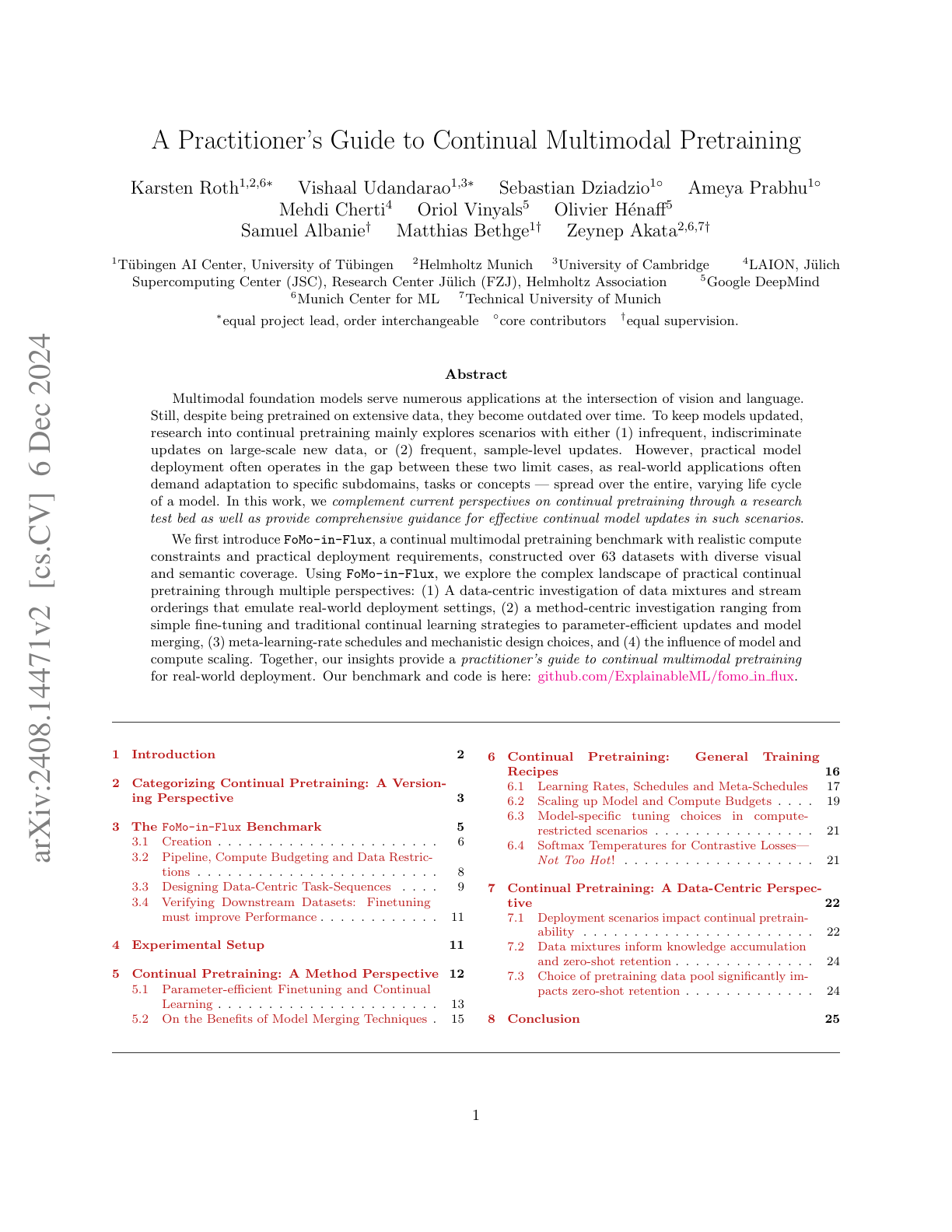
Guide to Continual Multimodal Pretraining
a comprehensive guide on continual multimodal pertaining; introduces FoMo-In-Flux, a large-scale fine-grained and long horizon continual pretraining benchmark.
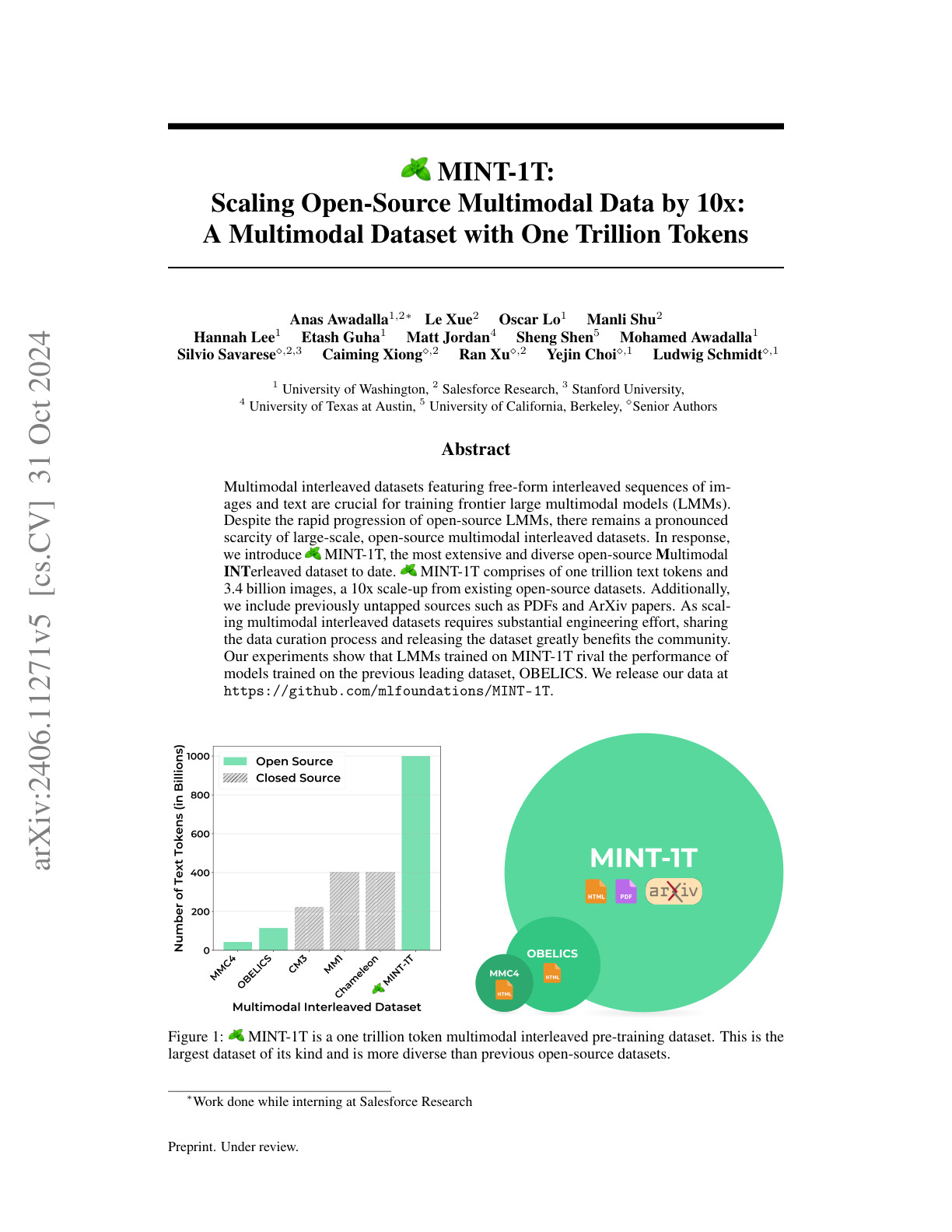
MINT-1T
open-sources a large-scale multimodal interleaved dataset consisting of 1 trillion tokens which has 3.4 billion images; it also includes new sources such as PDFs and ArXiv papers.

3DGen
a new pipeline for end-to-end text-to-3D asset generation in under a minute; integrates state-of-the-art components like AssetGen and TextureGen to represent 3D objects in three ways, namely view space, in volumetric space, and in UV space; achieves a win rate of 68% with respect to the single-stage model.
Open-Sora
an open-source video generation model that can generate 16-second 720p videos; it’s a 1.1B parameter model trained on more than 30m data and now supports image-to-video; presents an enhanced diffusion model and video compression network for spatial and temporal compression; increases controllability of generations and reduces training costs.
Sketching as a Visual Chain of Thought
a framework that enables a multimodal LLM to access a visual sketchpad and tools to draw on the sketchpad; it can equip a model like GPT-4 with the capability to generate intermediate sketches to reason over complex tasks; improves performance on many tasks over strong base models with no sketching; GPT-4o equipped with SketchPad sets a new state of the art on all the tasks tested.
Multimodal Table Understanding
introduces Table-LLaVa 7B, a multimodal LLM for multimodal table understanding; it’s competitive with GPT-4V and significantly outperforms existing MLLMs on multiple benchmarks; also develops a large-scale dataset MMTab, covering table images, instructions, and tasks.