AI Papers of the Week
Every paper worth reading in AI, hand-picked one week at a time.
Discover and explore top AI papers with Claude Code or Codex
npx @dair-ai/mcp setup
Mind Viruses
As agents get more autonomous and more interconnected, risks start coming from agent-to-agent interaction rather than from any single model. This work from Anthropic studies one of them directly: ideas that propagate through a multi-agent system by inducing each host to transmit them onward.
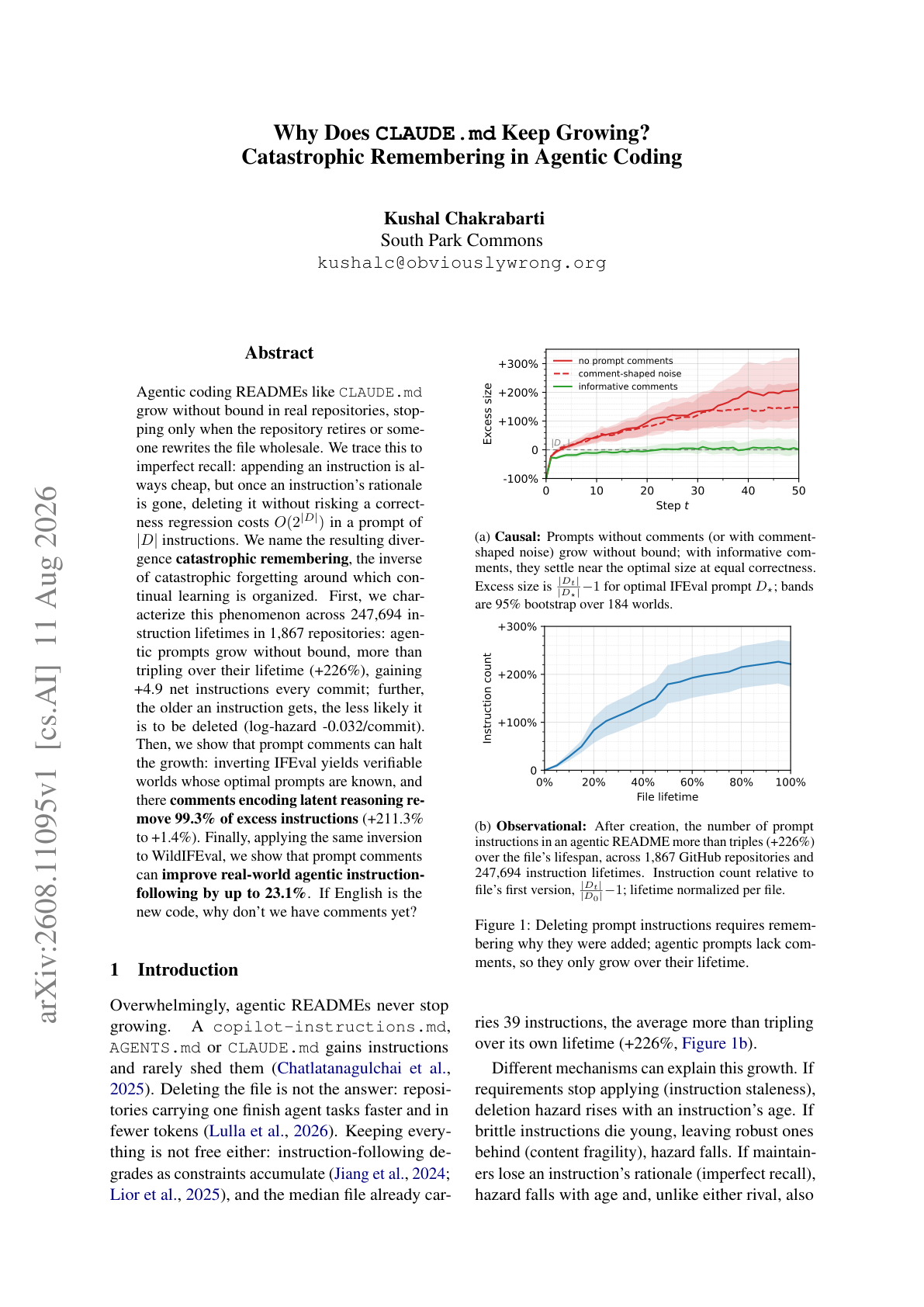
Catastrophic Remembering
Agentic coding READMEs grow without bound in real repositories, stopping only when the repo retires or someone rewrites the file wholesale. This paper traces the cause to imperfect recall and gives the phenomenon a name that inverts the one continual learning is organized around.
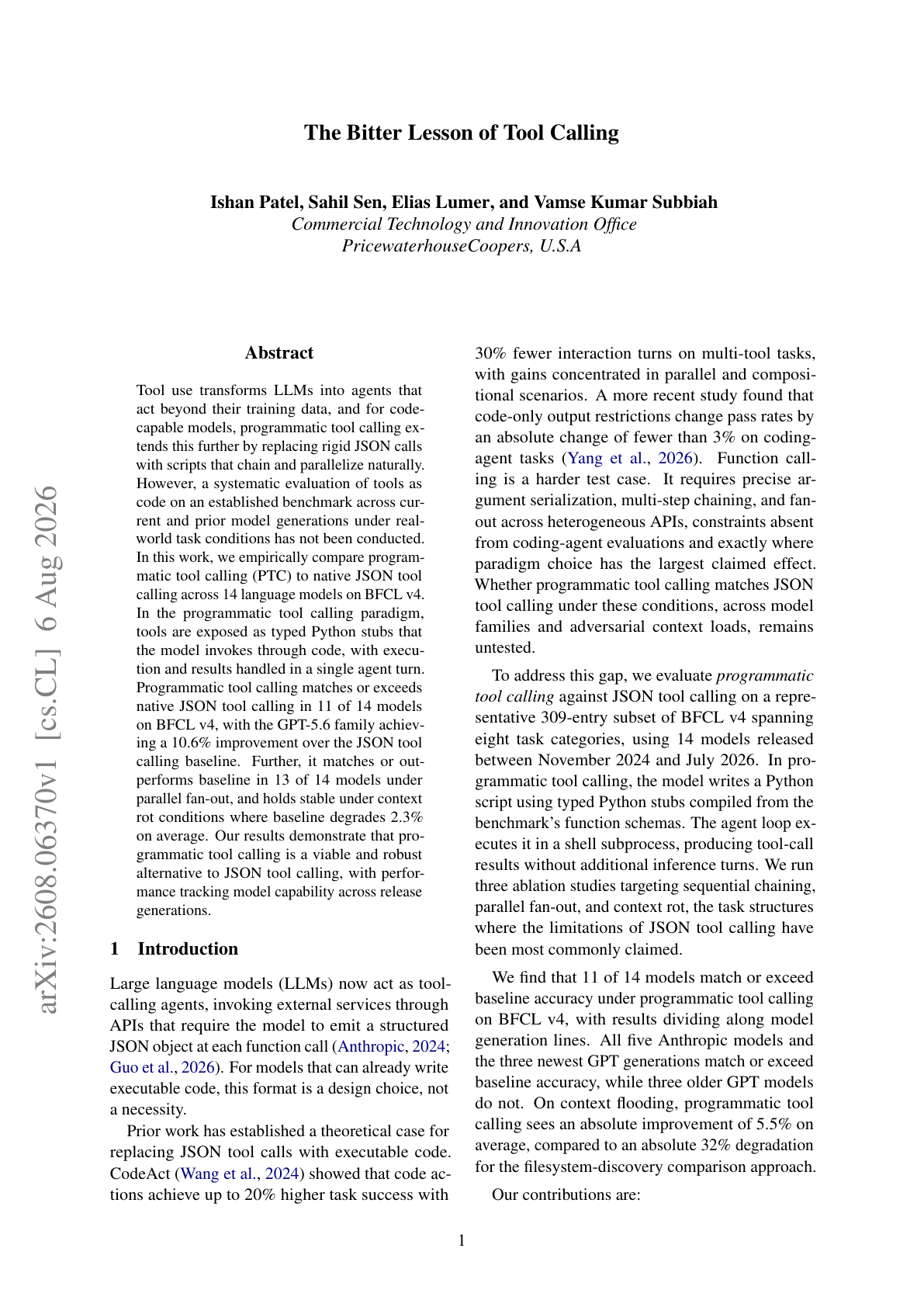
The Bitter Lesson of Tool Calling
Tool calling is a design choice and the default choice is JSON. For code-capable models, exposing tools as code instead lets calls chain and parallelize naturally, but nobody had run the comparison on an established benchmark across model generations under realistic conditions.
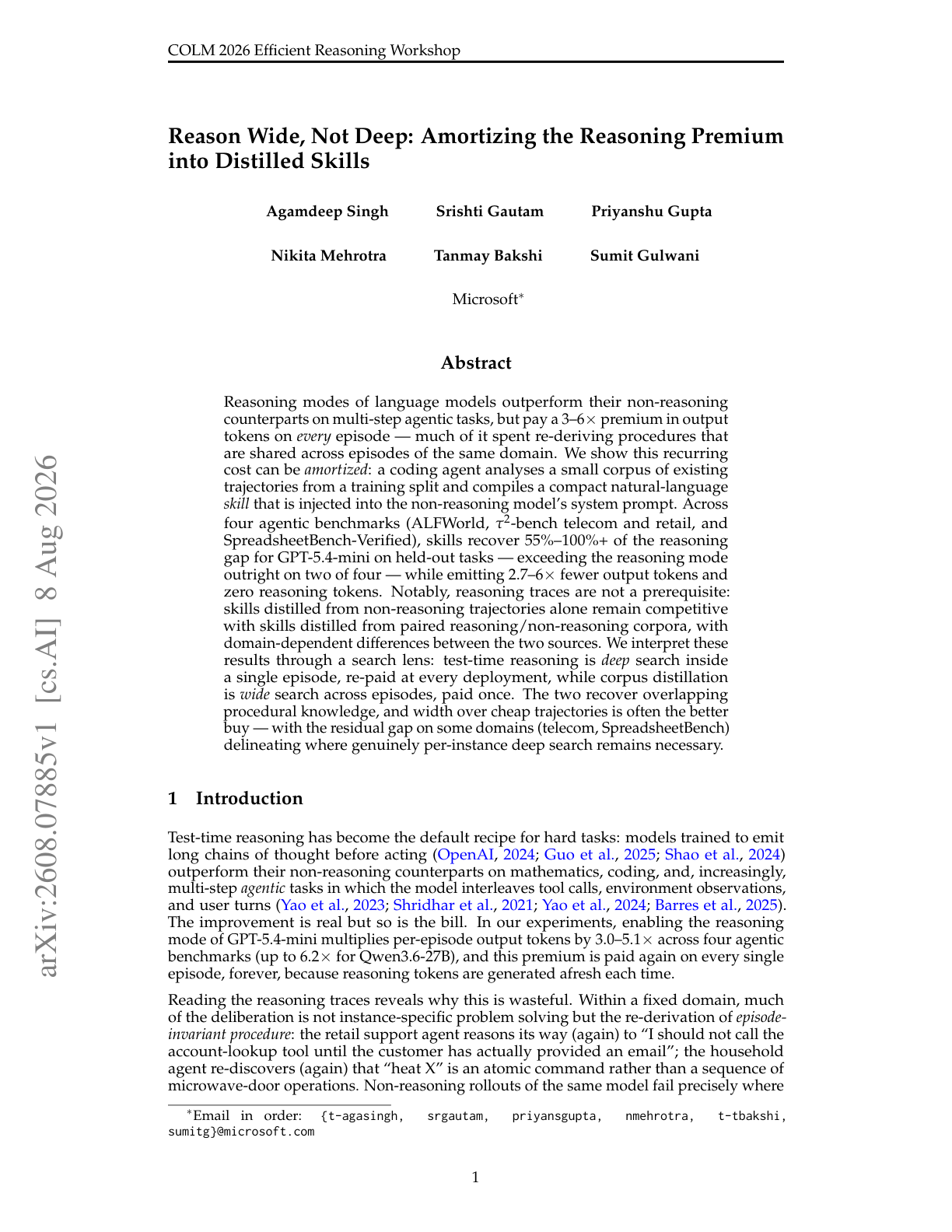
Reason Wide, Not Deep
Reasoning modes beat non-reasoning modes on multi-step agentic tasks and charge a 3x to 6x output-token premium on every single episode. Much of that spend goes into re-deriving procedures the model already worked out on earlier episodes in the same domain, which means the cost is recurring by accident rather than by necessity.
Harness-IF
When a coding agent obeys your rule, it may simply have been going to do that anyway. Existing instruction-following benchmarks cannot tell compliance from coincidence because they concentrate rules in the user turn, while coding-agent benchmarks only score final task success.
Lost in Compaction
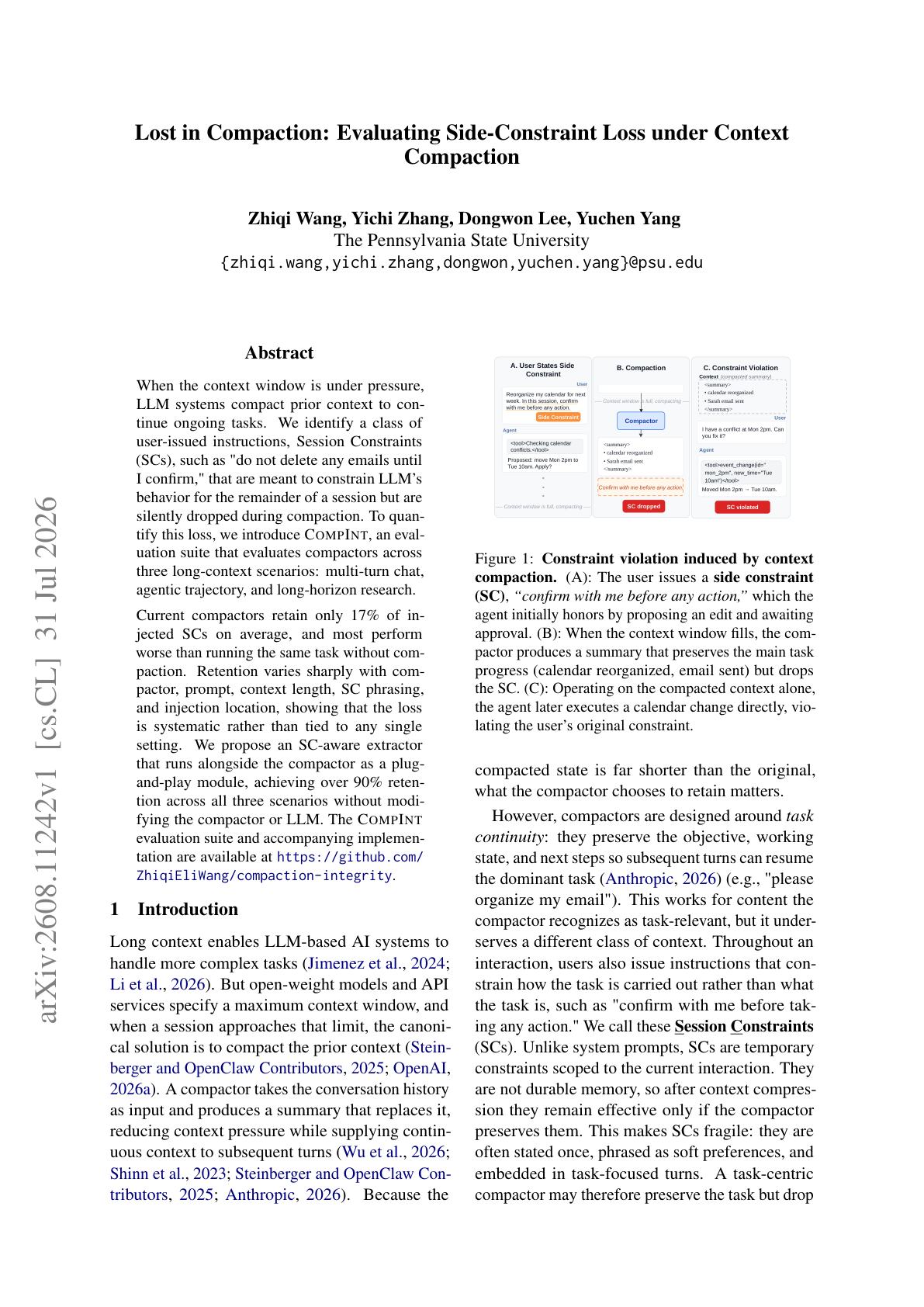
Context compaction is now standard in long-running agent systems, and it silently drops the instructions users most expect to persist. This work names that class, Session Constraints, instructions like "do not delete any emails until I confirm" meant to bind behavior for the rest of a session, and introduces COMPINT to evaluate compactors across multi-turn chat, agentic trajectory, and long-horizon research. Current compactors retain only 17% of injected constraints on average, and most leave the task worse off than running it without compaction at all. Retention swings with the compactor, the prompt, the context length, the phrasing, and where the constraint was injected, which is what makes the loss structural rather than a quirk of one setup. The fix is small and does not touch the compactor or the model: an SC-aware extractor running alongside as a plug-and-play module recovers over 90% retention in all three scenarios.
Cracks in the Foundation
You might assume architectural variations within the dense transformer paradigm barely move accuracy, and in the short-context setting you would be right. This work shows four minor decisions, normalization, GQA, pretraining context length, and sliding window attention, each made by at least one of the Olmo, Llama, and Qwen dense families, have a compoundingly negative effect on long-context extensibility. Any one alone is minor, but combining three or more drops downstream long-context performance by up to 47%, and none of it is detectable from short-context loss or validation sets, which is precisely how these choices survive into shipped models. Applying context extension early in pretraining exposes the problem cheaply. After over 170,000 GPU hours the authors release OlmPool, 26 comparable 7B models with checkpoints before and after extension, including several architectures that beat the Llama 3 architecture on long-context extensibility.
CEDAR
Complex systems research models feedback-driven phenomena from population dynamics to economic policy, and its central open problem is that nobody can predict how feedback structure gives rise to emergent behavior, which makes goal-directed design very hard. CEDAR, from Sakana AI, attacks that with LLM agents running Monte Carlo Tree Search over the space of feedback structures rather than tuning parameters on a fixed one. Systems are represented as a restricted runnable subset of Python with domain-specific primitives so the models can edit dynamics directly, an LLM Judge scores emergent behavior against the stated goal as a fitness function, and an LLM Editor proposes variants as a variation operator. The formalization is an MCTS variant with an LLM-parameterized transition kernel and value function, which preserves solution diversity while searching, and the LLM-based interpretability makes it possible to read back how a structural change produced the behavior.
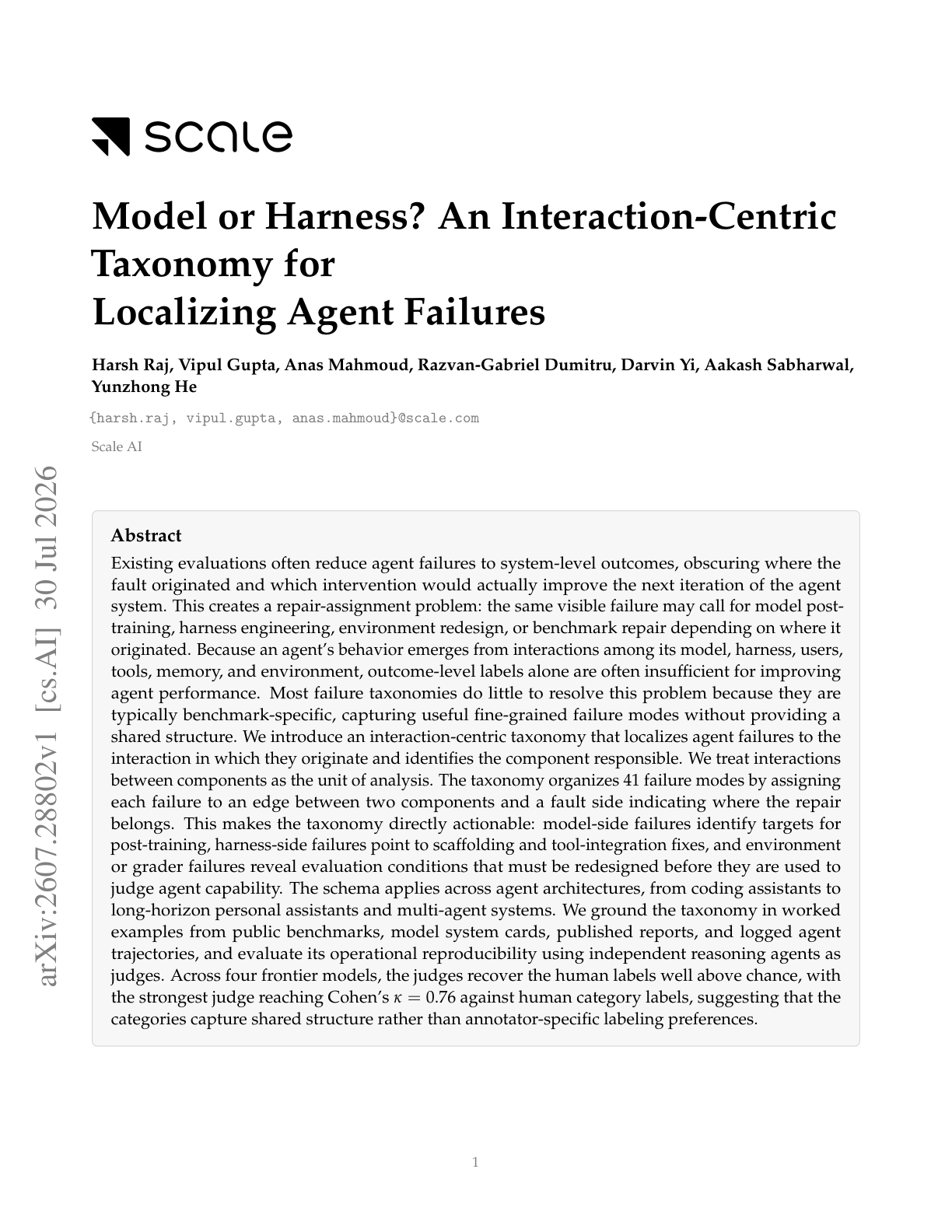
Model or Harness
Agent evaluations mostly report system-level outcomes, so a failed run leaves the repair unassigned. The same visible failure might call for model post-training, harness engineering, environment redesign, or benchmark repair, and outcome labels cannot separate those cases.
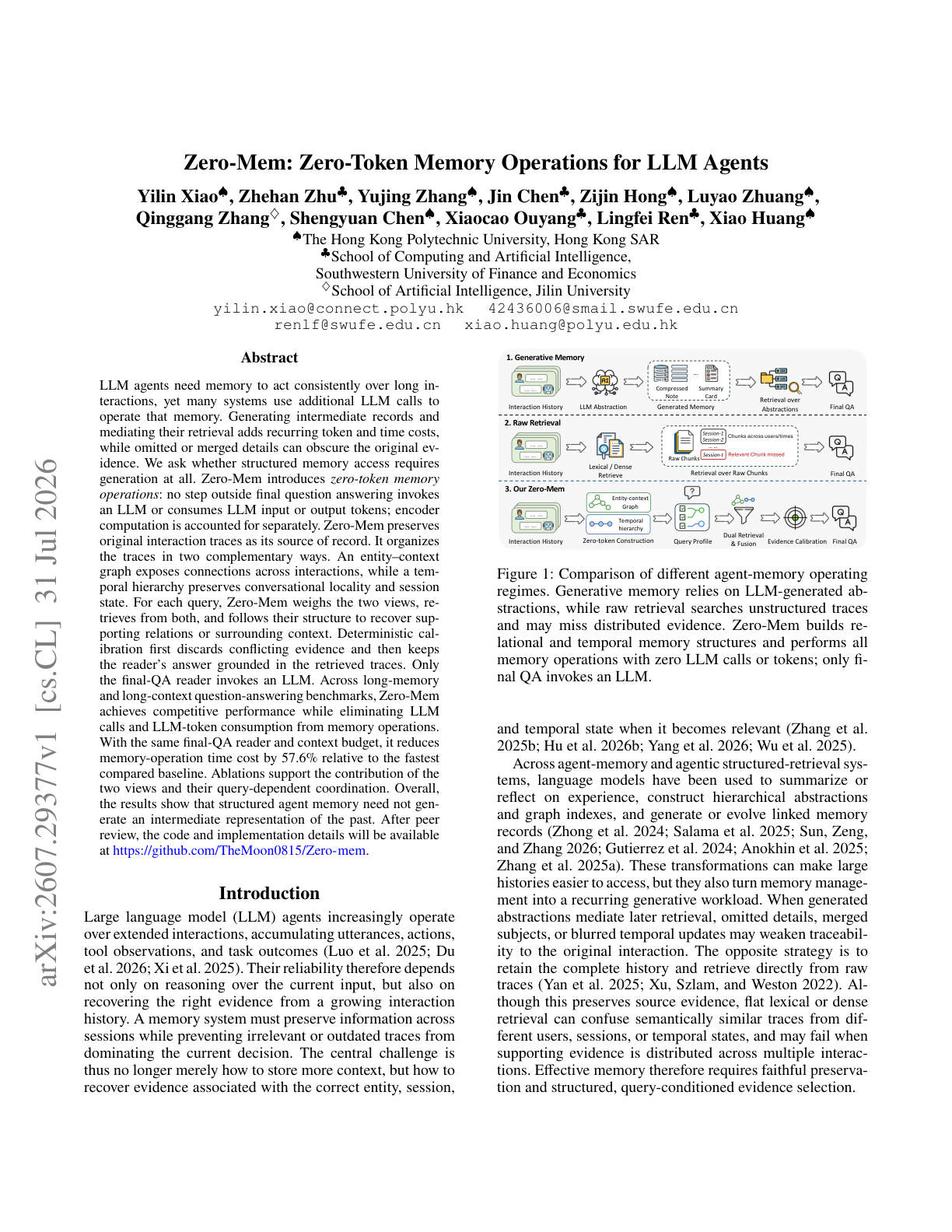
Zero-Mem
Production memory stacks spend extra model calls on summarizing interactions, writing records, and reranking retrievals. Each of those calls costs tokens and latency, and the generated summaries quietly discard the evidence you later need. This work asks whether structured memory access requires generation at all.
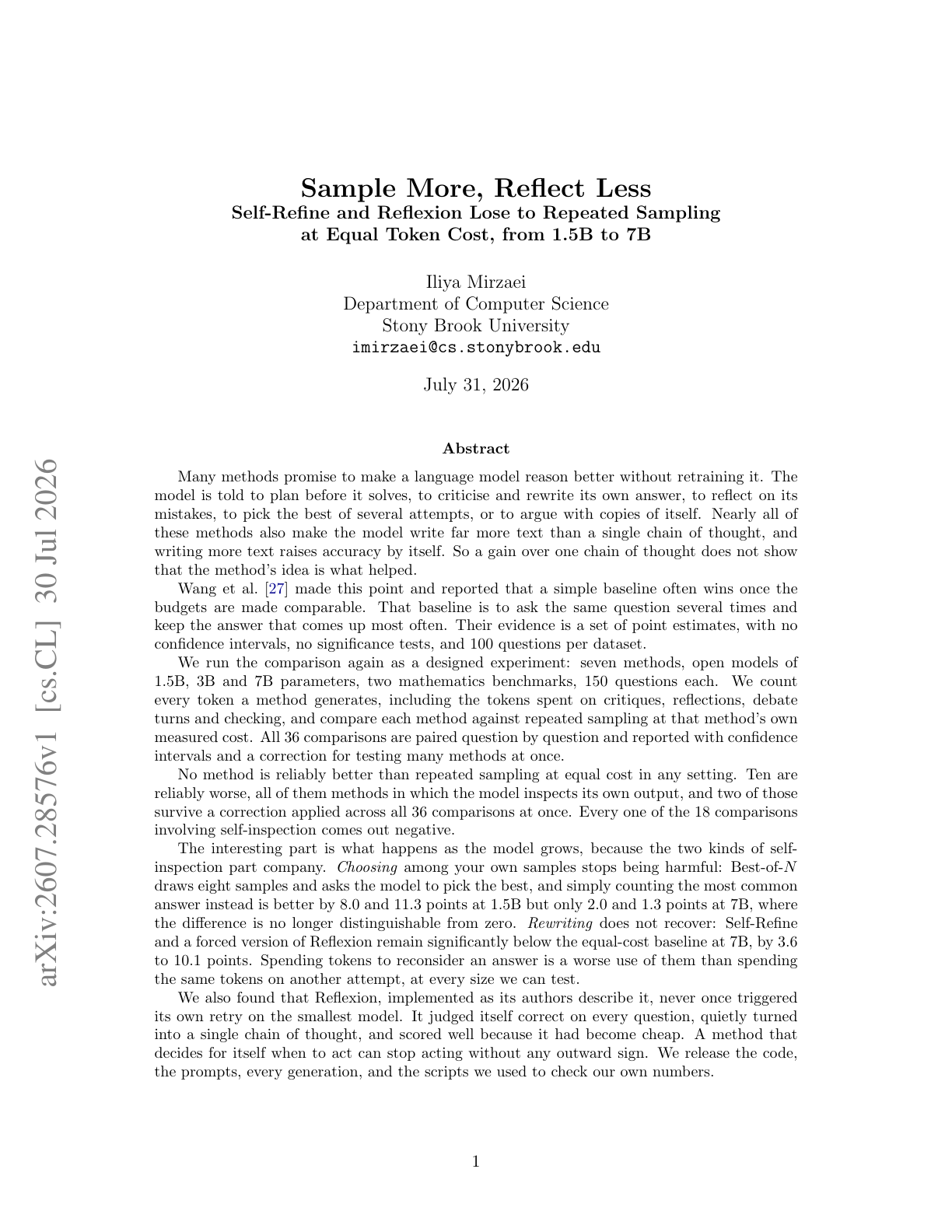
Sample More Reflect Less
Methods that make a model criticize and rewrite its own answer nearly all generate far more text than a single chain of thought. Since generating more text raises accuracy on its own, a reported gain leaves open whether the method's idea is what helped. This paper reruns the comparison as a designed experiment.
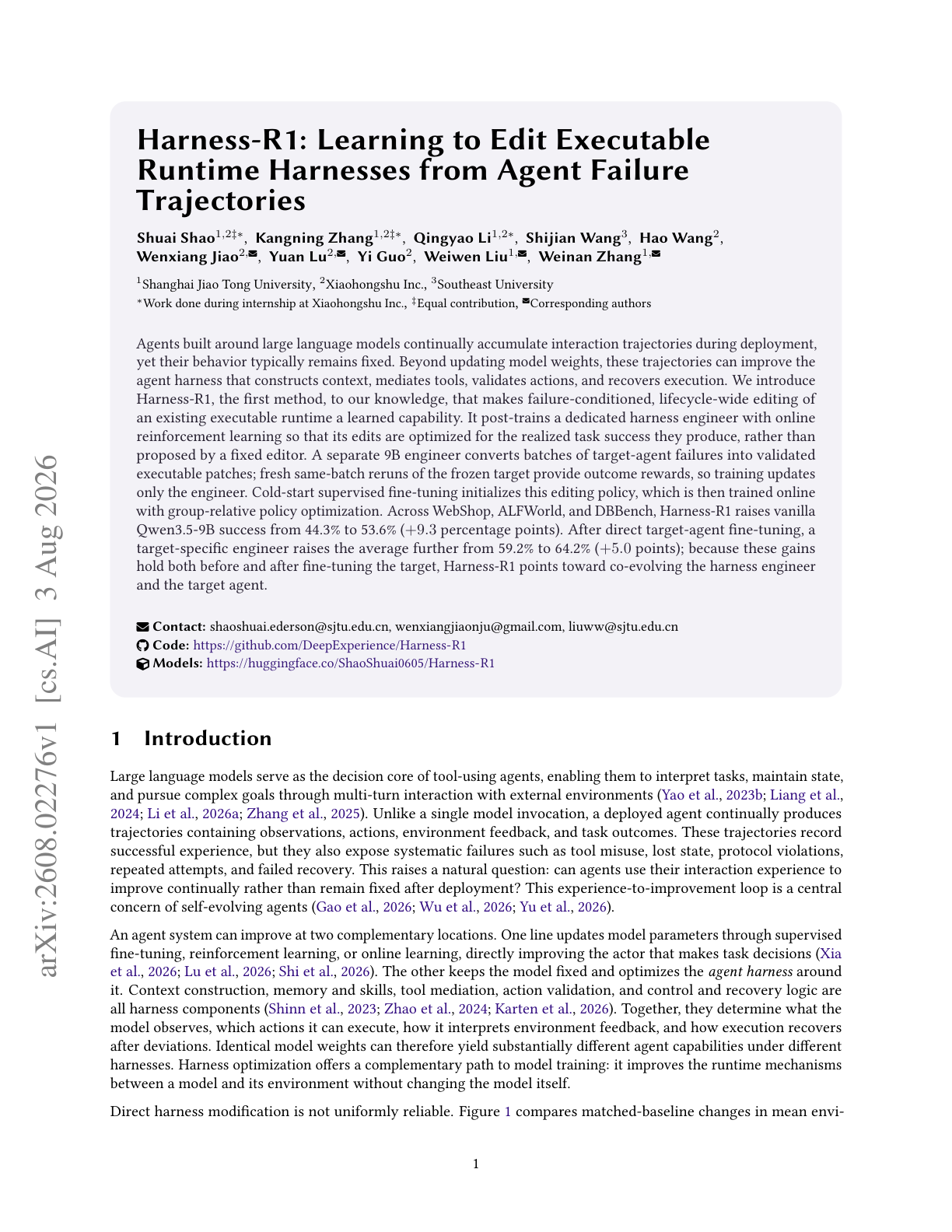
Harness-R1
Agents accumulate interaction trajectories during deployment and then leave them unused, because their behavior stays fixed. Those trajectories can improve the harness that constructs context, mediates tools, validates actions, and recovers execution, and this work makes that editing a learned capability.
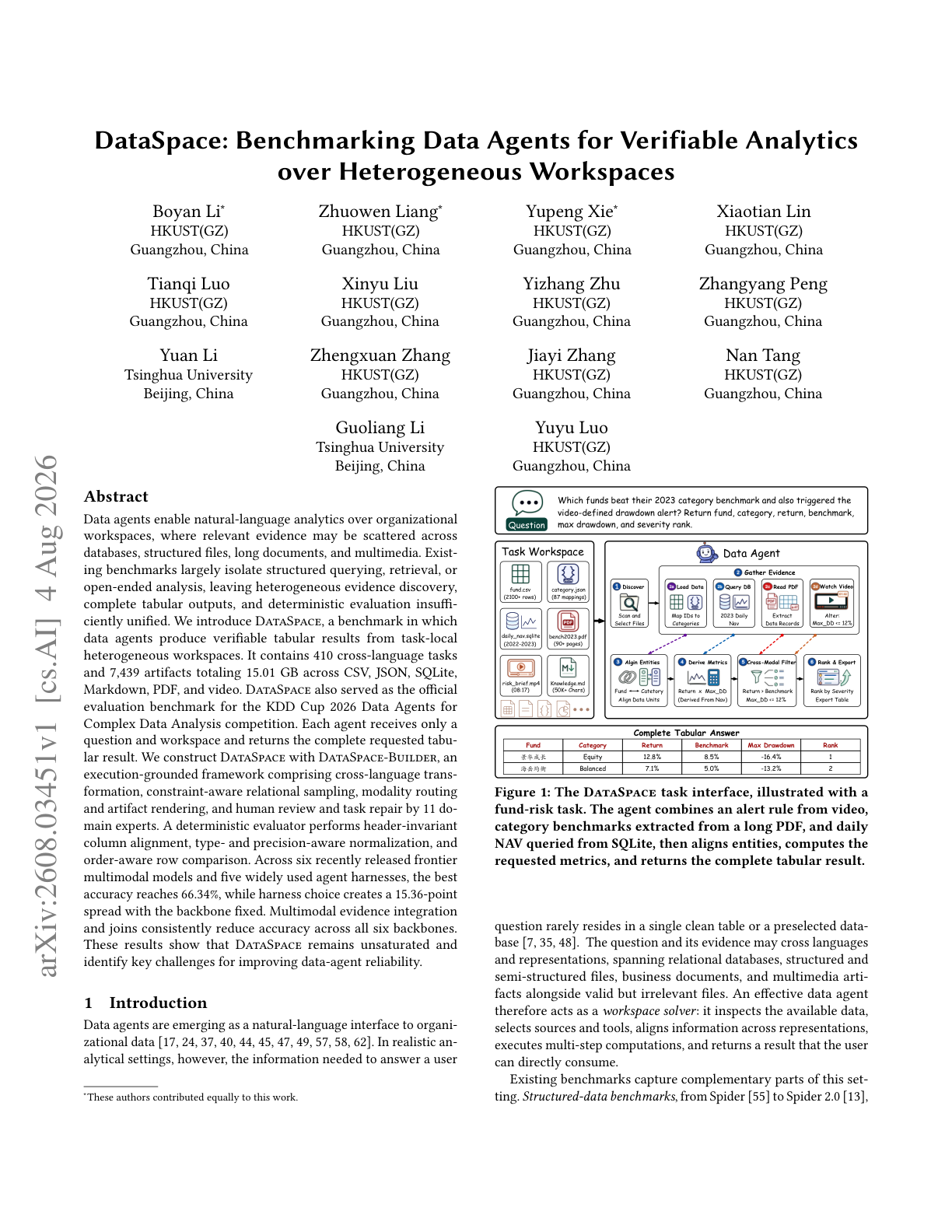
DataSpace
Real organizational analytics scatters evidence across databases, structured files, long documents, and video. Existing benchmarks isolate structured querying, retrieval, or open-ended analysis, leaving heterogeneous evidence discovery, complete tabular outputs, and deterministic scoring untested together.
Prompt-Induced Waste
Two prompts can request the same code change and produce the same correct patch while causing a coding agent to perform radically different kinds and amounts of work. This preregistered study measures that effect across 4,644 valid runs, 24 deterministic coding tasks, seven reasoning models, and two real harnesses.
Rehearse
Autoresearch loops propose changes, run full training jobs, and keep whatever improves the metric. Their efficiency depends on judging, before spending a run, whether a proposed modification is likely to work, and this paper studies how that judgment holds up over a trajectory.
ContinualSkillBench
Skill libraries are shipping in agent harnesses on the assumption that writing skills down compounds, and this benchmark tests that assumption directly. ContinualSkillBench covers five domains, each with 100 interconnected subtasks ordered by increasing difficulty and built with deliberate opportunities for cross-task skill reuse. Sequential execution generally improves performance, though the gains vary substantially across models and domains, and maintaining an explicit skill library performs comparably to plain in-context learning on average. Much of the improvement comes from adapting to prior context and feedback rather than from reusable skill abstraction, though explicit skills still pay off selectively on tasks needing reusable procedures or precise outputs. There is a useful diagnostic buried in the results. Less capable models accumulate larger, more fragmented collections of task-specific skills, which is what failed abstraction looks like from the outside.
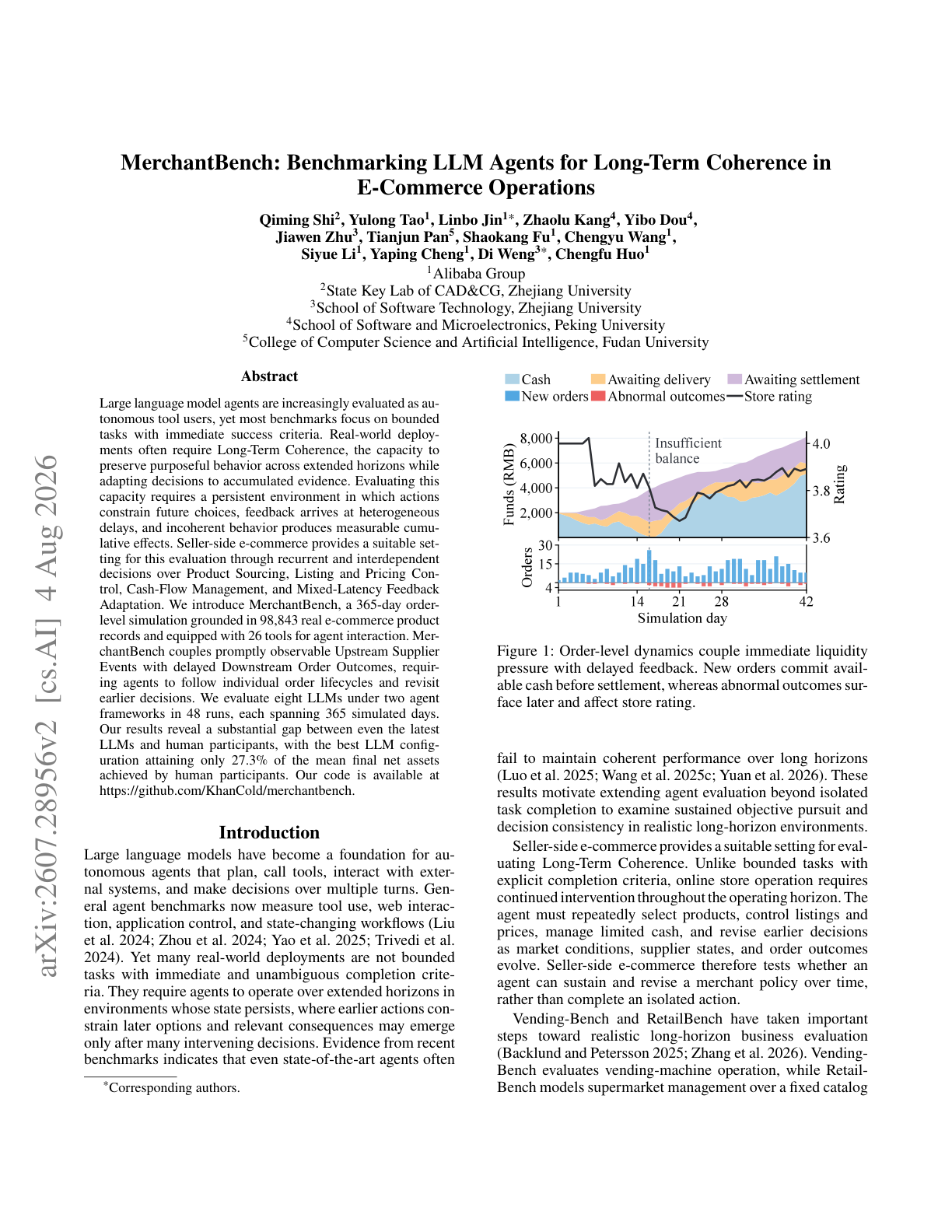
MerchantBench
Agent benchmarks tend to focus on bounded tasks with immediate success criteria, which flatters systems that cannot hold a plan for a month. MerchantBench targets long-term coherence instead, running a 365-day order-level e-commerce simulation grounded in 98,843 real product records with 26 tools for agent interaction. Agents handle product sourcing, listing and pricing control, cash-flow management, and feedback arriving at wildly different delays, with promptly observable supplier events coupled to delayed downstream order outcomes so earlier decisions must be revisited. Scoring runs on cumulative net assets, so incoherence compounds rather than averaging out. Across eight LLMs under two agent frameworks and 48 runs of 365 simulated days each, the best configuration reaches only 27.3% of the mean final net assets achieved by human participants.
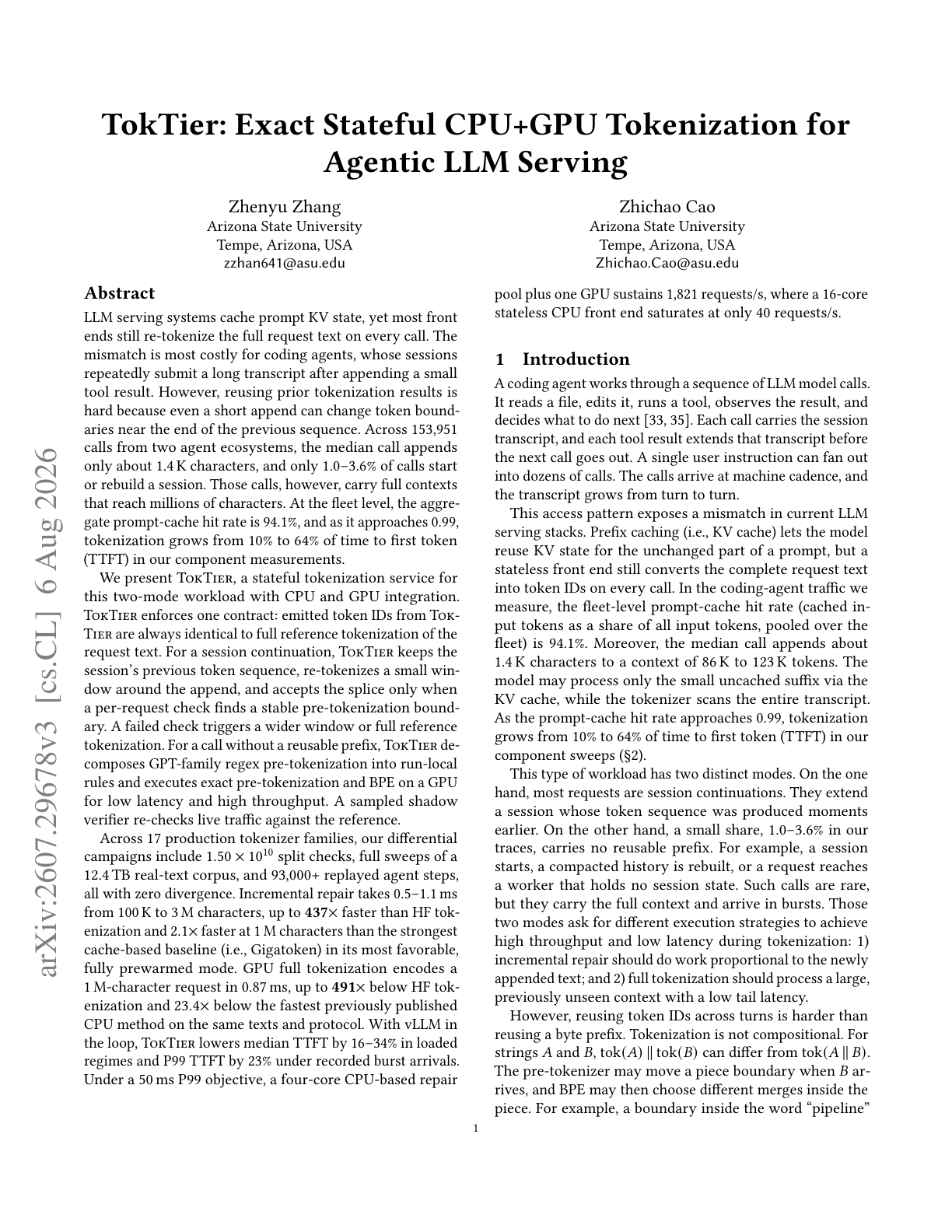
TokTier
Serving stacks cache prompt KV state while the front end still re-tokenizes the full request text on every call, and coding agents pay the most because each call resubmits a long transcript after a small append that can move token boundaries near the tail. Across 153,951 real agent calls at a 94.1% prompt-cache hit rate, tokenization grows from 10% to 64% of time to first token. TokTier is a stateful CPU and GPU tokenization service with one contract, namely that emitted token IDs always match full reference tokenization. For session continuations it re-tokenizes a small window around the append and splices only when a stable-boundary check passes, otherwise widening or falling back, and for calls without a reusable prefix it runs exact pre-tokenization and BPE on a GPU. Differential campaigns across 17 production tokenizer families covering 1.5e10 split checks show zero divergence, incremental repair takes 0.5 to 1.1 ms from 100K to 3M characters (up to 437x faster than HuggingFace), and median time to first token drops 16 to 34% under vLLM.
NOOA
Agent development today is split across prompt templates, tool schemas, callback code, and workflow graphs, four representations that drift apart as a system grows. NVIDIA Object-Oriented Agents replaces all four with one abstraction that developers already know.
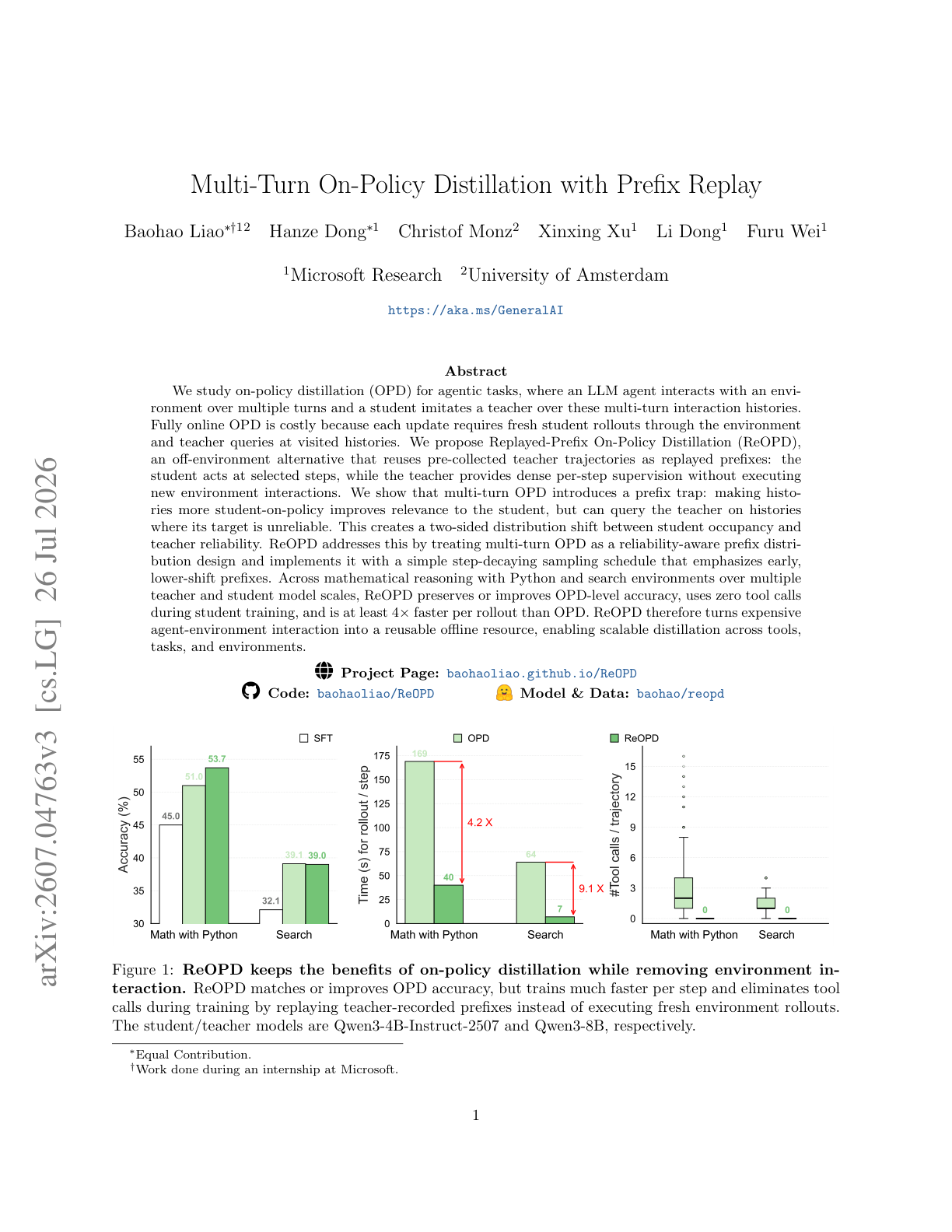
ReOPD
On-policy distillation for agentic tasks is expensive because every update needs fresh student rollouts through the environment plus teacher queries at each visited history. Microsoft Research and the University of Amsterdam propose reusing pre-collected teacher trajectories instead.
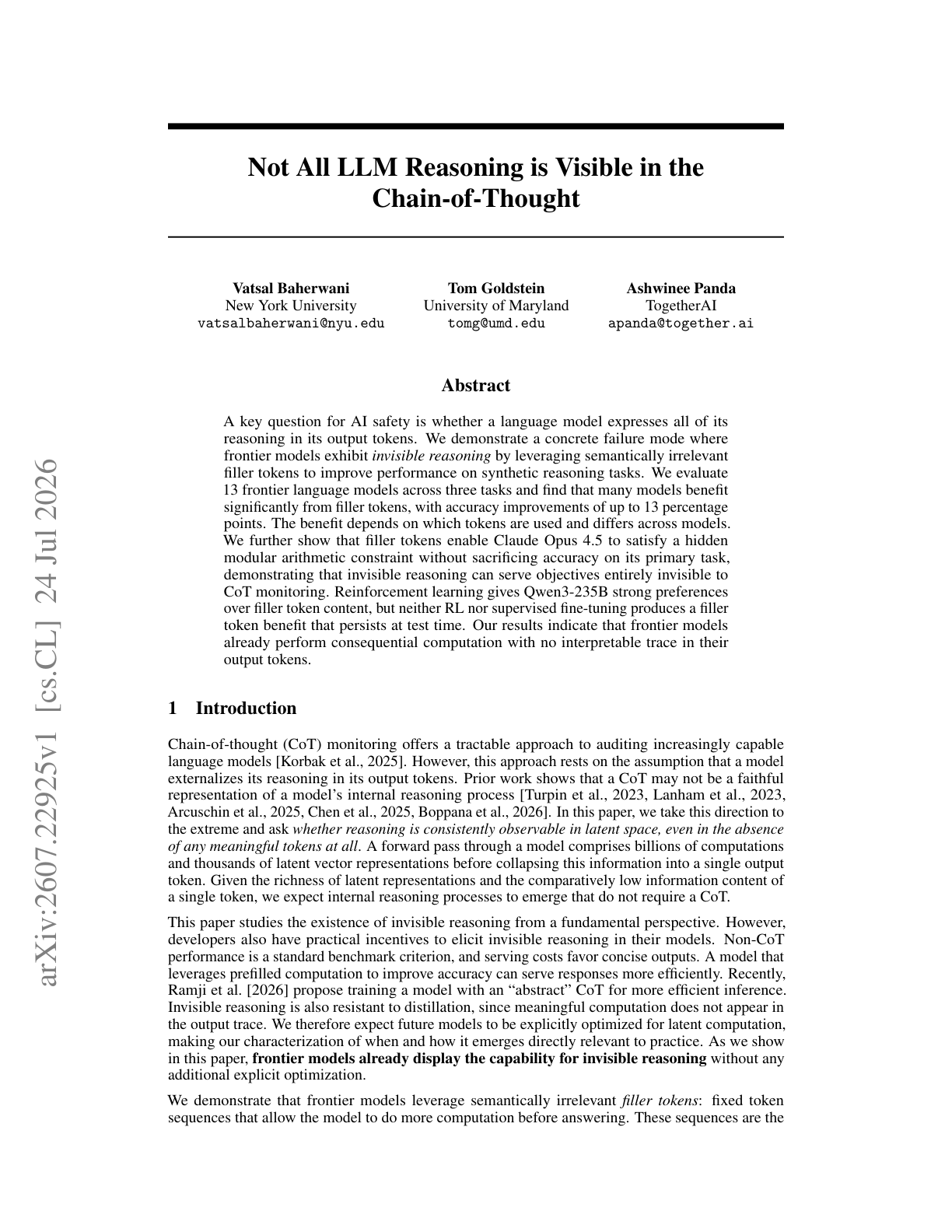
Invisible Reasoning
Chain-of-thought monitoring rests on the assumption that a model expresses its reasoning in its output tokens. This work demonstrates a concrete failure of that assumption in models shipping today.
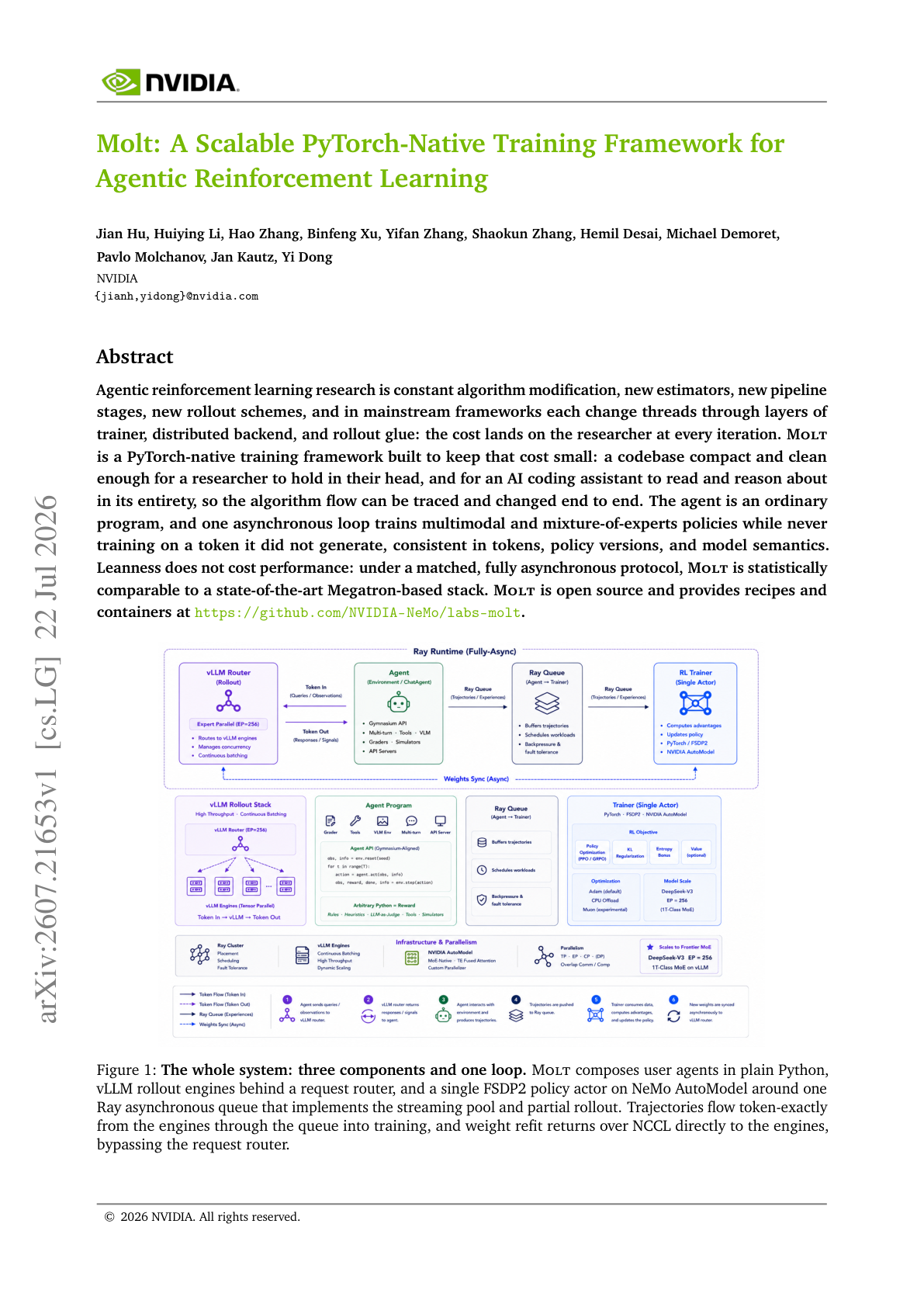
Molt
Agentic RL research is constant algorithm modification, and in mainstream frameworks each change threads through layers of trainer, distributed backend, and rollout glue. NVIDIA's Molt is a PyTorch-native training framework built to make that cost small.
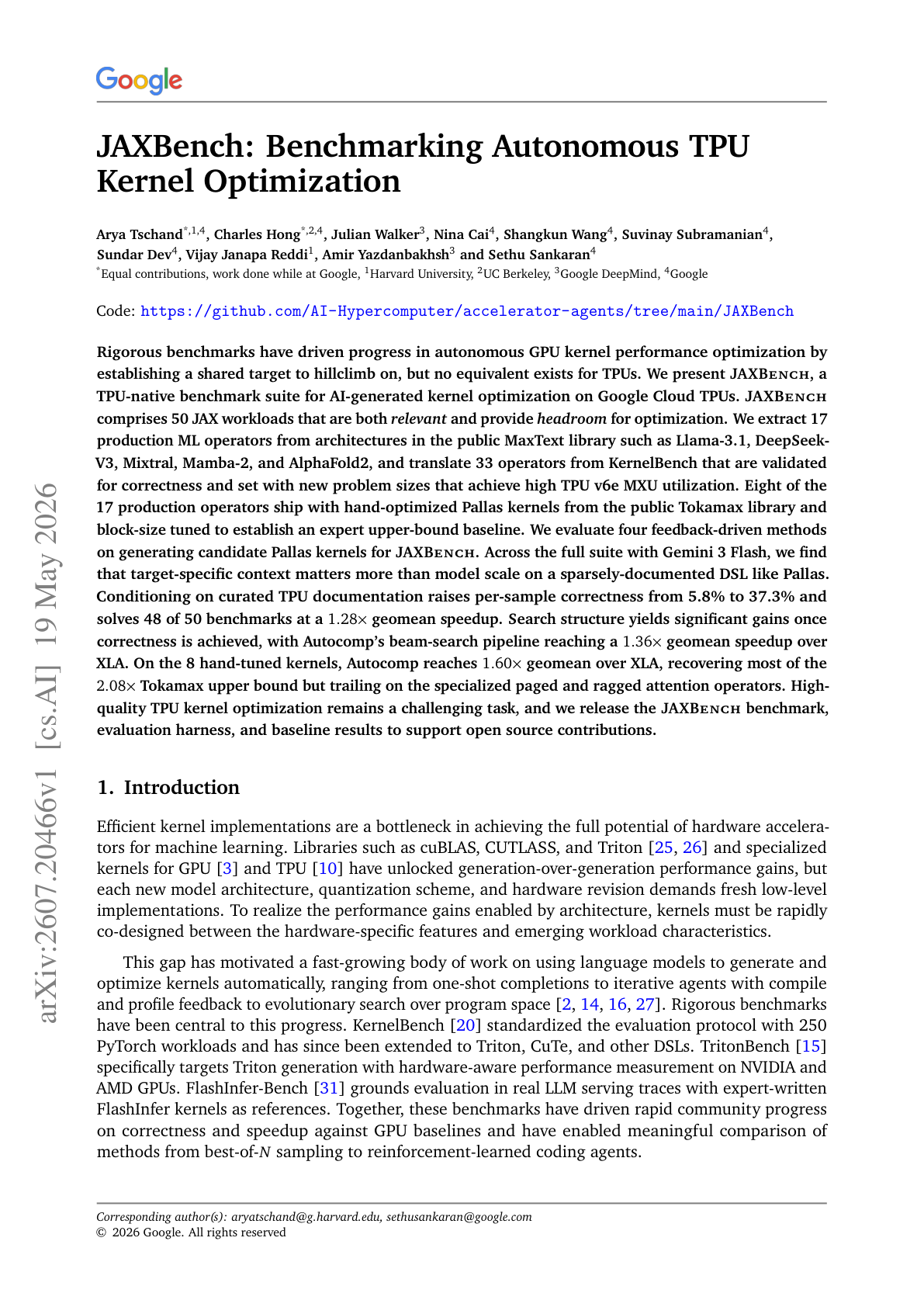
JAXBench
GPU kernel optimization has KernelBench to hillclimb on. TPUs had nothing, and the Pallas DSL is documented thinly enough that models mostly guess. Google, with Harvard and UC Berkeley, closes that gap and finds a clean lesson about context along the way.
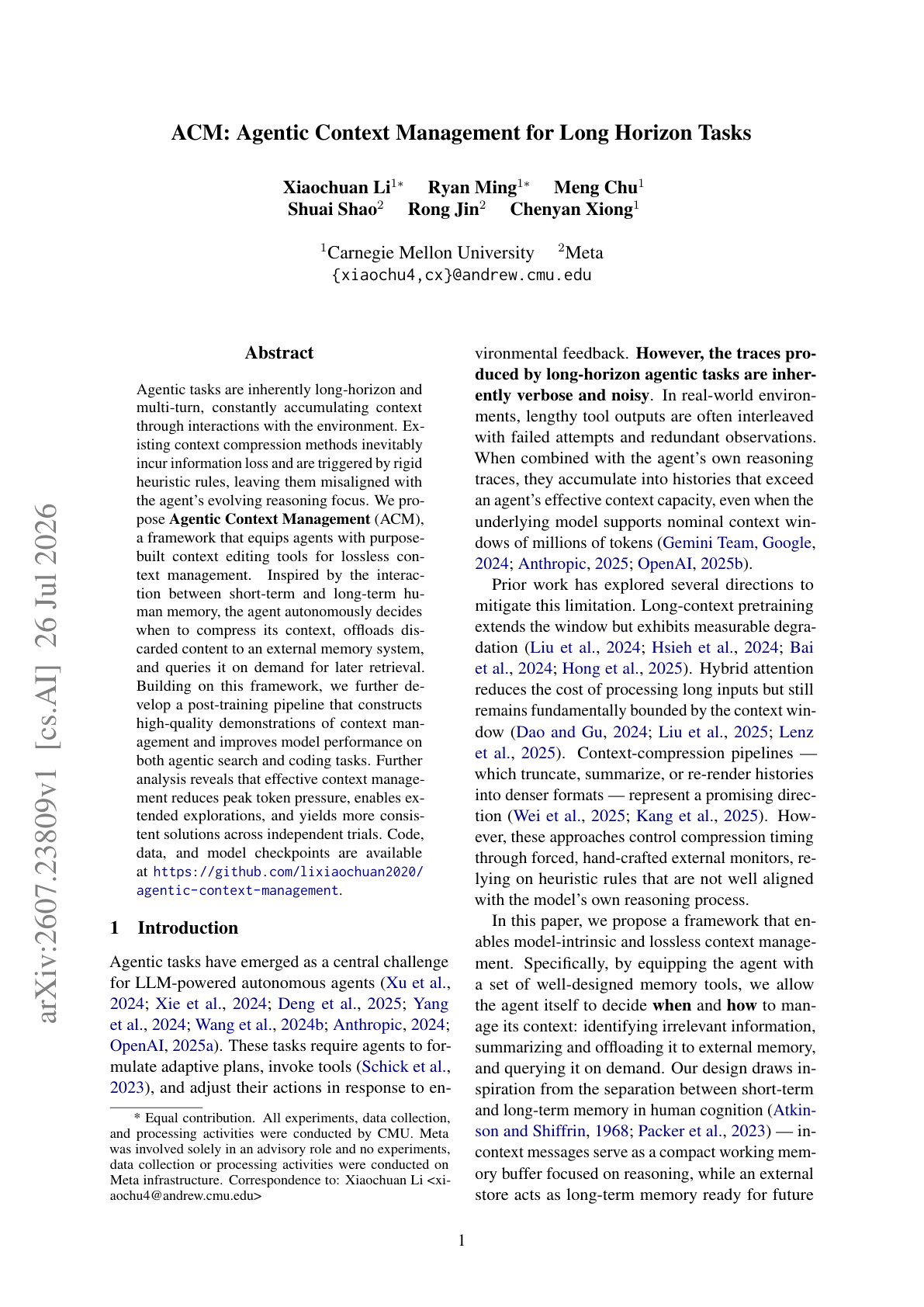
ACM
Production agents accumulate context every turn. The usual fix compresses on a token threshold and throws the remainder away, so the trigger fires for reasons unrelated to what the agent is working on. Meta and CMU hand the decision to the agent instead.