AI Papers of the Week
Every paper worth reading in AI, hand-picked one week at a time.
Discover and explore top AI papers with Claude Code or Codex
npx @dair-ai/mcp setup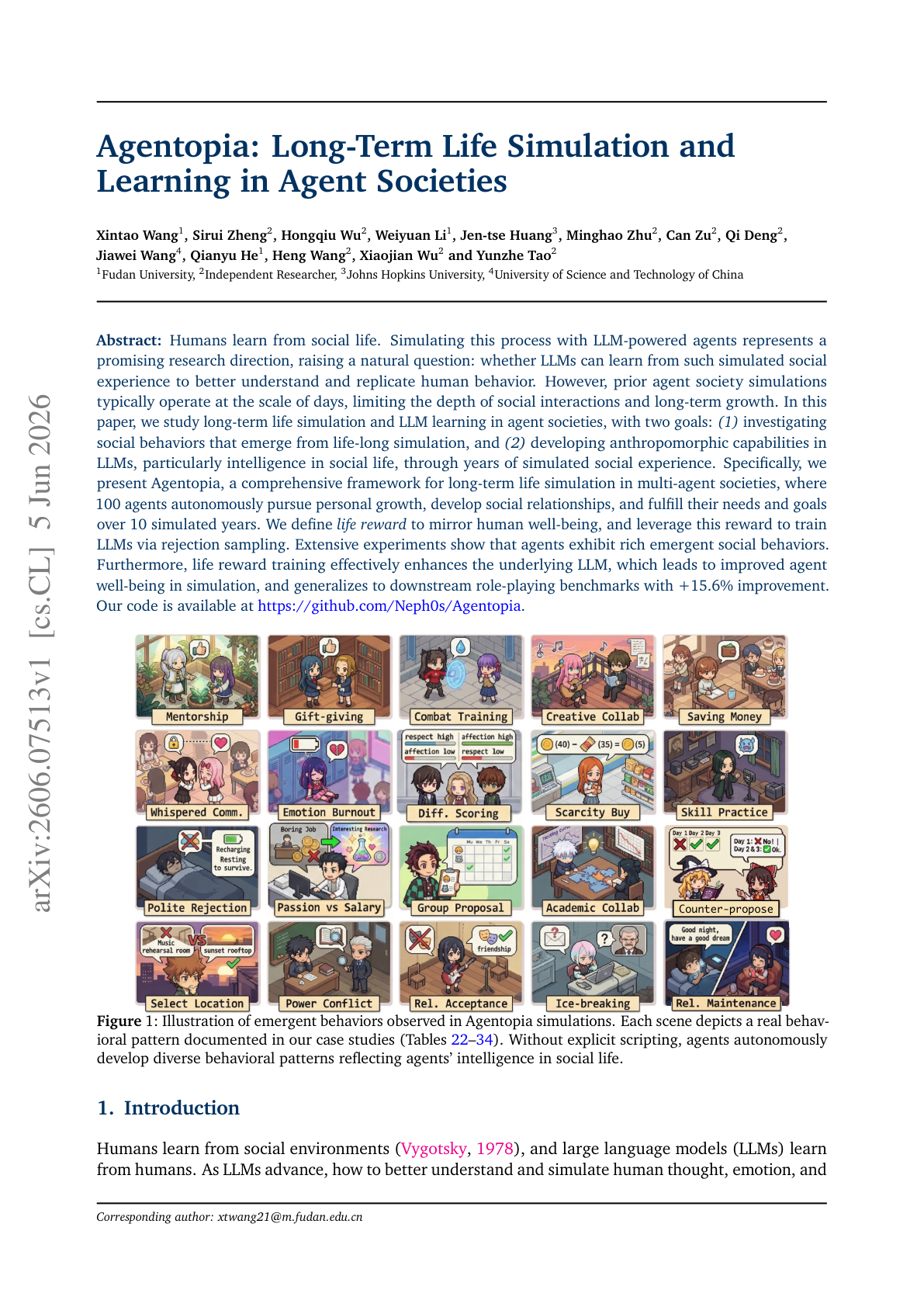
Agentopia
Agentopia is one of the most ambitious agent-society testbeds yet, a 79-page release that drops 100 LLM agents into a persistent world and lets them live, form relationships, and pursue goals over 10 simulated years, a horizon orders of magnitude longer than prior day-level work. Beyond observing emergent social behavior, the authors use the simulation as a training signal, optimizing models toward a life reward that reflects human well-being via rejection sampling.
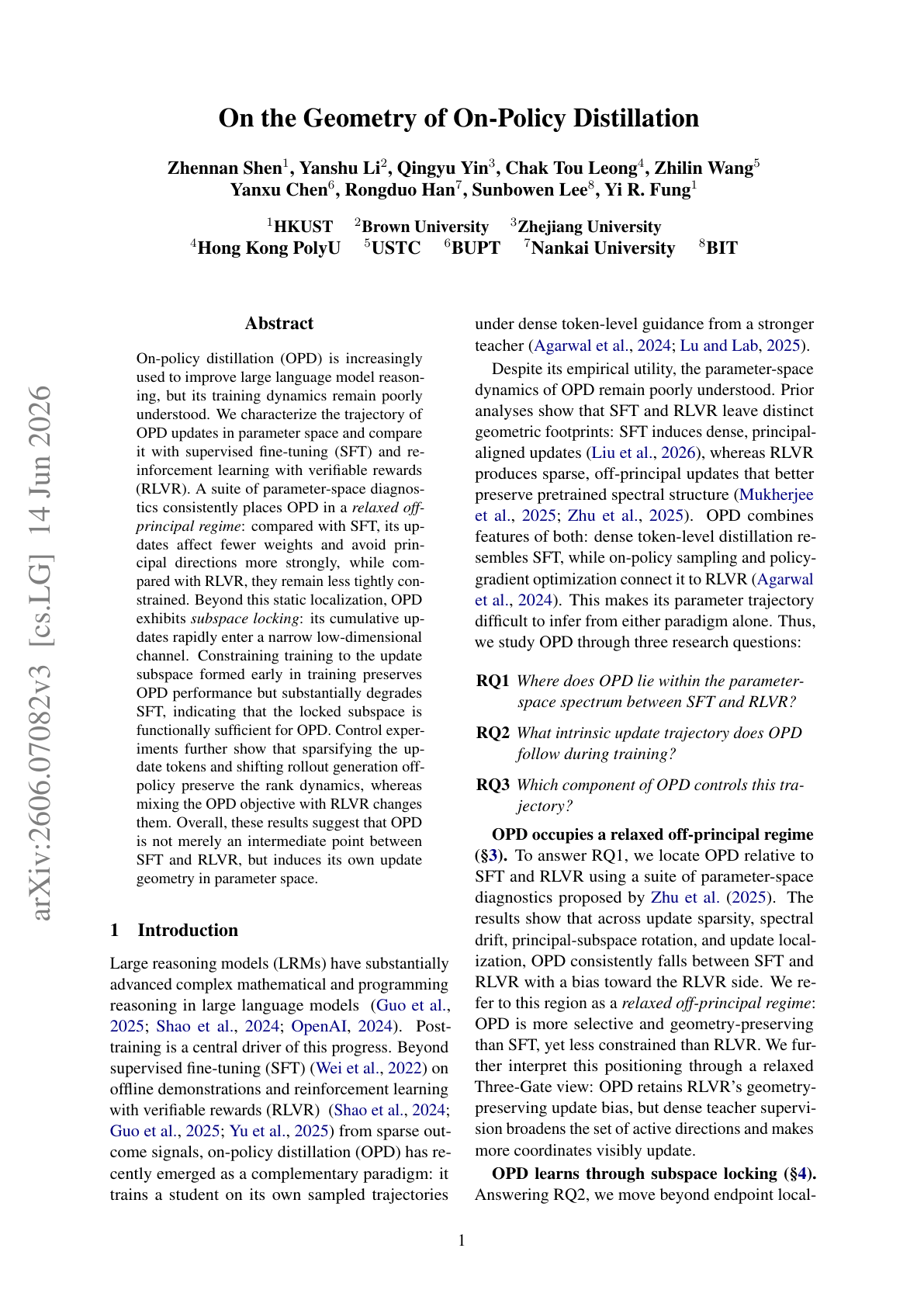
The Geometry of On-Policy Distillation
On-policy distillation (OPD) has become one of the most discussed post-training recipes of the year, but it has mostly been treated as a black box sitting somewhere between supervised fine-tuning and RL. This paper opens it up, characterizing how OPD changes a model's weights at the level of parameter geometry, and argues OPD is not a midpoint between SFT and RLVR but its own distinct kind of update.
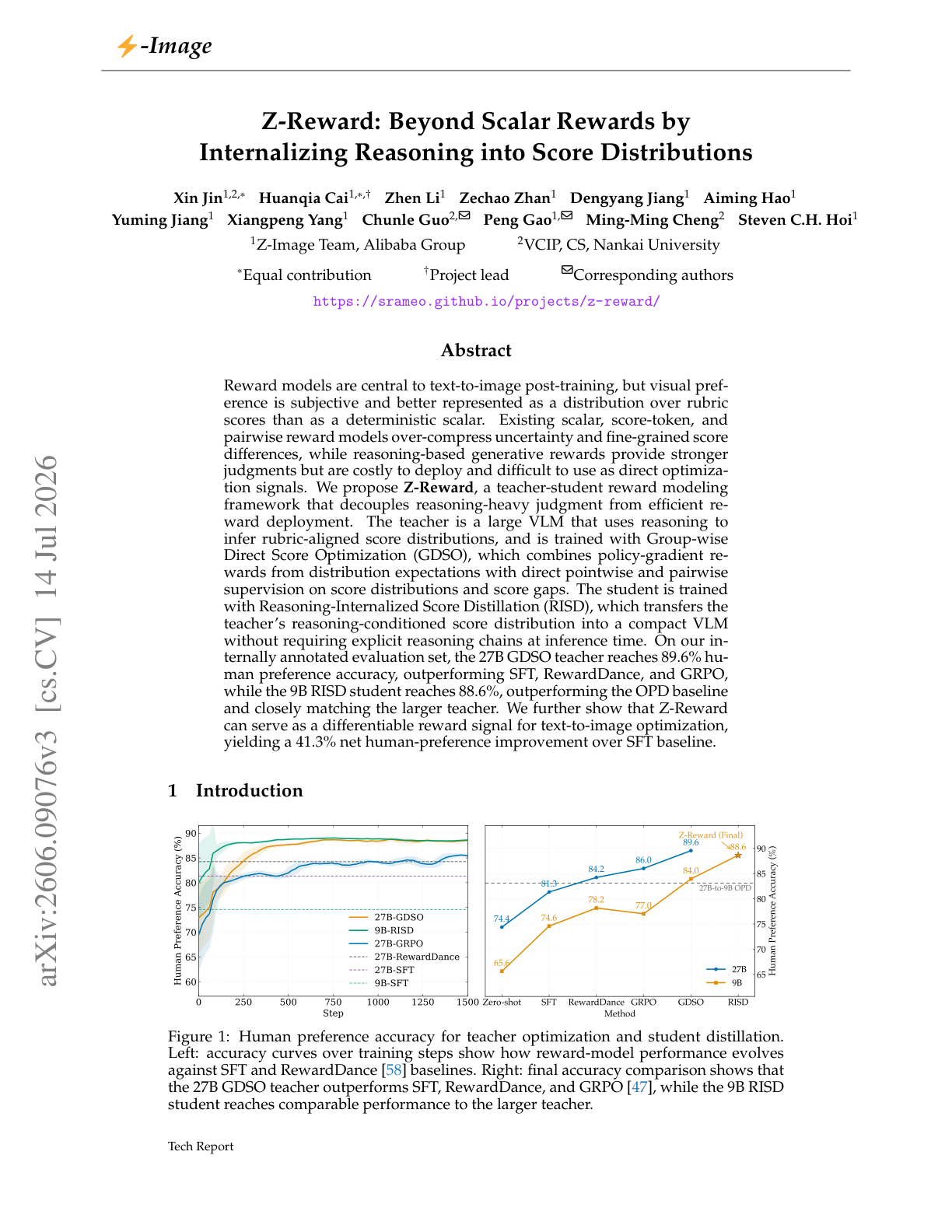
Beyond Scalar Rewards
Reward models usually compress a judgment into a single scalar, but this paper argues human preferences are better captured as score distributions, and proposes Z-Reward, which internalizes reasoning into a predicted distribution before scoring. A large vision-language teacher does the reasoning-heavy judgment and is distilled into a compact student for efficient deployment, with the 27B teacher reaching 89.6% human-preference accuracy and the 9B student nearly matching it at 88.6%. Used as a reinforcement learning signal, it delivers a 41.3% net preference improvement over a supervised baseline, beating GRPO and other reward methods.
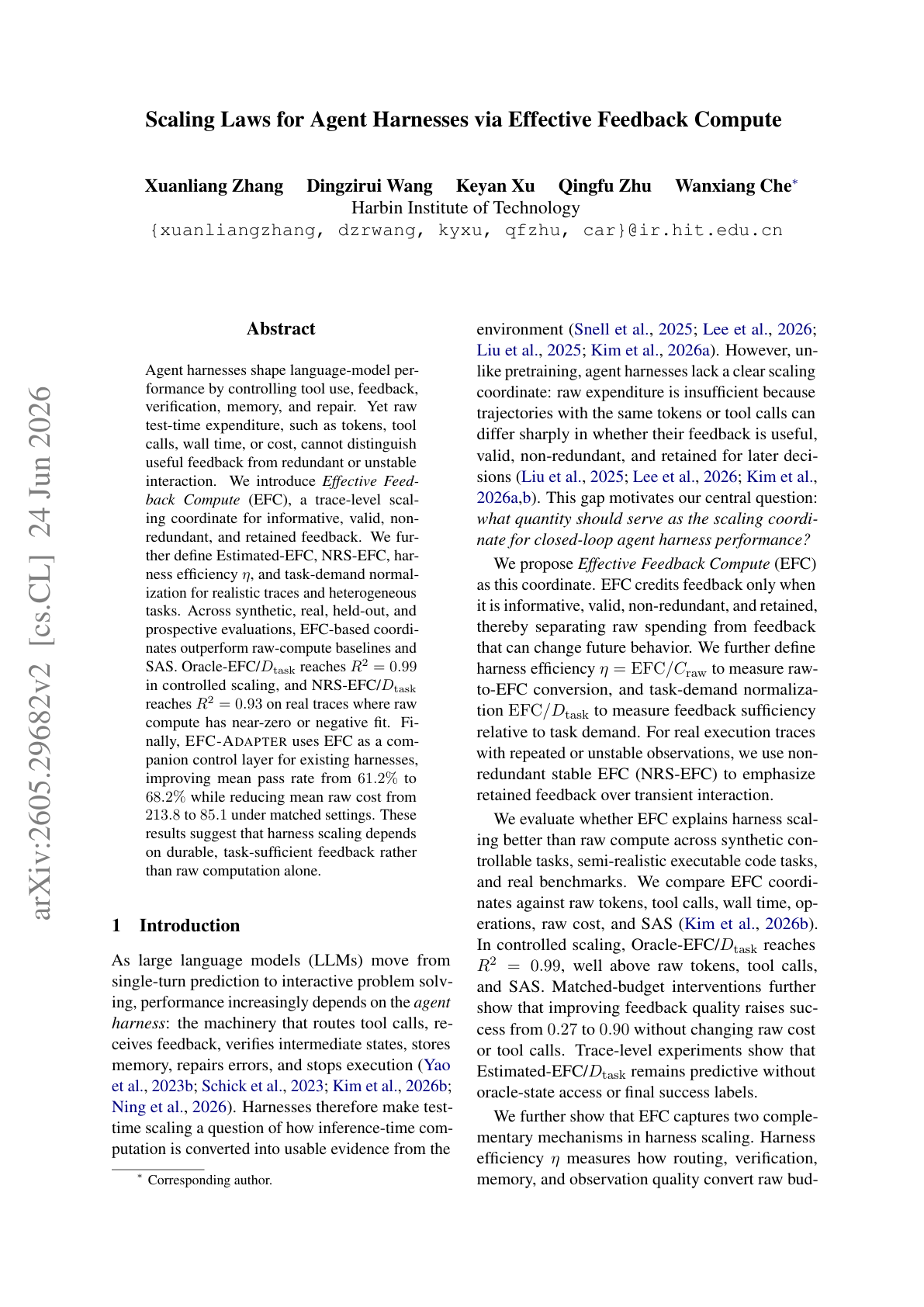
Scaling Laws for Agent Harnesses
Most harness tuning treats every token and tool call as if volume is what counts. This paper shows that it mostly does not, and introduces Effective Feedback Compute (EFC), a trace-level scaling coordinate that credits feedback only when it is informative, valid, non-redundant, and retained for later decisions, then normalizes by task demand.
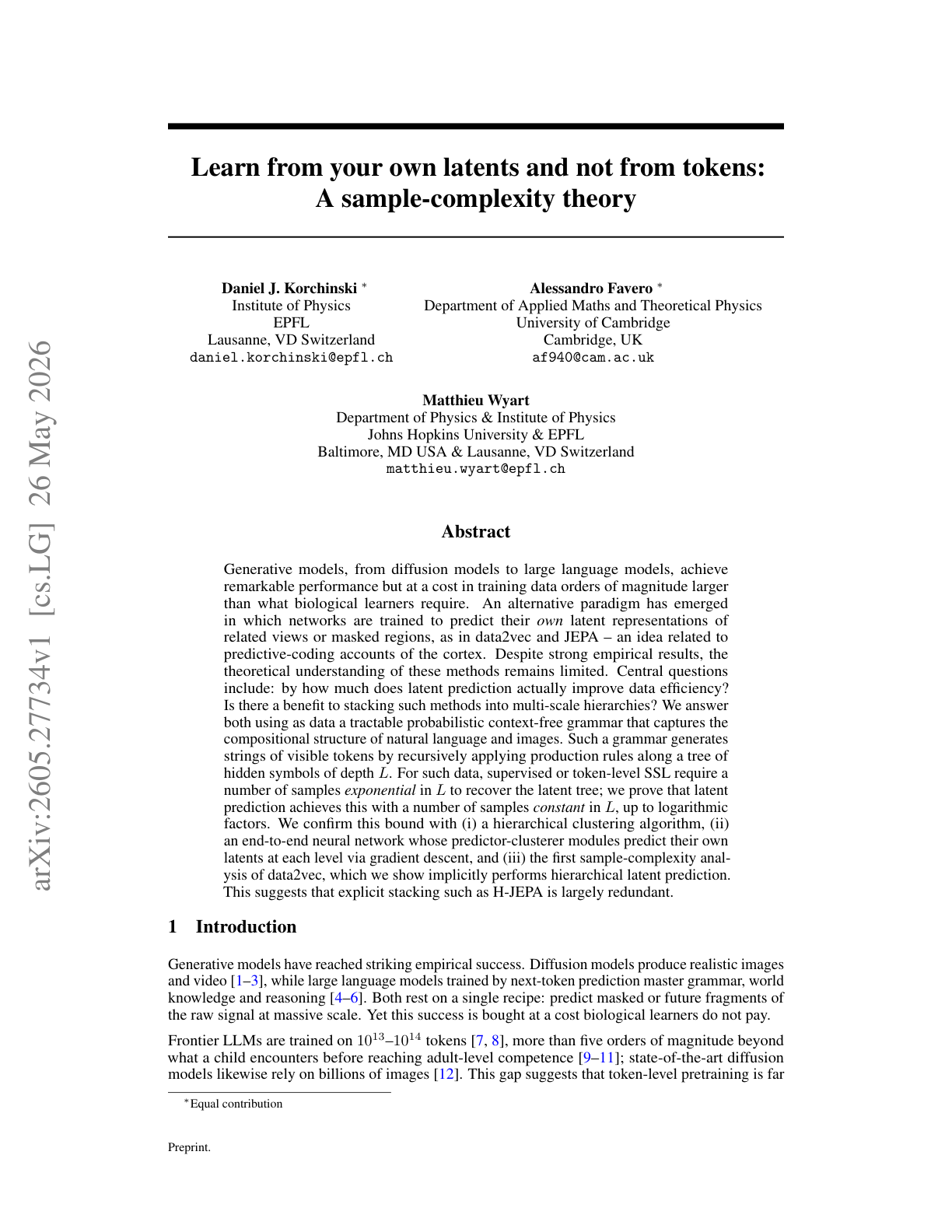
Learn From Your Own Latents
LLMs learn by predicting tokens, while world models like JEPA and data2vec learn by predicting their own internal representations. This paper provides a sample-complexity theory for why the second approach can be dramatically more data-efficient, using a tractable probabilistic context-free grammar as the analytical setting where compositional structure can be measured exactly.
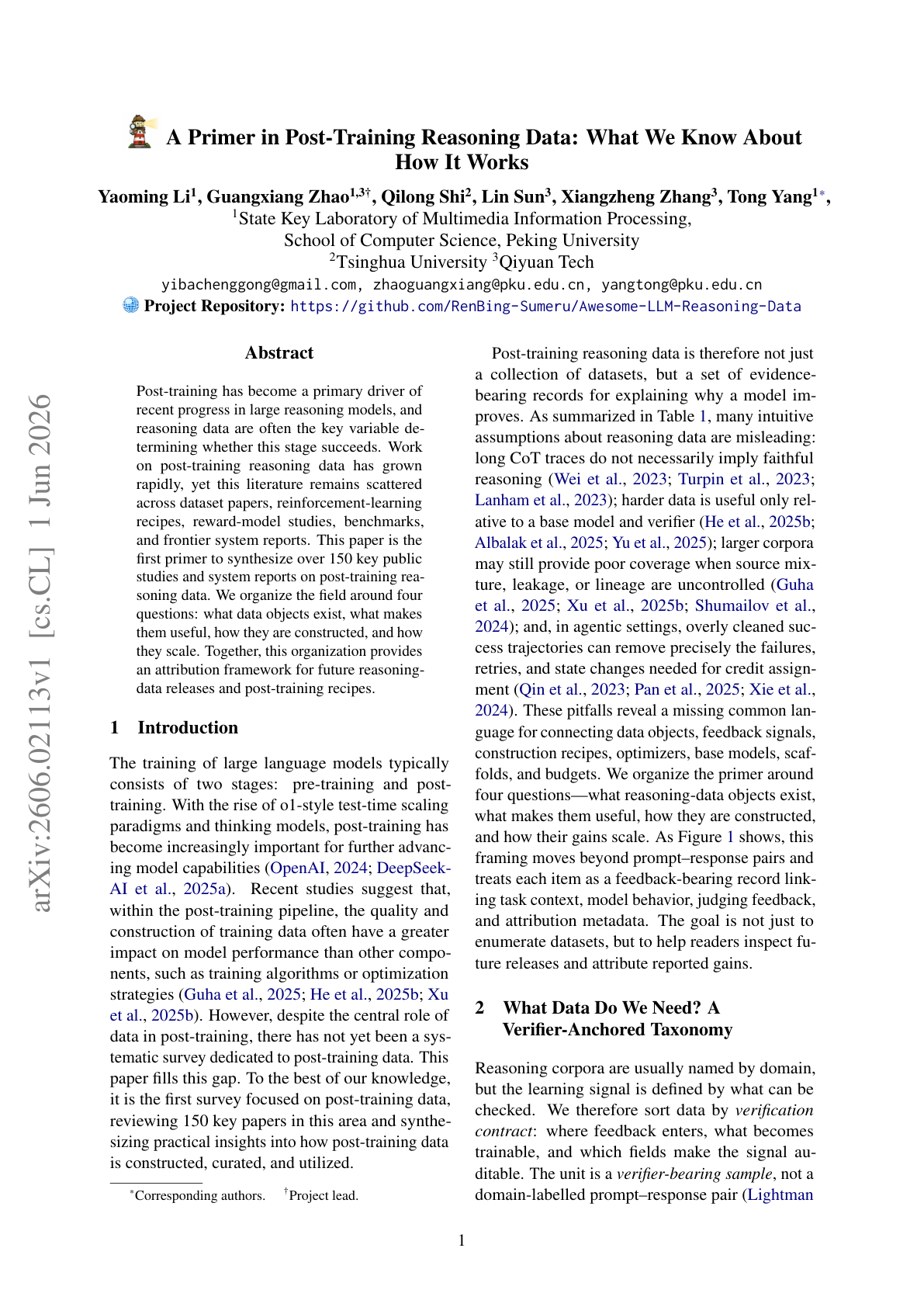
A Primer on Post-Training Reasoning Data
This primer is the first to pull the scattered post-training reasoning-data literature into one place, synthesizing over 150 public studies and system reports that previously lived across dataset papers, RL write-ups, and lab reports. It organizes the field around four questions: what data objects exist, what makes them useful, how they are constructed, and how they scale. The key reframing is that a reasoning-data item is more than a prompt-response pair: it packages a problem or state, model behavior, judging feedback, and attribution metadata, with usefulness defined relative to the verifier and the rest of the corpus rather than in isolation.
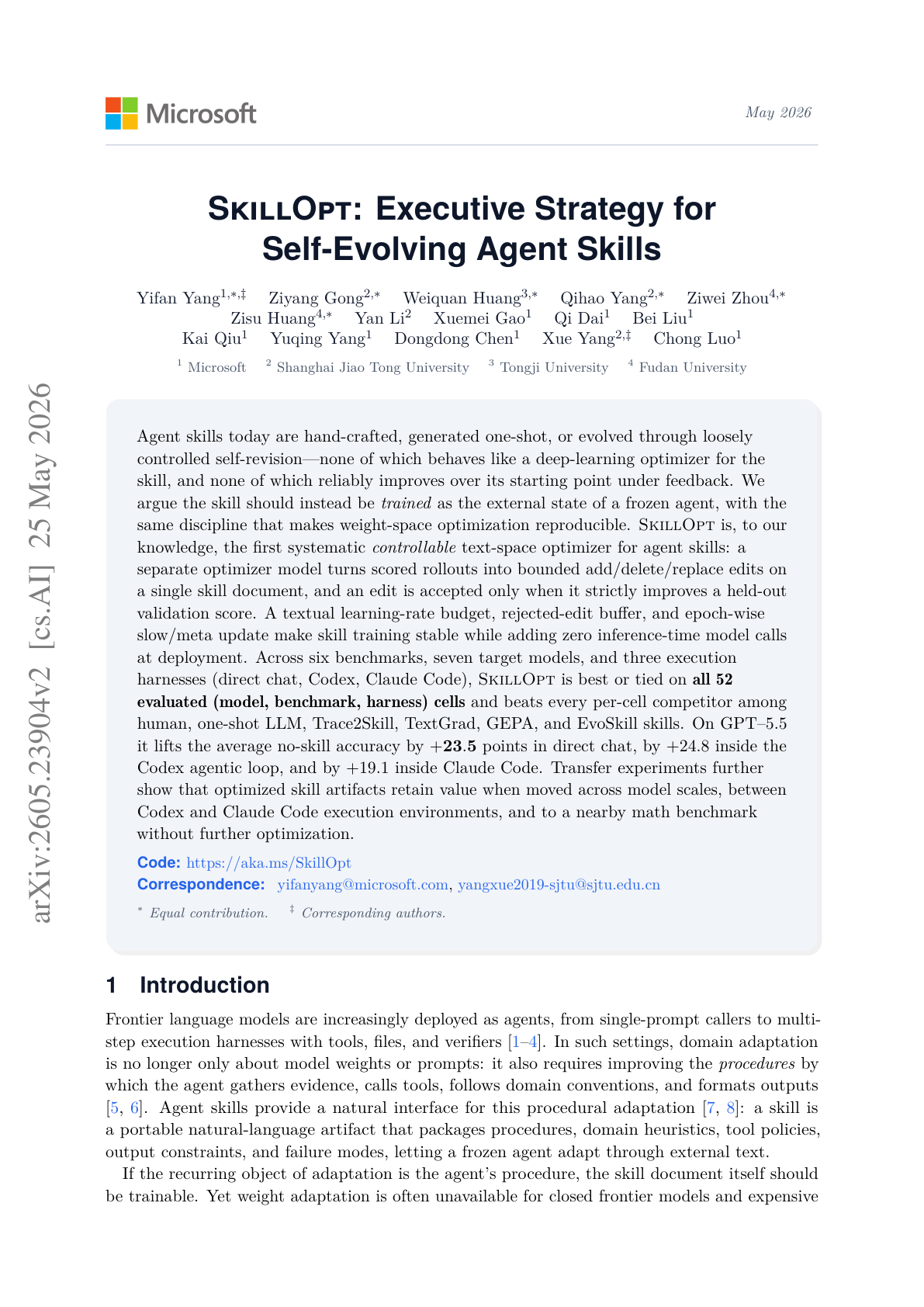
SkillOpt
Microsoft Research treats a compact natural-language skill document as the trainable state of a frozen agent, then learns that document through rollouts, reflection, and bounded edits gated by held-out validation. The argument is direct: most engineers handwrite agent skill docs and hope they generalize, when the doc itself should be optimized like a parameter. SkillOpt reframes the SKILL.md file as an external parameter of a model whose weights never change.
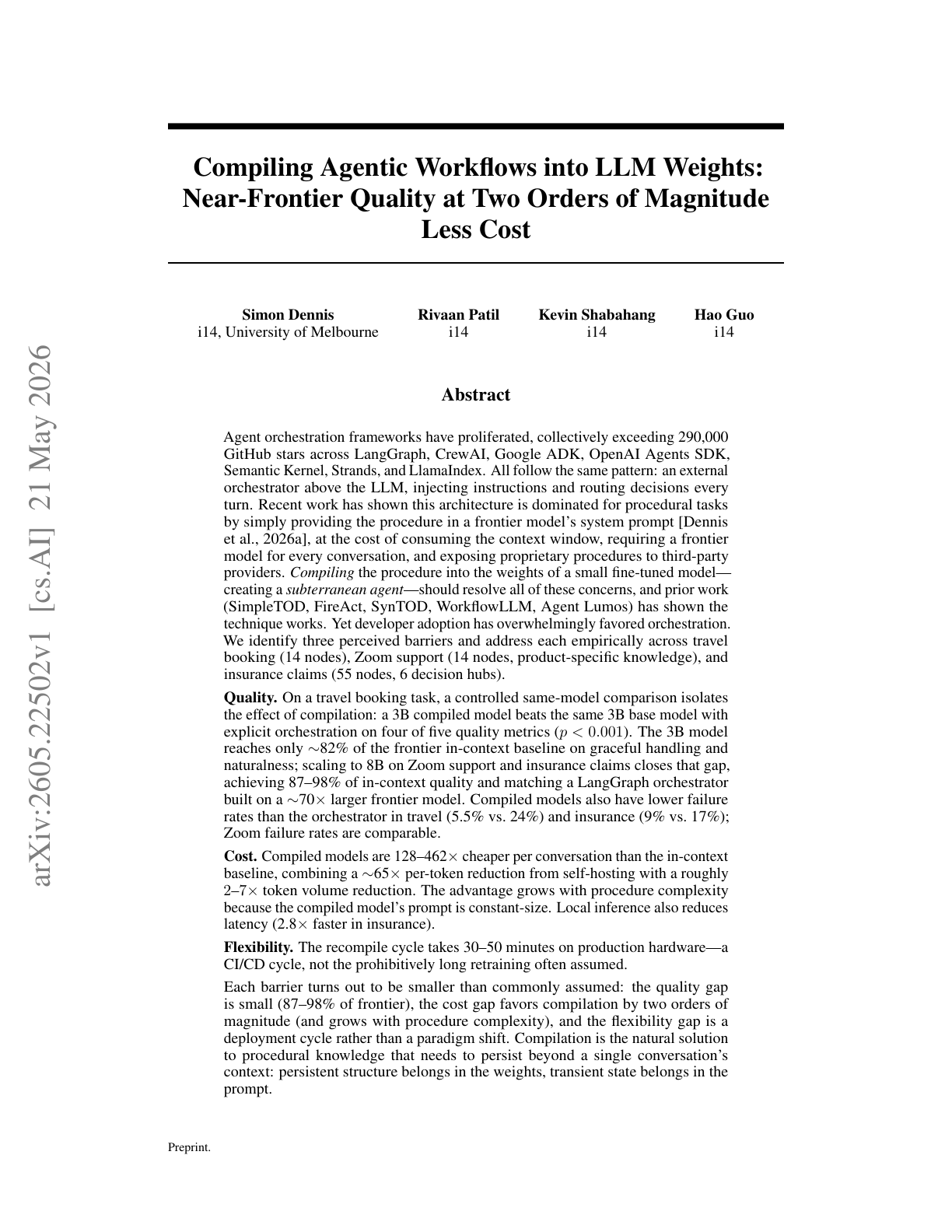
Compiling Agentic Workflows into Weights
This paper shows that a full agentic workflow can be distilled into the weights of a small model and run at roughly two orders of magnitude lower inference cost while preserving near-frontier task quality. Instead of keeping an external orchestrator above the LLM, the procedure is compiled into the weights of a fine-tuned model, producing what the authors call a subterranean agent.
Epicure
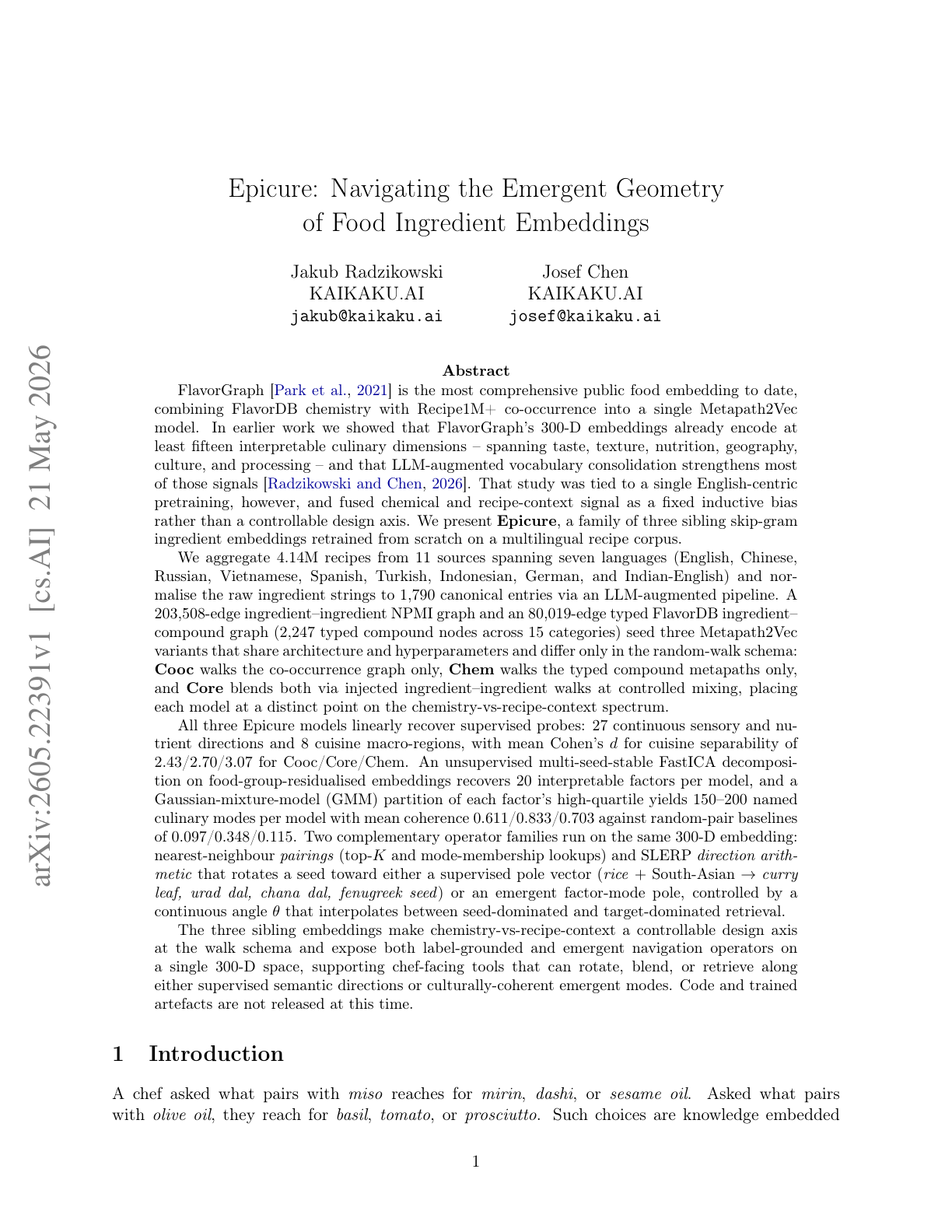
Epicure trains a family of multilingual ingredient embeddings from scratch on 4.14 million recipes aggregated from 11 sources across seven languages, with raw ingredient strings normalized to 1,790 canonical entries via an LLM-augmented pipeline. It ships three skip-gram (Metapath2Vec) variants that share architecture but differ in what they walk: recipe co-occurrence only, chemical-compound structure from FlavorDB only, or a blend of both, placing each model at a different point on the chemistry-versus-recipe-context spectrum. The result is a compact, downloadable map of the emergent geometry of food, a clean reminder that representation learning generalizes well beyond text into surprisingly everyday domains.
Lighthouse Attention
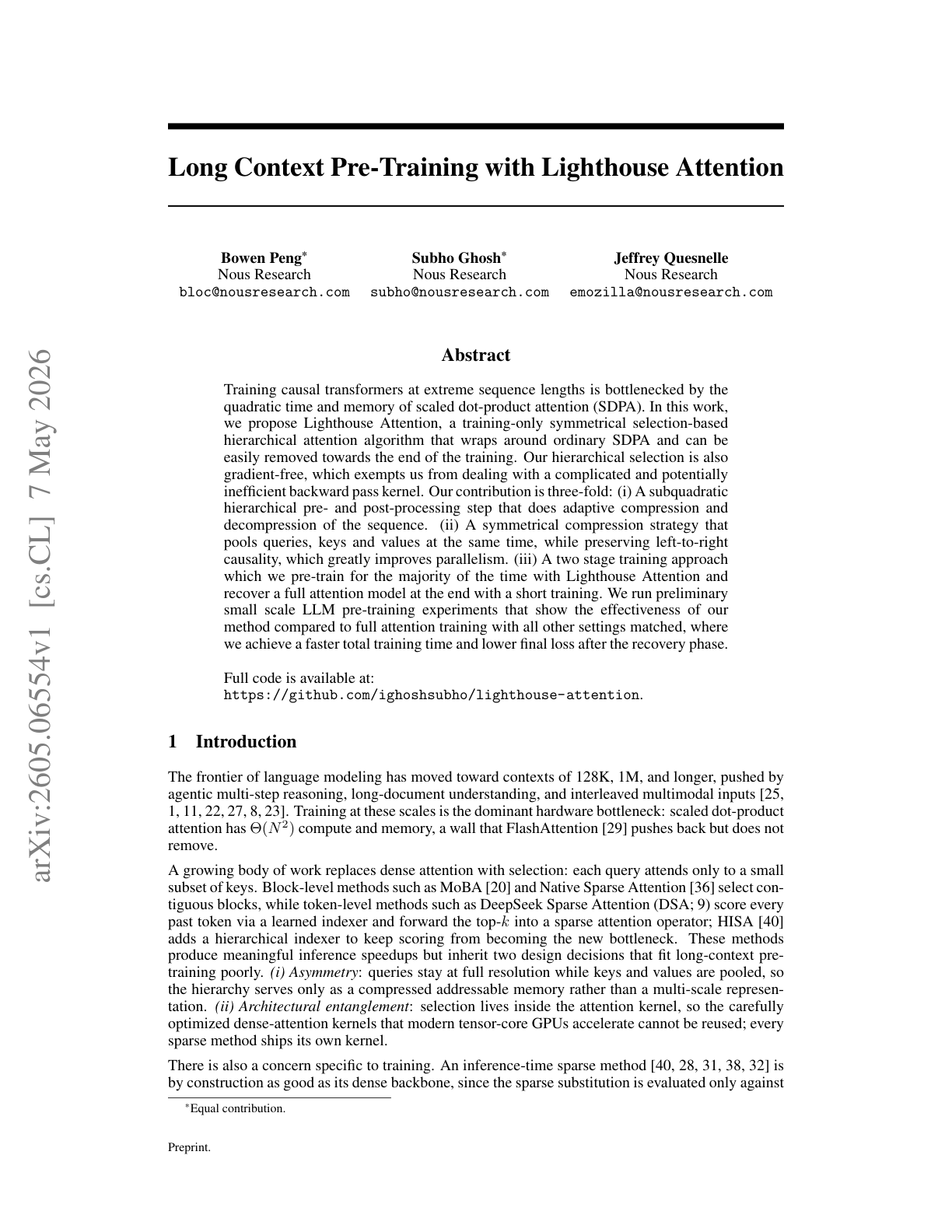
Nous Research proposes a training-only attention wrapper for long-context pretraining. Lighthouse Attention wraps standard SDPA with a hierarchical, gradient-free selection layer that compresses and decompresses queries, keys, and values symmetrically while preserving left-to-right causality. The wrapper is removed near the end of training in a short recovery phase, so the deployed model runs vanilla attention with no architectural change at inference. Preliminary LLM experiments report faster total training time and lower final loss than full-attention baselines.
Token Superposition Training
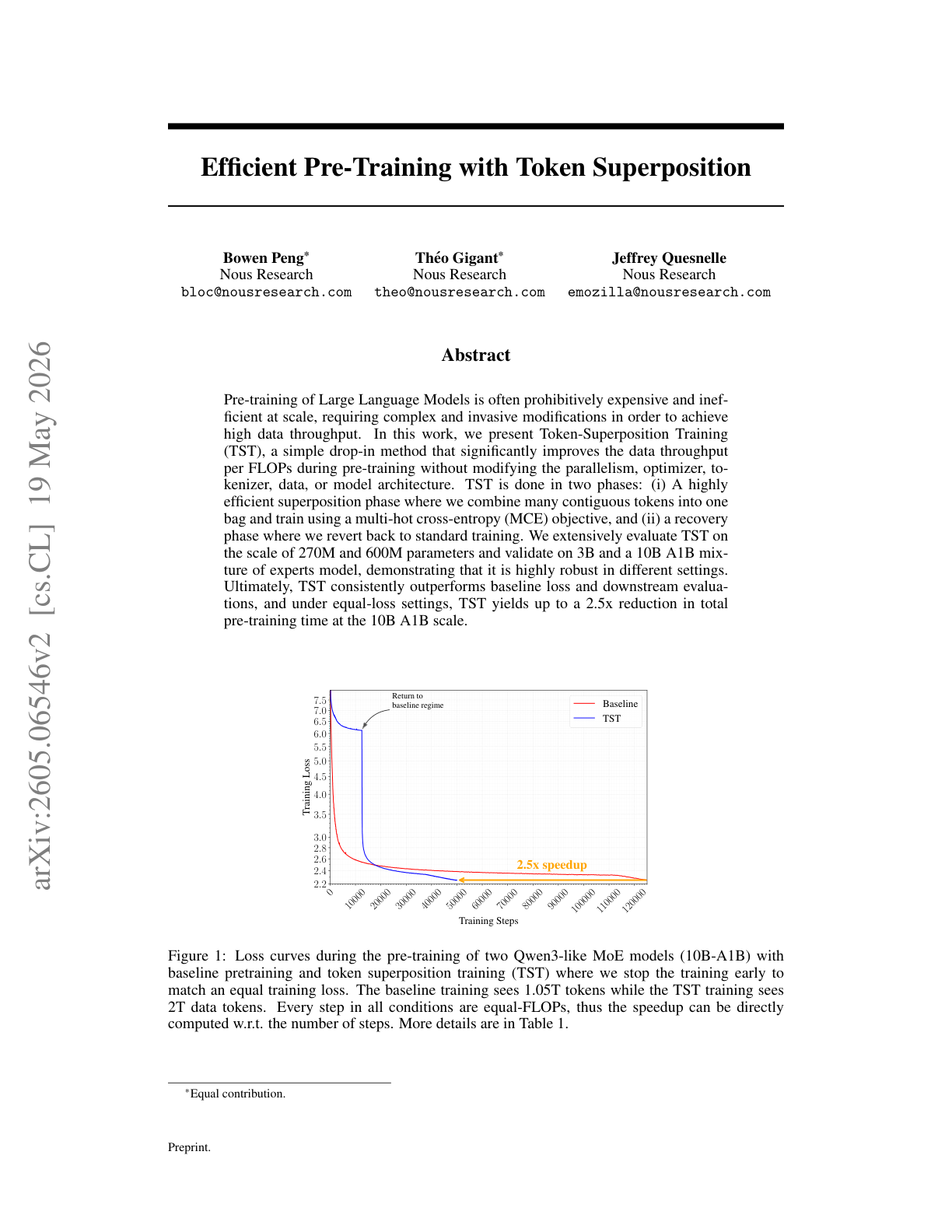
Nous Research's second pretraining paper of the week. Token Superposition Training (TST) is a modification to the standard LLM pretraining loop that produces a 2 to 3x wall-clock speedup at matched FLOPs without changing the model architecture, optimizer, tokenizer, or training data. During the first third of training, the model reads and predicts contiguous bags of tokens, averaging their embeddings on the input side and predicting the next bag with a modified cross-entropy on the output side. For the remainder of the run, training reverts to standard next-token prediction. The inference-time model is identical to one produced by conventional pretraining. TST was validated at 270M, 600M, and 3B dense scales, and at a 10B-A1B mixture-of-experts model where it reaches a lower final loss while consuming 4,768 B200-GPU-hours versus the baseline's 12,311. Together with Lighthouse Attention, this is the second pretraining-loop modification from the same lab this week reporting substantial speedups without architecture changes.
Self-Improving Pretraining
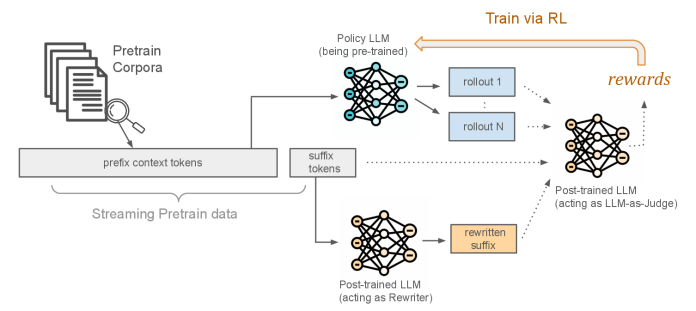
Most LLM safety, factuality, and reasoning fixes get bolted on at post-training. By then the patterns have already set. This Meta FAIR paper moves those behaviors into pretraining itself. The team uses a strong post-trained model as both a rewriter and a judge: it rewrites pretraining suffixes toward higher-quality, safer continuations, then scores model rollouts against the original suffix and the rewrite to drive RL during pretraining. Instead of next-token prediction, the policy learns sequence generation from the start, with rewards for quality, safety, and factuality.
Horizon Generalization
Microsoft Research runs a controlled study where the only variable is task horizon length. Same decision rules, same reasoning structure, different sequence length to the goal. The main finding: horizon alone is a training bottleneck. As goal distance grows, exploration explodes combinatorially and credit assignment gets ambiguous. Models that learn cleanly on short horizons fall apart on long ones, even when the underlying reasoning is identical. The fix is not more compute, it is horizon reduction.
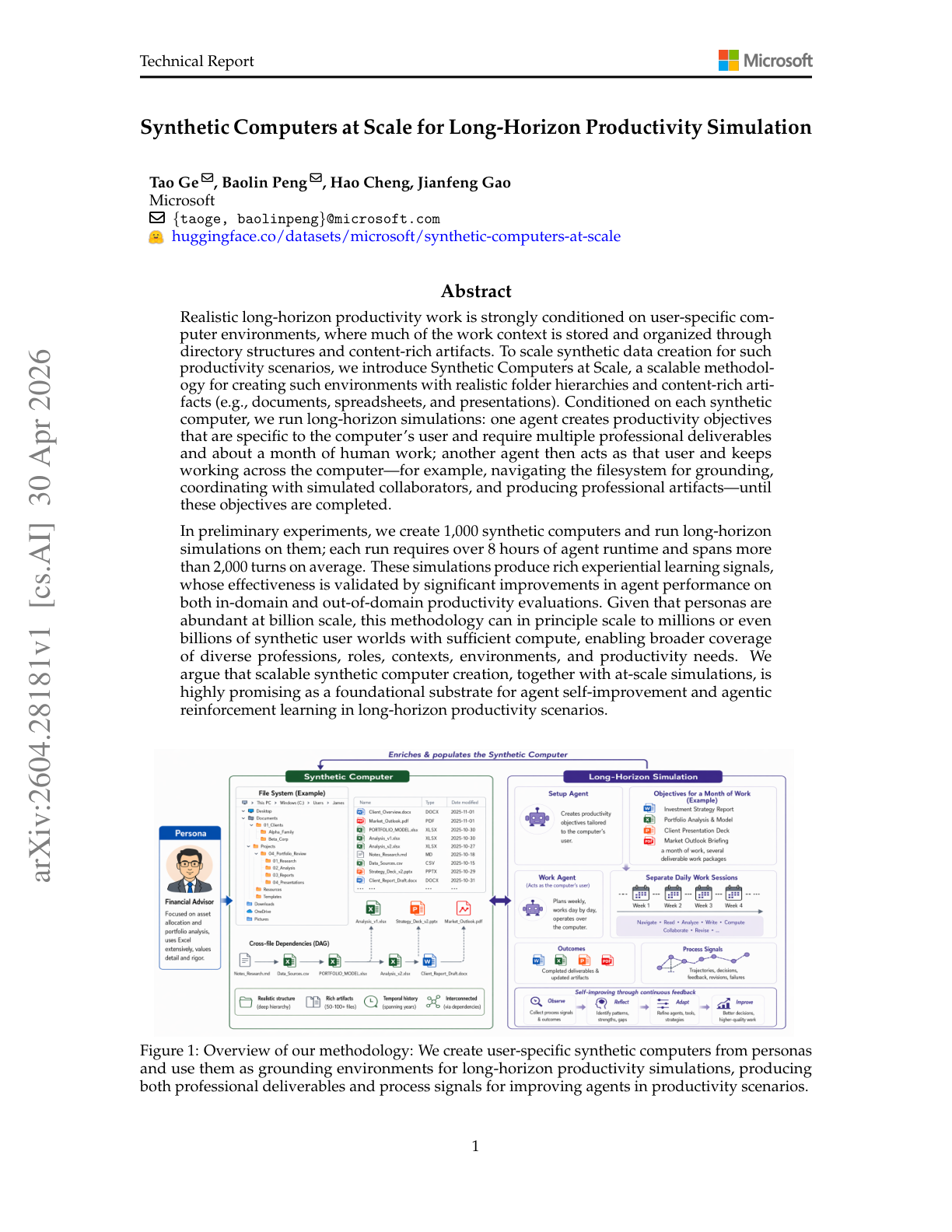
1,000 Synthetic Computers
Microsoft Research builds 1,000 synthetic computers, each with realistic directory structures, documents, and artifacts, then runs long-horizon simulations on top of them. One agent plays the user and sets productivity goals; another executes the work. Each simulation runs over 8 hours of agent runtime and 2,000+ turns on average, roughly a month of human work compressed into one trace. Training on this experiential data drives significant improvements on both in-domain and out-of-domain productivity evaluations.
AgenticQwen-30B-A3B
Alibaba shows that a 30B MoE model with only 3B active parameters can match Qwen3-235B on real tool-use workloads. AgenticQwen-30B-A3B scores 50.2 average on TAU-2 plus BFCL-V4 Multi-Turn, while AgenticQwen-8B scores 47.4. Both more than double their vanilla Qwen baselines and close most of the gap to a 235B model. The recipe is built around two reinforcement learning flywheels that run in parallel, with simulated users actively trying to mislead the agent.
Latent Agents
Multi-agent debate makes models reason better. It also burns tokens generating long transcripts before any answer comes out. Latent Agents distills the entire debate into a single LLM through a two-stage fine-tuning pipeline: the model first learns debate structure, then internalizes it through dynamic reward scheduling and length clipping. The internalized model matches or beats explicit multi-agent debate while using up to 93% fewer tokens, which makes debate-quality reasoning practical at production scale.
DeepSeek V4
DeepSeek V4 is the first open model family built from the ground up around million-token contexts as a default rather than a bolt-on feature. The release includes DeepSeek-V4-Pro (1.6T total / 49B active) and DeepSeek-V4-Flash (284B total / 13B active), both trained natively at 1M context length. The tech report details a hybrid attention architecture, new training stability techniques, and a domain-specialist post-training pipeline that together push the open-source frontier much closer to GPT-5.2 and Gemini 3.0-Pro at a fraction of the cost.
Attention to Mamba
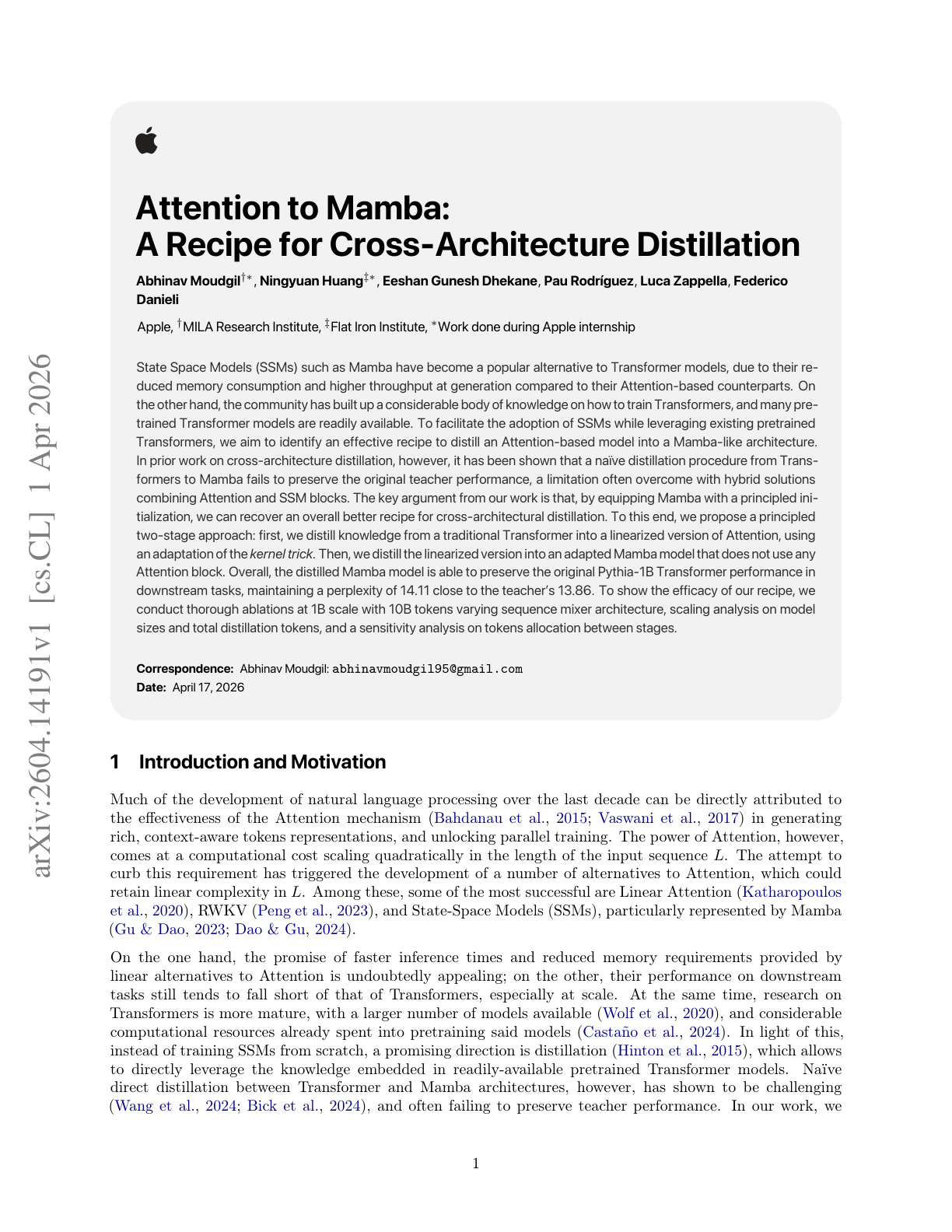
Apple proposes a two-stage recipe for cross-architecture distillation from Transformers into Mamba. Naive distillation collapses teacher performance because a Mamba student cannot directly imitate softmax attention. The fix is to distill the transformer into a linearized-attention student using a kernel adaptation first, then transfer that student into a pure Mamba with no attention blocks. On a 1B model trained on 10B tokens, the Mamba student hits 14.11 perplexity against a 13.86 Pythia-1B teacher, nearly matching quality at linear-time inference cost.
There Will Be a Scientific Theory of Deep Learning
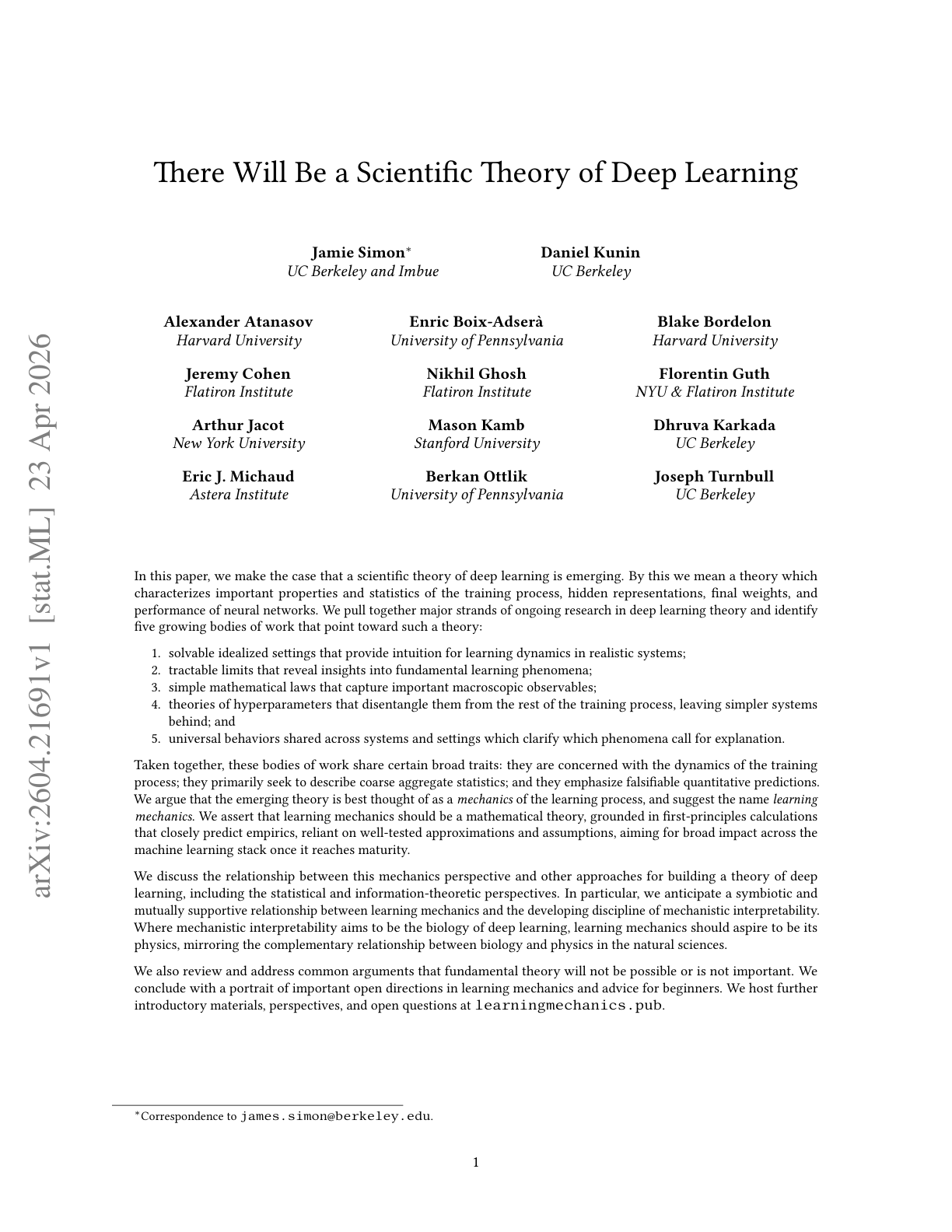
A position paper arguing that a genuine scientific theory of deep learning is already taking shape under the umbrella of "learning mechanics." The authors identify five converging research directions (solvable idealized models, tractable mathematical limits, simple macroscopic laws, hyperparameter theories, and universal cross-system behaviors) that share a common signature: they describe training dynamics, target coarse aggregate statistics, and commit to falsifiable quantitative predictions. The framing pushes back on skepticism about whether deep learning can have fundamental theory and positions learning mechanics as a complement to mechanistic interpretability, not a competitor.
Automated Weak-to-Strong Researcher
Anthropic shows that Claude can run fully autonomous progress on scalable oversight research. A team of parallel Automated Alignment Researchers (AARs) built on Claude Opus 4.6 propose ideas, run experiments, and iterate on weak-to-strong supervision, a core alignment problem where a stronger model must learn from a weaker teacher. The system closes almost the entire remaining performance gap that human researchers could not, at a total cost of roughly $18K in tokens and model training.
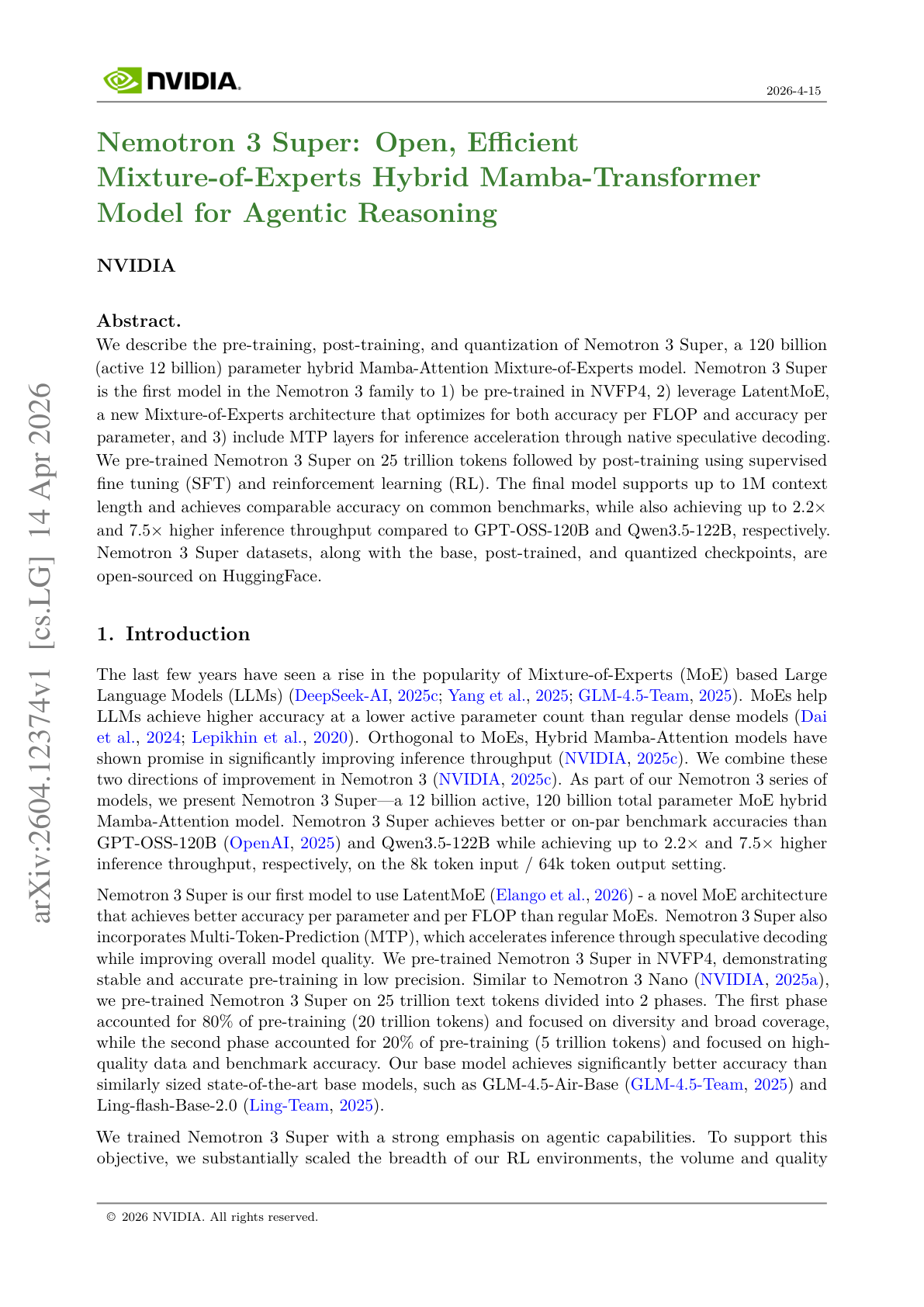
Nemotron 3 Super
NVIDIA introduces Nemotron 3 Super, an open 120B parameter model with 12B active parameters, built as a hybrid Mamba-Attention Mixture-of-Experts architecture optimized for agentic reasoning. The model targets long-context, high-throughput inference, a capability increasingly central to running agents reliably. It supports up to 1M context length while delivering up to 2.2x higher throughput than GPT-OSS-120B and 7.5x higher than Qwen3.5-122B, at comparable benchmark accuracy.
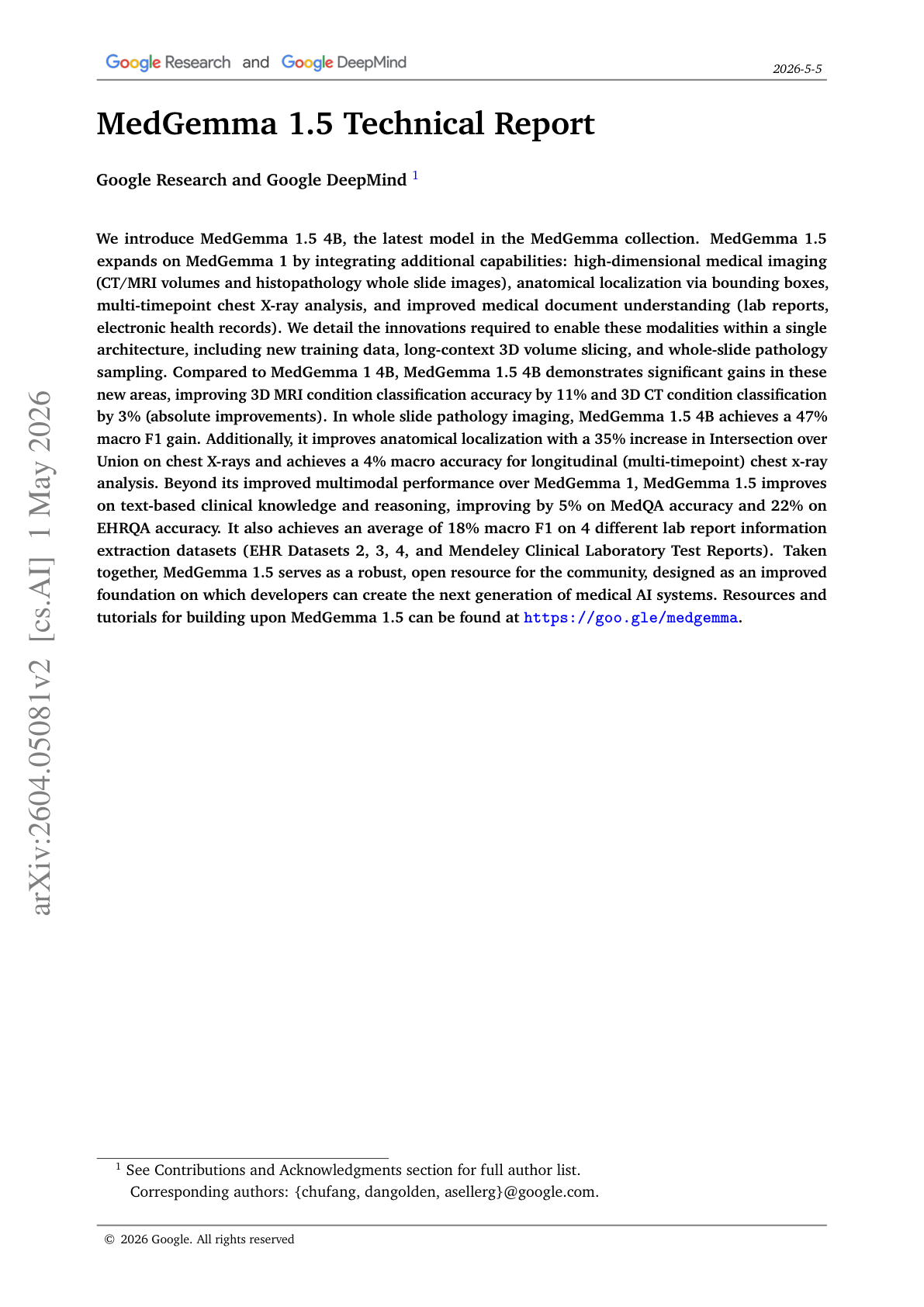
MedGemma 1.5
Google releases the MedGemma 1.5 technical report, introducing a 4B-parameter medical AI model that expands capabilities to 3D medical imaging (CT/MRI volumes), whole slide pathology, multi-timepoint chest X-ray analysis, and improved medical document understanding. The model achieves notable gains including a +47% macro F1 improvement on whole slide pathology and +22% on EHR question answering, positioning itself as an open foundation for next-generation medical AI systems.
Thinking Mid-training: RL of Interleaved Reasoning
Meta FAIR addresses the gap between pretraining (no explicit reasoning) and post-training (reasoning-heavy) with an intermediate SFT+RL mid-training phase. The approach annotates pretraining data with interleaved reasoning traces, then uses supervised fine-tuning followed by RL to teach models when and how to think during continued pretraining. Applied to Llama-3-8B, the full pipeline achieves a 3.2x improvement on reasoning benchmarks compared to direct RL post-training, demonstrating that reasoning benefits from being trained as native behavior early in the pipeline.
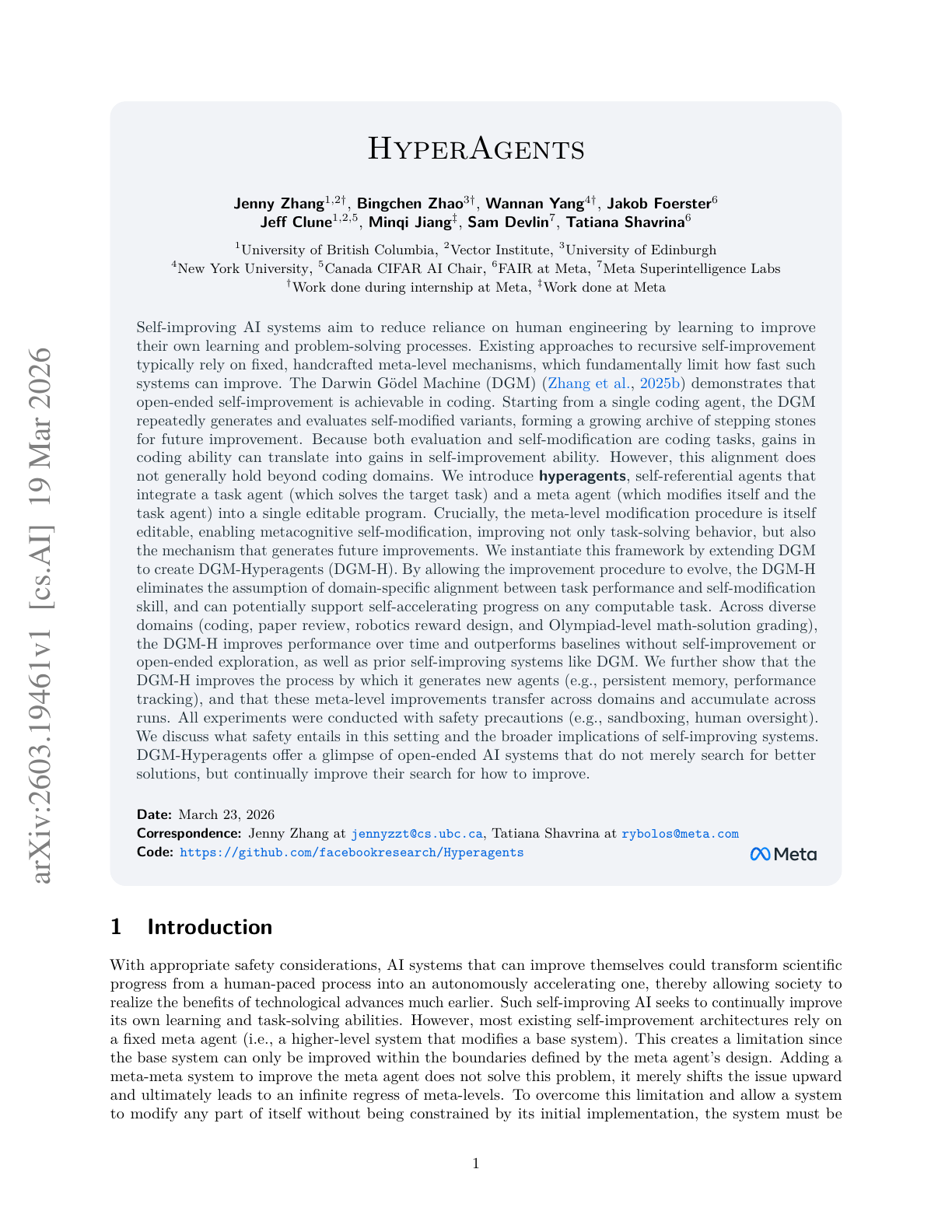
Hyperagents
Self-improving AI systems promise to reduce reliance on human engineering, but existing approaches rely on fixed, handcrafted meta-level mechanisms that fundamentally limit how fast they can improve. Hyperagents introduce self-referential agents that integrate a task agent and a meta agent into a single editable program, enabling the system to improve not just its task-solving behavior but also the mechanism that generates future improvements.