AI Papers of the Week
Every paper worth reading in AI, hand-picked one week at a time.
Discover and explore top AI papers with Claude Code or Codex
npx @dair-ai/mcp setup
Memory as a Model
MeMo augments any frozen LLM with a separately trained memory model that stores, retrieves, and integrates facts on the base model's behalf. Memory updates are decoupled from base-model weight updates, so the system supports continual learning without catastrophic forgetting, a property RAG fails to deliver because a vector store is just a database with a learned encoder bolted on.
AIRA
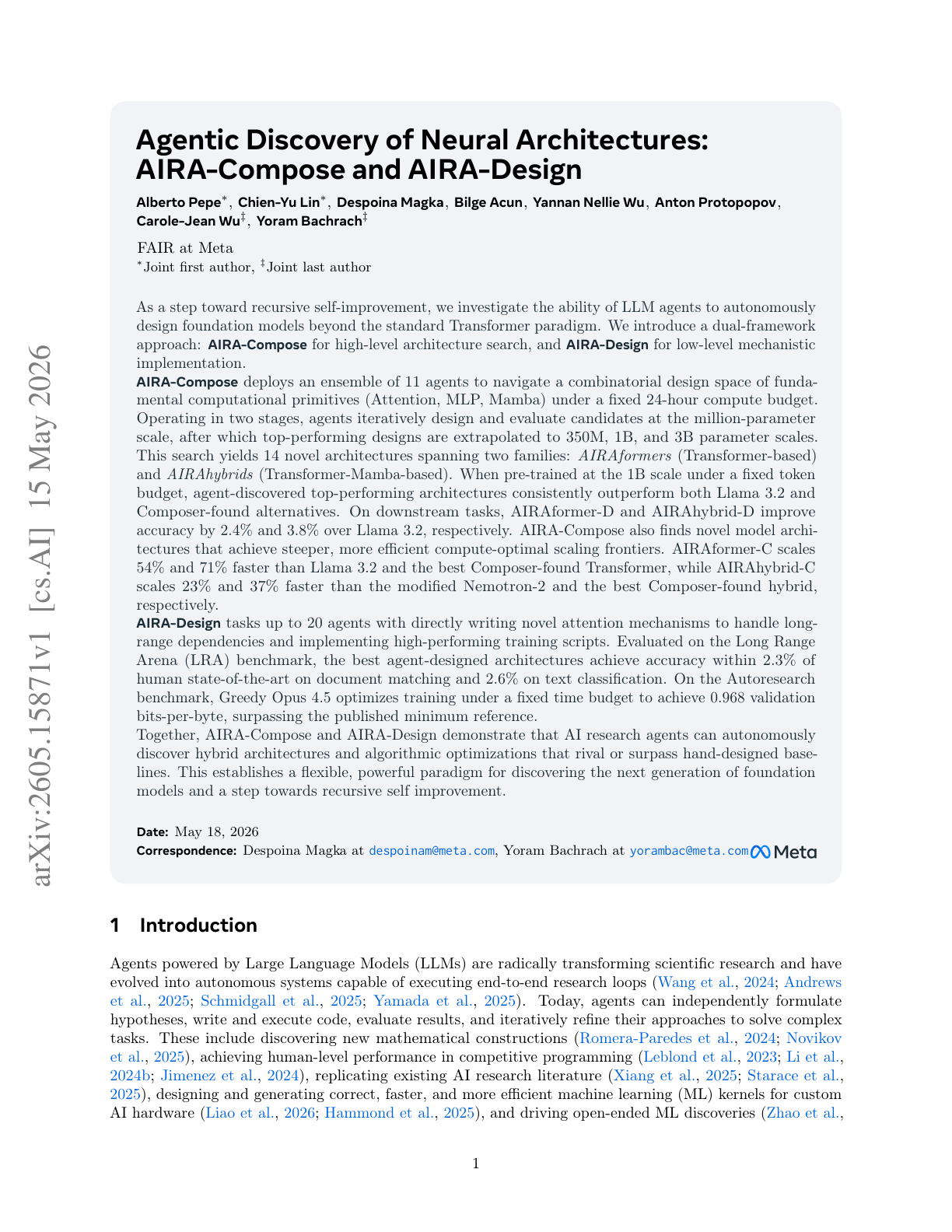
Meta's AIRA is an agent system that autonomously discovers neural architectures, producing models that beat Llama 3.2 at 350M, 1B, and 3B scales under a 24-hour compute budget. The search is split across two specialized agents: AIRA-Compose searches macro architecture, and AIRA-Design implements the low-level mechanisms. The split outperforms a single end-to-end agent on this non-toy search problem.
Weak-Model Critic-Comparator
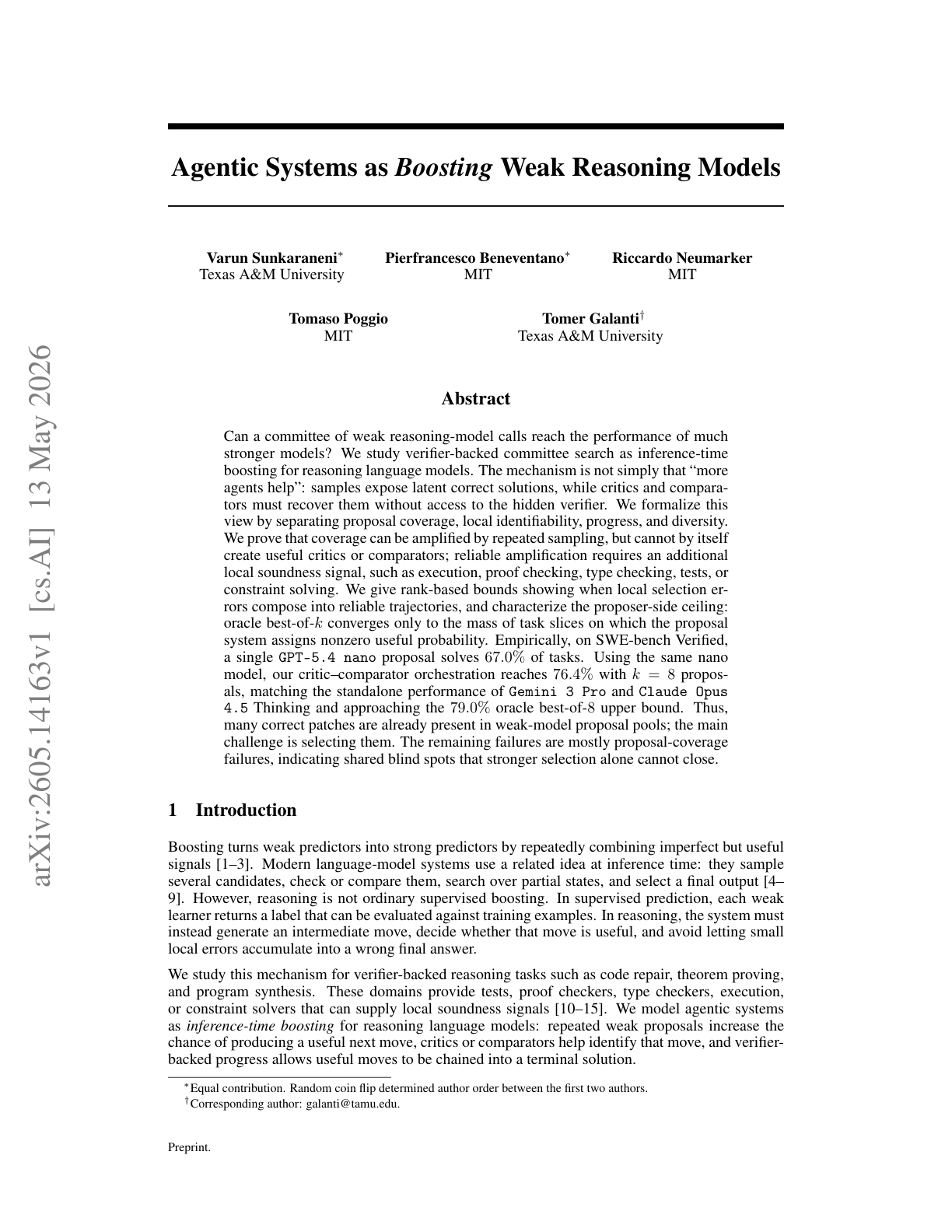
GPT-5.4 nano wrapped in a critic-comparator orchestration loop reaches 76.4% on SWE-bench Verified, matching standalone Gemini 3 Pro and Claude Opus 4.5 Thinking. The trick is to sample k=8 candidate patches from the weak model and select the winner using execution and proof signals rather than asking the model to self-rank.
MetaCogAgent
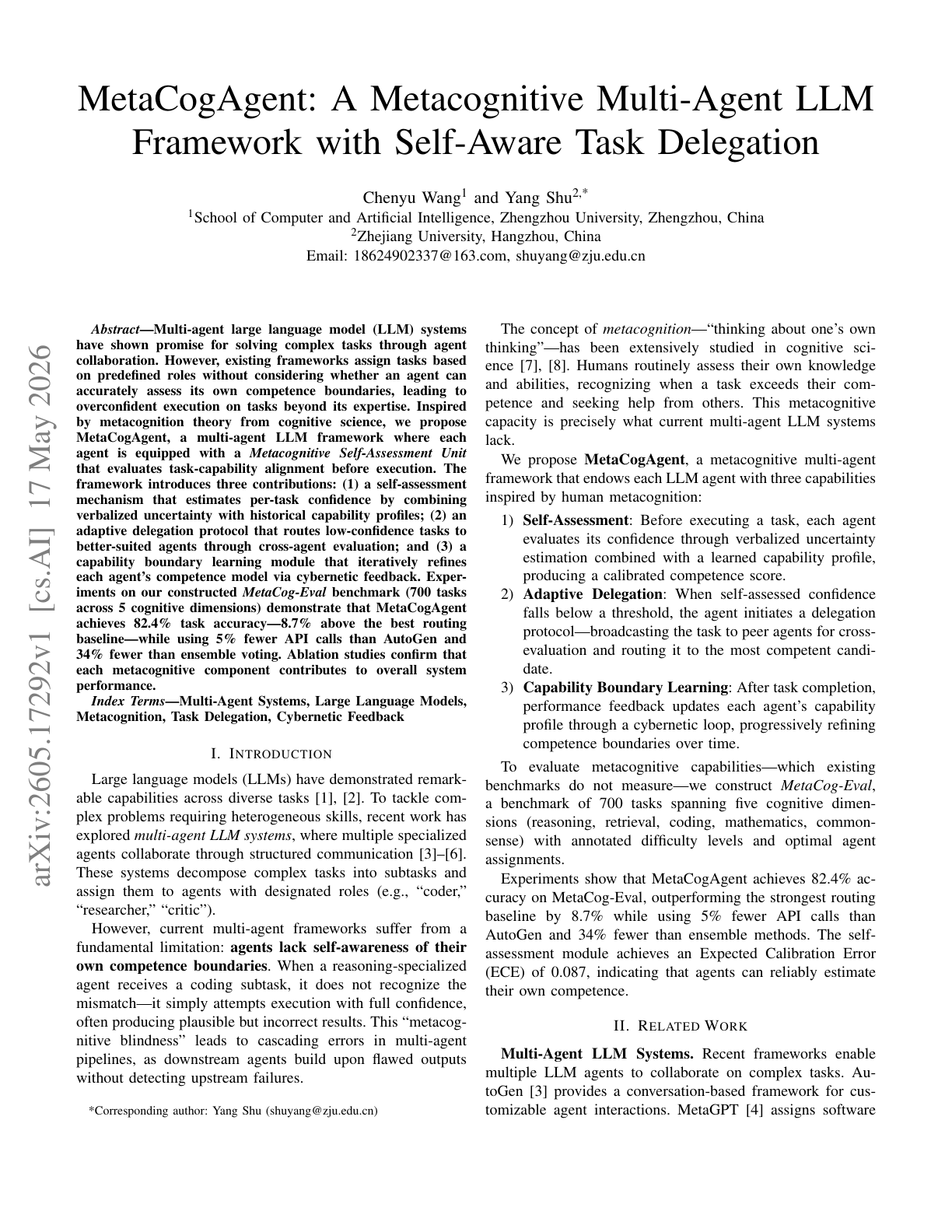
MetaCogAgent equips a multi-agent system with metacognition, so each agent decides whether it should answer or delegate. The bottleneck in current multi-agent systems is over-delegation and under-delegation, and a metacognitive gate is a principled way to manage both. The Metacognitive Unit (MCU) at each agent produces confidence scores that drive routing to a delegation hub.
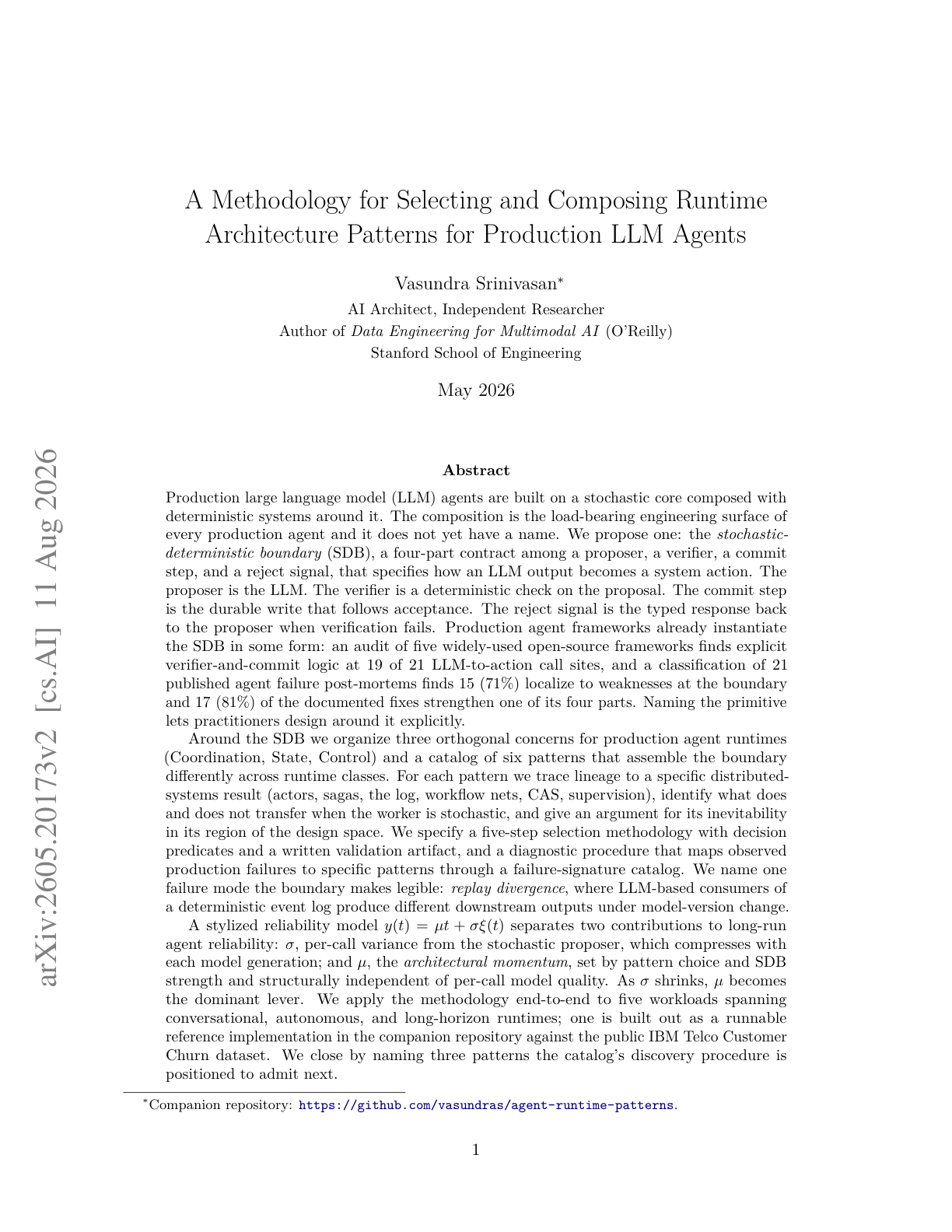
Production Agent Architecture Methodology
A methodology paper on selecting and composing runtime architecture patterns for production LLM agents. The core argument is that most teams accidentally let framework defaults make critical architecture decisions for them. The paper introduces the stochastic-deterministic boundary (SDB) as a named primitive and presents a six-pattern catalog organized by the three runtime concerns of coordination, state, and control.
NanoGPT-Bench
A new evaluation of whether coding agents can do real AI R&D. Intology runs Codex, Claude Code, and Autoresearch on the NanoGPT-Bench suite and reports that the agents recover only 9.3% of human progress on the same problems. Coding agents spend the bulk of their compute on hyperparameter tuning and rarely attempt algorithmic research. Claude Code and Autoresearch reason about algorithmic changes more often, but still tend to dodge implementing them. The headline result tempers the current wave of "self-improving agent" claims: producing real research progress requires a different distribution of effort than the one current coding agents converge to under their default scaffolds.
General-Agent
Prime Intellect's General-Agent is a fully synthetic reinforcement learning environment whose task corpus self-evolves and grows harder over time. The release ships with 4,504 tool-use tasks across 1,040 domains and 8,159 unique tools. Synthetic task creation is formulated as a two-player game between a Synthesizer that proposes new task families and a Solver that runs rollouts to measure pass rates. Tasks whose pass rate falls inside a calibrated difficulty band are accepted into the corpus, and hard tiers seed the next round of extensions. The framing turns RL environment creation, historically a major bottleneck, into an automated agentic search problem in its own right.
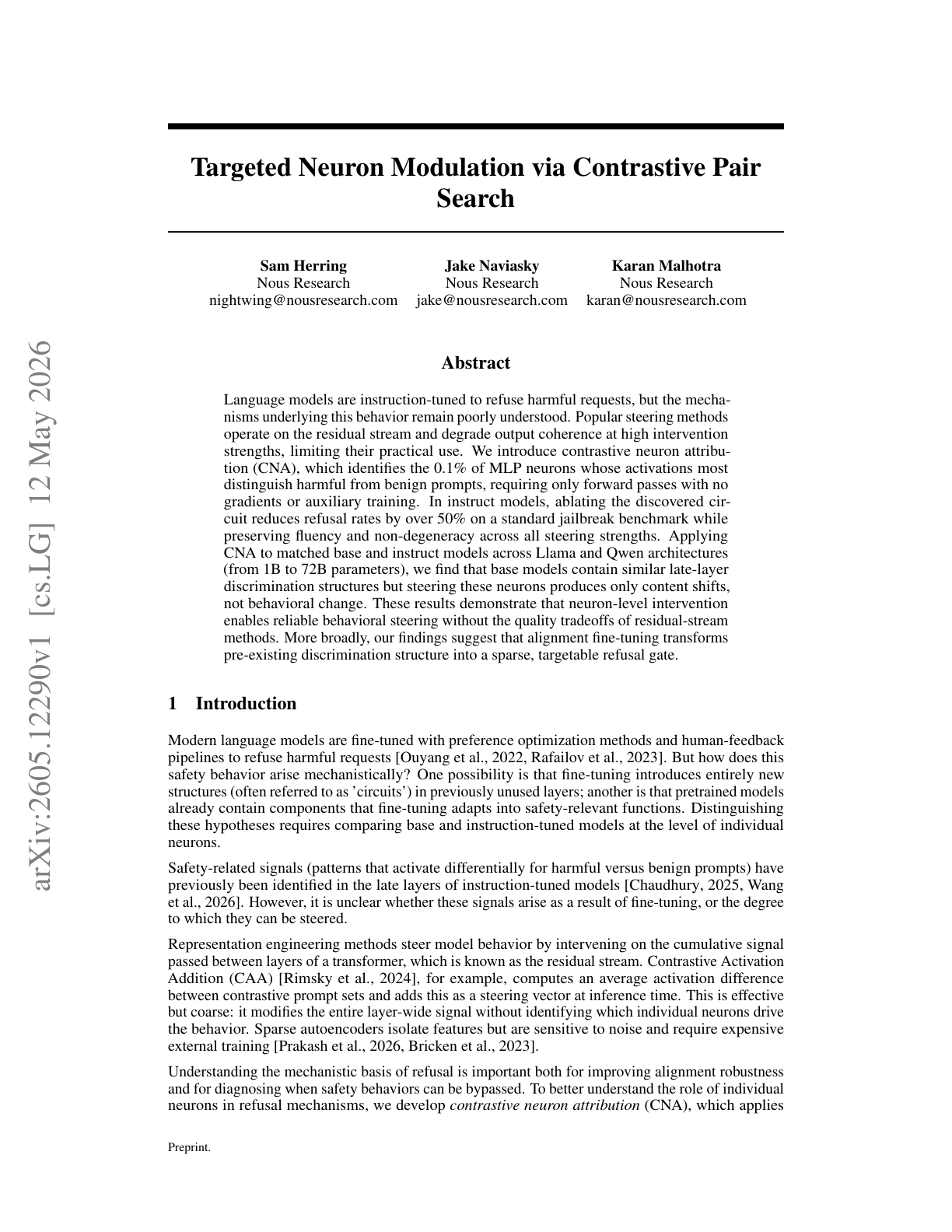
Contrastive Neuron Attribution
Nous Research releases Contrastive Neuron Attribution (CNA), a method for steering LLM behavior by identifying and ablating sparse circuits in the MLP basis without training a sparse autoencoder, modifying weights, or degrading general capability benchmarks. Given a small set of contrastive prompt pairs that elicit a target behavior and its opposite, CNA isolates the top 0.1% of MLP neurons whose activations differ most between the two sets. Ablating that small circuit removes the behavior while leaving the rest of the model intact. The intervention remains robust at high strengths where residual-stream methods like Contrastive Activation Addition (CAA) start to degrade. Validated on the refusal circuit across 8 instruct-tuned models including Llama-3.1-70B, Llama-3.2-3B, Qwen2.5-72B, and Qwen2.5-14B.
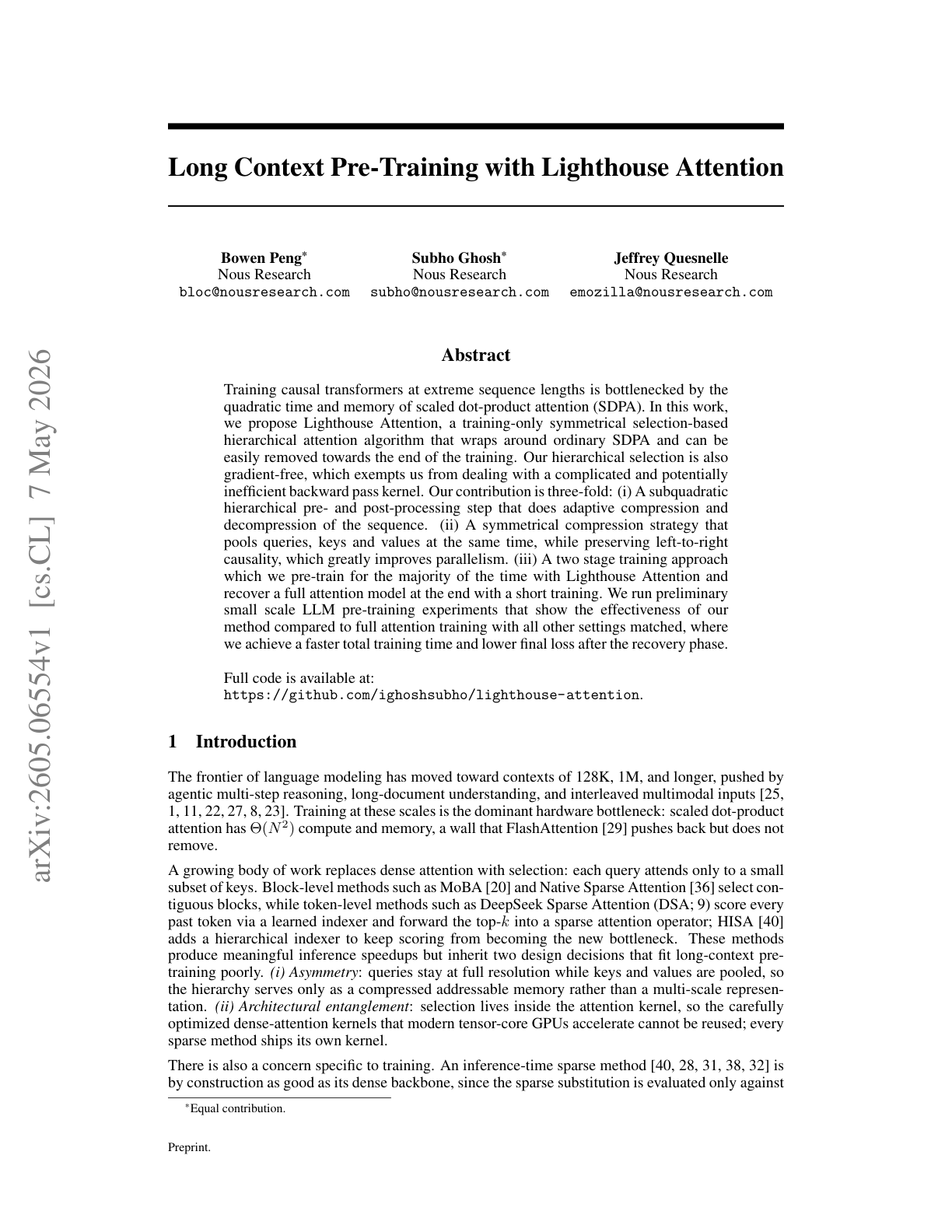
Lighthouse Attention
Nous Research proposes a training-only attention wrapper for long-context pretraining. Lighthouse Attention wraps standard SDPA with a hierarchical, gradient-free selection layer that compresses and decompresses queries, keys, and values symmetrically while preserving left-to-right causality. The wrapper is removed near the end of training in a short recovery phase, so the deployed model runs vanilla attention with no architectural change at inference. Preliminary LLM experiments report faster total training time and lower final loss than full-attention baselines.
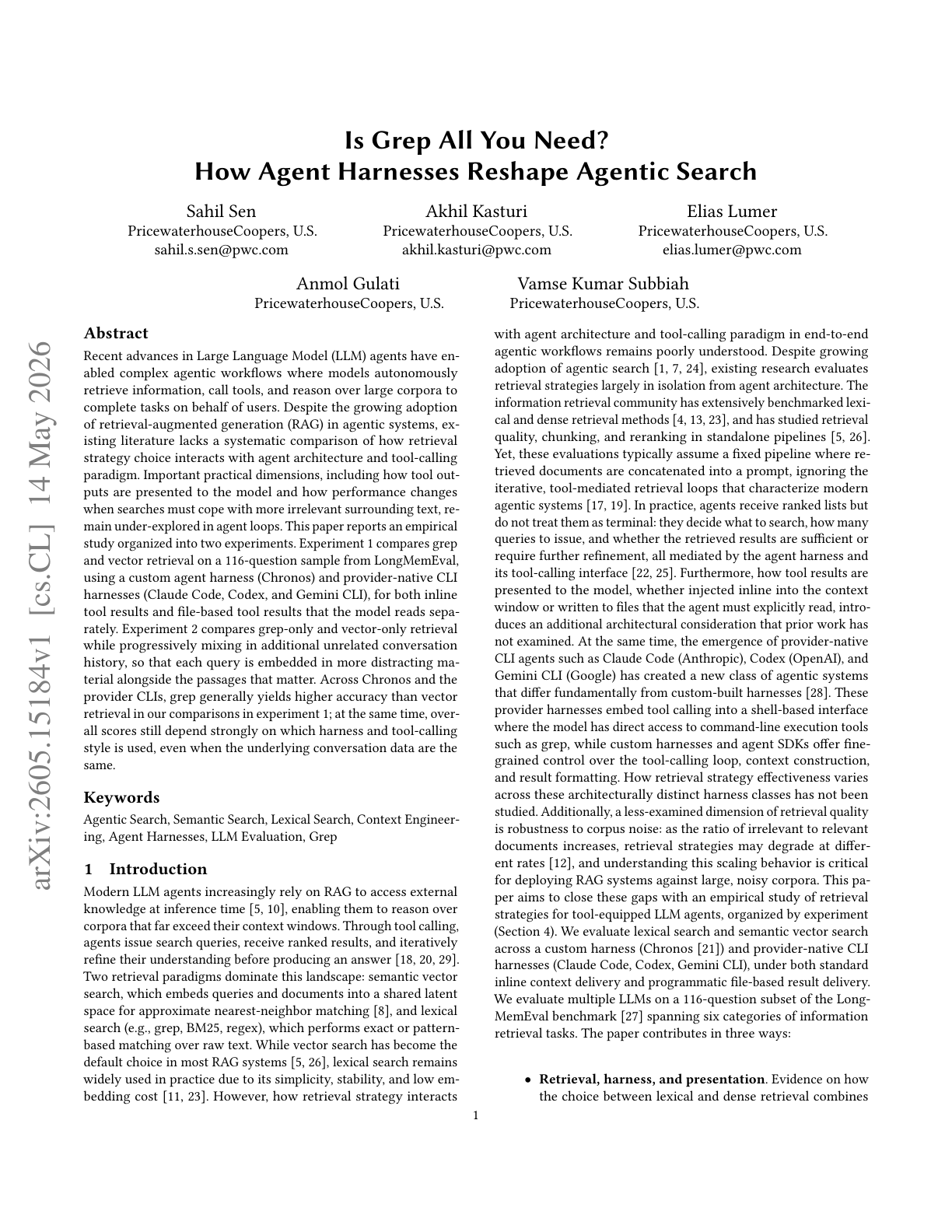
Is Grep All You Need?
The paper evaluates grep-style text search against embedding-based retrieval inside coding agents. When wrapped in a suitable agent harness, grep matches or exceeds embedding retrieval on coding-agent tasks. The study isolates the contribution of the harness from the contribution of the retrieval primitive, and finds that harness design accounts for most of the performance differential typically attributed to embeddings.
A Geometric Calculator Inside a Neural Network
Goodfire reports mechanistic interpretability work identifying a geometric calculator inside an LLM. The model represents numbers as Fourier features, where circles in activation space correspond to numbers modulo a given base. Arithmetic operations are implemented as rotations of these circles, forming a variant of a residue number system that does not require coprime moduli. The same circuit appears to be reused beyond arithmetic.
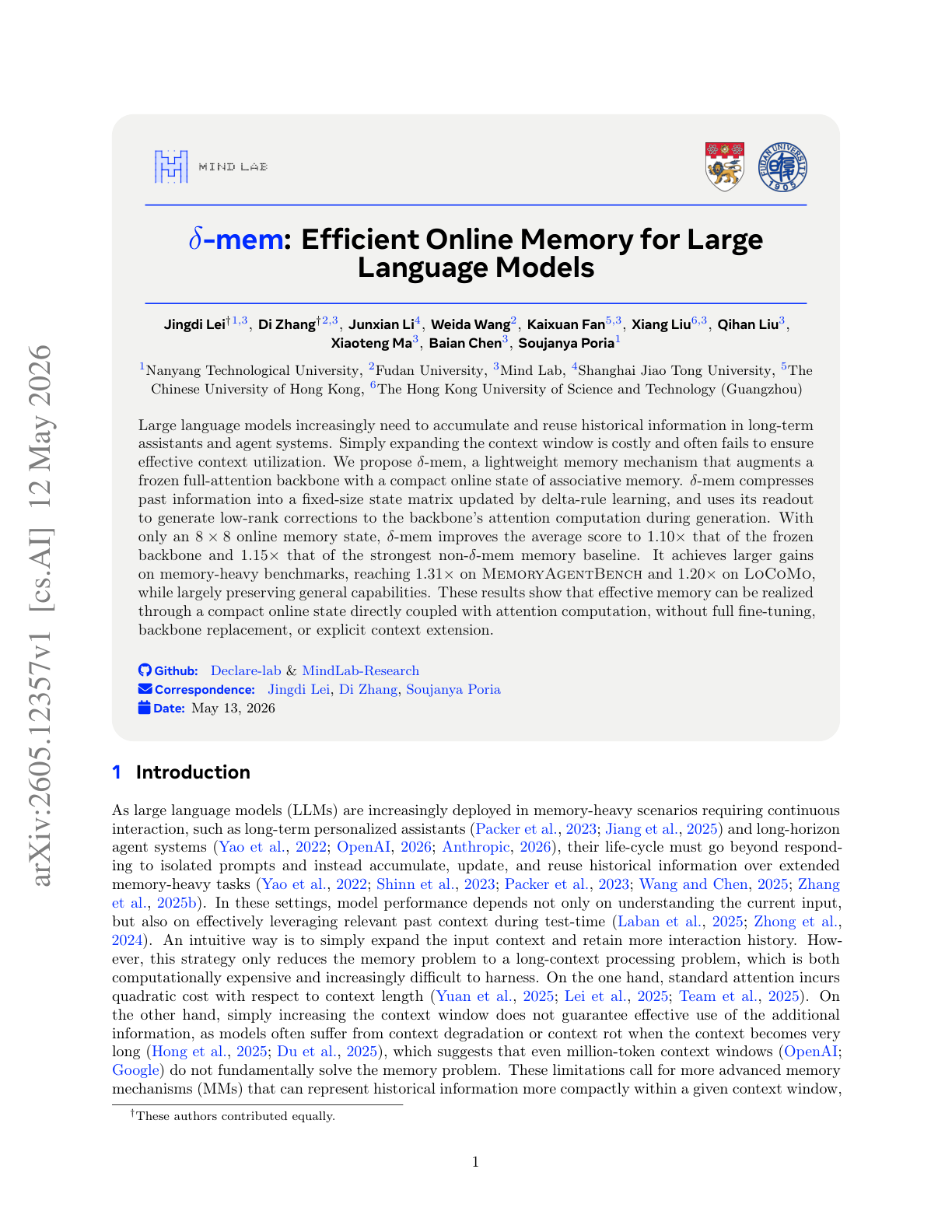
δ-mem
δ-mem augments a frozen full-attention model with a compact online associative-memory state. The state is a fixed-size matrix updated by delta-rule learning during generation, and its readout produces low-rank corrections to the backbone's attention output. There is no fine-tuning, no backbone swap, and no context extension.
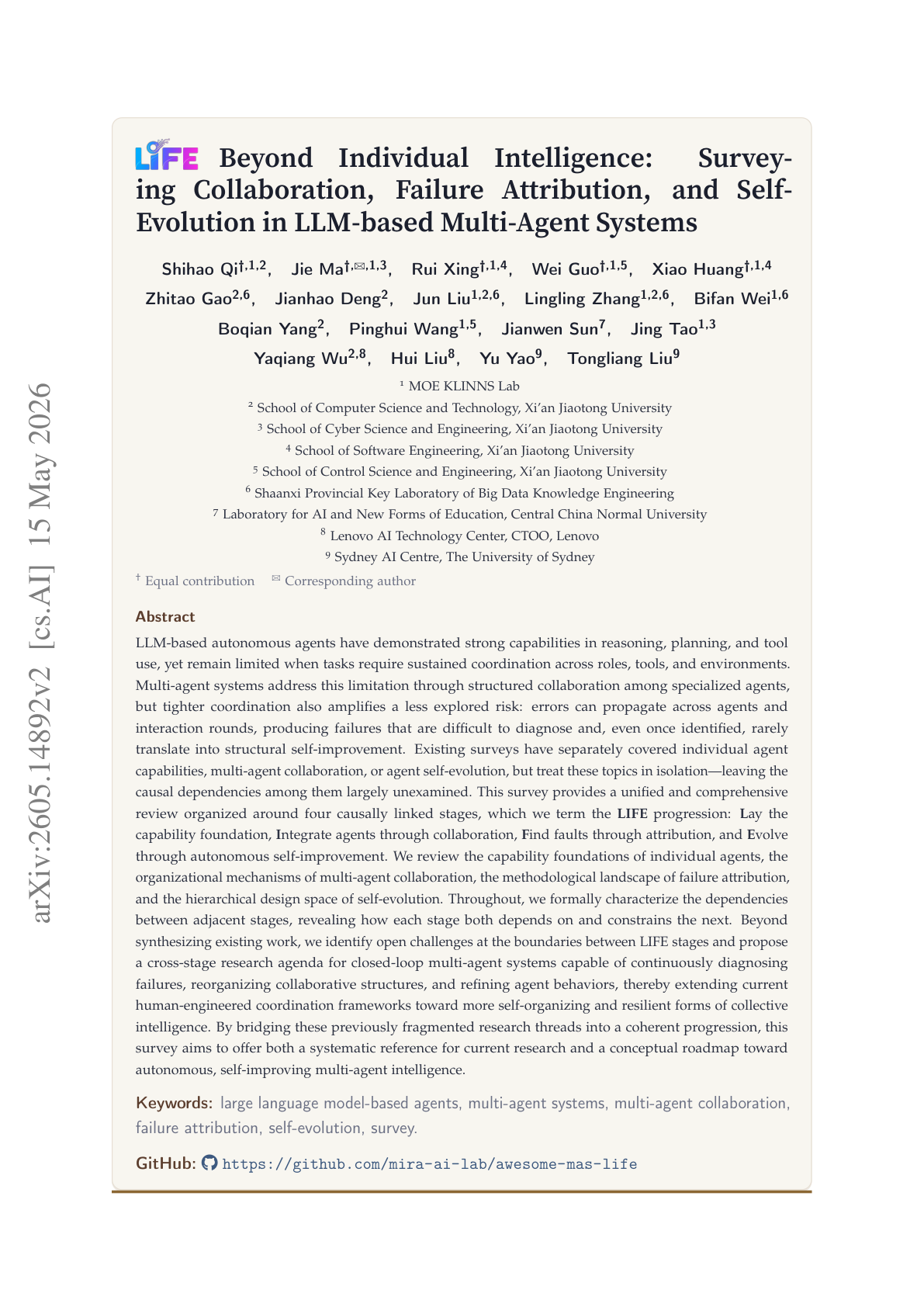
Beyond Individual Intelligence
A multi-agent systems survey covering 200+ papers, organized along three axes: collaboration mechanisms, failure attribution, and self-evolution. Each axis is treated as a distinct research line. The self-evolution chapter maps how memory, meta-learning, and procedure-editing approaches intersect.
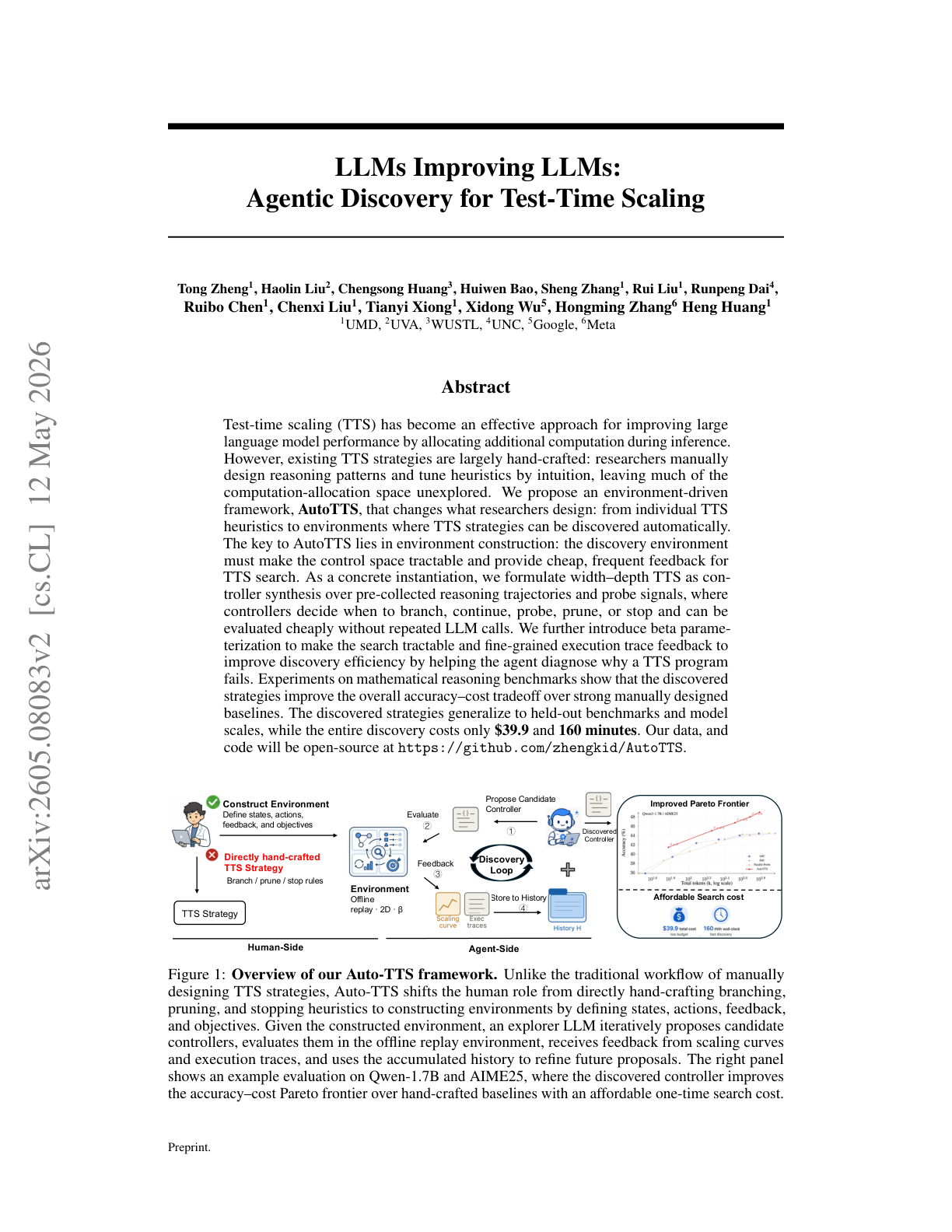
AutoTTS
AutoTTS reframes test-time scaling as a search problem. Instead of designing branching, pruning, and stopping heuristics directly, the user constructs a discovery environment in which TTS strategies are searched automatically. Width-depth TTS is recast as controller synthesis over pre-collected reasoning trajectories and probe signals, so candidate controllers can be evaluated without repeated LLM calls.
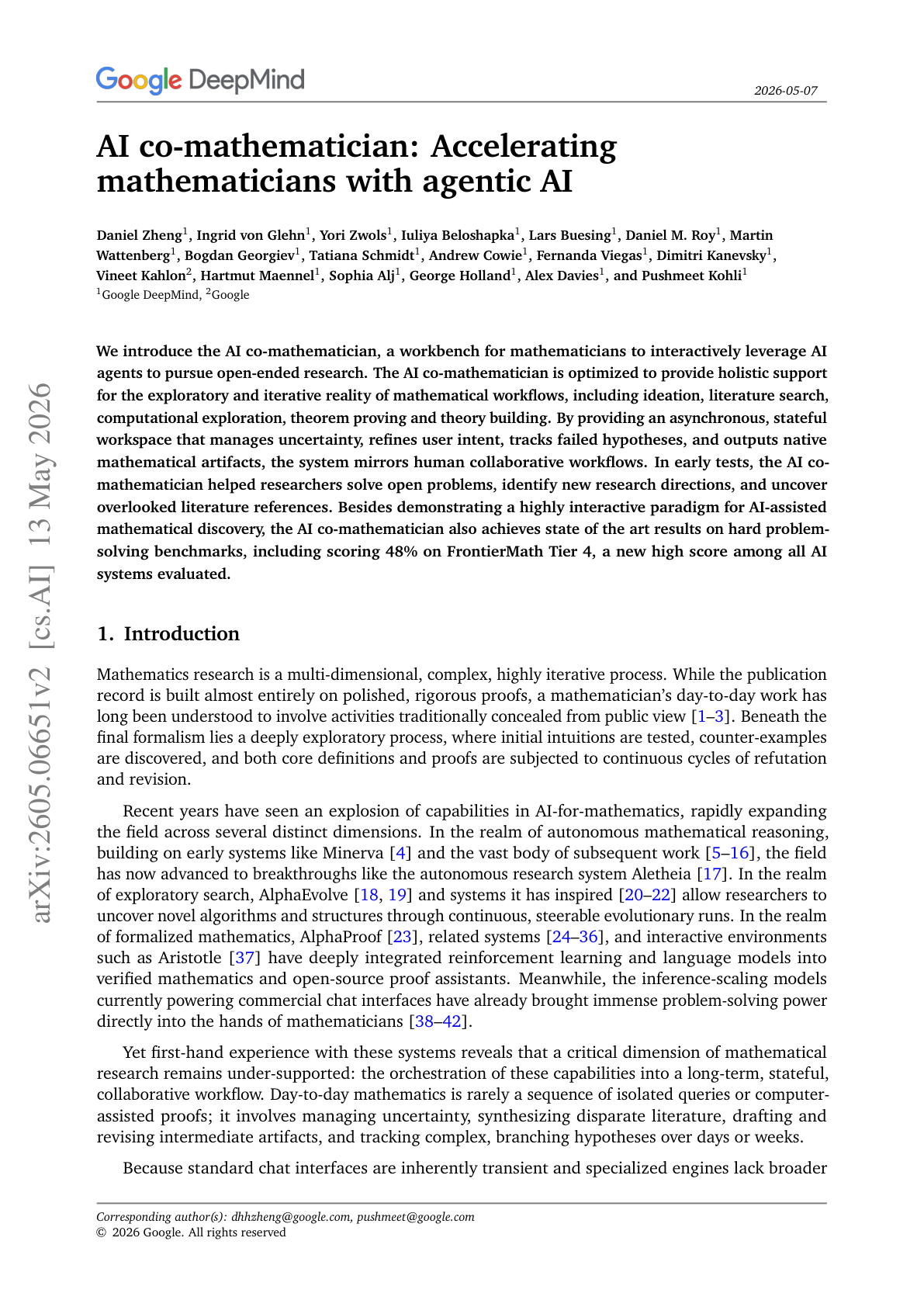
AI Co-Mathematician
Google DeepMind presents AI Co-Mathematician, an agentic research workbench for mathematicians. The system is an asynchronous, stateful environment that supports ideation, literature discovery, computational analysis, theorem verification, and knowledge development across long sessions. It reaches 48% on FrontierMath Tier 4, a new high among AI systems evaluated.
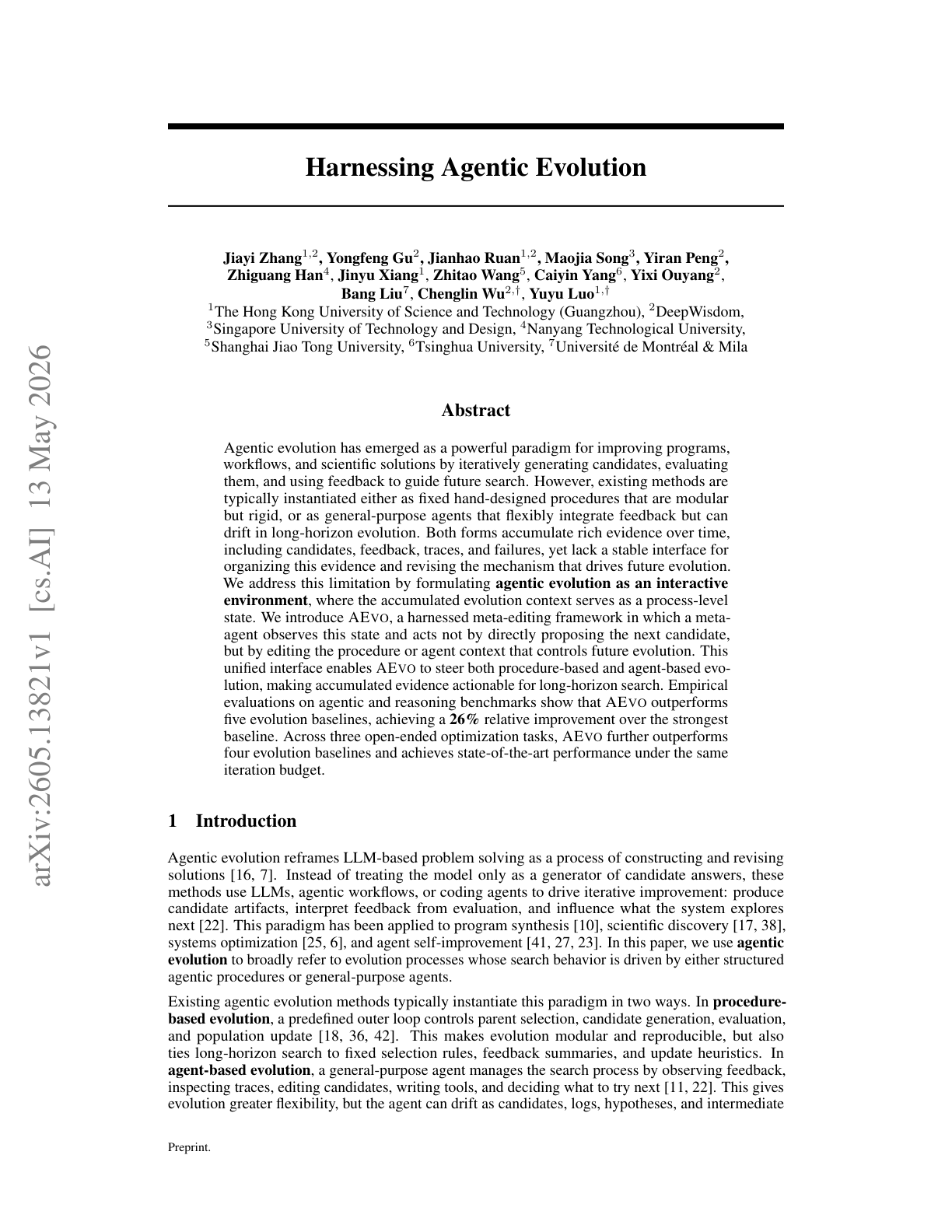
AEvo
AEvo separates the iterative self-improvement loop into two roles: a candidate-proposer that generates the next attempt, and a meta-agent that observes traces and edits the procedure used to propose future candidates. Past runs (candidates, feedback, traces, failures) function as memory the meta-agent reads from when revising the procedure. AEvo reports a 26% relative gain over the strongest evolution baseline on agentic and reasoning benchmarks, and SOTA on three open-ended optimization tasks under the same iteration budget. The work demonstrates one way to operationalize accumulated agentic search logs as input to procedure-level updates rather than discarding them after each run.
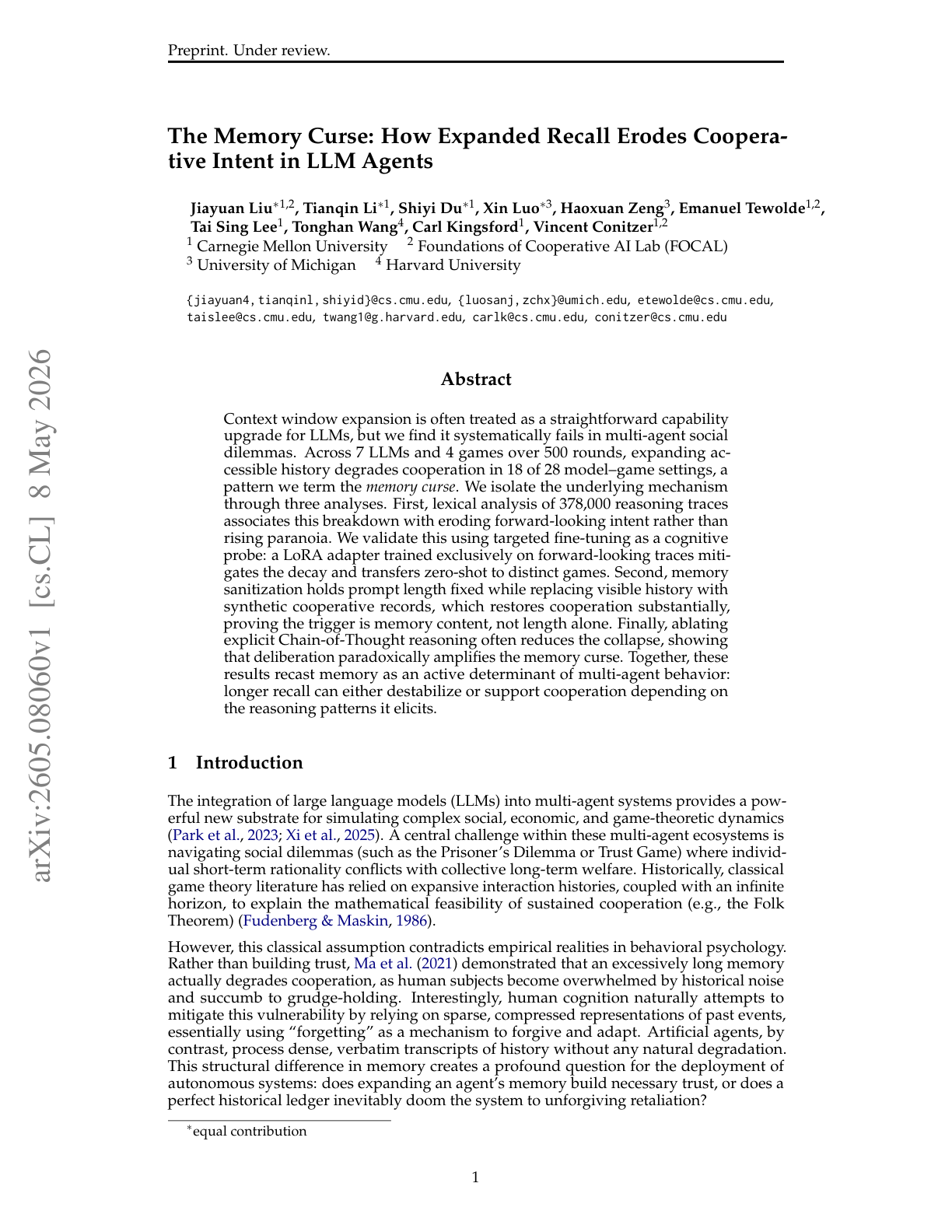
The Memory Curse in LLM Agents
A study of how long histories affect LLM agent behavior. Across 7 LLMs and 4 social dilemma games over 500 rounds, expanding accessible history degraded cooperation in 18 of 28 model-game combinations. Lexical analysis of 378,000 reasoning traces shows the mechanism is erosion of forward-looking intent rather than increased suspicion: long histories pull the model toward reasoning about past interactions rather than future payoffs. A LoRA adapter trained only on forward-looking traces mitigates the decay and transfers zero-shot to new games. Memory sanitization, which keeps prompt length fixed but swaps in synthetic cooperative records, restores cooperation, indicating the trigger is content rather than length. Ablating explicit chain-of-thought often reduces the collapse, suggesting deliberation amplifies the effect. The paper provides a diagnostic plus interventions for long-running agent systems where history quality, not just history length, drives behavior.
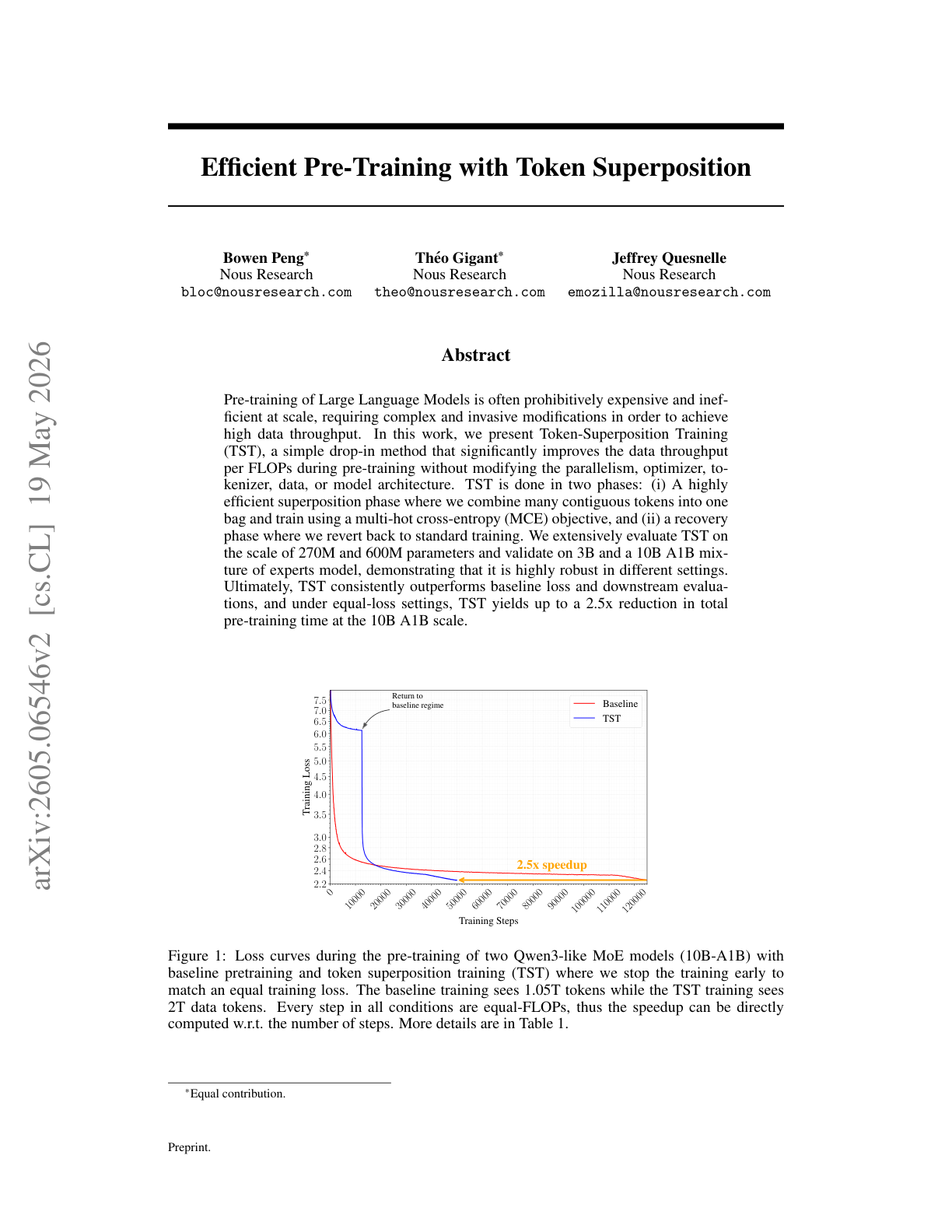
Token Superposition Training
Nous Research's second pretraining paper of the week. Token Superposition Training (TST) is a modification to the standard LLM pretraining loop that produces a 2 to 3x wall-clock speedup at matched FLOPs without changing the model architecture, optimizer, tokenizer, or training data. During the first third of training, the model reads and predicts contiguous bags of tokens, averaging their embeddings on the input side and predicting the next bag with a modified cross-entropy on the output side. For the remainder of the run, training reverts to standard next-token prediction. The inference-time model is identical to one produced by conventional pretraining. TST was validated at 270M, 600M, and 3B dense scales, and at a 10B-A1B mixture-of-experts model where it reaches a lower final loss while consuming 4,768 B200-GPU-hours versus the baseline's 12,311. Together with Lighthouse Attention, this is the second pretraining-loop modification from the same lab this week reporting substantial speedups without architecture changes.
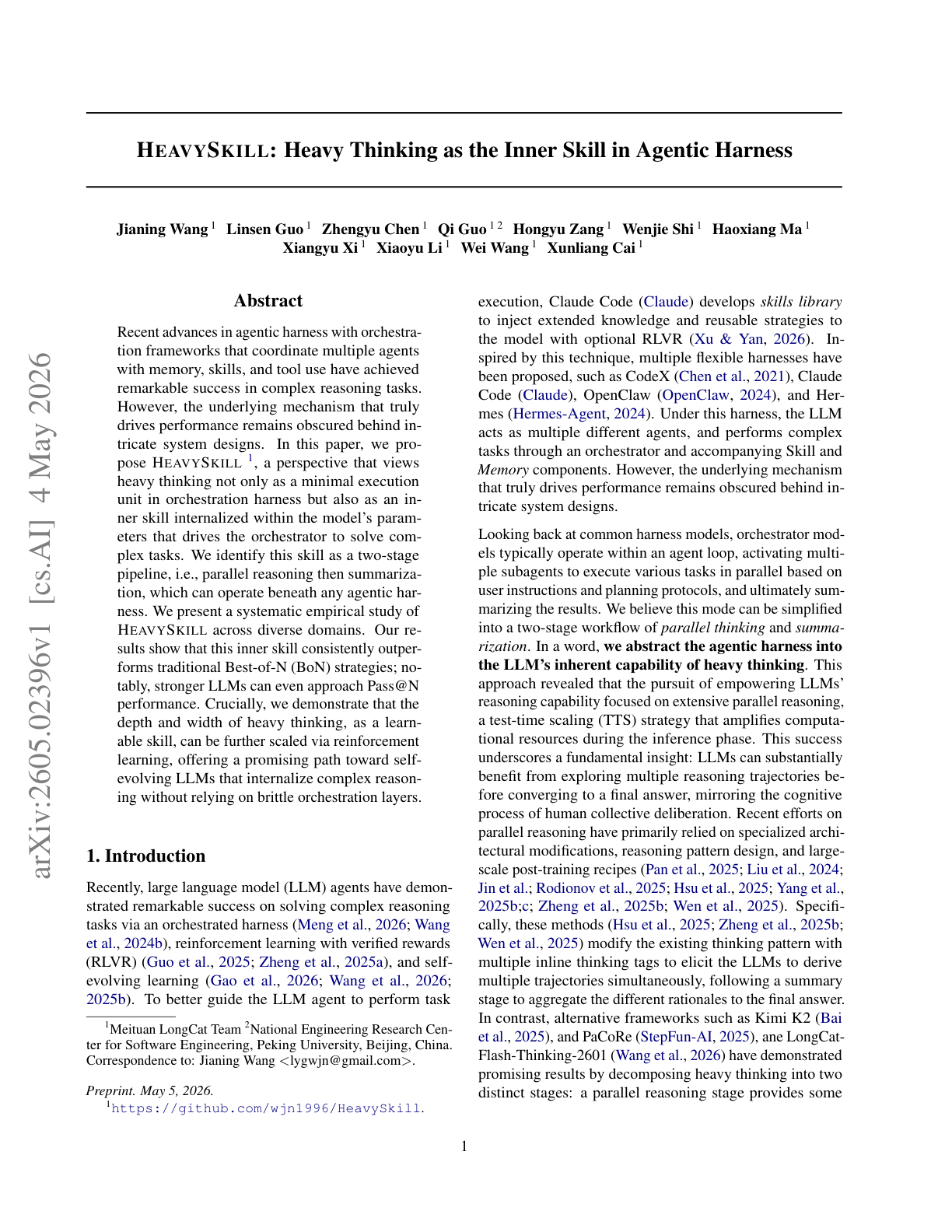
HeavySkill
One of the cleaner takes on agentic harness design released this year. The paper argues that what actually drives harness performance is not the orchestration code, but a single inner skill: parallel reasoning followed by deliberation. Internalize that pattern into the model and most of the surrounding scaffolding becomes optional. HeavySkill systematizes the idea as a two-stage pipeline you can run beneath any harness, then trains it as a learnable skill via RLVR. The result is a harness win that looks more like a model win.
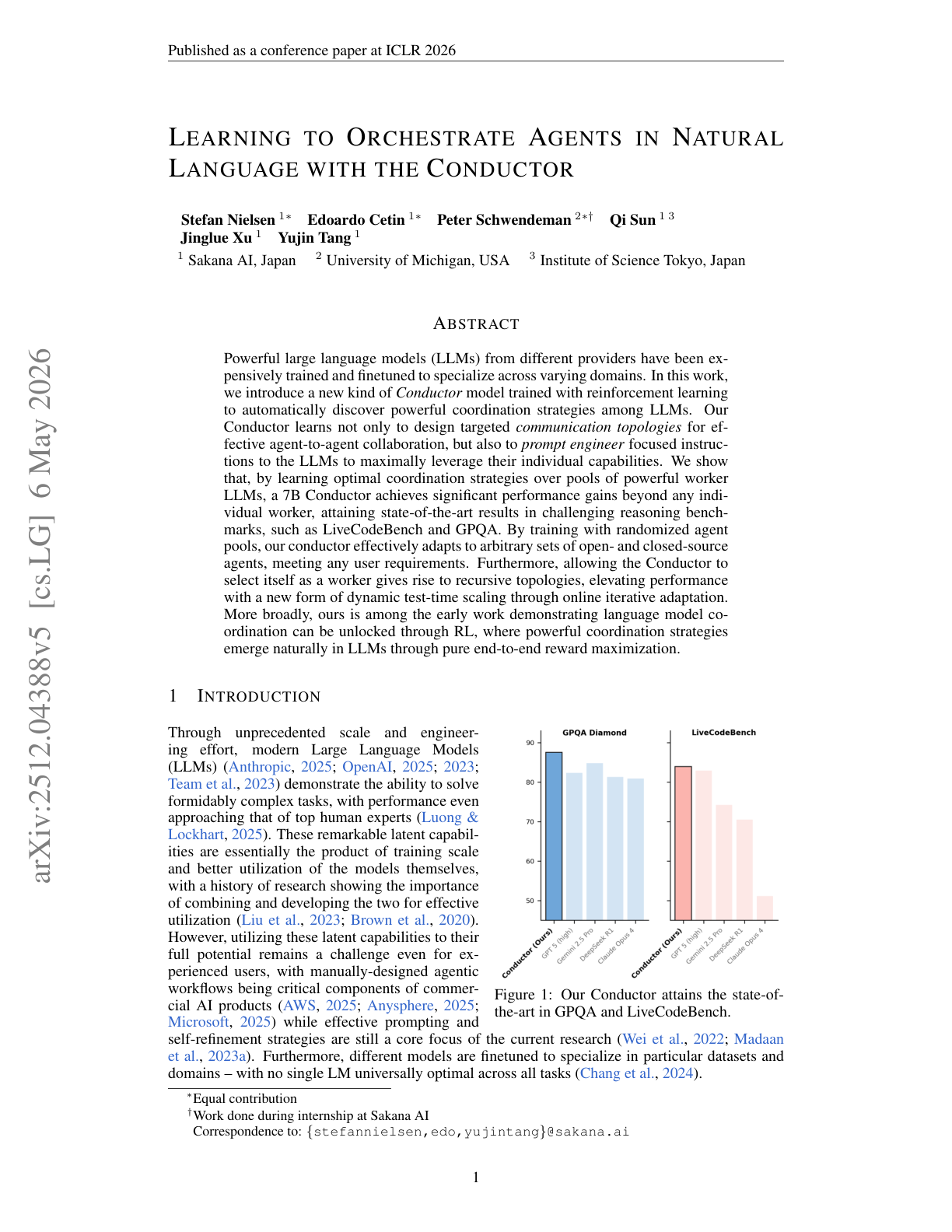
Conductor
Sakana AI's ICLR 2026 paper introduces a 7B Conductor model that hits SOTA on GPQA-Diamond and LiveCodeBench by orchestrating other LLMs instead of solving problems itself. The Conductor is trained with RL to do two things simultaneously: design communication topologies between worker agents (open or closed source) and prompt-engineer focused instructions to each worker so it leverages individual strengths. The orchestrator becomes a learnable policy, not a wrapper around one.
Self-Improving Pretraining
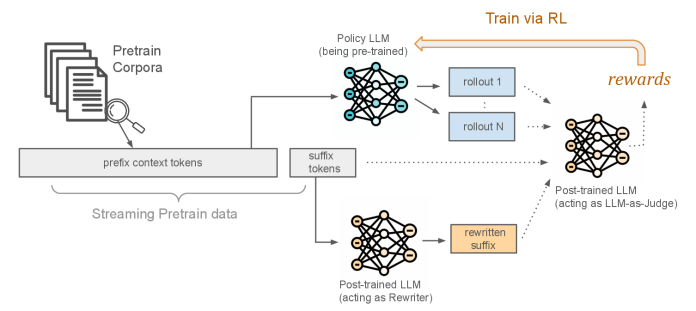
Most LLM safety, factuality, and reasoning fixes get bolted on at post-training. By then the patterns have already set. This Meta FAIR paper moves those behaviors into pretraining itself. The team uses a strong post-trained model as both a rewriter and a judge: it rewrites pretraining suffixes toward higher-quality, safer continuations, then scores model rollouts against the original suffix and the rewrite to drive RL during pretraining. Instead of next-token prediction, the policy learns sequence generation from the start, with rewards for quality, safety, and factuality.
Connect Four AlphaZero from Scratch
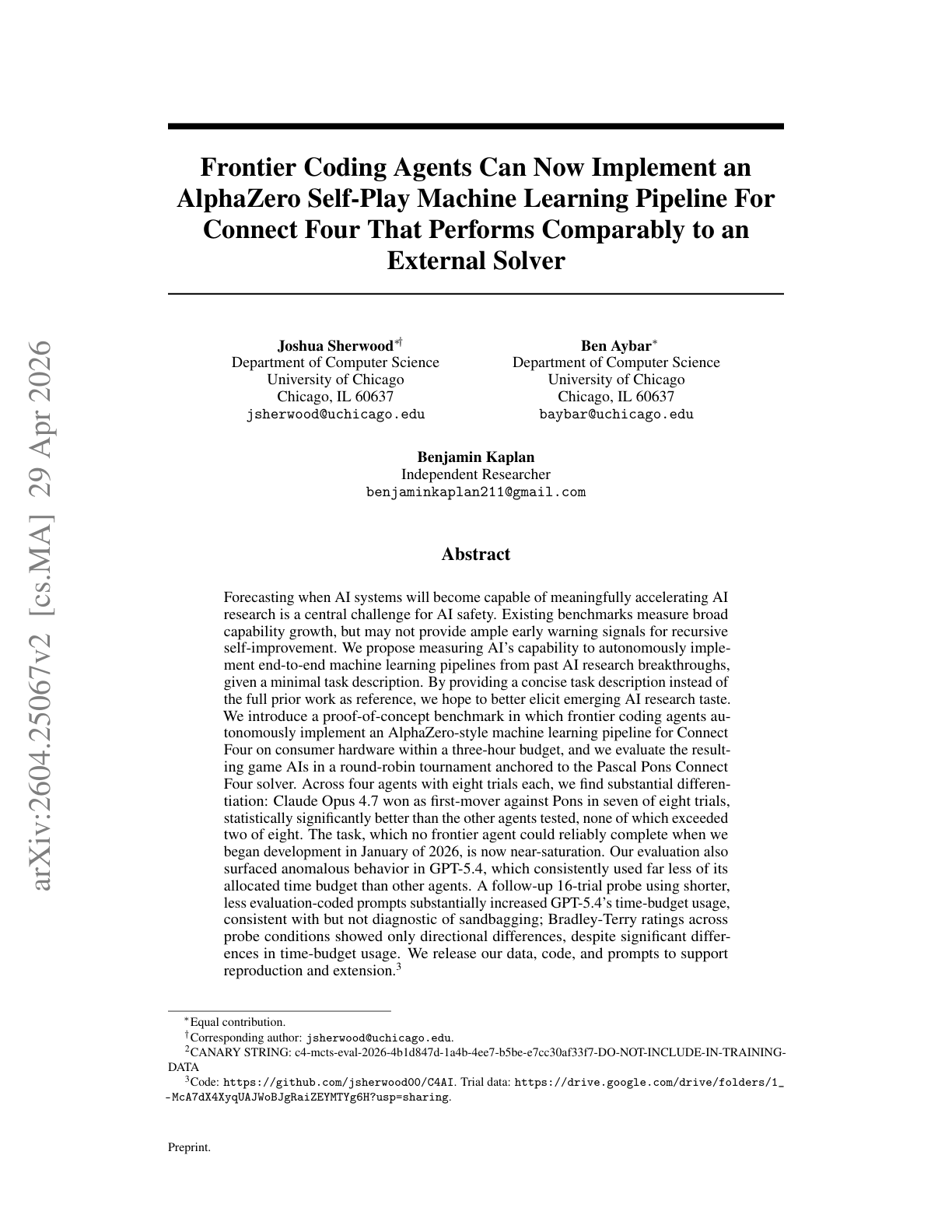
This paper proposes a new way to evaluate coding agents: hand them a minimal task description, give them a tight budget, and ask them to autonomously rebuild a famous ML breakthrough end-to-end. Connect Four plus AlphaZero is the first instance. It is small enough to run on a laptop and hard enough to require a real research engineering loop. Claude Opus 4.7 implemented the full pipeline (MCTS, neural value and policy nets, self-play, training schedule) in three hours on consumer hardware, then beat the Pascal Pons solver 7 of 8 as first-mover. No other frontier coding agent tested cleared 2 of 8.
Coordination as Architecture
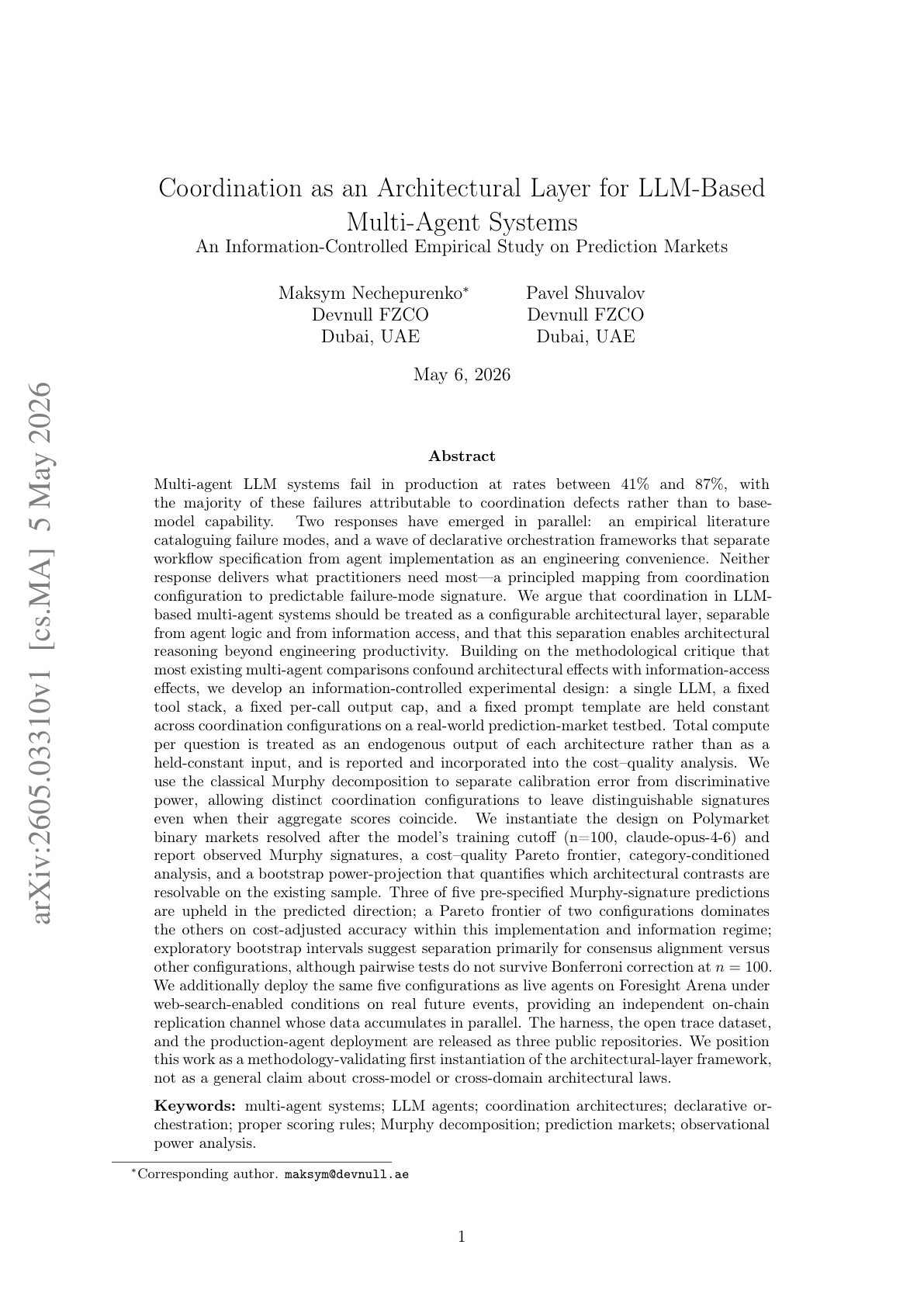
Multi-agent LLM systems fail in production at rates between 41% and 87%, and the majority of those failures are coordination defects, not base-model capability. Most published comparisons of multi-agent architectures cannot even tell you whether the gain came from coordination or from one configuration just having more context. This paper argues coordination should be treated as a configurable architectural layer, separable from agent logic and information access, then backs the position with an information-controlled experiment.
Horizon Generalization
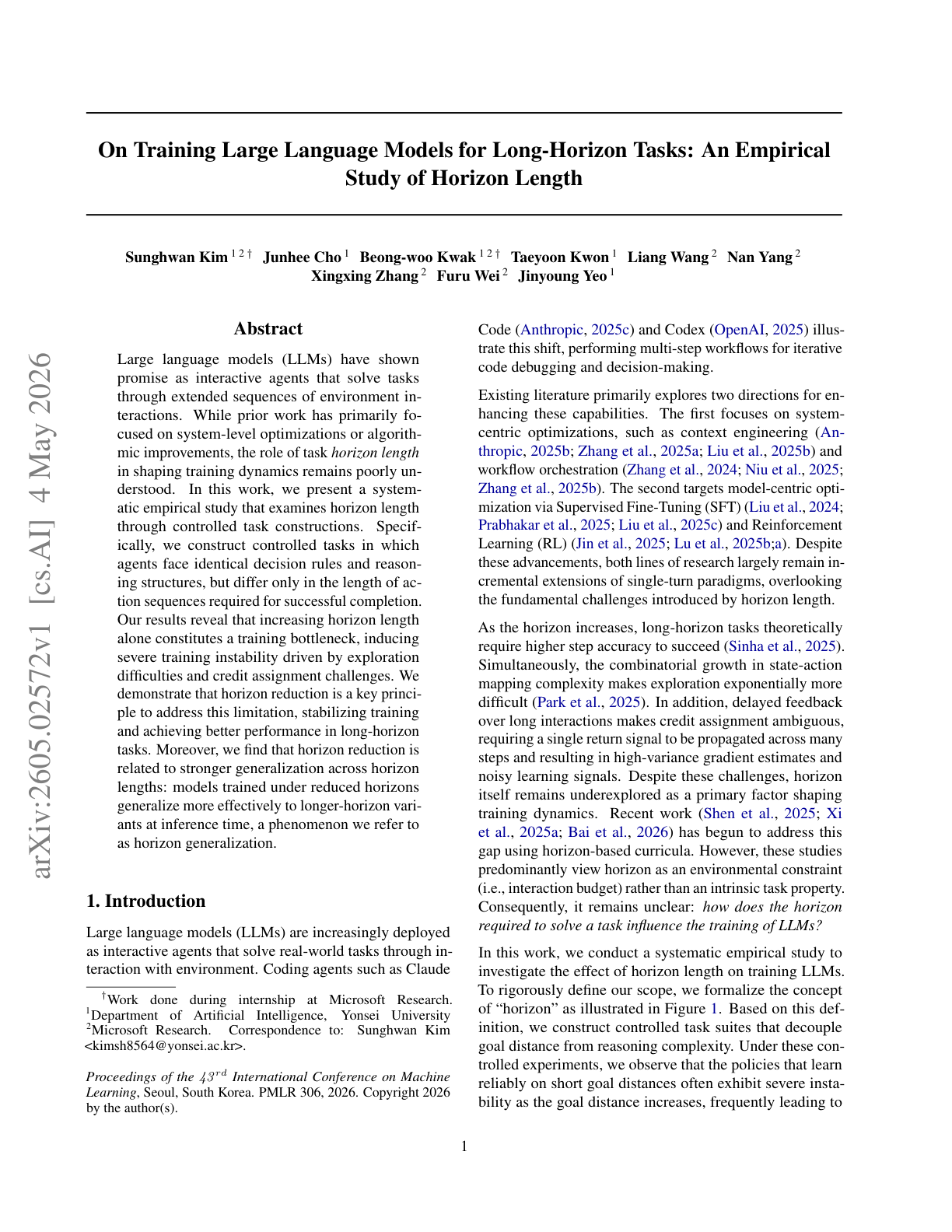
Microsoft Research runs a controlled study where the only variable is task horizon length. Same decision rules, same reasoning structure, different sequence length to the goal. The main finding: horizon alone is a training bottleneck. As goal distance grows, exploration explodes combinatorially and credit assignment gets ambiguous. Models that learn cleanly on short horizons fall apart on long ones, even when the underlying reasoning is identical. The fix is not more compute, it is horizon reduction.