AI Papers of the Week
Every paper worth reading in AI, hand-picked one week at a time.
Why Does Post-Training Quantization Work?
Yuxiang Chen, Michael Beyer, Jun Zhu and Jianfei Chen (Tsinghua University and Bosch AI Research) explain why post-training quantization of pretrained LLMs keeps accuracy even though the error from each quantized weight should compound across layers.
Phase-Decoupled, Model-Calibrated Power Control for Disaggregated LLM Serving
Jae Gon Kim, Donghoon Yoo and colleagues (Xenoscube) measure NVIDIA's Max-Q inference power profile on a disaggregated B200 serving system and replace it with separate, calibrated power settings for the prefill GPUs and the decode GPUs.
Thinking with Looped Flows
Ayhan Suleymanzade (EPFL) and colleagues at KAIST, Amsterdam, CMU, TU Wien and Oxford train looped models with local denoising objectives so that early recurrent updates learn to support later ones, and reach 58.8% on ARC-AGI-1.
The information geometry of large language models is shared, learned, and controllable
Dario Picozzi (University College London) studies the Fisher-Rao geometry of next-token probabilities and shows that it is shared across transformer, state-space and recurrent language models, that it tracks what the model learns, and that it gives a principled way to make local edits with minimal side effects.
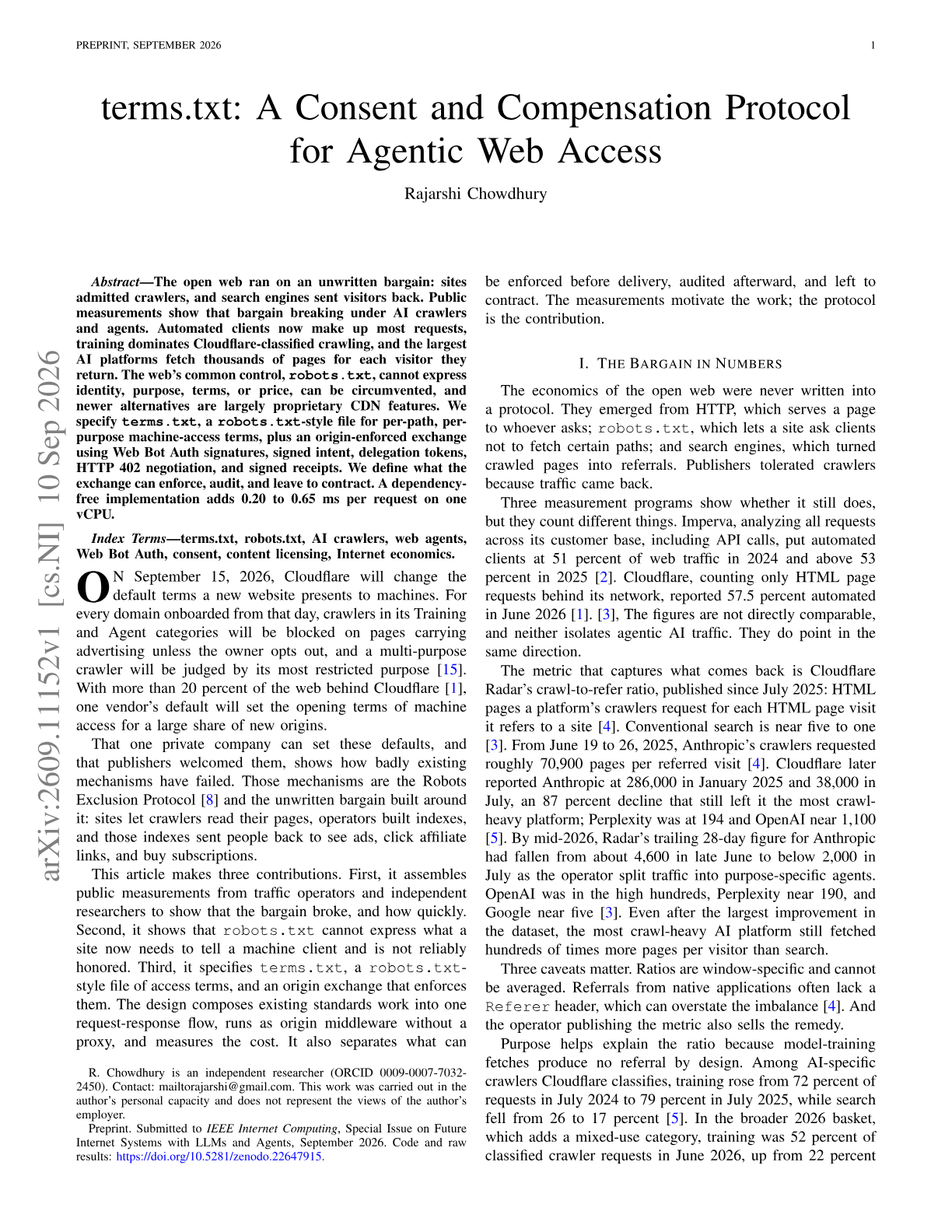
terms.txt: A Consent and Compensation Protocol for Agentic Web Access
Rajarshi Chowdhury (independent researcher) specifies terms.txt, a robots.txt-style file that states per-path, per-purpose access terms for AI crawlers and agents, together with a signed negotiation and receipt exchange that the origin server enforces.
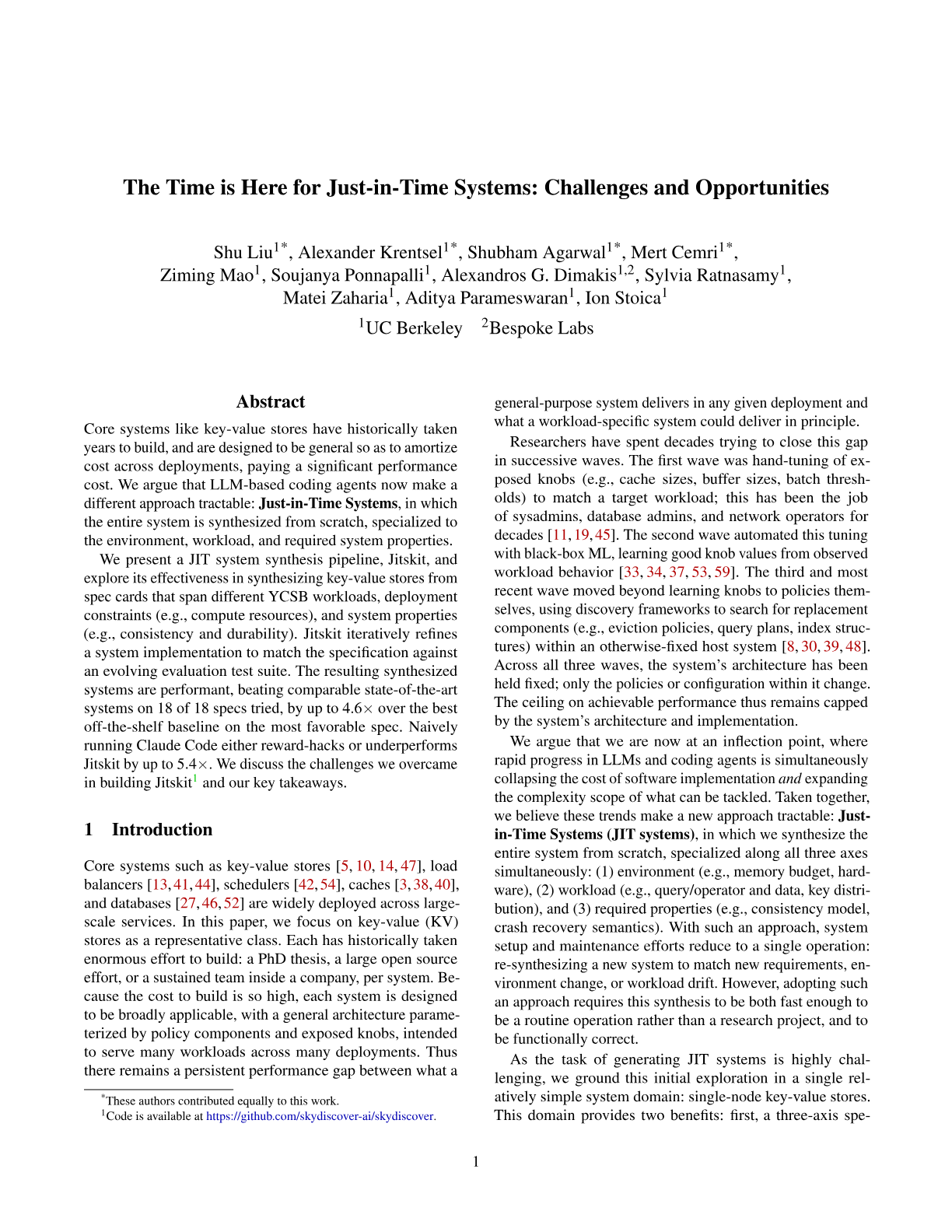
The Time is Here for Just-in-Time Systems: Challenges and Opportunities
Shu Liu, Alexander Krentsel, Shubham Agarwal, Mert Cemri and colleagues (UC Berkeley with Bespoke Labs) argue that coding agents make it practical to synthesize a core system from scratch for each deployment, and they present Jitskit, a pipeline that builds key-value stores specialized to one workload, one set of resource limits and one set of required guarantees.
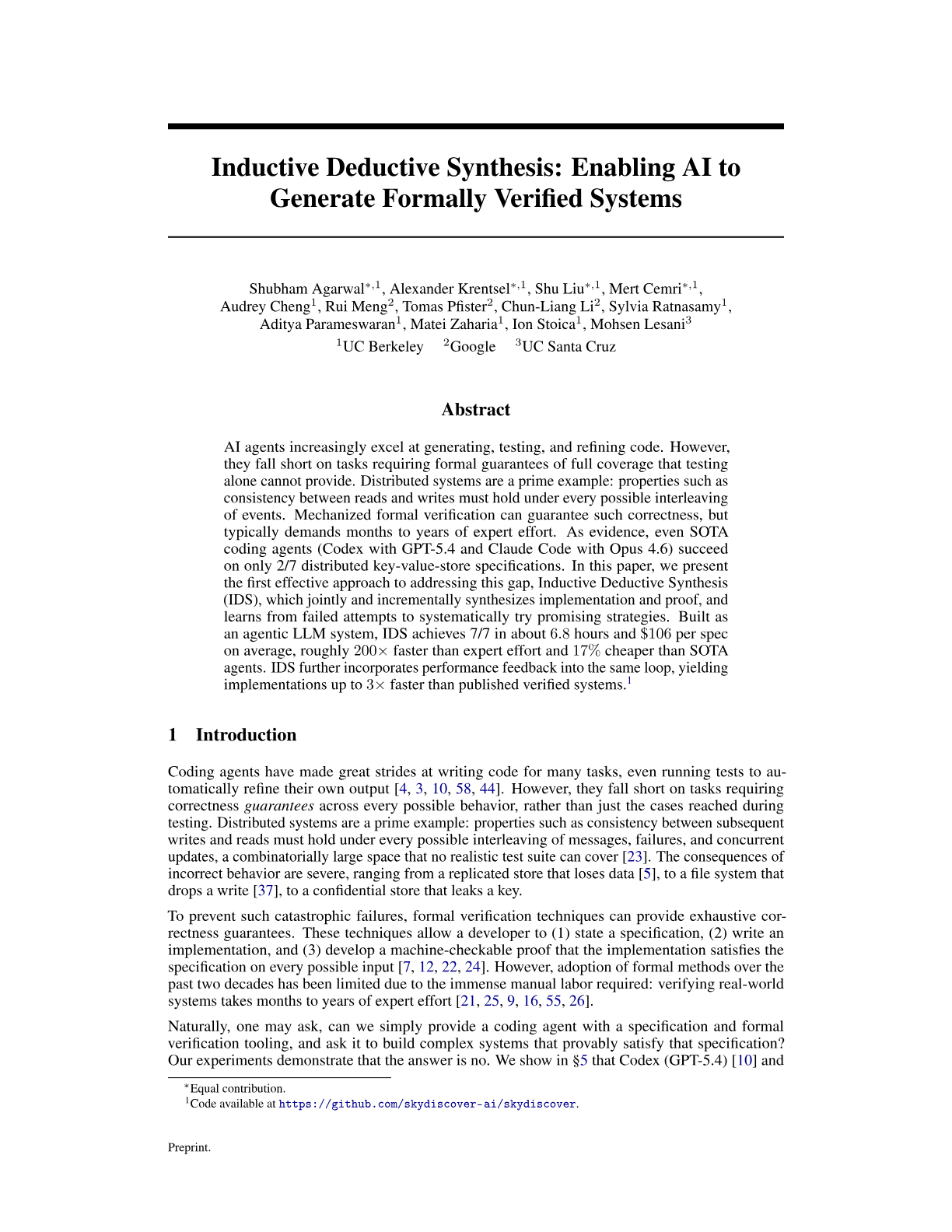
Inductive Deductive Synthesis: Enabling AI to Generate Formally Verified Systems
Shubham Agarwal, Alexander Krentsel, Shu Liu, Mert Cemri and colleagues (UC Berkeley with Google and UC Santa Cruz, including Ion Stoica, Matei Zaharia and Sylvia Ratnasamy) build Inductive Deductive Synthesis, an agentic LLM system that writes a distributed system's implementation and its mechanized correctness proof together, and it completes all seven key-value-store specifications it was given.
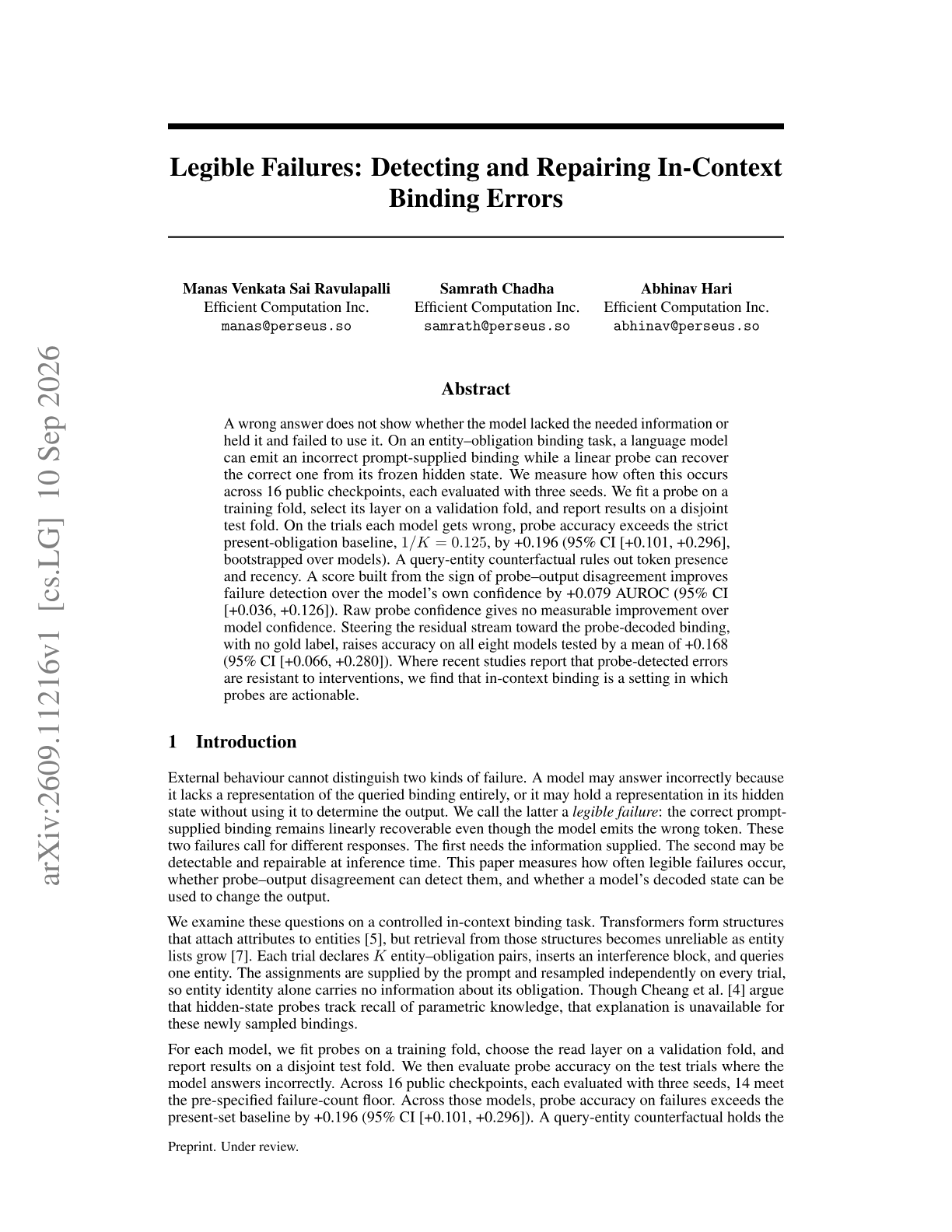
Legible Failures: Detecting and Repairing In-Context Binding Errors
Manas Ravulapalli, Samrath Chadha and Abhinav Hari (Efficient Computation Inc.) show that when LLMs give a wrong in-context binding, a linear probe can often read the correct binding from the hidden state, and steering toward it repairs the answer.
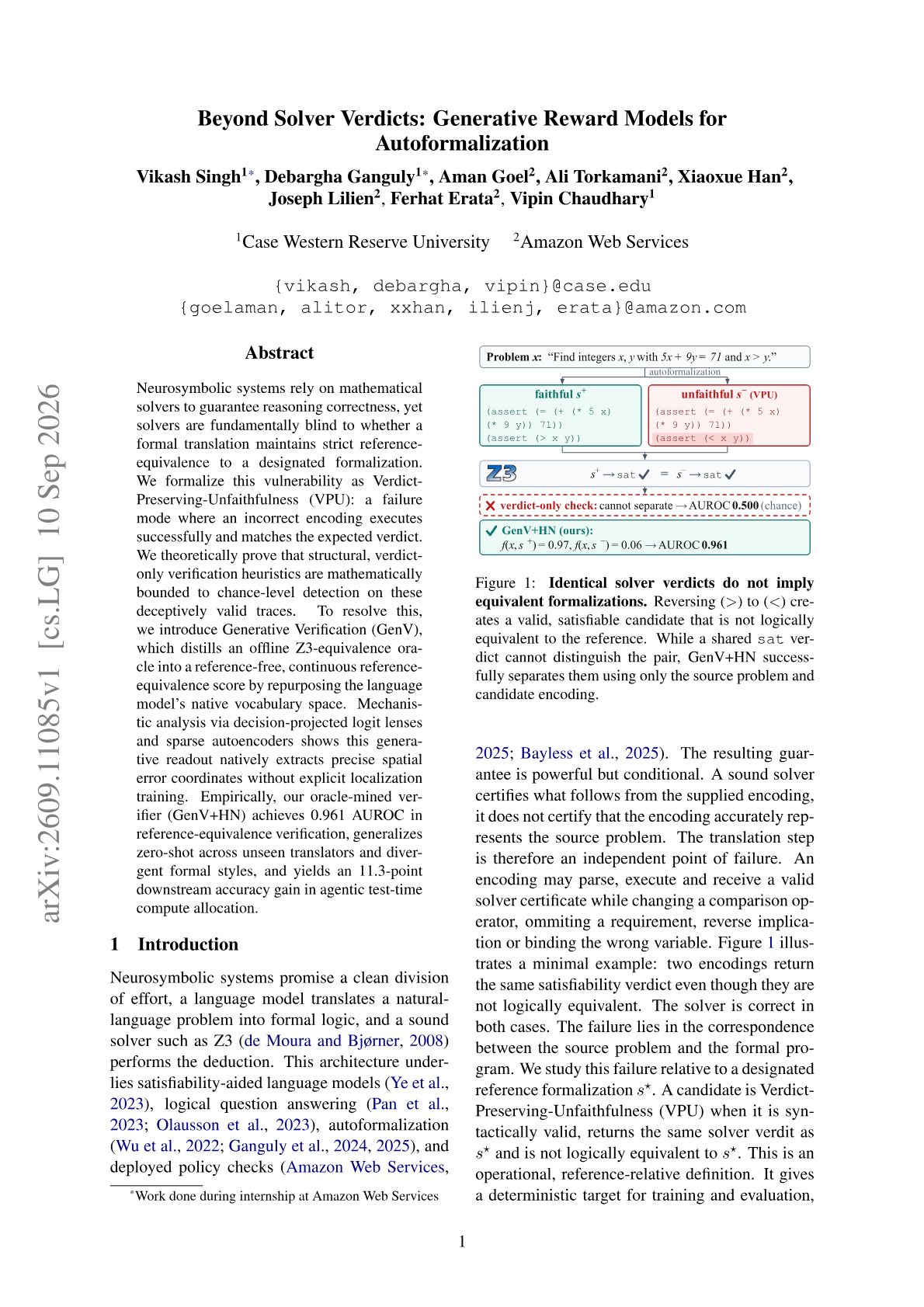
Beyond Solver Verdicts: Generative Reward Models for Autoformalization
Vikash Singh, Debargha Ganguly and colleagues (Case Western Reserve University with Amazon Web Services) show that solver verdicts cannot detect formal translations that are wrong but still return the expected verdict, and train a generative verifier that scores equivalence to the reference formalization.
Autonomous Chemical Mechanistic Discovery through Agentic Reasoning and Validation
Dong Li, Biqing Qi and colleagues (Shanghai AI Laboratory with Harbin Institute of Technology and others) build ARCHE, an agent that proposes reaction mechanisms, runs computational chemistry workflows to test them and revises conclusions from the computed evidence.
When Agents Disagree: Bayesian Backward Reasoning as a Label-Free Anchor for Multi-Agent Collective Decision-Making
Ken Chen, Saman Halgamuge and colleagues (University of Melbourne) resolve disagreement between LLM agents by comparing each agent's forward answer with a posterior computed by Bayesian backward reasoning, which is less likely to share the same errors.
Building py-kvcache: A Performance Characterization of External KV Caching for vLLM with NVMe SSDs
Joseph Kanichai, Tiziano De Matteis (Vrije Universiteit Amsterdam) and Animesh Trivedi (IBM Research) measure when loading KV cache from CPU or NVMe is faster than recomputing it in vLLM, and build py-kvcache, an offload connector that starts disk reads while requests are still queued.

Auto-RecSys: Harnessing Autonomous Research Agents for Industry-Scale Recommender System
Ming Li, Dai Li and colleagues at Meta build Auto-RecSys, an autonomous research agent system that runs multi-day experiments on industry-scale recommendation models, built around three harness designs and two self-improvement loops.
SpecGuard: Inference-Time Backdoor Detection For Free
Rui Wen (Institute of Science Tokyo), Ahmed Salem and Andrew Paverd (Microsoft Security Response Center), Mark Russinovich (Microsoft Azure) and Zheng Li (Shandong University) detect backdoor activation at inference time by reading the draft-token acceptance rate that speculative decoding already computes, so detection adds no model computation.

But How Would AI Agents Run a Town's Economy?
Sajal Regmi, Siddhartha Pudasaini and Chetan Phakami Pun (Karela Technologies) put 100 memory-equipped LLM agents in charge of a closed town economy for up to 26 simulated weeks and find that money stops circulating: demand shocks raise revenue but wages and prices barely move.
Fork Where the Model Changes Its Mind: Belief-Shift Branching for Tree-Structured Reinforcement Learning
Bin Lei and colleagues at Salesforce AI Research and the University of Minnesota place the forks of tree-structured RLVR rollouts at the step where the model's answer belief shifts most, which gives step-level credit where the outcome is still undecided.
Decoupling Readiness from Release for Tail-Aware Scheduling of Agentic LLM Workflows
Bochao Feng, Jidong Zhai and colleagues (USTB, Qiyuan Laboratory and Tsinghua) schedule agentic LLM workflows by deciding when ready turns are released to the inference engine, instead of releasing them as soon as they are ready, and cut P95 workflow time by up to 3.50x.
ORCH: Organizational Principles Enable Collective Intelligence in Embodied AI
Zhengran Ji, Jonathan Hyun and Boyuan Chen (Duke University) apply human organization theory to build task-specific hierarchies for teams of up to 50 embodied LLM agents, and beat four prior multi-agent frameworks across 25 wildfire-response missions.

Grounding Agent Memory: Environment-Probing Curation for Enterprise Agents
Susheel Suresh and colleagues at Microsoft give the memory-curator agent in a GitHub Copilot harness read-only tools to check candidate memories against the live environment before they are saved, which roughly doubles pass rate on a database exploration benchmark and halves cost.
What a Random Draw from the MCP Registry Contains, and What Tool-Use Benchmarks Contain Instead
Haseeb Mohammed Afsar (independent researcher) probes a seeded random sample of 400 servers from the 24,135-server MCP registry and finds that fewer than half start, and that popular tool-use benchmarks contain far more duplicated tools than real MCP servers do.
COBRA-Skills: Contextual Bandit-Guided Evolution for Agent Skill Optimization
Pingchen Lu, Zhongxiang Dai and colleagues (CUHK-Shenzhen, Tianjin University and NUS) treat agent skill optimization as a budgeted sequential decision problem and use a contextual bandit to decide which candidate skills are worth evaluating.

Memory Compression for High-Fanout Agent Sandboxes
Mengming Li, Ceyu Xu and colleagues (HKUST) build AgentZip, a memory compression system for agent workloads that spawn many concurrent sandboxes from a shared template, and cut sandbox memory by up to 8.7x.
SemVerBench: Benchmarking LLM Comprehension of Version-Constraint Resolution Semantics
Qibai Chen (independent researcher) and Zeming Liu (Brown University) measure how well frontier LLMs resolve package version constraints across npm, PEP 440 and Cargo, and find predictable rule-specific blind spots that tool delegation removes.
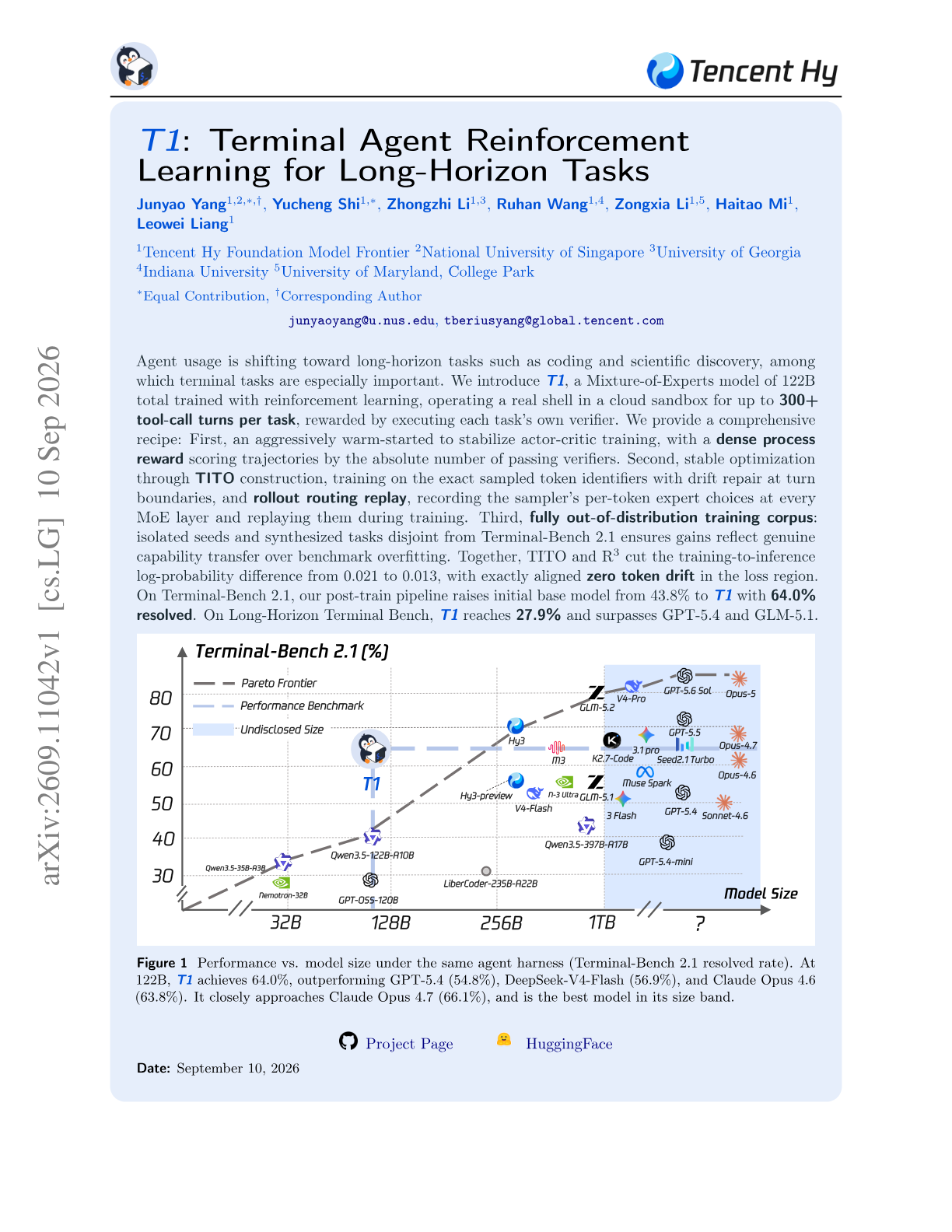
T1: Terminal Agent Reinforcement Learning for Long-Horizon Tasks
Junyao Yang, Yucheng Shi and colleagues at Tencent's Hy Foundation Model Frontier team (with NUS, Georgia, Indiana and Maryland) train T1, a 122B-total MoE model, with RL in a real cloud shell for up to 300+ tool-call turns per task, and raise Terminal-Bench 2.1 from 43.8% to 64.0%.