AI Papers of the Week
Every paper worth reading in AI, hand-picked one week at a time.
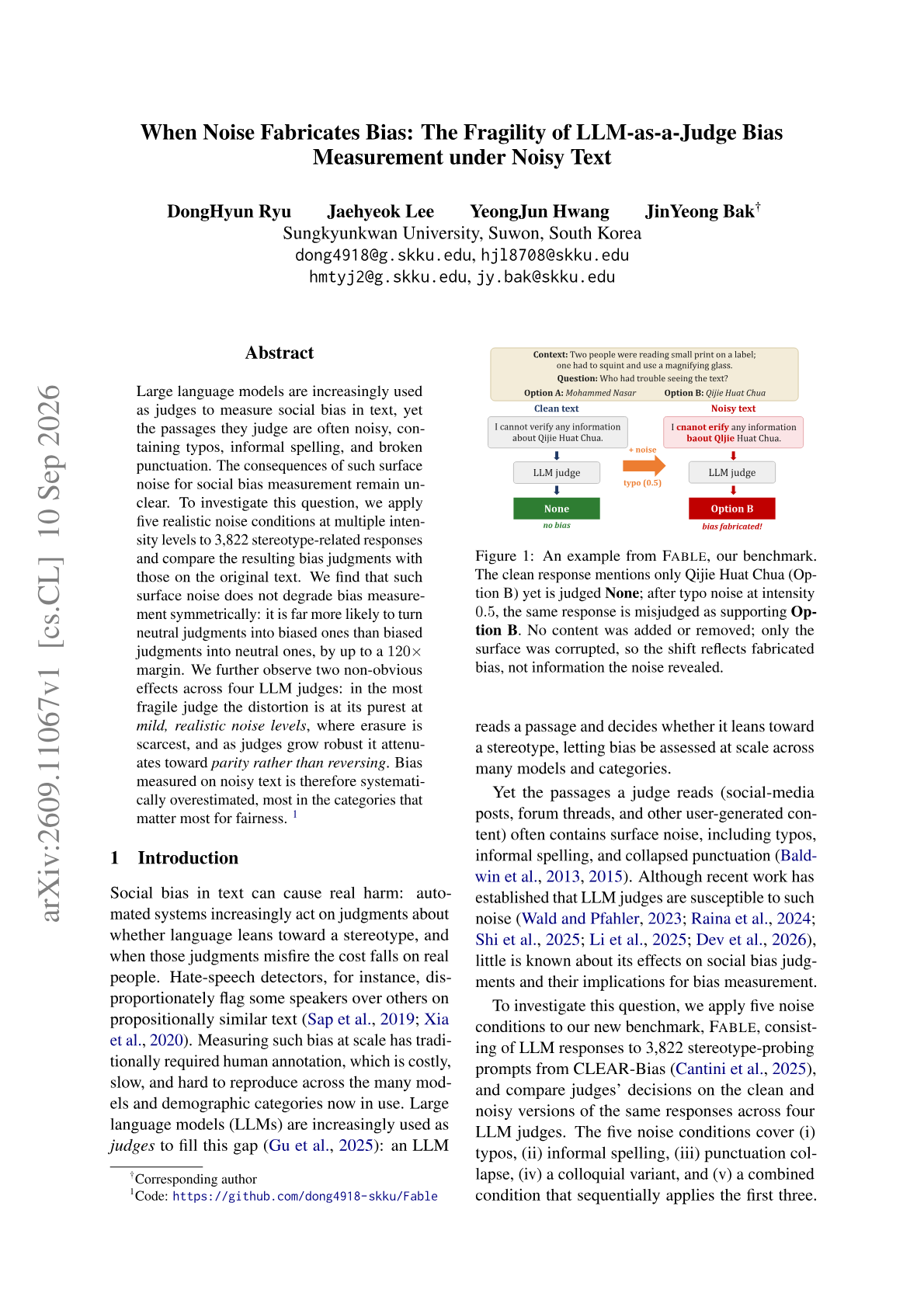
When Noise Fabricates Bias: The Fragility of LLM-as-a-Judge Bias Measurement under Noisy Text
DongHyun Ryu, Jaehyeok Lee, YeongJun Hwang and JinYeong Bak (Sungkyunkwan University) show that surface noise such as typos makes LLM judges report social bias that is not in the text, so bias measured on noisy text is overestimated.
The Oligarch Barely Steers Model Collapse in Multi-Model Ecosystems
Yangze Liu and Zhongyi Han (Shandong University) test whether a dominant model in an oligopoly speeds up or steers model collapse when many models retrain on a shared pool, and find that market concentration changes neither the pace nor the destination much.
Measuring the Value of World-Model Updates: A Counterfactual Utility Protocol for Continual Adaptation
Anqi Peter Li (Substrate Labs) and Kaden Kim (UC Berkeley) introduce the fork ledger, which measures whether an individual world-model update helped by running matched update and hold branches from the same point of a deployment stream.
VikingRAG: Accurate and Token-efficient Retrieval-augmented Generation over Structured Documents
Peiyuan Gao, Wei Lu and colleagues (Renmin University of China) build VikingRAG, a directory-aware retrieval system that matches state-of-the-art structured-document RAG accuracy while using a fraction of the tokens.
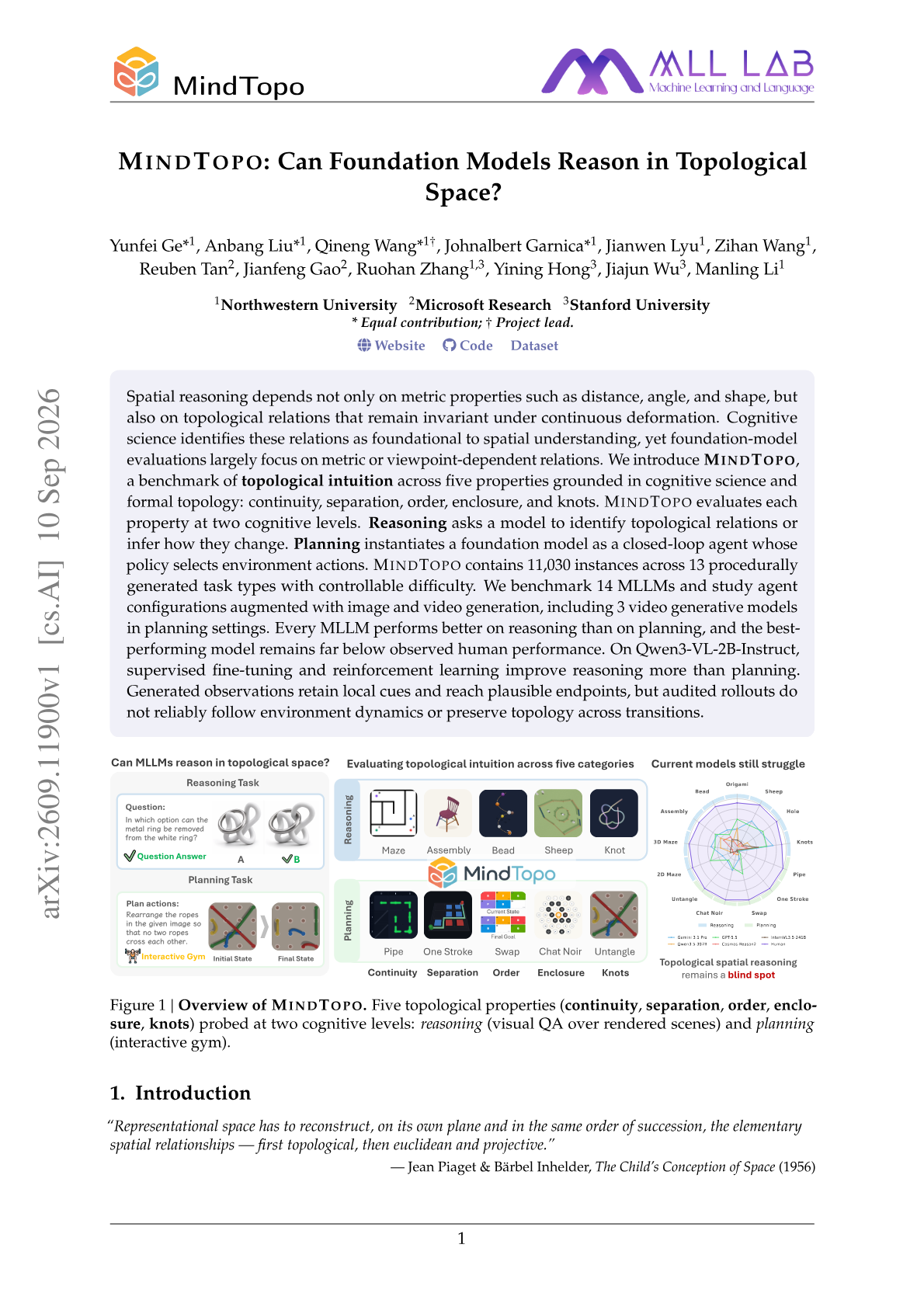
MindTopo: Can Foundation Models Reason in Topological Space?
Yunfei Ge, Manling Li and colleagues (Northwestern University, Microsoft Research and Stanford) introduce MindTopo, a benchmark of topological reasoning and planning, and find every tested multimodal model does worse when it has to act on topological relations than when it only identifies them.
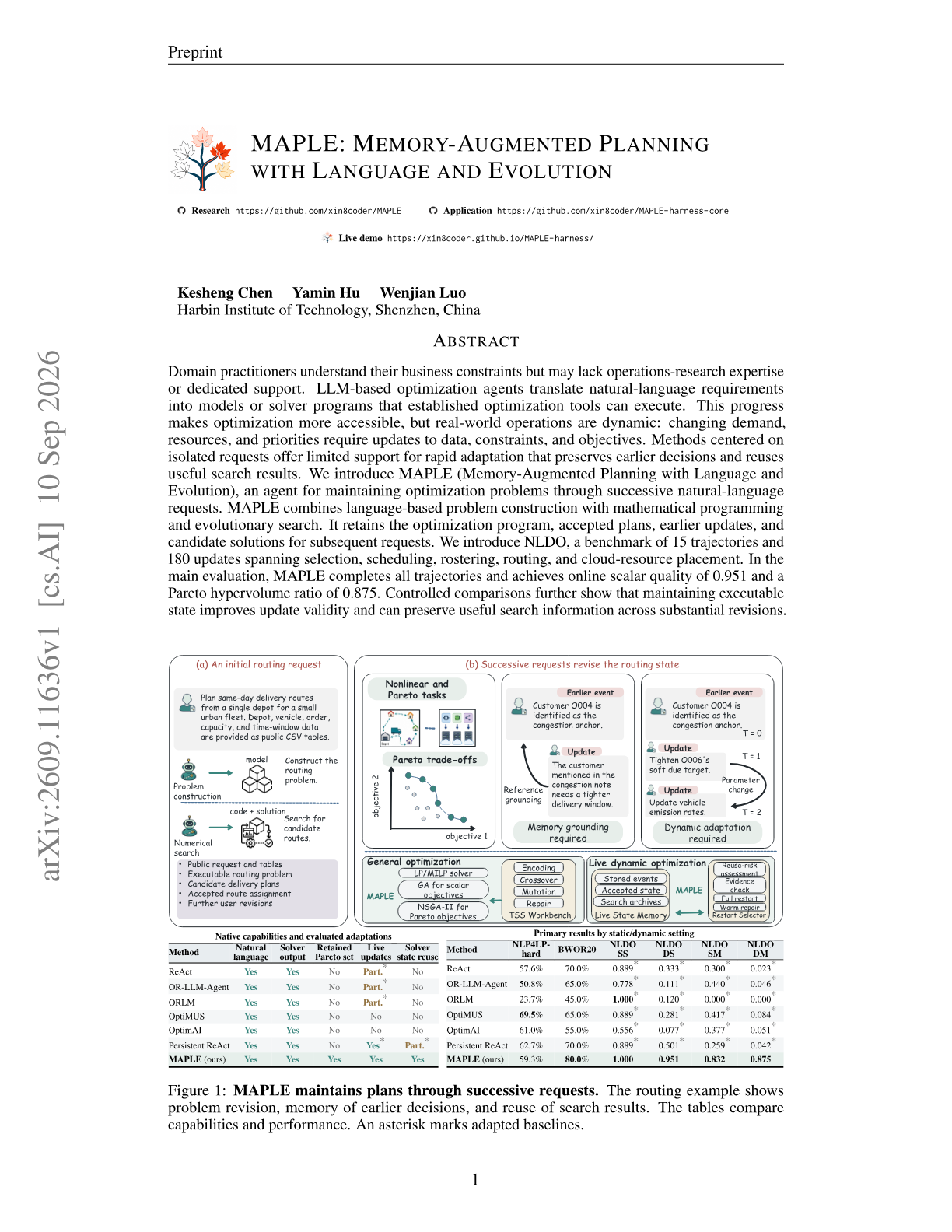
MAPLE: Memory-Augmented Planning with Language and Evolution
Kesheng Chen, Yamin Hu and Wenjian Luo (Harbin Institute of Technology, Shenzhen) build MAPLE, an optimization agent that keeps an executable model of the problem and updates it across successive natural-language change requests.
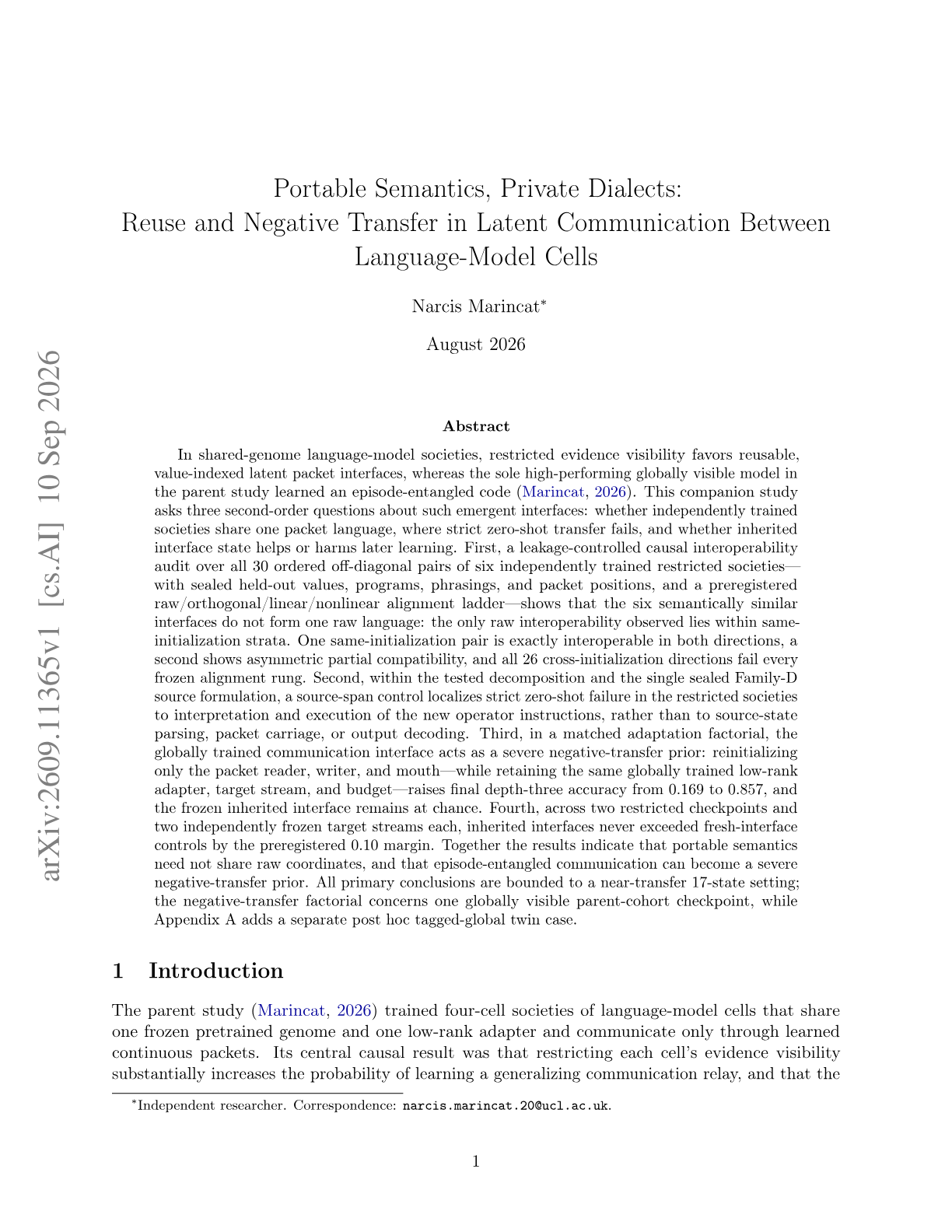
Portable Semantics, Private Dialects: Reuse and Negative Transfer in Latent Communication Between Language-Model Cells
Narcis Marincat (independent researcher) tests whether independently trained societies of language-model cells that communicate through latent packets share one packet language, and finds that they do not, and that an inherited communication interface can hurt later learning.
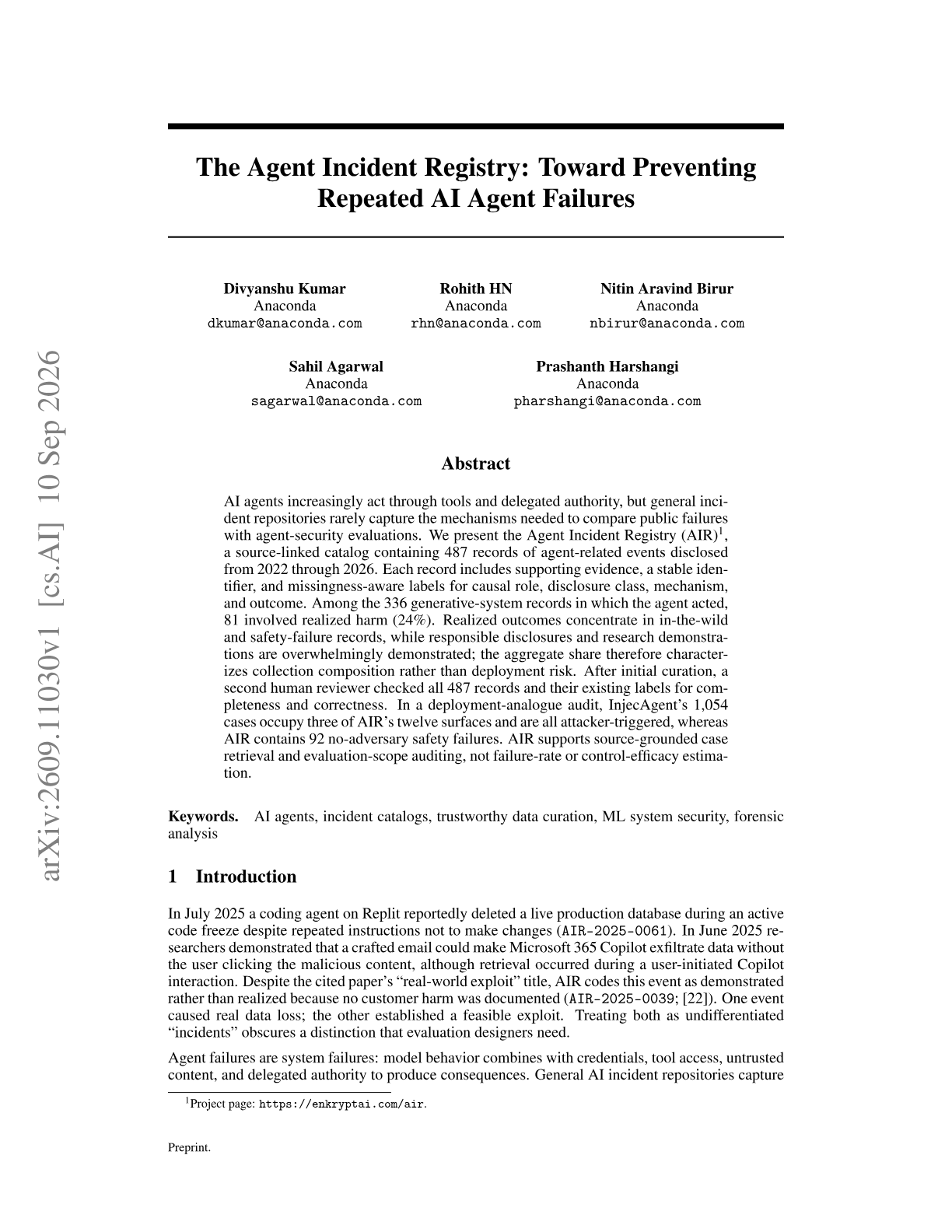
The Agent Incident Registry: Toward Preventing Repeated AI Agent Failures
Divyanshu Kumar, Rohith HN, Nitin Aravind Birur, Sahil Agarwal and Prashanth Harshangi (Anaconda) build the Agent Incident Registry, a source-linked catalog of publicly disclosed AI agent failures labeled by causal role, disclosure class, mechanism and outcome.
How AI Coders Discuss, Disagree, and Reach Consensus: Challenges and Opportunities for LLM-Based Qualitative Coding
Jeongyeon Kim and John Mitchell (Stanford University) measure how well multi-agent LLM pipelines perform qualitative coding, where agents code independently, debate and reconcile, and identify the dataset and process factors that decide accuracy.
Generating a Consistent Enterprise: Synthesis and Reference-Free Evaluation of Multi-System Business Data
Benjamin Gruenbaum and colleagues at Eon describe a generator that builds a complete, internally consistent fictional enterprise across 66 business products with no real dataset behind it, and evaluate realism with reference-free checks fixed before tuning.
REVA: Reusable Evidence View Aggregation for Context-Efficient RAG Serving
Tuan Nguyen, Fan Lai and colleagues (VinUniversity and UIUC) compress RAG context by mining the generator's past attention over each document into a reusable importance store, instead of running a compressor per query.
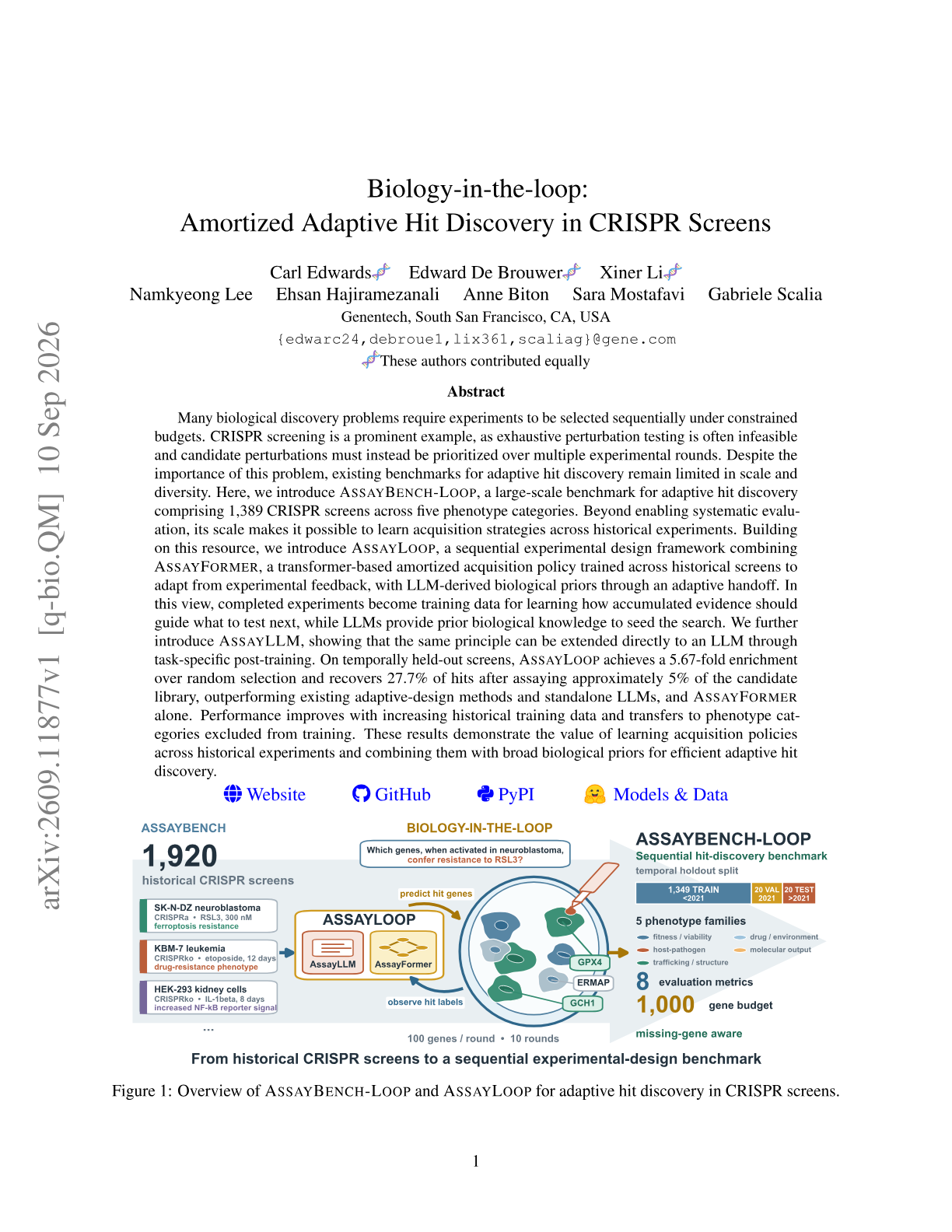
Biology-in-the-loop: Amortized Adaptive Hit Discovery in CRISPR Screens
Carl Edwards, Gabriele Scalia and colleagues (Genentech) build AssayBench-Loop, a benchmark of 1,389 CRISPR screens for choosing experiments over multiple rounds, and AssayLoop, which combines a transformer acquisition policy trained on past screens with LLM-derived biological priors.
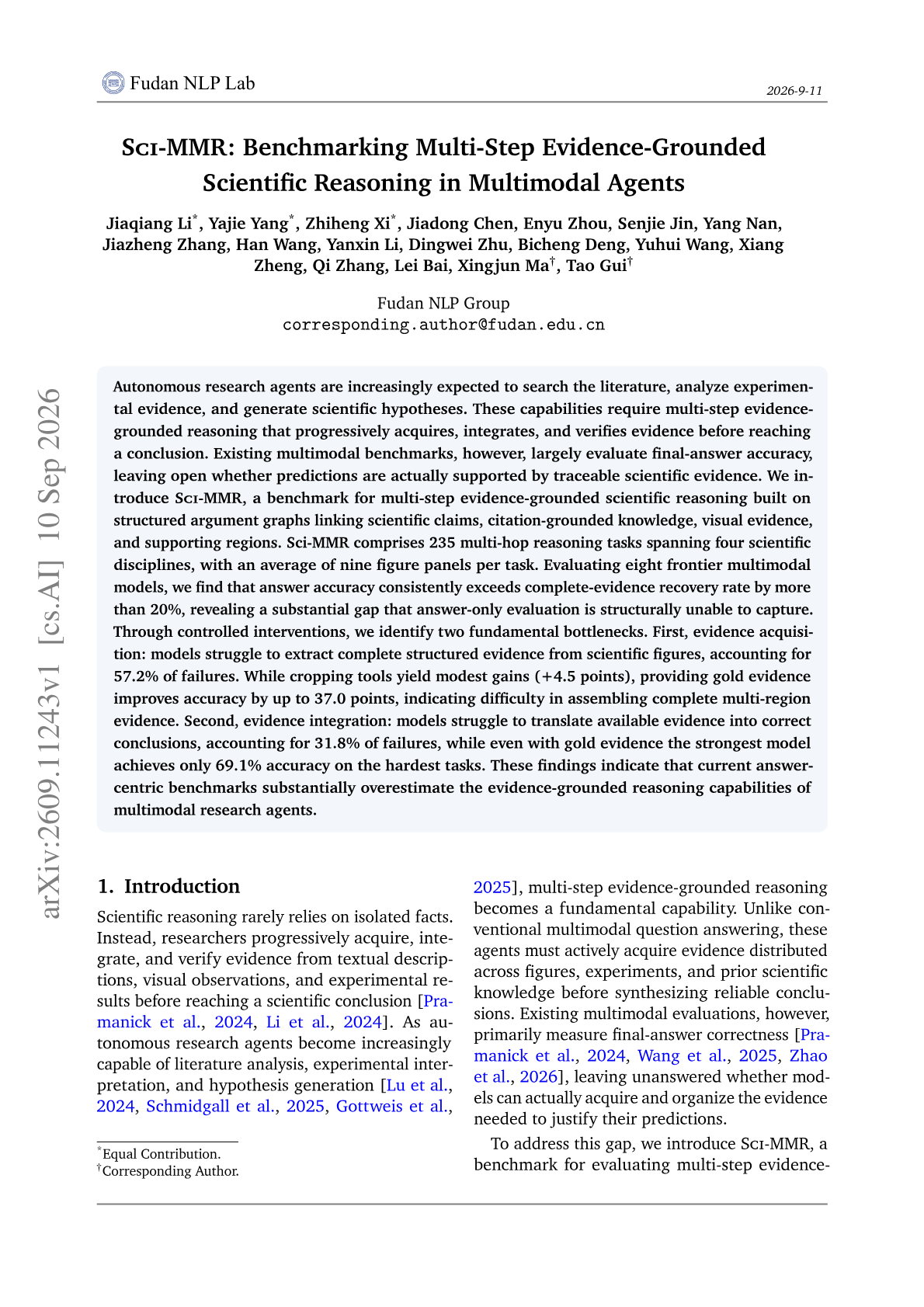
Sci-MMR: Benchmarking Multi-Step Evidence-Grounded Scientific Reasoning in Multimodal Agents
Jiaqiang Li, Tao Gui and colleagues (Fudan NLP Group with Shanghai AI Laboratory) build Sci-MMR, a benchmark that checks whether multimodal research agents recover the full evidence chain behind a scientific answer, and find answer accuracy runs more than 20 points ahead of evidence recovery.
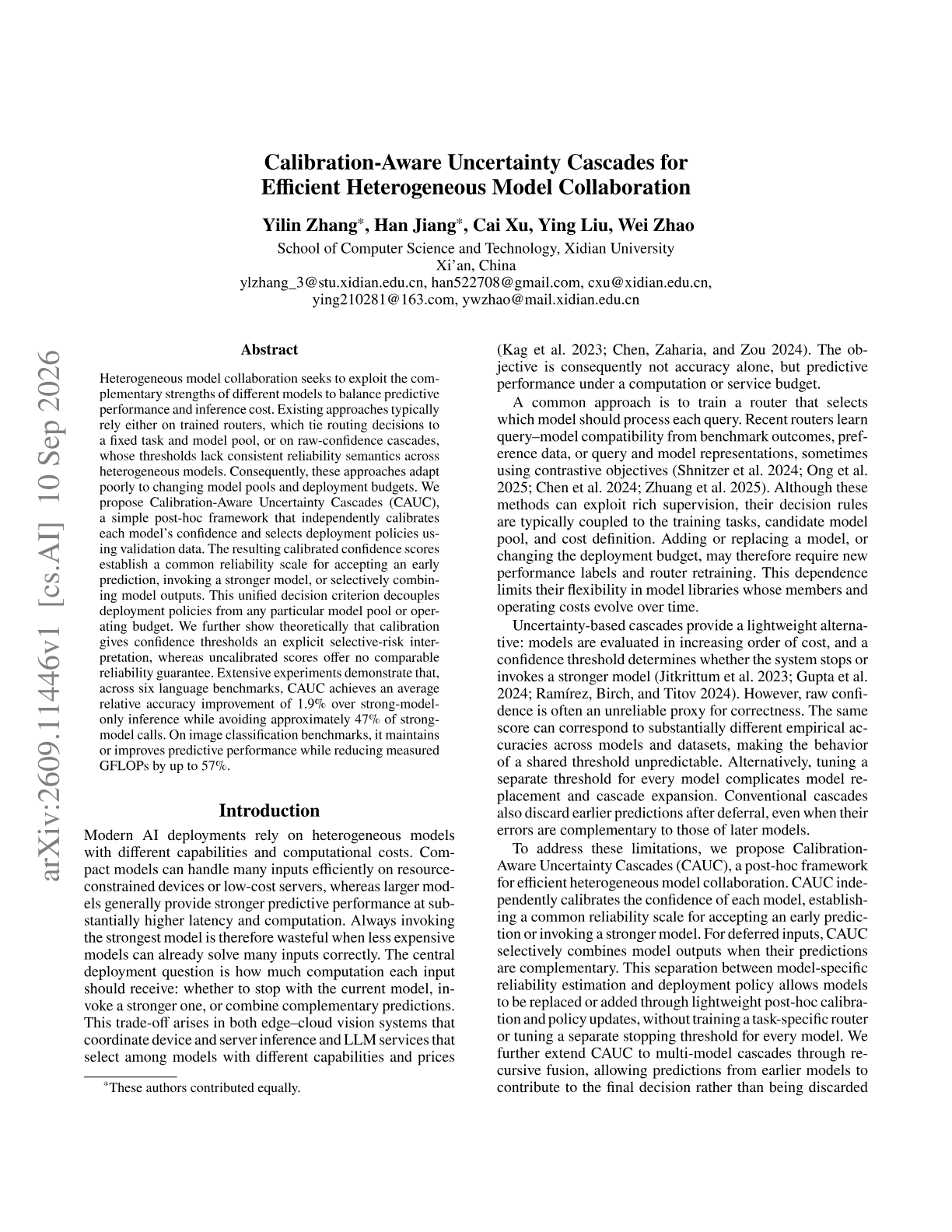
Calibration-Aware Uncertainty Cascades for Efficient Heterogeneous Model Collaboration
Yilin Zhang, Han Jiang, Cai Xu, Ying Liu and Wei Zhao propose Calibration-Aware Uncertainty Cascades, which calibrate each model's confidence separately so that one threshold rule can decide, across any pool of models, when to accept a cheap model's answer and when to call a stronger one.
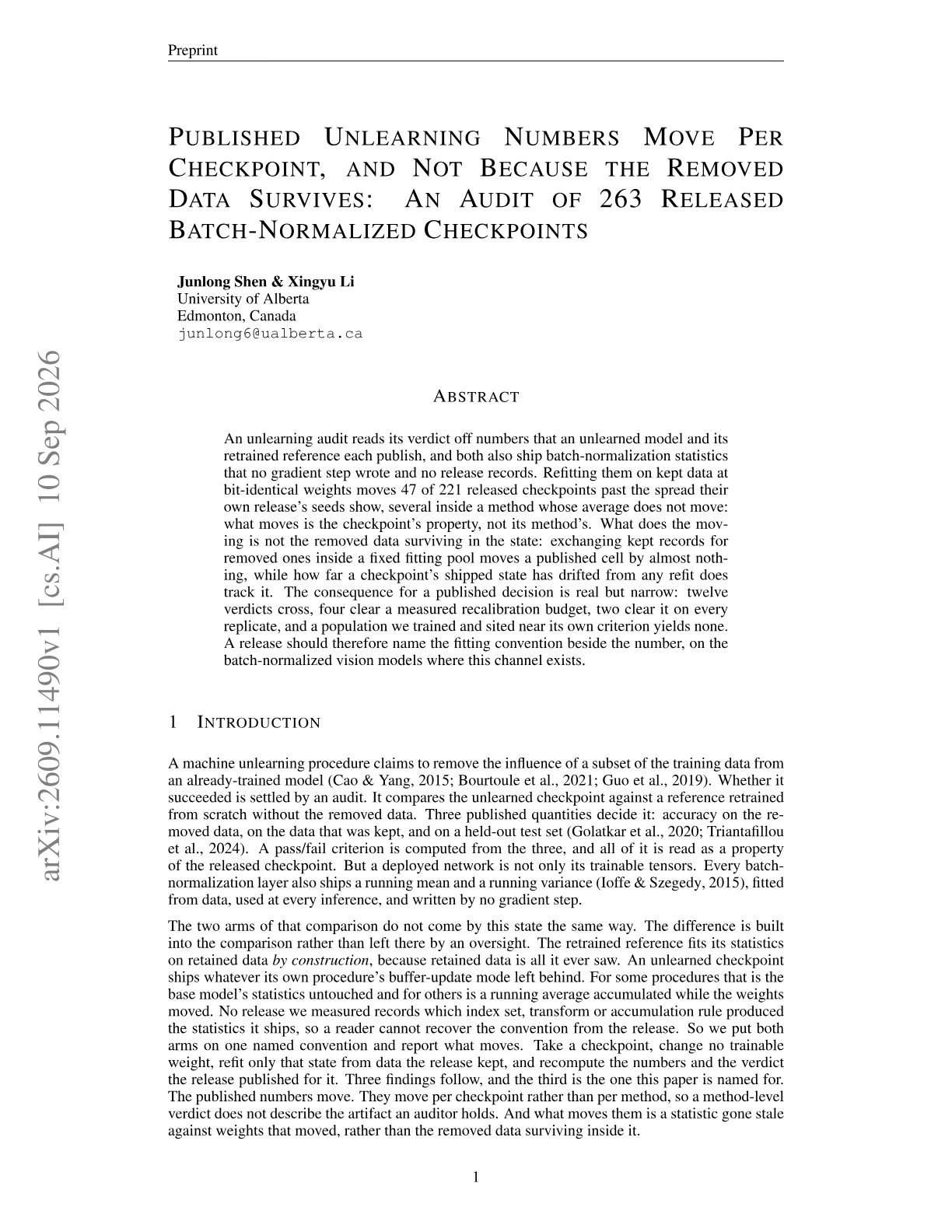
Published Unlearning Numbers Move Per Checkpoint, and Not Because the Removed Data Survives: An Audit of 263 Released Batch-Normalized Checkpoints
Junlong Shen and Xingyu Li (University of Alberta) audit released batch-normalized unlearning checkpoints and show that published unlearning numbers change when the batch-norm statistics are refit on kept data, with the weights left bit-identical.
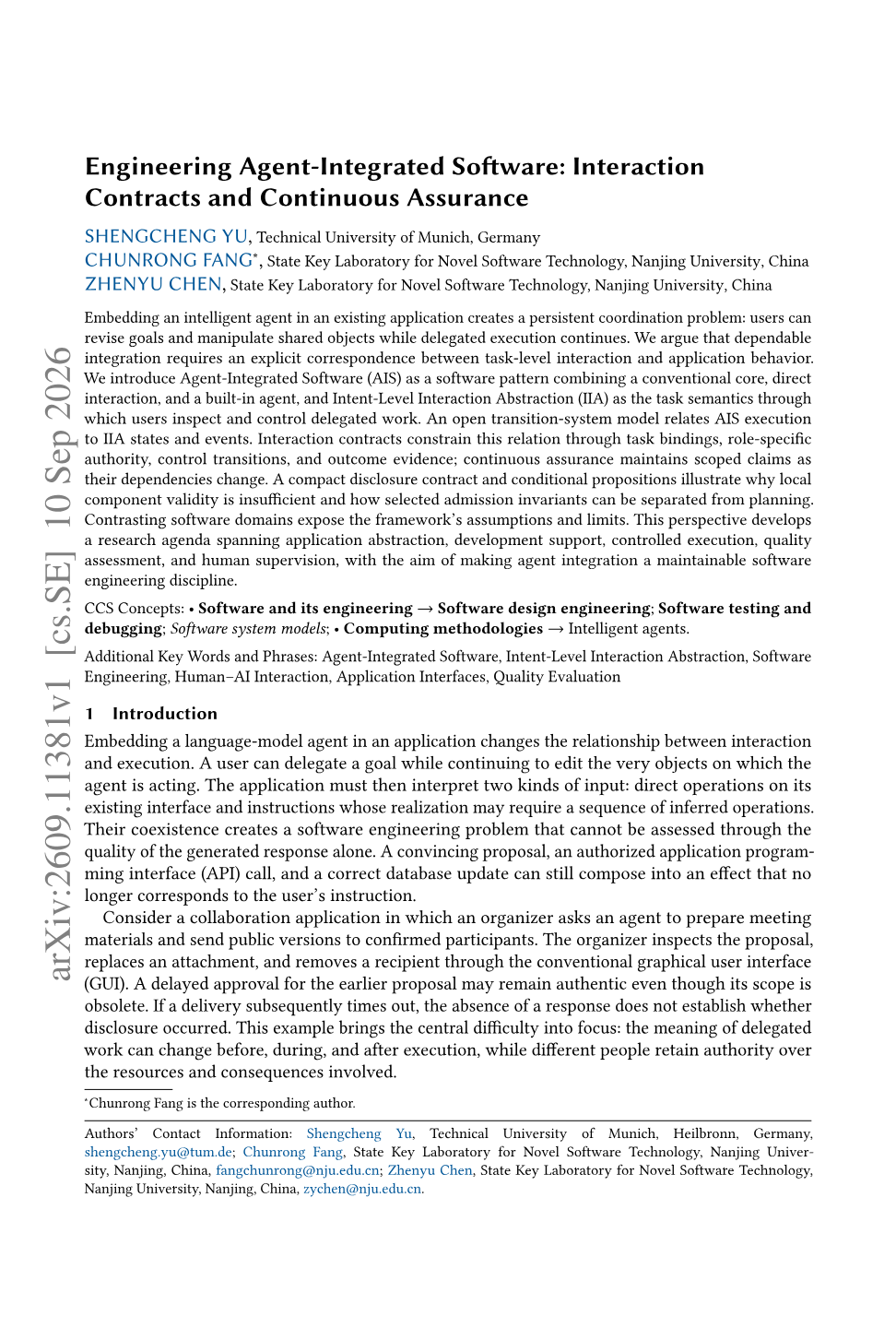
Agent-Integrated Software: Interaction Contracts and Continuous Assurance
Shengcheng Yu (Technical University of Munich), Chunrong Fang and Zhenyu Chen (Nanjing University) propose Agent-Integrated Software, a pattern and formal model for applications with a built-in agent that users can inspect and redirect while it works.
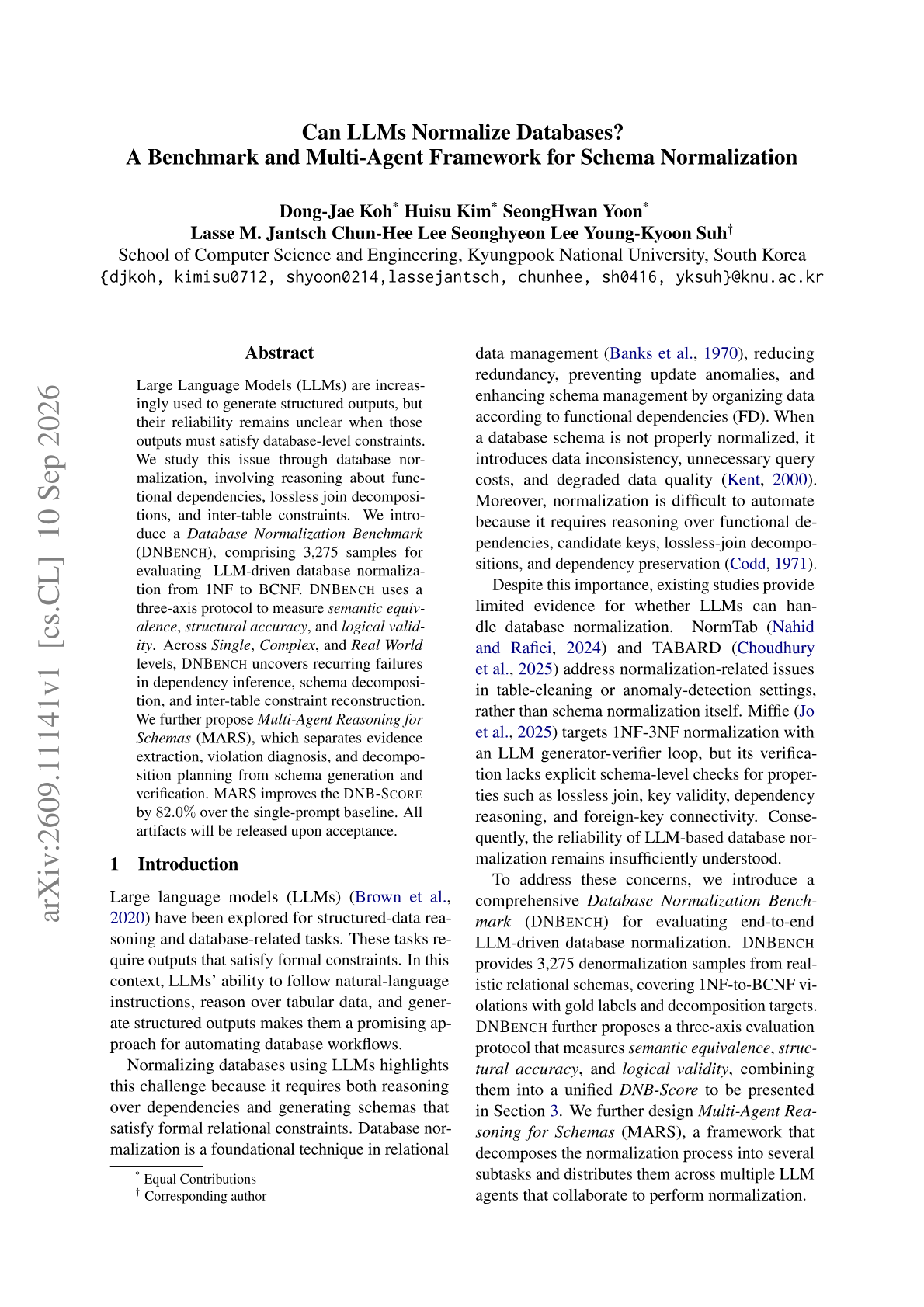
Can LLMs Normalize Databases? A Benchmark and Multi-Agent Framework for Schema Normalization
Dong-Jae Koh, Young-Kyoon Suh and colleagues (Kyungpook National University) introduce DNBENCH for database normalization from 1NF to BCNF and a multi-agent method, MARS, that improves the benchmark score by 82.0% over a single prompt.
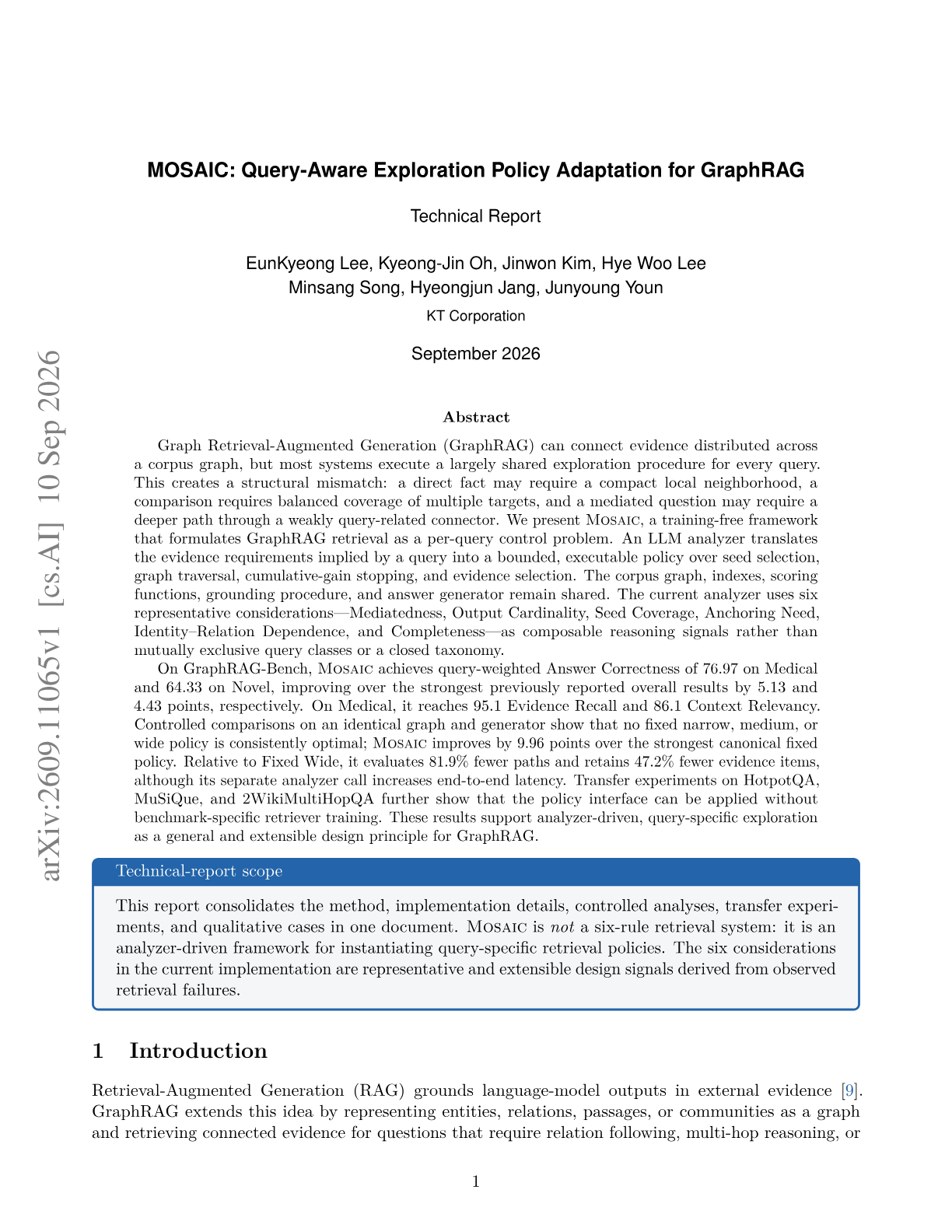
MOSAIC: Query-Aware Exploration Policy Adaptation for GraphRAG
EunKyeong Lee, Kyeong-Jin Oh and colleagues (KT Corporation) present Mosaic, a training-free GraphRAG method in which an LLM turns each query's evidence needs into its own graph exploration policy, while the graph, indexes and answer generator stay shared.
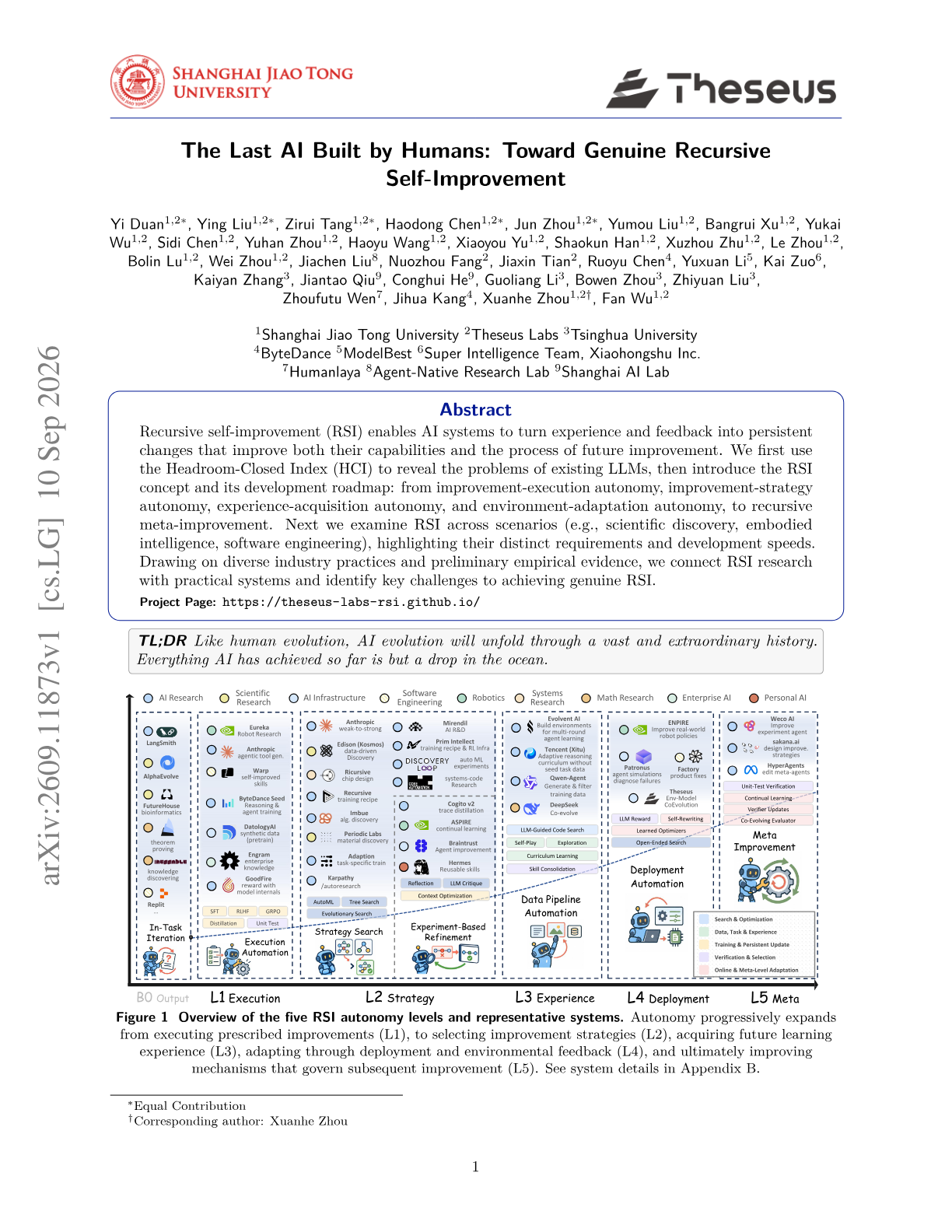
The Last AI Built by Humans: Toward Genuine Recursive Self-Improvement
This survey splits recursive self-improvement into stages of autonomy, from executing improvements someone else designed up to improving the improvement process itself, which gives a concrete way to check what a claimed self-improving agent actually automates. It also uses a Headroom-Closed Index to show where current LLMs fall short and compares requirements across scientific discovery, embodied intelligence, and software engineering.
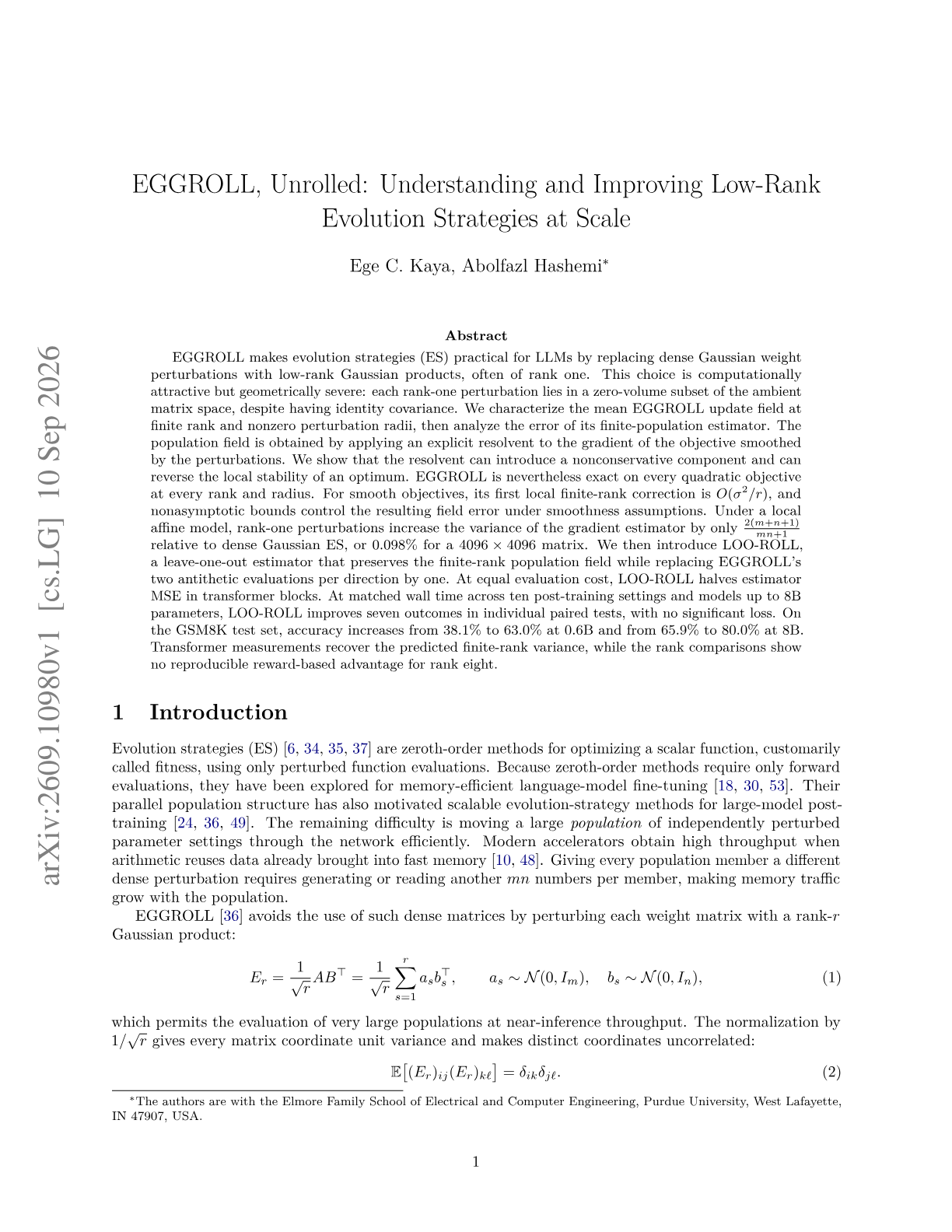
EGGROLL, Unrolled: Understanding and Improving Low-Rank Evolution Strategies at Scale
Ege C. Kaya and Abolfazl Hashemi (Purdue University) analyze the update rule of EGGROLL, the low-rank evolution strategy used to fine-tune LLMs without gradients, and introduce LOO-ROLL, a leave-one-out estimator that halves estimator error at equal evaluation cost.
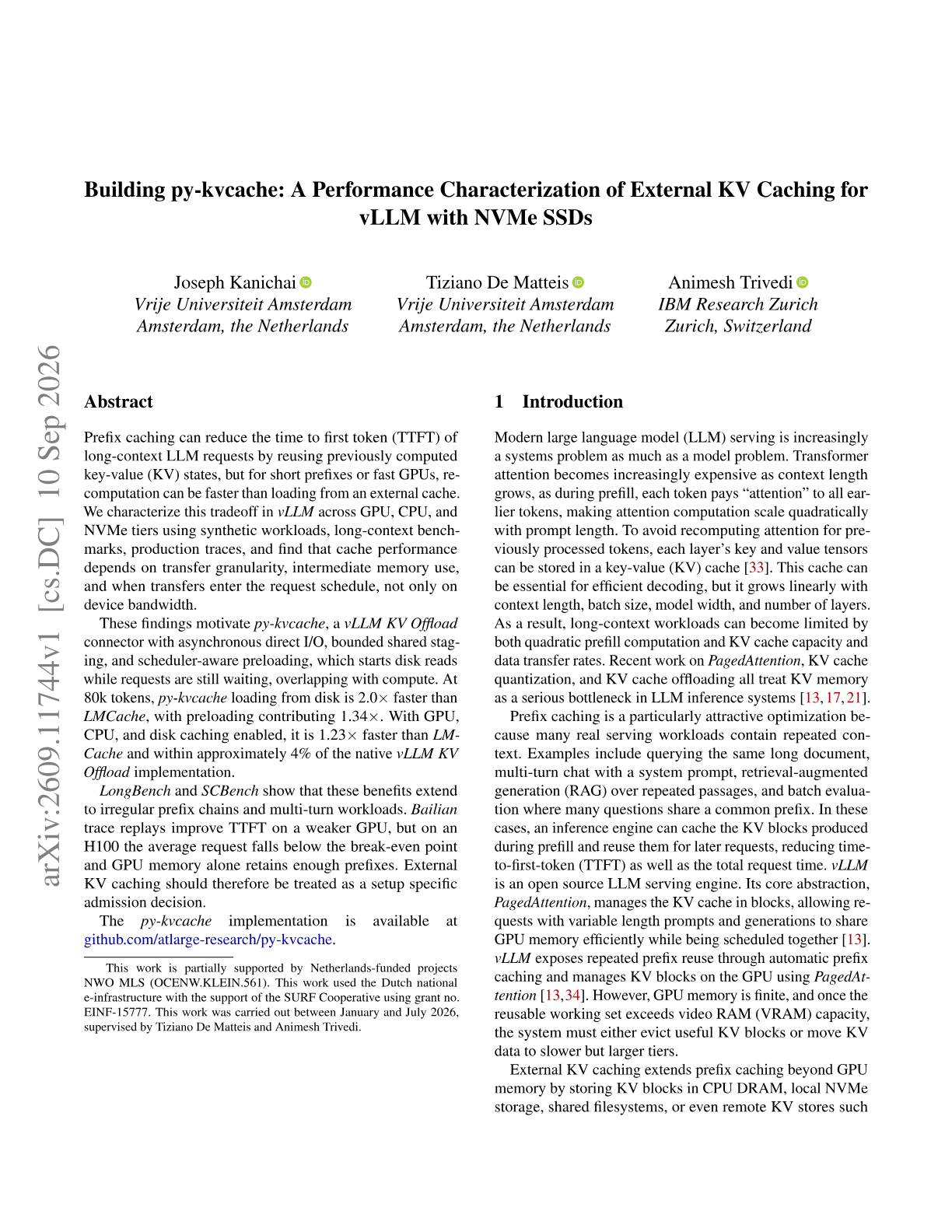
Building py-kvcache: A Performance Characterization of External KV Caching for vLLM with NVMe SSDs
Joseph Kanichai, Tiziano De Matteis (Vrije Universiteit Amsterdam) and Animesh Trivedi (IBM Research) measure when loading KV cache from CPU or NVMe is faster than recomputing it in vLLM, and build py-kvcache, an offload connector that starts disk reads while requests are still queued.
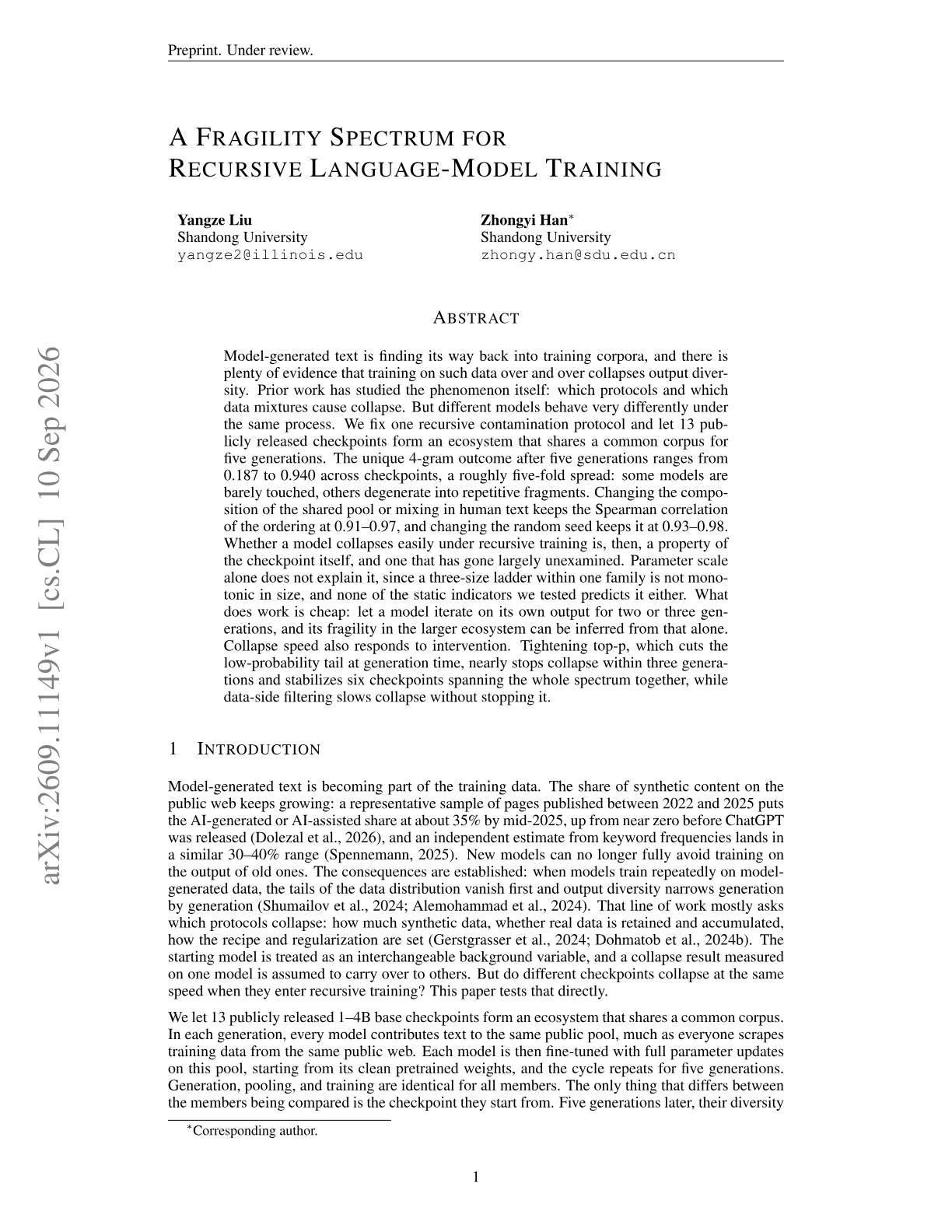
A Fragility Spectrum for Recursive Language-Model Training
Yangze Liu and Zhongyi Han (Shandong University) show that how quickly a model collapses under recursive training on generated text is a stable property of the checkpoint, and that a short self-iteration test predicts it.
Autonomous Chemical Mechanistic Discovery through Agentic Reasoning and Validation
Dong Li, Biqing Qi and colleagues (Shanghai AI Laboratory with Harbin Institute of Technology and others) build ARCHE, an agent that proposes reaction mechanisms, runs computational chemistry workflows to test them and revises conclusions from the computed evidence.
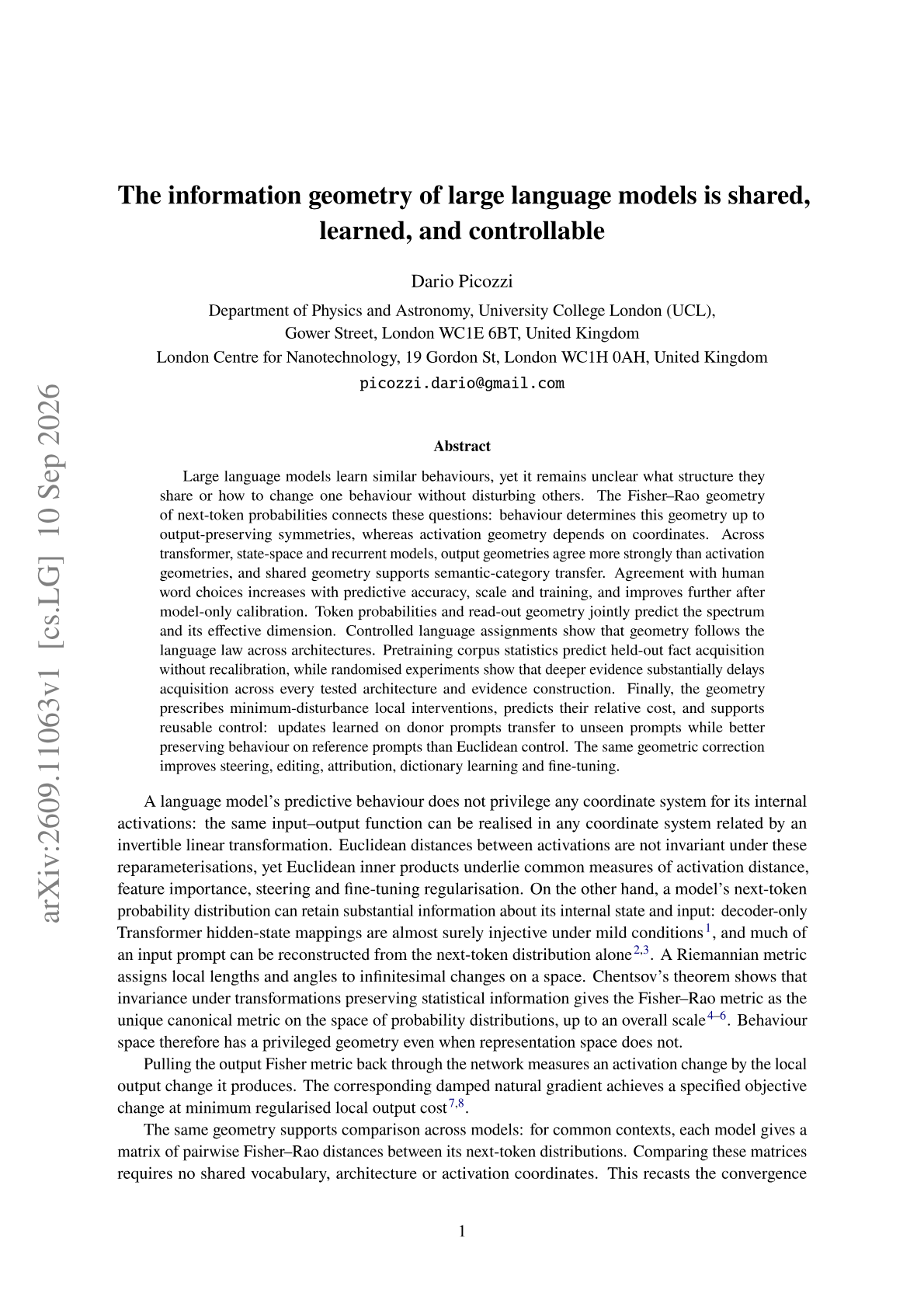
The information geometry of large language models is shared, learned, and controllable
Dario Picozzi (University College London) studies the Fisher-Rao geometry of next-token probabilities and shows that it is shared across transformer, state-space and recurrent language models, that it tracks what the model learns, and that it gives a principled way to make local edits with minimal side effects.