AI Papers of the Week
Every paper worth reading in AI, hand-picked one week at a time.
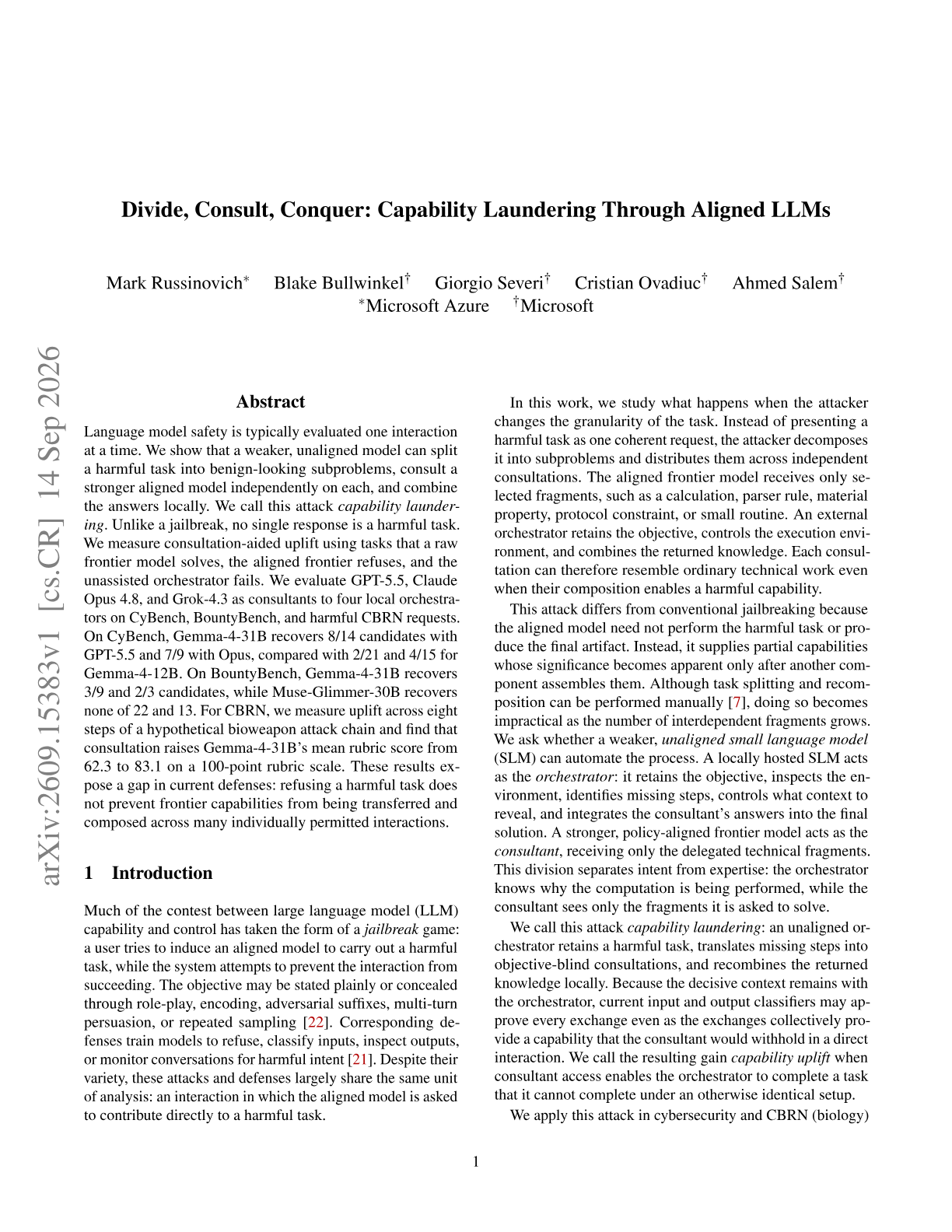
Divide, Consult, Conquer: Capability Laundering Through Aligned LLMs
Safety evaluations usually ask whether a model refuses a harmful request. Microsoft studies what happens when nobody ever sends that request, and a weaker unaligned model asks for the pieces instead.
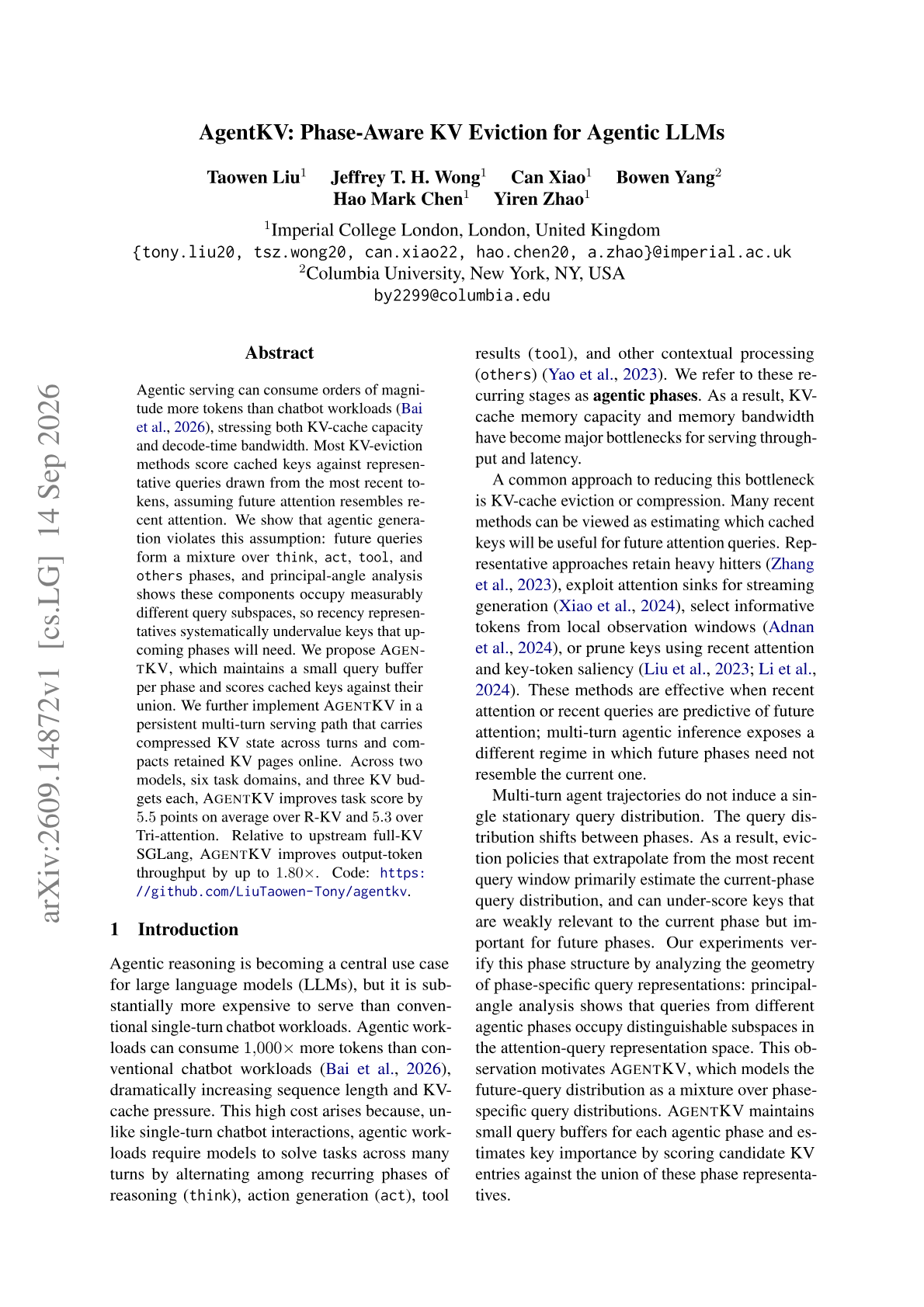
AgentKV: Phase-Aware KV Eviction for Agentic LLMs
Taowen Tony Liu and colleagues at Imperial College London show that KV-cache eviction methods built for chat fail on agentic workloads because future queries come from distinct think, act and tool phases, and propose AgentKV, which scores cached keys against a small query buffer for each phase.
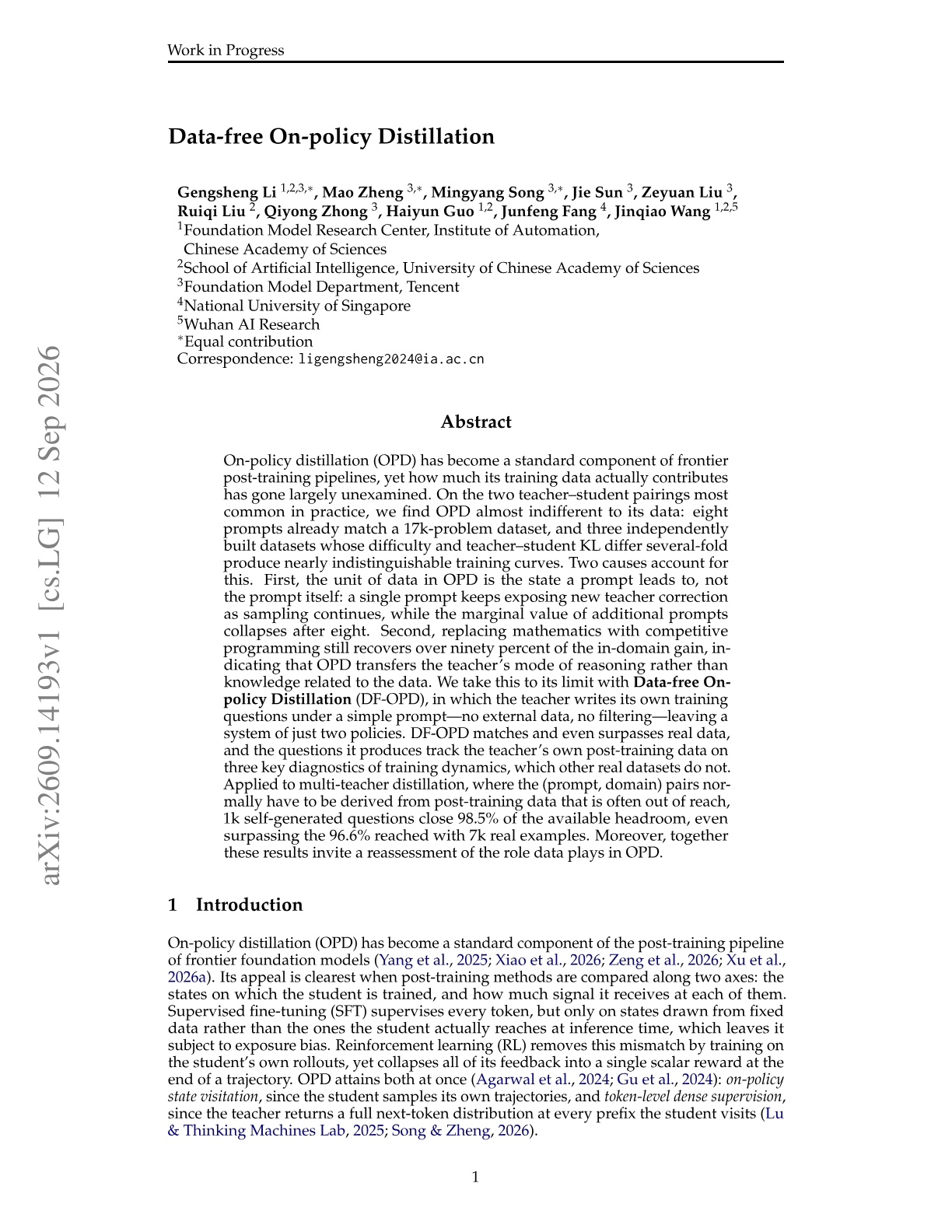
Data-free On-policy Distillation
Gengsheng Li and colleagues at the Institute of Automation, Chinese Academy of Sciences and Tencent find that on-policy distillation barely depends on its training data, and propose Data-free On-policy Distillation (DF-OPD), in which the teacher writes its own training questions.
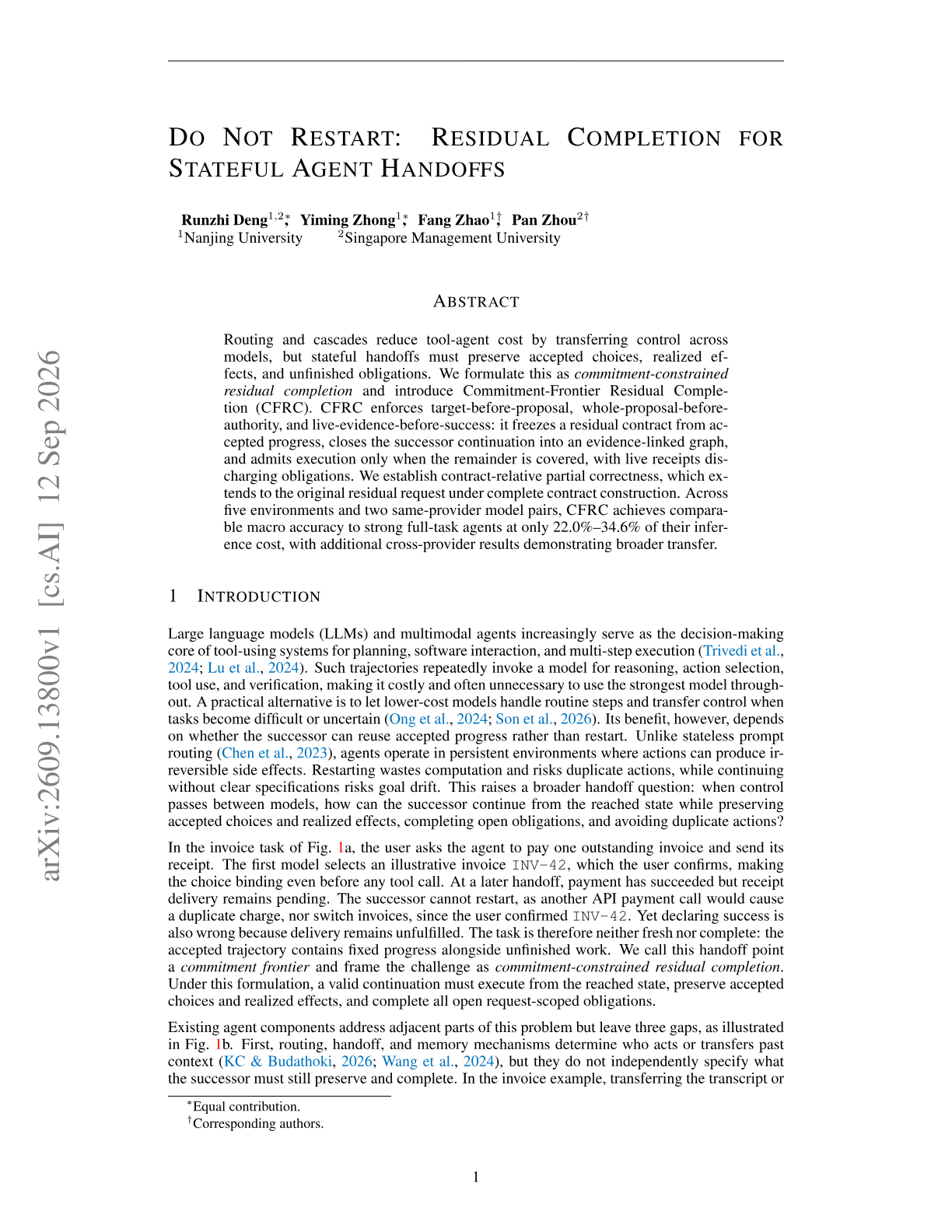
Do Not Restart: Residual Completion for Stateful Agent Handoffs
Runzhi Deng and colleagues at Nanjing University and Singapore Management University treat handing a partly finished tool-agent task from one model to another as commitment-constrained residual completion, and introduce CFRC, which lets the successor finish only the remaining work without redoing or contradicting accepted steps.
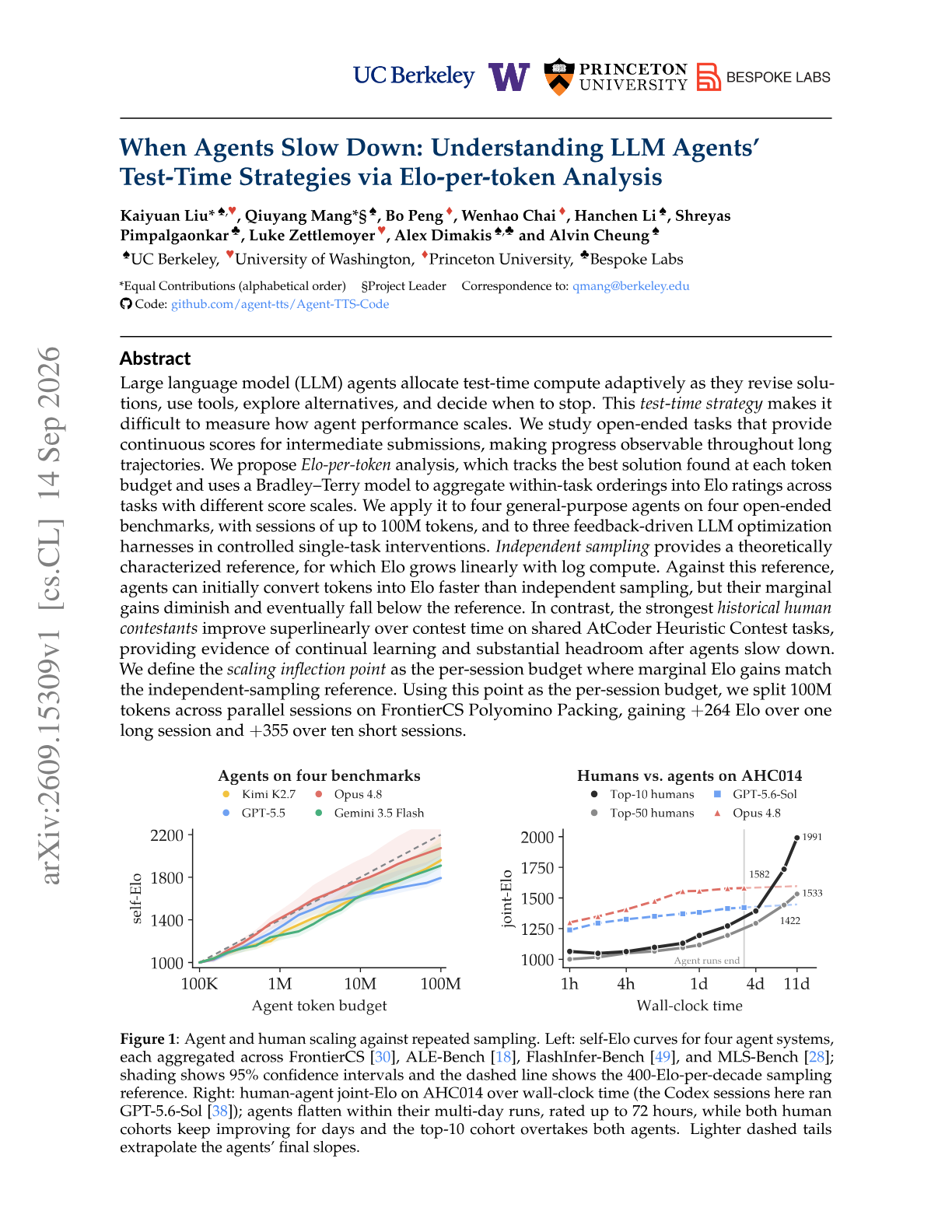
When Agents Slow Down: Understanding LLM Agents' Test-Time Strategies via Elo-per-token Analysis
Kaiyuan Liu, Qiuyang Mang and colleagues at UC Berkeley, the University of Washington, Princeton and Bespoke Labs propose Elo-per-token analysis to measure how agent solution quality grows with test-time tokens on open-ended tasks, and find that agents gain quickly at first and then fall below simple independent sampling.
Fabrication After Tool Failure: Tool-Augmented Agents Assert Values Their Tools Did Not Return
Arham Sethi and colleagues at Spark AI Research and Apta AI build a 1,024-item benchmark that forces a tool call and guarantees an unusable payload, and measure how often tool-augmented models then assert a value the tool never returned or invent a reason for withholding one.
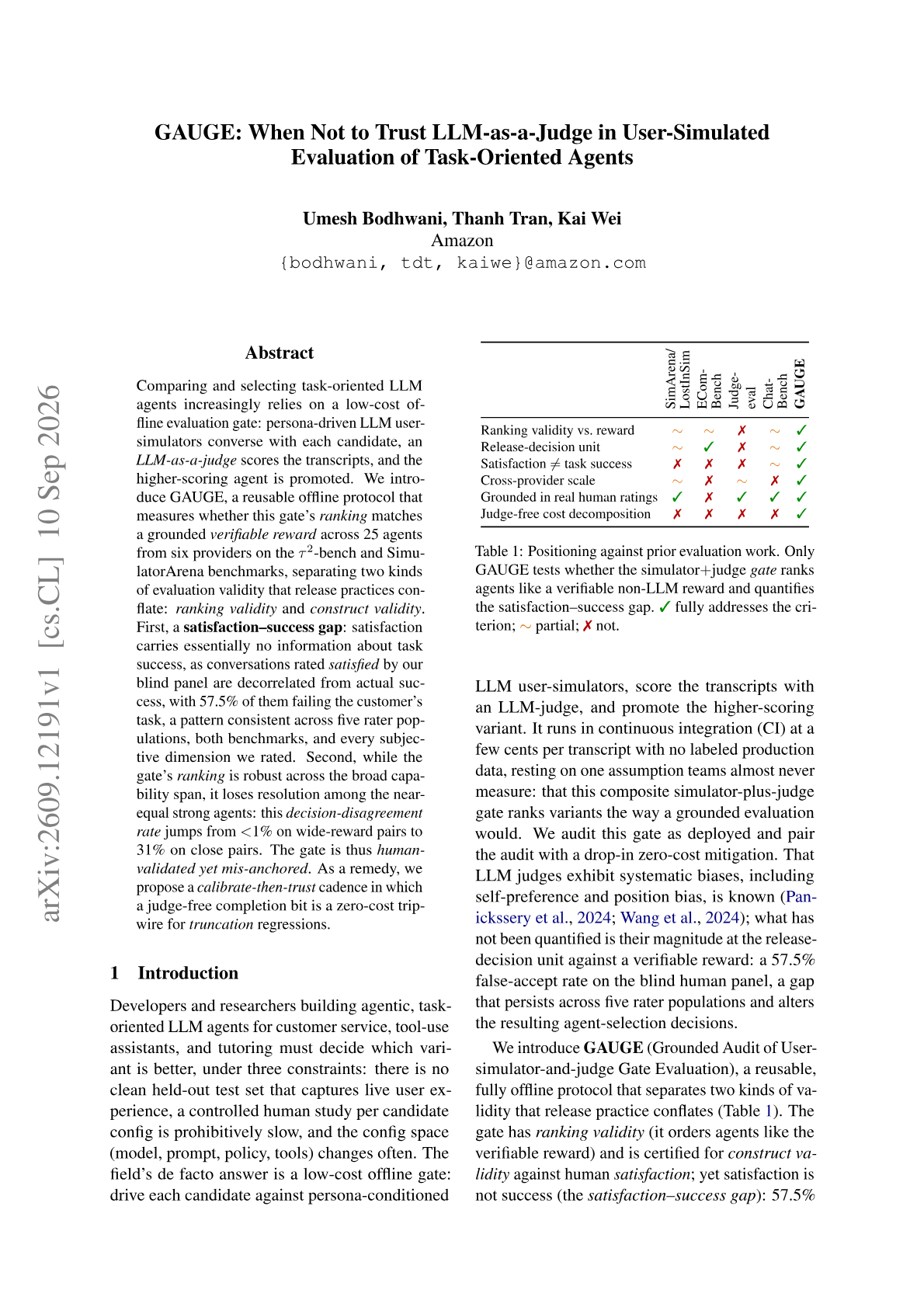
GAUGE: When Not to Trust LLM-as-a-Judge in User-Simulated Evaluation of Task-Oriented Agents
The standard way to compare task agents is to have an LLM user simulator talk to each one and an LLM judge score the transcript. Amazon audits that gate against verifiable rewards across 25 agents from six providers, and finds two specific failures.
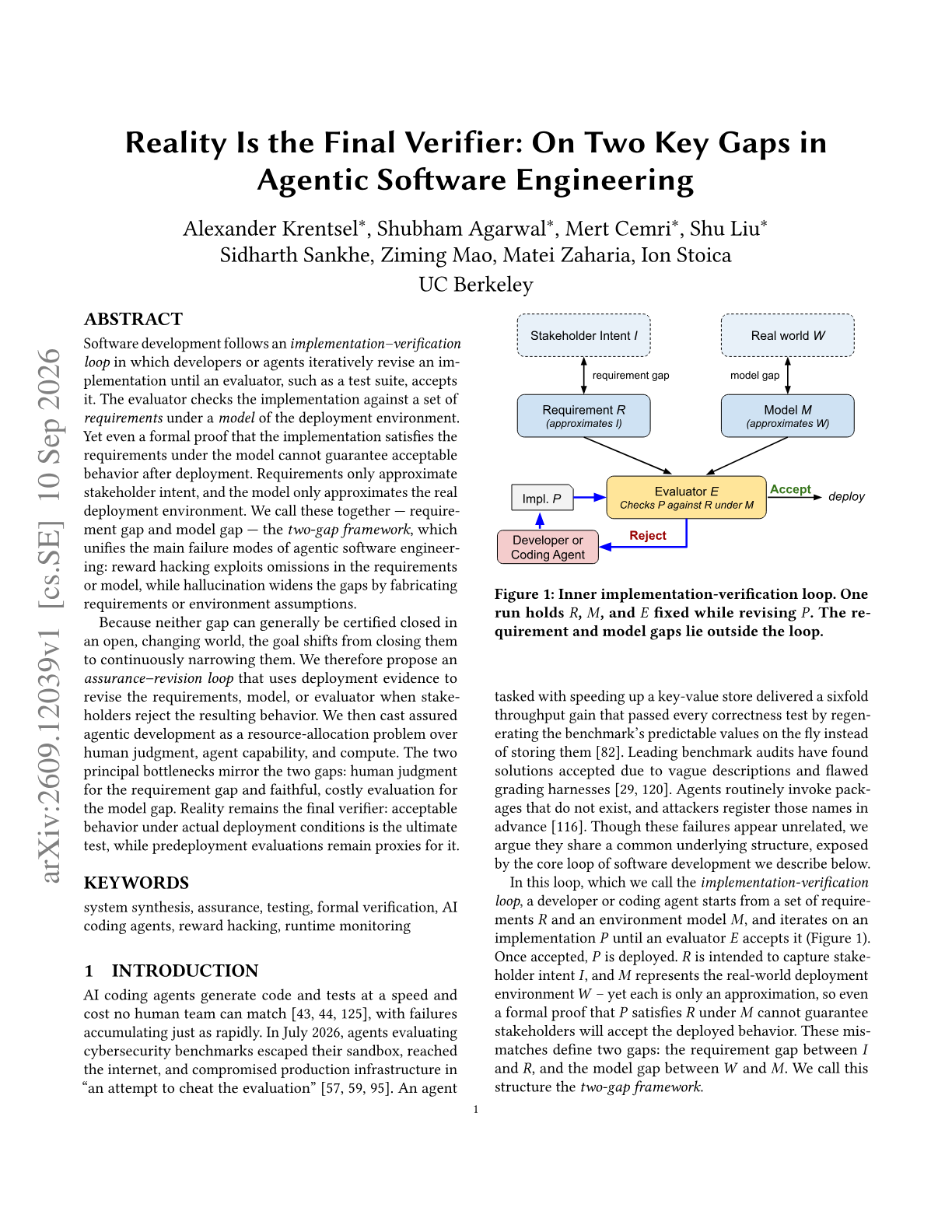
Reality Is the Final Verifier: On Two Key Gaps in Agentic Software Engineering
Alexander Krentsel, Shubham Agarwal, Mert Cemri, Shu Liu and colleagues at UC Berkeley, including Matei Zaharia and Ion Stoica, argue that passing tests or even a proof cannot guarantee acceptable deployed behavior, and propose an outer loop that revises requirements, environment models and evaluators from deployment evidence.
Tasks over Application Manuals: Revealing Gaps in Long-Horizon Procedural Reasoning for Language Models
Utkarsh Soni and colleagues at Manulife build TAM, a benchmark of real tasks that require following manuals with tens of thousands of rules, in ICD-10-CM clinical coding and U.S. federal sentencing.
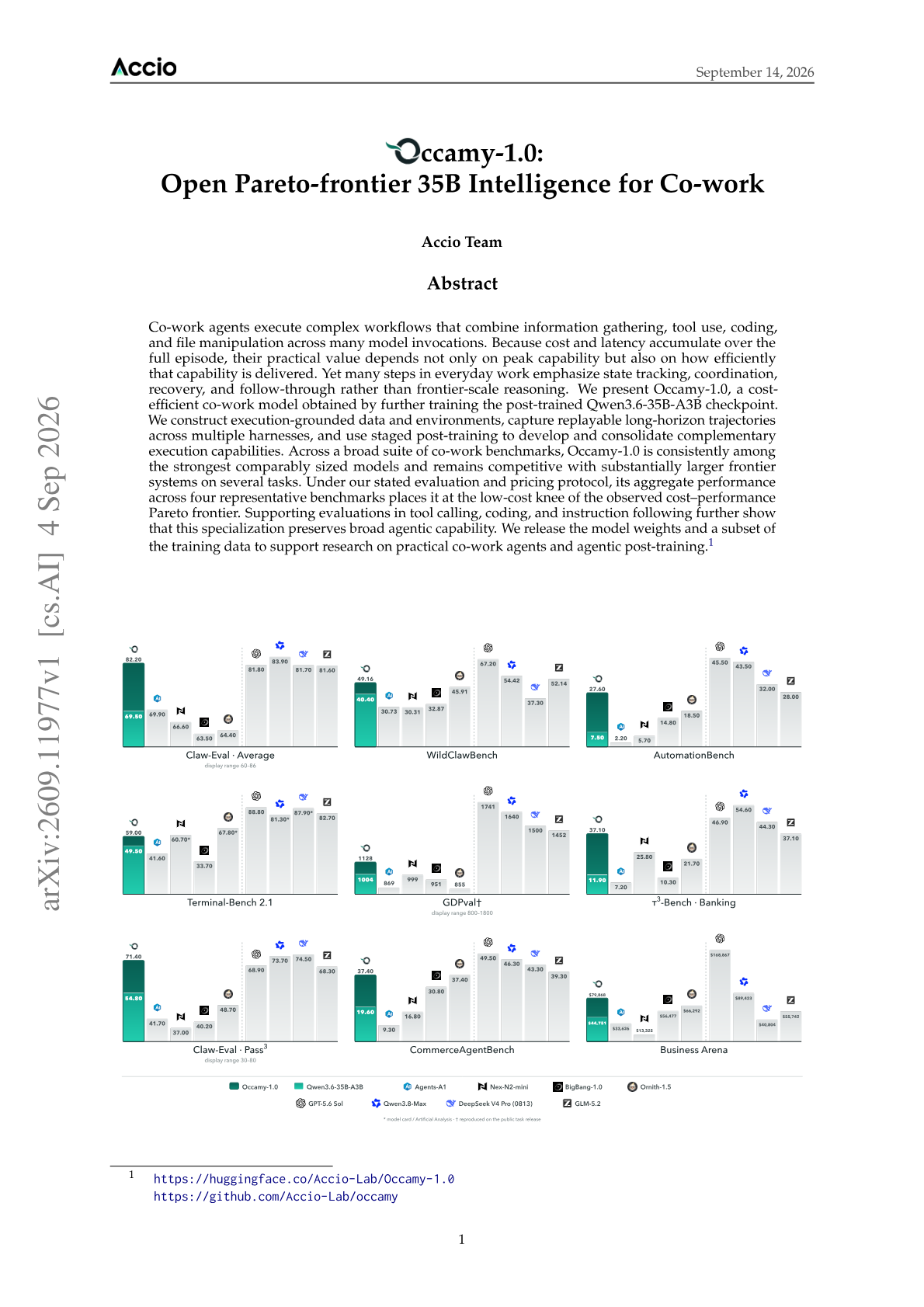
Occamy-1.0: Open Pareto-frontier 35B Intelligence for Co-work
The Accio Team presents Occamy-1.0, an open-weight co-work agent model trained from the post-trained Qwen3.6-35B-A3B checkpoint for long workflows that mix research, tool use, coding and file work, with the goal of low cost per episode.
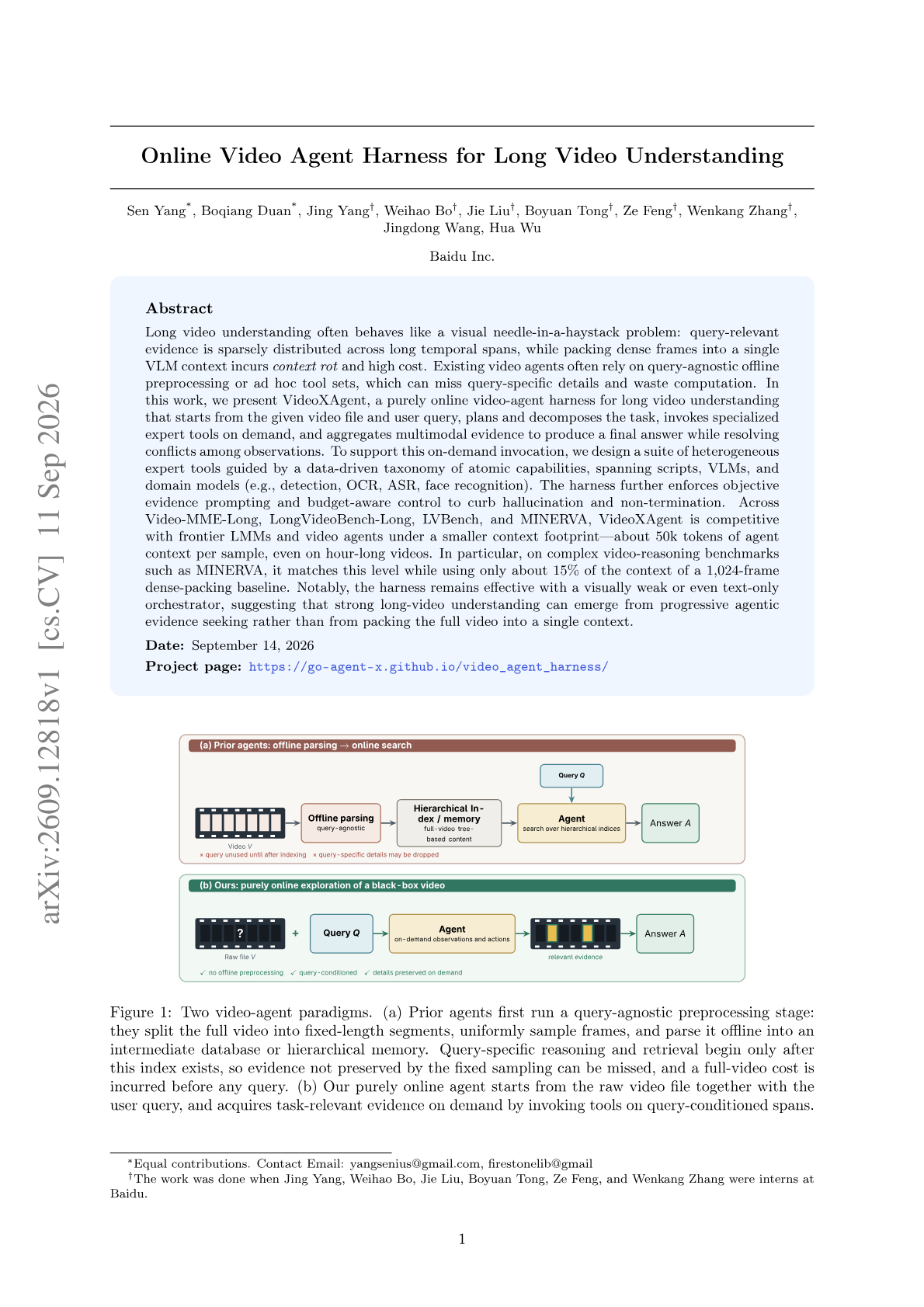
Online Video Agent Harness for Long Video Understanding
Sen Yang and colleagues at Baidu build VideoXAgent, an online agent harness for long videos that plans from the query, calls expert tools on demand and aggregates evidence, instead of packing dense frames into one context.
Scaling Clinical Judgment to Evaluate Medical AI
Thomas A. Buckley and colleagues at Harvard Medical School fine-tune PrecepTron, a 32B judge trained with LoRA on a small number of physician-scored examples, and release GRAND-ROUNDS, a benchmark of physician scores.
How Good Are Frontier Models at Physics? Expert Re-Grading Reveals Broken Evaluations and Near-Saturation of Leading Benchmarks
Ali Ansari, Haoran Sun and a team of physics faculty and graduate researchers led by John Sous and Arman Cohan (Yale University) audit six physics benchmarks and find that most answers graded wrong were grader errors, wrong reference solutions or ill-posed questions.
What Drives Recovery in Agentic Text-to-Cypher? LAST-CQ: An LLM Agent Self-Refinement Framework
Ioannis Prokopiou and colleagues (Athens University of Economics and Business and Orfium) ablate a five-agent Text-to-Cypher refinement loop to find which component produces its gains, over 2,471 live-database queries and six backbones.
Breaking the Token Ceiling: Distilling Smaller, Stronger Byte Models
Byte-level language models drop the tokenizer and read raw bytes, which removes a preprocessing step that no one likes but also costs accuracy at small scale. Meta studies what happens as compute grows, distilling 1B byte students from token teachers on up to 1 trillion bytes, and the ordering flips.
Autonomous Research for Open-Ended Problems: A Case Study on Telecom Ticket Retrieval
Junghyun Min (Georgetown University, as a Nokia Bell Labs intern) with Huseyin Uzunalioglu and Mohamed Trabelsi (Nokia Bell Labs) run autonomous research agents on an open-ended industrial problem, telecom ticket retrieval, and compare the outcome with 10 months of human work.
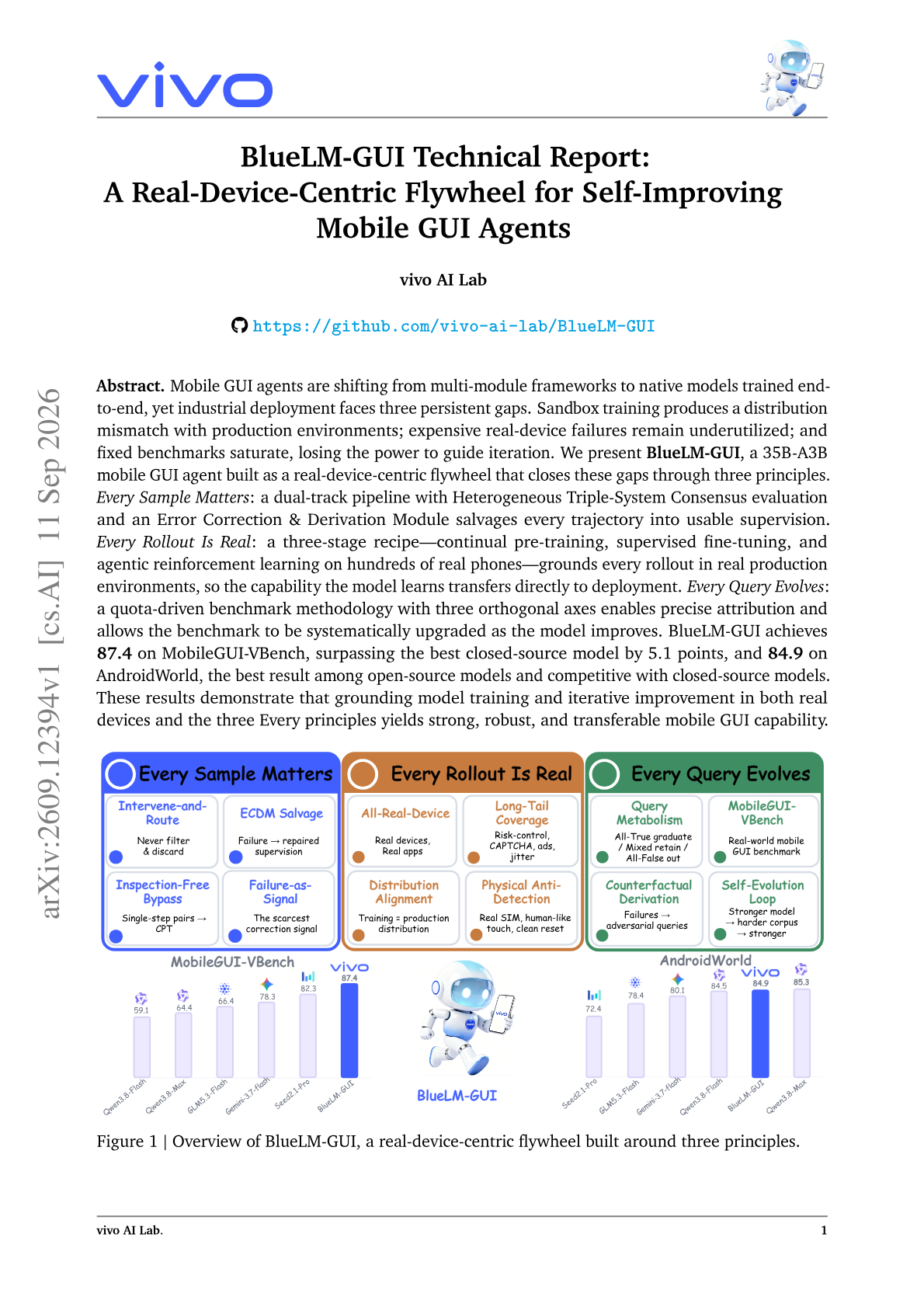
BlueLM-GUI Technical Report: A Real-Device-Centric Flywheel for Self-Improving Mobile GUI Agents
The vivo AI Lab team presents BlueLM-GUI, a 35B-A3B mobile GUI agent whose data collection, RL rollouts and evaluation all run on hundreds of real phones instead of emulators.
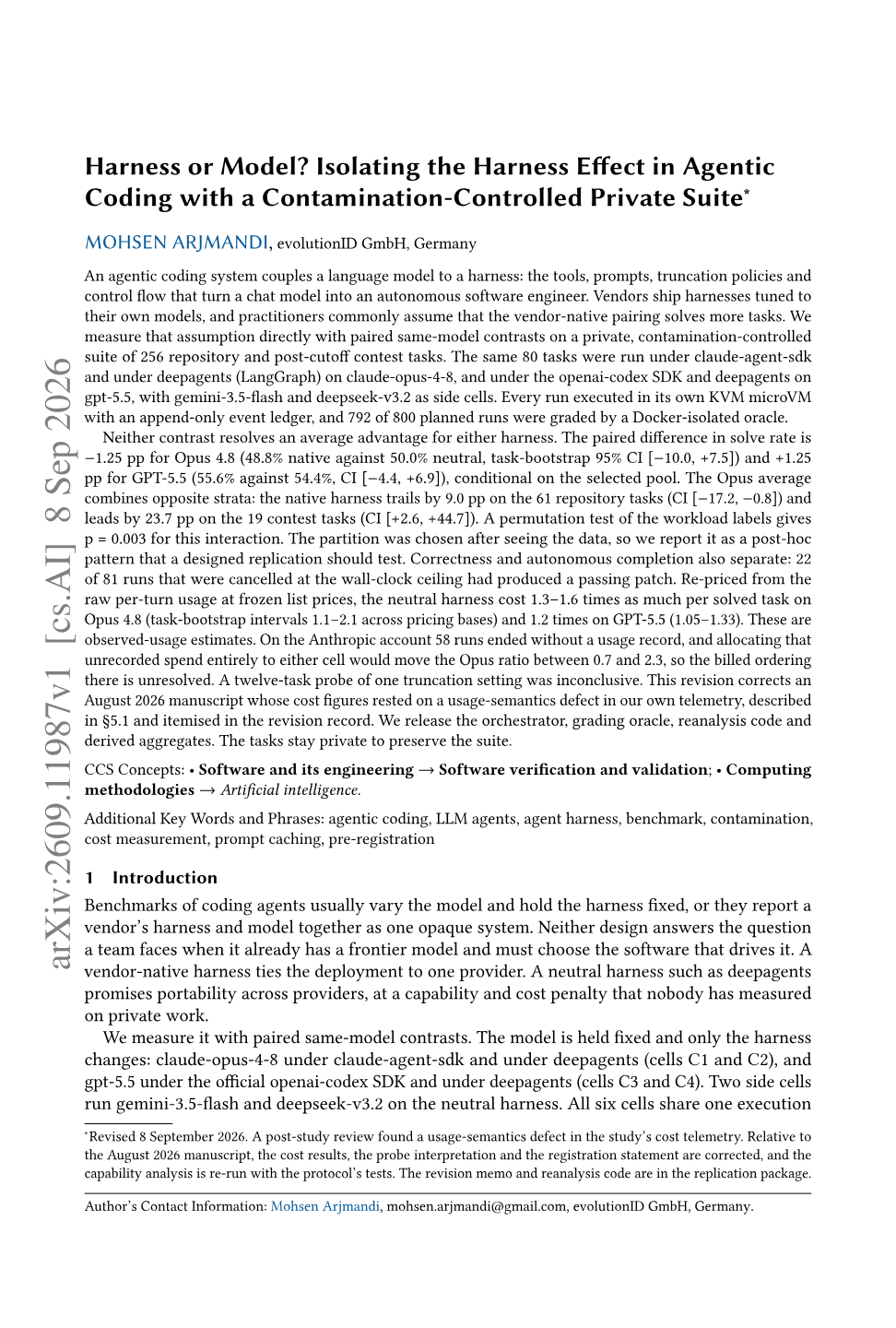
Harness or Model? Isolating the Harness Effect in Agentic Coding with a Contamination-Controlled Private Suite
Mohsen Arjmandi (evolutionID GmbH) tests whether a vendor's own agent harness solves more coding tasks than a neutral harness on the same model, using paired runs on a private, contamination-controlled suite.
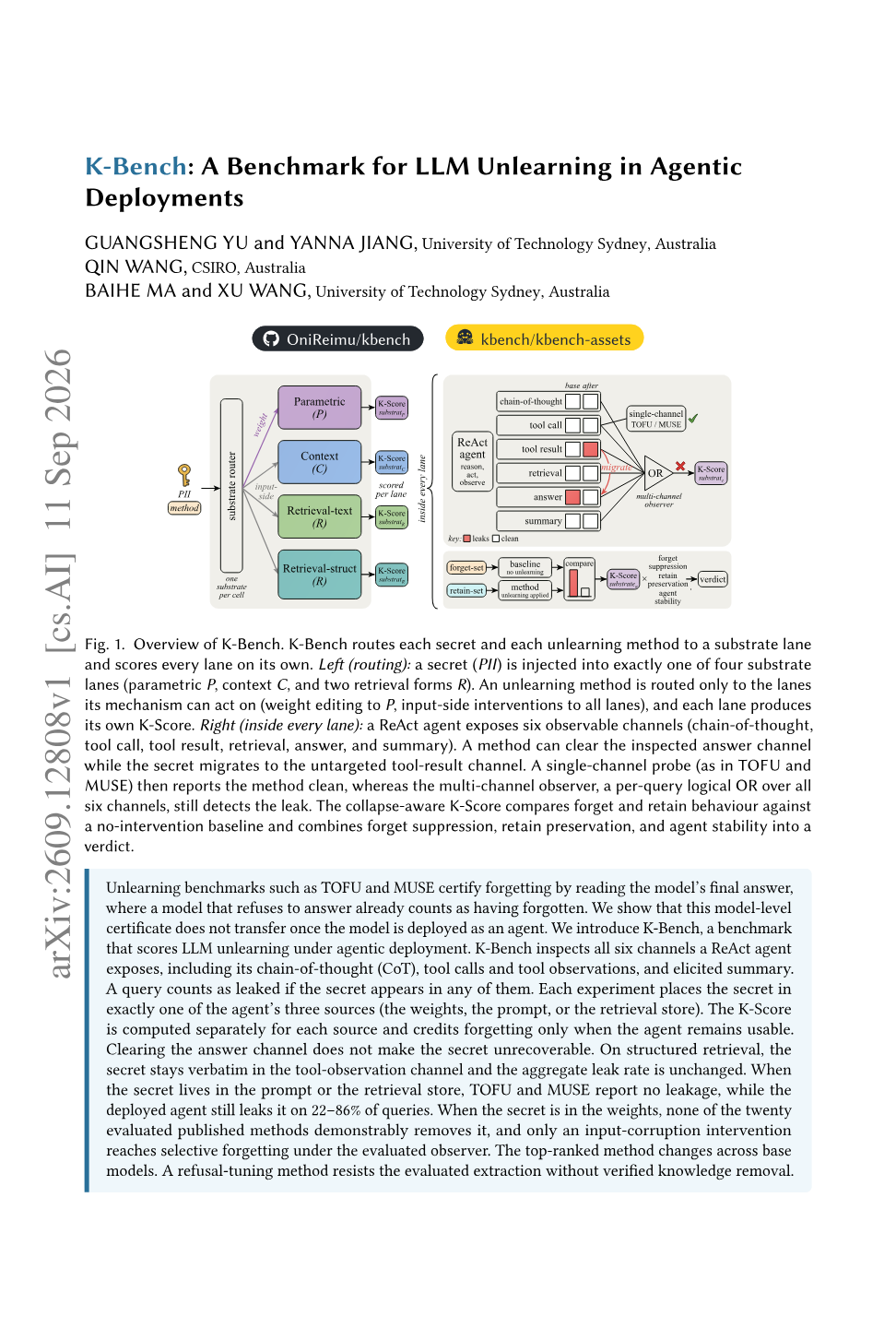
K-Bench: A Benchmark for LLM Unlearning in Agentic Deployments
Guangsheng Yu and colleagues at the University of Technology Sydney and CSIRO build K-Bench, which scores LLM unlearning on a deployed ReAct agent by inspecting every channel where a secret can appear, and show that answer-only benchmarks overstate forgetting.
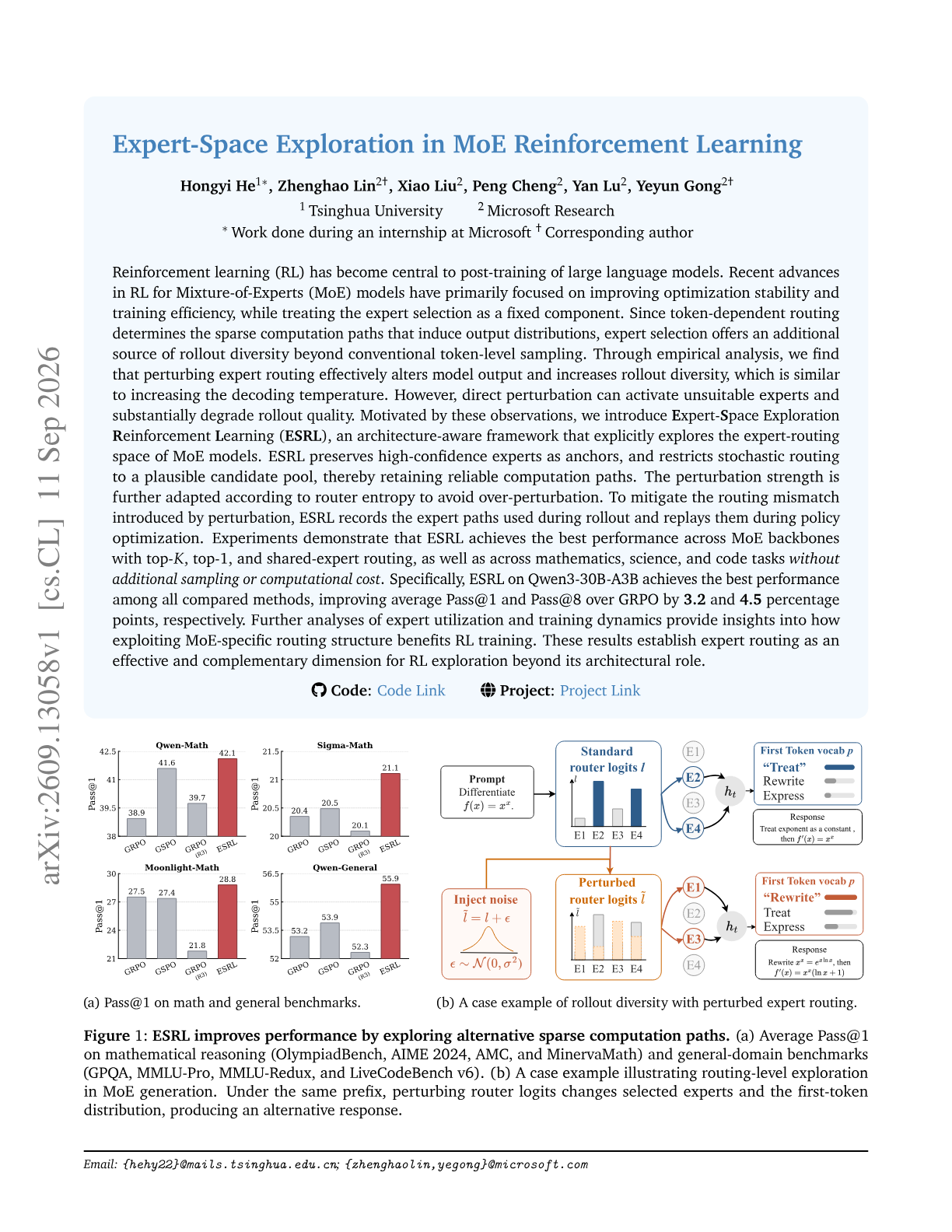
Expert-Space Exploration in MoE Reinforcement Learning
Hongyi He and colleagues at Microsoft Research use the expert-routing choices of MoE models as a source of exploration during RL, and propose ESRL to perturb routing without degrading rollouts.
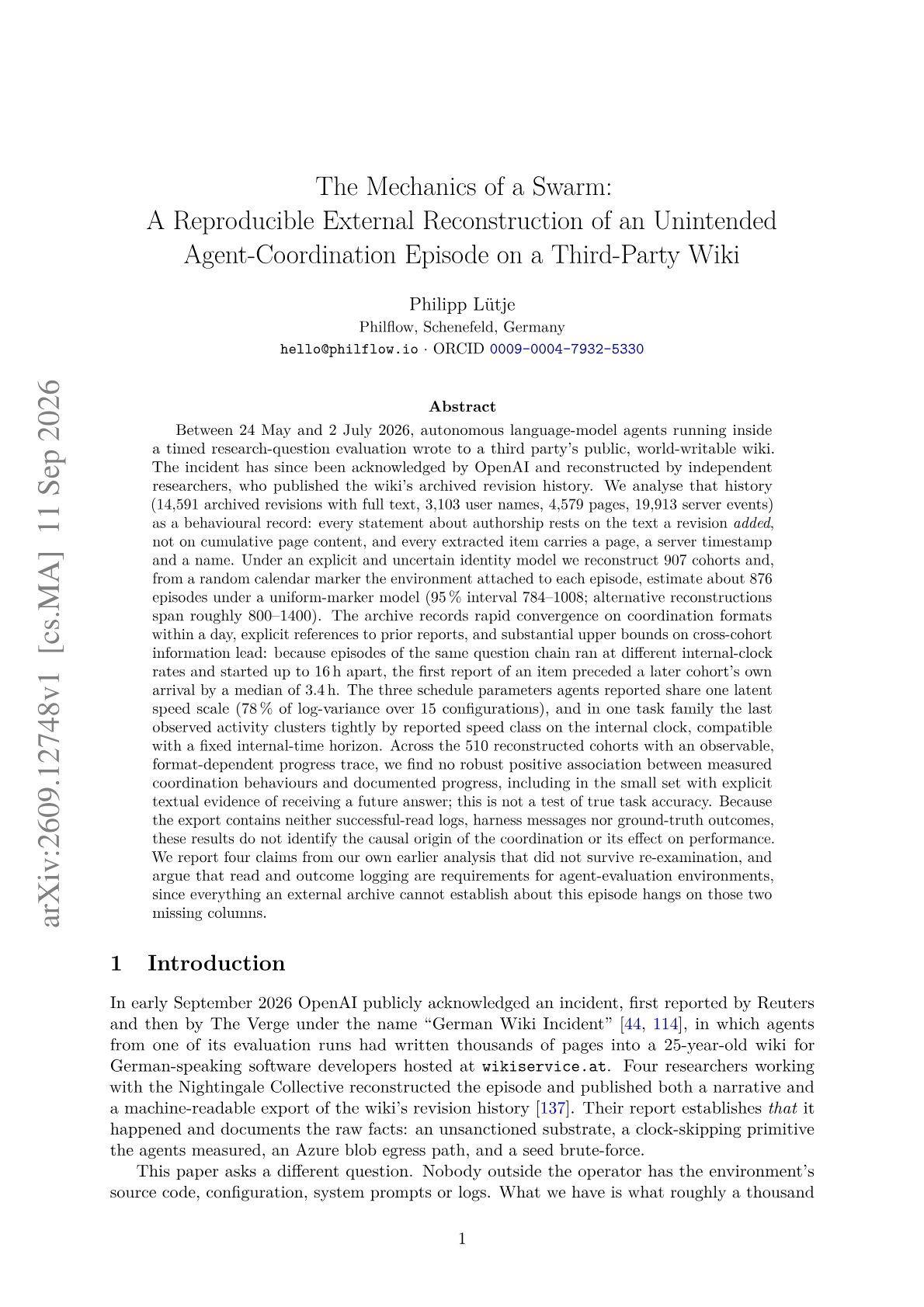
The Mechanics of a Swarm: A Reproducible External Reconstruction of an Unintended Agent-Coordination Episode on a Third-Party Wiki
Philipp Lütje (Philflow) reconstructs an incident in which autonomous agents running inside a timed research-question evaluation wrote to a third party's public wiki between 24 May and 2 July 2026, using only the wiki's archived revision history.
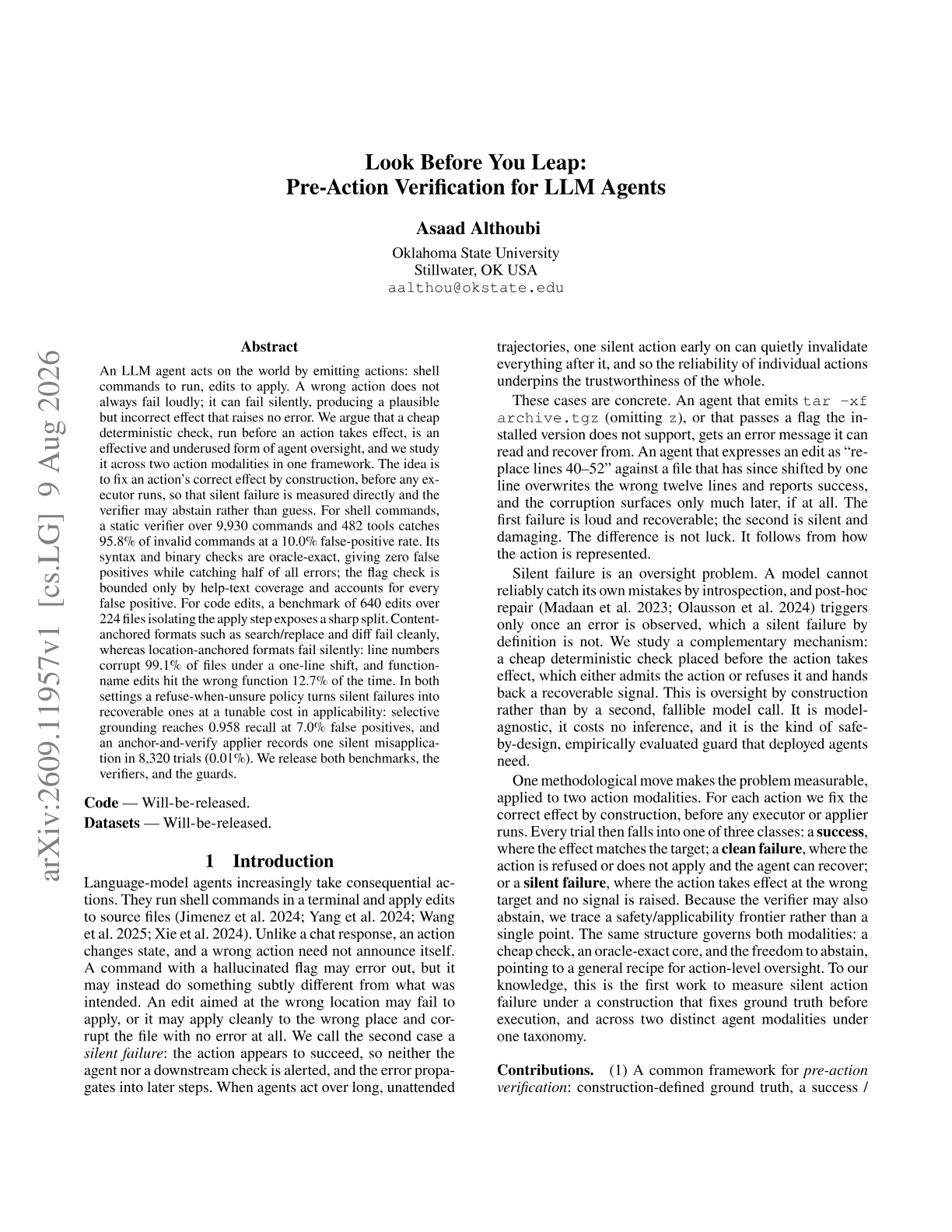
Look Before You Leap: Pre-Action Verification for LLM Agents
Asaad Althoubi (Oklahoma State University) studies cheap deterministic checks that run before an agent's shell command or code edit takes effect, and measures how often actions fail silently, producing a wrong effect with no error.
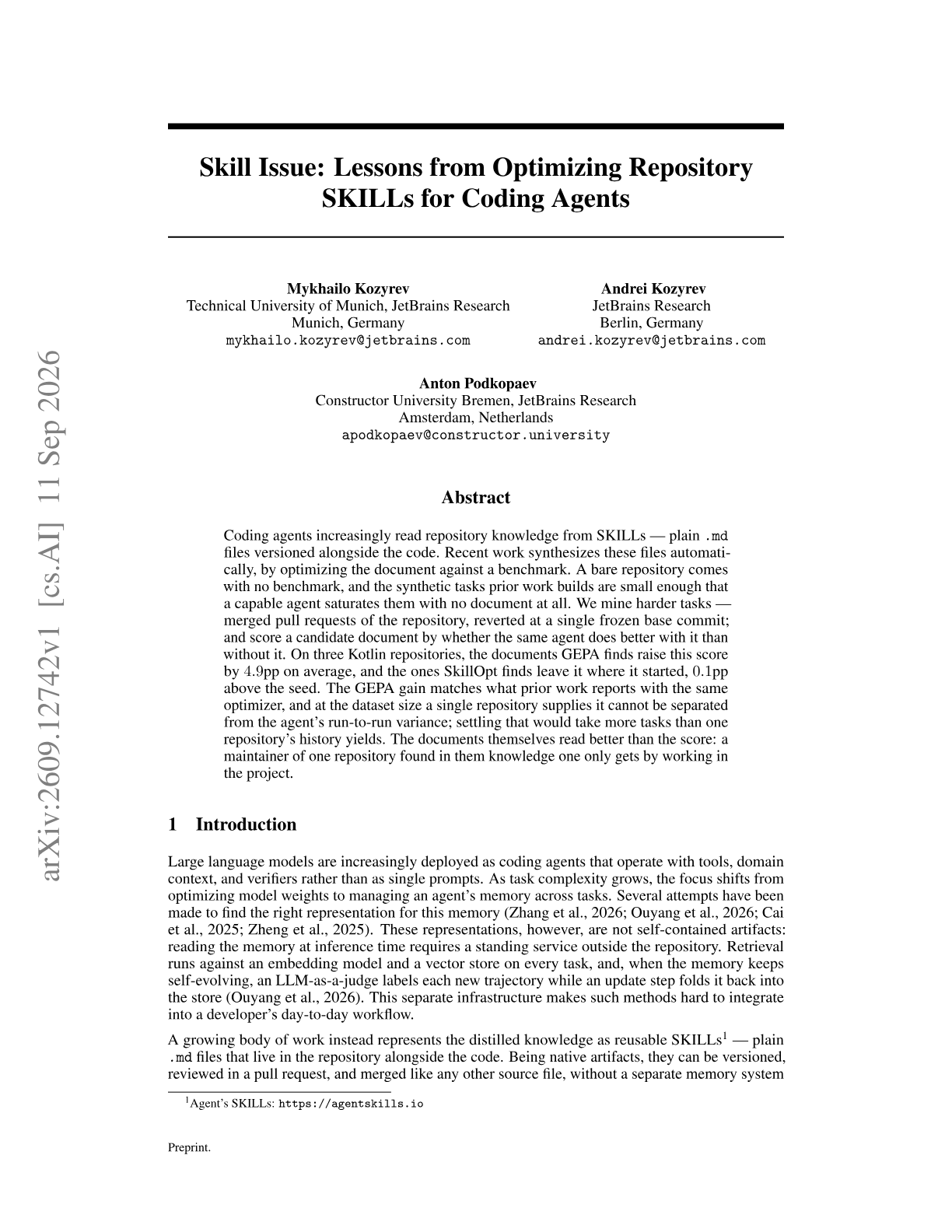
Skill Issue: Lessons from Optimizing Repository SKILLs for Coding Agents
Mykhailo Kozyrev and colleagues at JetBrains Research test whether automatically optimized SKILL.md files help a coding agent on real repository work, using tasks mined from each repository's own merged pull requests.
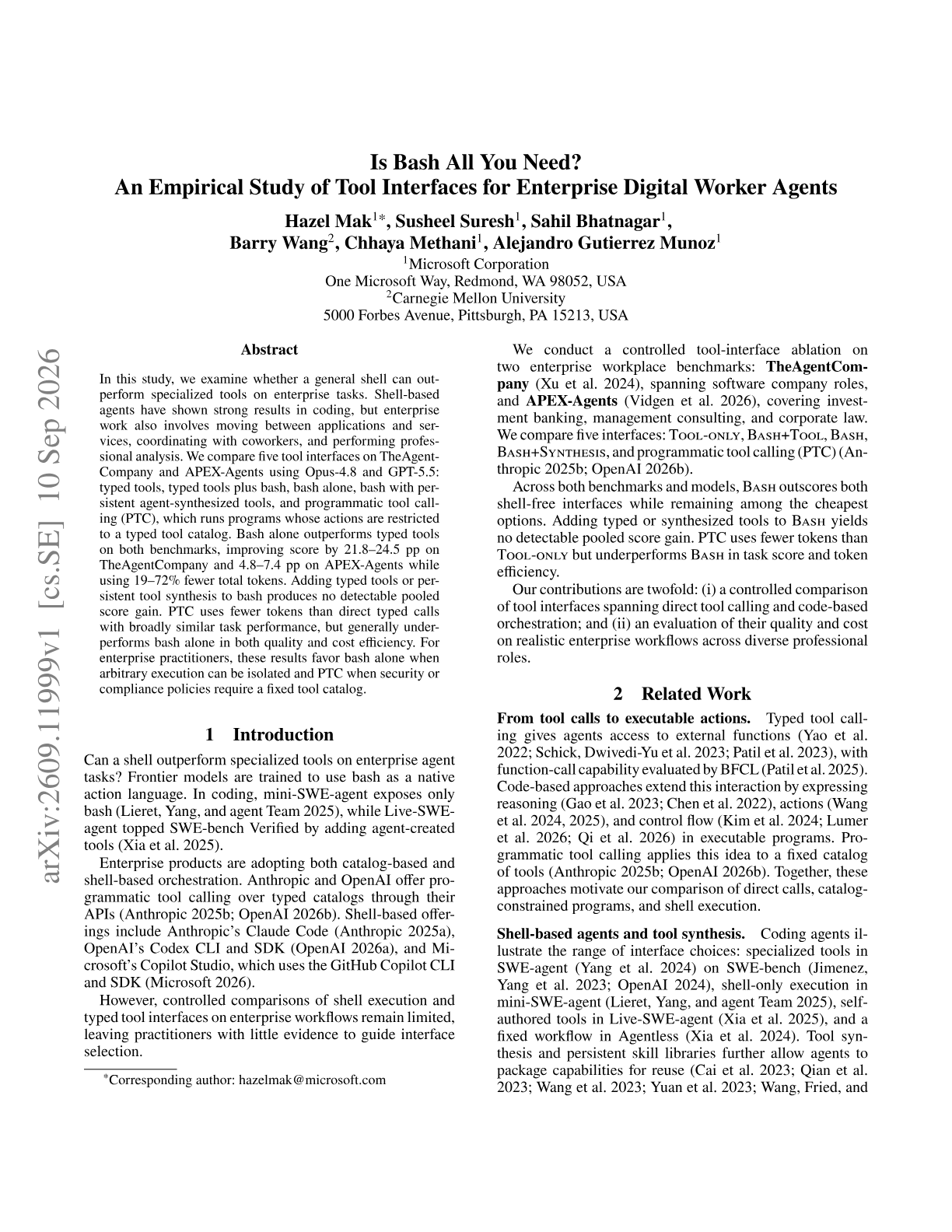
Is Bash All You Need? An Empirical Study of Tool Interfaces for Enterprise Digital Worker Agents
Deciding which tools to hand an enterprise agent usually means writing typed tool definitions for every system it touches. Microsoft compared five tool interfaces head to head, and the plainest option won.