AI Papers of the Week
Every paper worth reading in AI, hand-picked one week at a time.
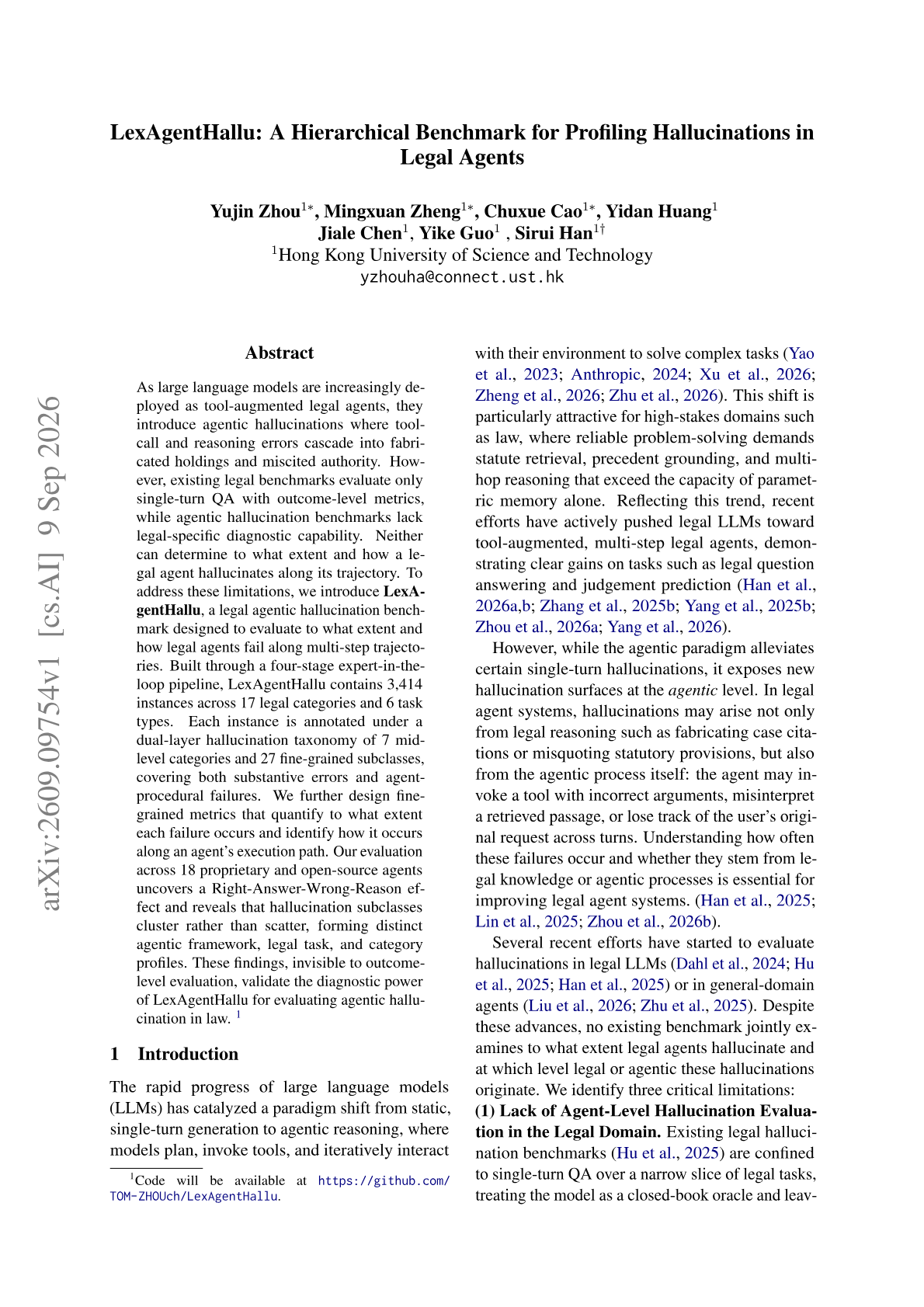
LexAgentHallu: A Hierarchical Benchmark for Profiling Hallucinations in Legal Agents
Yujin Zhou, Mingxuan Zheng, Yike Guo, Sirui Han and colleagues at HKUST release LexAgentHallu, a 3,414-instance benchmark that annotates where along a legal agent's trajectory a hallucination originates, under a 7-category, 27-subclass taxonomy.
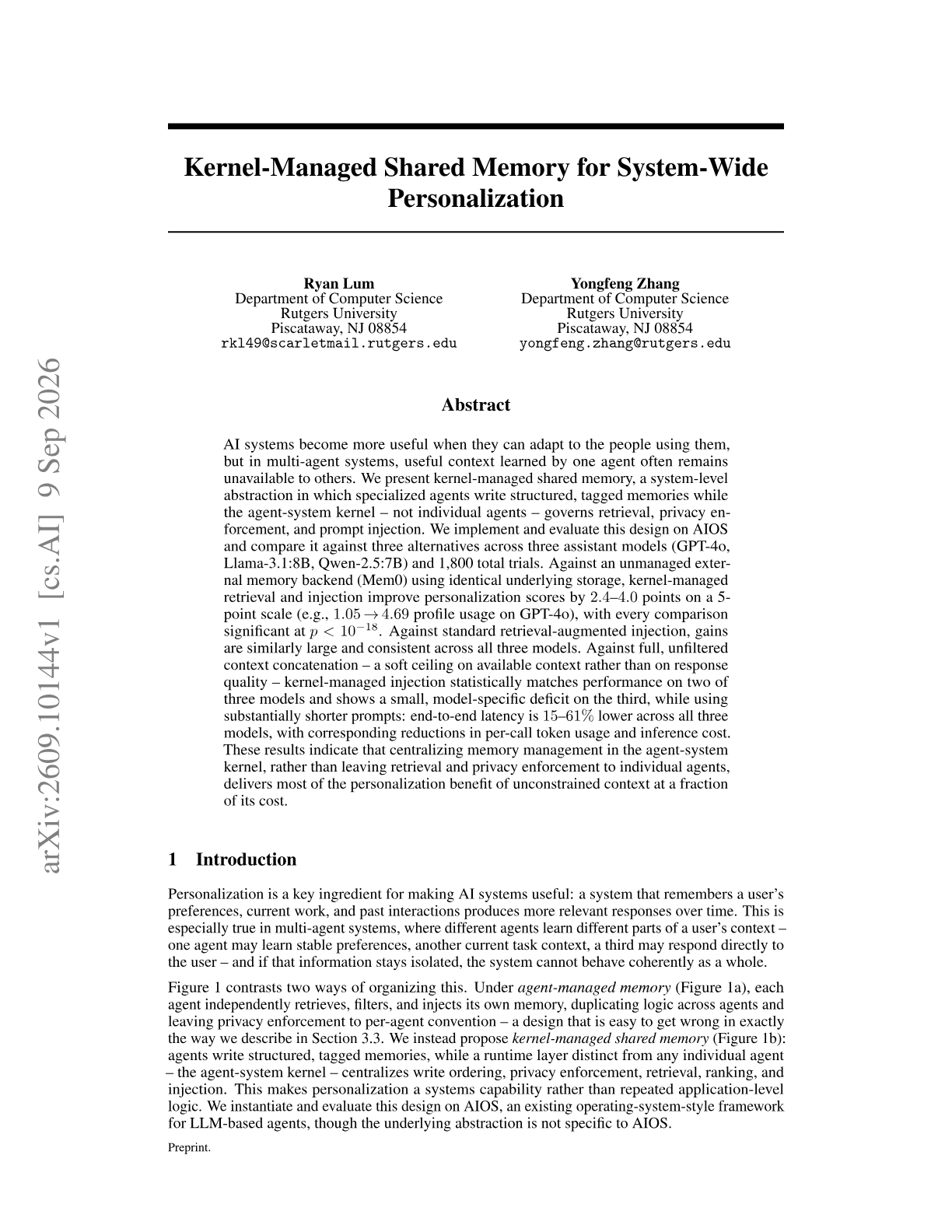
Kernel-Managed Shared Memory for System-Wide Personalization
Ryan Lum and Yongfeng Zhang (Rutgers University) move memory retrieval, privacy enforcement and prompt injection out of individual agents and into the agent-system kernel, and evaluate the design on AIOS across three assistant models and 1,800 trials.
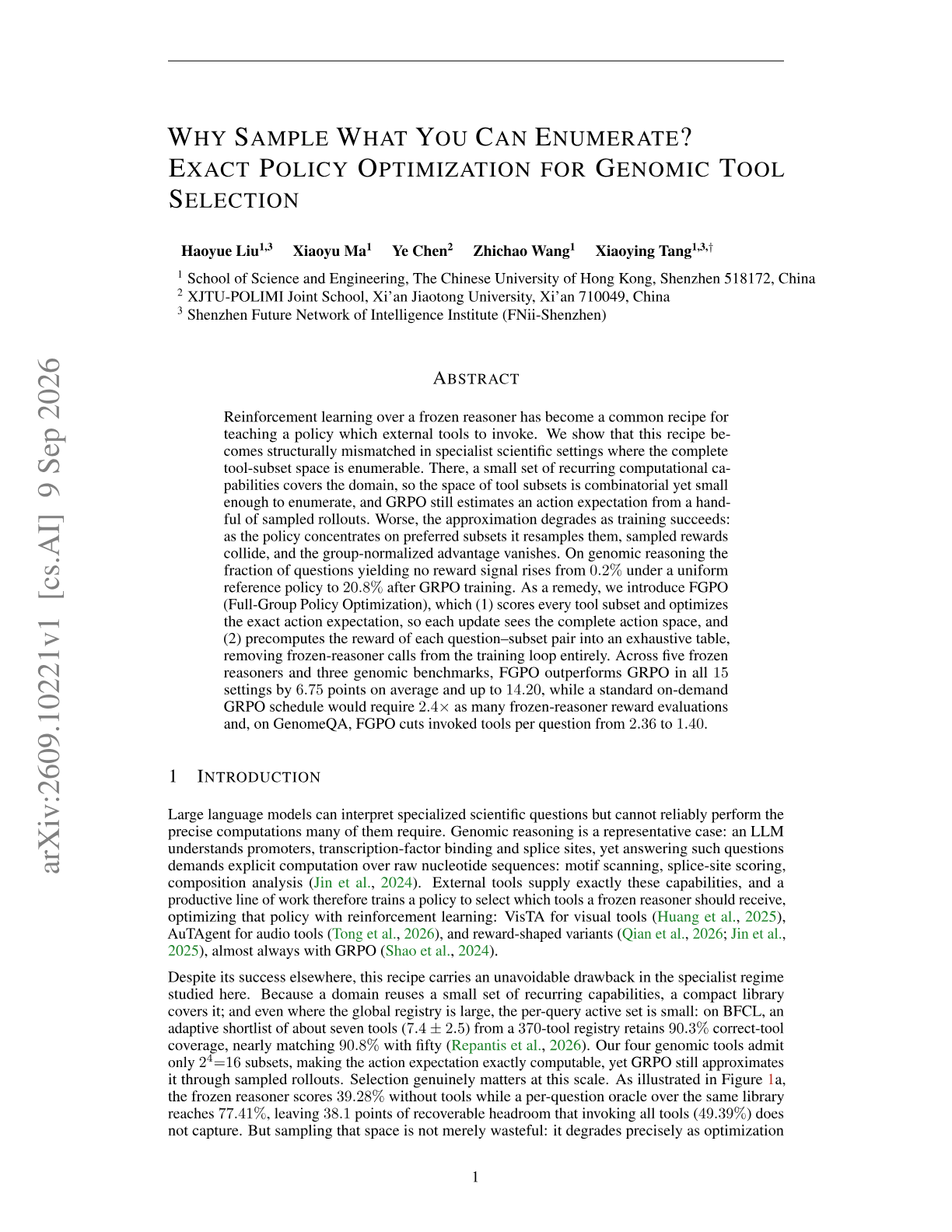
Why Sample What You Can Enumerate? Exact Policy Optimization for Genomic Tool Selection
Haoyue Liu, Xiaoyu Ma and Ye Chen (CUHK Shenzhen and FNii-Shenzhen) show that GRPO is structurally mismatched when the tool-subset action space is small enough to enumerate, and replace sampling with exact expectation over the full space.
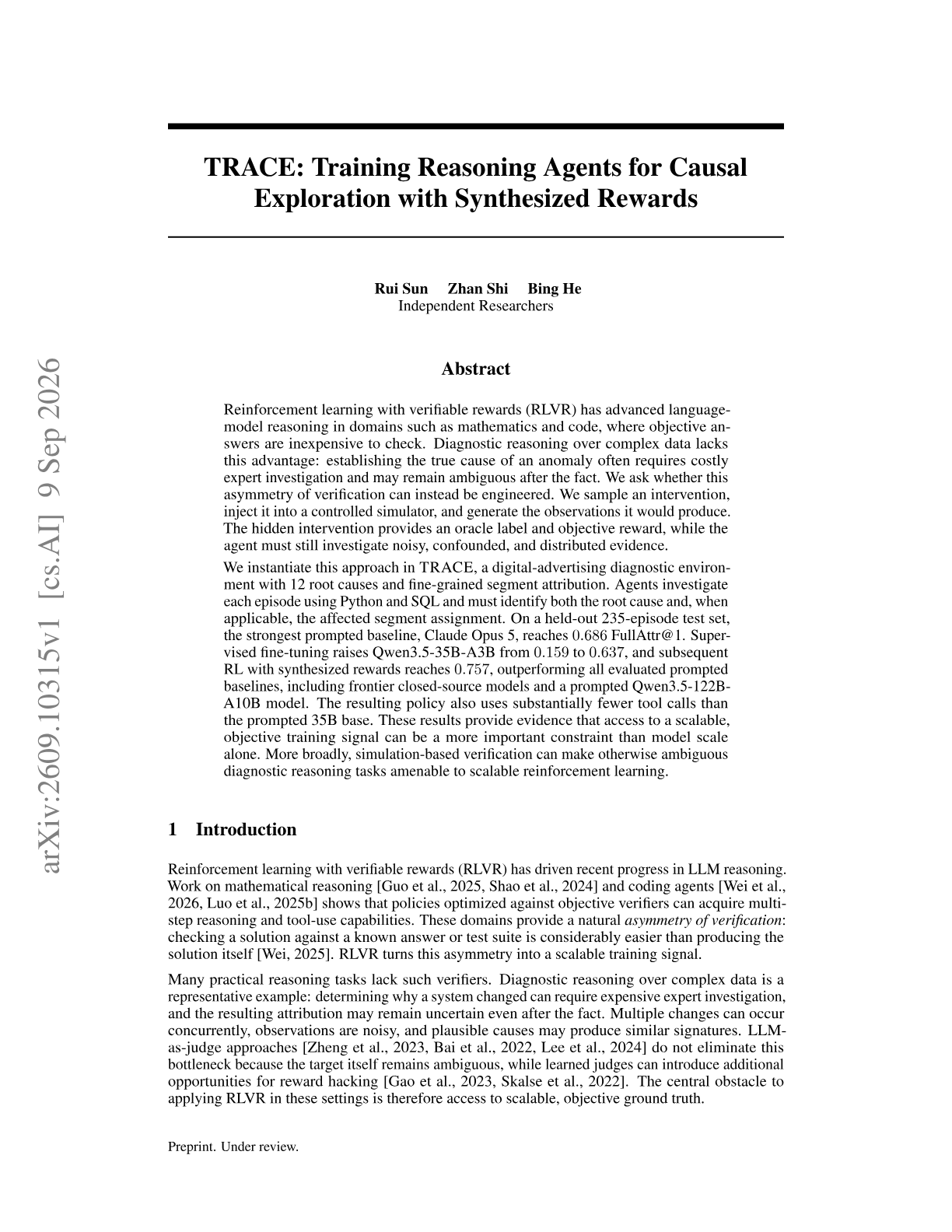
TRACE: Training Reasoning Agents for Causal Exploration with Synthesized Rewards
Rui Sun, Zhan Shi and Bing He (independent researchers) train diagnostic reasoning agents by sampling an intervention, injecting it into a simulator, and generating the observations it would produce, so the hidden intervention supplies an oracle label for a task where real ground truth would require expert investigation.
SkillAdam: Stable and Efficient Skill Evolution for Agents
Gaoyuan Li, Meihao Fan, Shaolei Zhang and Ju Fan at Renmin University present SkillAdam, which ports Adam's two moment estimates to the optimization of discrete, non-differentiable skill documents so that skill self-evolution stops oscillating.
MemForest: Efficient Agent Memory Management via EventTree Partitioning and Progressive Merging
Junxi Wang and collaborators across Shanghai Jiao Tong University, Fudan, Nanjing University, HIT and Sichuan University present MemForest, a memory compression layer that partitions history into event units, merges redundant nodes along a maximum spanning tree, and retrieves by propagating from anchor nodes.
Miles v0.1: Production-Level Post-Training
RadixArk releases Miles v0.1, an open-source post-training system built on the slime design, covering RL, LoRA RL, on-policy distillation and SFT, with an end-to-end case study running fully asynchronous agentic RL on a 744B-A40B GLM-5.2 model over terminal-use coding tasks.
Q2D-Web: A Large-Scale Benchmark for Retrieval in Agentic RAG Systems
Maximilian Schall, Sedigheh Eslami, Antoine Chaffin and colleagues at Perplexity AI release Q2D-Web, a 190M-document web corpus with 70k agent-reformulated search queries in ten languages, built because production RAG retrievers serve machine-written queries and existing benchmarks test human-written ones.
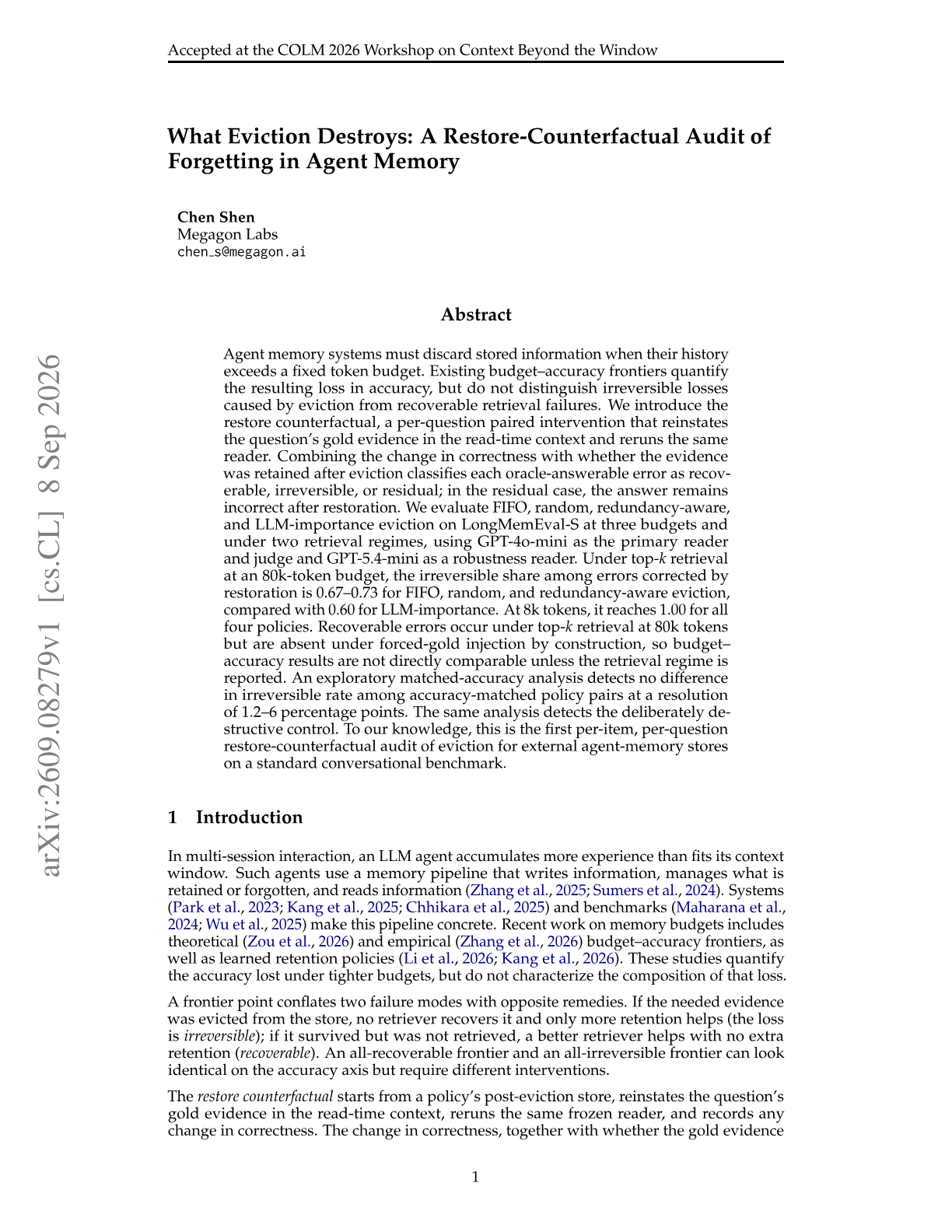
What Eviction Destroys: A Restore-Counterfactual Audit of Forgetting in Agent Memory
Chen Shen at Megagon Labs introduces the restore counterfactual, a per-question intervention that puts the gold evidence back into a reader's context after eviction, which separates losses eviction destroyed permanently from losses retrieval merely failed to surface.
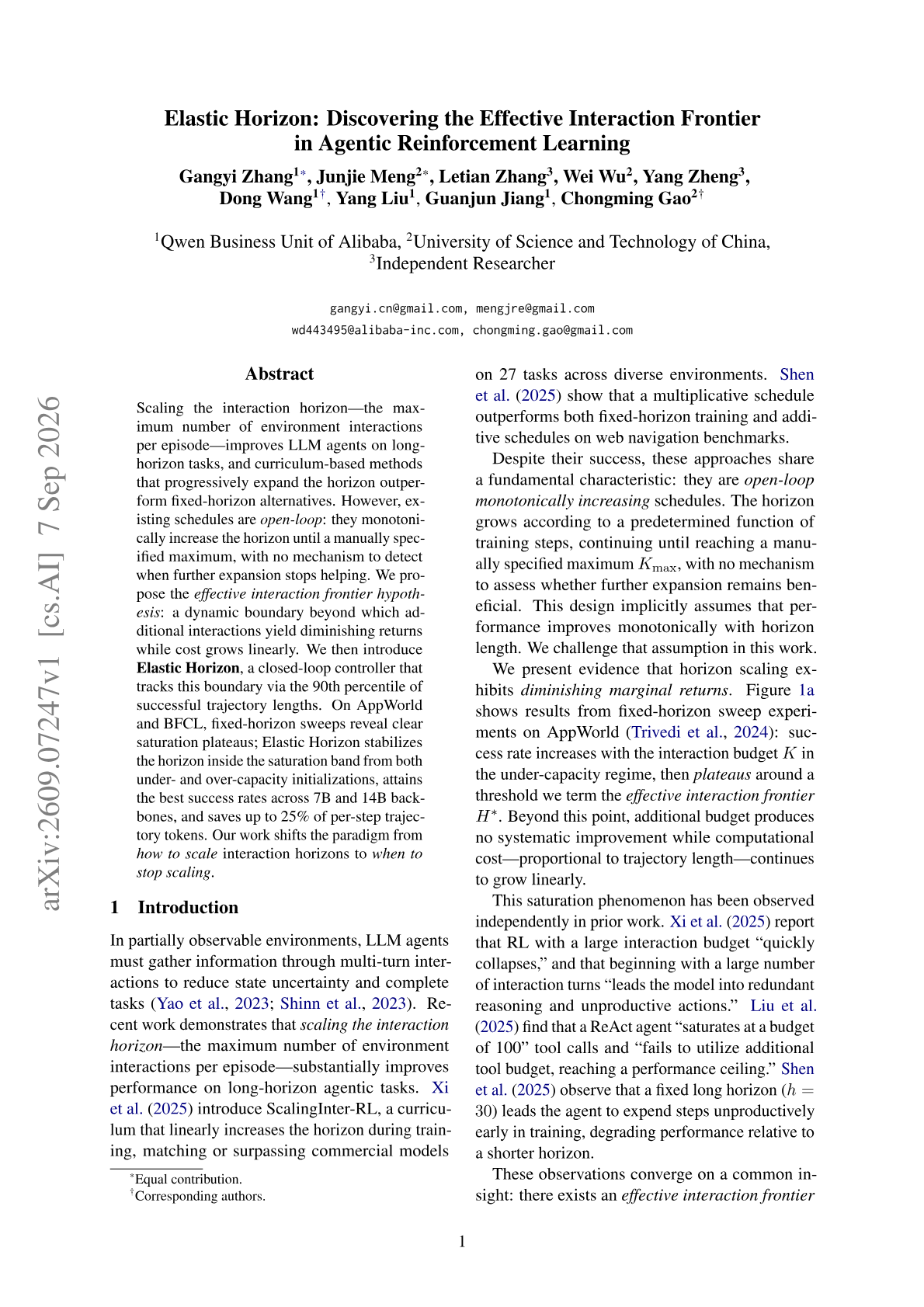
Elastic Horizon: Discovering the Effective Interaction Frontier in Agentic Reinforcement Learning
Gangyi Zhang in the Qwen Business Unit of Alibaba with USTC collaborators propose the effective interaction frontier hypothesis and Elastic Horizon, a closed-loop controller that sets an agent's interaction budget from the 90th percentile of successful trajectory lengths instead of a hand-set maximum.
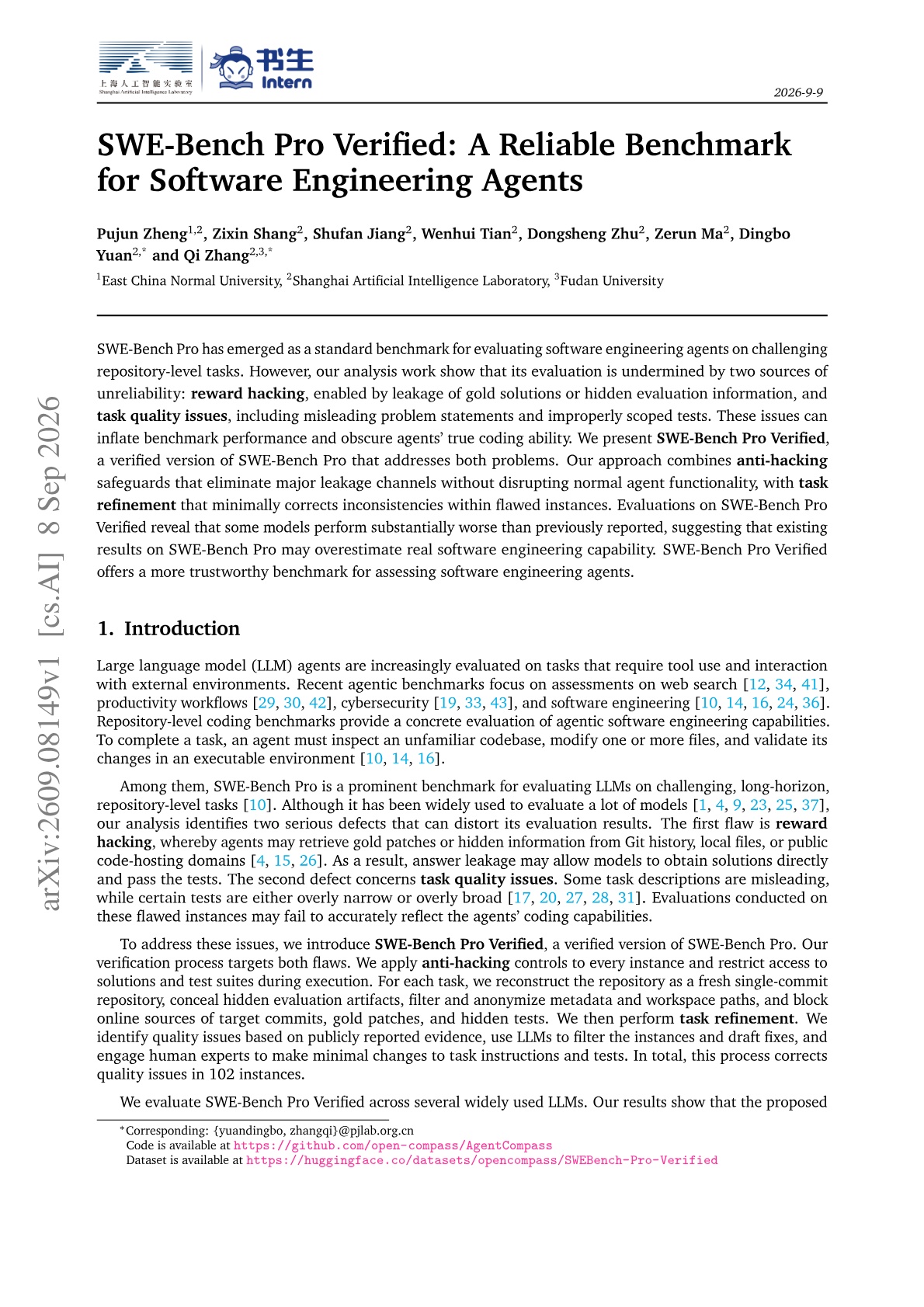
SWE-Bench Pro Verified: A Reliable Benchmark for Software Engineering Agents
Pujun Zheng at East China Normal University with Shanghai Artificial Intelligence Laboratory audits SWE-Bench Pro, finds reward hacking through gold-solution leakage and task-quality defects, and releases SWE-Bench Pro Verified, on which several models score substantially lower than previously reported.

Co-Evolving Harnesses and Models: On-Policy Correction Helps Weaker Models Catch Up Where Imitation Fails
Salesforce found that fine-tuning a weaker model on a stronger expert's full trajectories, under a harness evolved for the weaker model, dropped performance on all seven enterprise tasks by 4 to 30 points because the model copies a planning strategy it cannot execute. Having the expert rewrite only the failing turn in the weaker model's own rollout keeps its planning style intact and combines the gains of harness evolution and fine-tuning.
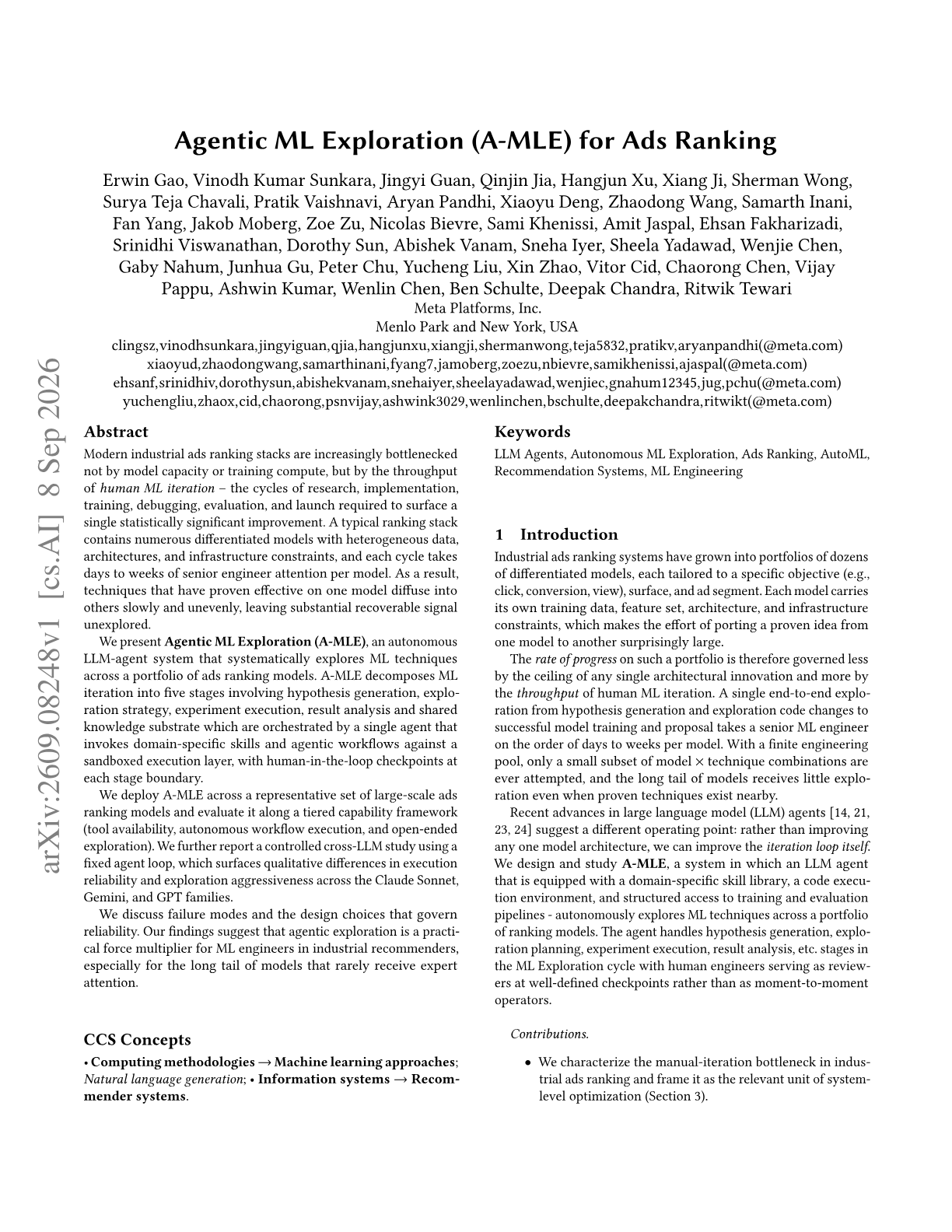
Agentic ML Exploration (A-MLE) for Ads Ranking
A 38-author team at Meta Platforms reports Agentic ML Exploration, an autonomous LLM-agent system that runs the ML iteration cycle across a portfolio of production ads ranking models, and includes a controlled cross-LLM study of Claude Sonnet, Gemini and GPT families under a fixed agent loop.
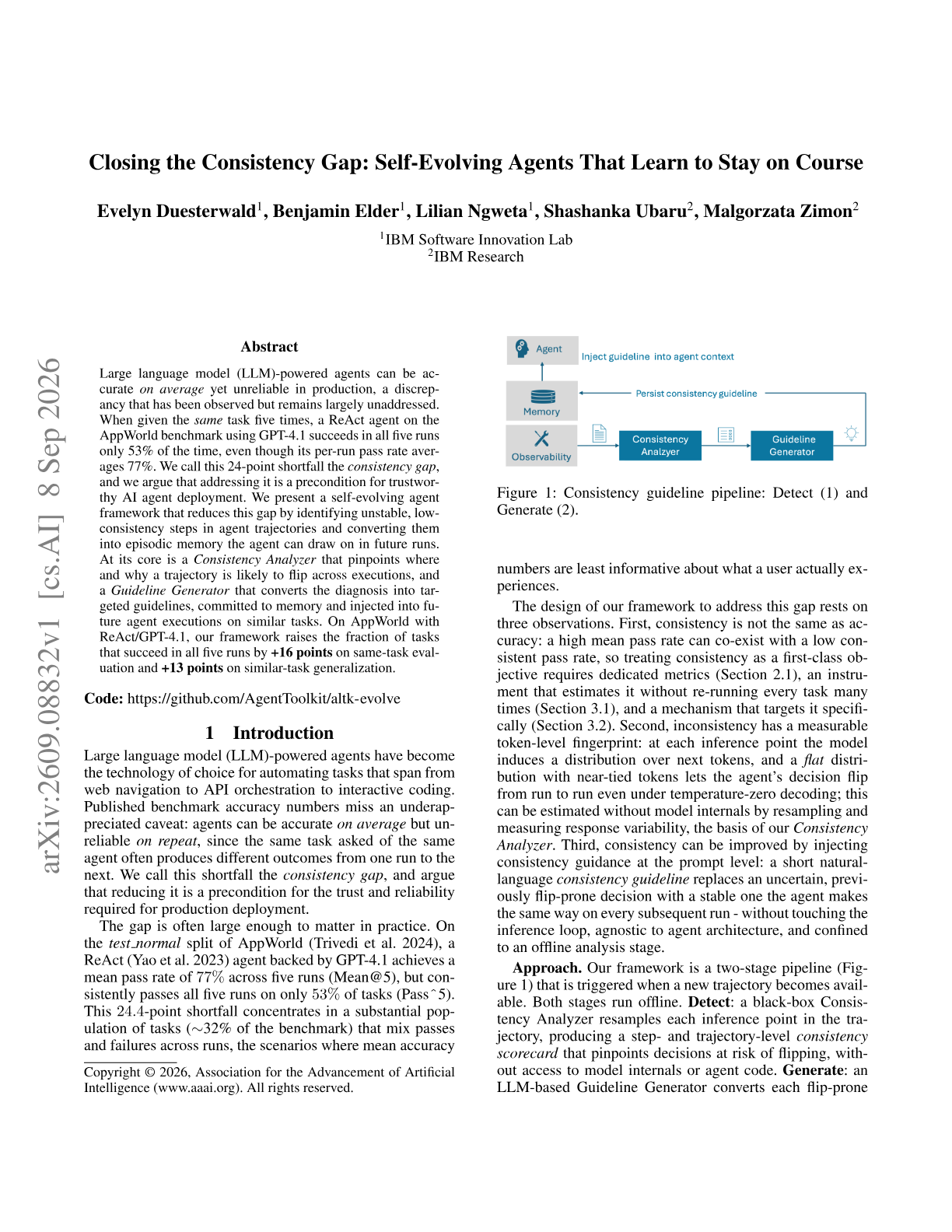
Closing the Consistency Gap: Self-Evolving Agents That Learn to Stay on Course
Evelyn Duesterwald, Benjamin Elder, Lilian Ngweta, Shashanka Ubaru and Malgorzata Zimon at IBM Research name the consistency gap, the difference between an agent's average pass rate and how often it succeeds on all five repeats of the same task, and close part of it with targeted episodic memory.
Procedural Graphs: Self-Evolving Execution Structures for LLM Agents
Long-horizon agents usually pick each action by generating over a growing history, which leaves the procedural knowledge of what to do next, in what order, and under which conditions implicit. As trajectories get longer they lose track of objectives, call tools out of order, and repeat actions that already failed. Researchers at Google make that knowledge an explicit graph the agent can query.
AttnCompress: Dynamic Attention-Guided Trajectory Compression for Software Engineering Agents
Zhengran Zeng and Yixin Li at Peking University present AttnCompress, which segments an agent trajectory at perplexity spikes, scores each historical block by proxy attention weight against the agent's current reasoning, and recalls blocks back into context as the task changes.
NeoHorse-1: Towards Recursive Self-Improvement via Agentic Post-Training with Routing Harness
The NeoHorse Team releases NeoHorse-1, a family of agent-native 4B and 9B models built on an agentic post-training loop in which a router's records of predicted capability demand and selected service tier become the training data for the next round.
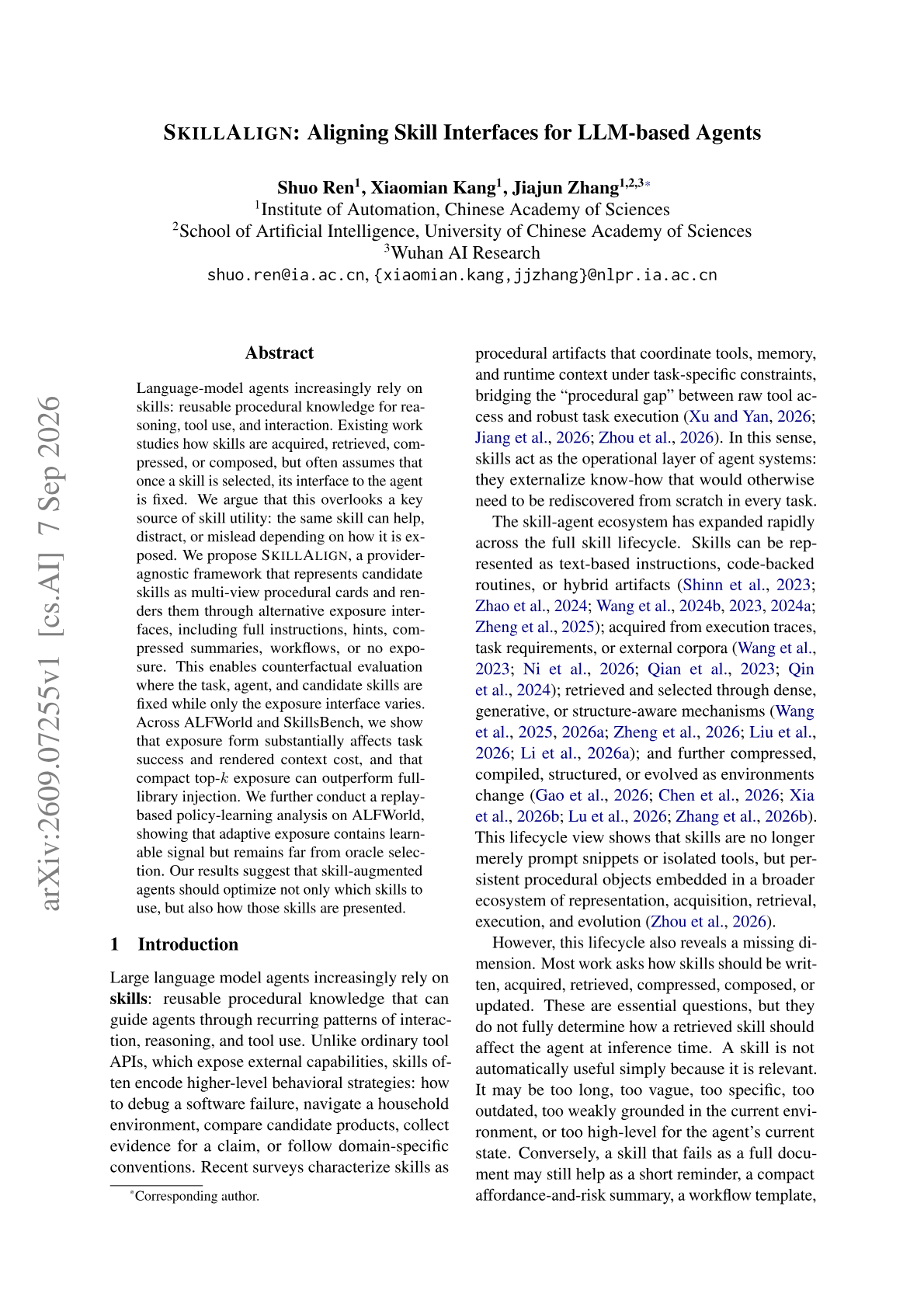
SkillAlign: Aligning Skill Interfaces for LLM-based Agents
Shuo Ren, Xiaomian Kang and Jiajun Zhang at the Institute of Automation, Chinese Academy of Sciences argue that how a skill is exposed to an agent changes its value as much as which skill is chosen, and build SkillAlign to measure that by holding everything else fixed.
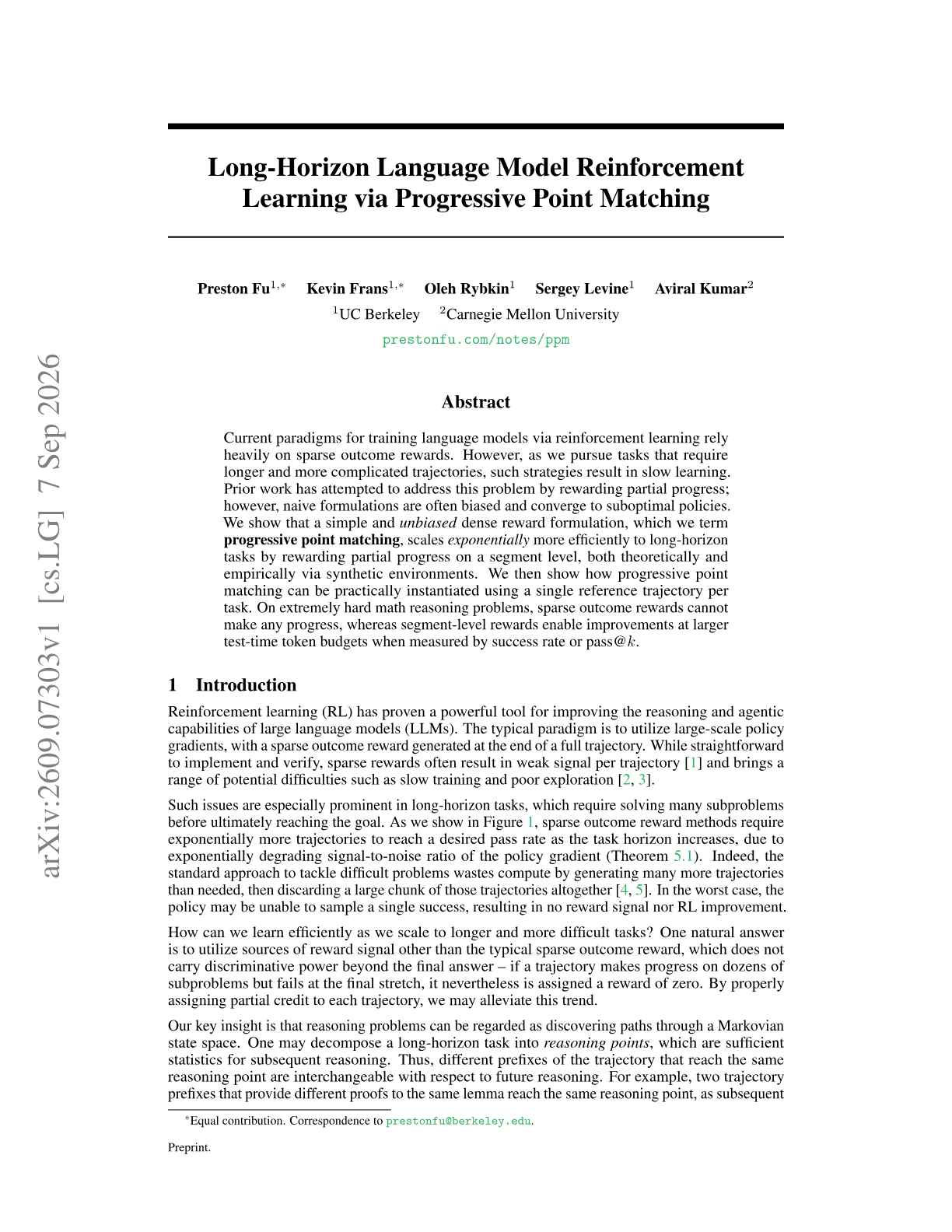
Long-Horizon Language Model Reinforcement Learning via Progressive Point Matching
Preston Fu, Kevin Frans, Oleh Rybkin and Sergey Levine at UC Berkeley with Aviral Kumar at CMU give an unbiased dense-reward formulation, progressive point matching, that rewards partial progress at the segment level and scales exponentially better than sparse outcome rewards on long trajectories.
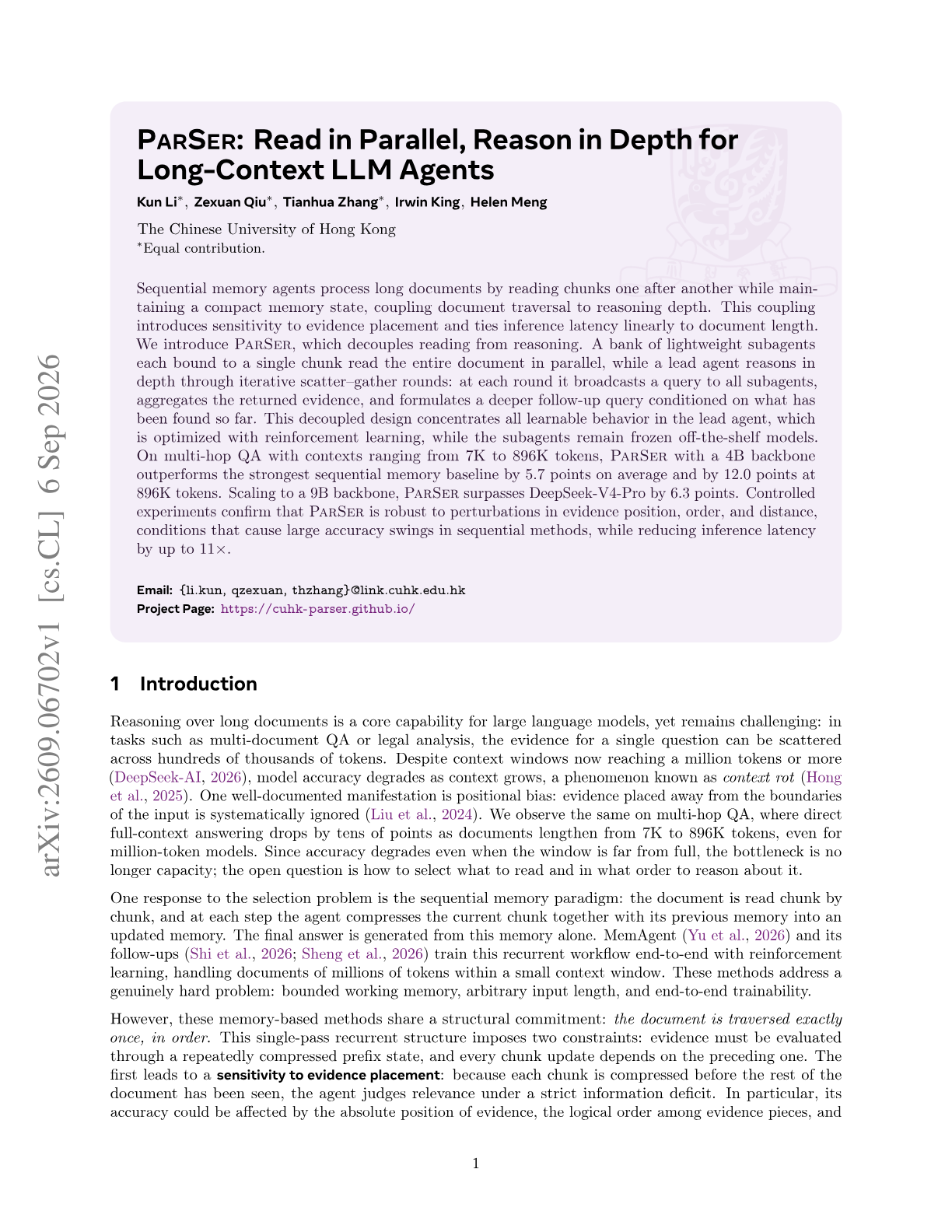
PARSER: Read in Parallel, Reason in Depth for Long-Context LLM Agents
Sequential memory agents read long documents one chunk at a time while carrying a compact memory state. That design ties reasoning depth to how far the agent has read, makes accuracy sensitive to where the evidence sits, and grows latency linearly with document length. PARSER separates reading from reasoning.
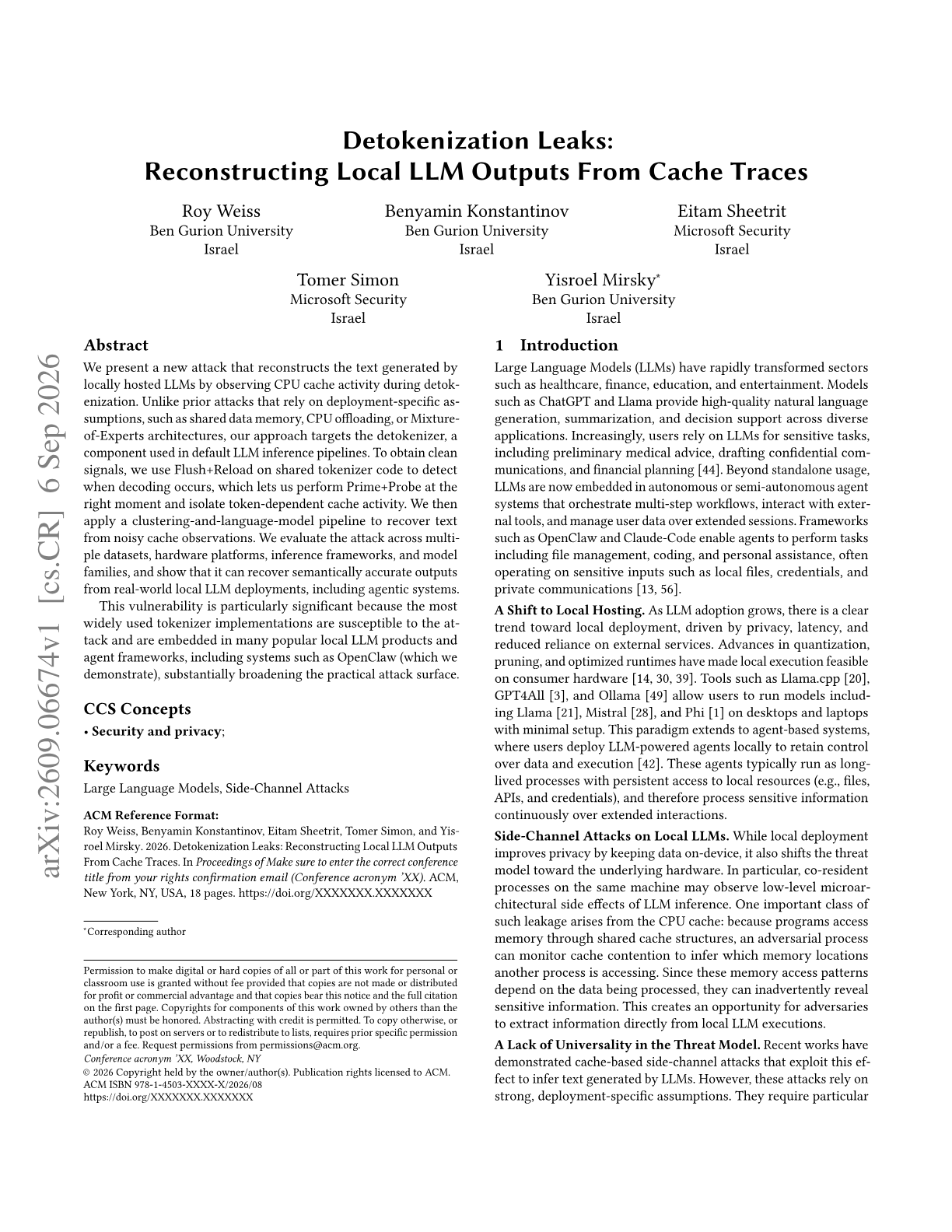
Detokenization Leaks: Reconstructing Local LLM Outputs From Cache Traces
Roy Weiss and Yisroel Mirsky at Ben Gurion University with Eitam Sheetrit and Tomer Simon at Microsoft Security recover text generated by locally hosted LLMs by watching CPU cache activity during detokenization, a component present in default inference pipelines.
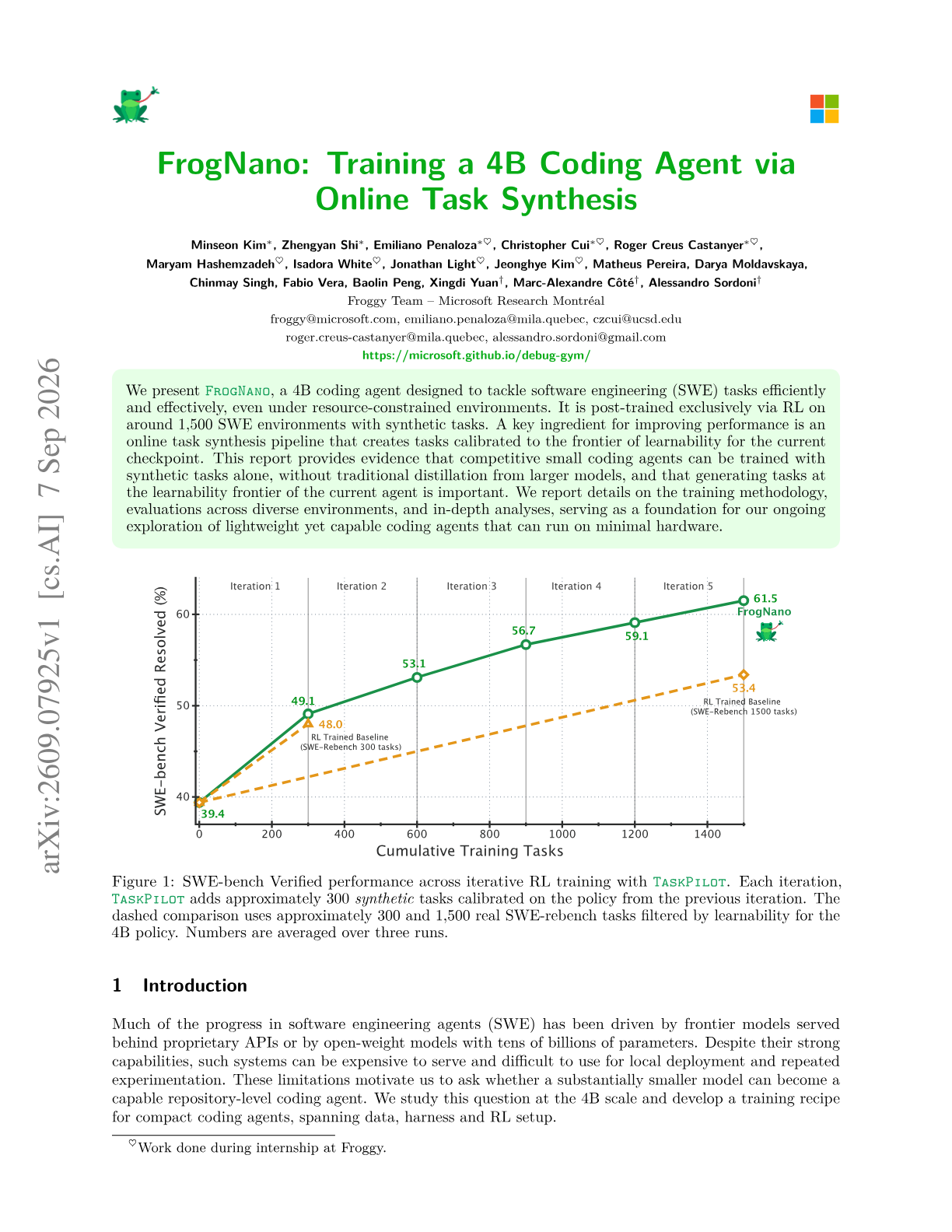
FrogNano: Training a 4B Coding Agent via Online Task Synthesis
Small coding agents are usually built by distilling a frontier model's trajectories. Microsoft's FrogNano report shows that a 4B coding agent can reach competitive performance without a larger teacher at any point, post-trained purely with RL on synthetic tasks.
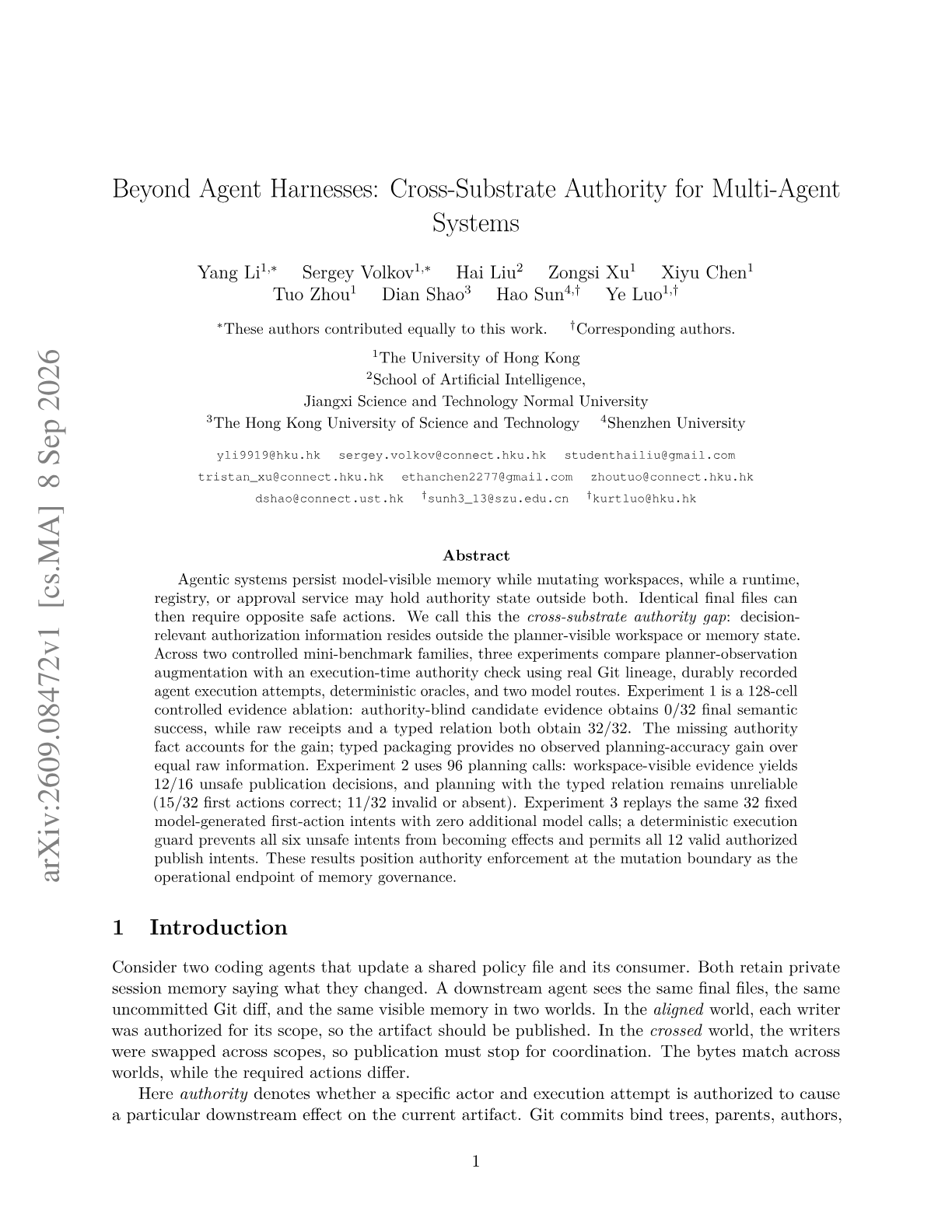
Beyond Agent Harnesses: Cross-Substrate Authority for Multi-Agent Systems
Yang Li and Sergey Volkov at the University of Hong Kong with collaborators name the cross-substrate authority gap, where the fact that decides whether an action is safe lives in a runtime, registry or approval service that the planner cannot see, and show a deterministic execution-time check handles it where planner-side evidence does not.
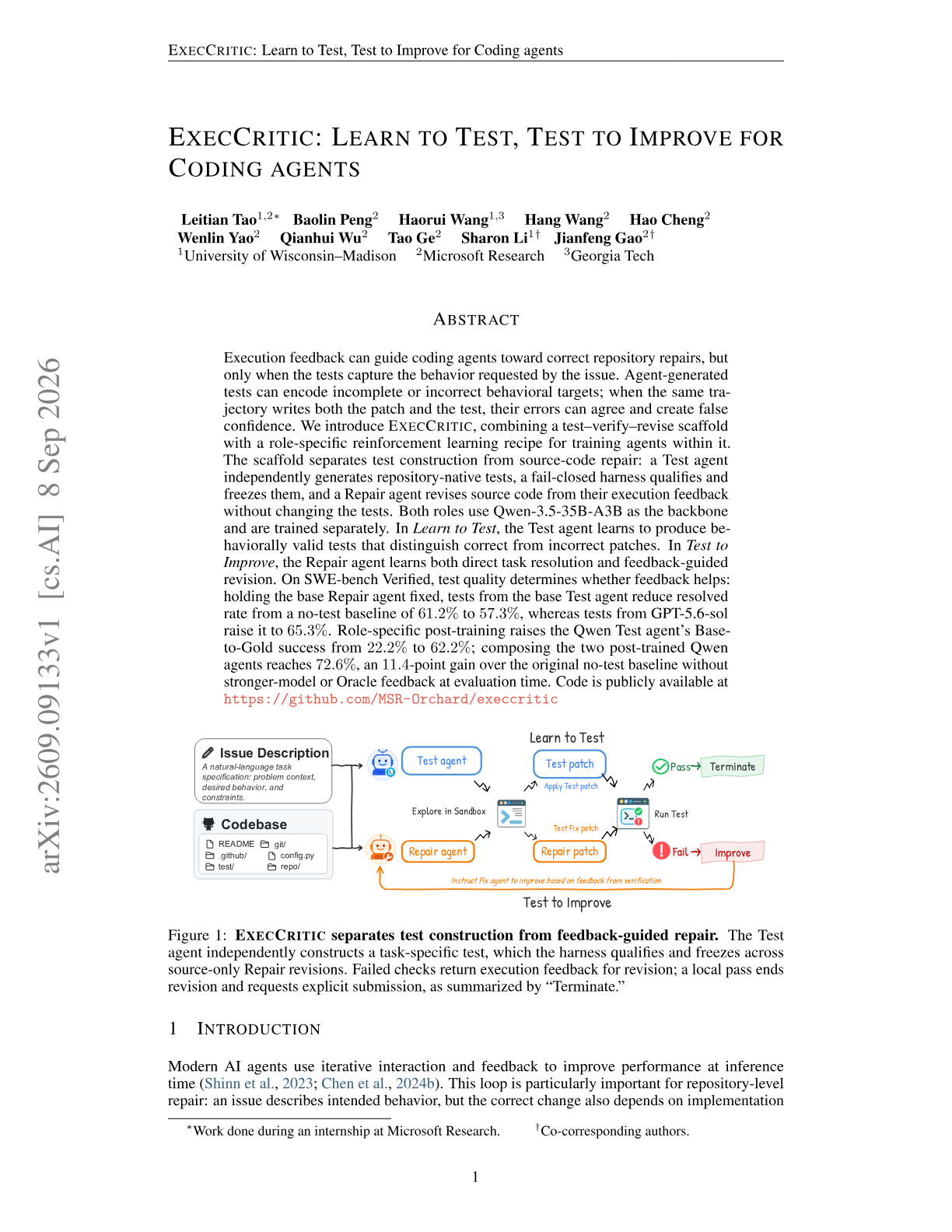
ExecCritic: Learn to Test, Test to Improve for Coding Agents
Leitian Tao (UW-Madison, internship at Microsoft Research) with Baolin Peng, Hao Cheng, Wenlin Yao and colleagues at Microsoft Research present ExecCritic, which separates test writing from source repair into two agents and trains each with its own RL objective, showing that test quality decides whether execution feedback helps at all.