AI Papers of the Week
Every paper worth reading in AI, hand-picked one week at a time.
Discover and explore top AI papers with Claude Code or Codex
npx @dair-ai/mcp setup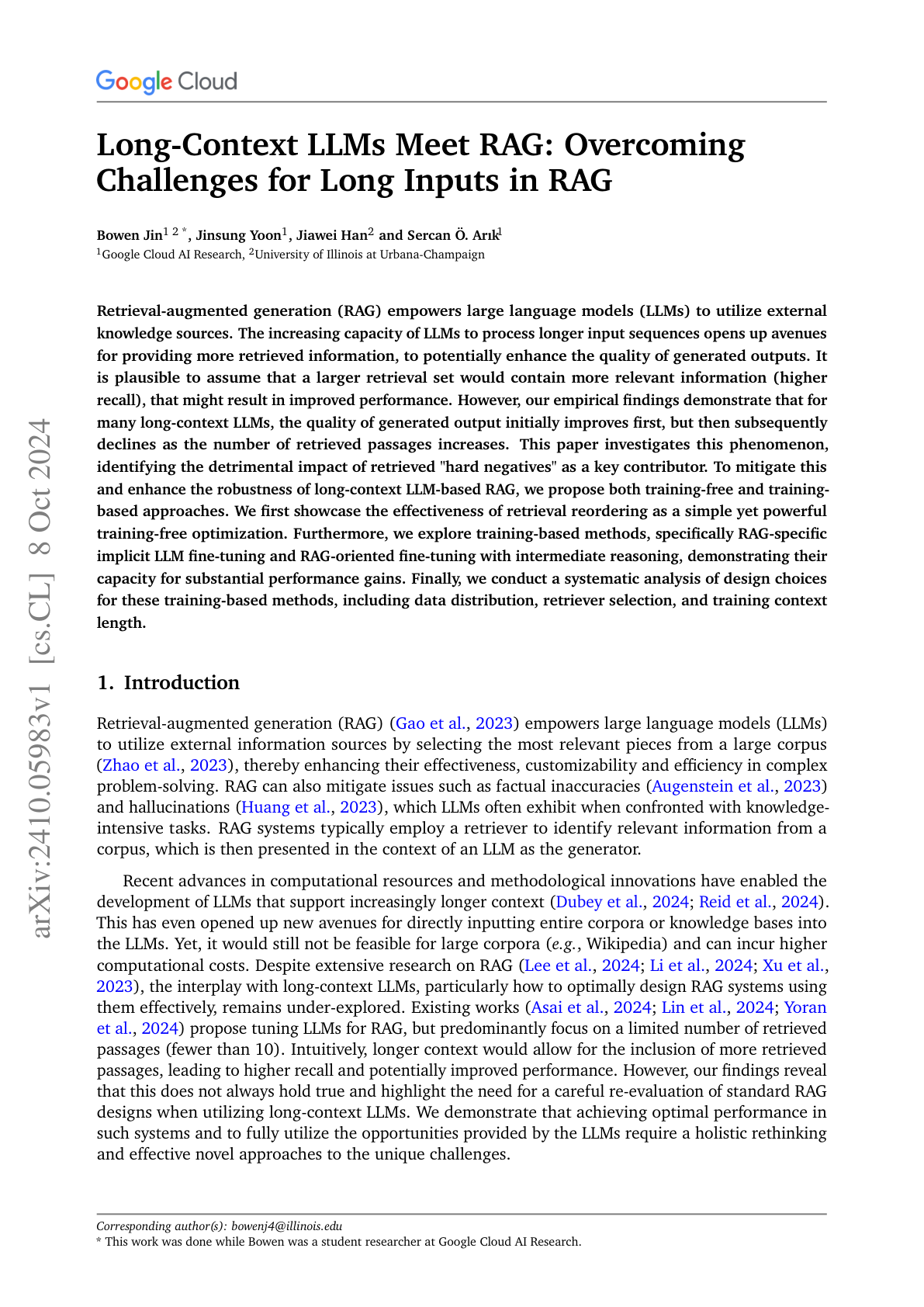
Long-Context LLMs Meet RAG
finds that for many long-context LLMs, the quality of outputs declines as the number of passages increases; reports that the performance loss is due to retrieved hard negatives; they propose two ways to improve long-context LLM-based RAG: retrieval reordering and RAG-specific tuning with intermediate reasoning to help with relevance identification; that approaches demonstrate significant accuracy and robustness improvements on long-context RAG performance.
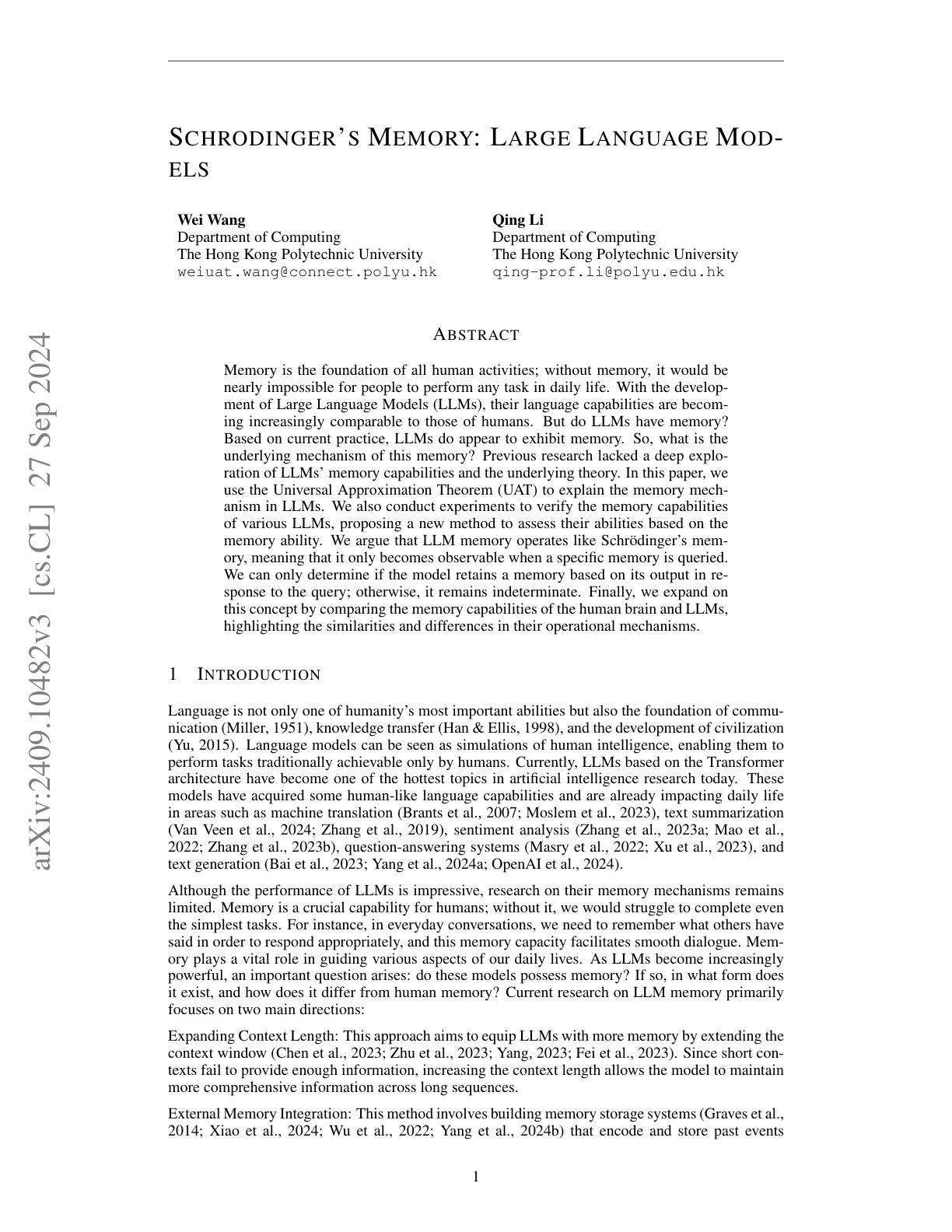
Schrodinger’s Memory
uses the Universal Approximation Theorem to explain the memory mechanism of LLMs. It also proposes a new approach to evaluate LLM performance by comparing the memory capacities of different models; the Transformer architecture functions as a dynamic fitting UAT model, with a strong ability to adaptively fit inputs; this enables LLMs to recall entire content based on minimal input information.
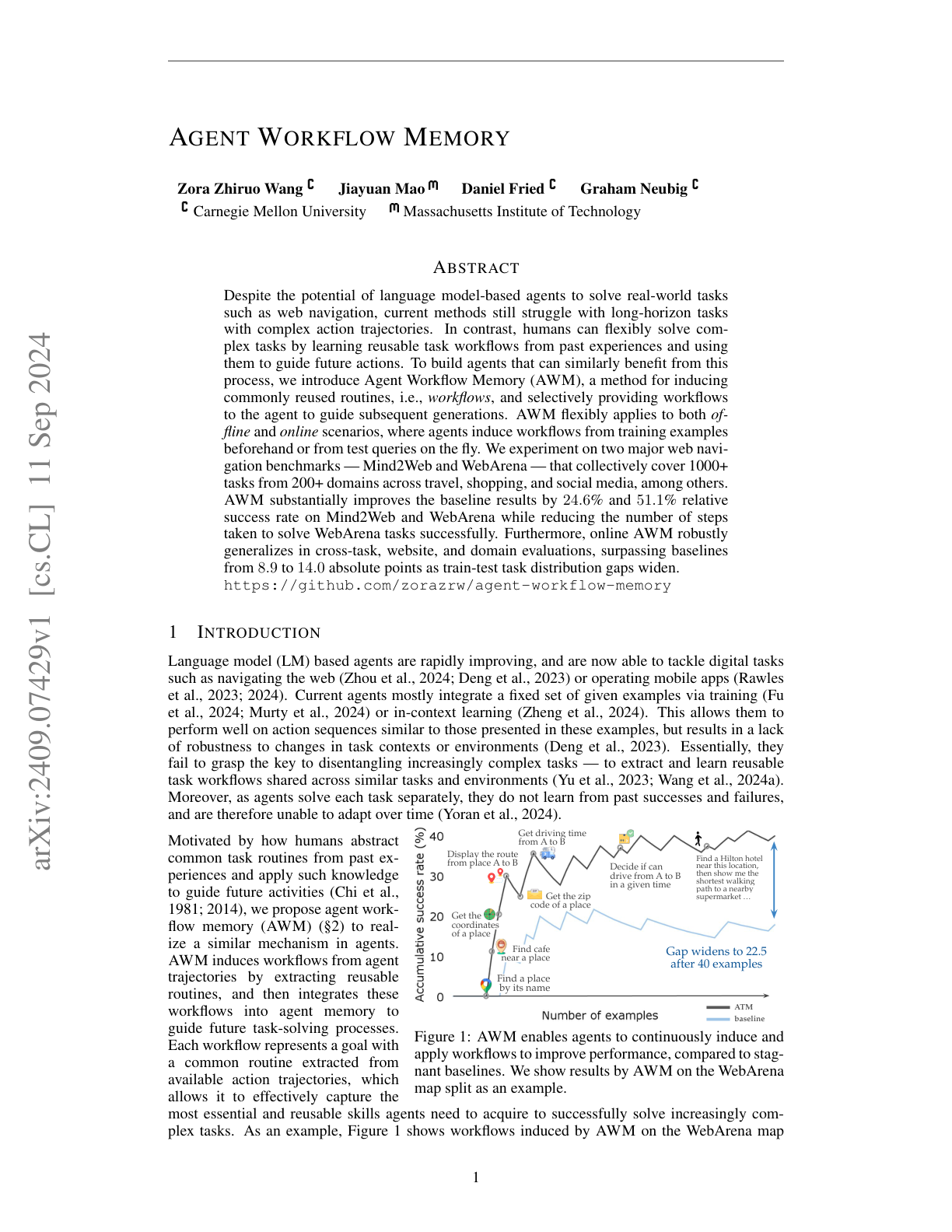
Agent Workflow Memory
introduces Agent Workflow Memory to induce commonly reused workflows and provide these to the agent on demand; works offline and online and is meant to guide the agent's subsequent generations; it’s inspired by how humans learn reusable workflows from past experiences and use them to guide future actions; claims to substantially improve the baseline results by 24.6% and 51.1% relative success rate on Mind2Web and WebArena while doing it in a more efficient way.
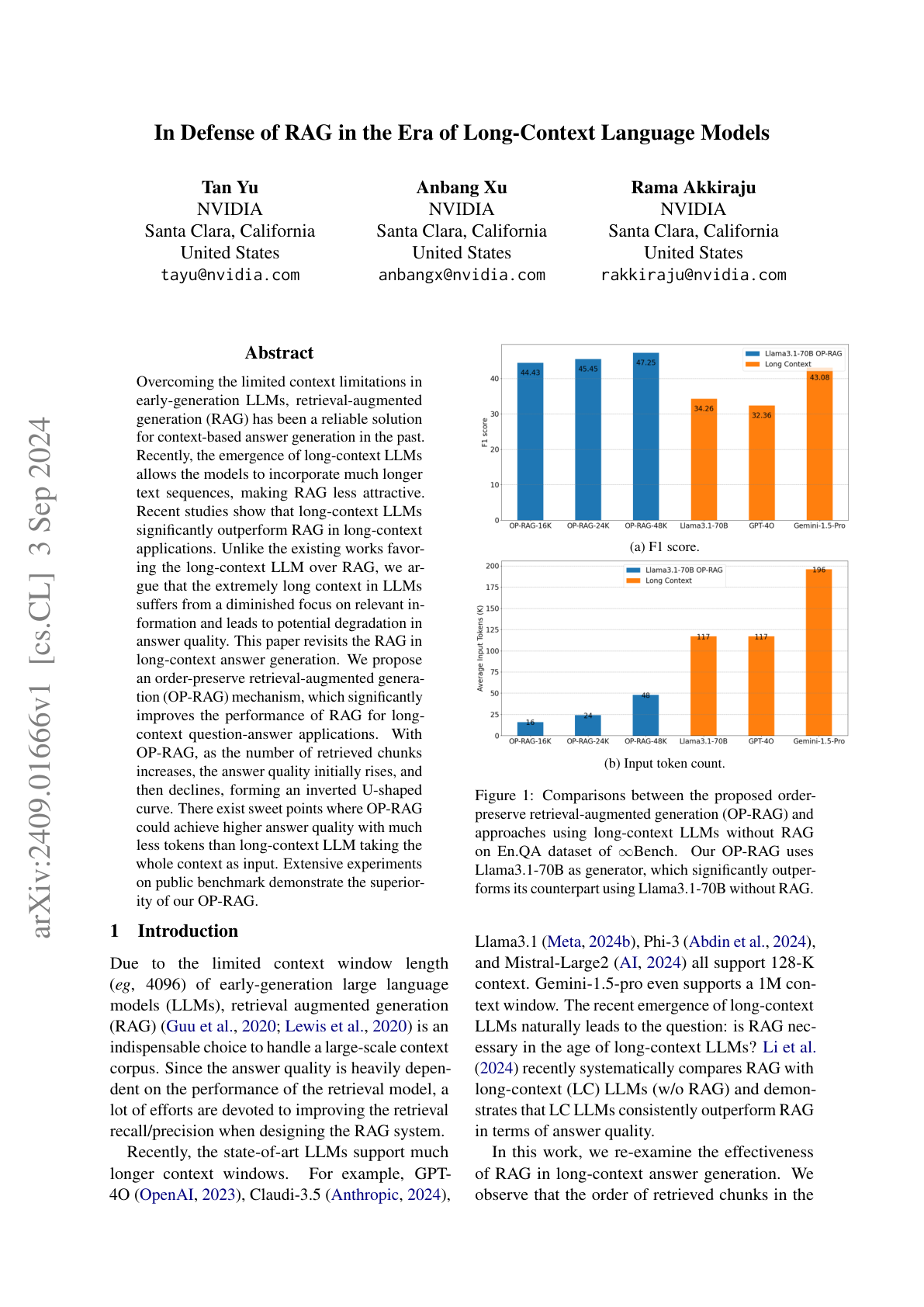
RAG in the Era of Long-Context LLMs
reports that longer-context LLMs suffer from a diminished focus on relevant information, which is one of the primary issues that a RAG system addresses (i.e., uses more relevant information); they propose an order-preserving RAG mechanism that improves performance on long-context question answering; it's not perfect and in fact, as retrieved chunks increase the quality of responses go up and then declines; they mention a sweet spot where it can achieve better quality with a lot fewer tokens than long-context LLMs.
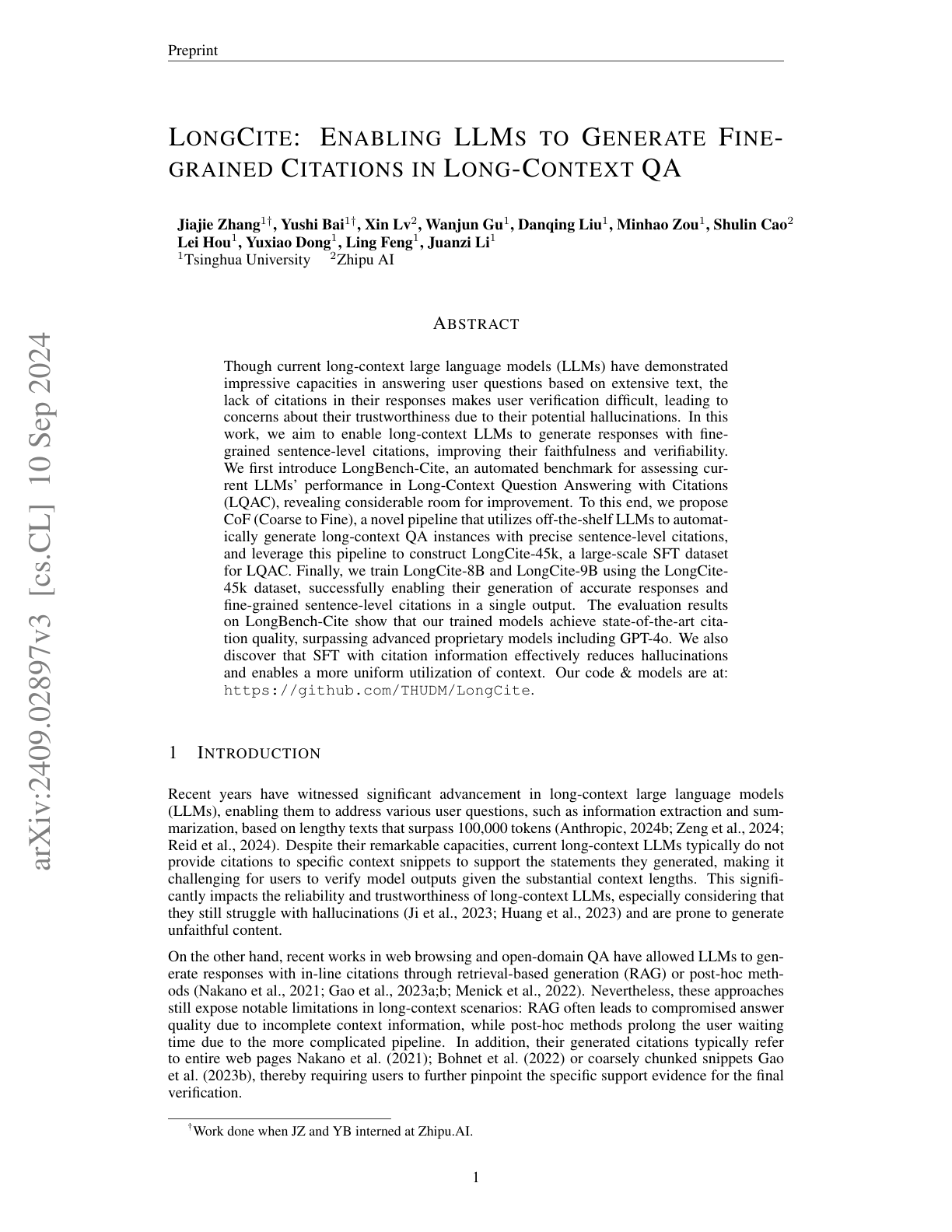
LongCite
synthesizes a large-scale SFT dataset with off-the-shelf LLMs to improve long-context question answering with citations; it trains 8B and 9B parameter models that enhance citation generation capabilities from lengthy contexts while improving response correctness; claims to even surpass GPT-4o on their proposed LongBench-Cite benchmark.
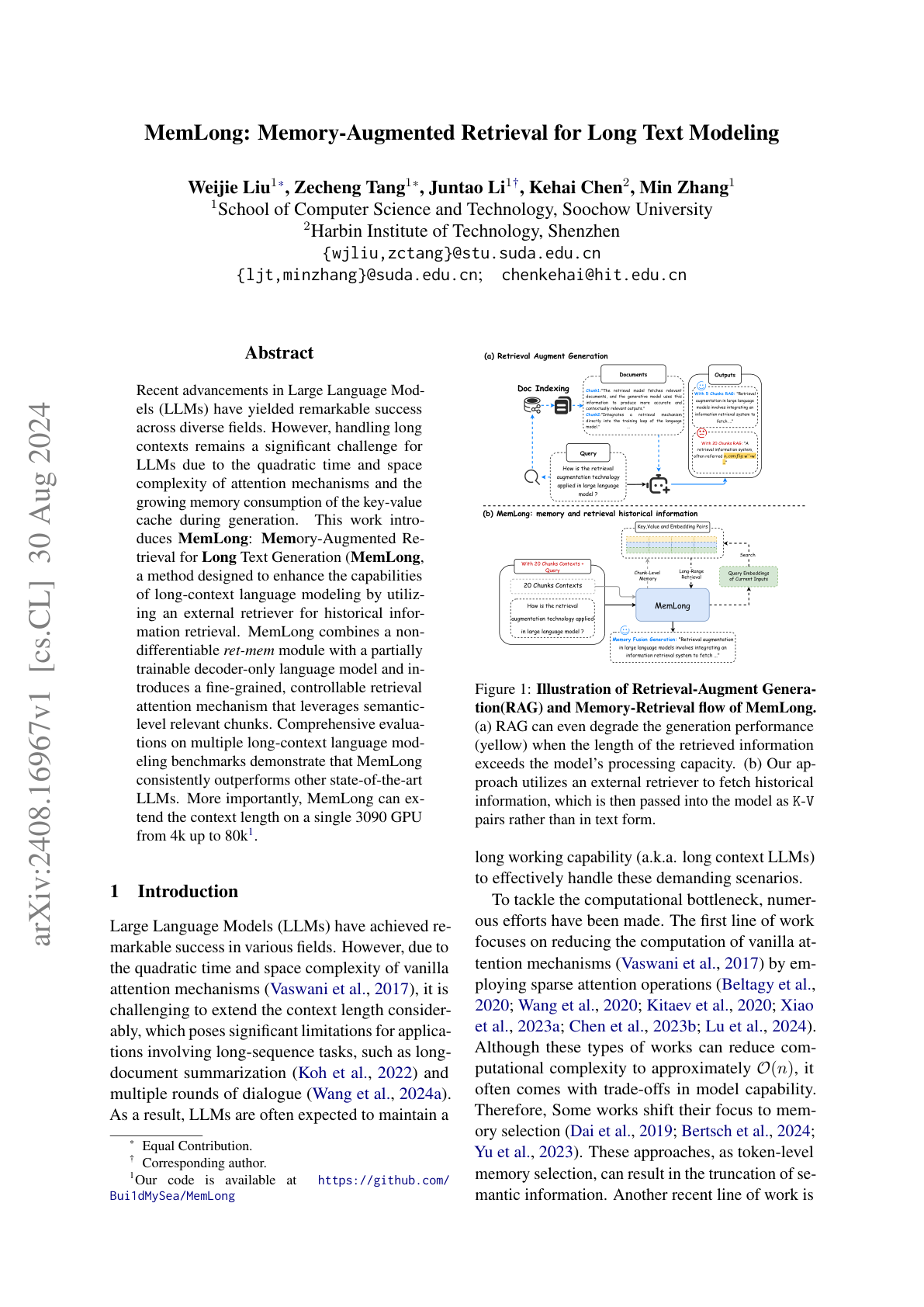
MemLong
utilizes an external retriever for retrieving historical information which enhances the capabilities of long-context LLMs; it consistently outperforms other SoTA LLMs on long-context benchmarks and can extend the context length on a single 3090 GPU from 4k up to 80k.
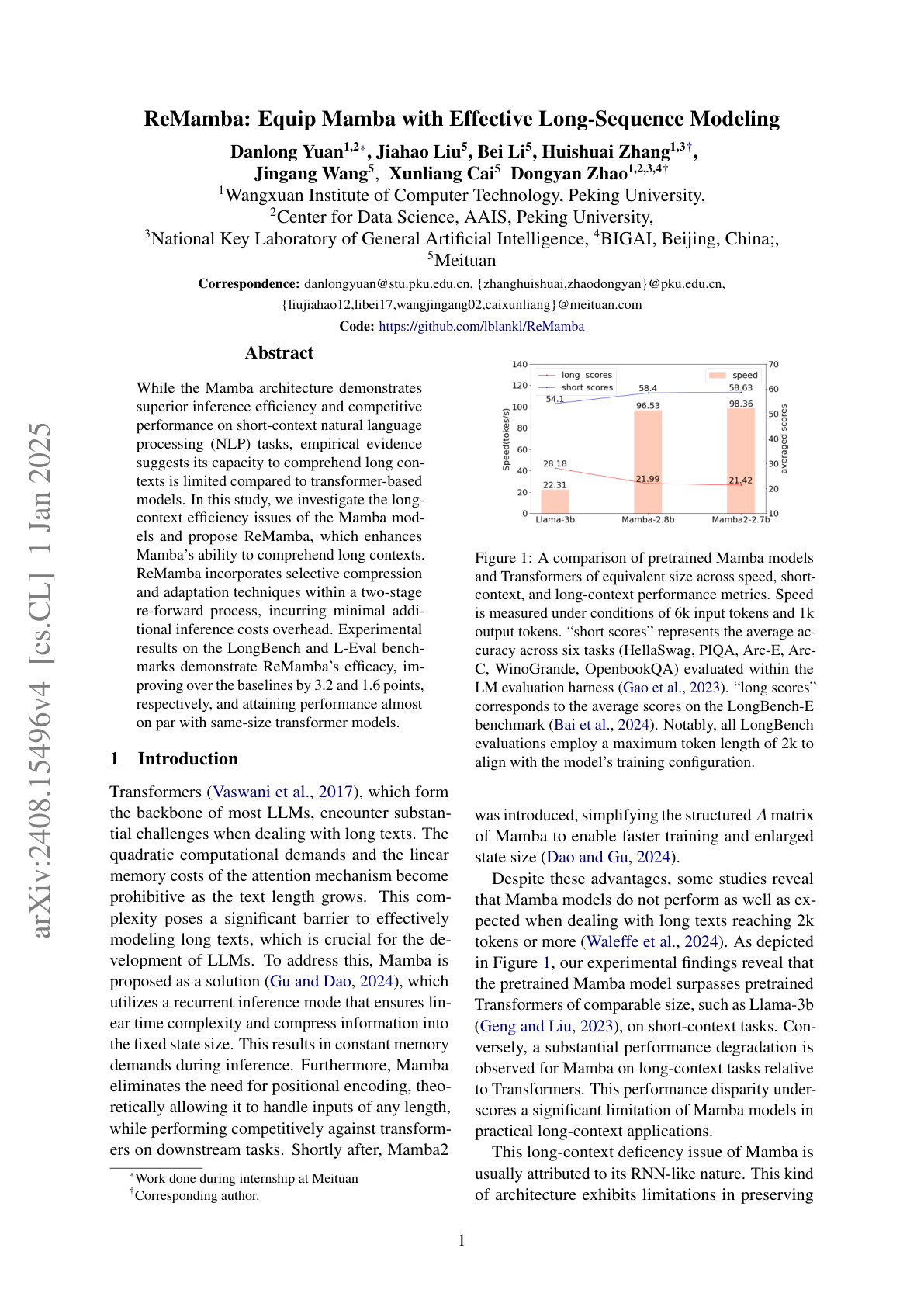
ReMamba
investigates the long-context capabilities and efficiencies of Mamba models; the long-context deficiency issues are due to Mamba's RNN-like nature; it achieves this by condensing information via the following compression strategy: the top-k hidden states during the first forward pass and leverages Mamba’s selective mechanism to incorporate them into the state space during the second forward pass; achieves a 3.2 improvement over the baseline on LongBench and 1.6 improvement on L-Eval; the strategy seems to also transfer to Mamba 2.
MagicDec
shows how speculative decoding can enhance throughput, reduce latency, and maintain accuracy in long context generation scenarios; it finds that as sequence length and batch size increase, bottlenecks shift from compute-bound to memory-bound; using these insights, they show it's possible to more effectively use speculative decoding for longer sequences, even when using large batch sizes.
SAM 2
an open unified model for real-time, promptable object segmentation in images and videos; can be applied to unseen visual content without the need for custom adaptation; to enable accurate mask prediction in videos, a memory mechanism is introduced to store information on the object and previous interactions; the memory module also allows real-time processing of arbitrarily long videos; SAM2 significantly outperforms previous approaches on interactive video segmentation across 17 zero-shot video datasets while requiring three times fewer human-in-the-loop interactions.
ThinK
proposes an approach to address inefficiencies in KV cache memory consumption; it focuses on the long-context scenarios and the inference side of things; it presents a query-dependent KV cache pruning method to minimize attention weight loss while selectively pruning the least significant channels
RAG vs. Long-Context LLMs
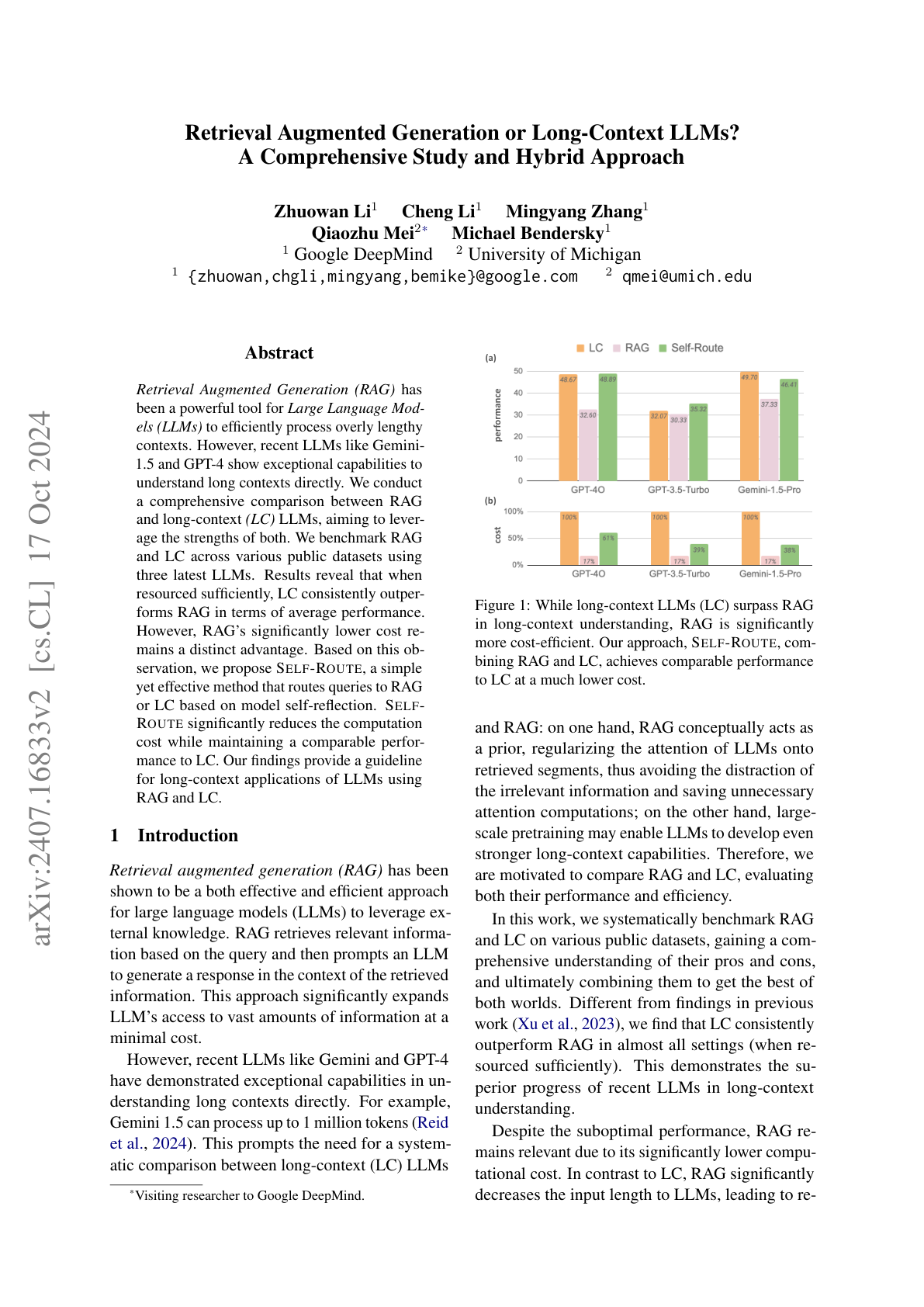
compares RAG and long-context LLMs and finds that long-context LLMs outperform RAG on average performance while RAG is significantly less expensive; proposes Self-Route, leveraging self-reflection to route queries to RAG or LC; reports that Self-Route significantly reduces computational cost while maintaining comparable performance to LC.
LazyLLM
introduces a novel dynamic token pruning method for efficient long-context LLM inference; it can accelerate the prefilling stage of a Llama 2 7B model by 2.34x and maintain high accuracy; it selectively computes the KV for tokens that are important for the next token prediction in both the prefilling and decoding stages; it allows language models to dynamically select different subsets of tokens from the context in different generation steps, even though they might be pruned in previous steps.
Mitigating Hallucination via Generation Constraint
proposes a new training-free approach to mitigate hallucination in LLMs; they scaled the readout vector that constrains generation in a memory-augmented LLM decoder; recent works claim that LLMs with explicit memory mechanisms can help lower hallucination; this work uses a memory-augmented LLM and constrains generation in the decoder by applying lightweight memory primitives to reduce hallucination.
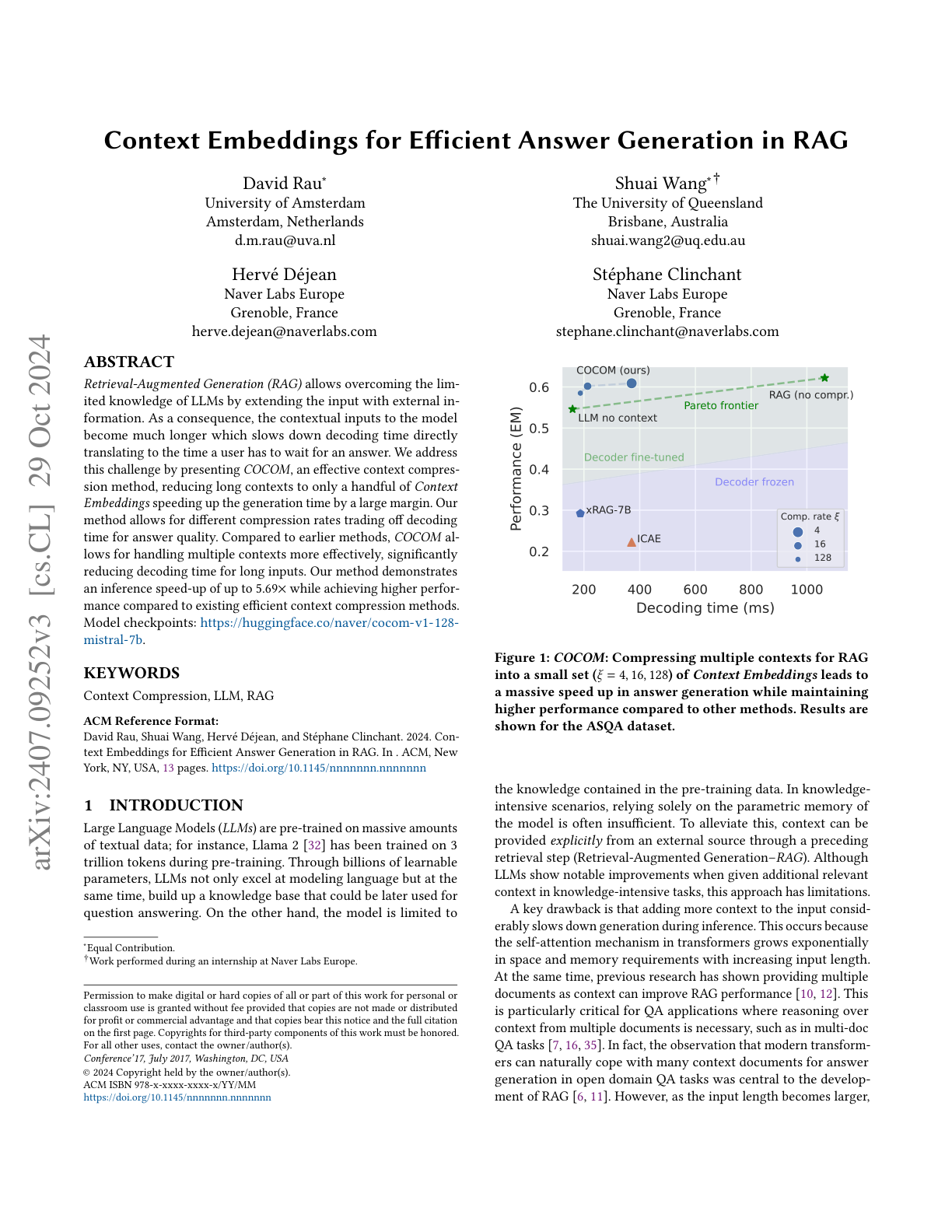
Context Embeddings for Efficient Answer Generation in RAG
proposes an effective context compression method to reduce long context and speed up generation time in RAG systems; the long contexts are compressed into a small number of context embeddings which allow different compression rates that trade-off decoding time for generation quality; reduces inference time by up to 5.69 × and GFLOPs by up to 22 × while maintaining high performance.
Can LLMs Do Retrieval and Reasoning in 1 Million Context Window?
proposes a framework (NeedleBench) of progressively challenging tasks to assess the long-context retrieval and reasoning capabilities of LLMs; they also present the Ancestral Trace Challenge that increases the need for complex logical reasoning which is common in real-world long-context tasks; their findings suggest that current LLMs struggle to handle reasoning tasks with complex logical relationships, even with texts shorter than 2K tokens.
Enhancing RAG with Long-Context LLMs
proposes LongRAG, which combines RAG with long-context LLMs to enhance performance; uses a long retriever to significantly reduce the number of extracted units by operating on longer retrieval units; the long reader takes in the long retrieval units and leverages the zero-shot answer extraction capability of long-context LLMs to improve performance of the overall system; claims to achieve 64.3% on HotpotQA (full-wiki), which is on par with the state-of-the-art model.
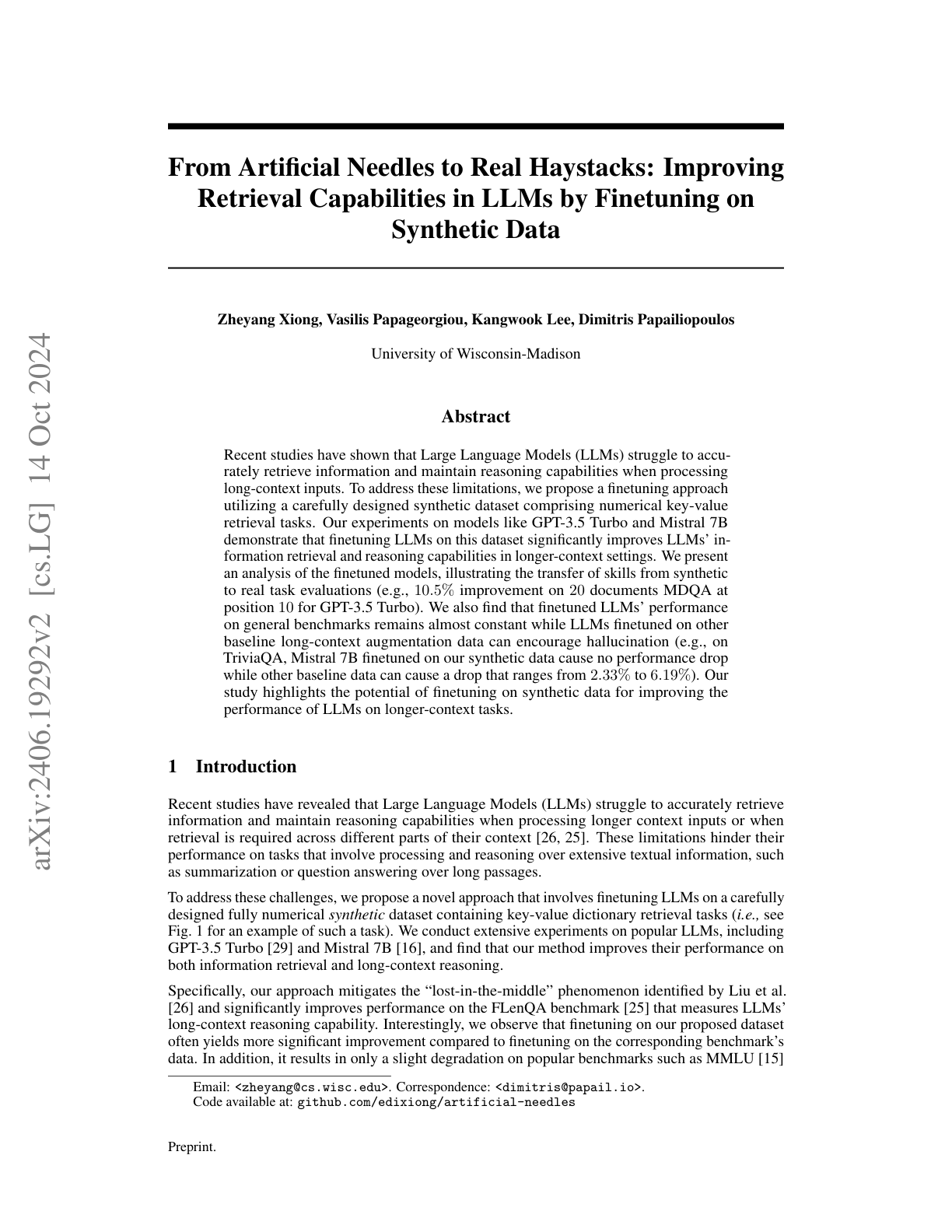
Improving Retrieval in LLMs through Synthetic Data
proposes a fine-tuning approach to improve the accuracy of retrieving information in LLMs while maintaining reasoning capabilities over long-context inputs; the fine-tuning dataset comprises numerical dictionary key-value retrieval tasks (350 samples); finds that this approach mitigates the "lost-in-the-middle" phenomenon and improves performance on both information retrieval and long-context reasoning.
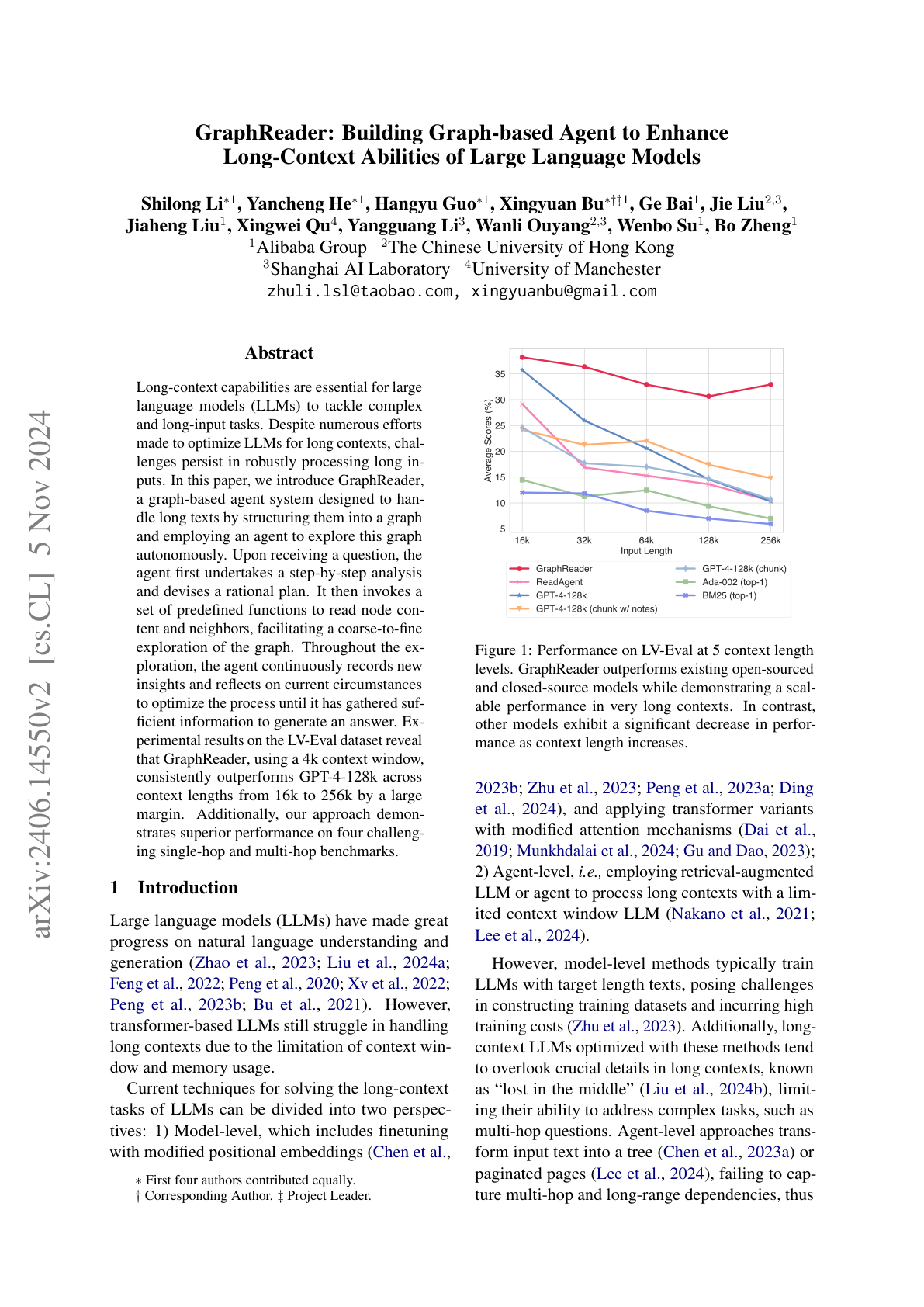
GraphReader
proposes a graph-based agent system to enhance the long-context abilities of LLMs; it structures long text into a graph and employs an agent to explore the graph (using predefined functions guided by a step-by-step rational plan) to effectively generate answers for questions; consistently outperforms GPT-4-128k across context lengths from 16k to 256k.
Adam-mini
a new optimizer that reduces memory footprint (45%-50% less memory footprint) by using fewer learning rates and achieves on-par or even outperforms AdamW; it carefully partitions parameters into blocks and assigns a single high-quality learning that outperforms Adam; achieves consistent results on language models sized from 125M -7B for pre-training, SFT, and RLHF.
Can Long-Context Language Models Subsume Retrieval, RAG, SQL, and More?
conducts a deep performance analysis of long-context LLMs on in-context retrieval and reasoning; they first present a benchmark with real-world tasks requiring 1M token context; reports that long-context LLMs can rival state-of-the-art retrieval and RAG systems, without any explicit training on the tasks; suggests that compositional reasoning (required in SQL-like tasks) is still challenging for these LLMs; they also encourage the need for continued research on advanced prompting strategies as they noted significant boosts in performance when applying them for long context problems.
Mixture of Memory Experts
proposes an approach to significantly reduce hallucination (10x) by tuning millions of expert adapters (e.g., LoRAs) to learn exact facts and retrieve them from an index at inference time; the memory experts are specialized to ensure faithful and factual accuracy on the data it was tuned on; claims to enable scaling to a high number of parameters while keeping the inference cost fixed.
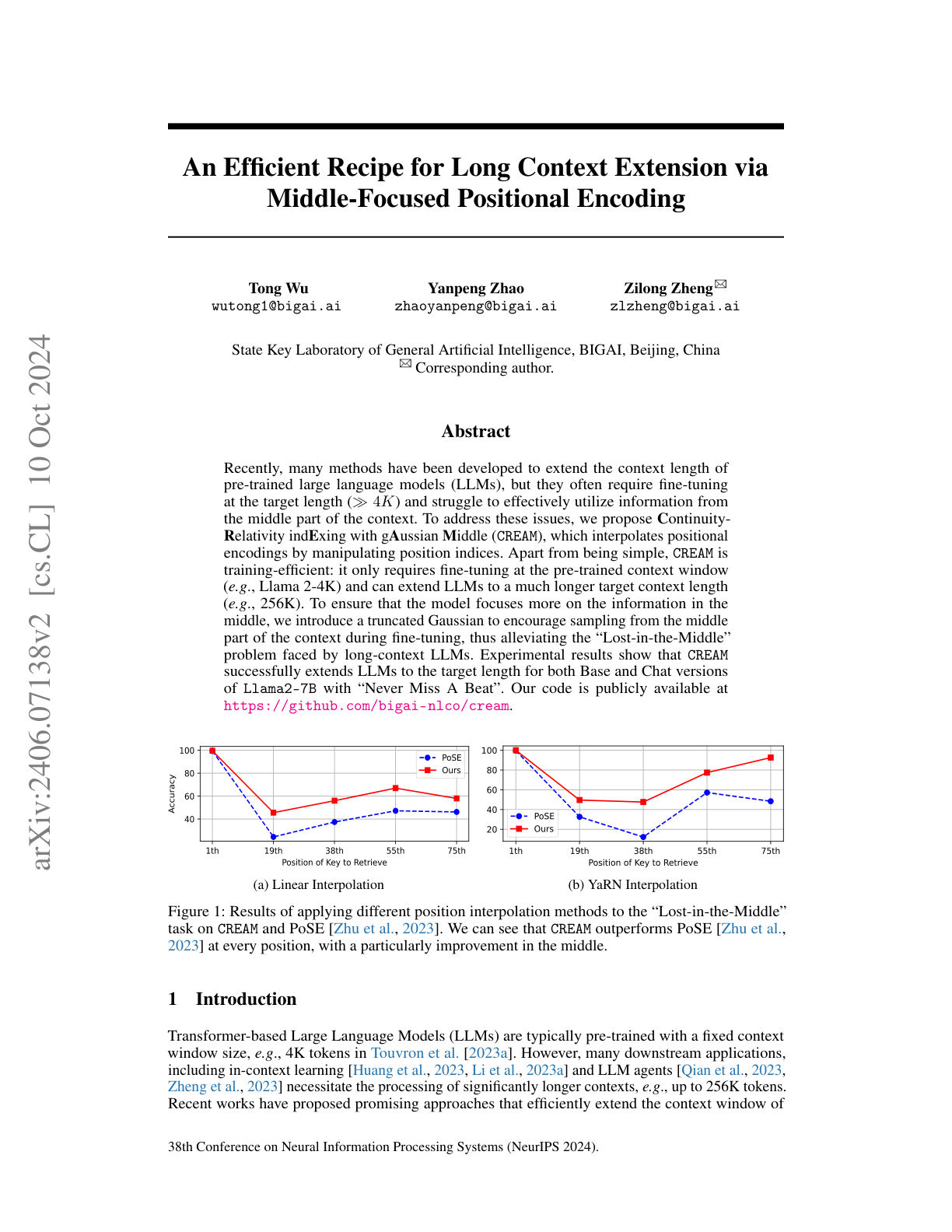
Consistent Middle Enhancement in LLMs
proposes an approach to tune an LLM to effectively utilize information from the middle part of the context; it first proposes a training-efficient method to extend LLMs to longer context lengths (e.g., 4K -> 256K); it uses a truncated Gaussian to encourage sampling from the middle part of the context during fine-tuning; the approach helps to alleviate the so-called "Lost-in-the-Middle" problem in long-context LLMs.
MatMul-free LLMs
proposes an implementation that eliminates matrix multiplication operations from LLMs while maintaining performance at billion-parameter scales; the performance between full precision Transformers and the MatMul-free models narrows as the model size increases; claims that by using an optimized kernel during inference, memory consumption is reduced by more than 10x.
Are Long-LLMs A Necessity For Long-Context Tasks?
claims that long-LLMs are not a necessity to solve long-context tasks; proposes a reasoning framework to enable short-LLMs to address long-context tasks by adaptively accessing and utilizing the context based on the presented tasks; it decomposes the long context into short contexts and processes them using a decision-making process.